Easy
Albino Cherry Barb (Rohanella titteya)
20–27°C · pH 6–8 · 54L
£2.99

The Albino Tiger Barb (Puntigrus tetrazona) is an active cyprinid from Sumatra and Borneo that reaches 7 cm. It suits keepers planning a group of at least five in an aquarium with an 80 × 30 cm base, at the FishBase and Seriously Fish overlap of 20–26°C, pH 6.0–8.0 and 5–19 dGH. Sold individually in 1,8 - 2,5 cm, 2,5 - 3 cm, 3 - 3,5 cm and XL dispatch sizes.
Adult size is the maximum length this species reaches at full maturity (scientific sources). The livestock you receive will be younger and smaller — pick a size above for the actual shipping size. Product-photo provenance and any image-specific limitations are stated on the listing.
Puntigrus tetrazona
Shoaling fish: kept in a group they feel safer, stay calmer and show their best colour.
Minimum of 2 per order.
The Albino Tiger Barb (Puntigrus tetrazona) is an active cyprinid from Sumatra and Borneo that reaches 7 cm. It suits keepers planning a group of at least five in an aquarium with an 80 × 30 cm base, at the FishBase and Seriously Fish overlap of 20–26°C, pH 6.0–8.0 and 5–19 dGH. Sold individually in 1,8 - 2,5 cm, 2,5 - 3 cm, 3 - 3,5 cm and XL dispatch sizes.
Adult size is the maximum length this species reaches at full maturity (scientific sources). The livestock you receive will be younger and smaller — pick a size above for the actual shipping size. Product-photo provenance and any image-specific limitations are stated on the listing.
Maintain these water conditions for optimal health and vibrant colors
The Albino Tiger Barb (Puntigrus tetrazona) is a selectively bred ornamental form of an active freshwater cyprinid native to Sumatra and Borneo. FishBase records a maximum length of 7 cm total length and advises keeping the fish in groups of five or more. It suits a keeper who can provide swimming space, a proper group and carefully chosen companions rather than a quiet aquarium of slow or long-finned fish.
The albino strain has the same care requirements as other Puntigrus tetrazona strains. Its lighter body and orange-toned fins change its appearance, not the space, water, feeding or social decisions needed for the fish. Expect a lively group with frequent interaction and a loose hierarchy.
| Suits | Not suited to |
|---|---|
| An active group of at least five | Keeping one fish alone |
| An aquarium with an 80 × 30 cm base or equivalent | A cramped aquarium with limited swimming room |
| Robust, comparably sized companions | Timid, slow-moving or long-finned fish |
| Water kept at 20–26°C and pH 6.0–8.0 | An aquarium outside the stated water range |
Choose this barb for its movement and group behaviour as much as for its colour. If your priority is a calm display centred on elaborate fins or timid fish, use a different stocking plan. You can also browse the barbs collection before deciding which character best fits the aquarium.
One purchase supplies one Albino Tiger Barb in the size selected on the live size selector. The labels are 1,8 - 2,5 cm, 2,5 - 3 cm, 3 - 3,5 cm and XL. The size you select is the size supplied, not the adult size. Use the selected grade to plan the fish you receive, then use the 7 cm adult figure when assessing permanent space and stocking.
A smaller dispatch fish is not a different species, temperament or care type. It still needs the social security of a proper group and an aquarium planned around adult movement. When adding fish to an existing group, compare body size and activity as part of the stocking assessment rather than treating the dispatch label as a promise about age or sex.
Sex is guaranteed only when the selected option explicitly states male or female. This Albino Tiger Barb listing has no sex-guaranteed option.
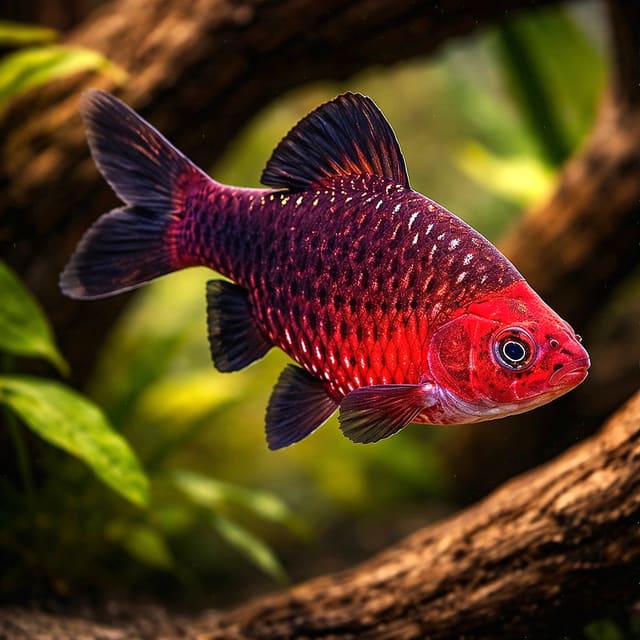
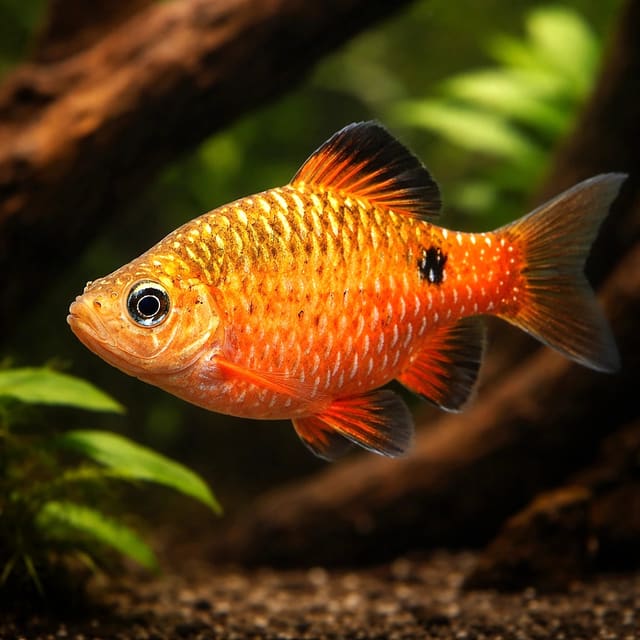
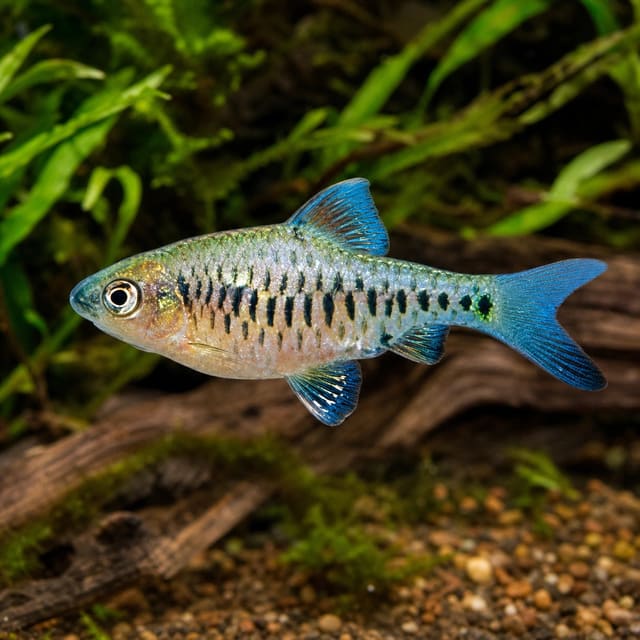
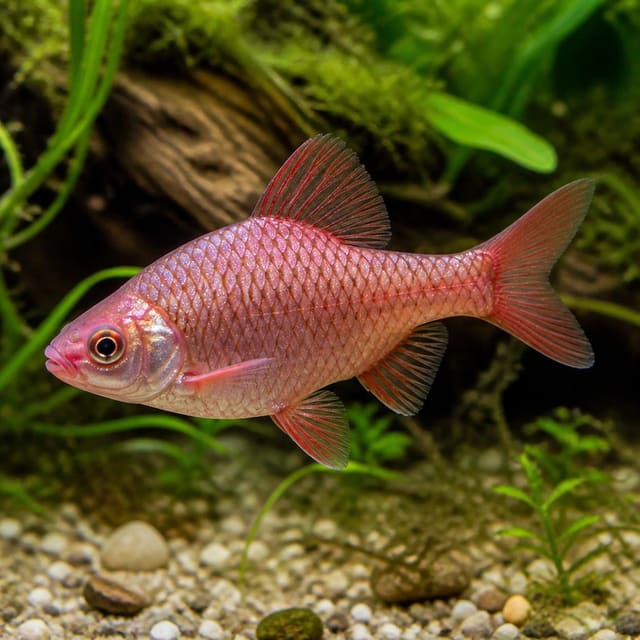
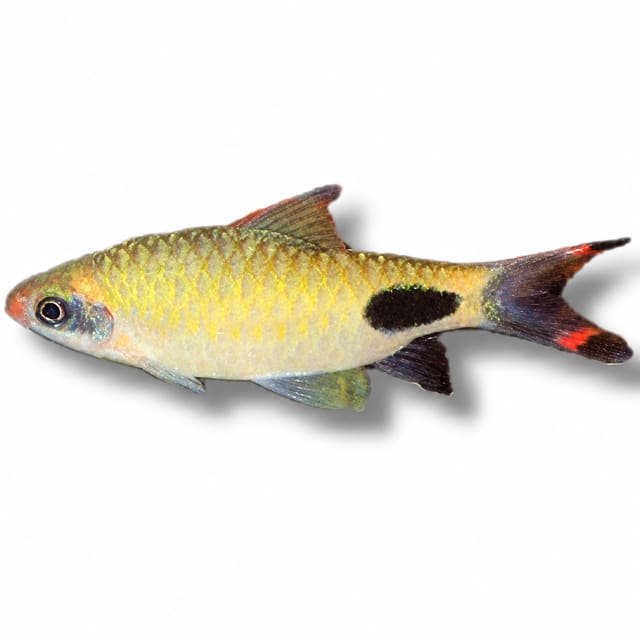
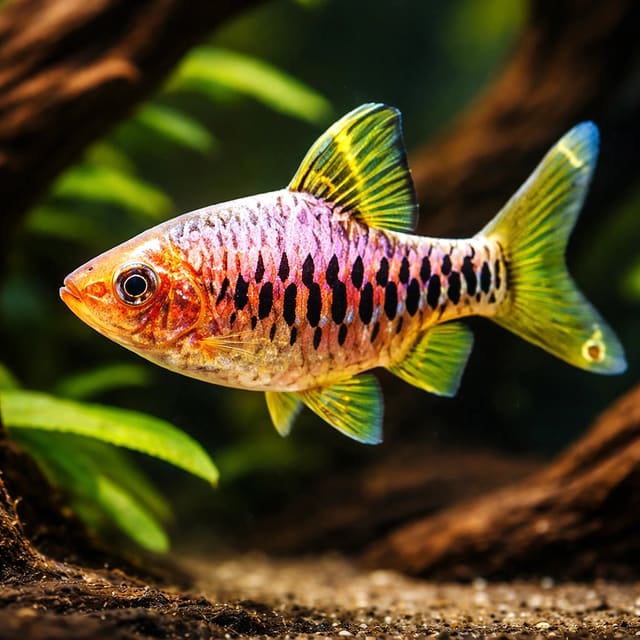
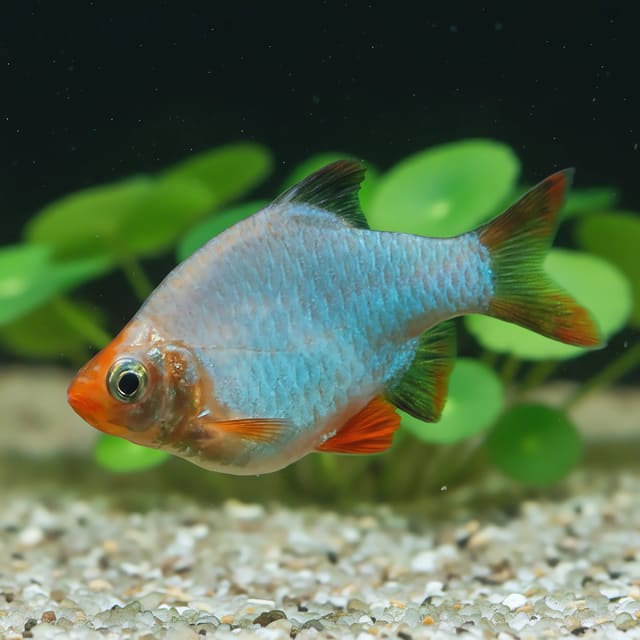
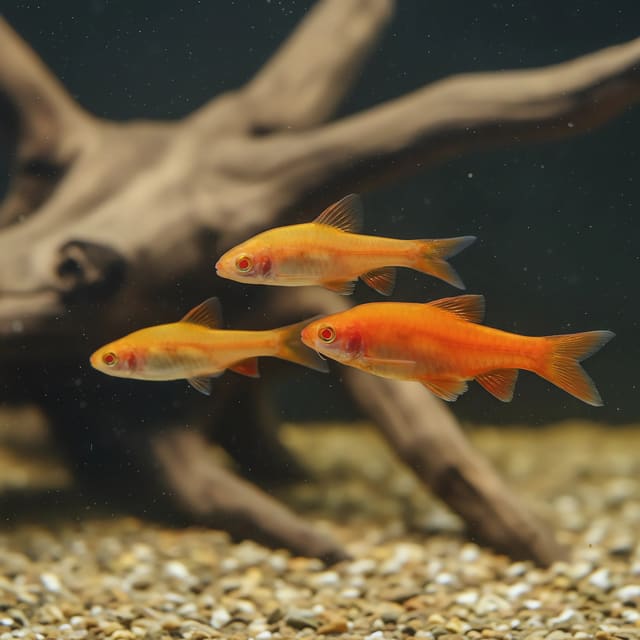
The gallery images are representative of this type of animal rather than photographs of the exact animal supplied, so colours can look slightly different from the live animal.
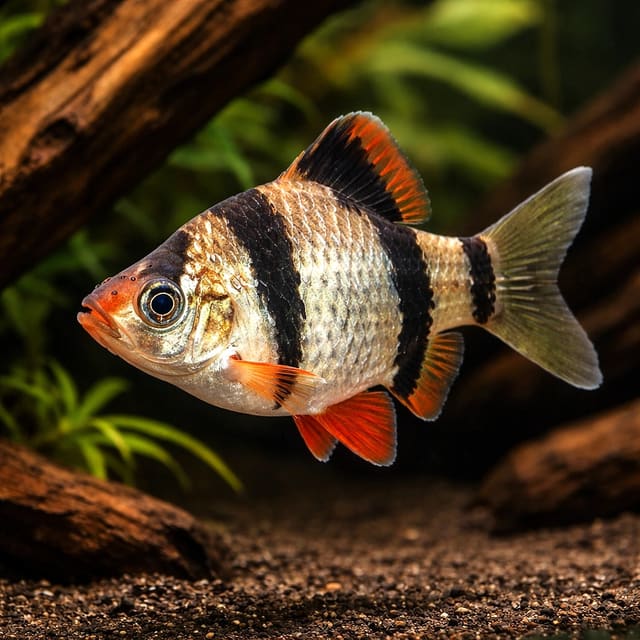
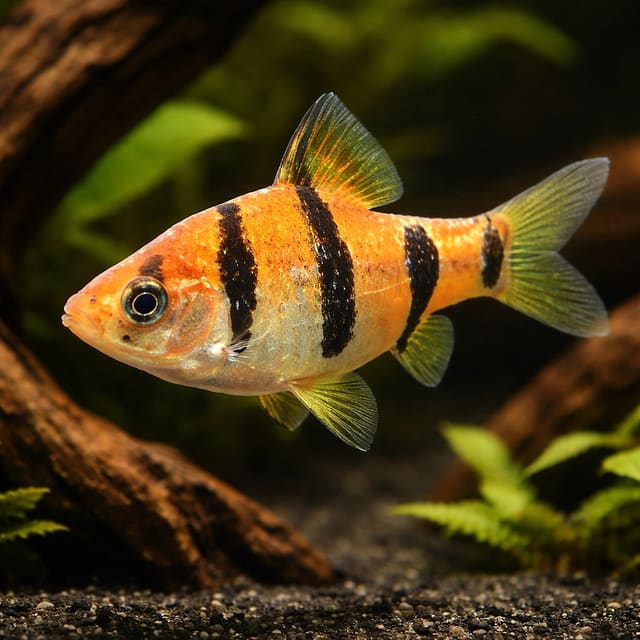
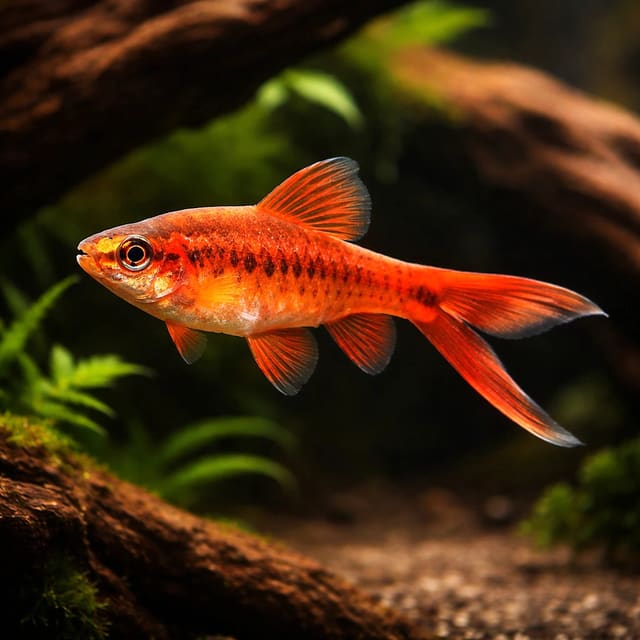
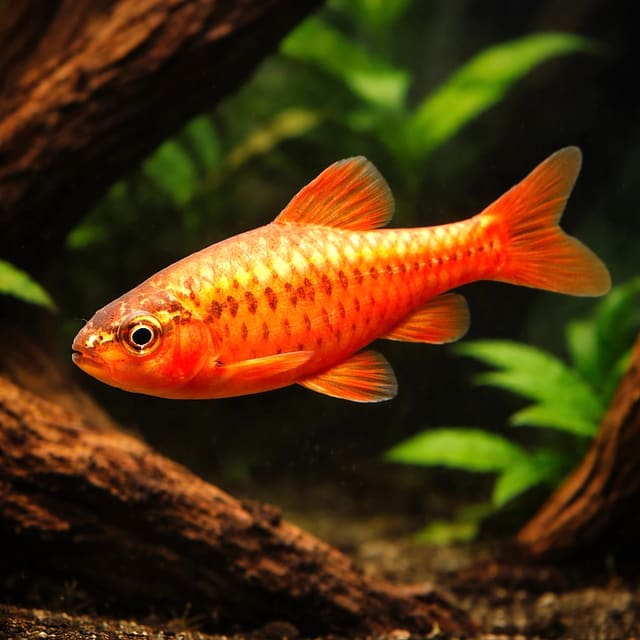
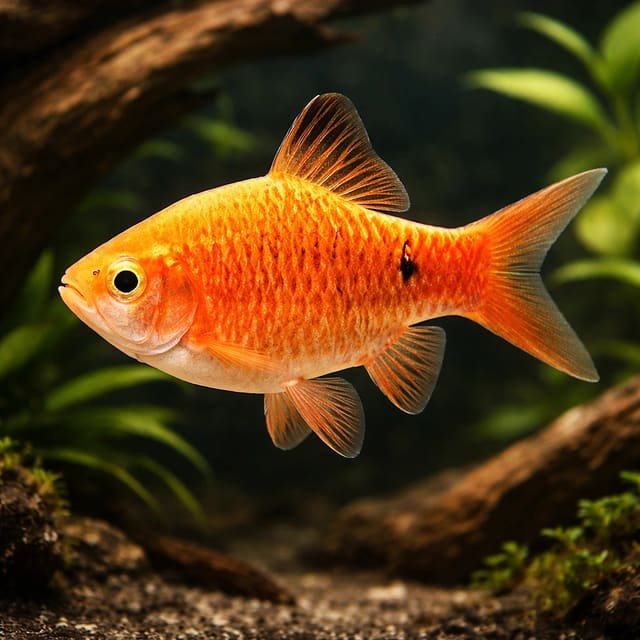
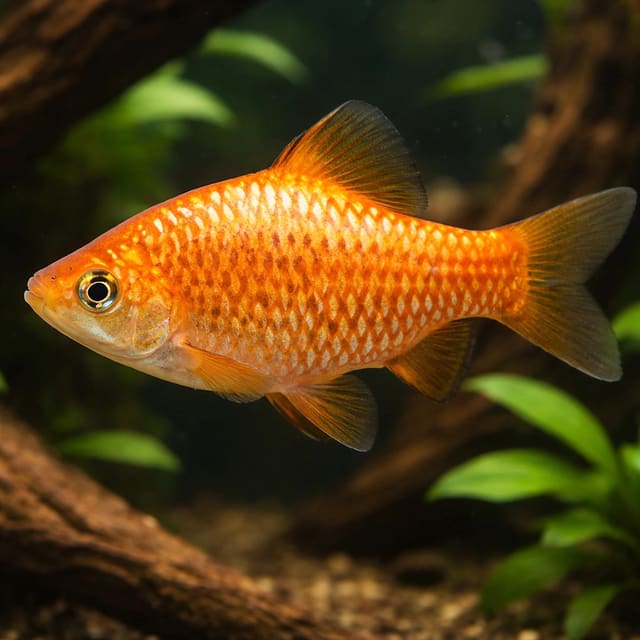
The pictured pale golden-orange body, faint vertical bands and orange-edged translucent fins show the general appearance of this ornamental form. Individual colour intensity and markings can differ, so base the care decision on the identity, adult size and behaviour rather than matching one pictured fish.
Plan for an adult maximum of 7 cm total length. FishBase gives that figure, while the Seriously Fish species profile gives 60 mm standard length. Use the 7 cm total-length figure as the consistent planning value throughout this page.
Choose an aquarium with a base measuring at least 80 × 30 cm or an equivalent footprint, around 72 litres. Seriously Fish says those base dimensions should be the smallest considered. The footprint matters because a group needs horizontal room for continuous movement, social encounters and separation after short chases.
Do not calculate space from the dispatch measurements alone. A group that looks small on arrival still grows into the same active adult form, and limited space can make fin-biting more pronounced. Leave enough open water for the whole group before adding décor or further livestock.
Start with the 80 × 30 cm base and organise the interior so the group can move through the aquarium without meeting a wall of décor. Décor style is flexible, but Seriously Fish notes that these barbs tend to show better colour in a well-decorated aquarium and appear to appreciate floating or overhanging vegetation with driftwood roots or branches.
The décor does not need to imitate one exact river scene. The practical test is whether five or more adult-sized fish can travel across the aquarium, turn and separate without being funnelled into a narrow gap. If a large ornament divides the base into small compartments, reposition it before adding the group.
Prepare and establish the aquarium before livestock arrives. Our first tropical aquarium guide explains the setup and maturation sequence. A completed aquascape is not automatically ready for fish: the biological filter must also be established and functioning.
For an aquarium of around 72 litres, Seriously Fish gives a turnover of four to five times the aquarium volume per hour and points to a filter rated around 290–360 litres per hour. Treat the rating as part of the complete setup, then arrange the outlet so the group retains usable swimming room.
View the aquarium from end to end before stocking. The 80 cm length should still function as swimming space after the filter, heater, wood and plants are installed. Check again as vegetation grows because a route that begins open can gradually narrow.
Use the adult group as the scale for each decision. Five fish reaching up to 7 cm need room to move at the same time, so a clear route that serves only one fish is not enough. Keep overhead planting and branches where they add structure without reducing the footprint below its intended purpose.
Keep this fish at 20–26°C, pH 6.0–8.0 and 5–19 dGH. FishBase gives 20–26°C, pH 6.0–8.0 and 5–19 dH for its recorded freshwater environment. Seriously Fish gives the same temperature range with broader limits of pH 5.0–8.0 and 1–20 dGH, making the stated routine values the overlap of the two references.
Read our water chemistry guide to understand what the measurements mean, then use the water matcher to compare measured aquarium values with this range. Enter actual test results so temperature, pH and hardness are considered together.
A temperature inside the range does not compensate for pH or hardness outside it. Work through all three values before stocking. When comparing this fish with proposed companions, retain the same complete check: every species in the aquarium needs compatible temperature, pH and hardness.
Seriously Fish estimates that an aquarium around 72 litres may require roughly a 50 W heater to maintain 20–26°C when the room is around 20°C. That example is tied to that room and aquarium size, so choose equipment according to the actual aquarium and ambient conditions while using 20–26°C as the target.
For example, water at 24°C and pH 7.0 passes those two checks, but the hardness must still fall within 5–19 dGH. A hardness result outside that range leaves the assessment incomplete even when the temperature and pH look suitable. Apply the same three-part comparison to the aquarium and to every proposed companion.
Record the measured values before the group is introduced and repeat the comparison during routine care. This turns broad descriptions such as soft, hard, acidic or alkaline into numbers that can be checked directly against the fish's range. When readings change, compare the new result with the earlier one as well as with the permitted limits.
Use a well-established and maintained biological filter. The RSPCA explains that fish release toxic ammonia, which filter bacteria convert first into toxic nitrite and then into the safer nitrate. The filter is therefore part of the fish's life-support system, not simply a way to make the water look clear.
For the approximately 72-litre example, aim for the Seriously Fish turnover of four to five aquarium volumes per hour, corresponding to a filter rated around 290–360 litres per hour. Check the intended flow against the actual aquarium volume. A larger aquarium needs a rating calculated from its own volume rather than copying the 72-litre example.
Clear-looking water alone cannot show whether ammonia and nitrite are being processed. Use water tests to follow these toxic compounds and inspect the group for changes in breathing, swimming and feeding. The fish's behaviour and the measured water together give a more useful picture than appearance alone.
Additions increase the waste entering the system, so include the whole proposed group and every existing animal in the stocking assessment. If the filter, footprint or water conditions cannot support that plan, revise the stocking before adding fish rather than reducing the Albino Tiger Barb group below five.
Work from the aquarium's actual volume, not the approximate 72-litre example, when matching the filter rating. At four to five turnovers per hour, multiply the aquarium volume by four and five to create the comparison range. The published 290–360 litres-per-hour example applies specifically to an aquarium around 72 litres.
Confirm biological readiness separately from pump output. A filter can move water at the intended rate while its bacterial community is still developing. Test ammonia and nitrite, verify that both remain controlled, and treat any measurable rise as a water-quality problem requiring attention before more fish are added.
Feed a varied omnivorous diet. In nature, FishBase records adults eating worms, small crustaceans and plant matter. Seriously Fish describes aquatic invertebrates as the primary natural food, accompanied by smaller amounts of plant material and organic detritus, and recommends good-quality dried foods alongside small live and frozen items in the aquarium.
The natural diet explains why both animal and plant components belong in the menu. Dried flakes and granules make a practical base, while the named live or frozen foods broaden the diet and support the condition and colour described by Seriously Fish.
Select pieces the fish can take readily. Observe the full group during meals so changes in interest become visible; reduced food intake is one of the health changes highlighted in OATA's fish-observation guidance. If one fish repeatedly fails to join feeding while the others feed normally, examine its swimming, breathing, body condition and position within the group.
Keep feeding and filtration decisions connected. Food entering the aquarium contributes to the waste processed by the biological filter, while uneaten food breaks down and adds waste. Use regular meals and monitor the response of the group instead of relying on colour alone as a sign of condition.
Watch where each fish feeds and whether all members take appropriately sized pieces. A fish that approaches food but repeatedly misses oversized pieces needs a smaller presentation, while a fish that stops approaching food needs a wider health check. Compare its response with the rest of the group rather than judging one missed item in isolation.
Rotate the named foods across regular meals instead of offering every item at once. Flakes or granules can provide the dried component, foods with additional plant content reflect the plant portion of the recorded diet, and bloodworm, Daphnia or Artemia provide the invertebrate variety recommended by Seriously Fish. Keep each choice small enough for the fish to take readily.
Organise routine care around the aquarium's water, filter, décor and entire fish group. This is a social species, so a useful check follows all members rather than focusing only on the boldest fish at the front. Compare activity, body condition, breathing and feeding across the group to notice a change early.
Keep the 80 × 30 cm minimum footprint usable as plants grow and equipment moves. Floating or overhanging vegetation can add useful structure, but trim or reposition it if it closes the main swimming route. Likewise, keep driftwood roots and branches arranged as cover rather than barriers.
Observe social behaviour in context. Short interactions within a loose hierarchy are part of the species' group behaviour, but persistent attention directed at one fish deserves a review of group number, swimming space and companion choice. Seriously Fish links pronounced fin-biting with insufficient numbers or restricted space, so those are the first structural decisions to revisit.
Keep a simple written note of measurements and changes if several people care for the aquarium. A sequence of actual readings and observations makes it easier to distinguish a one-off event from a developing water, equipment or behaviour problem.
Compare each inspection with the previous one. A temperature of 24°C, pH of 7.0 and hardness of 10 dGH all sit inside the stated ranges, but a change in ammonia, nitrite, breathing or feeding still needs attention. Record the numbers together so one acceptable measurement does not hide a problem elsewhere.
Include the physical layout in the same check. Plants that have spread across the main route, shifted wood or equipment projecting into open water can reduce usable swimming room without changing the aquarium's stated dimensions. Restore the route while retaining the floating vegetation, roots or branches that the fish appear to appreciate.
Know the group's normal movement, colour, feeding response and social pattern, then act when those change. OATA's general fish-observation checklist highlights swimming, colour, temperament, breathing, appearance, body condition and feeding as useful areas to watch.
| If you see | Do this first |
|---|---|
| Hanging at the surface, sitting on the bottom or erratic swimming | Test water and check filter operation |
| Faster or slower gill movement | Check water quality and compare the other fish |
| New hiding or increased aggression | Review group number, space and companions |
| White spots, fluffy growths, damaged fins or missing scales | Record the change and check water conditions |
| Loss of body condition or appetite | Observe the next feeding and examine the whole group |
Water testing is the first practical response because ammonia and nitrite are toxic, and the biological filter is responsible for processing fish waste. Also confirm temperature, pH and hardness against the stated ranges instead of treating every behaviour change as a social issue.
Fin damage can involve both aquarium conditions and tank-mate interactions. Review whether the group still contains at least five, whether the 80 × 30 cm or equivalent base remains usable and whether a timid, slow or long-finned companion is attracting attention.
If a health change persists or the fish deteriorates, contact us with the measured water values and a clear description of the change. Do not choose a treatment from appearance alone; accurate observations and water results are the useful starting point.
Note whether the change affects one fish or the whole group. If every fish changes its swimming or breathing at the same time, check shared conditions such as temperature, ammonia, nitrite and filter operation immediately. If one fish is affected, still test the shared water before reviewing its feeding, body condition, fins and social interactions.
Use precise observations: where the fish is swimming, whether gill movement is faster or slower, whether food is approached and whether fins or scales are damaged. These details make repeat checks meaningful and show whether the condition is improving, stable or deteriorating.
The fish is hand-bagged in pure oxygen and placed in an insulated poly box, with a heat pack used when the weather calls for it. Transport is handled through a tracked service licensed to carry live animals.
These steps come from the Tropical Fish Co delivery and Live Arrival Guarantee policy. Read that page before the parcel is due so the receiver knows the unpacking sequence and the policy requirements.
Prepare the permanent aquarium before this process begins. FishBase and Seriously Fish give an overlap of 20–26°C, pH 6.0–8.0 and 5–19 dGH, while the RSPCA explains why the biological filter must already be established and functioning. The stocking plan should account for at least five Albino Tiger Barbs in an aquarium with an 80 × 30 cm base or equivalent.
Once the fish has entered the aquarium, use the same observation points applied to the established group: swimming, breathing, body condition and feeding response. Keep the first assessment factual by comparing what each fish is doing rather than judging health from paler or stronger colour alone.
Complete these aquarium checks before the parcel arrives. The permanent setup, water match and stocking assessment should be ready when the arrival sequence begins.
Keep at least five Albino Tiger Barbs together. FishBase explicitly advises groups of five or more, while Seriously Fish describes the species as gregarious and forming loose hierarchies. Group planning is therefore a core welfare and compatibility decision, not an optional way to make the display look fuller.
Do not solve a stocking limit by keeping one or two. Seriously Fish reports that the species has a strong reputation for fin-biting and that this behaviour appears more pronounced when numbers are insufficient or space is limited. The useful response is to plan the correct group and footprint together.
A larger group still needs adequate room. Adding fish to a cramped aquarium does not resolve the underlying space problem, while increasing space without maintaining the minimum group does not address the social requirement. Work from the adult 7 cm size and assess the complete adult stocking load.
Expect active interaction within the group. The practical distinction is between brief exchanges among robust group members and repeated pressure on one fish or a vulnerable companion. When attention becomes persistent, reassess group number, usable footprint and the kinds of animals sharing the aquarium.
A group of fewer than five fails the FishBase minimum even in a large aquarium. A group of five or more can still be poorly accommodated when the footprint is below 80 × 30 cm, décor blocks movement or the overall stocking leaves too little room. Check both conditions instead of treating one as a substitute for the other.
Review the adult plan whenever the group or community changes. Count every Albino Tiger Barb, use 7 cm as the adult maximum for each one, and include all companions in the space assessment. If the complete plan exceeds the usable aquarium, revise it before adding another fish.
Avoid timid, slow-moving and long-finned fish. FishBase says not to keep Puntigrus tetrazona with long-finned fishes, and Seriously Fish identifies timid, slow-moving or long-finned species as poor companions for this boisterous barb. Many livebearers, cichlids and anabantoids can fall into those vulnerable categories, so judge the actual fish rather than approving an entire family.
The strongest candidates are robust fish with comparable size and activity that share the same water requirements. Seriously Fish names comparably sized pelagic cyprinids, balitorid, cobitid and nemacheilid loaches, benthic cyprinids such as Crossocheilus and Garra, and many rainbowfishes and tetras as possibilities.
| Screening point | Decision |
|---|---|
| Long or elaborate fins | Avoid |
| Timid or slow movement | Avoid |
| Robust, comparably sized and active | Assess further |
| Shared 20–26°C, pH 6.0–8.0 and 5–19 dGH | Water match passes |
| Enough room after the full group is counted | Space check passes |
A named kind is not a universal approval. Size, temperament, fin shape, water needs and the aquarium's remaining capacity still have to align. Research the exact companion before combining it with the barb group.
Treat shrimp, snails and other invertebrates as an individual stocking assessment rather than assuming community-fish rules apply; ask us once you can share the exact animal, its size and the aquarium plan. The same cautious assessment applies to any fish not covered by the named companion categories.
First exclude fish with long fins or a timid, slow-moving manner. Next compare adult size and activity, then test the proposed companion's temperature, pH and hardness against 20–26°C, pH 6.0–8.0 and 5–19 dGH. Finally, calculate whether the aquarium still accommodates the full barb group and every companion at adult size.
Passing one step does not approve the match. A robust fish can still require incompatible water, and a water-compatible fish can still be too timid or long-finned. Keep the outcome conditional until pace, fins, water and space all pass together.
FishBase records a maximum of 7 cm total length. Plan the aquarium around that adult figure rather than the dispatch size.
Use a base of at least 80 × 30 cm or equivalent, around 72 litres; Seriously Fish says this should be the smallest considered.
Keep at least five together. FishBase gives groups of five or more, and insufficient numbers or limited space can make fin-biting more pronounced.
It suits a keeper prepared to maintain a group of at least five, an 80 × 30 cm base, stable filtration and carefully screened companions.
Feed quality flakes or granules, including some plant content, with regular small live or frozen foods such as bloodworm, Daphnia and Artemia.
Keep it at 20–26°C, pH 6.0–8.0 and 5–19 dGH; these routine values are the overlap of FishBase and Seriously Fish.
It is boisterous and may bite fins, especially when kept in insufficient numbers or limited space. Avoid timid, slow-moving and long-finned fish.
Assess robust, comparably sized cyprinids, named loach groups, Crossocheilus, Garra, many rainbowfishes and tetras; screen every choice for water, pace, fins and space.
It is hand-bagged in pure oxygen, placed in an insulated poly box with a heat pack when needed, and carried by a tracked service licensed for live animals.
No reviews for this item yet. Bought one? Honest reviews only, good or bad.
What customers say about ordering from us
I have a small group of long finned mountain minnows. So was delighted to be able to order ten of this variety to increase the genetics in my tank . The ones I recieved are healthy but it’s to early to give a verdict on wether they are of a long finned type since they are small currently.
Gordon Walker · 23 Sept 2026
100% success travel and "installation". Pleased with quality of purchase. The Siamese fighter a bit "shy" so have not yet seen him at his best yet but looking good. Happy customer. GG
George E Garratt · 21 Sept 2026
Reviews of our shop, collected by Judge.me, an independent third-party review collector. Newest first.