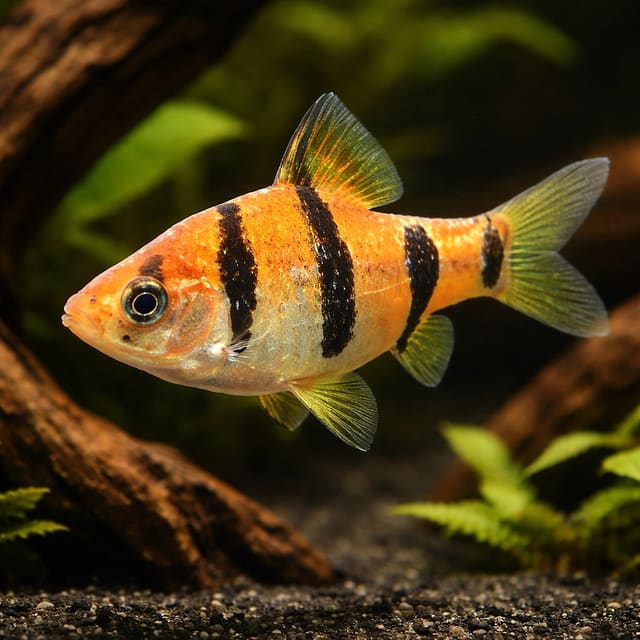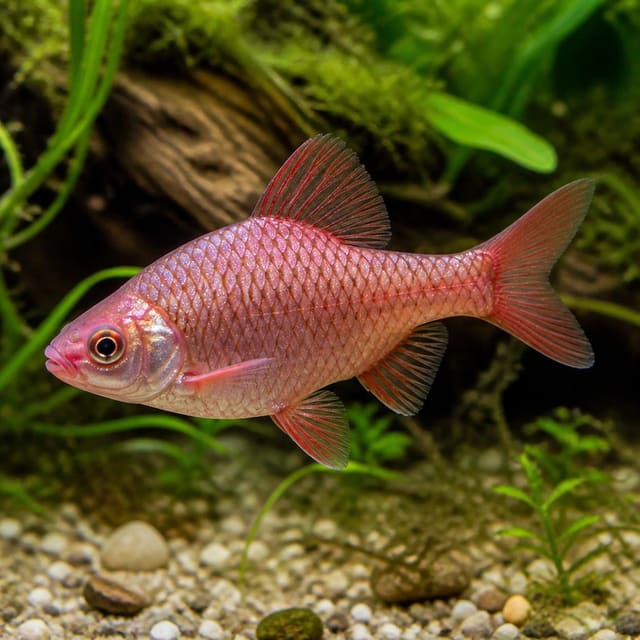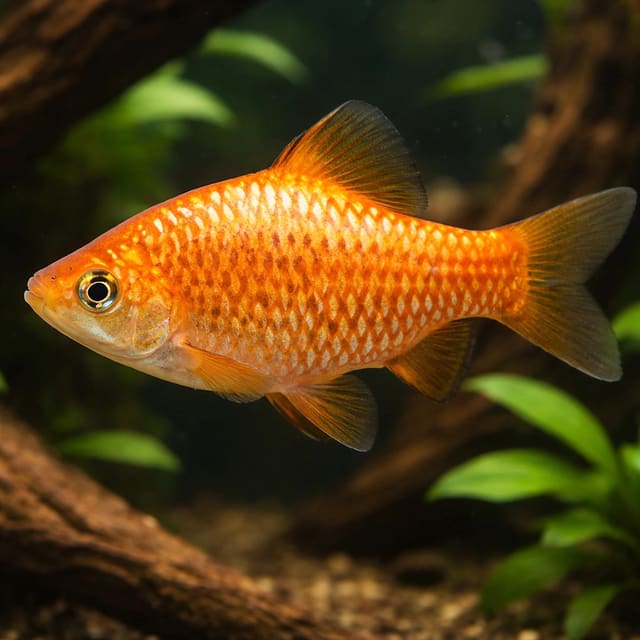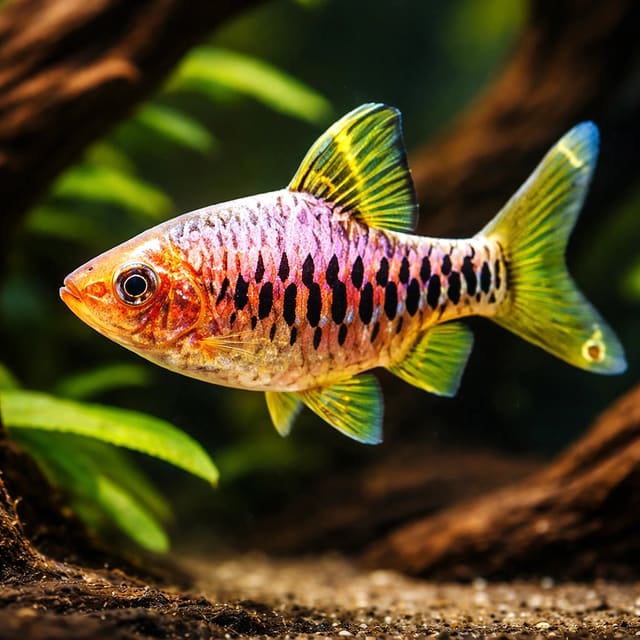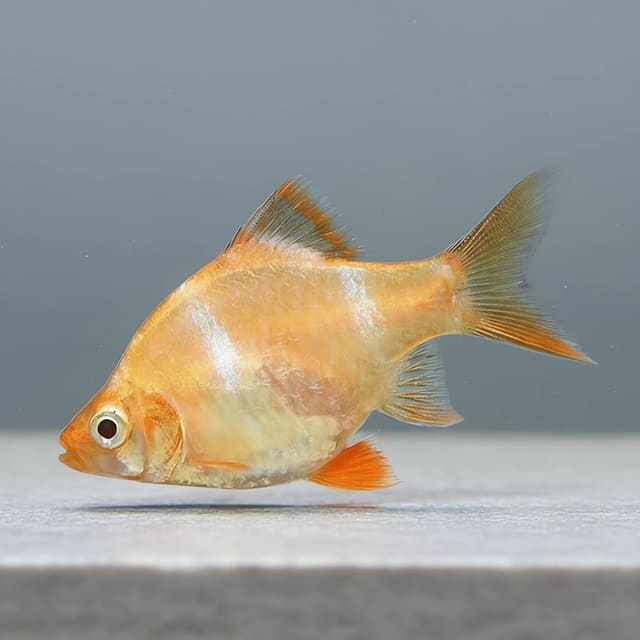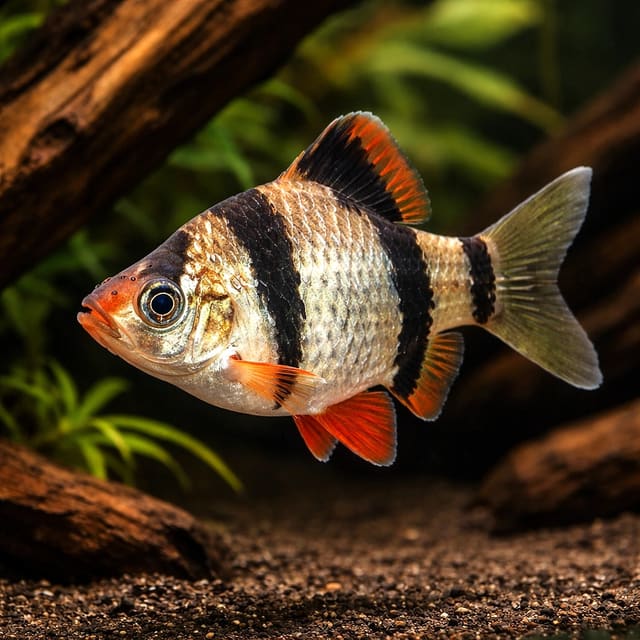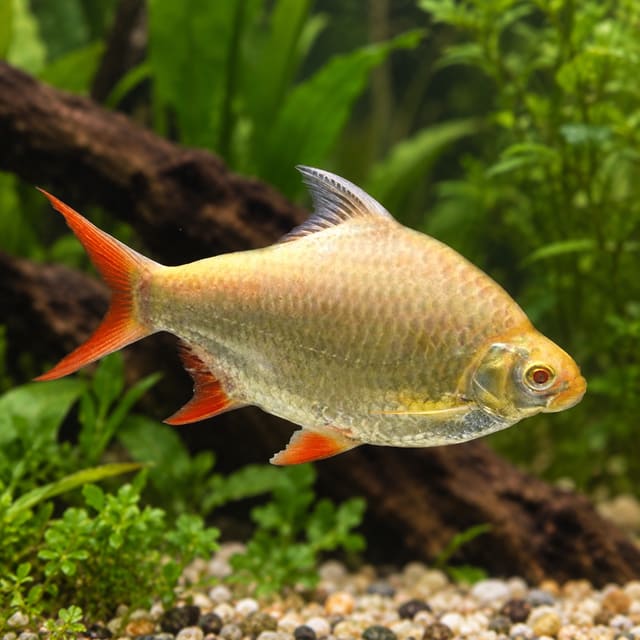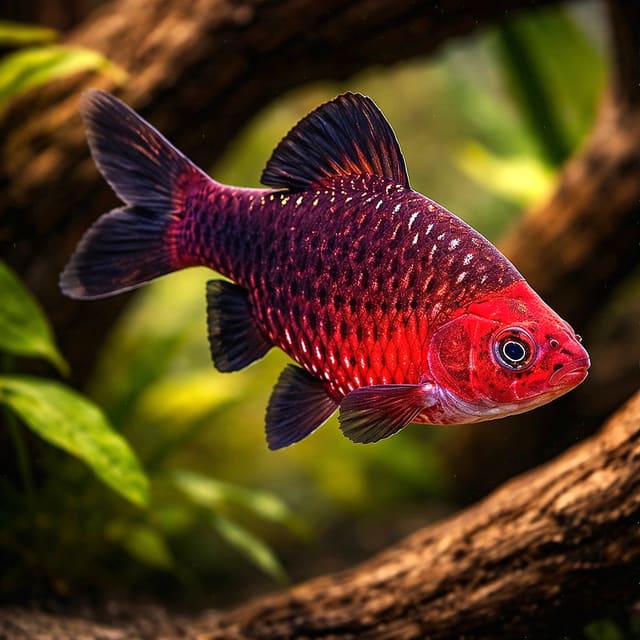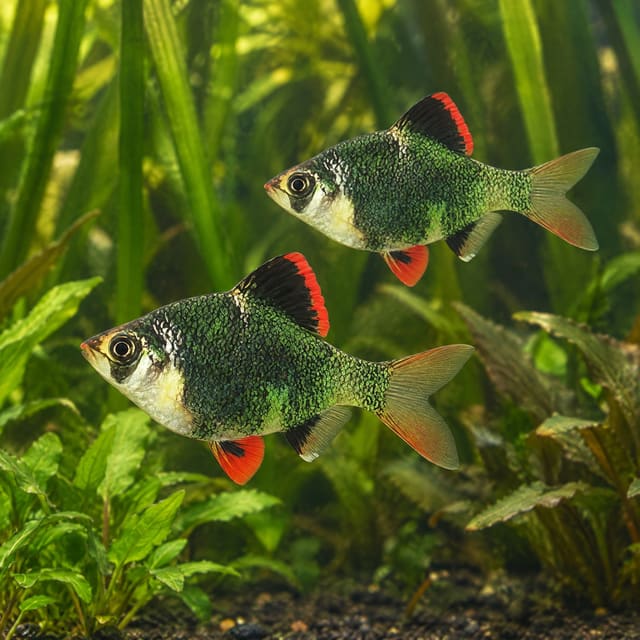
Green Tiger Barb (Puntigrus tetrazona)
20–26°C · pH 5–8 · 72L
£3.99

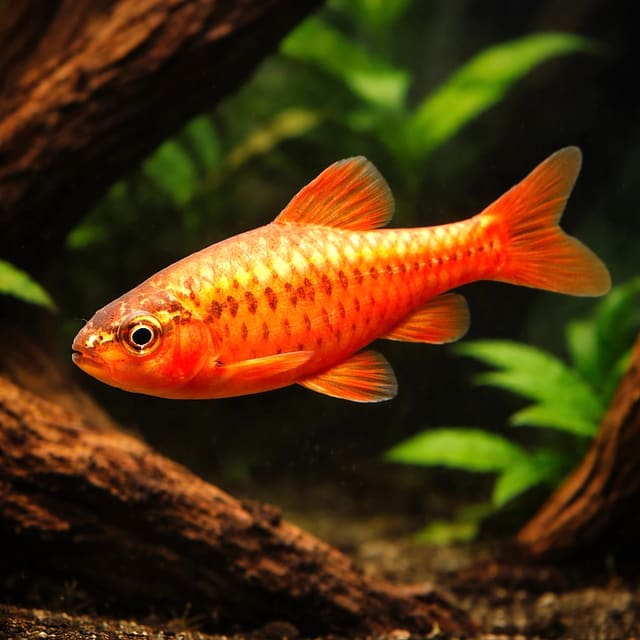
The Albino Cherry Barb (Rohanella titteya) is an ornamental Cyprinidae fish from Sri Lanka’s Kelani to Nilwala basins that reaches 5 cm. It suits beginners and peaceful communities; keep 6–10 at 20–27°C, pH 6.0–8.0 and 2–20 dGH in a base of at least 60 × 30 cm. Sold individually in 2.5–3 cm and 3–4 cm sizes.
Adult size is the maximum length this species reaches at full maturity (scientific sources). The livestock you receive will be younger and smaller — pick a size above for the actual shipping size. Product-photo provenance and any image-specific limitations are stated on the listing.
Rohanella titteya
Shoaling fish: kept in a group they feel safer, stay calmer and show their best colour.
Minimum of 2 per order.
The Albino Cherry Barb (Rohanella titteya) is an ornamental Cyprinidae fish from Sri Lanka’s Kelani to Nilwala basins that reaches 5 cm. It suits beginners and peaceful communities; keep 6–10 at 20–27°C, pH 6.0–8.0 and 2–20 dGH in a base of at least 60 × 30 cm. Sold individually in 2.5–3 cm and 3–4 cm sizes.
Adult size is the maximum length this species reaches at full maturity (scientific sources). The livestock you receive will be younger and smaller — pick a size above for the actual shipping size. Product-photo provenance and any image-specific limitations are stated on the listing.
Maintain these water conditions for optimal health and vibrant colors
The Albino Cherry Barb (Rohanella titteya) is an ornamental albino form of a Cyprinidae fish from Sri Lanka’s Kelani to Nilwala basins, reaching up to 5 cm. It suits beginners and peaceful community keepers who can provide a mature aquarium, a group of 6–10 and a base of at least 60 × 30 cm. Its care is the same as that of the standard form, so the decisive choices are social group size, swimming space, stable water and compatible companions rather than a different routine for the albino strain.
FishBase now lists it as Puntius titteya, places it in the Cyprinidae family and treats Barbus titteya as a synonym. It records a maximum length of 5 cm total length. Plan for that maximum rather than treating the dispatch size as the fish’s eventual size.
| Suits | Not suited to |
|---|---|
| Beginners prepared to maintain a mature, filtered aquarium | A plan based on keeping one fish alone |
| Peaceful community aquariums with overlapping water requirements | An aquarium base smaller than 60 × 30 cm or equivalent |
| A group of 6–10 with planted cover and swimming room | A community that cannot accommodate complete social groups |
| Water maintained at 20–27°C, pH 6.0–8.0 and 2–20 dGH | Companions whose adult space, behaviour or water needs conflict |
Seriously Fish gives the 60 × 30 cm base, approximately 54-litre volume and 6–10 group recommendation. Those figures form a practical starting point for the species, but the complete stocking plan must also include every companion’s adult size, social needs and swimming space.
This barb suits a peaceful community planned around overlapping water ranges. Its modest length does not make solitary keeping appropriate, and a small container cannot substitute for the horizontal room needed by an active group. If the aquarium cannot house at least six while leaving room for filtration, planting and swimming, choose a different stocking plan or a larger aquarium. You can also browse the barbs collection when comparing group needs and adult sizes.
One purchase quantity supplies one animal of the selected option. Use the live size selector to choose between the 2.5–3 cm and 3–4 cm dispatch grades. The size you select is the size supplied, not the adult size. Both grades therefore need the same adult aquarium plan: allow for a fish reaching up to 5 cm and for a social group rather than calculating space from the size on arrival.
A worked example makes the distinction clear. Six fish selected from the 2.5–3 cm grade are six individual animals dispatched at that smaller grade; they are not a miniature form and should not be assigned less permanent space. One fish selected from the 3–4 cm grade is still one animal, not a group. Adjust the quantity deliberately so that the resulting group and the aquarium’s total stocking plan match.
Sex is guaranteed only when the selected option explicitly states male or female. This Albino Cherry Barb listing has no sex-guaranteed option.
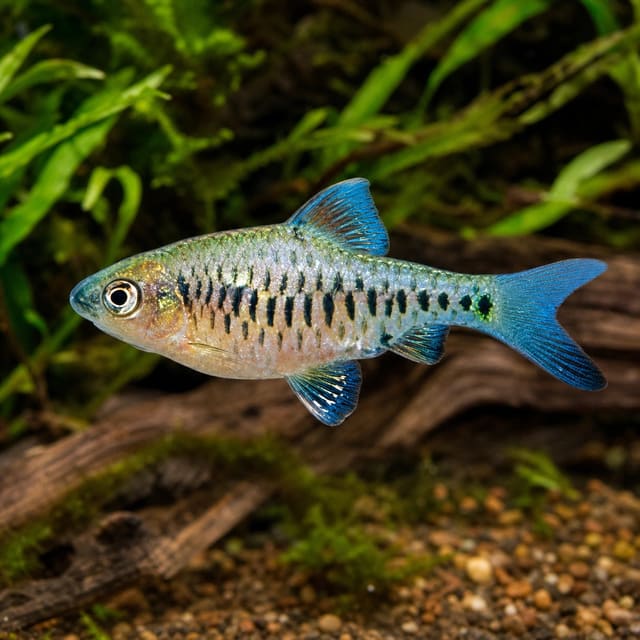
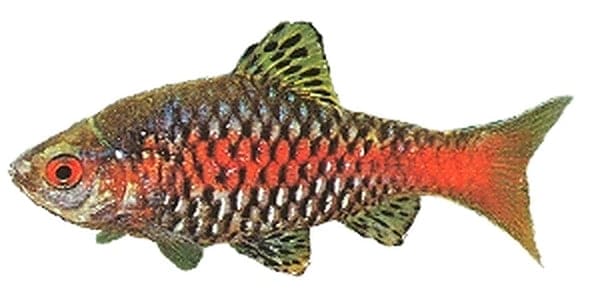
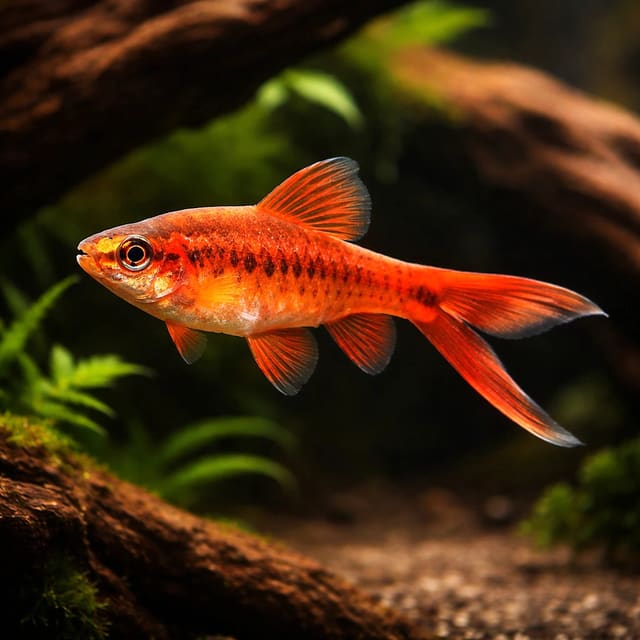
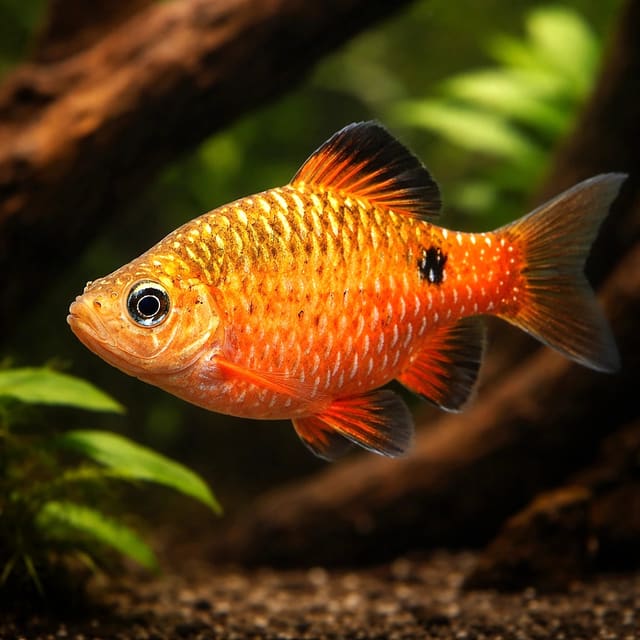
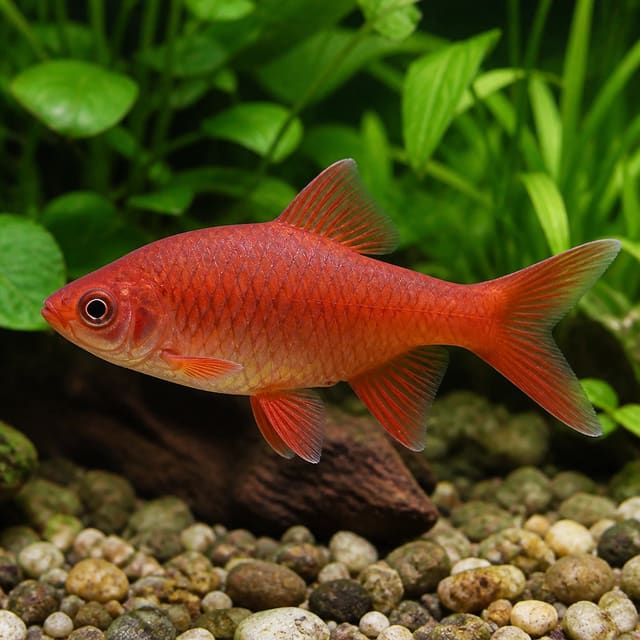
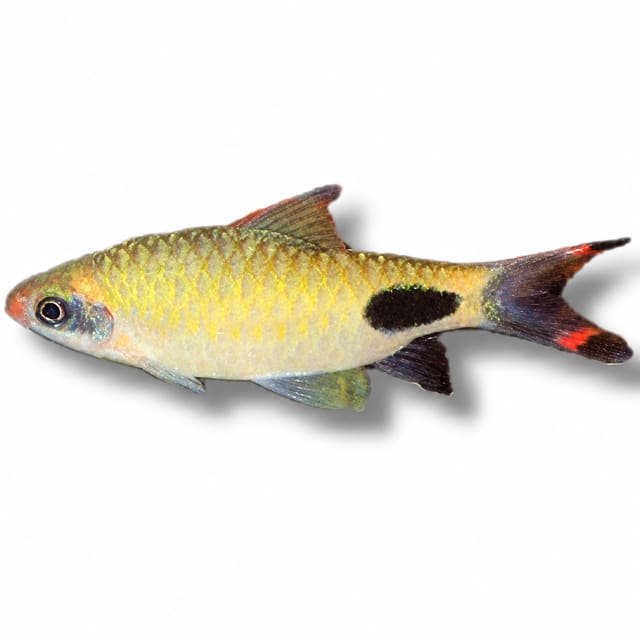
The gallery images are representative of this type of animal rather than photographs of the exact animal supplied, so colours can look slightly different from the live animal.
Colour should not be used to infer sex, age or origin. Treat the selector as a choice of dispatch size only and base the purchase decision on the aquarium’s capacity for the whole social group. For packing, dispatch days, delivery arrangements and claim steps, read our delivery and Live Arrival Guarantee policy before ordering.
Start with base dimensions of at least 60 × 30 cm or an equivalent footprint, which corresponds to approximately 54 litres in the cited species guidance. The footprint matters because a group needs horizontal swimming room as well as cover. A taller aquarium with a much smaller base does not create the same usable route through the tank.
Use the 60 × 30 cm base as a minimum planning point, not a promise that every community combination will fit. Six Cherry Barbs alone place fewer demands on the aquarium than ten barbs plus several other social species. For every proposed companion, add its adult body size, required group number and preferred swimming zone to the plan before deciding that the footprint is sufficient.
| Area | Purpose |
|---|---|
| Planted edges | Give the group cover and visual shelter. |
| Open route | Leaves uninterrupted swimming room through the aquarium. |
| Upper shade | Floating plants can soften exposed areas. |
| Wood and leaves | Driftwood roots, branches and leaf litter add structure. |
| Accessible foreground | Allows uneaten food and solid waste to be seen and removed. |
Décor is flexible, but a heavily planted arrangement with a darker substrate tends to show the fish well. Floating plants, driftwood roots or branches and leaf litter can add cover and a more natural feel. Keep enough open space that the group can move without repeatedly turning around obstacles. Smoothly arranged décor also makes routine cleaning easier.
Planting should support rather than crowd the fish. If stems close the entire swimming route, thin or reposition them. If the barbs stay exposed with nowhere to retreat, add cover along an edge or towards the rear while preserving the open path. The result should offer both choices: the fish can move into cover when unsettled and return to open water when confident.
Before using the minimum footprint for a mixed community, sketch the adult stocking plan. Write one row for each species, including its adult size and group requirement. If the combined plan leaves no clear swimming route or little margin for waste production, increase the aquarium size or reduce the number of species rather than compressing their groups.
Maintain 20–27°C, pH 6.0–8.0 and hardness of 2–20 dGH. These are usable ranges rather than targets that must be centred exactly. Measure the aquarium and source water before choosing companions, then favour fish whose requirements overlap without repeated chemical adjustments.
Use our water chemistry guide to understand the measurements and the water matcher to compare tested values with the stated range. Temperature, pH and hardness describe suitability, while ammonia, nitrite and nitrate help show whether filtration and maintenance are coping with the livestock.
OATA’s freshwater-barb sheet gives group guidance of zero mg per litre ammonia, zero mg per litre nitrite and nitrate not exceeding 20 mg per litre above the normal tap-water level. The Cherry Barb aquarium range is 20–27°C, pH 6.0–8.0 and 2–20 dGH; use those figures when assessing this fish.
| Test result | Action |
|---|---|
| Ammonia above zero | Pause further stocking, check filtration and address water quality. |
| Nitrite above zero | Pause further stocking and treat the reading as a filtration warning. |
| Rising nitrate | Review feeding, stocking and the weekly water-change routine. |
| Temperature outside 20–27°C | Correct the equipment or room-temperature cause steadily. |
| pH or hardness outside range | Reassess source water and livestock suitability before adding fish. |
Record test results rather than relying on a single impression. A short log makes trends visible: note the date, temperature, pH, ammonia, nitrite and nitrate, plus any maintenance completed. Similar readings over time are more useful than repeatedly altering the aquarium to chase one exact pH.
Test before introduction and at least weekly as part of routine care. Test again whenever swimming, breathing, feeding or appearance changes. Water results should guide the first response because toxic ammonia or nitrite can affect the whole aquarium even when only one fish initially appears unsettled.
A well-established biological filter is essential. The RSPCA explains that fish waste produces toxic ammonia, which beneficial filter bacteria convert first to toxic nitrite and then to safer nitrate. The filter therefore has to support living bacteria as well as move water and collect debris.
For an aquarium of about 54 litres, the Cherry Barb guidance uses turnover of four to five times the aquarium volume per hour. That calculation gives a nominal filter flow of roughly 215–270 litres per hour. Treat the manufacturer’s figure as a selection aid: décor, filter media and maintenance condition can affect actual movement in the aquarium.
| Equipment decision | 54-litre example |
|---|---|
| Filter turnover | Four to five times volume per hour |
| Nominal flow | About 215–270 litres per hour |
| Water movement | A degree of movement without unnecessarily strong flow |
| Heater guide | Roughly 50–75 W when the room is around 20°C |
| Temperature check | Confirm 20–27°C with a thermometer |
Filtration need not be particularly strong, although the fish appreciates some water movement. Arrange the outlet so the aquarium has circulation and surface movement while retaining calmer planted areas. If the group struggles continuously against the flow, diffuse or redirect the outlet rather than removing filtration.
Mature the filter before livestock arrives. Our first tropical aquarium guide explains how to prepare and mature the system. A newly installed filter is not equivalent to an established biological filter simply because water is circulating through it.
Choose equipment with the final group and community in mind. A filter selected only for one dispatch-sized fish will be the wrong planning basis. Count at least six barbs, their growth towards 5 cm and every companion in the expected biological load. Leave access around the intake and outlet so blockages can be spotted during weekly checks.
When maintenance is needed, preserve the bacteria living in the filter media. Rinse the media lightly in aquarium water removed during a partial water change. Do not rinse it under the tap.
Feed a varied omnivorous diet based on good-quality flakes or small granules. Include some prepared food with plant or algal content, then rotate suitable small live or frozen foods such as Daphnia, Artemia and small bloodworm. Variety supports condition while the prepared staple keeps daily feeding straightforward.
Wild Cherry Barbs forage on diatoms, algae, organic detritus, small insects, worms, crustaceans and other zooplankton. In the aquarium, imitate that breadth through varied small foods rather than trying to recreate wild feeding exactly. Match each item to the fish’s mouth and avoid pieces that remain untouched because they are too large.
A useful portion is defined by consumption, not by how eagerly the first fish responds. If everything disappears immediately and some group members never reach food, distribute the same controlled portion across a wider area. If flakes or granules remain after a few minutes, reduce the next portion and remove what is left.
Use live or frozen foods as part of the rotation rather than allowing rich items to displace the staple. Bloodworm should be appropriately small for the fish. Daphnia and Artemia provide alternatives with different shapes and movement, while plant or algal ingredients reflect the broader omnivorous diet.
Overfeeding adds waste faster than the filter and maintenance routine may process it. Uneaten food breaks down and contributes to poor water quality, so a generous-looking portion can work against the fish’s condition. When ammonia, nitrite or nitrate trends worsen, review feeding quantity alongside stocking, filtration and water changes.
Observe the whole group during each meal. Reduced intake or loss of interest in food is a health warning, while repeated exclusion of one fish can reveal a social or layout problem. Record a sudden change and test the water rather than masking it with a different food.
Prepare the aquarium before the fish arrives. Confirm that the filter is established, temperature is within 20–27°C, pH is within 6.0–8.0 and ammonia and nitrite both read zero mg per litre. The aquarium must already have the footprint, cover and open swimming route intended for the adult group.
Plan the social requirement before introduction. These barbs should be kept in a group, so avoid using a lone fish as a test occupant. At the same time, do not add an entire mixed community faster than the biological filter can adapt. Introduce the planned barb group to a suitably mature system, then consider further species only after tests show that water quality remains stable.
| Watch | Response |
|---|---|
| Swimming | Investigate hanging at the surface, prolonged bottom sitting or erratic movement. |
| Breathing | Test water if gill movement becomes noticeably faster or slower. |
| Feeding | Check any reduced intake or loss of interest. |
| Appearance | Look for damaged fins, missing scales, white spots, fluffy growths, ulcers or bumps. |
| Behaviour | Note increased hiding or an unexpected change in aggression. |
Healthy fish should show clear, bright eyes, intact scales, undamaged fins and appropriate swimming behaviour. Individual fish may settle at different rates, so compare each animal with its own recent behaviour while also looking for patterns across the group. Several fish showing the same change points strongly towards an aquarium-wide factor that needs prompt testing.
Keep the first stocking decision simple. Do not rearrange the aquarium repeatedly, add several new species and alter water chemistry at the same time. A stable setup makes observations easier to interpret and gives the filter time to respond to the new waste load.
If ammonia or nitrite rises above zero, pause all further stocking and deal with water quality. If tests remain within the stated limits and the group feeds, swims and breathes normally, continue the established routine rather than making unnecessary adjustments. Add later livestock slowly, rechecking the aquarium’s adult stocking capacity before each addition.
Carry out a partial water change of 25% at least once a week. Use a siphon to remove solid waste from accessible areas of gravel or sand, and treat replacement tap water with a suitable conditioner to remove chlorine or chloramine before it enters the aquarium.
Test ammonia, nitrite and nitrate at least weekly. Ammonia and nitrite should remain at zero mg per litre, while nitrate should not exceed 20 mg per litre above the normal level in the tap water. Note the results before the water change when you want to compare how the aquarium performs from week to week.
Do not rinse established biological media under the tap. Chlorine or chloramine may harm the bacteria that process ammonia and nitrite. Avoid replacing all mature media at the same time unless the equipment instructions make a specific component change necessary; preserving the biological population is central to stable filtration.
Use the maintenance record to make practical changes. If nitrate rises faster than before, check whether stocking or feeding has increased, whether solid waste is accumulating behind décor, or whether filter flow has fallen. If temperature drifts, inspect the heater setting and thermometer rather than assuming the fish’s behaviour alone identifies the cause.
During the first month after adding the group, compare each weekly entry with the last. Stable zero ammonia and nitrite readings, controlled nitrate, normal feeding and consistent behaviour indicate that the routine is coping. A worsening trend calls for action before another species is added.
Keep the aquarium layout serviceable. Plants and wood can remain dense enough for cover while still allowing access to trapped debris and equipment. Prune or reposition growth when it blocks circulation, hides the filter intake or closes the open swimming route.
Learn the group’s normal pattern so a change is easy to recognise. Cherry Barbs are schooling fish and should be maintained in numbers that support confident behaviour. Keeping too few barbs may increase stress, while a larger group can reduce skittishness and produce a more natural display.
Check behaviour during ordinary moments rather than only at feeding time. Watch how the fish use planted cover, open swimming space and the filter current. A settled group should be able to move between sheltered and open areas without being forced to hide continuously or fight the flow.
| Change | First check |
|---|---|
| Surface hanging | Test water and inspect filtration and surface movement. |
| Bottom sitting | Test water and compare the fish with the rest of the group. |
| Erratic swimming | Check water values, flow and interactions. |
| Faster or slower breathing | Test ammonia and nitrite promptly. |
| More hiding | Review group size, cover and tank-mate behaviour. |
| Reduced feeding | Test water and inspect appearance closely. |
| White spots or fluffy growth | Record the signs and seek health guidance. |
| Damaged fins or scales | Check décor and observe all interactions. |
Do not diagnose a treatment from one symptom. Water quality is the first practical check because ammonia and nitrite are toxic and can affect several fish. Record what changed, when it began, the measured water values and whether other animals show the same sign.
If you are concerned about a health change, test the water and contact us with the results and a clear description of swimming, breathing, feeding and appearance. That information helps separate an aquarium-wide water problem from an interaction or an individual health concern without delaying the immediate water-quality check.
Review husbandry after any warning. Confirm that at least six barbs are together, food is eaten within a few minutes, weekly maintenance has been completed and the filter has normal flow. These checks address the main controllable pressures without adding several changes at once.
Cherry Barbs are generally very peaceful and can suit a well-researched community aquarium. Suitable categories can include other small cyprinids, tetras, livebearers, rainbowfishes, anabantoids, catfishes and loaches, but the category name alone is not a compatibility guarantee. Every proposed species must pass the same water, space, group-size and behaviour checks.
| Screen | Question to answer |
|---|---|
| Water | Does its temperature, pH and hardness range overlap 20–27°C, pH 6.0–8.0 and 2–20 dGH? |
| Space | Can the aquarium house both species at adult size while preserving swimming room? |
| Social needs | Can every schooling or social species be kept in its proper number? |
| Behaviour | Is the companion peaceful enough not to intimidate, injure or continually displace the barbs? |
Begin with water overlap, but do not stop there. Two fish may share a temperature range while needing incompatible group sizes or more space than the aquarium offers. Calculate with the Cherry Barb’s maximum recorded 5 cm length and a group of at least six, then add the companion’s adult requirements.
Observe the whole aquarium after any introduction. Repeated chasing, persistent hiding, damaged fins, loss of feeding access or displacement from cover means the combination or layout needs reassessment. A single brief movement is less informative than a repeated pattern, so watch several areas and feeding points.
Barbs as a broad group include species that may be semi-aggressive or nip fins, but Cherry Barbs can generally mix with peaceful species. If fin chasing appears, pay particular attention to slow-swimming, timid or long-finned companions and act before damage accumulates. A proper same-species group, adequate room and planted cover all form part of the compatibility plan.
For a stocking and compatibility assessment, contact us with the aquarium dimensions, tested water values, filter details, existing livestock and proposed group numbers. Those details allow a conditional assessment of the complete aquarium rather than a simple yes-or-no answer based only on two names.
Build the community on paper before adding livestock. List the aquarium’s base dimensions and volume, then make one row for every existing and proposed species. Record adult size, required group number, water range and swimming area. This prevents several individually modest groups from becoming an overcrowded total.
For example, a 60 × 30 cm aquarium of about 54 litres reaches the stated starting footprint for the species. That does not automatically approve ten barbs plus several other complete schools. Begin with the barb group, reserve an open swimming route and cover, then test whether each additional group can be accommodated at adult size without compromising maintenance or filtration.
Do not solve lack of space by reducing a social species below its proper group number. If six Cherry Barbs plus a companion’s full group do not fit comfortably, choose one group, enlarge the aquarium or revise the community. Keeping two incomplete groups exchanges a space problem for a welfare problem.
Check feeding access as well as physical room. Peaceful fish can still compete at one feeding point. Spread the controlled daily portion so the whole group can approach, and watch whether companions consistently prevent any barb from eating. Persistent exclusion requires a layout or stocking change, not extra food left to decay.
After introduction, hold further stocking until weekly tests show zero ammonia, zero nitrite and controlled nitrate with the new biological load. Continue only when swimming, breathing, feeding and interactions remain normal. This stepwise approach lets the filter respond and makes any change easier to trace.
Use the live selector only to choose dispatch grade and quantity. It does not calculate social groups or community capacity, so complete those decisions from the adult plan before selecting the number of animals.
The Albino Cherry Barb reaches up to 5 cm total length, so plan the aquarium around that adult size rather than its size at dispatch.
Use a mature, filtered aquarium with a base of at least 60 × 30 cm or equivalent, approximately 54 litres, with planted cover and an open swimming route.
Keep at least six Albino Cherry Barbs together; Seriously Fish recommends 6–10 for less skittish behaviour and a more natural display.
Yes. Seriously Fish describes this fish as a beginner choice, provided it has a mature filtered aquarium, a proper group and stable water.
Feed good-quality flakes or small granules once daily, adding varied small foods such as Daphnia, Artemia or small bloodworm and some plant or algal content.
Maintain 20–27°C, pH 6.0–8.0 and 2–20 dGH, with ammonia and nitrite at zero mg per litre.
The Albino Cherry Barb is generally very peaceful. Keep a proper group, provide enough room and monitor chasing or fin damage, particularly around slow-swimming, timid or long-finned companions.
Potential companions include peaceful small cyprinids, tetras, livebearers, rainbowfishes, anabantoids, catfishes and loaches whose water ranges, adult space and social requirements fit the aquarium.
Have someone present to receive it. Start filming every delivery continuously before opening the sealed parcel, show it being opened and keep filming while the fish is still in the sealed bag. Float the bag for 20–30 minutes before release, and never pour the bag water into the aquarium.
No reviews for this item yet. Bought one? Honest reviews only, good or bad.
What customers say about ordering from us
I have a small group of long finned mountain minnows. So was delighted to be able to order ten of this variety to increase the genetics in my tank . The ones I recieved are healthy but it’s to early to give a verdict on wether they are of a long finned type since they are small currently.
Gordon Walker · 23 Sept 2026
100% success travel and "installation". Pleased with quality of purchase. The Siamese fighter a bit "shy" so have not yet seen him at his best yet but looking good. Happy customer. GG
George E Garratt · 21 Sept 2026
Reviews of our shop, collected by Judge.me, an independent third-party review collector. Newest first.