Easy
Cherry Barb (Barbus Capoeta titteya)
20–27°C · pH 6–8 · 54L
From £3.43Some sizes on sale
The red rosy barb (Pethia conchonius) is a hardy, active shoaling barb from South Asia that does best in a group of 8–10 or more, in a planted aquarium with a 100 cm base and cooler, stable water. Each purchase supplies one young fish at the size you choose.
Adult size is the maximum length this species reaches at full maturity (scientific sources). The livestock you receive will be younger and smaller — pick a size above for the actual shipping size. Product-photo provenance and any image-specific limitations are stated on the listing.
Pethia conchonius
Shoaling fish: kept in a group they feel safer, stay calmer and show their best colour.
The red rosy barb (Pethia conchonius) is a hardy, active shoaling barb from South Asia that does best in a group of 8–10 or more, in a planted aquarium with a 100 cm base and cooler, stable water. Each purchase supplies one young fish at the size you choose.
Adult size is the maximum length this species reaches at full maturity (scientific sources). The livestock you receive will be younger and smaller — pick a size above for the actual shipping size. Product-photo provenance and any image-specific limitations are stated on the listing.
Maintain these water conditions for optimal health and vibrant colors
The red rosy barb (Pethia conchonius) is a red-coloured form of one of the hardiest and most popular barbs in the aquarium hobby. It is an active, schooling cyprinid from South Asia that shows at its best in a busy group, and it prefers water on the cooler side of the usual tropical range. Those two facts, a proper shoal and moderate temperatures, shape almost every decision about keeping it well.
FishBase describes the species as one of the hardiest of the barbs, undemanding and beautiful, and Seriously Fish calls it an excellent choice for newcomers. That hardiness is real, but it does not replace the basics: a cycled aquarium with a base of about 100 cm, a group large enough for the fish to behave naturally, and companions that suit an energetic neighbour.
One purchase supplies one live red rosy barb at the size you choose, with two dispatch sizes: 3.5–4 cm and 4–5 cm. The size you select is the size supplied, not the adult size. Both are young fish that still have plenty of growing to do. Because a rosy barb should never be kept alone, set the quantity to the size of group you want: Seriously Fish recommends at least 8–10 fish.
You may also see this fish sold as Barbus Puntius conchonius red, a trade label that combines two older genus names. Sex is guaranteed only when the selected option explicitly states male or female. This Barbus Puntius conchonius red listing has no sex-guaranteed option. Young rosy barbs are hard to sex reliably, so a mixed group bought at random is the normal way to start.
Rosy barbs suit a lively community of robust fish or a species tank given over to one large shoal. They are a poorer match for a calm aquarium built around slow, ornate fish, and for a very warm tank kept for heat-loving species, because both clash with what this barb needs to thrive.
| Suits | Beginners and community keepers with a mature aquarium of about 90 litres or more on a 100 cm base |
|---|---|
| Group | At least 8–10 rosy barbs; never a single fish |
| Temperature | Cooler than many tropicals: 18–24 °C as a routine range |
| Behaviour | Generally peaceful and very active; best kept away from slow, long-finned fish |
| Feeding | Easy omnivore: flakes and granules with small live or frozen foods |
| Our care rating | Easy, provided the group and tank are the right size |
In the hobby this fish has been sold as Barbus conchonius and Puntius conchonius. It is now placed in the genus Pethia, into which a group of closely related small barbs was moved from Puntius. FishBase lists the species as Pethia conchonius and treats Puntius conchonius as a synonym. Whichever name appears on a tank label, it is the same species, and "red" describes the colour form rather than a different fish.
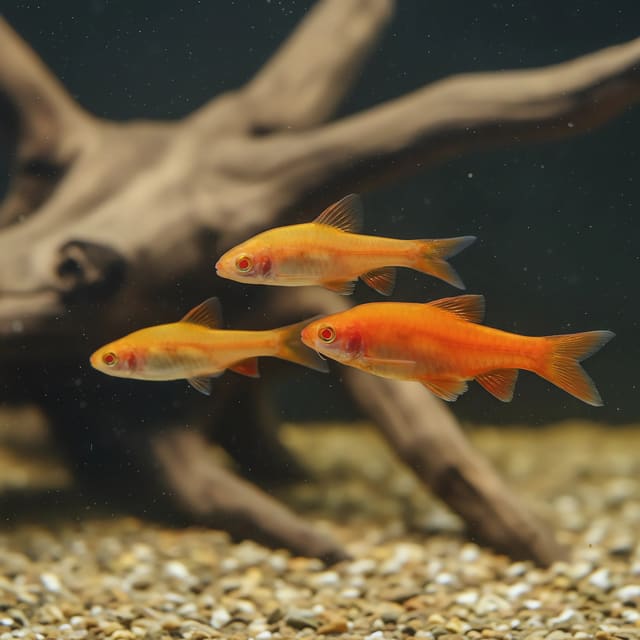
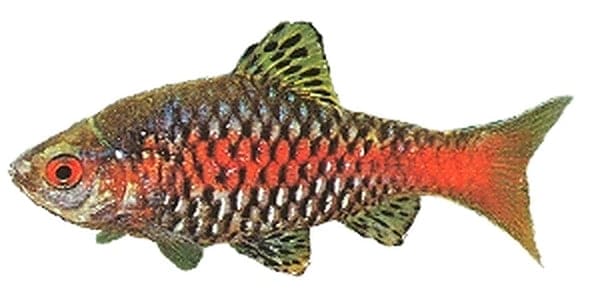
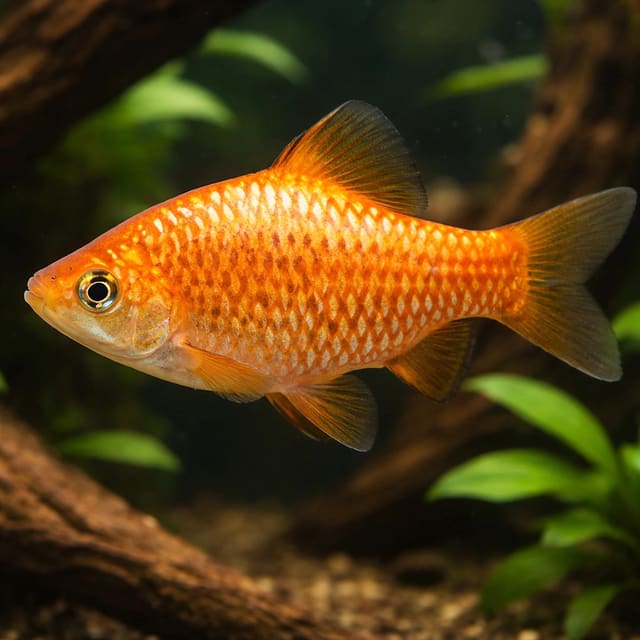
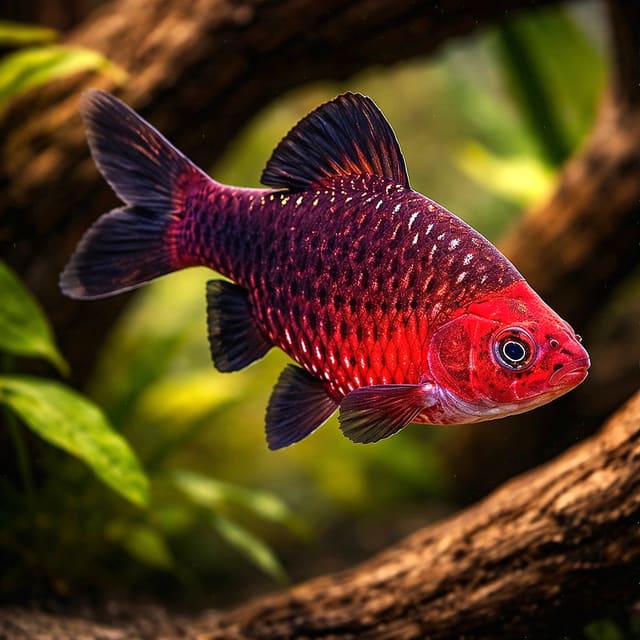
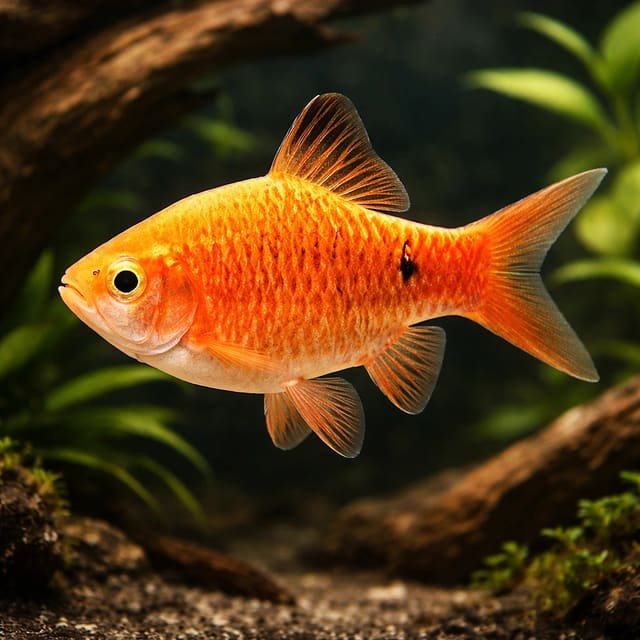
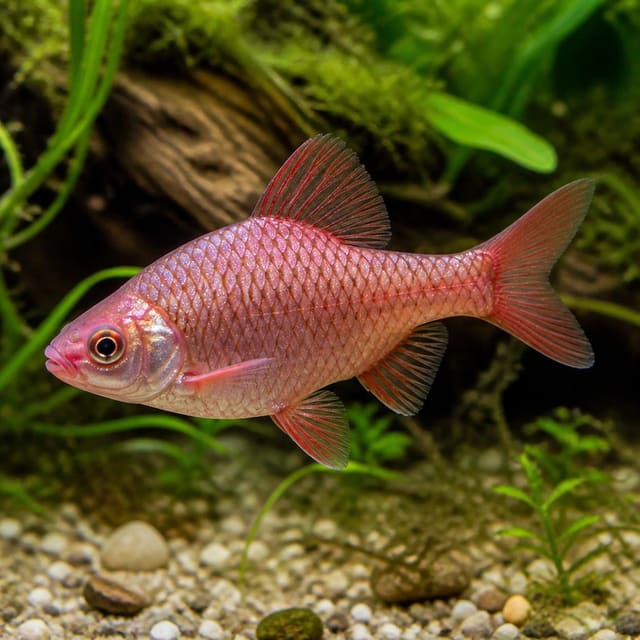
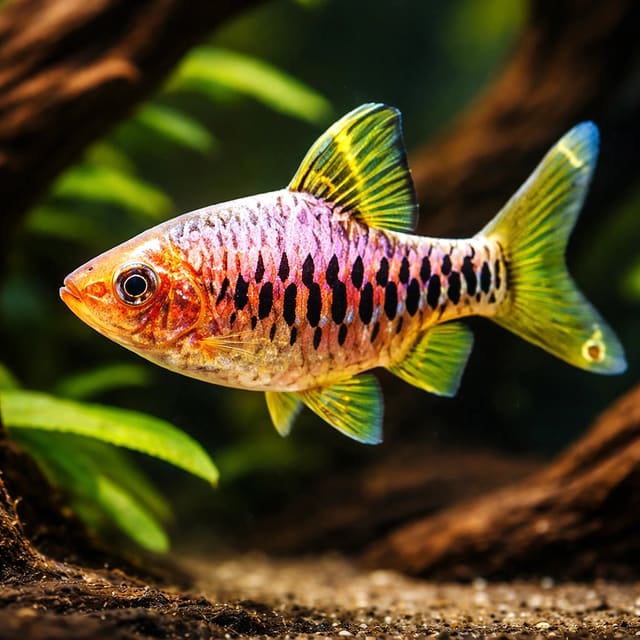
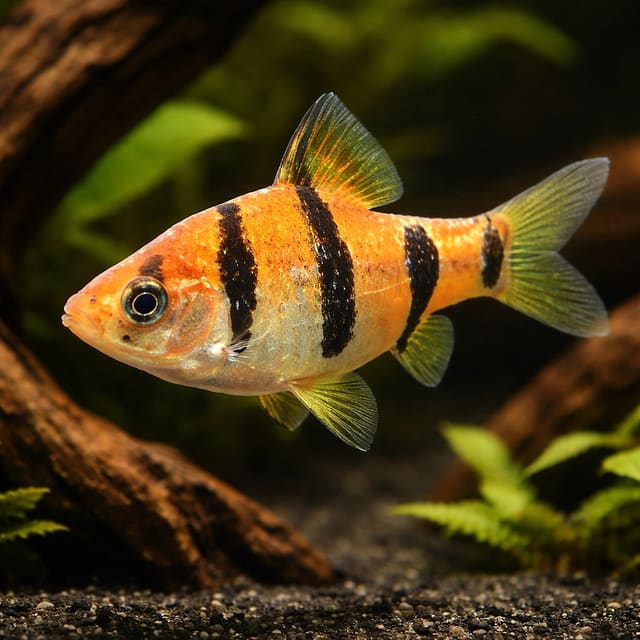
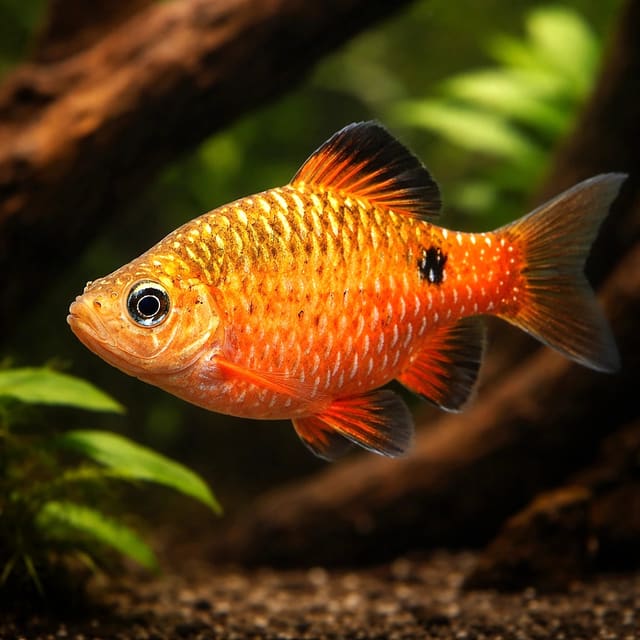
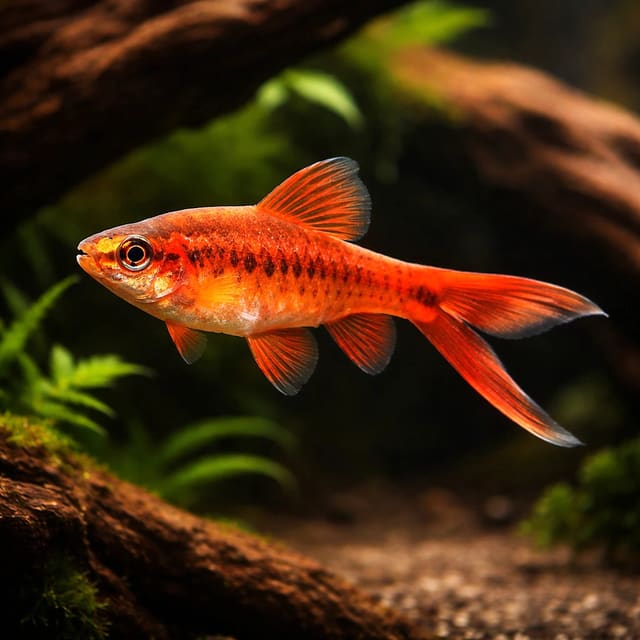
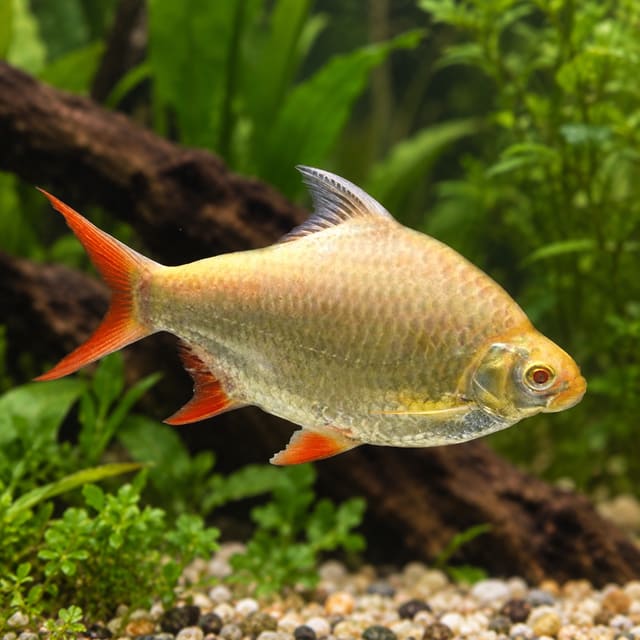
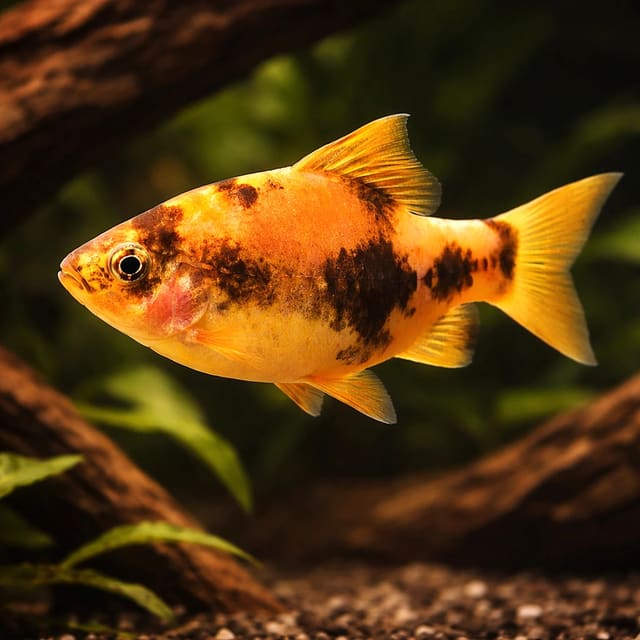
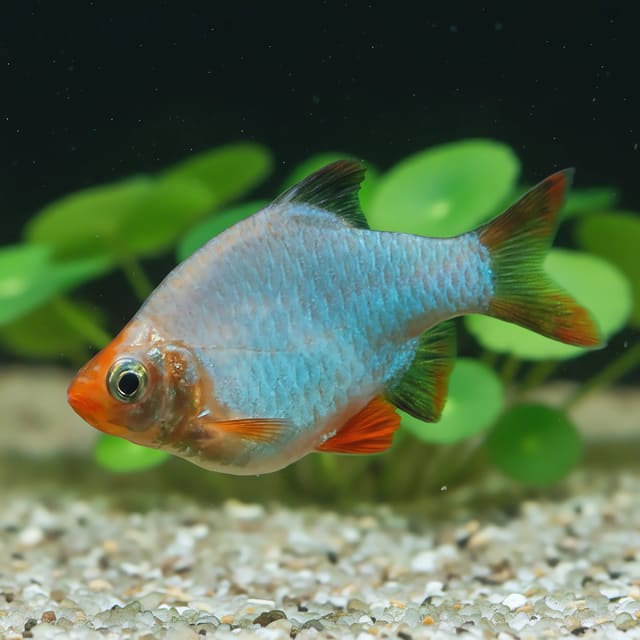
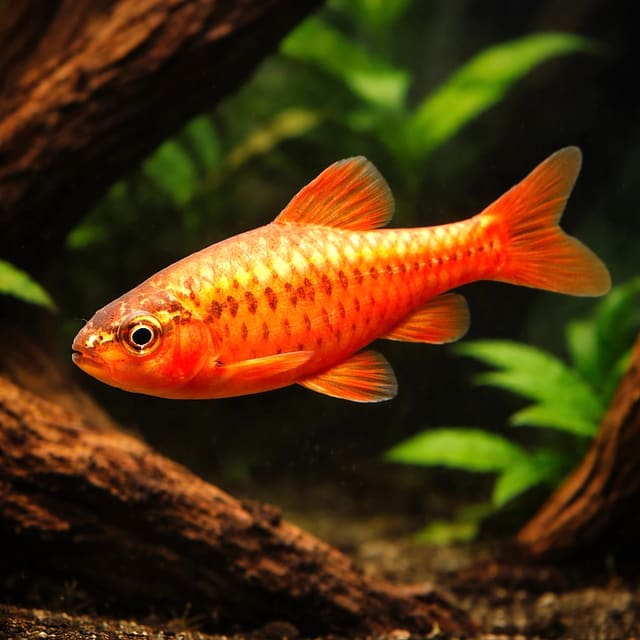
In the wild-type fish, FishBase notes that the normally silvery male takes on a rich claret flush in the breeding season while the slightly larger female becomes more luminous. Selective breeding has since produced a range of ornamental strains, and Seriously Fish notes that some of them keep bright colour all year round. The gallery shows a well-coloured fish with red-orange body and fins; young fish supplied at 3.5–5 cm are still developing. Gallery images have been digitally enhanced to improve image quality. Natural colour, pattern, size and maturity can vary between live animals.
Seriously Fish also observes that rosy barbs tend to show better colour in a heavily planted aquarium with a dark substrate, and that males display their best colours when competing for the attention of females in a decent-sized group. A well-planted tank and a proper shoal are the most reliable ways to see the red at its best.
If you are comparing barbs, our barb collection shows the other barbs in our range side by side.
Seriously Fish describes the rosy barb as a schooling species by nature that ideally should be kept in a group of at least 8–10. Keeping it in decent numbers makes the fish less nervous, gives a more natural-looking display, and encourages males to show their best colours as they compete for females. FishBase notes aquarium keeping in groups of 5 or more, and OATA's barb care sheet says barbs should be kept in groups of at least five, with more being better.
OATA adds a warning worth taking seriously: barbs kept singly or in too small groups will often become stressed. It also notes that keeping barbs in larger groups helps to reduce their fin-nipping. The practical target for this species is therefore 8–10 fish or more, with five as an absolute floor rather than a goal.
Each rosy barb is a separate purchase, so a shoal of ten means a quantity of ten. Buying the whole group at once lets the fish settle together and start schooling straight away. If the aquarium is newly cycled, though, OATA's advice to increase stocking slowly still applies: a sudden jump in fish and food can outpace the filter bacteria. In that case add the group in two batches of at least five, testing ammonia and nitrite before the second batch goes in. If you are adding to rosy barbs you already keep, choose the size closest to your existing fish.
| Tank base | At least 100 × 30 cm, as Seriously Fish requires |
|---|---|
| Volume | About 90 litres for a single-species group |
| Minimum aquarium length | 80 cm in FishBase's aquarium note |
| Larger groups or communities | More length and volume than the minimum |
Seriously Fish sets base dimensions of at least 100 × 30 cm, or equivalent, with a volume of around 90 litres. FishBase gives a minimum aquarium size of 80 cm. We use the longer figure because an active group needs swimming length more than it needs height.
OATA's barb sheet suggests at least 60 litres for a small group of the smallest barbs, around 8 cm long, and much more for large species such as the tinfoil barb. A rosy barb grows beyond that small-barb figure, so plan from the species-level dimensions above. A community with other fish needs more volume again.
FishBase records a maximum length of 14 cm total length for a male or unsexed fish. Seriously Fish gives the adult length as 100 mm standard length, which is measured differently. Plan for a fish that will grow well beyond the 3.5–5 cm at which it is supplied and may reach 14 cm at the top of its range, and size the tank for a whole shoal of adults rather than a group of juveniles.
OATA notes that barbs can live for several years in a well-matured set-up with good water quality. A rosy barb shoal is a long-term commitment, so choose a tank that will still suit the group when every fish is full grown.
Rosy barbs come from subtropical waters. FishBase gives an environmental range of 18–22 °C for the species, and Seriously Fish gives an aquarium range of 16–24 °C. FishBase also notes that it tolerates low water temperatures. We suggest 18–24 °C as the routine range: it stays within both species sources and avoids treating the coolest end as an everyday target.
| Temperature | 18–24 °C routine range |
|---|---|
| pH | 6.0–8.0 |
| General hardness | 5–19 dGH |
| Ammonia and nitrite | Zero |
| Nitrate | No more than 20 mg per litre above your tap water |
OATA's care sheet for barbs as a whole gives 20–27 °C, pH 6.0–7.5 and 4–12 °dH, and notes that some species can live in cooler water. That sheet covers the whole group, so for this species follow the rosy barb figures and do not run the tank at the warm end of the general barb range. This matters most when choosing companions: fish that need 26–27 °C are a poor match.
Because the routine range tops out at 24 °C, a warm room in summer needs watching. A heater can only add warmth, so check the thermometer daily during hot spells and act early if the tank drifts above the range. In colder months the heater does the work, which is why Seriously Fish still sizes one even for this cool-water species. The aim in every season is the same: a steady temperature within the range, without big swings between day and night.
FishBase and Seriously Fish agree on pH 6.0–8.0, and give hardness of 5–19 dH and 5–20 dGH respectively. That wide tolerance is one reason the species has a reputation for being easy; test your own tap water to see where it falls. As ever, stable readings matter more than hitting a precise number, and any change should be gradual.
If you are new to GH, KH and pH, our aquarium water chemistry guide explains how to test and read them. You can then check your results against published ranges with the water parameter matcher.
The RSPCA reminds keepers that no fish should be kept without a well set up and maintained filter. Beneficial bacteria in the filter convert toxic ammonia into nitrite, which is also toxic, and then into the safer nitrate. A shoal of eight to ten active barbs produces a steady waste load, so choose a filter for the stocked tank, not the empty one.
Seriously Fish says the choice of décor is not especially critical for this species, but it tends to show better colour in a heavily planted set-up with a dark substrate. Floating plants and driftwood roots or branches that diffuse the light entering the tank also seem to be appreciated and give the aquarium a more natural feel.
OATA recommends aquarium gravel or sand and, ideally, live plants to provide cover, while noting that some barbs will eat live plants. FishBase lists plant matter in the wild diet of the rosy barb, so choose robust plants and watch for grazing on soft new growth. Where live plants struggle, OATA suggests plastic plants and ornaments such as plant pots or model caves for shelter.
FishBase records adult rosy barbs in lakes and fast-flowing hill streams, and Seriously Fish notes that the species also does well in a hill-stream style set-up. That means a layout built around gravel and rounded stones, a little more current along the length of the tank and hardy plants or wood at the margins. It suits keepers who like a riverine look, and it plays to the species' liking for some water movement. Keep a calmer area out of the main current so fish can rest.
Leave enough open water for the whole group to school together; a tank packed wall to wall with plants and ornaments hides the fish and breaks up the shoal.
FishBase records wild rosy barbs feeding on worms, crustaceans, insects and plant matter, and Seriously Fish describes a generalised omnivore that also takes plant material and organic detritus. In the aquarium they are easily fed.
For the best condition and colour, Seriously Fish recommends regular meals of small live and frozen foods such as bloodworm, Daphnia and Artemia alongside good-quality dried flakes and granules, at least some of which include additional plant or algal content. OATA's barb care sheet similarly suggests a good-quality flake or granule, with live or frozen daphnia, small bloodworm or tubifex for smaller species.
| Everyday base | Quality flake and granules, some with added plant or algal content |
|---|---|
| Regular extras | Small live or frozen bloodworm, Daphnia and Artemia |
| Portion | Only what the group eats within a few minutes |
| Frequency | Once a day, as OATA's barb care sheet advises |
OATA advises that barbs should only be fed what they can eat within a few minutes once a day, and warns that overfeeding leads to uneaten food breaking down and releasing toxic waste. With a lively shoal it is easy to overestimate how much has been eaten, so watch the food disappear and remove anything left behind.
Fish supplied at 3.5–5 cm need small granules or finely crumbled flake. As they grow, larger granules and bigger frozen foods become practical. A varied diet also prepares a group for spawning if you plan to breed them later.
FishBase lists plant matter alongside worms, crustaceans and insects in the wild diet, and Seriously Fish recommends that at least some of the dried food includes additional plant or algal content. A flake or granule with some vegetable content alongside the usual protein-rich foods covers both sides of that omnivorous diet without turning plant food into the whole menu.
Well-fed rosy barbs have gently rounded bodies, feed eagerly and hold their colour. Thin fish at the edge of the group may be losing out to bolder shoal mates, so spread food across the surface and feed a little at a time until every fish has had a share.
Our team bags each order by hand in pure oxygen, packs it in an insulated box with a heat pack when the weather calls for it, and hands it to a licensed live-animal courier. You receive the tracking number and your confirmed delivery date by email. Read the full delivery and Live Arrival Guarantee policy before ordering; the steps below match it.
The guarantee also requires the parcel to be opened and inspected on the day it arrives. The video exists to make any claim quicker and clearer, as our licensed courier may request continuous unboxing footage when we raise one.
A shoal usually shows its confidence through steady schooling and eager feeding. Watch over the following days for clear eyes, undamaged fins, steady swimming and interest in food. Test the water more often than usual during the first weeks, since a new group adds a noticeable load to the filter.
The tank should be matured well before the fish arrive. Our guide to setting up a first tropical aquarium explains how to cycle the filter and confirm zero ammonia and nitrite. OATA also advises adding fish slowly, because the filter bacteria need time to grow each time stocking and feeding increase; stocking too quickly can cause new tank syndrome, with ammonia and nitrite rising to unhealthy levels.
OATA warns that barbs can be stressed by even the smallest amounts of ammonia and nitrite. Test results give earlier warning than behaviour, so keep testing even when the shoal looks lively.
OATA describes healthy fish as having clear, bright eyes, undamaged fins, intact scales, no ulcers or bumps and normal swimming behaviour. A healthy rosy barb shoal moves together, feeds eagerly and keeps its colour. Use that picture as your baseline, so any change stands out quickly.
OATA's list of changes to watch for is a useful daily check. Look for fish hanging at the surface, sitting on the bottom or swimming erratically; colour turning darker or paler than usual; more hiding or aggression than normal; gill covers moving faster or slower than usual; white spots, fluffy growths or missing scales or fins; a change in body weight; and reduced interest in food.
Seriously Fish notes that adult males are noticeably smaller, slimmer and more colourful than females, especially in the spawning season, when they also develop tubercles on the head and snout. OATA adds that barbs can be difficult to sex because there may be no obvious differences, although females are generally larger bodied during spawning. In some ornamental strains that stay brightly coloured all year, colour alone may not separate the sexes. Young fish at the sizes supplied usually show none of these differences yet.
Like most small cyprinids, Pethia species are egg-scattering free spawners that show no parental care. FishBase describes the rosy barb as a prolific spawner. In good condition the fish spawn often, and in a mature aquarium a few fry may appear without any help.
Seriously Fish describes a more controlled approach for anyone who wants to raise more young:
Seriously Fish also notes that the species has been hybridised with related barbs, and that the offspring of such crosses appear to be infertile. Keeping the species on its own for breeding avoids that problem.
Seriously Fish describes the rosy barb as generally peaceful and an ideal resident of a well-researched community aquarium. Because it places no special demands on water chemistry, it can be combined with many popular fish, and the profile names other small cyprinids, tetras, livebearers, rainbowfishes, anabantoids, catfishes and loaches as possibilities. FishBase also notes that it can be kept with other small fishes.
Those are broad groups of fish, and not every species within them will suit. Check each candidate against three things before buying.
| Temperature | Can the companion live happily at 18–24 °C? |
|---|---|
| Pace | Is it quick and confident enough to share space with an active shoal? |
| Size | Is it too big to fit in an adult barb's mouth, without being large enough to bully the shoal? |
OATA advises increasing the number of fish in an aquarium slowly, because the filter bacteria need to grow each time stocking and feeding rise. In a community, that usually means establishing the rosy barb shoal first and adding companions later, one group at a time, testing ammonia and nitrite before each addition. Building up this way also lets you see how the barbs behave before slower or more delicate fish are added, rather than discovering a mismatch after everything is in the tank.
OATA notes that some barbs can be semi-aggressive and may nip the fins of other fish, and that such barbs should not be mixed with slow-swimming, timid or long-finned fish. Seriously Fish, by contrast, describes the rosy barb as generally peaceful and lists anabantoids among possible companions. The two views fit together once you look at group size: OATA says that keeping barbs in larger groups helps to reduce fin-nipping.
Seriously Fish notes that keeping rosy barbs in decent numbers makes them less nervous, and OATA links larger groups with less fin-nipping. In practice a proper shoal gives the fish each other to interact with, so displays and chasing stay mostly within the group instead of spilling over onto tank mates. A group of three or four in a busy community runs against both points.
Some chasing within the group is normal, as Seriously Fish notes that males compete for the attention of females. Persistent pursuit of another species, or ragged fins on a tank mate, is a sign the mix is not working, and moving the affected fish is kinder than waiting for it to settle.
FishBase records a maximum of 14 cm total length for Pethia conchonius, while Seriously Fish gives an adult length of 100 mm measured as standard length. Plan the aquarium for a group of full-grown adults, not the juveniles you start with.
Seriously Fish sets a base of at least 100 × 30 cm, around 90 litres, for a group of red rosy barbs. A longer tank or more volume is better for bigger groups or a mixed community.
Keep at least 8–10, as Seriously Fish recommends. OATA says barbs should be kept in groups of at least five, that more is better, and that barbs kept singly or in too small groups will often become stressed.
Yes, with the basics in place. FishBase calls Pethia conchonius one of the hardiest of the barbs, and Seriously Fish calls it an excellent choice for newcomers, but it still needs a cycled tank, a proper group and room to swim.
They are omnivores. Offer good-quality flakes and granules, some with plant or algal content, plus small live or frozen foods such as bloodworm, Daphnia and Artemia. OATA advises feeding barbs only what they eat within a few minutes, once a day.
Our routine range is 18–24 °C, within Seriously Fish's 16–24 °C and close to FishBase's 18–22 °C, with pH 6.0–8.0 and 5–19 dGH. OATA's broad barb guidance runs warmer, but this species is better kept at the cooler end.
They are generally peaceful, but OATA notes that some barbs nip fins and that larger groups help to reduce it. Keep a group of 8–10 or more and avoid slow, timid or long-finned tank mates.
Seriously Fish names other small cyprinids, tetras, livebearers, rainbowfishes, anabantoids, catfishes and loaches as possible companions. Choose species that suit 18–24 °C, are quick and confident, and are too big to be eaten.
They are bagged by hand in pure oxygen, packed in an insulated box with a heat pack when needed and carried by a licensed live-animal courier. Be in to receive the parcel, film a continuous unboxing video from the sealed box, and float the sealed bag for 20–30 minutes before releasing the fish. Contact us the same day with your order number and video if anything is wrong.
No reviews for this item yet. Bought one? Honest reviews only, good or bad.
What customers say about ordering from us
Easy website plenty of info on fish your buying great to pick a time slot
TRACEY DURRANT · 7 Oct 2026
Got some lovely fish thank you
Kevin Mackie · 7 Oct 2026
Reviews of our shop, collected by Judge.me, an independent third-party review collector. Newest first.