Easy
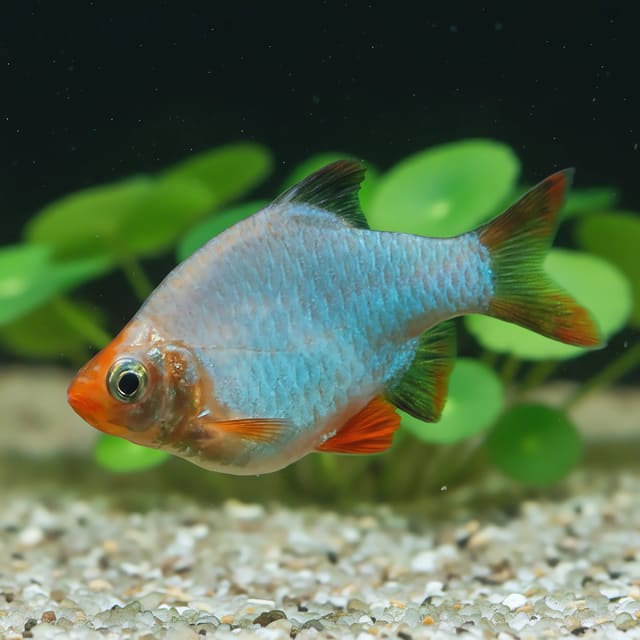
Albino Cherry Barb (Rohanella titteya)
20–27°C · pH 6–8 · 54L
£2.99

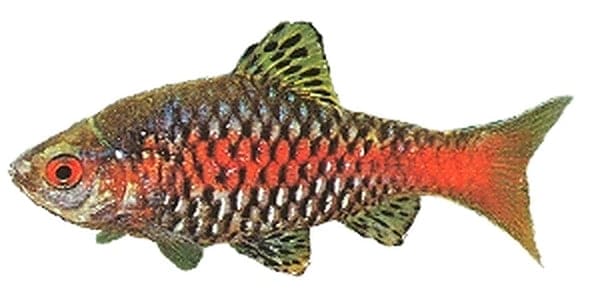
The Rosy Barb (Puntius conchonius) is an active cyprinid from Afghanistan, Pakistan, India, Nepal and Bangladesh that reaches 14 cm. It suits a well-planned community; Seriously Fish gives a group of at least 8–10, 16–24°C, pH 6.0–8.0 and 5–20 dGH. Sold individually in 2–2.5 cm, 2.5–3 cm, 3–4 cm, 4–5 cm and XL sizes.
Adult size is the maximum length this species reaches at full maturity (scientific sources). The livestock you receive will be younger and smaller — pick a size above for the actual shipping size. Product-photo provenance and any image-specific limitations are stated on the listing.
Barbus Puntius conchonius
Shoaling fish: kept in a group they feel safer, stay calmer and show their best colour.
Minimum of 2 per order.
The Rosy Barb (Puntius conchonius) is an active cyprinid from Afghanistan, Pakistan, India, Nepal and Bangladesh that reaches 14 cm. It suits a well-planned community; Seriously Fish gives a group of at least 8–10, 16–24°C, pH 6.0–8.0 and 5–20 dGH. Sold individually in 2–2.5 cm, 2.5–3 cm, 3–4 cm, 4–5 cm and XL sizes.
Adult size is the maximum length this species reaches at full maturity (scientific sources). The livestock you receive will be younger and smaller — pick a size above for the actual shipping size. Product-photo provenance and any image-specific limitations are stated on the listing.
Maintain these water conditions for optimal health and vibrant colors
The Rosy Barb (Puntius conchonius) is an active freshwater cyprinid native to Afghanistan, Pakistan, India, Nepal and Bangladesh, with a report from Myanmar. FishBase records a maximum length of 14 cm total length. It suits a keeper who wants conspicuous group movement and can provide a long aquarium, a mature biological filter and enough space for at least 8–10 fish.
FishBase now lists it as Pethia conchonius. The species belongs to Cyprinidae, the minnow and carp family, and has also been introduced around the world.
| Suits | Not suited to |
|---|---|
| A long, mature community aquarium | A solitary-fish plan |
| A group of at least 8–10 | An aquarium without room for the complete group |
| Keepers seeking an active, generally peaceful school | Communities where active feeding and movement would prevent companions behaving normally |
| Planted layouts with open swimming room | Layouts that fill the swimming area with décor |
FishBase records a maximum of 14 cm total length for male or unsexed fish. Seriously Fish uses 100 mm standard length as its aquarium-planning reference. Use the 14 cm maximum when checking whether the completed aquarium and its companions leave enough long-term room.
| Decision | Planning figure |
|---|---|
| Maximum recorded length | 14 cm total length |
| Aquarium footprint | At least 100 × 30 cm or equivalent |
| Approximate volume | About 90 litres |
| Social group | At least 8–10 specimens |
Seriously Fish gives the aquarium figures above, including a routine temperature range of 16–24°C, pH 6.0–8.0 and hardness of 5–20 dGH. Those ranges make water matching straightforward for many aquariums, but the tank must meet every occupant’s requirements rather than relying on the Rosy Barb’s tolerance alone.
Keepers preparing their first properly matured community can compare the Rosy Barb with other fish in our barbs collection, then screen each candidate for adult size, activity, water overlap and group requirements.
One purchase supplies one animal of the selected size. The sizes shown are 2–2.5 cm, 2.5–3 cm, 3–4 cm, 4–5 cm and XL; use the live size selector to see the choices presented for your order. The size you select is the size supplied, not the adult size.
The numeric sizes describe the fish’s dispatch measurement. XL is a named size without a centimetre range, so do not turn that label into an assumed measurement, age or life stage. Whichever size you choose, plan the completed aquarium around the recorded maximum length and the space needed by the whole group.
Seriously Fish recommends at least 8–10 Rosy Barbs because maintaining a decent group can make them less nervous and creates a more natural-looking display. If the aquarium has none yet, a target group of eight requires a purchase quantity of eight because each purchase unit is one fish. If a suitable established group already contains six, adding two would bring the total to eight, provided the filter capacity, aquarium footprint and existing stocking can accept the additional waste load.
Do not use dispatch size to justify a temporarily cramped aquarium. A 2–2.5 cm fish still needs a long-term plan based on a base of at least 100 × 30 cm or equivalent, about 90 litres and the adult planning length. Smaller dispatch sizes also do not establish sex, age, origin or eventual colour.
Sex is guaranteed only when the selected option explicitly states male or female. This Rosy Barb listing has no sex-guaranteed option. Adult sexual differences described for the species cannot be used as a promise about the fish chosen for an order.
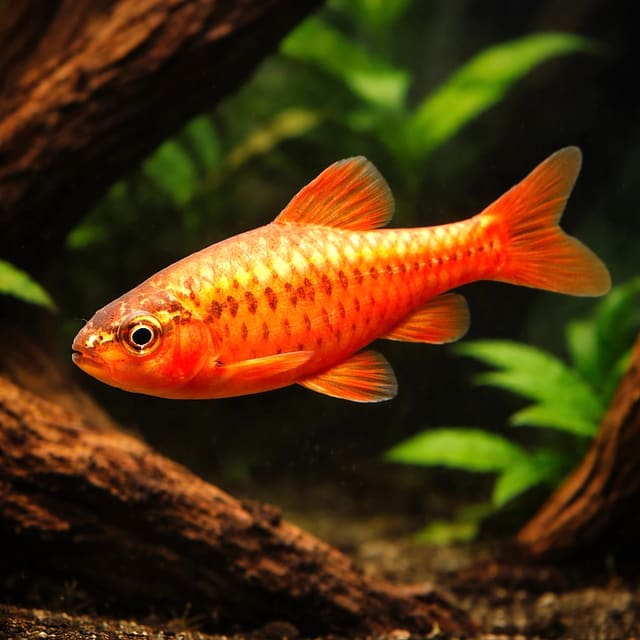
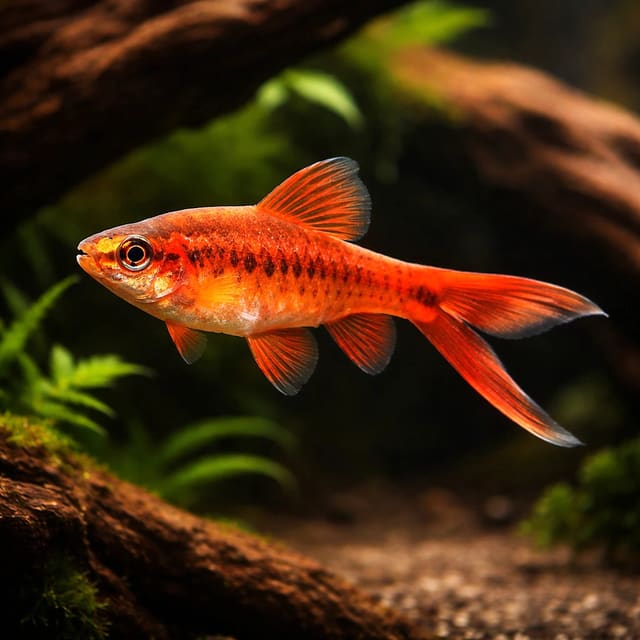
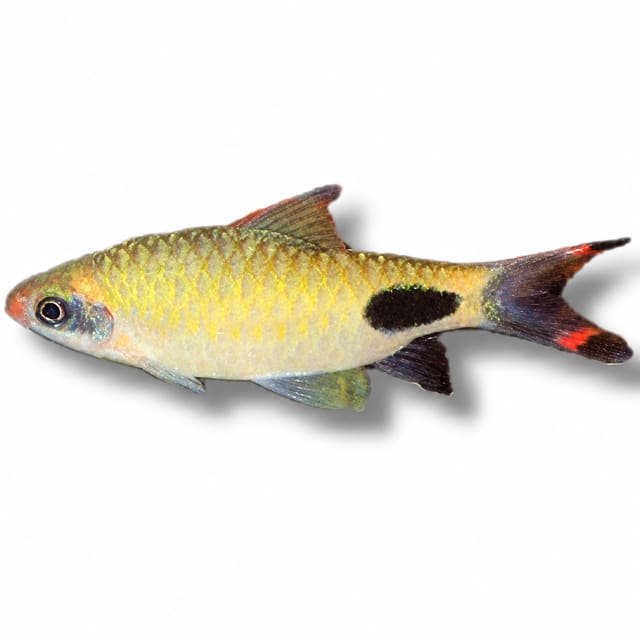
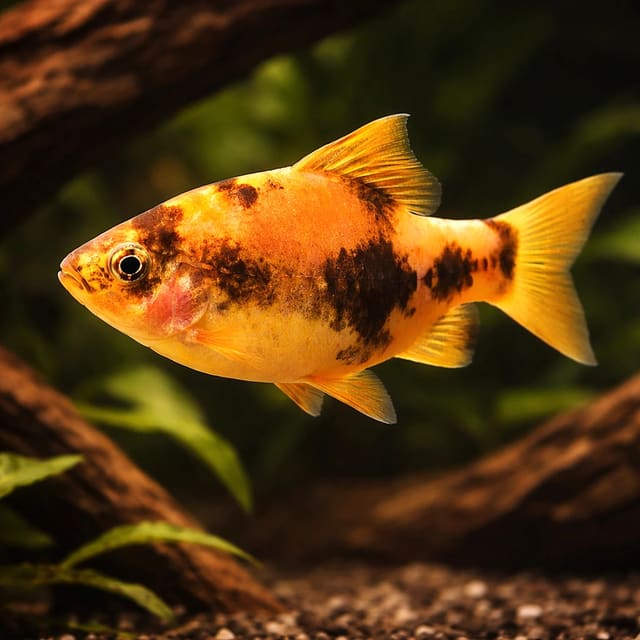
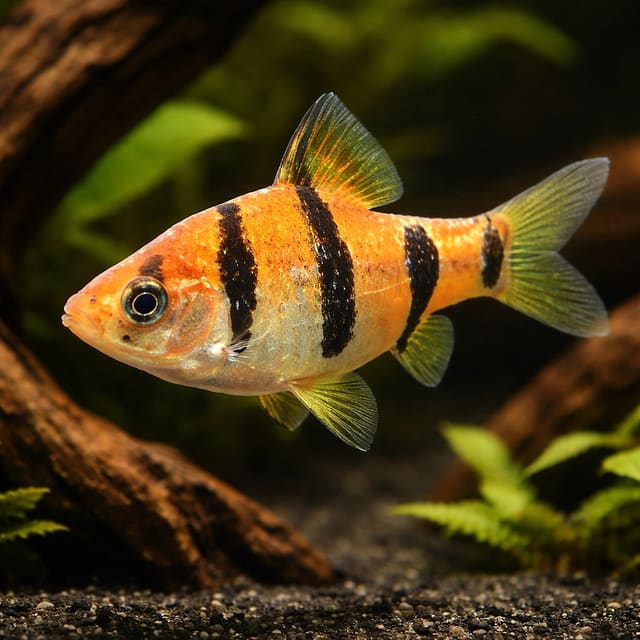
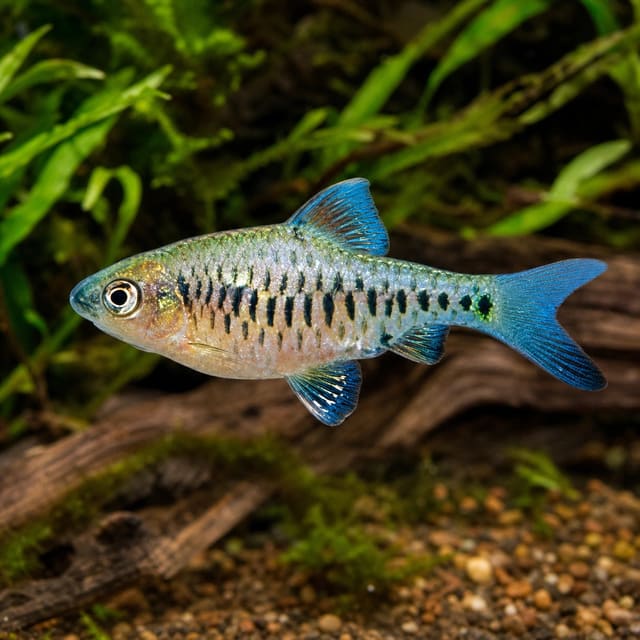
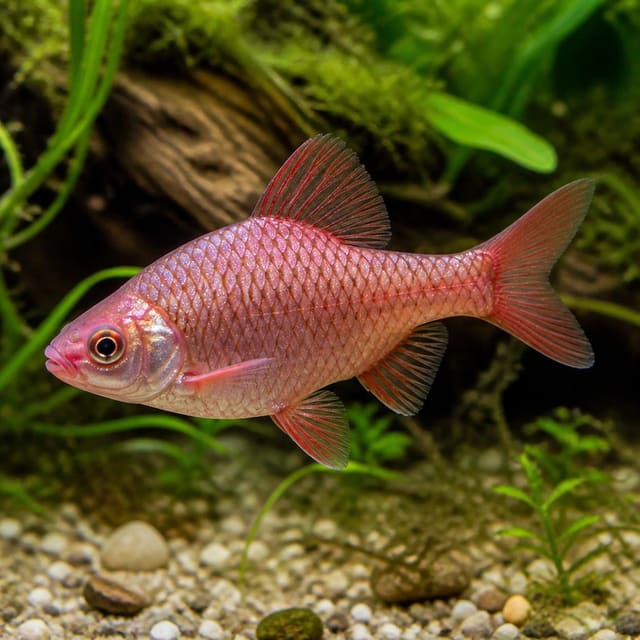
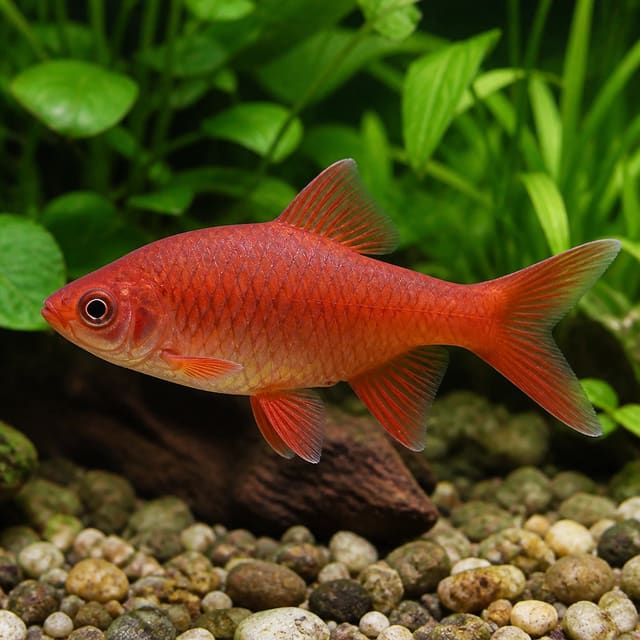
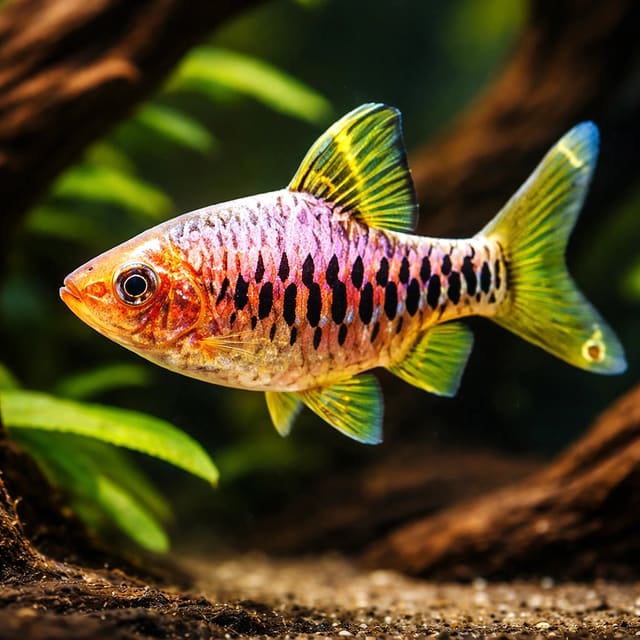
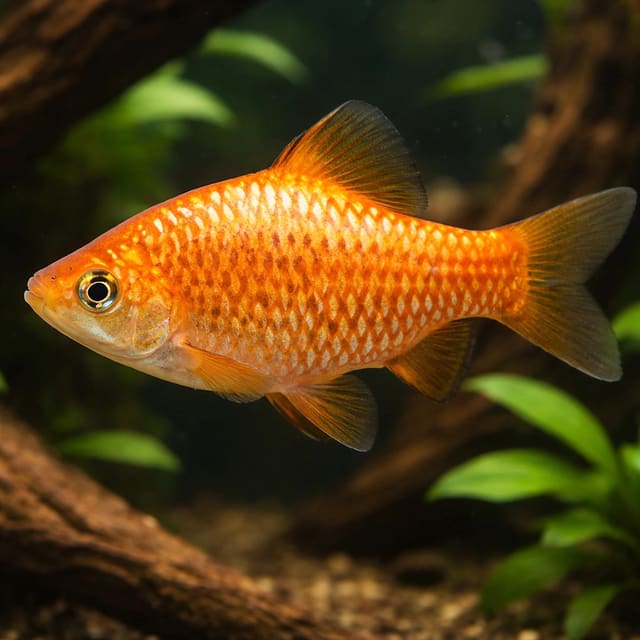
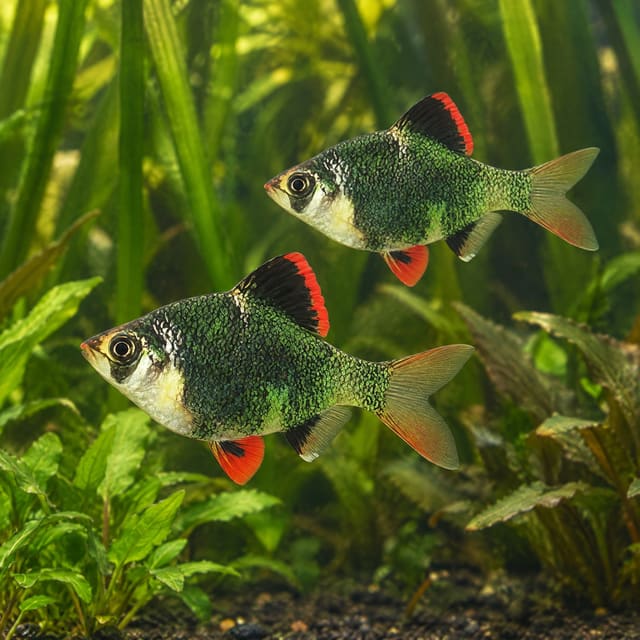
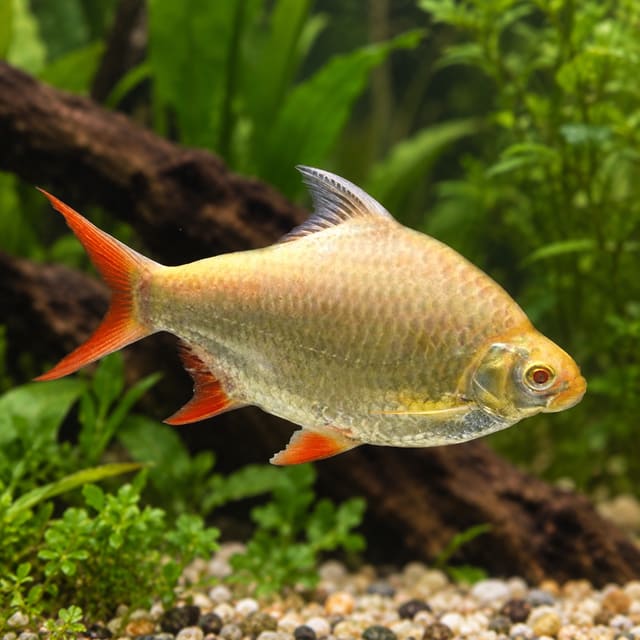
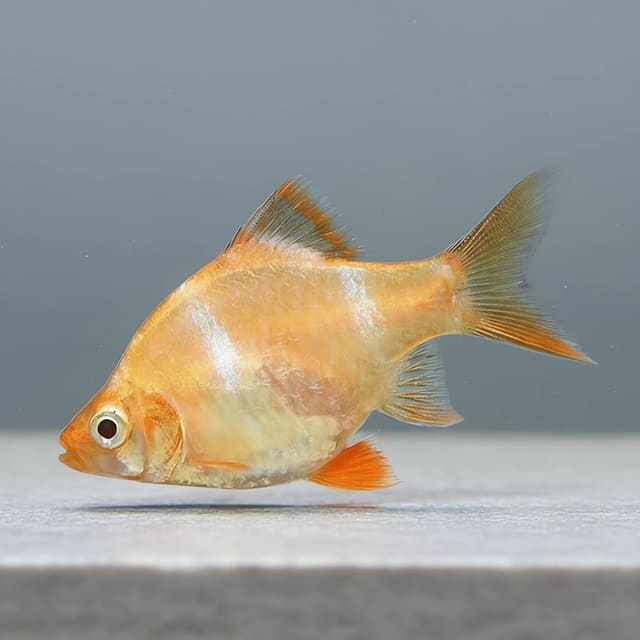
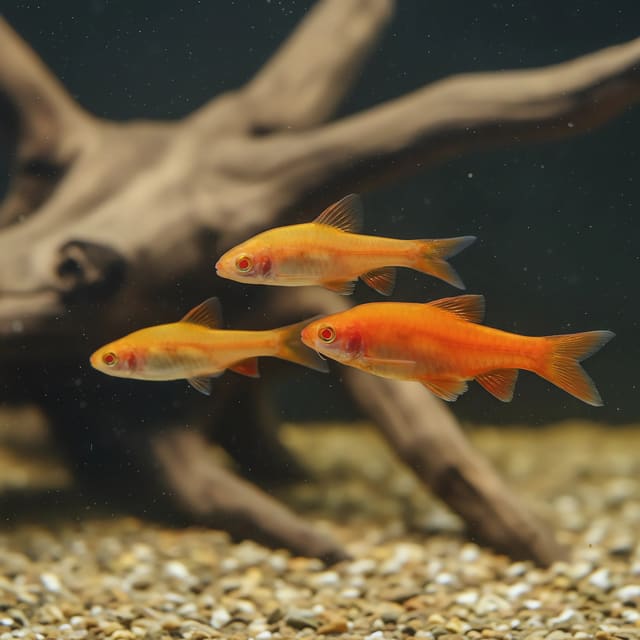
The gallery images are representative, based on reference photographs of this species, so colours can look slightly different from the live animal.
Read our delivery and Live Arrival Guarantee policy for the applicable dispatch days, delivery arrangements and claim process. Keep those order details separate from the husbandry decision: the aquarium should be mature, tested and ready before the fish is introduced.
Start with the footprint rather than choosing a tank from its litre label alone. Base dimensions of at least 100 × 30 cm or equivalent are required, with about 90 litres used as the associated volume reference. The long dimension gives an active group room to move, while the width allows cover to be arranged without filling the whole swimming area.
A nominal 90-litre aquarium is suitable only when its usable base meets the stated footprint or an equivalent layout. A tall, narrow aquarium can hold a similar volume but offers less horizontal room. Before committing to a tank, measure the internal or usable swimming footprint, account for bulky décor and confirm that the group will still have an open route through the aquarium.
| Check | Action |
|---|---|
| Base dimensions | Provide at least 100 × 30 cm or equivalent |
| Volume | Plan around approximately 90 litres or more |
| Adult length | Allow for a recorded maximum of 14 cm total length |
| Group demand | Reserve room and filtration capacity for at least 8–10 |
Volume must also cover the other occupants. Adding bottom-dwelling or midwater companions does not remove the Rosy Barbs’ own space requirement, and every added fish increases the load on the filter. A community built around ten Rosy Barbs therefore needs a separate stocking calculation rather than assuming that approximately 90 litres can accept any additional combination.
Write down each intended species, its adult planning size, social number, temperature range and preferred aquarium area. Reject the plan if the combined groups crowd the same swimming space or if one species needs conditions outside 16–24°C, pH 6.0–8.0 or 5–20 dGH. This simple list catches conflicts before livestock enters the aquarium.
When upgrading, prepare and mature the larger aquarium before moving the group. Growth is gradual, but the biological filter must still be ready for the fish load on transfer day. Avoid treating a future upgrade as extra capacity in the aquarium being used now.
Maintain the Rosy Barb at 16–24°C, pH 6.0–8.0 and 5–20 dGH. Stability within the overlapping needs of the community is more useful than repeatedly adjusting the aquarium towards a single point. Measure the source water and aquarium before choosing companions, then investigate any sustained movement away from the planned values.
Select a temperature within 16–24°C that also suits every tank mate. For example, 22°C falls inside the Rosy Barb range, but it is suitable for a community only when all other residents can live at 22°C as well. Do not raise the temperature merely because the fish is displayed with tropical species; the full permitted range includes cooler conditions than many familiar community fish use.
For an aquarium of about 90 litres in a room around 20°C, Seriously Fish gives roughly 25–50 W as a heater reference for holding 16–24°C. Treat that wattage as a planning example rather than a guarantee. Room temperature, aquarium shape, cover, airflow and the intended set point all affect heating demand, so monitor the water with suitable aquarium equipment.
A pH result describes acidity or alkalinity, while dGH describes dissolved mineral hardness. One value cannot substitute for the other. Our water chemistry guide explains which aquarium values to measure and why, and the water matcher helps compare measured values with the Rosy Barb ranges.
| Measured result | Decision |
|---|---|
| Inside all three ranges | Check stability and tank-mate overlap |
| Near a boundary | Monitor for ordinary weekly variation |
| Outside a range | Resolve the mismatch before introduction |
| Rapid unexplained change | Test again and inspect maintenance or equipment changes |
FishBase records 18–22°C, pH 6.0–8.0 and 5–19 dH for the species’ freshwater environment. Use the aquarium husbandry range of 16–24°C and 5–20 dGH for routine care while recognising that the FishBase figures describe environmental records rather than a separate aquarium target.
Run the aquarium with a well-established biological filter before adding Rosy Barbs. The RSPCA’s general aquarium guidance explains that fish release toxic ammonia, biological filtration converts it to toxic nitrite and further bacteria convert nitrite to the safer nitrate. The filter must therefore support living bacterial populations, not simply move water.
Rosy Barbs do not require particularly strong filtration, but they appreciate some water movement. For an aquarium of about 90 litres, a turnover of four to five times the volume per hour gives a filter-flow reference of 360–450 litres per hour. Use the manufacturer’s rating as a starting point and check how the completed layout affects the actual current.
A worked calculation is straightforward: 90 litres multiplied by four equals 360 litres per hour, while 90 multiplied by five equals 450 litres per hour. This reference belongs to a tank around 90 litres. A different aquarium volume needs its own calculation, and filter media, pipework and maintenance condition can influence flow.
| Observation | Response |
|---|---|
| Fish struggle continuously against current | Diffuse the outlet while preserving filtration |
| Debris gathers in dead areas | Adjust circulation or décor placement |
| Flow falls unexpectedly | Check the filter for a blockage |
| Ammonia or nitrite appears | Pause further stocking and address water quality |
Our first tropical aquarium guide covers preparation and filter maturation. Before introduction, confirm that ammonia and nitrite measure zero, the heater and filter run reliably, the temperature is stable and the aquarium has enough capacity for the entire planned group.
Additions should be gradual because the bacterial population must grow as fish numbers and feeding increase. A filter that copes with an existing community may still be overloaded by a large, sudden increase in waste. Group welfare and filter capacity must be planned together: do not keep one Rosy Barb alone merely to protect an immature filter, and do not add the intended group until the system can support it.
Arrange the aquarium with both planted cover and open swimming space. Décor is flexible, but Rosy Barbs tend to show better colour in a heavily planted arrangement with a dark substrate. Floating plants and driftwood roots or branches can diffuse incoming light and create a more natural visual structure.
A dark substrate is an aesthetic and behavioural design choice, not a substitute for water quality or group size. Choose aquarium-safe sand or gravel that works with the intended plants and maintenance routine. The group should be able to move without squeezing through narrow gaps or encountering rough, unstable decorations.
Some water movement is appreciated, and the species can also do well in a hill stream-style arrangement. That does not mean every aquarium needs forceful flow. Watch how the group uses the full tank: comfortable fish should be able to leave the strongest current, gather food and rest without being pushed continuously into one area.
If the group avoids one end of the aquarium, examine the outlet direction, lighting, exposed sight lines and obstruction placement before adding more décor. If movement is concentrated only around food, observe again at ordinary times so feeding excitement is not mistaken for normal space use.
Leave enough room to siphon waste, inspect the filter intake and observe every fish. Dense planting can provide useful cover, but it should not conceal persistent isolation, damaged fins or changes in body condition. A successful arrangement supports natural-looking group movement while still allowing weekly cleaning and daily visual checks.
Rosy Barbs are generalised omnivores. Studies summarised by Seriously Fish describe natural feeding on worms, insects, other small invertebrates, plant material and organic detritus. In the aquarium, use a good-quality dried flake or granule as the regular foundation, with some products containing plant or algal material.
Small live or frozen bloodworm, Daphnia and Artemia can supplement the dried diet. These foods add variety and support condition, but they should not displace the balanced staple or create uneaten waste. Select particle sizes that the fish can take readily, especially when feeding smaller dispatch sizes alongside larger members of a group.
| Food role | Supported choices |
|---|---|
| Regular staple | Good-quality flakes or granules |
| Plant component | Dried food with plant or algal content |
| Live or frozen variety | Daphnia, small bloodworm or Artemia |
| Portion limit | Only what the group eats within a few minutes |
OATA’s barb guidance recommends feeding once a day and limiting the portion to what the fish consume within a few minutes. Use that schedule as a practical group routine while watching whether every individual reaches food. Remove or reduce food when particles remain after the feeding period, because uneaten material breaks down and adds waste to the water.
Spread an appropriate portion across more than one point if dominant or faster fish consistently intercept everything. The aim is not to extend feeding or increase the total portion automatically; it is to let quieter group members reach suitable food within the same short feeding period.
Variation comes from rotating supported food types in sensible portions, not from feeding many rich foods at one sitting.
OATA’s broad barb guidance sets ammonia and nitrite at zero mg per litre and recommends that nitrate should not exceed 20 mg per litre above the normal tap-water level. Test at least weekly so maintenance decisions follow measured conditions rather than appearance alone.
For a 90-litre aquarium, 25% equals 22.5 litres. That arithmetic is a starting quantity, not permission to ignore test results or displacement from substrate and décor. Measure replacement water carefully and keep the maintenance routine suitable for the real water volume and stocking load.
If filter media needs cleaning, rinse it lightly in aquarium water removed during the partial change. Do not rinse it under the tap because chlorine or chloramine may kill beneficial bacteria. Avoid cleaning every component aggressively at the same time when a light rinse is enough to restore flow.
| Result or change | Immediate decision |
|---|---|
| Ammonia above zero | Address water quality and pause further stocking |
| Nitrite above zero | Address water quality and pause further stocking |
| Nitrate trend rising | Review water changes, feeding and stocking load |
| Reduced filter flow | Inspect for blockage and rinse media correctly if needed |
Check for hanging at the surface, sitting on the bottom, erratic swimming, unusual hiding, altered aggression, faster or slower gill movement, colour change, white spots, fluffy growths, lost fins or scales, changing body condition and reduced feeding. These signs do not identify one cause by themselves. Test the water first, compare the behaviour with the group’s normal pattern and speak to our team or an aquatic veterinary professional when health changes cause concern.
Prepare the aquarium before the group arrives rather than trying to correct basic conditions during introduction. Confirm a mature filter, zero ammonia, zero nitrite, stable temperature, suitable pH and hardness, secure décor and enough open space for the planned group. Introduce stocking gradually so the biological filter can adjust to increased fish waste and feeding.
Observe the group at ordinary times as well as during feeding. Check whether all fish can move through the aquarium, reach food and leave the strongest current. Compare each fish with the others for breathing, fin position, colour, body condition and willingness to remain with the group.
Test ammonia and nitrite whenever behaviour changes and continue the normal weekly testing routine even when the water looks clear. Clear water can still contain dissolved ammonia or nitrite. If either appears, address water quality and do not add more livestock while the biological filter is under strain.
| What you see | What to do |
|---|---|
| One fish repeatedly isolated | Check group size, flow, aggression, fins and water quality |
| Food left after a few minutes | Reduce portions and remove accessible waste |
| Group confined to one area | Review current, cover and tank-mate pressure |
| Normal activity and feeding | Maintain the measured routine without unnecessary changes |
Review whether the group still has adequate swimming room as the fish settle and grow. Confirm that the filter maintains zero ammonia and nitrite at the established feeding level, nitrate remains controlled through maintenance and no companion persistently chases or excludes the barbs.
Avoid making several major changes together unless immediate welfare demands it. Altering temperature, flow, décor, feeding and stocking at once makes the cause of a new problem difficult to identify. Change one manageable factor, measure the result and preserve the stable conditions that are already working.
Compatibility begins with the Rosy Barbs’ own social requirement. Keep at least 8–10 specimens rather than treating one or two fish as a complete group. Seriously Fish describes the species as naturally schooling and reports that decent numbers make the fish less nervous and produce a more effective, natural-looking display.
Because one purchase supplies one animal, the quantity chosen must match the group plan. Eight fish means eight purchase units when starting from none. An existing suitable group of seven needs one more to reach eight, but only after checking the aquarium base, filter capacity and all established residents.
A larger social number is not automatically better when the aquarium is already at its practical limit. The minimum footprint of 100 × 30 cm or equivalent and the approximate 90-litre reference must be considered alongside every additional occupant. If ten Rosy Barbs leave no responsible capacity for another intended species, keep the barb group and revise the community plan rather than reducing the barbs below their recommended number.
Barbs kept singly or in groups that are too small will often become stressed, while larger groups can help reduce fin-nipping behaviour across barbs generally. For Rosy Barbs, start with the stronger species recommendation of at least 8–10 and then observe how the group distributes its activity.
| Pattern | Screening response |
|---|---|
| Persistent focus on one fish | Check group number, space, injuries and escape routes |
| Companion cannot reach food | Reassess activity and feeding compatibility |
| Long fins attract repeated attention | Separate the affected fish and revise the pairing |
| Group uses the tank without exclusion | Continue observation and routine maintenance |
Minor display or chasing within an active group should still be judged by its outcome. Damaged fins, persistent hiding, exclusion from food or confinement to one corner means the arrangement needs intervention. Do not assume that a generally peaceful label makes every repeated chase harmless.
Seriously Fish describes the Rosy Barb as generally peaceful and suitable for a well-researched community aquarium. Candidate companions include other small cyprinids, tetras, livebearers, rainbowfishes, anabantoids, catfishes and loaches, but those categories are starting points rather than universal approvals.
OATA advises caution when mixing barbs because some species can be semi-aggressive or nip fins. Barbs showing that behaviour should not be mixed with slow-swimming, timid or long-finned fish. The Rosy Barb’s generally peaceful species profile is encouraging, but it does not turn a broad tank-mate category into a guaranteed match.
| Candidate type | Decision rule |
|---|---|
| Small cyprinid or tetra | Check water overlap, adult size, confidence and group space |
| Livebearer or rainbowfish | Compare temperature, hardness, activity and total stocking |
| Catfish or loach | Check bottom space, social number and feeding access |
| Slow, timid or long-finned fish | Avoid the pairing when fin-nipping behaviour is present |
A species combination that works in one tank may fail in another because aquarium length, group sizes, décor, feeding competition and individual behaviour differ. Monitor new interactions closely and separate fish if chasing leads to injury, persistent hiding or loss of feeding access.
For a stocking assessment, send our team the aquarium dimensions and volume, measured temperature, pH and hardness, filter details, existing species and numbers, and the number of Rosy Barbs planned. Those details allow a specific decision instead of relying on a generic tank-mate name.
A Rosy Barb reaches a recorded maximum of 14 cm total length. Plan the completed aquarium and its community around that adult figure rather than the fish’s dispatch size.
A Rosy Barb group needs base dimensions of at least 100 × 30 cm or equivalent, with approximately 90 litres as the associated volume reference from Seriously Fish. Preserve open horizontal swimming room and use a mature biological filter.
Keep Rosy Barbs in a group of at least 8–10 specimens. Seriously Fish says this schooling number can make them less nervous and create a more natural-looking display.
The Rosy Barb can suit a newcomer who can provide a mature filtered aquarium, at least 8–10 fish, a base of at least 100 × 30 cm and stable water. Seriously Fish describes it as an excellent choice for newcomers.
Feed a Rosy Barb good-quality flake or granule once daily, including some plant or algal content, with small live or frozen Daphnia, bloodworm or Artemia for variety. Offer only what the group consumes within a few minutes.
Maintain this fish at 16–24°C, pH 6.0–8.0 and 5–20 dGH according to Seriously Fish. Keep ammonia and nitrite at zero mg per litre and choose a stable point that suits every aquarium occupant.
This fish is generally peaceful, but OATA warns that some barbs can be semi-aggressive or nip fins. Keep at least 8–10, monitor interactions and avoid mixing a fin-nipping barb with slow-swimming, timid or long-finned fish.
Potential companions for Puntius conchonius include other small cyprinids, tetras, livebearers, rainbowfishes, anabantoids, catfishes and loaches. Screen every pairing for water overlap, adult space, activity, feeding access and temperament.
Someone must be present to receive the parcel. Film every delivery continuously from the sealed parcel as it is opened, keeping the fish visible inside the sealed bag; then float the bag for 20–30 minutes before releasing the fish and never pour the bag water into the aquarium.
No reviews for this item yet. Bought one? Honest reviews only, good or bad.
What customers say about ordering from us
I have a small group of long finned mountain minnows. So was delighted to be able to order ten of this variety to increase the genetics in my tank . The ones I recieved are healthy but it’s to early to give a verdict on wether they are of a long finned type since they are small currently.
Gordon Walker · 23 Sept 2026
100% success travel and "installation". Pleased with quality of purchase. The Siamese fighter a bit "shy" so have not yet seen him at his best yet but looking good. Happy customer. GG
George E Garratt · 21 Sept 2026
Reviews of our shop, collected by Judge.me, an independent third-party review collector. Newest first.