Easy
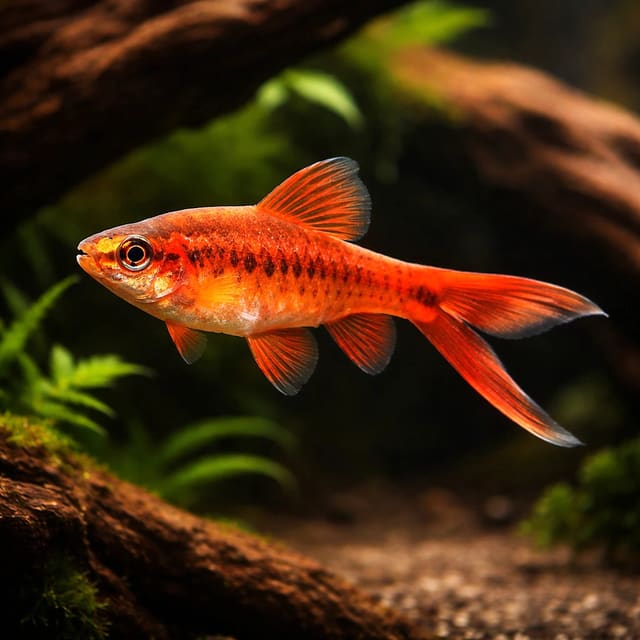
Albino Cherry Barb (Rohanella titteya)
20–27°C · pH 6–8 · 54L
£2.99

One albino tinfoil barb, sent at 4–5 cm, that grows into a 35 cm shoaling fish. It needs a group of six or more, an aquarium with a base of at least 210 × 60 cm, a heavy lid, strong filtration and a diet rich in vegetables. Not a fish for an ordinary community tank.
Adult size is the maximum length this species reaches at full maturity (scientific sources). The livestock you receive will be younger and smaller — pick a size above for the actual shipping size. Product-photo provenance and any image-specific limitations are stated on the listing.
Barbonymus schwanefeldii
Shoaling fish: kept in a group they feel safer, stay calmer and show their best colour.
One albino tinfoil barb, sent at 4–5 cm, that grows into a 35 cm shoaling fish. It needs a group of six or more, an aquarium with a base of at least 210 × 60 cm, a heavy lid, strong filtration and a diet rich in vegetables. Not a fish for an ordinary community tank.
Adult size is the maximum length this species reaches at full maturity (scientific sources). The livestock you receive will be younger and smaller — pick a size above for the actual shipping size. Product-photo provenance and any image-specific limitations are stated on the listing.
Maintain these water conditions for optimal health and vibrant colors
Each unit on this listing is one albino tinfoil barb, sent at 4–5 cm. That is the size it leaves us, not the size it stays. FishBase records a maximum of 35 cm standard length for Barbonymus schwanefeldii. Standard length runs from the snout to the base of the tail, so a fish of that size is longer still once you add the tail fin. Seriously Fish gives 355 mm SL and Wikipedia 36 cm, so the sources agree closely. FishBase also lists a common length of 20 cm SL, the size most often recorded. Even an ordinary adult is several times the length of a typical community fish, and a big one is longer than a sheet of A4 paper.
Seriously Fish is frank about what happens next. Tinfoil barbs are usually offered at 50–75 mm with little or no information about their eventual size, and shop owners report them among the species most often returned after outgrowing their aquarium. Many shops are reluctant to take them back because the resale value is low. Wikipedia makes the same point: plenty of people buy young fish and find out too late how large they grow. We would much rather you read this page and decide against buying than end up with a group of 30 cm fish in a 120 cm tank.
Our honest summary is this. The albino tinfoil barb is a lively, sociable, eye-catching fish that needs a group of at least six and an aquarium with a base of at least 210 × 60 cm. If you have that, or are building it, read on. If you do not, the aquarium section below suggests smaller barbs that genuinely suit ordinary tanks.
Be honest with yourself on each point before ordering:
If every line fits, a group of albino tinfoil barbs makes a bright, constantly moving centrepiece for a big display aquarium.
Wikipedia gives tinfoil barbs a lifespan of 10 to 15 years. Add that to the adult size and you are planning a large aquarium for a decade or more, with the filtration, water changes and electricity that go with it.
| Feature | Albino tinfoil barb |
|---|---|
| Scientific name | Barbonymus schwanefeldii (also spelt schwanenfeldii) |
| Family | Cyprinidae |
| Size when sent | 4–5 cm |
| Common adult length | 20 cm SL |
| Maximum length | 35 cm SL |
| Minimum aquarium | Base of 210 × 60 cm, about 756 litres |
| Group size | Six or more |
| Temperature | 22–26 °C |
| pH | 6.5–7.5 |
| Hardness | 2–15 °dGH |
| Diet | Omnivore with a strong leaning to plant foods |
| Lifespan | 10–15 years |
| Wild status | Least Concern (IUCN) |
The natural fish is easy to pick out once you know the marks. Seriously Fish quotes Kottelat's 1998 list of defining features, and Wikipedia repeats it: a red dorsal fin with a black blotch at its tip; red pectoral, pelvic and anal fins; and a red tail fin with a white edge and a black stripe running just inside the margin of each lobe. There are eight scale rows between the front of the dorsal fin and the lateral line. Wikipedia adds that large fish are silvery or golden yellow in life, with a red dorsal fin and an orange or blood-red tail.
The name fits the scales. They are large and mirror-bright, and in our gallery they catch the light like a sheet of foil, which is exactly what makes a group of these fish so striking in a big, open tank.
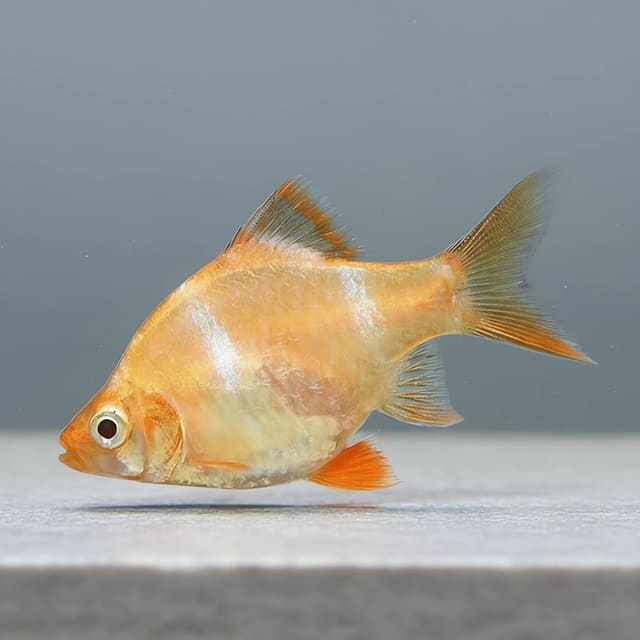
The fish on this listing is the albino, one of several ornamental colour forms of the species. Seriously Fish illustrates an ornamental albino form, alongside selectively bred golden and blushing strains and a leucistic form with enlarged, reflective scales on the flanks. Its comment on the golden and blushing strains applies just as much here: they were selectively bred for the trade with slightly gaudier colours than wild fish, care is identical, and all are equally unsuitable for most aquaria. The albino is the same species with the same adult size, so a paler body does not mean a smaller or calmer fish.
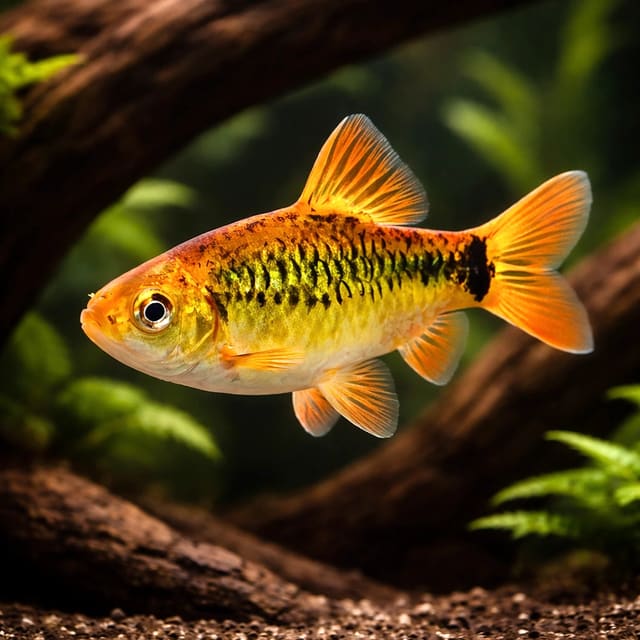
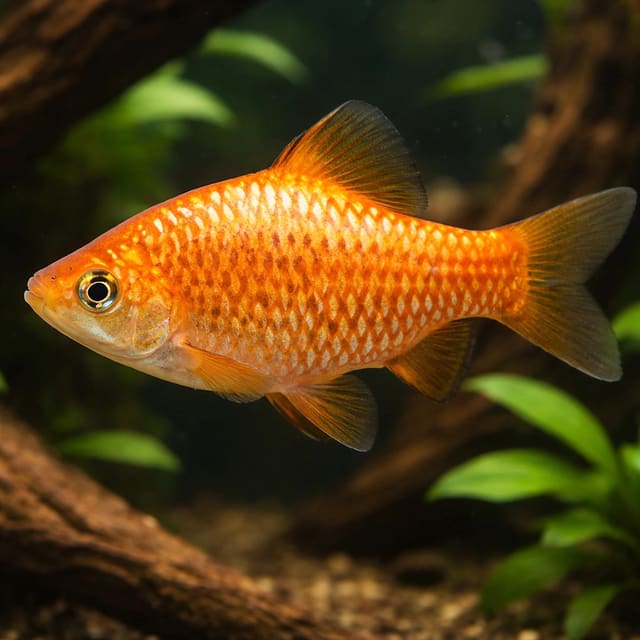
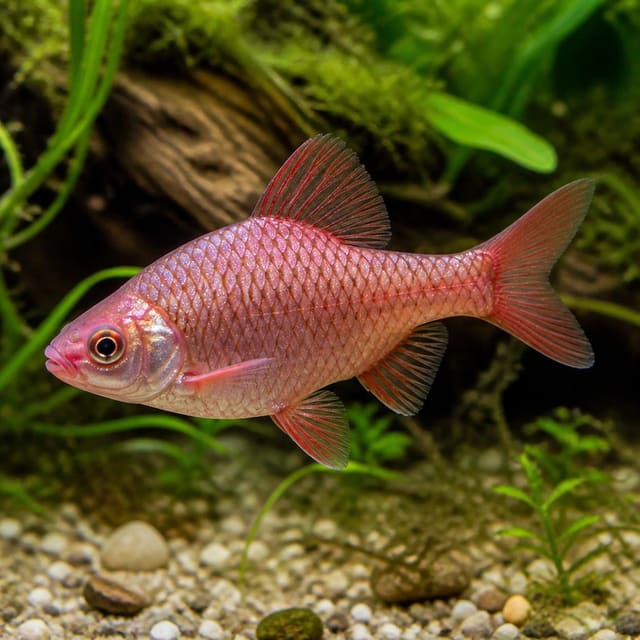
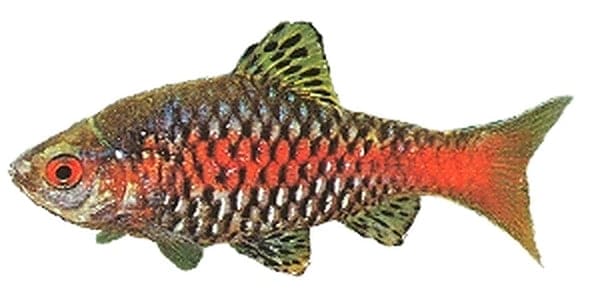
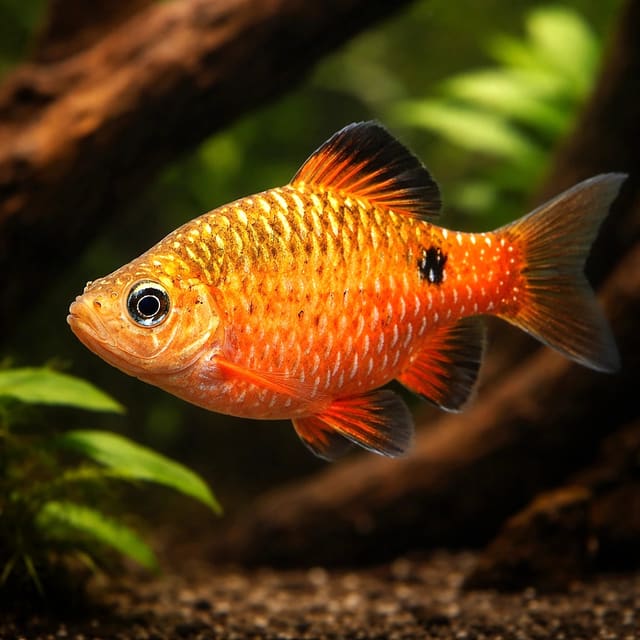
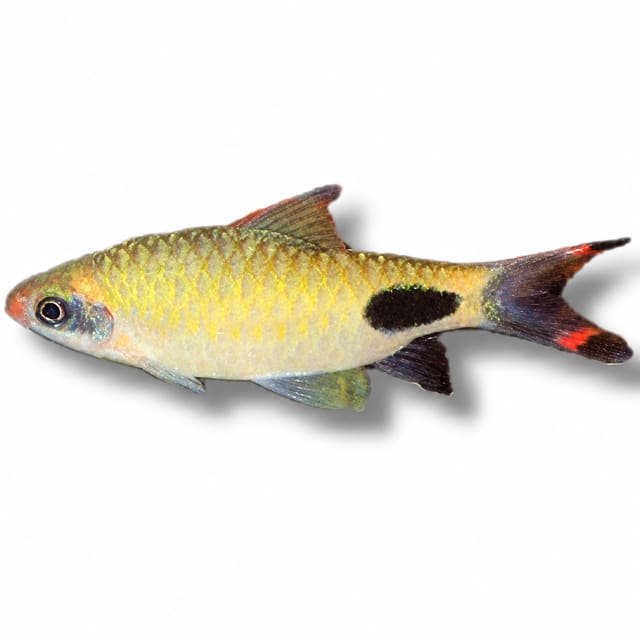
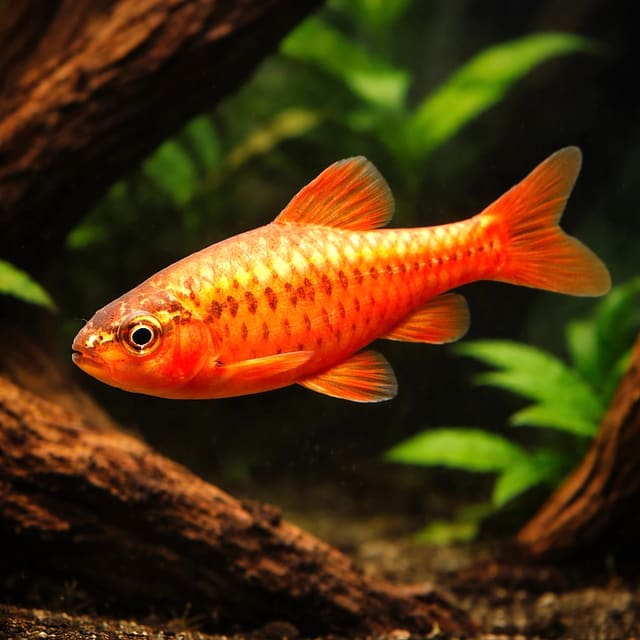
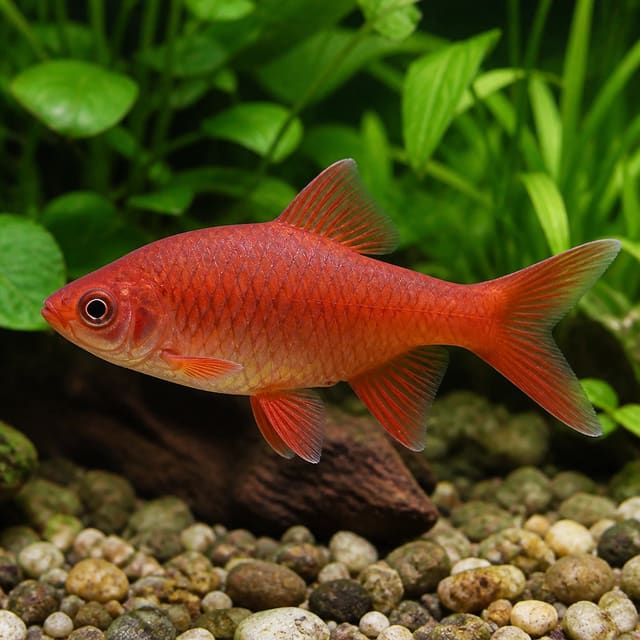
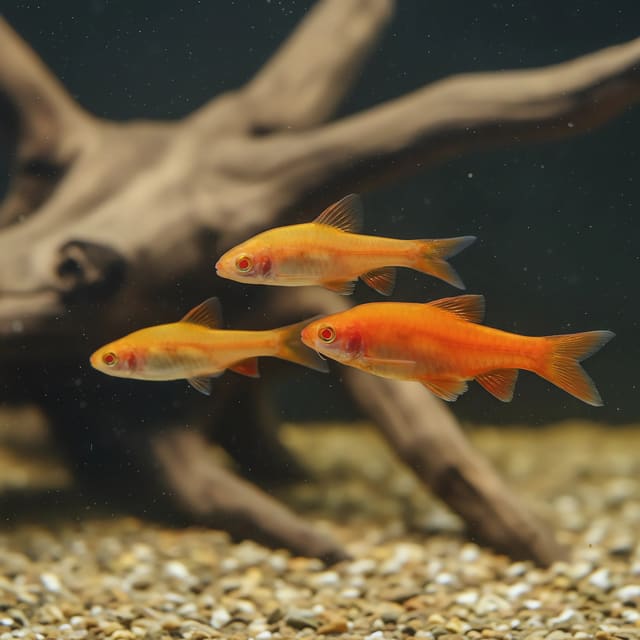
Our gallery shows pale, silvery-gold bodies, gold-tinted heads and orange-red fins. Remember that the fish you receive are 4–5 cm juveniles, a small fraction of the adult size described above.
Seriously Fish also warns that this species has been subjected to artificial dyeing, which it describes as an abhorrent and undoubtedly painful process of injecting fish repeatedly with coloured dye. Albinism is an inherited colour form, which is a different thing entirely. If you ever see tinfoil barbs in unnatural pinks, blues or greens, they are best left in the shop.
There is no practical way to sex juveniles. Seriously Fish notes that mature females are usually deeper-bodied than males, especially when full of eggs, and that otherwise there are no obvious external differences. Wikipedia says the same. This listing is not sold by sex, and at 4–5 cm nobody could tell you which is which.
Search for this fish and you will find its species name spelt two ways. Seriously Fish explains why: when Pieter Bleeker named the species he made a spelling mistake, which he later tried to amend. The name schwanenfeldii was the one most commonly used until Kottelat (2013) emended it, and both FishBase and Seriously Fish now use Barbonymus schwanefeldii. Wikipedia still heads its article Barbonymus schwanenfeldii and treats the shorter spelling as the error. We follow FishBase, so the title reads schwanefeldii, but both spellings refer to exactly the same fish. The two main sources also differ on the year of description, with FishBase giving 1854 and Wikipedia 1853.
Older books and labels add further names. Seriously Fish notes that members of the genus were previously placed in Barbus, Puntius and Barbodes, and Wikipedia lists all three among this species' former names. The genus Barbonymus was set up by Kottelat in 1999 for large South-East Asian barbs previously placed in Barbus and Barbodes, and this species is its type species. Wikipedia notes that this lineage of large barbs seems closer to the common carp and to Cyclocheilichthys than to the true barbels of Barbus.
Seriously Fish points out that two species are traded under the name tinfoil barb. The second is Barbonymus altus, which it describes as just as widely available and in many cases seen more often. FishBase gives B. altus the English name red tailed tinfoil and a maximum of 25 cm total length, so it is the smaller of the pair, though still far too big for a standard community tank.
For the natural forms, Seriously Fish gives a simple way to tell them apart. B. schwanefeldii has a distinct black stripe along each lobe of the tail, which B. altus lacks, and adult B. altus tends to show a golden or bronze hue against the more silvery B. schwanefeldii. That tip is written for the natural forms, so treat it with care on an ornamental colour form.
One practical consequence: you may see our fish described elsewhere as a red tail tinfoil barb. Because FishBase uses that name for B. altus, we no longer use it for this listing. What we send is Barbonymus schwanefeldii in its albino form, and the sizes and care on this page are for that species.
FishBase gives the natural range as the Mekong and Chao Phraya basins, the Malay Peninsula, Sumatra and Borneo. Seriously Fish lists the countries: Cambodia, Laos, Thailand, Vietnam, Singapore, Malaysia, Brunei and Indonesia. Across that range the fish lives in rivers, streams and floodplains according to FishBase, and Wikipedia adds canals and ditches, noting that it also enters flooded fields.
Seriously Fish describes the typical habitat in more detail. Tinfoil barbs mostly live in medium-sized river channels that flood in the wet season, together with the surrounding floodplains, and they are increasingly found in man-made canals and lakes. During the wetter months they move into flooded riverside land and forest to feed and spawn, then return to the rivers as the water drops. FishBase classes the species as benthopelagic and potamodromous, meaning it lives near the bottom as well as in open water and migrates within fresh water.
Wikipedia, drawing on FishBase, gives the natural water as pH 6.5–7.0, hardness up to 10 °dGH and a temperature of 22–25 °C. It also records a much wider range of 20.4–33.7 °C measured in Indonesia. That is a field record of what wild fish have been found in, not a target for an aquarium. In the tank, stable conditions inside the normal range are what matter.
FishBase describes the tinfoil barb as largely herbivorous. It eats aquatic plants, submerged land plants and filamentous algae, and also takes small fishes, worms and crustaceans, with Wikipedia adding occasional insects. Seriously Fish notes that wild Barbonymus have even been seen feeding on the carcasses of dead animals. Put plainly, it is a big, mainly plant-eating fish that will also swallow any small animal it can catch, and that combination shapes everything in the aquarium and tank mates sections below.
In its home countries the tinfoil barb is more than an ornamental. FishBase lists subsistence and commercial fisheries, commercial aquaculture and occasional use as bait, and notes that it is usually marketed fresh. Seriously Fish adds that it is used in aquaculture projects in its native countries and further afield. The IUCN assesses the species as Least Concern.
The wild picture explains the aquarium rules. This is a fish of big, moving rivers that swims in large schools, shifts with the seasons and eats a great deal of plant matter. A short tank, a lone fish or a meat-heavy diet works against every part of that.
Seriously Fish sets the minimum at an aquarium base of 210 × 60 cm, about 756 litres. Length matters most. A group of six fish heading towards 20–35 cm each needs room to turn and cruise, and a short tank, however deep, cannot provide that. The volume figure in our care details follows that 756-litre minimum.
Please plan the large tank first. Seriously Fish's warning about returned tinfoil barbs describes what happens when young fish go into a smaller tank for now and the bigger one never arrives.
Seriously Fish expects one or two very large external filters to provide enough oxygen, flow and surface area for filter bacteria. Its equipment guidance for a tank of about 756 litres suggests a turnover of four to five times the tank volume an hour, which it translates into two filters rated at roughly 1,510–1,890 litres per hour each. Wikipedia notes that the species prefers strong currents like those of its native streams. A long tank with filter outlets at one end gives the shoal a current to swim into and calmer water at the other end.
Seriously Fish recommends a heavy, tightly fitting cover because the fish can be skittish at times and has a powerful leap. A startled adult of this size can lift a light lid or find any gap around pipework, so close those gaps before the fish arrive.
Seriously Fish says décor is less important than water quality and open swimming space, and mentions very healthy-looking fish kept in completely bare set-ups. A practical layout keeps rocks and wood towards the ends and back, leaves a long, open run through the middle, and uses smooth, heavy pieces that cannot be knocked over. Plants are another matter. Given a wild diet built on aquatic plants, expect soft-leaved plants to be eaten, and plan any planting with that in mind.
Size heating for the full volume and fit a thermometer you can read without opening the lid. Our care range is 22–26 °C, explained in the water section.
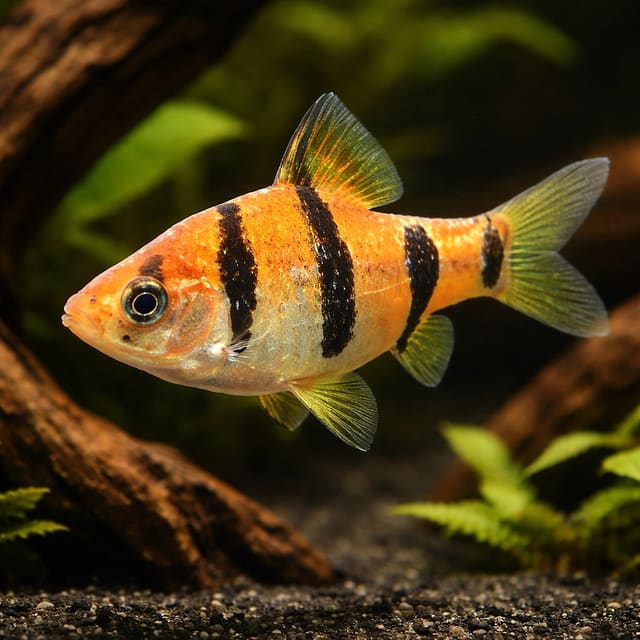
If you love the albino look but your aquarium is an ordinary community size, choose a barb that stays small. Our Albino Cherry Barb belongs to a species FishBase records at 5 cm, and our Albino Tiger Barb to one FishBase records at 7 cm. Both are suggestions for a different tank, not companions: Seriously Fish notes that tinfoil barbs will eat small fishes, so small barbs and tinfoil barbs should never share an aquarium.
Tinfoil barbs are not fussy about water chemistry, but a large, heavy-feeding shoal produces a lot of waste, so water quality is where most of the effort goes. Seriously Fish puts water quality and swimming space ahead of décor in importance.
Our care range is 22–26 °C. The sources place that band comfortably: Seriously Fish gives an aquarium range of 20–28 °C, while FishBase and Wikipedia give 22–25 °C for the natural habitat. Somewhere in the middle of our range, held steady, suits the fish well.
We list pH 6.5–7.5. Seriously Fish accepts a wider 6.0–8.0, and the natural water described by FishBase is pH 6.5–7.0. For hardness, Seriously Fish gives 2–15 °dGH, and FishBase records natural water of up to 10 °dGH. If your tap water falls inside those ranges, it is fine once dechlorinated, provided it does not swing about from one change to the next.
The filtration Seriously Fish describes, one or two very large external units turning the water over four to five times an hour, is there for oxygen as much as for cleaning. Keep the surface moving, clean filter media in tank water rather than tap water so the bacteria survive, and test ammonia and nitrite whenever something seems off. Both should read zero.
A group of adult fish this size eats a lot and produces a matching amount of waste. Plan on regular, substantial partial water changes, use a dechlorinator every time, match the temperature of the new water, and let your nitrate readings tell you whether the schedule is keeping up. A long hose that runs straight to a drain makes changes on a tank of this size far less of a chore.
| Measure | Our care range | What the sources say |
|---|---|---|
| Temperature | 22–26 °C | Seriously Fish 20–28 °C; FishBase 22–25 °C (natural habitat) |
| pH | 6.5–7.5 | Seriously Fish 6.0–8.0; FishBase 6.5–7.0 (natural habitat) |
| Hardness | 2–15 °dGH | Seriously Fish 2–15 °dGH; FishBase up to 10 °dGH |
| Ammonia and nitrite | 0 | Basic aquarium standard |
Seriously Fish calls the tinfoil barb omnivorous and something of an opportunist, while noting that studies suggest it is primarily a herbivore. In the aquarium it is easily fed and will accept just about anything. Wikipedia describes it as a greedy eater that tries to fill its mouth with as much food as possible at each feed. The challenge is not getting it to eat but feeding it the right balance without overdoing it.
At dispatch size, your fish need foods small enough to swallow. A good-quality small pellet or flake and an algae-based food, the two dried foods Seriously Fish recommends, make a sound base, with small frozen foods as a regular extra. Blanched vegetables can be chopped fine for young fish. As they grow, move up through pellet sizes rather than simply feeding more of the small ones.
Seriously Fish suggests regular meals of live and frozen foods along with good-quality dried products and plenty of vegetable matter. It names shelled peas, blanched courgette, spinach and chopped fruit as good additions. Larger fish will also take chopped earthworm, prawn and mussel. Given how much plant material makes up the wild diet, we would make vegetables and an algae-based food a fixed part of the weekly menu rather than an occasional treat.
Rotating foods is the easiest way to keep vegetables in the diet without forgetting them. This is only an example built from the foods Seriously Fish lists; adjust portions to the size of your fish and their body condition.
| Day | Main feed |
|---|---|
| Monday | Quality pellet, plus algae-based food |
| Tuesday | Blanched courgette and shelled peas |
| Wednesday | Frozen foods sized to the fish |
| Thursday | Quality pellet, plus spinach |
| Friday | Algae-based food and a little chopped fruit |
| Saturday | Live or frozen foods; chopped earthworm, prawn or mussel once the fish are large enough |
| Sunday | Quality pellet, plus vegetables |
Seriously Fish adds a short warning: take care not to overfeed. Judge portions by body shape and by what is left, not by how eager the fish seem at the front glass. Feed amounts they clear quickly, remove leftovers, and spread food across the surface so every fish gets a share. Uneaten food in a heavily stocked tank turns into ammonia and nitrate fast, which is the main reason the water changes above matter so much.
Seriously Fish notes that the tinfoil barb's vigorous feeding can upset slower or more timid tank mates. If you keep bottom-feeding catfish with a shoal, drop sinking food after the barbs have had their fill, or feed it once the lights go down, so the quieter fish are not simply outcompeted.
This is a shoaling fish. Seriously Fish notes that it swims in large schools in nature and that some individuals may become skittish or even aggressive if kept in insufficient numbers, so a group of six or more should be the smallest considered. It adds that a proper group rewards you with a much more natural-looking display and more interesting behaviour. Wikipedia agrees that the tinfoil barb prefers to be kept with a number of its own kind.
Six is a minimum, not a target, and it is also the reason the tank has to be so large. Six fish heading towards 20 cm or more need the 210 cm run Seriously Fish describes. If you cannot house six adults, a tinfoil barb is not the right choice.
Wikipedia describes an active, peaceful fish that spends most of its time in the middle and lower levels of the water. Seriously Fish adds the important qualification: it is not usually aggressive, but it will eat small fishes and can upset slow-moving or timid tank mates with its constant activity and vigorous feeding. A shoal of adults is calm in temperament but busy and boisterous in practice.
Seriously Fish says the tinfoil barb is only appropriate for very large tanks with robust, similarly sized tank mates, and that there are plenty of suitable choices among cichlids, catfish, other cyprinids and characins. Wikipedia recommends fish of similar size or larger and notes that tinfoil barbs are often kept in large aquaria alongside big cichlids such as the oscar. The rule is size and robustness first: every companion should be too large to be swallowed by an adult tinfoil barb and confident enough not to be pushed around at feeding time.
Do not expect spawning at home. Seriously Fish says the species is not known to have been bred in private aquaria, although it is used in aquaculture projects in its native countries and further afield. Wikipedia describes it as an egg scatterer that releases several thousand eggs per spawning, and notes that it is not often bred in captivity for the aquarium trade because of its large size. In the wild, Seriously Fish records it moving into flooded forest during the wet season to feed and spawn, conditions no home aquarium recreates.
The simplest way to build a shoal is to buy the whole group at once, at the same size, and grow them on together in the final aquarium. Adding a few small youngsters to a shoal of large adults later on is harder to manage, simply because of the size difference and the feeding competition described above.
A healthy tinfoil barb is easy to read. It swims with the group, holds its fins open, comes eagerly to food and shows clean, bright fins and scales. The problems our sources point to come from a few causes, and the tank, filtration and feeding described above deal with most of them.
The commonest problem with tinfoil barbs is not a disease but a tank that is too small. Seriously Fish's note about how often they are returned after outgrowing their aquarium says it all. The fix is the 210 × 60 cm base, ideally from the start, rather than a series of upgrades that never quite catch up with the fish.
Seriously Fish describes the species as skittish at times with a powerful leap. Anything sudden, such as a hand in the tank, a slammed door or a light snapping on, can startle a skittish shoal. A heavy, well-fitted lid stops fish ending up on the floor, and smooth, stable décor reduces knocks during a panic. Switching room lights on before the tank light helps avoid sudden darkness-to-bright changes.
Like most fish, tinfoil barbs carry parasites. Wikipedia cites a 2023 study that found at least three species of Dactylogyrus monogeneans, often called gill flukes, on the gills of tinfoil barbs imported into South Africa from Sri Lanka and Thailand. That is a good reason to quarantine new fish in a separate tank where you can watch them closely before adding them to an established display. Fast or laboured breathing, or a fish hanging apart from the group, deserves a closer look, starting with a water test.
Big, greedy fish make water deteriorate quickly when filtration or water changes slip. Ammonia and nitrite should always read zero; if either appears, cut feeding, change water and check the filter before anything else.
Seriously Fish's warning not to overfeed matters for the fish's own condition as well as for the water. Wikipedia's description of a greedy eater that tries to fill its mouth at every feed is worth remembering: eagerness is simply how this fish behaves, not a sign that more food is needed.
Never buy tinfoil barbs that have been artificially coloured. Seriously Fish describes the injection of dye as an abhorrent and undoubtedly painful process. A natural albino is a different thing entirely and needs no such treatment to look the way it does.
Get the tank ready before you order: filter running and fully cycled, water tested, temperature matched to the 22–26 °C range, and the lid fitted. Someone must be at the delivery address to receive live animals. Please read our delivery and live-arrival information before ordering. Fish travel in oxygen-filled bags in insulated packaging, with heat packs when conditions call for them, via a tracked courier licensed to carry live animals. We send your confirmed delivery date and tracking by email.
Start a continuous video while the parcel is still sealed and open it in the same take, showing the fish in their still-sealed bags. If a fish arrives dead, dying or clearly compromised, email hello@tropicalfishco.co.uk on the day of delivery with your order number and that video. Photos alone do not meet the policy. The resolution is replacement with your next order or a refund for the affected fish, subject to the guarantee terms.
Keep the lights low for the first day and watch breathing, appetite and behaviour over the week. Watch that the young fish swim together as a group; a fish that hides alone, breathes hard or refuses food for more than a day or two needs watching closely. Start with small feeds of the foods described above, increase gradually as the group settles, and test ammonia and nitrite every couple of days. If you are introducing them to a quarantine tank first, as we suggest in the health section, keep them there until they are feeding well and behaving normally. If anything worries you, contact us and we will talk it through.
The care figures on this page come from these sources:
No reviews for this item yet. Bought one? Honest reviews only, good or bad.
What customers say about ordering from us
I have a small group of long finned mountain minnows. So was delighted to be able to order ten of this variety to increase the genetics in my tank . The ones I recieved are healthy but it’s to early to give a verdict on wether they are of a long finned type since they are small currently.
Gordon Walker · 23 Sept 2026
100% success travel and "installation". Pleased with quality of purchase. The Siamese fighter a bit "shy" so have not yet seen him at his best yet but looking good. Happy customer. GG
George E Garratt · 21 Sept 2026
Reviews of our shop, collected by Judge.me, an independent third-party review collector. Newest first.