Easy
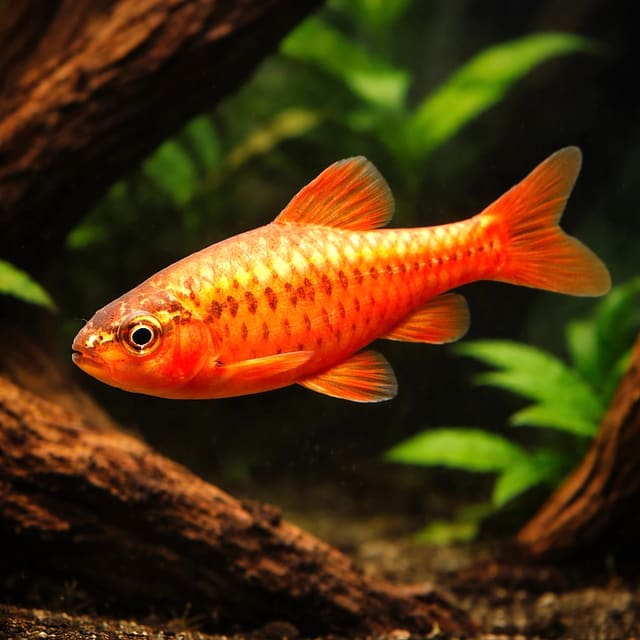
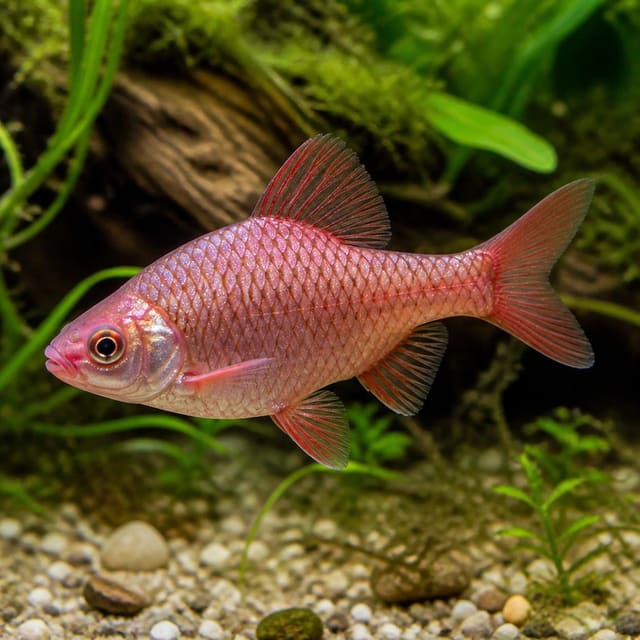
Albino Cherry Barb (Rohanella titteya)
20–27°C · pH 6–8 · 54L
£2.99

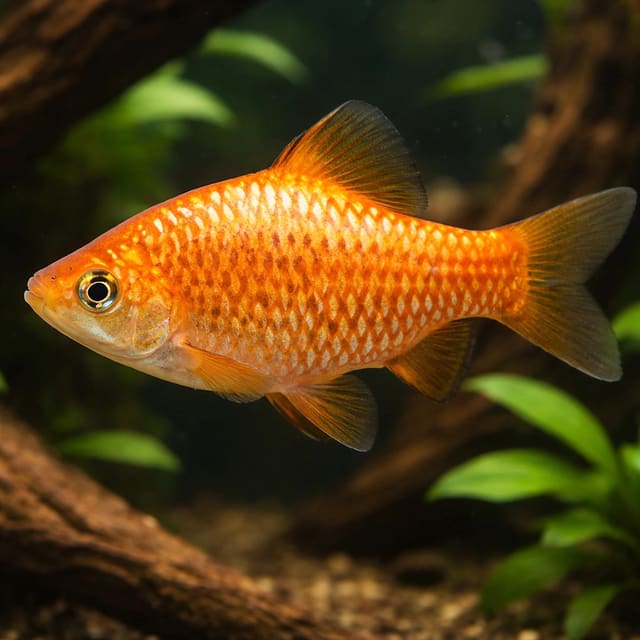
The Golden Barb (Barbodes semifasciolatus) is a freshwater cyprinid from the Red River basin, south-western China and Hainan that reaches 7.6 cm. It suits beginners who can keep 8–10 fish in an aquarium with a base of at least 90 × 30 cm; Seriously Fish gives 16–24°C, pH 6.0–8.0 and 2–20 dGH. Sold individually in dispatch sizes from 2 cm to 5–7 cm.
Adult size is the maximum length this species reaches at full maturity (scientific sources). The livestock you receive will be younger and smaller — pick a size above for the actual shipping size. Product-photo provenance and any image-specific limitations are stated on the listing.
Barbodes semifasciolatus
Shoaling fish: kept in a group they feel safer, stay calmer and show their best colour.
Minimum of 2 per order.
The Golden Barb (Barbodes semifasciolatus) is a freshwater cyprinid from the Red River basin, south-western China and Hainan that reaches 7.6 cm. It suits beginners who can keep 8–10 fish in an aquarium with a base of at least 90 × 30 cm; Seriously Fish gives 16–24°C, pH 6.0–8.0 and 2–20 dGH. Sold individually in dispatch sizes from 2 cm to 5–7 cm.
Adult size is the maximum length this species reaches at full maturity (scientific sources). The livestock you receive will be younger and smaller — pick a size above for the actual shipping size. Product-photo provenance and any image-specific limitations are stated on the listing.
Maintain these water conditions for optimal health and vibrant colors
Golden Barb is the selectively bred golden form of Barbodes semifasciolatus, a freshwater member of the Cyprinidae family. FishBase identifies the species as the Chinese barb, records a maximum of 7.6 cm total length and places its natural distribution in the Red River basin, south-western China and Hainan. It suits beginners who can provide a mature, filtered aquarium, a proper social group and enough horizontal swimming room.
The natural form is also called the green barb. Aquarium literature has used Barbus schuberti and Puntius schuberti for the golden form, but these are not official scientific names. The customer-facing identity remains Golden Barb (Barbodes semifasciolatus).
This is an active, social fish rather than a solitary centrepiece. The Seriously Fish species profile describes it as generally very peaceful, hardy and undemanding, making it a practical beginner choice when the aquarium is mature, filtered and large enough for a proper group. Its constant movement suits a community designed around peaceful fish with comparable size, activity and water requirements.
| Suits | Not suited to |
|---|---|
| A group of 8–10 fish | Solitary or undersized group plans |
| A base of at least 90 × 30 cm or equivalent | Aquariums without the required horizontal footprint |
| Peaceful communities with compatible water needs | Unscreened communities with conflicting water or activity needs |
| Planted layouts with open swimming room | Layouts that obstruct the shoal’s swimming route |
| Beginners prepared to mature and maintain the aquarium | Unfiltered or biologically immature aquariums |
Choose this fish when you can dedicate horizontal swimming room to the shoal while retaining planted cover and shaded areas. A tall aquarium with limited base space is a weaker fit than a longer layout because the group needs room to move together. If that footprint or group commitment is too large, compare other fish through our barbs collection before deciding.
One purchase supplies one Golden Barb in the size selected. The size choices are 2 cm, 2.5 cm, 3–4 cm, 4–5 cm and 5–7 cm. Use the live size selector to choose the dispatch size that fits your stocking plan.
The size you select is the size supplied, not the adult size. Dispatch size describes the animal when sent; it does not reduce the aquarium footprint, social group or mature care requirements. Plan every size around a recorded maximum of 7.6 cm total length and a group of 8–10 fish.
| Selection | What it means |
|---|---|
| Select 3–4 cm with quantity 1 | One animal in that dispatch size |
| Select 3–4 cm with quantity 8 | Eight animals in that dispatch size |
| Select a larger size | A larger animal at dispatch, not a larger adult form |
| Select a smaller size | A smaller animal at dispatch with the same long-term plan |
Build the purchase quantity around the shoal rather than treating one fish as a complete display. If Golden Barbs will join an established group, count the animals already present and assess the aquarium’s base dimensions, filtration capacity and existing livestock before choosing the additional quantity.
Sex is guaranteed only when the selected option explicitly states male or female. This Golden Barb listing has no sex-guaranteed option.
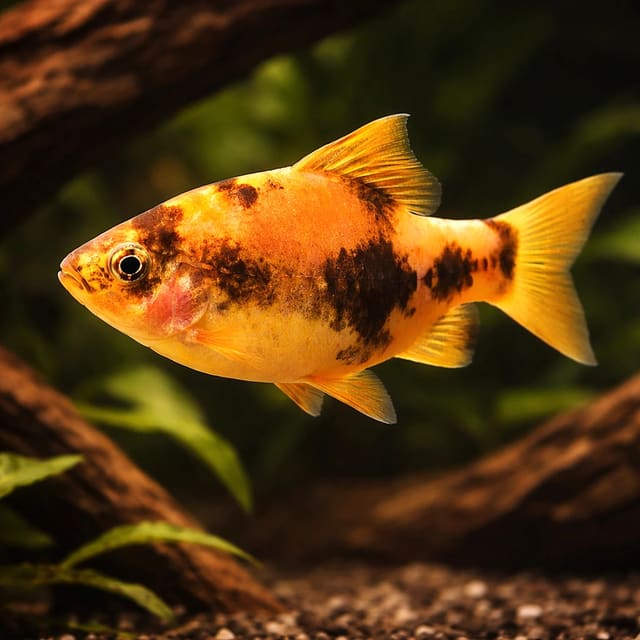
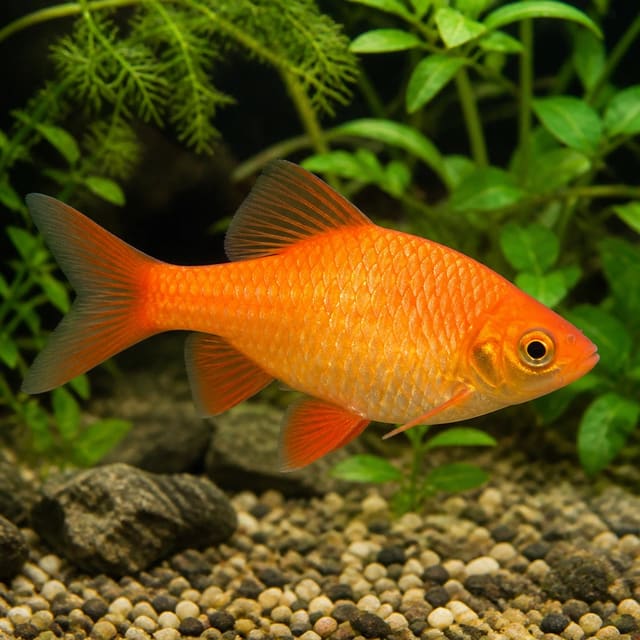
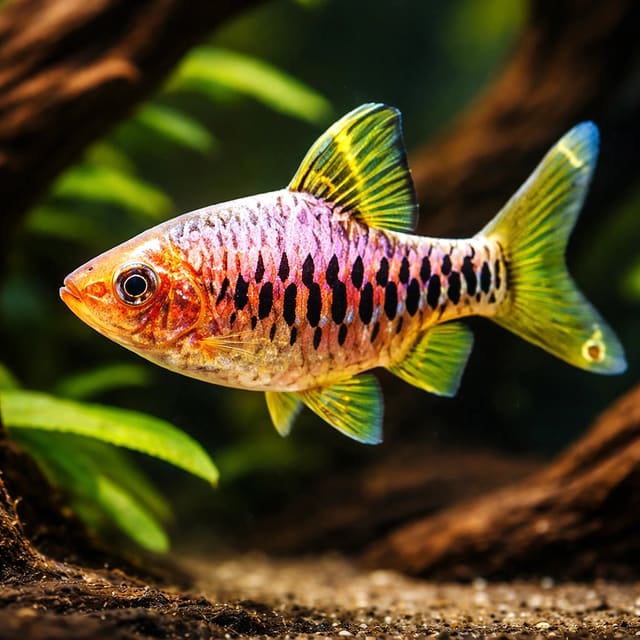
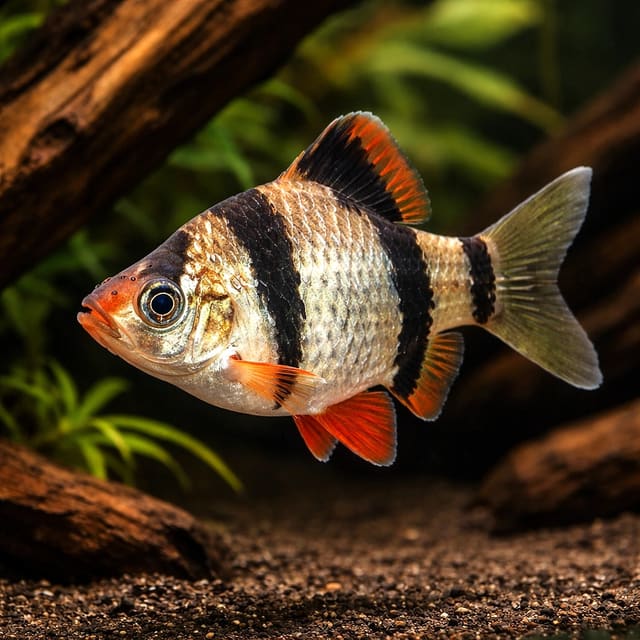
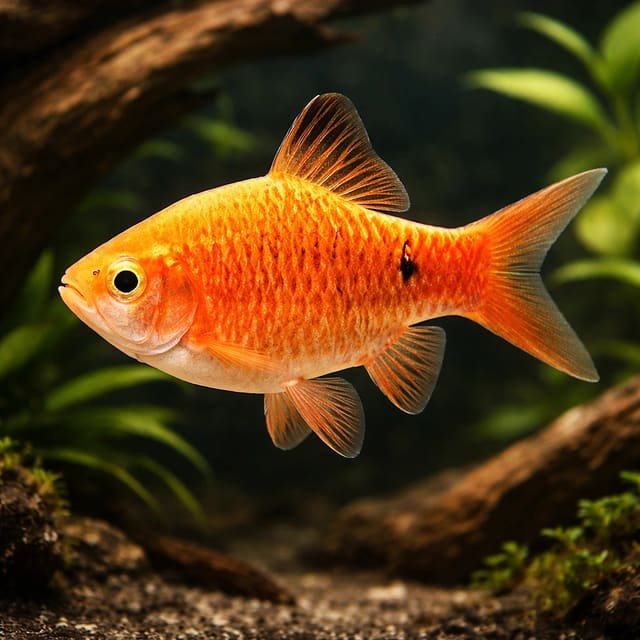
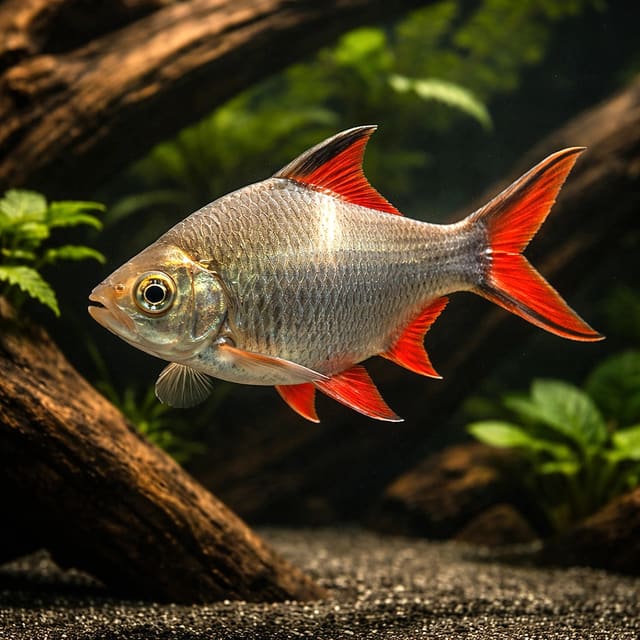
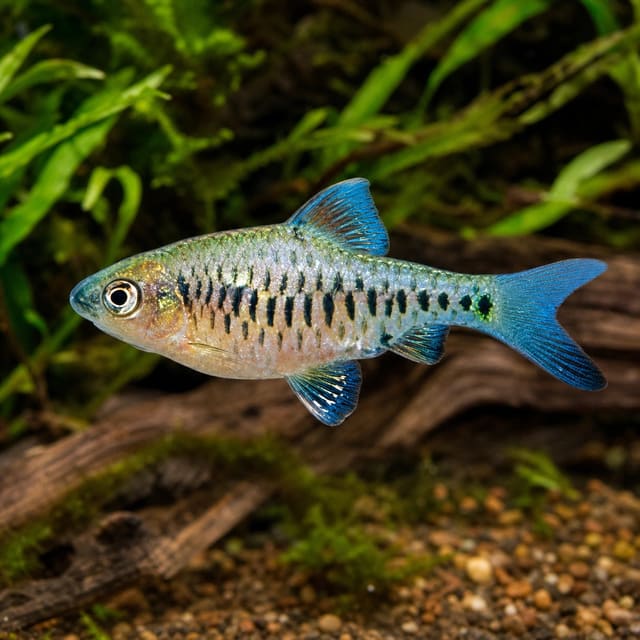
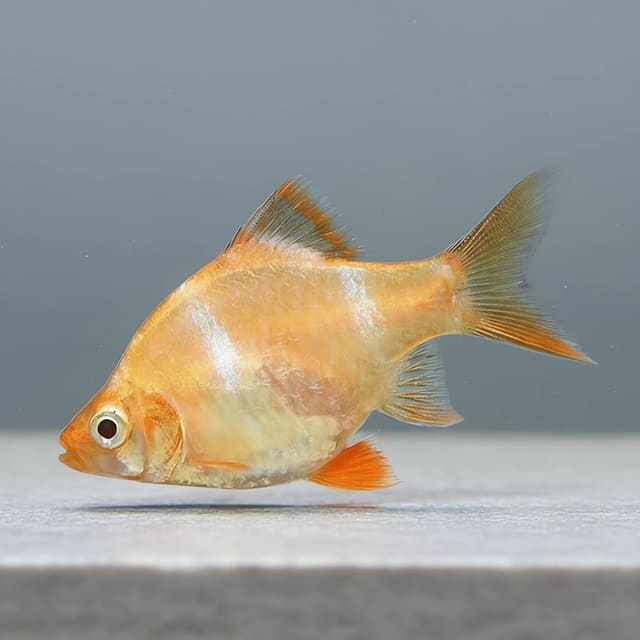
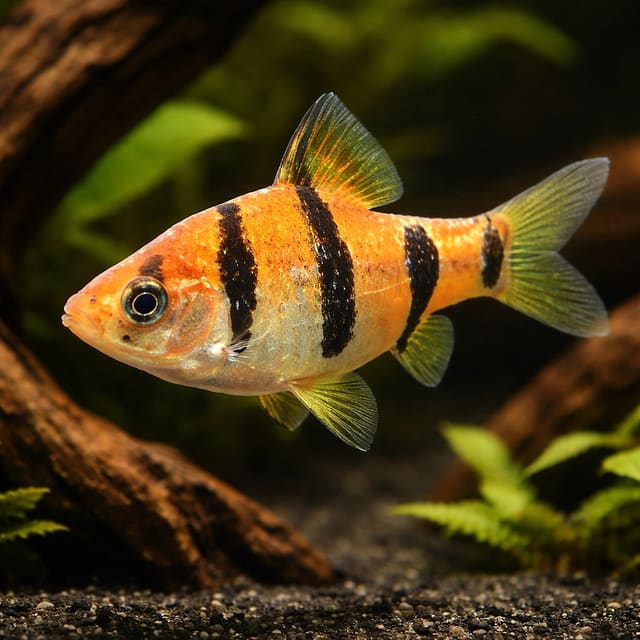
The gallery images are representative, based on reference photographs of this species, so colours can look slightly different from the live animal.
Prepare the aquarium and receiving arrangements before placing the order. The delivery and Live Arrival Guarantee policy explains dispatch days, delivery timing and the steps attached to the guarantee. Check that policy alongside the live selector so the aquarium, planned group and receiving schedule are ready together.
The decisive space requirement is a base of at least 90 × 30 cm or an equivalent aquarium, with an approximate volume of 81 litres. Treat both dimensions and volume as planning checks: litres describe water capacity, while the base determines how much horizontal room the shoal can use. A taller aquarium may hold a similar volume without delivering the same swimming length.
Two published lengths inform the adult plan. Seriously Fish gives 75 mm standard length, while FishBase records a maximum of 7.6 cm total length. Use the 7.6 cm maximum as the catalogue figure and the 90 × 30 cm base as the practical housing threshold.
A worked example shows why the dispatch size cannot set the aquarium size. Eight fish selected at 2 cm are small when sent, but the long-term plan still covers eight active fish approaching the species’ adult dimensions. Selecting eight at 5–7 cm changes their starting size, not the required footprint or social arrangement.
Do not use approximate volume alone to justify a shorter aquarium. The species is active, and its profile expressly gives base dimensions rather than only a litre figure. Open swimming space, planted cover and a suitable group all need to fit within that footprint without obstructing filtration flow.
Maintain Golden Barbs at 16–24°C, pH 6.0–8.0 and 2–20 dGH. Seriously Fish gives these aquarium ranges for the species. Choose stable values within them that also suit every other fish in the aquarium rather than moving repeatedly between the limits.
Measure your tap water and aquarium before changing chemistry. Our water chemistry guide explains what the main readings mean, while the water matcher helps compare measured values with the stated range. A compatible, steady baseline is preferable to repeated adjustments made solely to reach the middle of each range.
| Reading | Action |
|---|---|
| Temperature | Keep it consistently between 16°C and 24°C |
| pH | Confirm the aquarium remains between 6.0 and 8.0 |
| General hardness | Keep measured hardness within 2–20 dGH |
| Ammonia | Maintain zero mg per litre |
| Nitrite | Maintain zero mg per litre |
| Nitrate | Keep it no more than 20 mg per litre above the normal tap-water level |
OATA’s barb guidance is broad group advice: it gives zero mg per litre for ammonia and nitrite and says nitrate should not exceed 20 mg per litre above normal tap-water levels. Apply those waste-control limits alongside the aquarium temperature, pH and hardness ranges given for Golden Barbs.
If a reading moves outside the intended range, check the measurement, recent maintenance and any change in stocking or feeding before making another alteration. Water values work together: a suitable pH does not compensate for detectable ammonia, and a suitable temperature does not compensate for an immature or overloaded biological filter.
A well-established biological filter is essential. The RSPCA’s aquarium welfare guidance explains that fish release toxic ammonia, beneficial filter bacteria convert it to nitrite and then to the safer nitrate. The filter therefore manages a continuous waste process rather than simply making the water look clear.
For an aquarium of about 81 litres, the Golden Barb profile recommends turnover of four to five times the aquarium volume per hour. That corresponds to a filter rated at roughly 325–405 litres per hour. Treat the rating as a starting point and arrange the outlet so the fish receive some water movement without turning the whole aquarium into an excessively strong current.
Use our first tropical aquarium guide to prepare and mature the filter before the fish arrive. Testing must show zero ammonia and zero nitrite before introduction. Clear-looking water alone cannot show whether enough beneficial bacteria are present.
| Filter check | Required response |
|---|---|
| Reduced outlet flow | Check the filter and intake for blockages |
| Media needs cleaning | Rinse it lightly in aquarium water removed during maintenance |
| New or immature filter | Complete maturation and confirm zero ammonia and nitrite |
| Stocking or feeding increases | Test frequently enough to catch any rise in waste readings |
Do not rinse biological media under the tap. Chlorine or chloramine may damage the bacterial population on which the aquarium depends. Use water removed during a partial water change, clean only as needed and preserve as much established media as possible.
Plan filtration around the completed group and the rest of the community. A filter that copes with a lightly stocked aquarium may face a larger waste load when fish numbers and feeding increase, so measure ammonia and nitrite rather than assuming the printed flow rating guarantees biological capacity.
Décor is flexible, but Golden Barbs tend to show better colour in a heavily planted aquarium with a dark substrate. Floating plants and driftwood roots or branches can diffuse the incoming light and create a more natural feel. Balance that cover with a clear route where the shoal can move together.
| Area | Purpose |
|---|---|
| Open central route | Gives the active group uninterrupted swimming room |
| Planted margins | Create cover without closing the whole aquarium |
| Floating cover | Diffuses light over selected areas |
| Wood roots or branches | Add structure and shaded boundaries |
| Dark substrate | Supports the presentation recommended for stronger colour |
Begin with the minimum 90 × 30 cm base and sketch the swimming route before placing hardscape. A branch that looks modest outside the aquarium can divide the usable width once plants grow around it. Position larger pieces towards the rear or side when that preserves a continuous open path.
Filtration does not need to create a particularly strong current, although the fish appreciate some water movement. Aim the return so water circulates around plants and wood while leaving places where the group can move without fighting the outlet. A hill stream-style arrangement is another suitable approach when its flow, footprint and water values remain within the stated conditions.
Watch how the shoal uses the finished layout. Regular movement through the open area with access to planted or shaded edges shows that both functions are present. If the group has to squeeze through narrow gaps or remains confined to one corner, simplify the hardscape and restore a broader swimming route.
Décor should support the group rather than compensate for insufficient space. Dense planting cannot turn a short aquarium into an equivalent of the required footprint, and an empty layout cannot replace the security created by plants, floating cover and structured edges.
Golden Barbs are foraging omnivores. In nature they feed mainly on benthic diatoms, algae, organic detritus, small insects, worms, crustaceans and other zooplankton. In the aquarium, use good-quality dried flakes or suitably sized granules as the dependable base, with at least some products containing plant or algal material.
Regular additions of small live or frozen foods such as bloodworm, Daphnia and Artemia support condition and colour. Rotate these alongside the dried food rather than relying on one item for every meal. Match particle size to the dispatch size so each fish can take food readily.
| Food choice | Role |
|---|---|
| Quality flake | Practical dried staple for the group |
| Suitable granules | Alternative dried staple in an appropriate particle size |
| Plant or algal content | Reflects the plant material in the species’ varied diet |
| Bloodworm, Daphnia or Artemia | Adds varied animal-based live or frozen food |
Feed only what the fish can consume within a few minutes, once a day. This timing comes from OATA’s guidance for barbs and gives a clear limit for routine feeding. Scatter the ration where the group can reach it rather than dropping a large pile into one place.
Use the first portion as a measure. If food remains after a few minutes, remove the excess where practical and reduce the next ration. Uneaten food breaks down and adds waste, increasing the pressure on water quality and biological filtration. If every piece disappears immediately, observe whether all members of the shoal obtained food before increasing the amount.
Changes in appetite are useful warning signs. Reduced intake or a complete loss of interest should prompt a water test and a broader check of swimming, breathing, colour and body condition. Do not respond by repeatedly adding different foods while uneaten material is accumulating.
At least once every week, carry out a partial water change of 25%. Use a siphon to remove solid waste from the substrate, and treat replacement tap water with an appropriate conditioner to remove chlorine or chloramine before it enters the aquarium.
Test ammonia, nitrite and nitrate at least weekly. Ammonia and nitrite must remain at zero mg per litre, while nitrate should stay no more than 20 mg per litre above the normal tap-water level. Record the readings so a rising trend becomes visible before the fish show a marked change.
| Checkpoint | Action |
|---|---|
| Before the water change | Test and record ammonia, nitrite and nitrate |
| During the change | Replace 25% and siphon collected solid waste |
| Replacement water | Treat it for chlorine or chloramine |
| Filter flow | Check for blockages or an obvious reduction |
| After maintenance | Confirm equipment is operating normally |
Use the same weekly sequence so changes are easier to compare. Testing before maintenance shows what accumulated since the previous change; testing only after adding clean water can hide that pattern. A written log also helps connect a change with heavier feeding, added livestock or reduced filter flow.
Clean biological filter media only when flow or accumulated debris makes it necessary, following the filter-care method above. Avoid replacing all established media at the same time. The beneficial bacteria living on that media are part of the waste-control system.
A larger aquarium can offer greater environmental stability, but volume does not remove the need for weekly work. The complete group remains dependent on regular waste removal, conditioned replacement water and a functioning biological filter. Consistent small routines are preferable to waiting for cloudiness, odour or visible distress.
Before adding Golden Barbs, confirm that the aquarium is an appropriate size for the intended group and that the biological filter is mature. Test the water immediately before introduction: ammonia and nitrite must both read zero mg per litre, and temperature, pH and hardness must sit within the species’ aquarium ranges.
Plan the completed community before increasing its population. Beneficial bacteria need to process the extra waste produced when fish numbers and feeding rise. Adding livestock faster than the filter can adjust may lead to new tank syndrome, with unhealthy ammonia or nitrite levels.
| Stage | Checkpoint |
|---|---|
| Before introduction | Mature filter, suitable footprint and zero ammonia and nitrite |
| During the stocking decision | Capacity for an 8–10 fish social group and all existing livestock |
| After introduction | Normal swimming, breathing, colour and feeding |
| First weekly check | Repeat the full water test and carry out the maintenance routine |
| Before further additions | Confirm stable readings and adequate community space |
Slow stocking and social care must be considered together. Do not design a long-term plan around one or two Golden Barbs merely to reduce the first addition. Prepare sufficient biological capacity and aquarium space for the required group, then judge any later additions against the measured waste readings and existing fish load.
Observe the fish after introduction for changes such as hanging at the surface, sitting on the bottom, erratic swimming, faster or slower gill movement, unusual hiding, colour loss or reduced feeding. These signs call for an immediate water-quality check rather than an assumption that the aquarium is safe because it looks clear.
Continue the same planned feeding and maintenance rather than making several changes at the same time. Stable conditions and written test results make it easier to identify whether the aquarium is coping with the increased biological load.
Golden Barbs are generally very peaceful and suit a well-researched community aquarium. The strongest candidates are peaceful fish of comparable size that share the same temperature, pH and hardness range without competing for insufficient swimming space.
The species profile highlights comparably sized peaceful cyprinids, balitorid, cobitid and nemacheilid loaches, and benthic cyprinids such as Crossocheilus and Garra. These are screening categories rather than automatic pairings: check the adult size, group needs, activity, water requirements and footprint of the exact fish being considered.
| Question | Pass condition |
|---|---|
| Do their water ranges overlap? | All fish can remain within suitable temperature, pH and hardness |
| Are their adult sizes comparable? | The proposed fish match the comparable-size guidance |
| Can each social group fit? | The aquarium accommodates every required group at adult size |
| Do activity levels match? | The Golden Barb shoal will not continually disturb a timid companion |
| Is the footprint sufficient? | Open swimming room remains after cover and territories are considered |
OATA’s broader barb advice warns that some barbs may nip fins and says those barbs should not be mixed with slow-swimming, timid or long-finned fish. Avoid those combinations if fin nipping appears, and monitor the community because Golden Barbs are described separately as generally peaceful.
Individual combinations still depend on aquarium dimensions, group sizes and the other fish involved. For a stocking and compatibility assessment, contact us with the aquarium’s base dimensions and volume, measured water values, filter details and a complete list of livestock with quantities.
Some interaction within an 8–10 fish group is expected. Rival males may display stronger colour while competing for attention or hierarchical position, but the offer does not guarantee the sex of any animal. Judge behaviour by its effect on the group rather than trying to sex fish from colour or photographs.
Brief displays and movement through the shoal differ from a persistent change that leaves a fish hiding, unable to feed or repeatedly confined to one area. When behaviour changes, assess water quality, group structure, swimming room and the wider community together.
| If you see | Do this first |
|---|---|
| Hanging at the surface or sitting on the bottom | Test ammonia, nitrite, nitrate and temperature |
| Erratic swimming | Check water readings and observe interactions |
| Faster or slower gill movement | Test water and check filter operation |
| Darker or paler colour | Review water quality, behaviour and recent changes |
| More aggression or hiding | Reassess group size, cover, space and tank mates |
| White spots, fluffy growths or damaged scales | Test water and seek fish-health guidance |
| Reduced feeding or body condition | Check water, feeding access and group behaviour |
Do not treat a behavioural change as a compatibility issue without checking the aquarium. Detectable ammonia or nitrite, altered temperature, reduced filter flow or excess waste may affect several fish and require immediate husbandry action.
If the water readings are outside their required limits, correct the husbandry cause and continue monitoring. If appearance, breathing, swimming or appetite remains abnormal, contact us for health guidance with the test results, aquarium details and a clear description of the change.
FishBase records a maximum of 7.6 cm total length for the Golden Barb, so plan its aquarium and community around that adult figure rather than its dispatch size.
Use a mature, filtered aquarium with a base of at least 90 × 30 cm or equivalent, approximately 81 litres, with open swimming room and planted or shaded cover.
Plan for a group of at least 8–10 Golden Barbs. Seriously Fish recommends this group for natural social interaction and display.
Yes. Seriously Fish describes the golden form as hardy, undemanding and a good beginner choice when its mature filter, group, footprint and water requirements are met.
Feed quality flakes or granules with some plant or algal content, plus varied small live or frozen bloodworm, Daphnia or Artemia. Offer only what the group eats within a few minutes, once daily.
Seriously Fish gives 16–24°C, pH 6.0–8.0 and hardness of 2–20 dGH for this species. Keep ammonia and nitrite at zero mg per litre.
It is described as generally very peaceful, but broader OATA barb guidance warns that some barbs may nip fins. Keep a proper group, monitor behaviour and avoid slow-swimming, timid or long-finned fish if fin nipping appears.
Screen comparably sized peaceful cyprinids, balitorid, cobitid or nemacheilid loaches, and Crossocheilus or Garra species for matching water, activity, group and space needs before combining them.
Someone must be present to receive the parcel. Film every delivery continuously from the sealed parcel as it is opened, showing the fish still inside the sealed bag; then float the bag for 20–30 minutes before releasing the fish and never pour the bag water into the aquarium.
No reviews for this item yet. Bought one? Honest reviews only, good or bad.
What customers say about ordering from us
I have a small group of long finned mountain minnows. So was delighted to be able to order ten of this variety to increase the genetics in my tank . The ones I recieved are healthy but it’s to early to give a verdict on wether they are of a long finned type since they are small currently.
Gordon Walker · 23 Sept 2026
100% success travel and "installation". Pleased with quality of purchase. The Siamese fighter a bit "shy" so have not yet seen him at his best yet but looking good. Happy customer. GG
George E Garratt · 21 Sept 2026
Reviews of our shop, collected by Judge.me, an independent third-party review collector. Newest first.