Easy
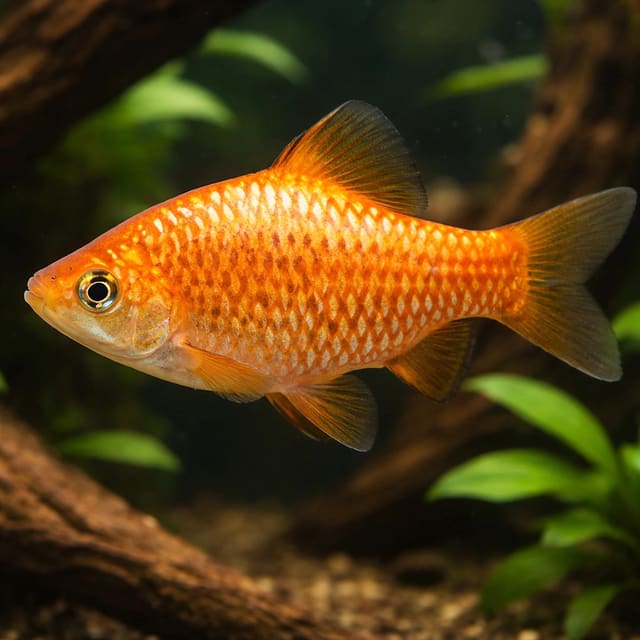
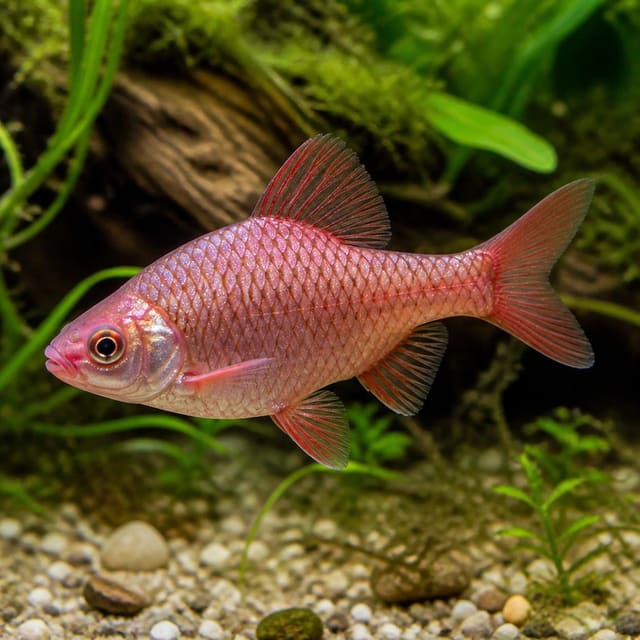
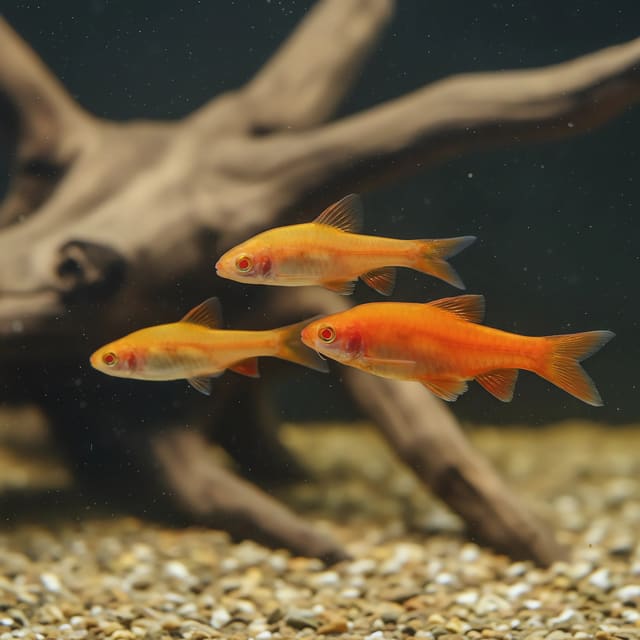
Albino Cherry Barb (Rohanella titteya)
20–27°C · pH 6–8 · 54L
£2.99

The Denison Barb (Dawkinsia denisonii) is an active freshwater cyprinid from India’s Western Ghats that reaches 15 cm. It suits an intermediate keeper planning at least five fish; FishBase’s species range and OATA’s barb guidance overlap at 20–25°C, pH 6.8–7.5 and 5–12°dH. Sold individually in sizes from 2–3 cm to 9–10 cm.
Adult size is the maximum length this species reaches at full maturity (scientific sources). The livestock you receive will be younger and smaller — pick a size above for the actual shipping size. Product-photo provenance and any image-specific limitations are stated on the listing.
Dawkinsia denisonii
Shoaling fish: kept in a group they feel safer, stay calmer and show their best colour.
The Denison Barb (Dawkinsia denisonii) is an active freshwater cyprinid from India’s Western Ghats that reaches 15 cm. It suits an intermediate keeper planning at least five fish; FishBase’s species range and OATA’s barb guidance overlap at 20–25°C, pH 6.8–7.5 and 5–12°dH. Sold individually in sizes from 2–3 cm to 9–10 cm.
Adult size is the maximum length this species reaches at full maturity (scientific sources). The livestock you receive will be younger and smaller — pick a size above for the actual shipping size. Product-photo provenance and any image-specific limitations are stated on the listing.
Maintain these water conditions for optimal health and vibrant colors
The Denison Barb is a freshwater cyprinid also known as Denison’s Barb, Miss Kerala, Red-Line Torpedo Barb and Roseline Shark. FishBase lists it as Dawkinsia denisonii in the family Cyprinidae. Roseline Shark is a trade name inspired by its streamlined form; this fish is a barb rather than a true shark.
Wikipedia describes the Denison Barb as an endangered species endemic to fast-flowing hill streams and rivers in the Western Ghats of India. FishBase places it in fast-flowing hill streams and rocky pools with thick vegetation along the banks. It records gregarious behaviour and a herbivorous feeding pattern in the wild.
| Suits | Not suited to |
|---|---|
| An intermediate keeper prepared to mature and test a filtered aquarium | Solitary long-term keeping or a group of fewer than five |
| A plan accommodating at least five active fish at up to 15 cm each | A permanent aquarium chosen around the juvenile dispatch size |
| Stable water within the FishBase and OATA overlap | An aquarium without an established biological filter |
We class this as an intermediate fish because its adult length, active social behaviour and group requirement must all be accommodated together. It suits a keeper prepared to mature and test the aquarium before arrival, maintain the filter every week and provide enough swimming room for the complete adult group. A small juvenile should never be treated as a permanent small-aquarium fish.
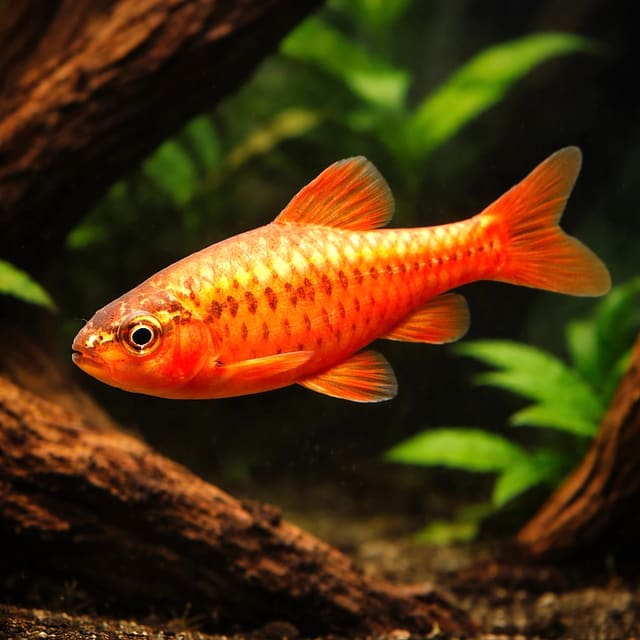
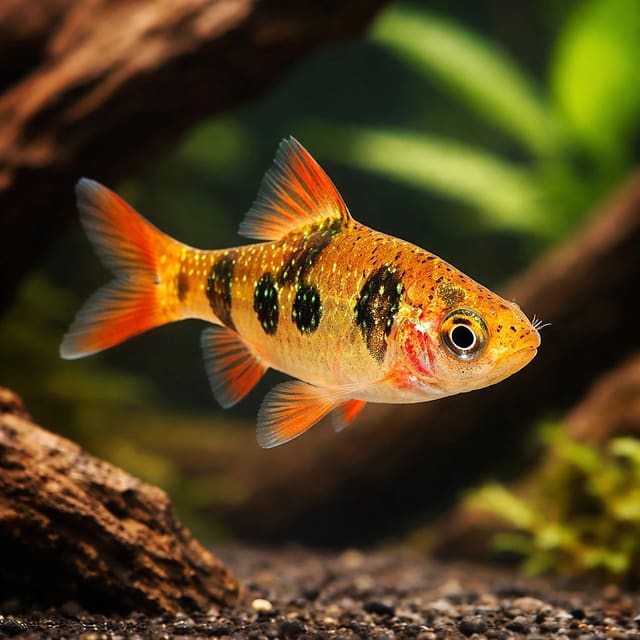
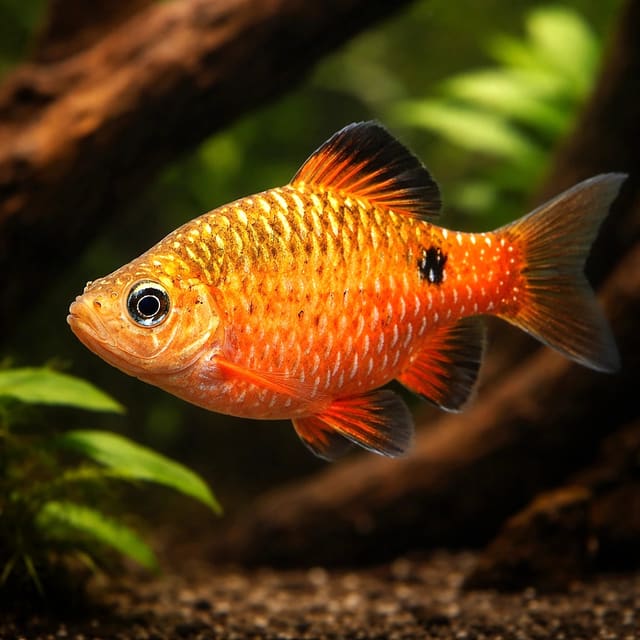
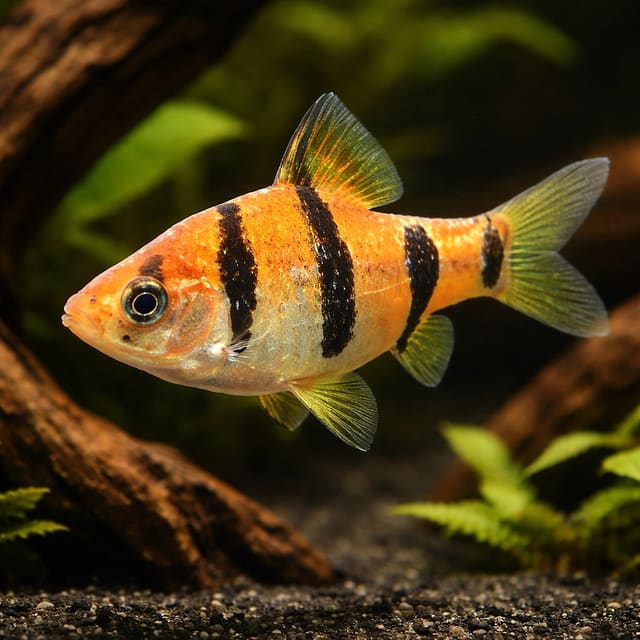
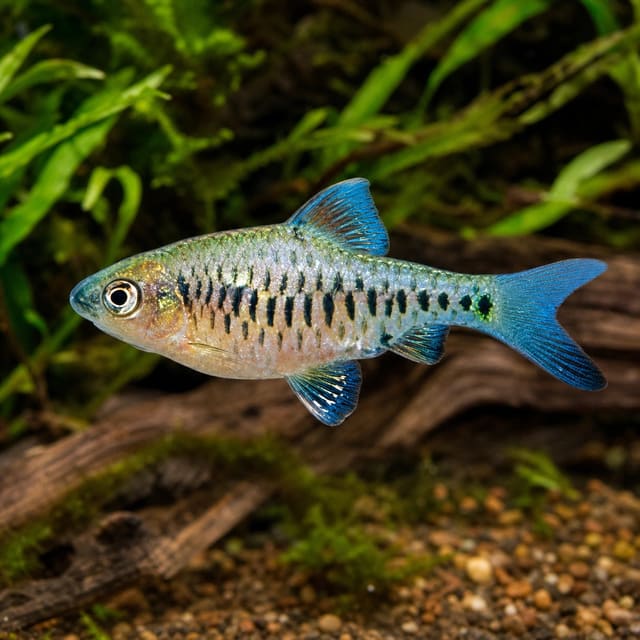
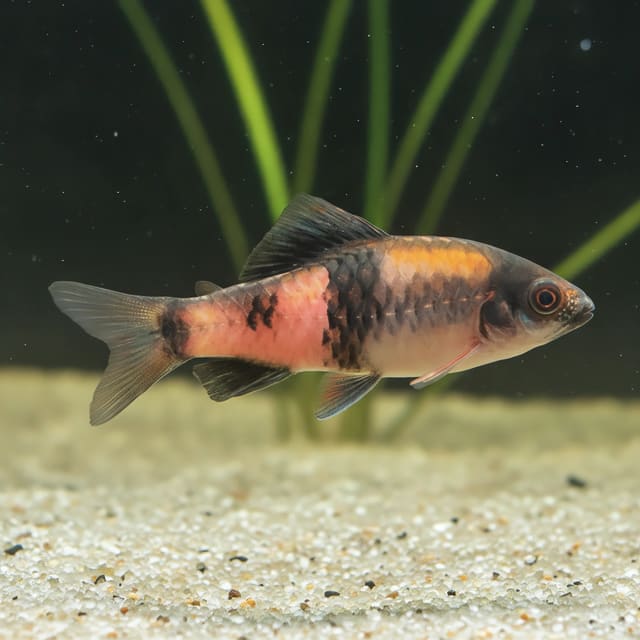
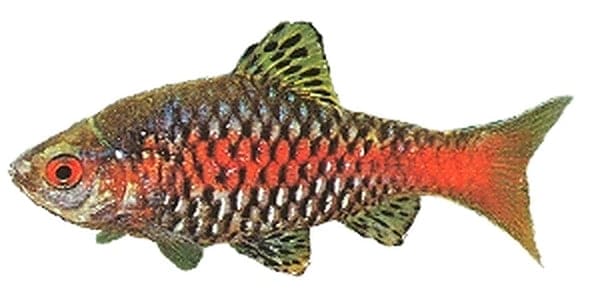
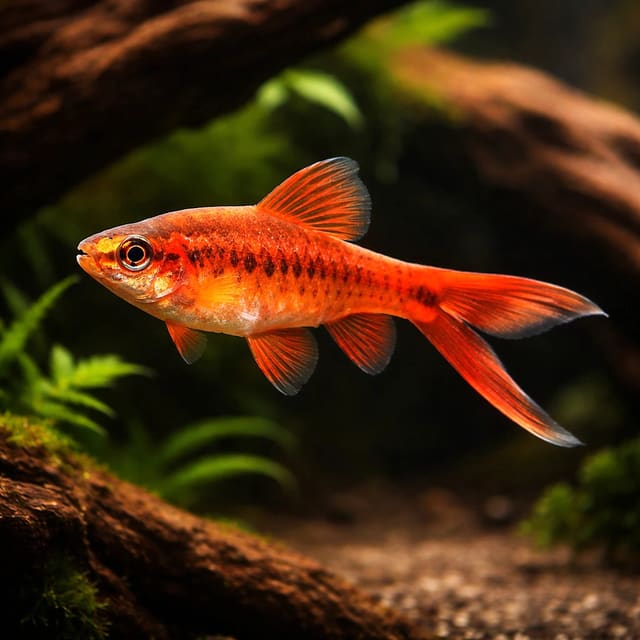
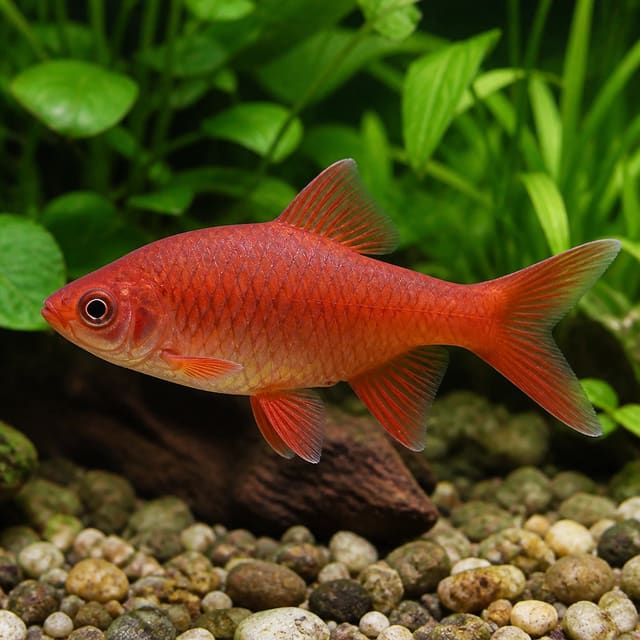
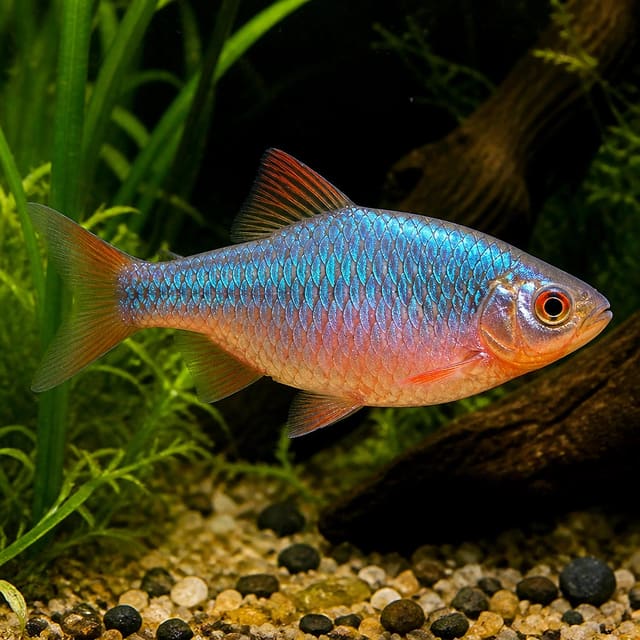
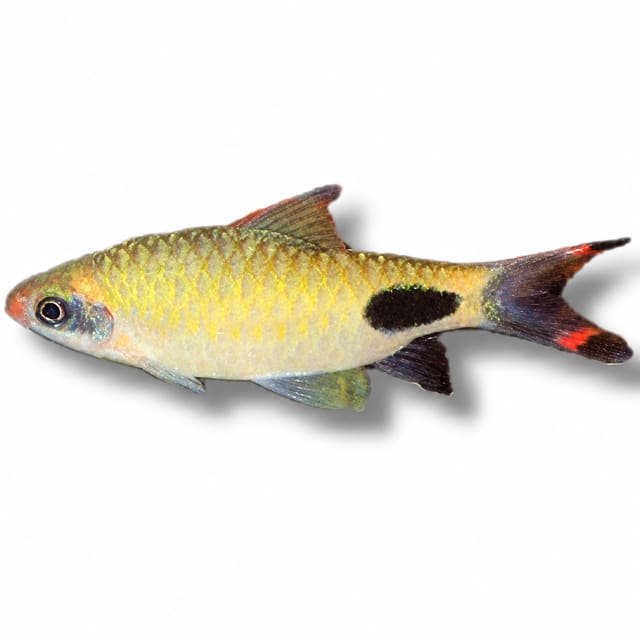
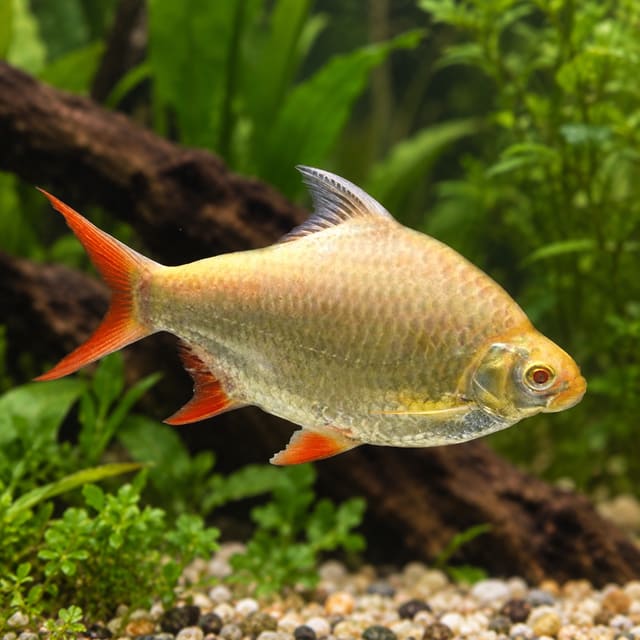
The gallery shows the characteristic silver body, red and black side markings, red dorsal fin and yellow-and-black tail pattern in planted and plain-background scenes. The gallery images are representative, based on reference photographs of this species, so colours can look slightly different from the live animal. Use the images to understand the general appearance rather than to select an individually pictured specimen.
FishBase records a maximum of 15 cm total length for male or unsexed fish and lists the species as Endangered. Plan every purchase as a long-term welfare commitment to an active group, with stable water and enough adult space rather than choosing solely for the bright markings shown in the gallery.
One purchase supplies one Denison Barb in the size selected on the live selector. The labels are 2-3 cm, 3 - 4 cm, 4 - 5 cm, 5-6 cm, 6-7 cm, 7-8 cm, 8 - 9 cm and 9 - 10 cm. Read the live selector when choosing because each label represents its own dispatch size.
The size you select is the size supplied, not the adult size. Every size belongs to the same species and must be planned around the recorded maximum of 15 cm total length. A smaller dispatch size changes the immediate food-particle and filter-intake decisions, but it does not reduce the adult social or swimming-space commitment.
Sex is guaranteed only when the selected option explicitly states male or female. This Denison Barb listing has no sex-guaranteed option.
OATA’s group-level barb guidance advises keeping barbs in groups of at least five, with more being better when the aquarium can support them. It also recommends choosing an aquarium as large as reasonably possible and ensuring that it accommodates the group. For this species, combine that advice with the 15 cm adult planning size instead of judging space from the fish delivered today.
| Decision | What to plan |
|---|---|
| Purchase unit | One fish for each unit purchased |
| New group | At least five fish, with adult space arranged first |
| Existing group | Check total adult stocking and behaviour before adding another |
| Aquarium | A filtered layout large enough for the entire active adult group |
FishBase records 15–25°C, pH 6.8–7.8 and 5–25°dH for the species’ environment. OATA gives 20–27°C, pH 6.0–7.5 and 4–12°dH as broad aquarium guidance for barbs. The practical overlap used here is 20–25°C, pH 6.8–7.5 and 5–12°dH; these are planning values rather than a species-specific optimum.
Prepare mature biological filtration before choosing a group. Ammonia and nitrite should both be zero, while nitrate should stay no more than 20 mg per litre above the normal level in the tap water. The aquarium must provide enough room for active movement, gravel or sand, cover and reliable access for weekly maintenance.
Maintain a routine temperature of 20–25°C, pH of 6.8–7.5 and general hardness of 5–12°dH. Choose a stable point inside each interval rather than repeatedly adjusting the aquarium towards a boundary. Stability allows the fish and the biological filter to experience predictable conditions.
| Test | Action point |
|---|---|
| Temperature | Keep between 20°C and 25°C |
| pH | Keep between 6.8 and 7.5 |
| General hardness | Keep between 5°dH and 12°dH |
| Ammonia | Maintain at zero mg per litre |
| Nitrite | Maintain at zero mg per litre |
| Nitrate | Keep within 20 mg per litre above the tap-water baseline |
Use the water chemistry guide to interpret these readings together. A pH result is more useful when considered alongside hardness, while ammonia and nitrite show whether biological filtration is processing the waste produced by the group.
Test the aquarium and replacement water with the same method so that the comparison is meaningful. The water matcher helps compare measured values with the stated planning ranges. If a reading has moved, repeat the test and inspect recent feeding, stocking and maintenance before making a large correction.
Treat replacement tap water with a suitable conditioner before it enters the aquarium. This removes harmful chlorine or chloramine that could affect both the fish and the filter bacteria. Match replacement water sensibly to the aquarium so a routine water change does not create an abrupt shift.
Temperature, pH and hardness describe only part of the decision. Clear water can still contain ammonia or nitrite, so visual appearance never replaces testing. Conversely, one unexpected reading should lead to a careful retest and a check of the aquarium rather than a series of rapid chemical adjustments.
Record the weekly results in one place. A short trend showing temperature, pH, ammonia, nitrite and nitrate makes gradual change easier to recognise than isolated readings remembered from different days.
A filter is essential in a Denison Barb aquarium. The RSPCA’s aquarium welfare guidance explains that fish release toxic ammonia and that a working biological filter supports bacteria which convert ammonia to nitrite and then to the safer nitrate. That process must be established before livestock is introduced.
Choose filtration for the full planned group rather than one dispatch-sized fish. The filter must continuously process the waste created by the animals and their food. A unit moving water is not automatically biologically mature, so confirm zero ammonia and zero nitrite with tests before the fish arrive.
If this is your first aquarium, follow the first tropical tank guide while preparing and maturing it. Additions increase the amount of waste entering the system, and OATA advises increasing the aquarium population slowly so the bacterial population can respond to the higher load.
Denison Barbs should be planned as a group of at least five. Do not leave one or two fish as an indefinite substitute for that social group. Instead, mature the aquarium for the intended addition, check its adult capacity and test closely whenever the livestock or feeding load increases.
| Before adding fish | Required check |
|---|---|
| Filter | Running, mature and free from blockage |
| Ammonia | Zero mg per litre |
| Nitrite | Zero mg per litre |
| Group plan | At least five, with adult space considered |
| Maintenance access | Room to siphon waste and service the filter |
Position the filter so water circulates around the occupied aquarium rather than bypassing a large section. After every service, confirm that the unit restarts and that water movement has returned. Check the intake for trapped leaves or debris before assuming reduced output is a mechanical failure.
Do not run established filter media under the tap. Chlorine or chloramine may damage the bacteria responsible for processing waste. Rinse dirty media lightly in aquarium water removed during a partial water change, preserving the biological population while clearing material that restricts flow.
Plan the aquarium footprint around a group of fish reaching up to 15 cm total length. OATA recommends choosing as large an aquarium as reasonably possible and making sure it can accommodate the intended barb group. Give priority to usable swimming space, filtration capacity and maintenance access rather than relying on the current juvenile length.
FishBase associates the wild animal with fast-flowing hill streams, rocky pools and thick vegetation beside the water. In the aquarium, use that natural history as layout inspiration: retain a generous route for active movement while arranging cover around the margins. Avoid building a dense obstacle course through the whole swimming area.
OATA recommends aquarium gravel or sand and ideally live plants for cover. Plastic plants and suitable ornaments can provide an alternative where live planting is not used. Some barbs may eat live plants, so inspect leaves during routine maintenance and adjust the planting plan if damage becomes persistent.
| Layout choice | Reason |
|---|---|
| Gravel or sand | Provides the recommended aquarium base |
| Plants at the margins | Give cover without consuming every swimming route |
| Secure ornaments | Create shelter while leaving maintenance access |
| Clear group space | Allows active fish to move without constant obstruction |
The species’ stream habitat supports providing purposeful water movement, but the filter still has to perform its main biological role. Arrange circulation so waste reaches the filter and the fish can use the aquarium without being held continuously in one narrow jet. Observe how the whole group distributes itself after any outlet adjustment.
Place decor so it cannot shift into the fish’s route or block the filter. Leave enough room around plants and ornaments to siphon trapped waste during the weekly water change. A layout that looks attractive on the first day must remain practical once the fish grow and maintenance becomes routine.
Reassess the space as the group develops. If adults spend their time turning sharply around decor, crowding one clear patch or repeatedly competing for the same route, reduce obstruction and review the aquarium’s overall suitability for the adult group.
FishBase describes the Denison Barb as herbivorous in the wild. OATA advises that most aquarium barbs accept a good-quality flake or granule and notes that predominantly vegetarian species need vegetable matter in the diet. Build this fish’s routine around a quality prepared food with deliberate vegetable content rather than treating plant matter as an occasional extra.
Feed once a day and offer only what the group can eat within a few minutes. This schedule comes from OATA’s barb guidance. Watch the entire group during that short period, then remove visible leftovers before they break down and add toxic waste to the water.
| Food decision | How to use it |
|---|---|
| Quality flake or granule | Use as the prepared base of the diet |
| Vegetable-rich food | Include regularly to reflect the wild herbivorous pattern |
| Daphnia, small bloodworm or tubifex | Offer suitable portions as live or frozen variety for smaller fish |
| Artemia, bloodworm or chopped cockle or mussel | Use appropriately sized variety for larger barbs |
Match every piece to the mouths of the fish being fed. A group chosen from a smaller size label needs finer food than larger individuals, but the nutritional plan remains the same. Break food into suitable particles before it enters the aquarium rather than relying on smaller fish to tackle pieces intended for larger animals.
Active group feeding can make a meal look successful even when one fish receives little. Spread the measured portion so more than one part of the group can reach it, then identify whether any individual repeatedly hangs back, spits food out or loses body condition.
Do not keep adding food because the quickest fish continue searching. Overfeeding creates uneaten material, raises the burden on the filter and can lead to harmful ammonia or nitrite. Judge the portion by what the complete group finishes within a few minutes and by the waste seen during maintenance.
If food remains after the group stops actively taking it, remove the residue and reduce the next portion. If one fish consistently misses meals while the others maintain condition, review group behaviour, particle size and feeding distribution before increasing the total amount.
Complete the aquarium checks before the delivery day. The filter should be mature and running normally, temperature should sit within 20–25°C, and ammonia and nitrite should both test at zero. Confirm that the planned group and adult space are ready rather than using the transport bag as time to finish the setup.
Our delivery and Live Arrival Guarantee policy requires someone to be present to receive the parcel. Start filming before the sealed parcel is opened, then keep one continuous video as it is opened and while the fish remains inside the sealed bag.
Float the bag in the aquarium for 20–30 minutes before releasing the fish. Never pour transport-bag water into the aquarium.
| Checkpoint | What to do |
|---|---|
| Immediately before release | Confirm the filter is running and the aquarium readings are suitable |
| After release | Watch balance, breathing, fin condition and swimming behaviour |
| First feeding opportunity | Offer a measured portion and note whether each fish responds |
| After adding the group | Retest ammonia and nitrite as the filter adjusts to the increased load |
Look for clear bright eyes, intact scales, undamaged fins and swimming behaviour appropriate to the active group. A new fish may behave differently after a move, so use repeated observations rather than judging one brief pause or dash in isolation.
During the first week, keep feeding measured and inspect the group at the same daily meal. Test water regularly, verify that the filter has not become blocked and note any persistent isolation, reduced feeding or change in breathing. Early attention links a behavioural change to water, feeding or group conditions before it becomes harder to interpret.
Do not add more livestock merely because the first day looks calm. OATA advises increasing aquarium populations slowly because the beneficial bacteria must respond whenever animal numbers and feeding rise.
Carry out a 25% partial water change at least once every week. OATA strongly recommends this schedule for barbs and suggests using a siphon to remove solid waste from the gravel. Treat all replacement tap water with conditioner before adding it to the aquarium.
This order gives you a view of normal behaviour and pre-maintenance water before the aquarium changes. Keep ammonia and nitrite at zero and nitrate no more than 20 mg per litre above the normal tap-water level.
Service media only as needed to restore clear flow. Rinse it lightly in water removed from the aquarium rather than under the tap. Do not turn every maintenance session into a complete filter clean; the beneficial bacteria living on the media are responsible for processing ammonia and nitrite.
| If you find | Do this |
|---|---|
| Reduced filter output | Check the intake, pipework and mechanical media for blockage |
| Waste behind decor | Siphon it and improve future maintenance access |
| Ammonia or nitrite | Retest, review feeding and inspect filter operation immediately |
| Nitrate rising quickly | Review food input, stocking and the water-change routine |
Use the same test method and record the result each week. Trends help distinguish a gradual increase in waste from a one-off testing error. If adding fish or increasing food, test more closely while the biological filter responds to the larger load.
Finish by checking that all equipment restarted correctly and that decor remains secure. Watch the group after the disturbance; normal movement should resume, while persistent hiding, unusual breathing or erratic swimming belongs in the health check rather than being dismissed as routine maintenance behaviour.
Learn the group’s normal swimming, colour, breathing, feeding and use of cover. OATA advises watching for changes because each fish has slight individual variation. A change from that animal’s usual pattern is more useful than expecting every member of the shoal to behave identically.
| Change seen | First response |
|---|---|
| Hanging at the surface or sitting on the bottom | Test water and inspect filter operation |
| Erratic swimming | Check temperature, water readings and recent disturbance |
| Darker or paler colour | Compare behaviour, feeding and water conditions |
| More hiding or altered aggression | Review group size, space and recent additions |
| Faster or slower gill movement | Check water quality and circulation promptly |
| White spots, fluffy growths or damaged scales | Record the appearance and assess whether it is spreading |
| Reduced feeding or changing body condition | Observe the next measured meal and check individual access |
Start with ammonia, nitrite, temperature and filter flow because poor water can produce several outward signs at once. Review the last water change, filter clean, feeding increase or livestock addition. This sequence identifies correctable environmental causes before they continue affecting the group.
Contact us for guidance when abnormal signs persist, become severe or spread through the group. Share the measured water results and a clear description of the change, including when it began and whether feeding or swimming has altered. Those details make the next decision more useful than a symptom name alone.
Continue the normal care fundamentals while seeking guidance: keep the filter running, maintain the stated water range and remove uneaten food. Do not increase feeding to compensate for a fish that has stopped eating, because additional waste places more pressure on the aquarium.
Inspect every member rather than focusing only on the most visibly affected fish. A second animal breathing differently or missing food can show that the issue involves the aquarium or group, while one isolated change may require a more individual assessment.
Plan at least five Denison Barbs together. OATA describes barbs as shoaling fish and advises that animals kept alone or in groups that are too small will often become stressed. More can be beneficial when the aquarium has enough adult room and filtration for every additional 15 cm fish.
One purchase supplies one fish. A new group therefore requires multiple fish, each in its selected size. The social calculation stays the same whether the fish are chosen at 2-3 cm or 9 - 10 cm because those labels describe dispatch size rather than separate adult forms.
| Situation | Decision |
|---|---|
| Starting a group | Plan at least five and prepare the adult aquarium first |
| Adding one fish | Use this only when a suitable Denison Barb group already exists |
| Choosing more than five | Increase adult space, filter capacity and maintenance planning |
| Keeping one alone | Do not use solitary housing as the long-term social plan |
Larger groups can also help spread fin-nipping behaviour among barbs generally, but extra fish are never free capacity. Each animal adds adult body mass, feeding demand and waste. Decide group size and aquarium capacity together instead of increasing one without reviewing the other.
Observe the fish at feeding time and between meals. Persistent hiding, repeated isolation, erratic swimming or a lasting change in aggression can indicate that the social or environmental plan needs attention. Test the water as part of that review because group stress and poor water may appear at the same time.
When comparing another barb for a separate aquarium plan, browse the current barbs collection and check adult size, group needs and water range for each animal. Sharing a family name does not make different barb species interchangeable members of one social group.
Keep the same-species requirement central when planning cost and space. A mixed collection of visually similar fish should not be used to reduce the number of Denison Barbs below five.
Compatibility should be assessed as a set of conditions rather than a universal list of names. Compare adult size, water range, swimming pace, social needs and total aquarium capacity. A candidate must fit the same aquarium after every fish has reached adult size, not just while the Denison Barbs are small.
OATA warns that some barbs can be semi-aggressive or fin nippers and says fin-nipping barbs should not be mixed with slow-swimming, timid or long-finned fish. Avoid those companions. Whether an individual Denison Barb will nip cannot be predicted, so continue monitoring fins, feeding and hiding behaviour in every mixed aquarium.
| Candidate feature | Starting decision |
|---|---|
| Similar water requirements and active behaviour | Consider only after checking adult space and social needs |
| Slow, timid or long-finned | Avoid because fin-nipping barbs should not be mixed with them |
| Small enough to fit in an adult fish’s mouth | Avoid the combination |
| Different temperature or chemistry needs | Do not combine conflicting care ranges |
| Another social species | Include its full group in the stocking calculation |
OATA advises that larger barbs should not be mixed with animals they might fit in their mouths, even though barbs are not described as predatory by nature. With a recorded maximum of 15 cm, apply that screen to the adult Denison Barb rather than the dispatch-sized fish. Very small companions should not be treated as safe merely because the juvenile barb currently ignores them.
Feeding should also be observed. An active shoal may reach food quickly, so verify that every species can complete its normal feeding routine. If one group repeatedly misses meals, the combination needs reassessment even when there is no visible attack.
A species name alone cannot guarantee the outcome because aquarium size, group numbers and individual behaviour all affect the result. Contact us with the aquarium dimensions, water readings, existing livestock and planned group numbers if you would like a stocking and compatibility assessment.
Introduce only after the aquarium is mature and the adult capacity calculation works. Continue watching swimming, hiding, feeding and fin condition after the mix is made; a combination that begins quietly still needs routine observation.
The Denison Barb reaches a recorded maximum of 15 cm total length. Plan the aquarium and group around that adult size rather than the dispatch size.
Choose as large an aquarium as reasonably possible and make sure it accommodates at least five active fish reaching 15 cm each. Prioritise adult swimming space, mature filtration and maintenance access.
Keep at least five Denison Barbs together. OATA advises that barbs are shoaling fish and will often become stressed when kept singly or in groups that are too small; more can be considered when the aquarium supports the complete adult group.
We class the Denison Barb as intermediate because a group of at least five fish reaching 15 cm needs careful adult-space planning, mature filtration, stable water and consistent weekly maintenance.
Feed a good-quality flake or granule with regular vegetable content, reflecting its herbivorous wild feeding pattern. OATA advises one daily portion that the group finishes within a few minutes, with suitable live or frozen food for variety.
Maintain 20–25°C, pH 6.8–7.5 and 5–12°dH. These values are the overlap of FishBase’s species range and OATA’s barb guidance; keep ammonia and nitrite at zero.
Some barbs can be semi-aggressive or nip fins, and OATA says fin-nipping barbs should not be mixed with slow-swimming, timid or long-finned fish. Avoid those companions and monitor every mixed aquarium because individual behaviour can vary.
Screen every companion for overlapping water needs, adult size, activity, social requirements and total space. Avoid slow-swimming, timid or long-finned fish and animals small enough to fit in an adult Denison Barb’s mouth.
Start filming before the sealed parcel is opened, then keep one continuous video as it is opened with the fish still inside the sealed bag. Someone must be present to receive it. Float the bag for 20–30 minutes before release, and never pour the bag water into the aquarium.
No reviews for this item yet. Bought one? Honest reviews only, good or bad.
What customers say about ordering from us
I have a small group of long finned mountain minnows. So was delighted to be able to order ten of this variety to increase the genetics in my tank . The ones I recieved are healthy but it’s to early to give a verdict on wether they are of a long finned type since they are small currently.
Gordon Walker · 23 Sept 2026
100% success travel and "installation". Pleased with quality of purchase. The Siamese fighter a bit "shy" so have not yet seen him at his best yet but looking good. Happy customer. GG
George E Garratt · 21 Sept 2026
Reviews of our shop, collected by Judge.me, an independent third-party review collector. Newest first.