
X Rhombo Barb (Desmopuntius rhomboocellatus) - UK
Add rare pattern and lively movement to your aquarium with X Rhombo Barb. Moderate care and ideal for community setups. Order now with UK delivery.
Premium Quality
Healthy, vibrant fish from trusted suppliers
Expert Care
Detailed care guides and support
Live Arrival Guarantee
Your fish arrives healthy or we'll replace it
Acclimated
Properly quarantined and ready for your tank
Why Choose This Fish?
Add rare pattern and lively movement to your aquarium with X Rhombo Barb. Moderate care and ideal for community setups. Order now with UK delivery.
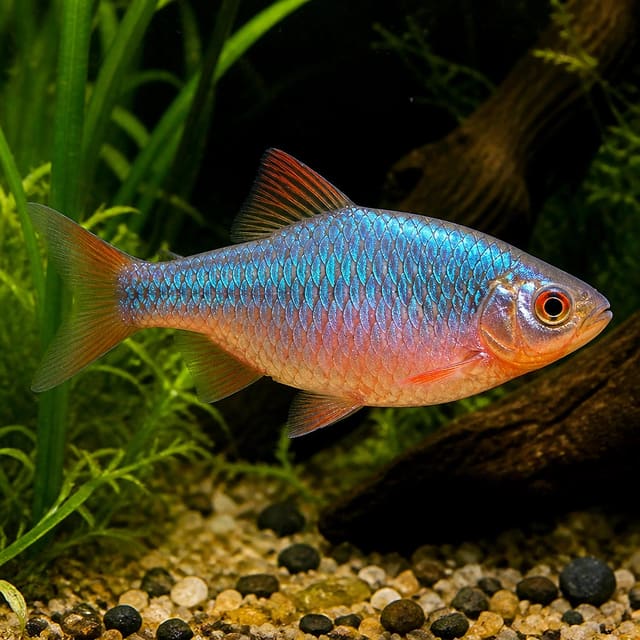
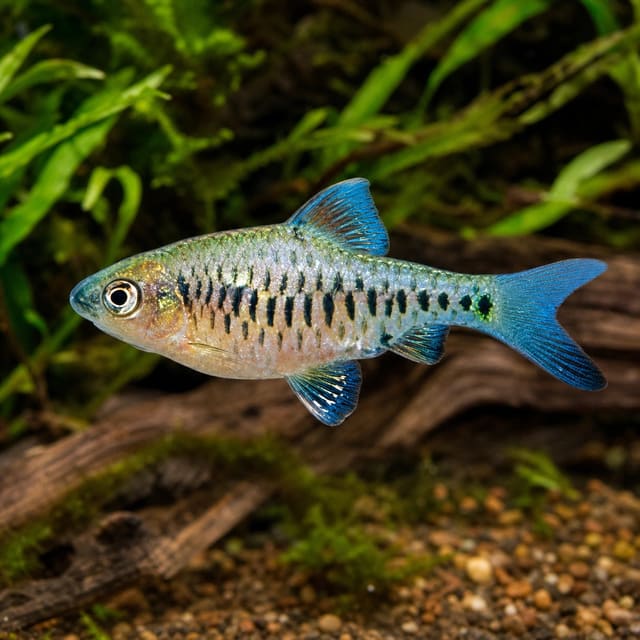
The Rhombo Barb, Desmopuntius rhomboocellatus, is one of those fish that stops people mid-scroll. Its warm copper body, dark rhomboid markings, and subtle glow through the fins give it a refined look that stands out in a soft, leaf-litter aquascape. For aquarists searching for freshwater fish UK hobbyists can keep in a peaceful blackwater setup, this species offers something different from the usual community staples. Also sold as the Snakeskin Barb or Orange Buffalo Barb, it stays compact at around 5-5.5 cm, thrives in groups, and rewards careful fishkeepers with calm schooling behaviour and rich colour. See our detailed photos showing the pattern contrast and body sheen that make this a sought-after choice among tropical fish UK keepers.
This is not a beginner-proof barb, but it is a deeply rewarding one. The species comes from Southeast Asia, specifically Indonesian Borneo, where soft, acidic water and dim surroundings shape its needs in captivity. A proper rhombo barb care guide focuses on stable water, low nitrate, and social security in a group of at least 8-10 fish. If you want community fish UK aquarists rarely see in every shop, or you are looking for rare tropical fish uk stock with genuine personality, the Rhombo Barb Fish deserves attention. It is especially appealing for a rhombo barb for planted community tank layout with rasboras, loaches, and other small, peaceful species. For fishkeepers browsing freshwater fish uk for sale, buy live fish online uk, or even the best place to buy tropical fish online uk, this species offers a more specialist, naturalistic option than many popular fish in uk aquariums.
🔹 Quick Facts
- Scientific Name: Desmopuntius rhomboocellatus
- Care Level: Intermediate
- Min Tank Size: 72 litres (16 gallons)
- Recommended Tank Size: 100 litres+
- Temperature: 20-28°C (68-82°F)
- pH Range: 4.0-7.0
- Lifespan: 3-5 years
- Temperament: Peaceful
- Diet: Omnivore
- Swimming Level: Mid-water
Classification
- Order: Cypriniformes
- Family: Cyprinidae
- Genus: Desmopuntius
The Rhombo Barb belongs to the carp and minnow family, Cyprinidae, a huge group that includes many familiar aquarium barbs, rasboras, danios, and pond fish. In the hobby it is valued as a smaller, more peaceful barb with a distinct netted pattern, making it a strong alternative to louder, more fin-nippy species. It is sometimes discussed under older barb naming conventions, so hobbyists searching for puntius rhomboocellatus for sale UK or puntius rhomboocellatus for sale online UK are usually looking for this same fish.
Where Do Rhombo Barbs Come From? Natural Habitat Explained
The natural puntius rhomboocellatus habitat is found in Southeast Asia, especially Indonesian Borneo in Kalimantan. These fish are associated with forest streams, peat swamps, and slow-flowing blackwater environments where tannins stain the water tea-brown. In the wild, leaf litter, submerged roots, and overhanging vegetation create a dim, sheltered world. That matters because puntius rhomboocellatus behaviour in the aquarium makes much more sense when you understand its background: this is a fish adapted to soft, acidic water, filtered light, and safety in numbers.
Wild conditions are often far softer and more acidic than many standard community tanks. The accepted puntius rhomboocellatus pH range in captivity is 4.0 to 7.0, while puntius rhomboocellatus water hardness should remain very low at 1-5 dGH. These numbers are not just trivia. They explain why this species can struggle in hard, alkaline setups and why its colours often look washed out in unsuitable water. If you want to buy rhombo barb UK stock and keep it well long term, replicating these conditions is the key to success.
The fish’s natural diet likely includes tiny insect larvae, biofilm, algae traces, detritus, and small crustaceans picked from the water column and submerged surfaces. Adult puntius rhomboocellatus size is modest, usually around 5 to 5.5 cm, which suits this feeding style. In a home aquarium, that translates into a need for small foods and a varied omnivorous menu rather than oversized pellets. The typical rhombo barb lifespan is 3-5 years, but fish kept in stable, low-stress blackwater conditions often show better colour, stronger immune response, and more natural schooling.
Some shoppers compare this species with more familiar barbs before buying, especially in searches like puntius rhomboocellatus vs pentazona barb. The Rhombo Barb is generally subtler in colour than a Pentazona, but it offers a more unusual pattern and a very attractive natural look in the right aquascape. It is a specialist choice for aquarists who appreciate authenticity over flash. That is why it remains in demand among keepers looking for freshwater fish uk for tank setups that mimic real habitats rather than bright, mixed hard-water communities.
💡 Expert Tip
Mimicking the natural habitat with Indian almond leaves, alder cones, driftwood, and subdued lighting often improves confidence, colour depth, and schooling behaviour. Fish that hide constantly in bright tanks usually become much bolder once the environment feels secure.
How to Set Up the Perfect Tank for Rhombo Barbs
A successful rhombo barb tank setup starts with understanding that this is a group fish from soft, acidic water. Although the listed puntius rhomboocellatus tank size minimum is 72 litres, that should be treated as the bare minimum for a small group. A more comfortable long-term setup is 100 litres or more, especially if you want a proper shoal and compatible tank mates. In cramped tanks, schooling fish become nervous, colour fades, and social pecking can increase.
Tank Size Requirements
For 8-10 fish, aim for at least 80-100 cm of swimming length. The species is active in the mid-water zone, and a wider footprint is more useful than a tall tank. A larger aquarium also helps keep nitrate lower, which matters because the Rhombo Barb is sensitive to deteriorating water quality. This makes it a better fit for aquarists who already understand maintenance routines than for people setting up their first tank on impulse through searches like tropical fish uk for sale or buy tropical fish online uk free delivery.
Water Parameters
The ideal rhombo barb water parameters are stable rather than extreme. Keep temperature between 20 and 28°C, with 24-26°C ideal for most mixed community setups. If you are checking the rhombo barb temperature range, think of 25°C as a safe target. The same applies if you search snakeskin barb temperature, as the care is the same species profile. pH should be 4.0-7.0, ideally around 6.0, and hardness should stay between 1 and 5 dGH. These values define proper puntius rhomboocellatus water hardness and are central to any serious rhombo barb care guide.
Filtration
Use efficient but gentle filtration. A mature external filter or a well-sized internal filter with spray-bar dispersion works well. You want clean water and biological stability without blasting the fish around the tank. Moderate circulation is enough. Add pre-filter sponges if you intend to raise fry later. If you are building a specialist barb setup, combining a reliable filter with a properly sized heater gives much better consistency than budget equipment that swings between temperatures.
Substrate
Dark sand or fine natural gravel suits this species best. A darker base reduces stress and helps the copper and amber tones show more strongly. Leaf litter scattered across the substrate is not just decorative; it supports the blackwater look, releases tannins, and creates microfauna for grazing. In a bright white substrate tank, these fish often appear pale and timid.
Plants & Decor
Puntius rhomboocellatus for planted aquarium layouts can work beautifully, provided you choose species that tolerate soft, acidic water. Use Cryptocoryne, Java fern, Anubias on wood, floating plants, and fine-leaved stems around the edges. This is one of the best fish for a shaded, natural display, and many aquarists specifically want a rhombo barb for planted community tank because it combines movement with a wild look. Branching wood, root tangles, and broken lines of sight help the group feel secure. For compatible companions, a school of X Strawberry Rasbora can reinforce the calm blackwater feel, while Protomyzon pachychilus may suit cooler, well-oxygenated specialist layouts if water chemistry and flow are planned carefully.
Lighting Requirements
Keep lighting moderate to subdued. Bright lighting without floating cover can make the fish skittish. Floating plants or tannin-stained water diffuse the light and encourage better display behaviour. Around 6-8 hours daily is enough in many blackwater tanks, especially if plant demand is low to moderate. If you want the fish to settle quickly after arrival, dim the tank for the first few days.
Quick Setup Checklist
- Tank size: 72 litres minimum, 100 litres recommended
- Group size: keep 8-10+ for natural schooling
- Temperature: 24-26°C ideal within the 20-28°C range
- pH: aim for 5.5-6.5 if possible
- Hardness: 1-5 dGH
- Decor: driftwood, leaves, roots, shaded zones
- Plants: soft-water species and floating cover
- Maintenance: weekly testing and low nitrate control
💡 Pro Tip
Always cycle the tank for 4-6 weeks before adding Rhombo Barbs. In soft-water setups, immature filtration can lead to fast pH instability and ammonia stress, which this species handles poorly.
What Do Rhombo Barbs Eat? Complete Feeding Guide
The Rhombo Barb is an omnivore with a clear preference for small, varied foods. In nature it picks at tiny invertebrates, plant matter, and organic particles. In captivity, the best results come from rotating quality micro pellets, crushed flakes, frozen foods, and occasional live foods. A good snakeskin barb diet should be diverse rather than repetitive, because colour, activity, and body condition all improve with variety.
It is worth clearing up a common source of confusion from search results. Queries such as freshwater fish to eat list, freshwater fish uk to eat, british fish to eat, and edible freshwater fish uk relate to food fish and angling, not aquarium care. The Rhombo Barb is an ornamental tropical species, not one of the freshwater fish representative species discussed in UK angling guides. It is also unrelated to searches for common bream freshwater fish uk, bream freshwater fish uk, gudgeon freshwater fish uk, or common roach freshwater fish uk. Those are native or naturalised temperate fish, while this species belongs firmly in the tropical fish uk freshwater hobby.
Staple Foods
Use a fine high-quality tropical micro pellet or crushed flake as the base diet. Choose foods rich in marine proteins, insect meal, and plant components rather than low-grade fillers. Small mouths mean food should be tiny enough to eat within seconds. This is not one of the large tropical fish uk keepers feed chunky sticks to; think small and frequent.
Supplemental Foods
Frozen daphnia, cyclops, baby brine shrimp, and finely chopped bloodworm are excellent 2-4 times per week. These foods encourage stronger colour, fuller body shape, and more active schooling. Because this species can show orange-red in the fins, some hobbyists searching for freshwater fish with red fins are pleasantly surprised by how attractive a settled group becomes under dark décor and a rich diet.
Treats & Special Foods
Live baby brine shrimp, microworms, and mosquito larvae are useful as conditioning foods before attempted spawning. Soft vegetable matter such as blanched spinach fragments or spirulina-based foods can also be offered in small amounts. This mixed approach is one reason many enthusiasts rank it among the best tropical fish uk options for a natural community display.
Feeding Frequency & Portion Control
Feed small amounts 2 times daily, only what the group can finish in about 30-60 seconds. In heavily planted tanks with leaf litter and microfauna, they will also spend time browsing between meals. Avoid dumping in large portions “for later”; uneaten food quickly damages water quality, and this species is not forgiving of rising nitrate or bacterial bloom.
| Time | Food | Amount |
|---|---|---|
| Morning | Micro pellet or crushed flake | Small pinch, eaten within 1 minute |
| Evening | Frozen daphnia, cyclops, or baby brine shrimp | Very small portion, no leftovers |
⚠️ Feeding Warning
Overfeeding causes ammonia spikes, cloudy water, and rising nitrate. Rhombo Barbs are sensitive to poor water quality, so a “little and often” routine is far safer than one heavy daily feed.
If you are planning a blackwater nano-community, this species shares a similar preference for small foods and calm feeding conditions.
Another barb option for keepers who enjoy schooling fish and want to compare feeding style, temperament, and adult size.
What Does the Rhombo Barb Look Like? Colors, Patterns & Varieties
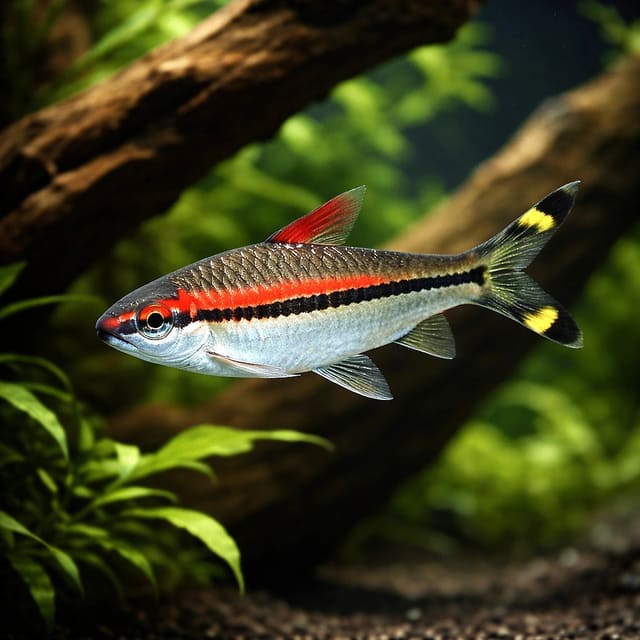
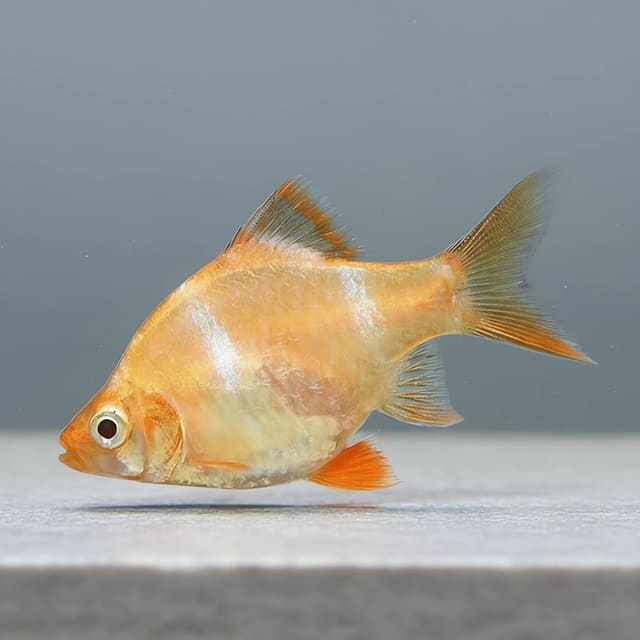
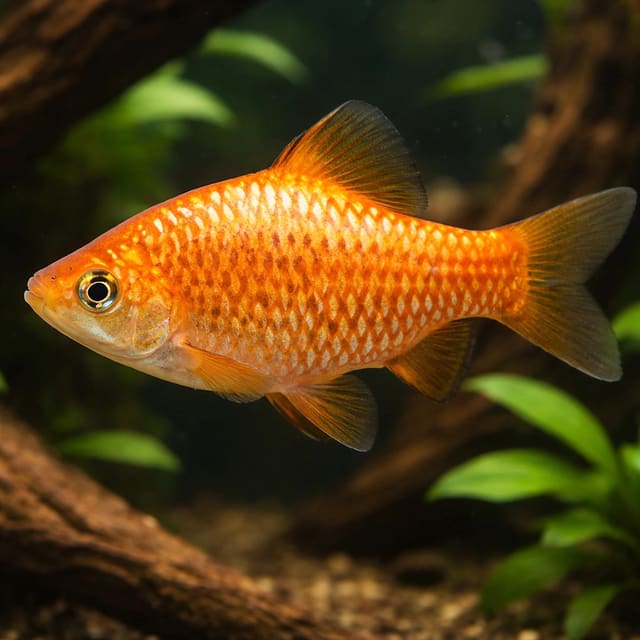
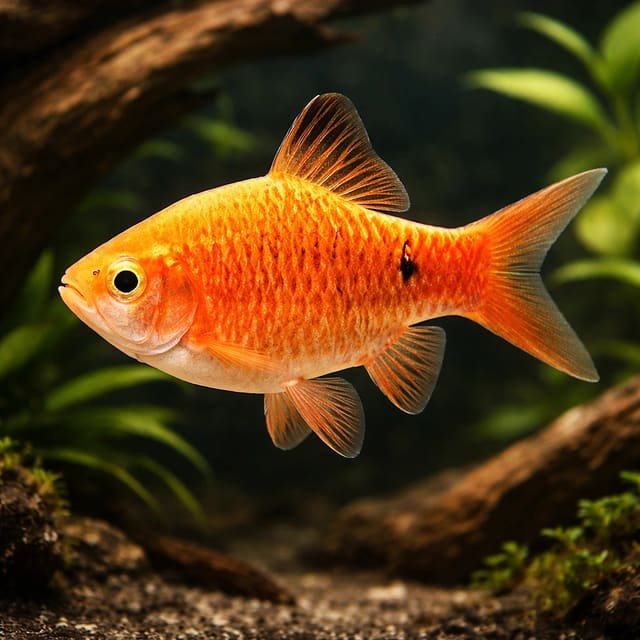
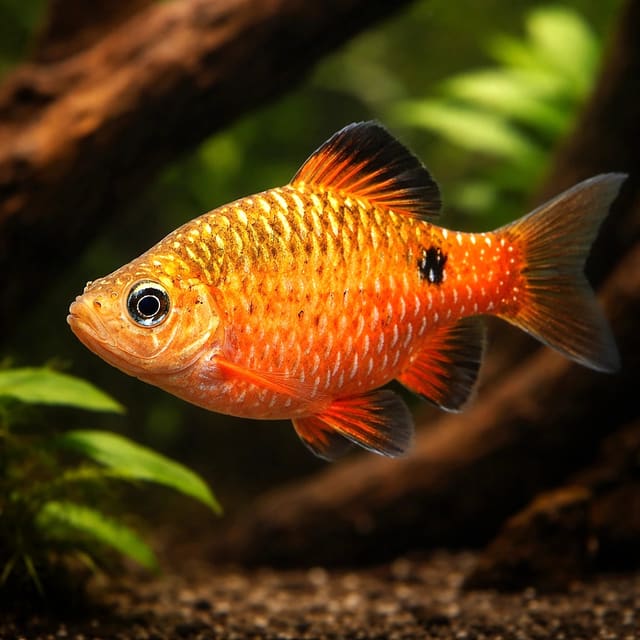
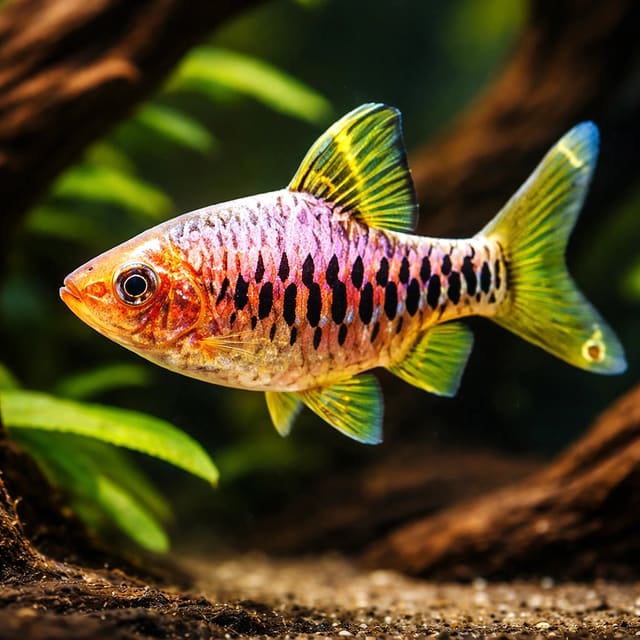
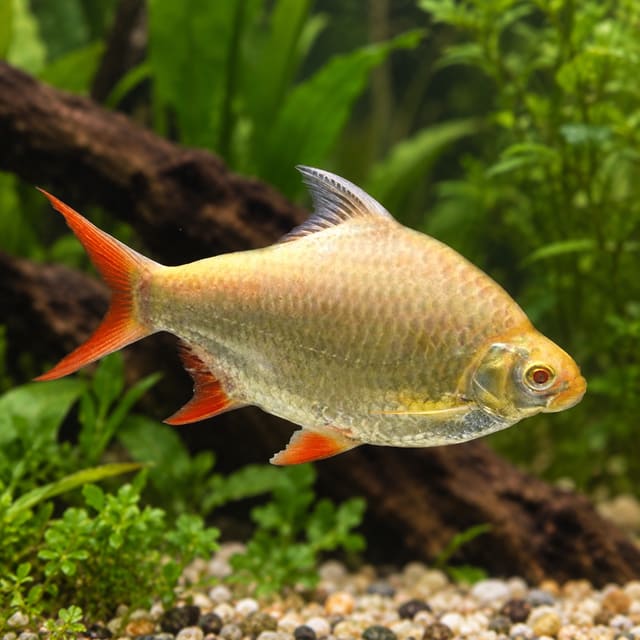
The Rhombo Barb has a compact, laterally compressed body with a softly arched back and neat barb profile. Adult size is usually 5-5.5 cm, making it ideal for medium planted tanks rather than very small nano aquariums. Its most distinctive feature is the chain of dark rhomboid or diamond-like blotches along the flanks, which gives the fish a netted, snakeskin effect. That is why the common name Snakeskin Barb appears so often in the trade.
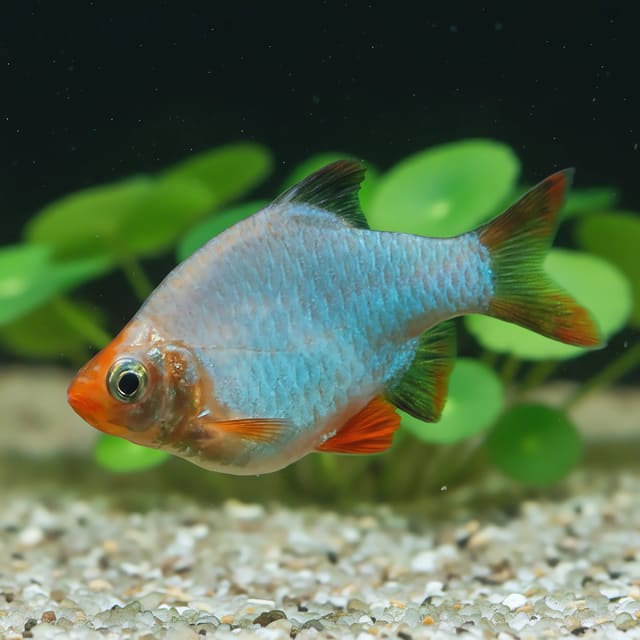
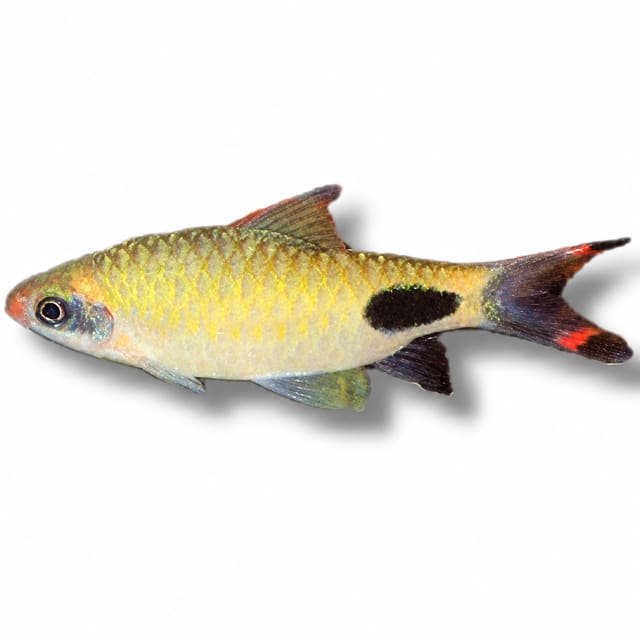
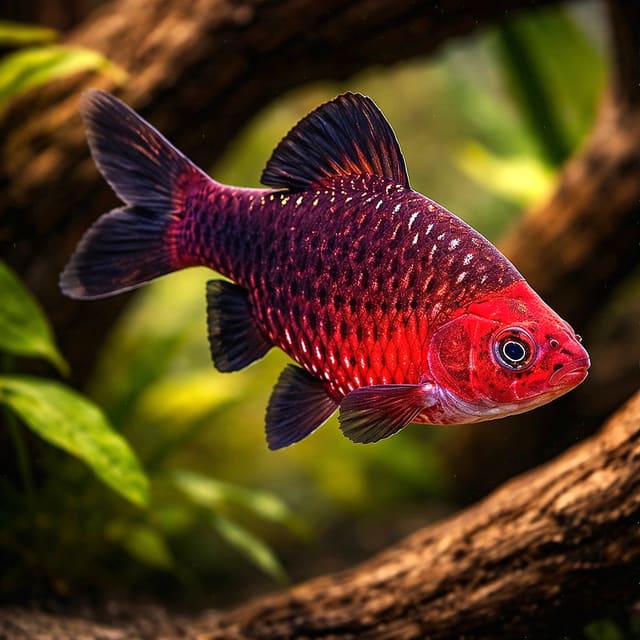
Base colour can range from bronze and orange-copper to warm brown depending on mood, sex, lighting, and décor. Fins often take on orange to reddish highlights, especially in settled males. For shoppers looking for freshwater fish with red fins, this species can be a subtle rather than flashy answer. Our photos show the intense chocolate-brown and copper tones achieved through dark substrate, tannins, and a varied diet. In a bright bare tank, those same fish may look much plainer.
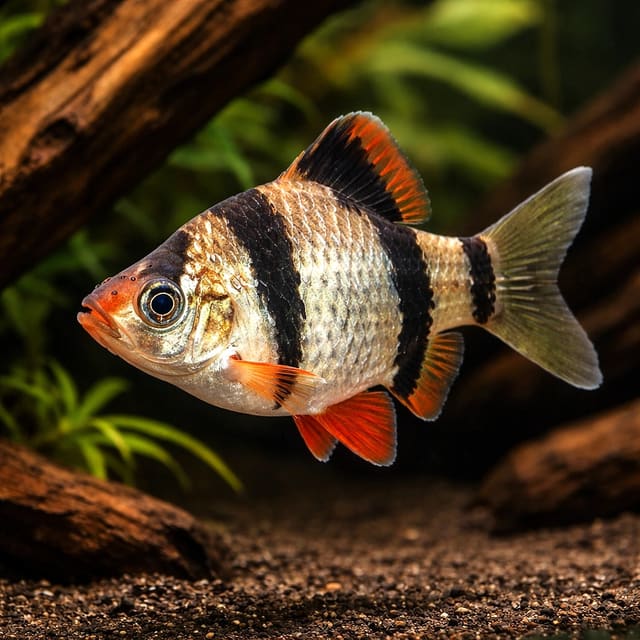
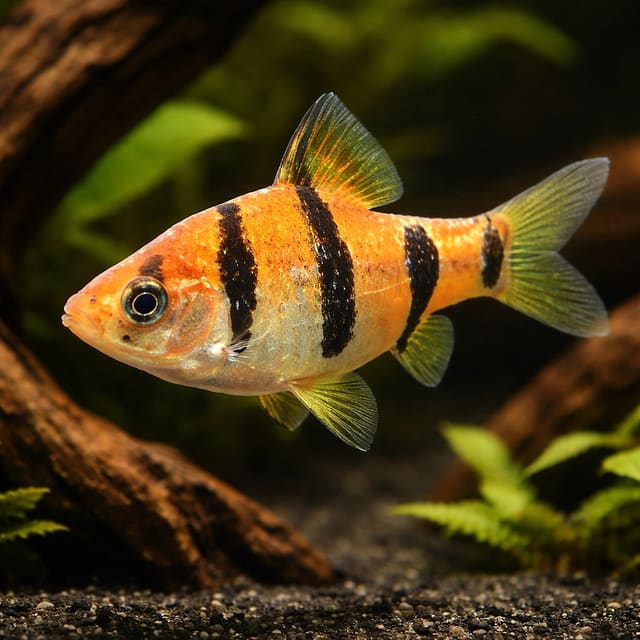
Males are usually slimmer, more colourful, and more sharply patterned, while females tend to appear rounder, especially when carrying eggs. Hobbyists sometimes compare rhombo barb vs cherry barb when choosing a peaceful red-toned fish. Cherry Barbs are brighter and easier for beginners, but Rhombo Barbs offer a rarer, more natural pattern. Searches such as snakeskin barb vs tiger barb are also common. Compared with Tiger Barbs, Rhombo Barbs are usually calmer, less boisterous, and better suited to a peaceful soft-water community. If you have seen a stunning snakeskin barb group UK display in a leaf-litter aquascape, you will understand why specialist keepers seek them out. They are not an orange tench-style novelty fish or a mass-market colour morph; their appeal is understated and authentic.
You may also see trade references like snakeskin barb for sale UK or snakeskin barb price UK. These usually point to the same species under a more marketable common name. Whether listed as Rhombo Barb or Snakeskin Barb, the pattern and care requirements remain the same.
What Fish Can Live With Rhombo Barbs? Compatibility Guide
The Rhombo Barb is best described as a peaceful barb UK aquarists can use in a calm, soft-water community. It is not a fin-nipper in the way more assertive barb species can be, but it is still a social cyprinid that needs a proper group. Keeping too few often leads to nervous behaviour and a less cohesive display. For anyone searching puntius rhomboocellatus tank mates, the safest rule is simple: choose small, peaceful fish that enjoy similar water chemistry and do not outcompete them at feeding time.
Ideal Tank Mates
Small rasboras are an excellent match. A group of X Strawberry Rasbora works especially well in a blackwater layout, adding movement without intimidation. Other small barbs can also fit, and X Sixbanded Barb is worth considering in larger, carefully planned setups where temperament and water conditions align. Small loaches and gentle anabantoids may also work, provided the aquarium has enough cover and floor space.
For aquarists interested in unusual but peaceful schooling fish, X Yellow-Tailed African Tetra can be considered in larger communities if water chemistry is suitable. In very spacious, well-managed aquariums, Lake Kurumoi Rainbowfish may suit a different style of display, though rainbowfish often prefer harder water than ideal for Rhombo Barbs, so this is more of a comparison point than a default recommendation.
Species to Avoid
Avoid boisterous fish, large cichlids, and hard-water species. The Short Body Texas Cichlid is a clear no for this species due to temperament and size mismatch. Likewise, fish such as Hybrid Blue Neon / Tiger Parrot Fish are not suitable companions in a typical Rhombo Barb setup. Even if aggression is not constant, the activity level and feeding pressure will stress the barbs. Large herbivorous or semi-aggressive fish like Myleus schomburgki are also unsuitable due to scale, water chemistry, and behaviour differences.
Community Tank Stocking Examples
In a 100-litre blackwater community, try 10 Rhombo Barbs with 12 small rasboras and a small bottom group of peaceful loaches. In a 120-150 litre planted soft-water tank, a larger school of 12-14 Rhombo Barbs can become the main visual feature. This makes them one of the best peaceful barb species UK hobbyists can choose for a specialist soft-water display. If you want a peaceful barb for community tank UK conditions, this species works best when the whole stocking plan respects its chemistry needs.
Compatibility with Invertebrates
Large adult shrimp may coexist in dense planting, but tiny shrimplets can be eaten. Snails are usually safe. The fish are not dedicated hunters, but they are still opportunistic omnivores. If shrimp breeding is the priority, a species-only shrimp tank is safer.
| Species | Compatible? | Notes |
|---|---|---|
| X Strawberry Rasbora | ✅ Yes | Excellent soft-water companion for a shaded planted aquarium |
| X Sixbanded Barb | ⚠️ Caution | Possible in larger tanks if both groups are well sized and water is suitable |
| Short Body Texas Cichlid | ❌ Avoid | Too aggressive and too large for a peaceful Rhombo Barb community |
Searches like uk freshwater fish, freshwater uk fish, freshwater fish species uk, uk freshwater fish species, freshwater fish in uk, freshwater fish in the uk, freshwater fish of the uk, uk fish species freshwater, and list of uk freshwater fish often mix native British species with aquarium species. The Rhombo Barb is not one of the native common freshwater fish uk or small freshwater fish uk found in local rivers. It is a tropical import for indoor aquaria, so questions like what size sea fish can you keep or uk sea fish species are unrelated to its care. That said, many people searching uk freshwater fish for sale or freshwater fish for sale uk do want something peaceful and unusual, and this species fills that niche very well.
💡 Compatibility Tip
Always quarantine new arrivals for 2-4 weeks before adding them to an established community. Rhombo Barbs dislike sudden stress, and introducing disease into a soft-water tank can be much harder to correct than preventing it in the first place.
How to Breed Rhombo Barbs: Complete Breeding Guide
Puntius rhomboocellatus breeding is considered difficult, and captive spawning is not commonly documented. The species is assumed to be a typical egg-scattering cyprinid, but it is not a fish most keepers breed accidentally in a community aquarium. If you are building a specialist project tank and working through a freshwater fish uk list of unusual species to spawn, this is one for advanced aquarists rather than first attempts.
Breeding Setup
Use a separate 40-60 litre breeding tank with very soft water, low conductivity, and an acidic pH around 5.0-6.0. Fine-leaved plants, spawning mops, or a mesh base can help protect eggs from hungry adults. Dim lighting is important. Condition a mature pair or small group with live and frozen foods. This is where terms like freshwater fish uk for tank, freshwater fish uk species, and freshwater fish uk identification matter less than close observation of body condition and behaviour.
Spawning Behaviour
Males should intensify in colour and display around females. Courtship is likely subtle rather than dramatic. Slight temperature changes, very soft water, and heavy conditioning often act as triggers in similar species. If you have kept Snakeskin Barb, Rhombo Barb, Diamond Eye Barb, or Orange Copper Barb type fish before, you will know that spawning often happens early in the day among plants or mops.
Egg Care & Hatching
Remove adults after spawning if eggs are seen, because barbs usually eat them. Gentle aeration and clean water are essential. Exact hatch times are not well established for this species, but similar small cyprinids hatch within 24-48 hours depending on temperature. Once free-swimming, fry need infusoria, vinegar eels, or powdered fry foods before graduating to baby brine shrimp.
Fry Care & Growth
Keep the tank spotless but avoid harsh water changes. Small, frequent changes with matched water are safer. Fry grow slowly in very soft water if underfed, so consistency matters more than force-feeding. Anyone working through a freshwater fish list uk, list of freshwater fish uk, or uk freshwater fish list for breeding projects will find this species more challenging than common livebearers or danios.
Common Breeding Challenges
The biggest problems are infertile eggs, adults eating the spawn, fungal losses, and unstable chemistry. Searches like pictures of freshwater fish in uk, british freshwater fish pictures, or how many freshwater fish species are there in the uk do not help much here because this is a specialist tropical breeding project, not a native species question. Success depends on soft water control, patience, and careful conditioning.
Advanced Breeding Tip
Use peat-filtered or RO-remineralised water to achieve low hardness and a stable acidic pH. Many blackwater cyprinids show better spawning response when conductivity is reduced gradually over 1-2 weeks rather than changed suddenly.
Rhombo Barb vs Similar Species: Which Should You Choose?
Comparison matters because many fishkeepers looking for a peaceful barb end up choosing between species that look similar in shop tanks but behave very differently at home. The Rhombo Barb is often compared with Cherry Barbs, Tiger Barbs, and Pentazona-type barbs. It is also sometimes confused with fish sold under trade names such as Snakeskin Barb. If you want a naturalistic soft-water fish rather than a bright beginner barb, the Rhombo is often the better fit.
| Feature | Rhombo Barb | Cherry Barb |
|---|---|---|
| Max Size | 5-5.5 cm | 4.5-5 cm |
| Care Level | Intermediate | Easy to moderate |
| Temperature | 20-28°C | 22-27°C |
| Price | £36.00 | £Varies |
| Best For | Soft acidic blackwater communities | General peaceful planted tanks |
| Feature | Rhombo Barb | Tiger Barb |
|---|---|---|
| Temperament | Peaceful | More assertive, can nip fins |
| Pattern | Diamond/snakeskin markings | Bold vertical stripes |
| Water Preference | Soft, acidic | More adaptable |
| Community Suitability | High with calm species | Moderate with robust tank mates |
| Best For | Specialist planted blackwater tanks | Livelier mixed barb communities |
If you are weighing up puntius rhomboocellatus vs pentazona barb, the Pentazona is often a little easier to source and more familiar in the hobby, but the Rhombo Barb has a more unusual reticulated pattern. In rhombo barb vs cherry barb terms, Cherry Barbs are easier for mixed beginner communities, while Rhombo Barbs are better for aquarists who want authenticity and softer water fish. In snakeskin barb vs tiger barb comparisons, the Rhombo is the calmer choice and one of the strongest candidates for a peaceful barb for community tank UK setup. If your goal is a subtle, elegant shoal rather than a high-energy display, choose the Rhombo.
For shoppers comparing species available as barb UK stock, it helps to decide whether you want colour intensity, rarity, or behaviour. Rhombo Barbs are not the loudest fish in the room, but they are among the most rewarding once settled.
Common Health Problems in Rhombo Barbs & How to Prevent Them
Healthy Rhombo Barbs are alert, school tightly but not fearfully, feed eagerly, and show clean fins with no fraying or clamping. Their pattern should look distinct, and the body should be gently rounded rather than pinched. Because they come from soft, acidic environments, they are less forgiving of poor water than many common community fish. The biggest health issue is not one specific disease but stress caused by unsuitable chemistry, rising nitrate, or repeated transport shock.
Signs of a Healthy Fish
Look for smooth swimming, good balance, clear eyes, and coordinated group behaviour. A settled shoal will move together through the mid-water and explore shaded areas confidently. Good appetite is another strong sign. If several fish hang at the surface, hide constantly, or lose colour, check water quality first.
Common Diseases & Symptoms
Like many small tropical fish, Rhombo Barbs can suffer from white spot, bacterial fin damage, wasting due to internal parasites, and stress-related secondary infections. White spot often appears after sudden temperature swings or after adding unquarantined fish. Fin issues are more common in tanks with poor maintenance or rough tank mates. Skinny fish that continue to eat may need parasite assessment.
Treatment Options
Start with testing ammonia, nitrite, nitrate, pH, and temperature. Correcting the environment often solves the underlying problem faster than medicating blindly. Use a separate hospital tank where possible. In soft-water species, overdosing medication can be risky, so always follow instructions carefully and consider reduced lighting during treatment. If invertebrates are present, choose treatments with care.
Prevention Tips
Stable rhombo barb water parameters, a varied diet, and a proper group size prevent most issues. Weekly partial water changes of 20-30% are usually appropriate, provided replacement water is matched closely. Keep nitrate low, avoid sudden pH shifts, and never add fish straight from a bag into a bright, busy display. This species rewards patience.
Quarantine Procedures
Quarantine all new fish for 2-4 weeks in a separate, cycled tank with simple décor and close observation. This is especially important when mixing specialist species from different sources. Many losses blamed on “delicate fish” are really preventable quarantine failures.
⚠️ Medication Warning
NEVER use copper-based medications with invertebrates in the same system. Copper is lethal to shrimp and can linger in décor and substrate.
Quarantine Protocol
- Duration: 2-4 weeks minimum
- Tank: separate cycled aquarium with heater and filter
- Observe: appetite, respiration, colour, faeces, fin condition
- Test: ammonia, nitrite, nitrate, pH, temperature
- Transfer only when fish are feeding and symptom-free
Understanding Rhombo Barb Behavior in the Aquarium
The Rhombo Barb is a classic shoaling fish with a calm but active personality. It spends most of its time in the middle levels, weaving through plants and wood, then regrouping in open water. Good puntius rhomboocellatus behaviour is easiest to observe in larger groups. In small numbers, fish often become withdrawn and nervous.
This species is not hyperactive, but it is not static either. Expect gentle schooling, occasional sparring between males, and more intense colour during feeding or courtship. In a dim, structured tank, the group becomes noticeably bolder. This is one reason many aquarists looking for schooling fish UK displays choose it over more common barbs.
To encourage natural behaviour, keep 8-10 or more, provide shaded retreats, and avoid loud tank mates. A proper blackwater layout often transforms them from shy imports into a cohesive shoal. For aquarists building a display around unusual barbel freshwater fish uk searches or broader freshwater fish in uk curiosity, this species shows how much behaviour depends on habitat matching rather than just species label.
Why Buy from Tropical Fish Co?
Rhombo Barbs are not a fish to treat like a generic mixed-community barb. Their appeal lies in condition, pattern quality, and how well they have been stabilised before sale. We select this species for aquarists who want a true soft-water shoaling fish, not a substitute for common hardier barbs. That matters because newly imported blackwater species often arrive pale and stressed, and they need time to settle before they show the look seen in established aquariums.
Our holding approach focuses on calm acclimation, stable temperature, and careful observation before listing fish as available. We pay close attention to feeding response, body condition, and group behaviour so that customers shopping freshwater fish uk for sale, uk freshwater fish for sale, freshwater fish for sale uk, or buy live fish online uk receive fish that are already eating and schooling properly. This species is especially popular with keepers searching puntius rhomboocellatus for sale UK, puntius rhomboocellatus for sale online UK, rhombo barb buy online UK, and specialist barb UK stock.
Fish are packed for UK transit in insulated boxes, with heat packs in cold weather and secure professional bagging to reduce movement and temperature loss. Tracked delivery helps minimise time in transit. We also provide practical acclimation guidance because soft-water fish can react badly to rushed introduction. If you have been searching tropical fish uk, tropical fish uk for sale, or even the best place to buy tropical fish online uk for something more unusual than standard shop stock, the Rhombo Barb is one of the most rewarding species to order with a proper plan in place. Order your Rhombo Barb today with confidence and build a peaceful, naturalistic shoal that looks better with every week it settles.
Why Choose Tropical Fish Co for Rhombo Barb
- Selected for pattern quality, feeding response, and calm group behaviour rather than sold straight from import stress
- Held and observed with soft-water needs in mind, helping this sensitive species settle better after arrival
- Packed for UK conditions with insulation and seasonal heat protection to support safe live fish delivery
You Might Also Like
To complete a peaceful soft-water community, consider a group of X Strawberry Rasbora for upper-level movement and colour contrast. If you enjoy barb species with a different pattern style, X Sixbanded Barb is a useful comparison. For specialist algae-grazing interest, Protomyzon pachychilus may appeal in the right setup. If you are exploring unusual schooling fish beyond barbs, X Yellow-Tailed African Tetra and Lake Kurumoi Rainbowfish offer different community directions. For aquarists comparing what not to mix, viewing Short Body Texas Cichlid, Hybrid Blue Neon / Tiger Parrot Fish, and Myleus schomburgki helps show why Rhombo Barbs do best with smaller, gentler companions.
You Might Also Like


Black Ruby Barb - UK

X Mahecola Barb - UK

X Gold Checkered Barb - Tropical Fish for Sale UK

X Green Tiger Barbs (Puntigrus tetrazona) - UK

Gold Barb (X Golden Barb) - UK

Gold Barb (X Gold Rosy Barb) - UK

Tiger Barb - Moderate Care | UK
Popular Right Now

Yellow Vampire Crab (Geosesarma sp.) - UK

Aulonocara sp. 'Firefish' - Tropical Fish for Sale UK

Yellow Lepturus Cichlid - UK

Apistogramma agassizii “Super Red” - UK

Endler Gold Guppy Breeding (Poecilia wingei) - UK

X Neon Green Rasbora - UK

Rasbora Heteromorpha (Trigonostigma heteromorpha) - UK