Moderate
Rhombo Barb (Desmopuntius rhomboocellatus)
23–28°C · pH 6.5–7.5 · 100L
£8.99
Peaceful striped barb for shaded planted aquariums, best kept in a group with calm tank mates and softer water.
Adult size is the maximum length this species reaches at full maturity (scientific sources). The livestock you receive will be younger and smaller. Product-photo provenance and any image-specific limitations are stated on the listing.
Desmopuntius hexazona
Shoaling fish: kept in a group they feel safer, stay calmer and show their best colour.
Confirm your email, then we’ll send an availability message for this exact item if it returns within 180 days.
This request is only for this product—no newsletter or other promotions. A mail-provider retry may very rarely duplicate the same availability message. Unconfirmed addresses are removed after 48 hours. See our privacy policy.
Peaceful striped barb for shaded planted aquariums, best kept in a group with calm tank mates and softer water.
Adult size is the maximum length this species reaches at full maturity (scientific sources). The livestock you receive will be younger and smaller. Product-photo provenance and any image-specific limitations are stated on the listing.
Maintain these water conditions for optimal health and vibrant colors
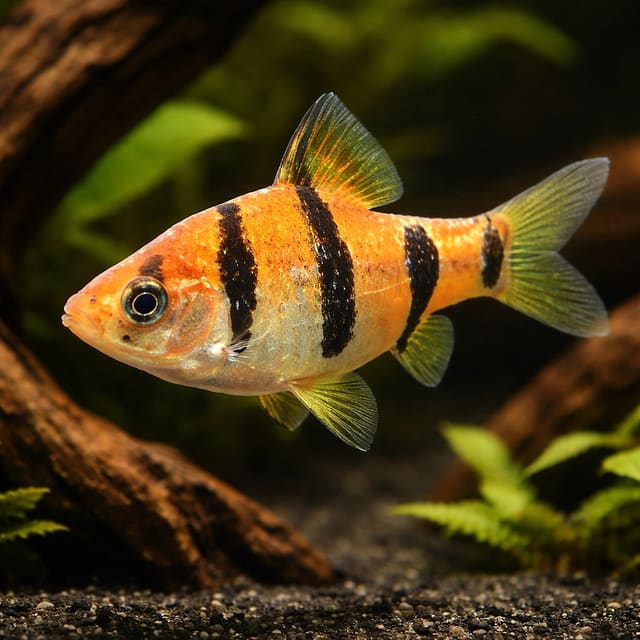
Sixbanded Barb (Desmopuntius hexazona) is a peaceful, small striped barb for shaded planted aquariums, especially tanks built around calm movement, soft acidic water and a proper group. It gives the classic banded-barb look without the constant bustle many keepers associate with Tiger Barbs, so it is a strong choice for a quiet community display when the aquarium is mature and the tank mates are chosen carefully.
The useful search terms are still here naturally: Sixbanded Barb, Six Banded Barb, Desmopuntius hexazona, Hexazona Barb and the older trade name Puntius hexazona. The difference is that those names now support genuine aquarium advice instead of being forced into every sentence.
| Scientific name | Desmopuntius hexazona |
|---|---|
| Common names | Sixbanded Barb, Six Banded Barb, Six-banded Tiger Barb, Hexazona Barb |
| Older trade synonyms | Puntius hexazona, Barbus hexazona, Systomus hexazona |
| Adult size | About 5 cm, with FishBase listing up to 5.5 cm total length |
| Best group size | At least 6; larger groups are calmer and show better schooling |
| Minimum aquarium | 80 litres or more for a settled group, with swimming space and cover |
| Temperature | 25-28 C is ideal; stable 22-28 C can be acceptable in mature aquariums |
| pH | Soft, slightly acidic water, usually pH 5.0-7.0 |
| Hardness | Soft to low-medium hardness; avoid hard alkaline community setups |
| Temperament | Peaceful, gregarious mid-to-lower level barb |
| Diet | Quality flakes, micro pellets, small frozen foods, daphnia, brine shrimp and mosquito larvae |
In the wild, Desmopuntius hexazona is associated with shaded Southeast Asian freshwater habitats such as swamp-forest streams, blackwater channels and quiet, heavily vegetated water. FishBase describes the species as freshwater, tropical, omnivorous and gregarious, frequenting the lower and middle levels. That matters in the aquarium because this is not a bright, bare-tank barb. It looks and behaves best when it has dimmer areas, plant cover and the confidence of its own group.
The species is often confused with the Five-Banded or Pentazona Barb in the aquarium trade. The practical care overlap is close, but the listing should still use the accepted name Desmopuntius hexazona while keeping Puntius hexazona and Barbus hexazona as natural synonym bridges for customers and search engines.
Plan the aquarium around stability, cover and low stress. A dark substrate, driftwood, roots, leaf-litter style decor, floating plants and shaded planting all suit this barb. Leave open lanes at the front or middle of the tank so the group can move together, but avoid a stark layout where every fish is exposed all day.
| Layout | Planted sides and back, open swimming lane, wood or root structure, shaded resting areas |
|---|---|
| Flow | Gentle to moderate; enough oxygen and filtration without blasting the group |
| Lighting | Subdued or broken by floating plants; strong light is best softened with cover |
| Water quality | Mature filter, low ammonia/nitrite, steady maintenance and careful acclimation |
| Best visual effect | A group over dark substrate with green plants and tannin-tinted decor brings out the warm body colour and bands |
Do not chase very low pH with sudden chemical changes. For home aquariums, a stable soft to slightly acidic range is usually safer than rapid adjustments. If your tap water is hard and alkaline, this is a fish to research before ordering rather than a species to force into unsuitable water.
Sixbanded Barbs are easy to feed once settled, but their small mouth and calm nature mean food size matters. Use a high-quality fine flake or micro pellet as the daily base, then rotate small frozen or live-style foods such as daphnia, brine shrimp, mosquito larvae and finely chopped bloodworm. SeriouslyFish describes the natural diet around small insects, worms, crustaceans and zooplankton, so small varied foods are more appropriate than large floating pellets.
Keep this barb in a group of at least six. A single fish, pair or tiny trio will be less confident and can become shy, washed out or unsettled. In a proper shoal the fish distribute attention among themselves, show more natural movement and are much easier to enjoy at the front of the aquarium.
Compared with boisterous barbs, Sixbanded Barbs are better suited to calmer community aquariums. They are still active cyprinids, so the goal is not a tiny still-life tank; the goal is a mature planted aquarium where the group has room to move but is not bullied by larger, faster or nippy species.
| Good choices | Small rasboras, peaceful tetras, gentle barbs, small loaches and calm Corydoras-type catfish where water needs overlap |
|---|---|
| Use caution | Very fast danios, larger barbs and pushy feeding fish that may outcompete them |
| Avoid | Large predators, fin nippers, hard-water specialists and aggressive cichlids |
| Community style | Peaceful planted community with similar-sized fish and soft-water preferences |
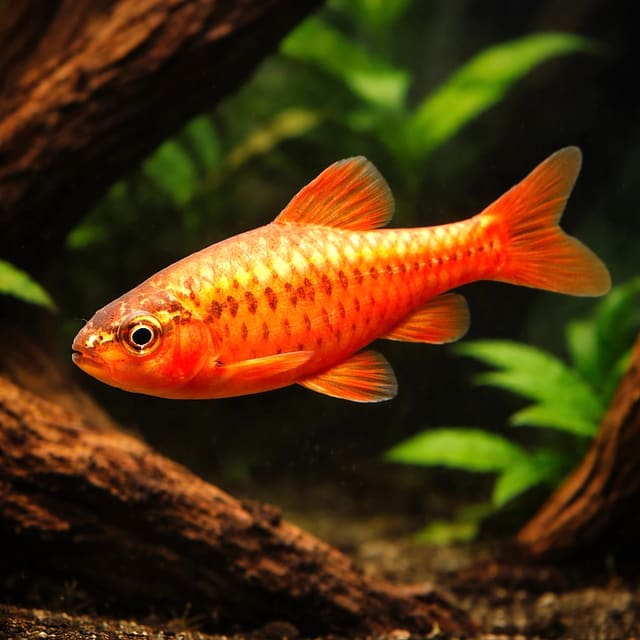
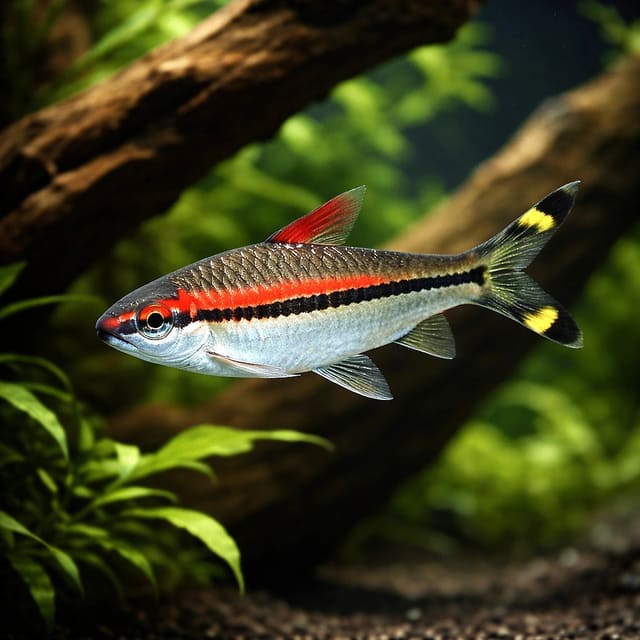
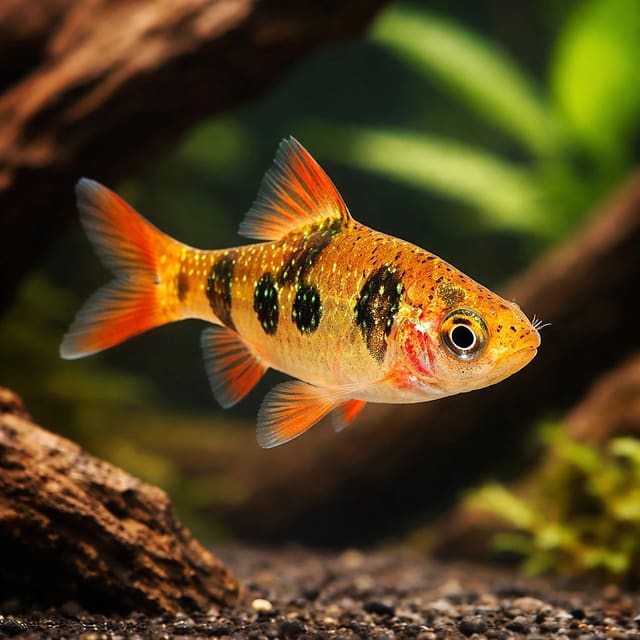
If you are building a soft-water community, compare this species with our Rhombo Barb, Five-Banded Barb, Cherry Barb and Golden Dwarf Barb. For a calmer planted-tank companion, also look at Neon Green Rasbora.
The appeal is the warm body colour crossed by dark vertical bands. The pattern is a big part of why this fish is searched as Sixbanded Barb, Six Banded Barb and Six-banded Tiger Barb. Mature females are normally fuller-bodied, while males can appear slimmer and more intensely coloured when settled, though young stock may not show strong differences.
Colour is strongly linked to stress and environment. A newly arrived or brightly lit fish may look pale. Give the group time, soft cover, dimmer areas and regular small feeds before judging final colour.
This species rewards careful acclimation. Match temperature slowly, avoid sudden pH or hardness swings, and only add the group to a cycled aquarium. Like many small barbs, it can be sensitive to unstable water, poor oxygen, crowding and aggressive tank mates. Quarantine is sensible if you already keep valuable soft-water fish.
When Sixbanded Barb is available, order only when the aquarium is mature, stable and ready for a group. Tropical Fish Co packs livestock for UK dispatch with live-fish welfare in mind, and livestock orders are covered by our Live Arrival Guarantee. First-time customers can use WELCOME5 where eligible, but the most important preparation is still the aquarium: soft, clean, stable water and peaceful tank mates.
If local inventory shows out of stock, this care guide remains useful for planning. It is better to prepare the tank first and wait for suitable stock than to buy a soft-water schooling barb before the setup is ready.
Choose Sixbanded Barb if you want a peaceful striped barb for a planted community, not a rough-and-tumble display. It suits aquarists who enjoy natural behaviour, groups of small fish, shaded aquascapes and careful soft-water husbandry. The cleaned page keeps the commercial intent in the right places, but the main value is now the care detail customers and search engines actually need.
You might also like Rhombo Barb, Five-Banded Barb, Cherry Barb and Golden Dwarf Barb.
No reviews for this item yet. Bought one? Honest reviews only, good or bad.
What customers say about ordering from us
Easy website plenty of info on fish your buying great to pick a time slot
TRACEY DURRANT · 7 Oct 2026
Got some lovely fish thank you
Kevin Mackie · 7 Oct 2026
Reviews of our shop, collected by Judge.me, an independent third-party review collector. Newest first.