Easy
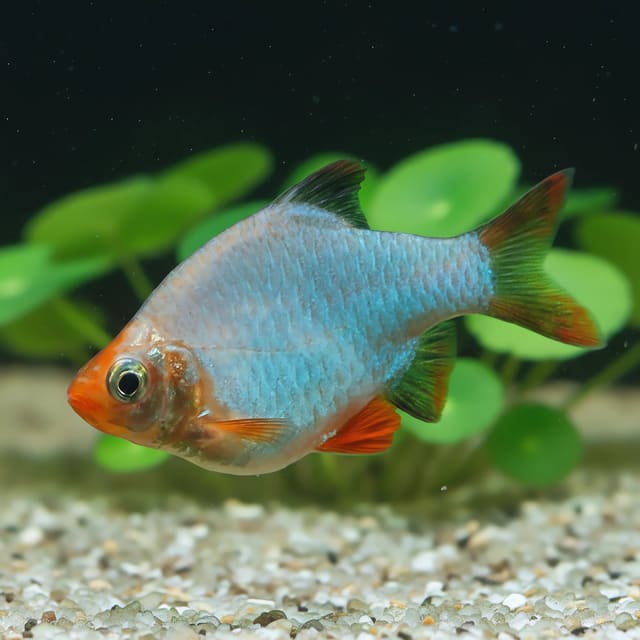
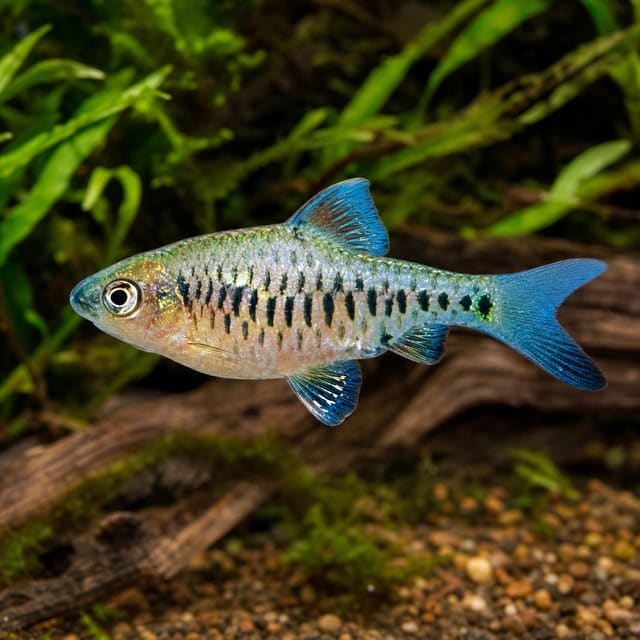
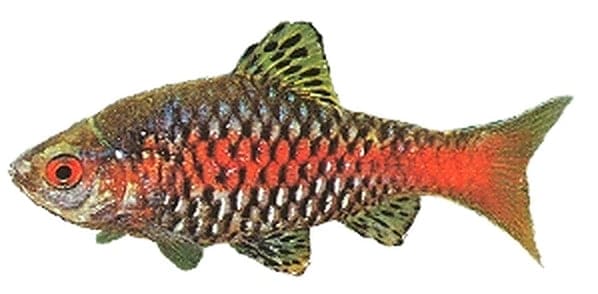
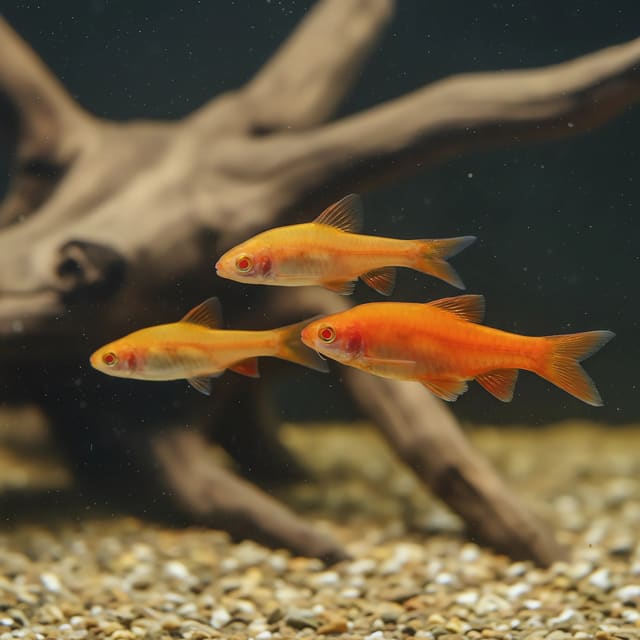
Albino Cherry Barb (Rohanella titteya)
20–27°C · pH 6–8 · 54L
£2.99
Photo coming soon
The size, price and care details on this page are for this listing.
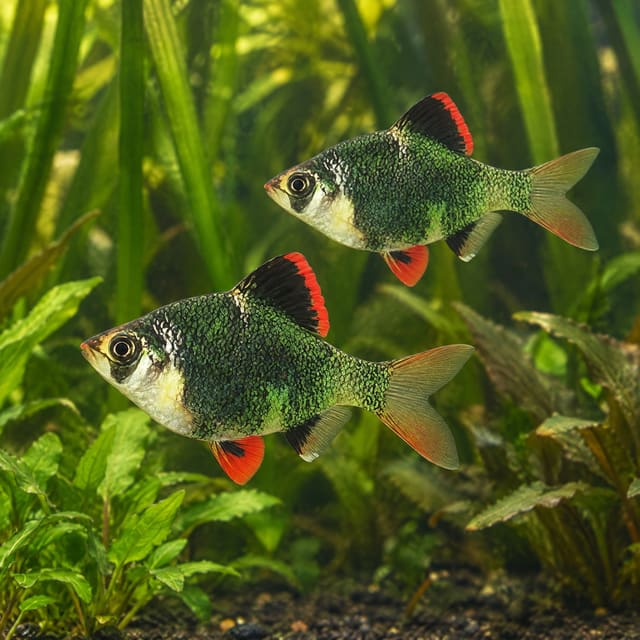
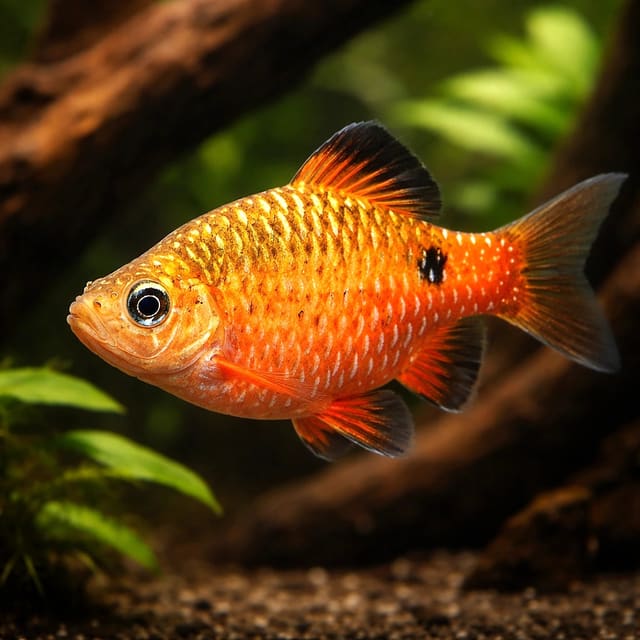
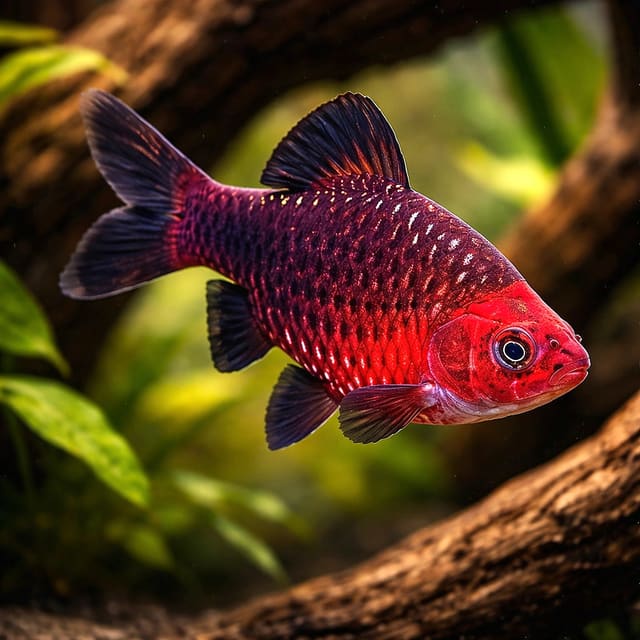
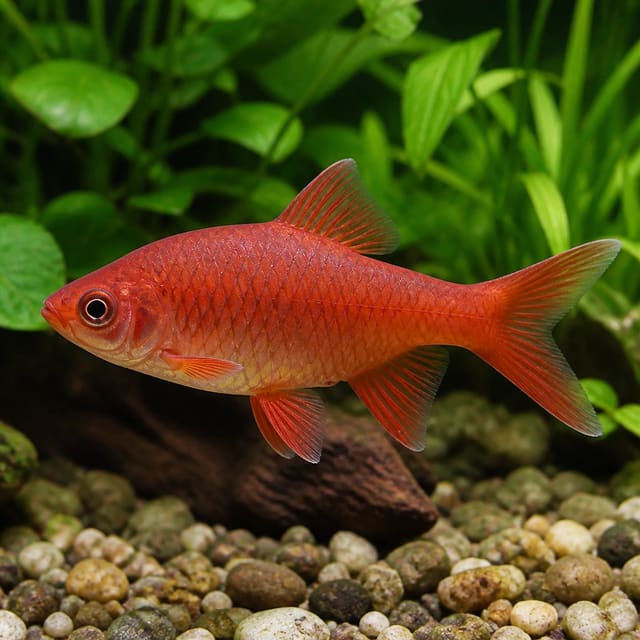
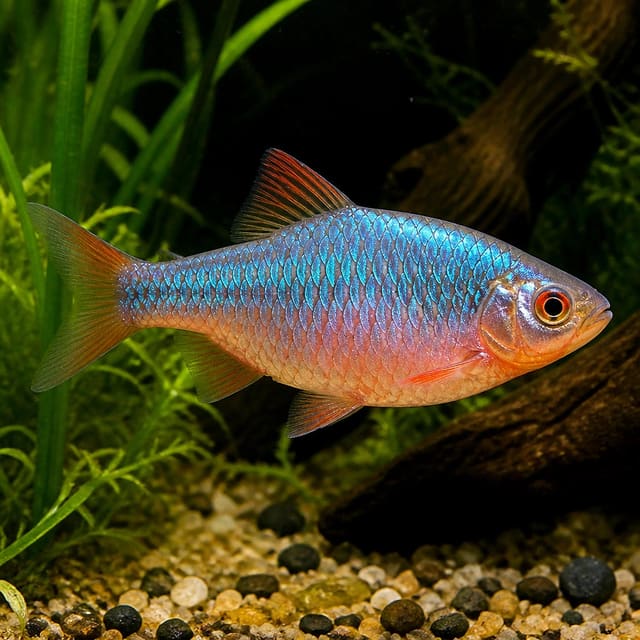
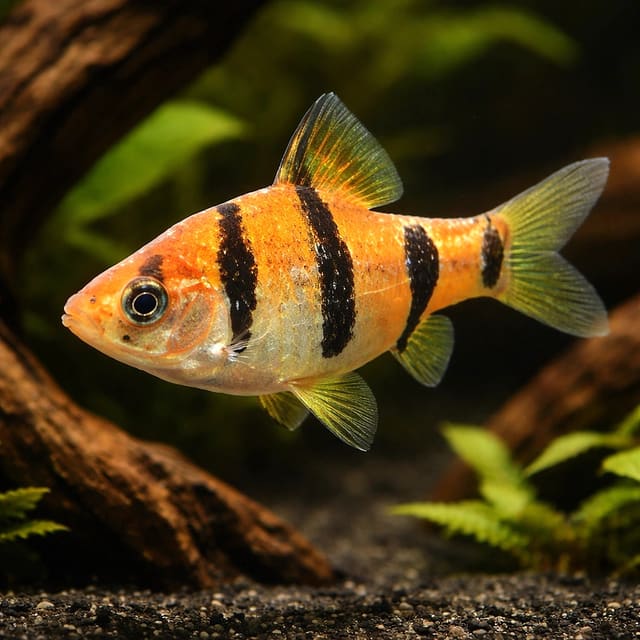
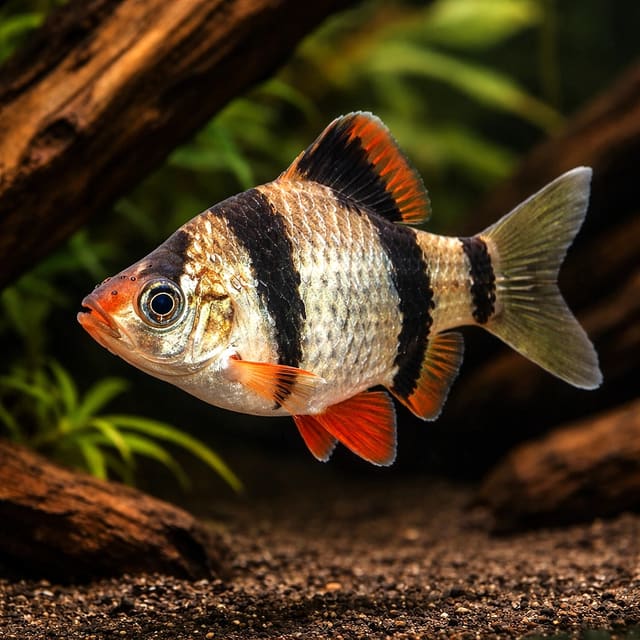
The Barbus tetrazona platinum orange (Barbus tetrazona) is an ornamental Cyprinidae barb from Sumatra and Borneo that reaches 7 cm. It suits prepared keepers who can keep at least five at 20–26°C, pH 6.0–8.0 and 5–19 dGH, the overlap of FishBase and Seriously Fish. Sold individually as one live fish per purchase.
Adult size is the maximum length this species reaches at full maturity (scientific sources). The livestock you receive will be younger and smaller. Product-photo provenance and any image-specific limitations are stated on the listing.
Barbus tetrazona
Shoaling fish: kept in a group they feel safer, stay calmer and show their best colour.
Minimum of 2 per order.
The Barbus tetrazona platinum orange (Barbus tetrazona) is an ornamental Cyprinidae barb from Sumatra and Borneo that reaches 7 cm. It suits prepared keepers who can keep at least five at 20–26°C, pH 6.0–8.0 and 5–19 dGH, the overlap of FishBase and Seriously Fish. Sold individually as one live fish per purchase.
Adult size is the maximum length this species reaches at full maturity (scientific sources). The livestock you receive will be younger and smaller. Product-photo provenance and any image-specific limitations are stated on the listing.
Maintain these water conditions for optimal health and vibrant colors
Barbus tetrazona platinum orange (Barbus tetrazona) is an ornamental platinum strain of the freshwater Sumatra barb, a member of the Cyprinidae family native to Sumatra and Borneo. FishBase records a maximum length of 7 cm and now lists the species as Puntigrus tetrazona. It suits a keeper prepared to maintain a lively social group, provide clear swimming space and choose companions around its boisterous behaviour.
The species is benthopelagic in nature, using the lower and open parts of freshwater habitats rather than living solely at the surface. Adults feed on worms, small crustaceans and plant matter. Its natural distribution and diet help explain two important aquarium decisions: leave room for active movement and offer an omnivorous diet that includes both animal and plant content.
Seriously Fish identifies platinum as one of the selectively bred ornamental strains and applies the same husbandry to it as to the standard form. The colour strain therefore does not change the adult-space, group, feeding or water-planning decisions set out here.
| Suits | Not suited to |
|---|---|
| A group of at least five | Keeping a single fish or too few companions |
| An aquarium with an 80 × 30 cm base or equivalent | A cramped aquarium with limited swimming space |
| Robust companions selected for similar size and temperament | Timid, slow-moving or long-finned fish |
| A maintained biological filter and stable water | An immature or unfiltered aquarium |
This is not a passive addition to a mixed community. Its social needs, activity and potential for fin biting make the composition of the whole aquarium as important as the water readings.
Plan for a 7 cm adult and keep at least five together. Seriously Fish recommends an aquarium base of at least 80 × 30 cm or equivalent, with an approximate volume of 72 litres, while FishBase records aquarium keeping in groups of five or more. These are adult planning figures, not temporary targets for a newly acquired fish.
Keep the aquarium at 20–26°C, pH 6.0–8.0 and 5–19 dGH. Those values are the overlap of the FishBase and Seriously Fish ranges for this species, so every stated value sits within both. Aim for stability inside the range instead of repeatedly adjusting water to chase a single point.
| Decision | Planning figure |
|---|---|
| Recorded adult size | 7 cm |
| Social group | At least five |
| Smallest base to consider | 80 × 30 cm or equivalent |
| Approximate volume | 72 litres |
| Temperature | 20–26°C |
| pH | 6.0–8.0 |
| General hardness | 5–19 dGH |
A group of five in the stated footprint is the starting point, not permission to fill every remaining part of the aquarium. Decorations, other fish and the space needed for active swimming all use the same capacity. If other residents are planned, assess their adult dimensions, behaviour and water requirements before adding them.
Use our water matcher to compare measured aquarium values with these targets. The result should be considered alongside the group, footprint and compatibility requirements rather than as a water-only decision.
This fish is sold individually, so one purchase supplies one live animal. Build the intended group deliberately: the species should be kept in groups of at least five, and every member contributes to the biological load and space used by the aquarium.
The adult length is the planning figure even when the fish received is smaller. Do not use a smaller temporary aquarium on the assumption that it can be replaced later; prepare the adult footprint and filtration before the fish arrives.
Sex is guaranteed only when the selected option explicitly states male or female. This Barbus tetrazona platinum orange listing has no sex-guaranteed option.
For other members of the same broad aquarium-fish category, you can browse the barbs collection. Treat each species as a separate care and compatibility decision rather than assuming that all barbs can share identical conditions.
Use 7 cm as the adult planning length throughout the aquarium plan. FishBase records that maximum total length for male or unsexed fish, while Seriously Fish gives 6 cm standard length. The 7 cm figure is the decisive value here, and the aquarium footprint should already accommodate it before the group is introduced.
Adult length affects more than whether a fish can physically turn around. A group of at least five needs shared swimming room, while decorations, wood and plants reduce the unobstructed area. Other residents also occupy space and add waste, so adult dimensions must be considered across the whole community.
At the planning stage, sketch the aquarium base and mark the areas occupied by wood, plants and other fixed décor. The remaining horizontal area shows whether the stated footprint still offers a clear route for the group. Repeat the exercise with every proposed resident included at adult size. If the plan depends on removing essential cover or compressing the swimming route, revise the stocking plan before introducing fish.
Do not estimate capacity by adding together the fishes’ lengths. Five adults at up to 7 cm form an active social group, and their combined needs include movement, behaviour, filtration and access to food. Judge the complete aquarium rather than treating each fish as an isolated measurement.
A fish fitting comfortably into a small space today does not make that space an appropriate long-term home. Moving an established group later also changes its surroundings and biological load. Beginning with the adult plan avoids making growth the trigger for an urgent aquarium change.
Keep the temperature at 20–26°C, pH at 6.0–8.0 and general hardness at 5–19 dGH. This is the overlap of FishBase and Seriously Fish: FishBase gives 20–26°C, pH 6.0–8.0 and 5–19 dGH, while Seriously Fish gives 20–26°C, pH 5.0–8.0 and 1–20 dGH. Using the shared range keeps every routine target inside both sets of figures.
Choose a stable point that works with the established aquarium and compatible residents. A reading near one end of a range is still a valid reading when it is steady; repeated chemical adjustment can create swings without improving the underlying aquarium. Measure first, compare the result with all three ranges, and make changes gradually when correction is necessary.
| Test result | Action |
|---|---|
| All values inside the stated ranges | Maintain the routine and watch for drift |
| Temperature outside 20–26°C | Check the heater, room conditions and thermometer |
| pH outside 6.0–8.0 | Check the source water and recent aquarium changes |
| Hardness outside 5–19 dGH | Compare aquarium water with the replacement water |
Temperature, pH and hardness answer different questions. A suitable temperature does not compensate for unsuitable pH or hardness, and one good test does not show that conditions remain stable over time. Record results so that gradual drift can be distinguished from a single unusual reading.
Test the aquarium and the prepared replacement water before the group is introduced. Record the date, temperature, pH and hardness together so later readings can be compared with the same starting point. A sequence of readings is more useful than an isolated number because it shows whether the aquarium is stable, moving gradually or changing abruptly.
If a later result differs, check the measurement again before changing the aquarium. Then review the heater, source water, recent water changes and anything newly added to the setup. Correct the cause gradually while keeping the result inside 20–26°C, pH 6.0–8.0 and 5–19 dGH. This prevents one unusual reading from prompting several competing adjustments.
Our water chemistry guide explains what the principal measurements mean. Test the prepared aquarium before introducing the group, then continue testing as part of routine maintenance and whenever behaviour, breathing, appetite or appearance changes.
Use an aquarium with a base of at least 80 × 30 cm or an equivalent footprint. Seriously Fish describes this as the smallest base to consider and gives an approximate volume of 72 litres. The footprint matters because this is an active, boisterous group fish; an alternative aquarium should provide genuinely equivalent horizontal room rather than matching litres through extra height alone.
Keep at least five together. FishBase gives five or more for aquarium keeping, and Seriously Fish links pronounced aggression and fin biting with insufficient numbers or limited space. A group therefore needs both the social number and the room to use it. Meeting one requirement does not cancel the other.
Décor is flexible, but Seriously Fish notes that the fish tends to show better colour in a well-decorated aquarium and appears to appreciate floating or overhanging vegetation with driftwood roots or branches. Place these features around clear movement routes instead of creating a dense barrier across the whole base.
View the aquarium from the front and both ends after the décor is installed. Confirm that the group can move through the central area without every route narrowing around the same branch, plant or ornament. Cover can frame the swimming space, but it should not divide the stated minimum footprint into several cramped compartments.
Next, include the space used by every established resident. Bottom-dwelling companions, open-water swimmers and the barb group may occupy different positions, but they still share the aquarium’s volume, filtration and feeding areas. If adding the planned group removes the open route or crowds another resident’s adult space, use a larger aquarium or revise the community.
The aquarium should be mature before livestock is introduced. If this is your first setup, follow our guide to preparing and maturing a first tropical aquarium. Maturation establishes the biological filtration needed to process fish waste; simply filling a new tank and reaching the right temperature does not complete that preparation.
Run a well-established biological filter continuously. The RSPCA explains that fish release toxic ammonia and that beneficial bacteria in a working biological filter convert it first to toxic nitrite and then to safer nitrate. A filter is therefore part of the life-support system, not simply a device for making the water look clear.
For an aquarium of about 72 litres, Seriously Fish recommends turnover of four to five times the aquarium volume per hour and gives a filter rating of approximately 290–360 litres per hour. Use those figures as the worked example for the stated minimum plan. If the aquarium volume changes, assess the filter rating against that actual volume rather than copying the same litres-per-hour figure.
Seriously Fish also gives roughly 50 W of heating to hold 20–26°C in an aquarium of this size when the room is around 20°C. That example depends on the room temperature and aquarium, so choose equipment for the actual conditions and confirm performance with a thermometer.
For the approximate 72-litre example, a rating below 290 litres per hour falls short of the stated four-times turnover, while 290–360 litres per hour represents the recommended worked range. Read the filter’s rating, then check that water is actually entering the intake and returning through the outlet. A stated rating cannot compensate for clogged media or a blocked intake.
After maintenance, confirm that the outlet flow has resumed and that the heater is holding the chosen point inside 20–26°C. Check again after the aquarium has settled rather than relying only on the moment the equipment restarts. If debris quickly returns to the same area, review the flow path and décor arrangement while preserving the group’s open swimming route.
Visible flow is not a substitute for water testing. Clear water can still contain ammonia or nitrite, and a filter can continue running while its flow is reduced. Treat declining output, unusual noise or accumulating debris as prompts to inspect the system before water quality deteriorates.
Make good-quality dried flakes or granules the practical staple, with at least some foods containing additional plant material. Seriously Fish recommends regular meals of small live or frozen foods such as bloodworm, Daphnia and Artemia alongside those dried foods. This matches the recorded natural diet of aquatic invertebrates with smaller amounts of plant material and organic detritus.
For portion and timing, OATA's tetra and pencilfish sheet offers broad small-fish guidance: feed once a day and give only what can be eaten within a few minutes. Use that schedule to control waste while using the species diet above to decide what goes into the meal.
| Food role | Supported choices |
|---|---|
| Regular dried food | Quality flakes or granules, including plant content |
| Live or frozen variety | Bloodworm, Daphnia or Artemia |
| Portion limit | Only what is eaten within a few minutes |
| Routine frequency | Once a day |
Watch the whole group during feeding. Food should reach multiple fish rather than remaining concentrated in one place, and the meal should finish without a persistent layer of uneaten material. If food remains after a few minutes, reduce the next portion instead of leaving it to break down.
Begin with the dried staple and keep the whole meal within the same few-minute limit when live or frozen variety is included. Adding bloodworm, Daphnia or Artemia is a change in variety, not permission to add a second full portion. Include plant-containing dried food regularly so the diet continues to reflect both sides of the recorded omnivorous feeding pattern.
Observe whether every member approaches food, whether one area receives most of it and whether material reaches the substrate uneaten. Adjust where the food is placed so multiple fish can feed, but reduce the total amount if remnants persist. Remove the cause of repeated leftovers through portion control rather than relying on the filter to process extra waste.
A reduced appetite can be an early sign that something has changed. Check temperature and water quality, observe breathing and swimming, and compare the behaviour across the group. Do not respond by adding extra food, because uneaten food increases the waste the filter must process.
Make a 25% partial water change at least once every week. Test the water at least weekly, aiming for zero ammonia and zero nitrite. OATA also advises keeping nitrate no more than 20 mg per litre above the normal tap-water level.
Treat replacement tap water with a suitable conditioner before adding it to the aquarium so chlorine or chloramine does not enter the system. Match the replacement water closely enough to avoid an abrupt change to the established temperature and chemistry. A regular record of temperature, pH, hardness, ammonia, nitrite and nitrate makes gradual changes easier to identify.
Keep each weekly result beside the maintenance action taken that day. Record ammonia, nitrite and nitrate before the water change, then note the volume changed, whether filter flow needed attention and whether the replacement water was conditioned. This creates a practical history of the aquarium rather than a collection of unrelated test numbers.
If ammonia or nitrite appears above zero, test again and inspect the filter, recent feeding and recent stocking changes. If nitrate rises beyond 20 mg per litre above the normal tap-water level, review the weekly maintenance and waste removal. Continue observing the group while correcting the water conditions because breathing, swimming and appetite changes can show that the fish are affected.
Observe swimming, colour, temperament, breathing, body condition, fins, scales and interest in food. Warning changes include hanging at the surface, sitting on the bottom, erratic swimming, darker or paler colour, increased aggression, unusual hiding, faster or slower gill movement, white spots, fluffy growths, damaged fins or scales, weight change and reduced feeding.
If you notice one of these changes, test the water first and contact us for guidance. The immediate measurements help distinguish a water-quality problem from a change that needs a different response. Avoid adding an unselected treatment before the aquarium conditions and visible signs have been assessed.
Have the mature, filtered aquarium ready at 20–26°C, pH 6.0–8.0 and 5–19 dGH before the parcel arrives. Confirm the readings and leave enough room for the intended group and existing residents. Arrival day is not the time to begin cycling a filter or redesigning the aquarium.
The continuous recording is required for a Live Arrival Guarantee claim, so film every parcel from its sealed state rather than trying to recreate the sequence after opening. The policy also requires someone to be at the delivery address, with the parcel opened and inspected on the day it arrives.
If there is an arrival problem, contact us the same day with the order number and continuous unboxing video showing the sealed parcel, opening and fish still inside the bag. Keep the video intact so the full sequence can be assessed.
Read the current delivery and Live Arrival Guarantee policy before arrival. It explains the packing approach, reception requirements and claim process in one place.
Avoid timid, slow-moving and long-finned fish. FishBase specifically says not to keep this species with long-finned fishes, while Seriously Fish describes it as notoriously aggressive, relatively boisterous and known for biting fins. The biting tendency appears most pronounced when too few are kept or space is limited, so maintain at least five and provide the stated footprint without treating those measures as permission to add vulnerable companions.
Many livebearers, cichlids and anabantoids fall into the timid, slow-moving or long-finned categories identified by Seriously Fish. Assess the individual species rather than approving or rejecting an entire family by name, but place any fish that meets one of those vulnerable descriptions under avoid.
| First test | Second test |
|---|---|
| Does the companion tolerate 20–26°C, pH 6.0–8.0 and 5–19 dGH? | Is it robust, suitably sized and free of vulnerable long fins? |
| Can the aquarium hold every adult and social group? | Will enough open swimming and lower-area space remain? |
Passing the water test alone is not enough. A slow or timid fish can share the same chemistry and still be a poor behavioural match. Conversely, a robust fish is not suitable if its own water, adult-space or social requirements conflict with this aquarium.
Watch whether chasing is brief and distributed or repeatedly directed at one fish. Concentrated fin attention, persistent hiding or reduced access to food means the community needs immediate reassessment. Check that the barb group still contains at least five and that the 80 × 30 cm minimum footprint has not become crowded by the combined adult community.
Do not use a larger barb group as a reason to retain a timid, slow-moving or long-finned companion. Group size and space address the barb’s social plan, while the avoid rule protects vulnerable fish. Both decisions must remain satisfied throughout the life of the aquarium.
Introduce additions only after the full adult community has been planned. Observe the established group for chasing, concentrated fin attention, hiding and reduced access to food, especially after a stocking change.
Seriously Fish names comparably sized pelagic cyprinids as strong possibilities and also lists balitorid, cobitid and nemacheilid loaches, benthic cyprinids such as Crossocheilus or Garra, and many rainbowfishes and tetras. These are candidate groups, not universal approvals. Research the exact species and confirm water, adult size, social number, temperament and available space before combining them.
When comparing a proposed companion, start with its own care needs rather than its shop category. Then compare those needs with the 80 × 30 cm minimum base, the approximate 72-litre starting volume, the group of at least five and the shared water ranges. If the combined adult plan leaves too little swimming area or filtration capacity, the match fails even if the species are behaviourally compatible.
First confirm that the candidate’s temperature, pH and hardness needs fit 20–26°C, pH 6.0–8.0 and 5–19 dGH. Next check its adult size, required group number and preferred swimming area. Finally compare its temperament and fins with the avoid rule. A candidate that fails any stage should not be added simply because its broader group appears in the potential list.
For invertebrates, keep the decision at exact-species level. Do not treat “shrimp”, “snail” or another broad label as a compatibility result. Their adult dimensions, behaviour and water needs must be compared with the barb group before introduction.
Our team can help assess a proposed stocking plan when you provide the aquarium dimensions, measured water values, filter details, existing residents and intended group numbers. Those details produce a more useful decision than a list of fish names alone.
It reaches a recorded maximum length of 7 cm according to FishBase. Plan the aquarium and community around that adult figure.
Seriously Fish recommends an aquarium base of at least 80 × 30 cm or equivalent, with an approximate volume of 72 litres, for the required social group.
FishBase says to keep at least five. Maintain that group in adequate space because insufficient numbers or limited room may make fin biting more pronounced.
It suits a prepared keeper who can provide at least five fish, an 80 × 30 cm base or equivalent, stable filtered water and carefully screened companions.
It is omnivorous: offer quality flakes or granules containing some plant material, with small live or frozen bloodworm, Daphnia or Artemia for variety. OATA's broad small-fish schedule is once daily, limited to what is eaten within a few minutes.
Keep it at 20–26°C, pH 6.0–8.0 and 5–19 dGH. These values are the overlap of the FishBase and Seriously Fish ranges for this species.
It is boisterous and has a reputation for fin biting, especially when numbers are insufficient or space is limited. Keep at least five and avoid timid, slow-moving or long-finned fish.
Consider comparably sized pelagic cyprinids, named loach groups, Crossocheilus, Garra, many rainbowfishes and many tetras after exact-species screening. Compatibility with shrimp, snails and other invertebrates should be treated as uncertain.
The Tropical Fish Co delivery policy says it is hand-bagged in pure oxygen in an insulated poly box, with a heat pack when weather calls for it. Receive it in person, film continuously from the sealed parcel, and float the bag for 20–30 minutes before release.
No reviews for this item yet. Bought one? Honest reviews only, good or bad.
What customers say about ordering from us
Easy website plenty of info on fish your buying great to pick a time slot
TRACEY DURRANT · 7 Oct 2026
Got some lovely fish thank you
Kevin Mackie · 7 Oct 2026
Reviews of our shop, collected by Judge.me, an independent third-party review collector. Newest first.