−15%
Easy
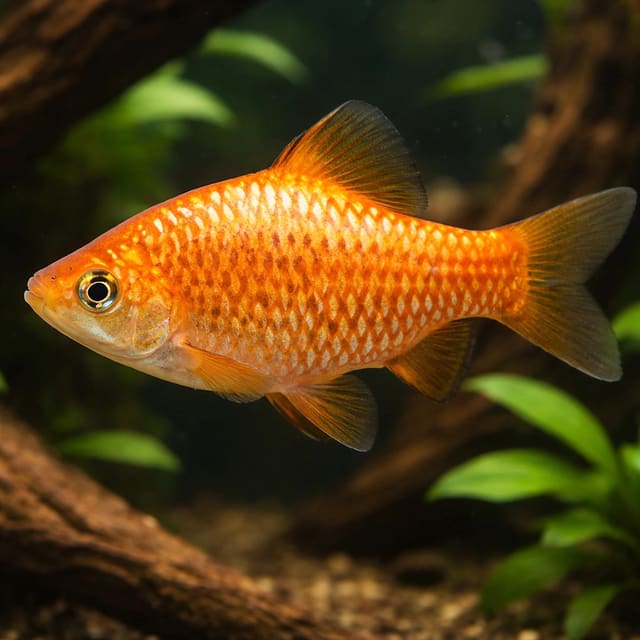
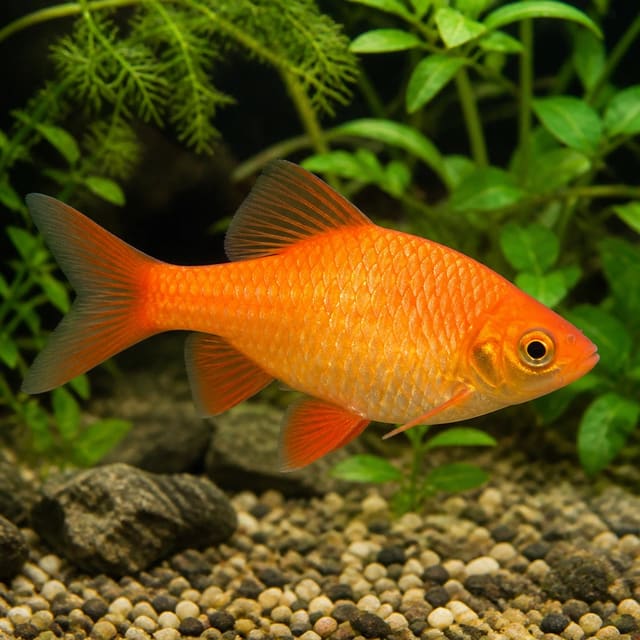
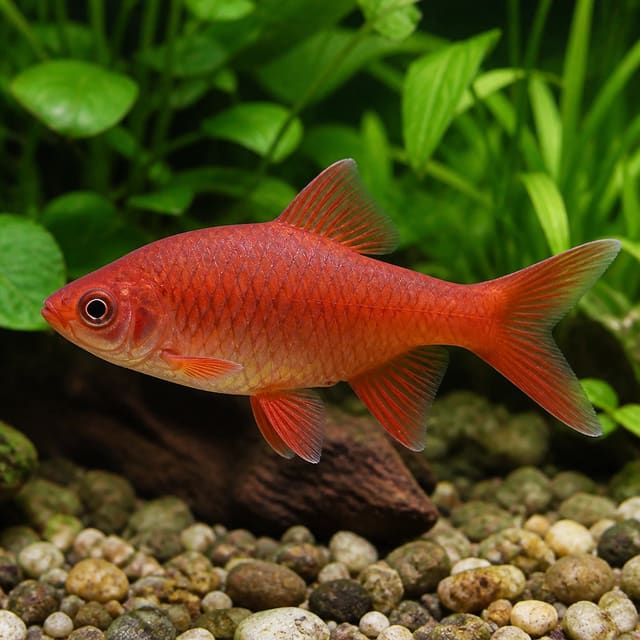
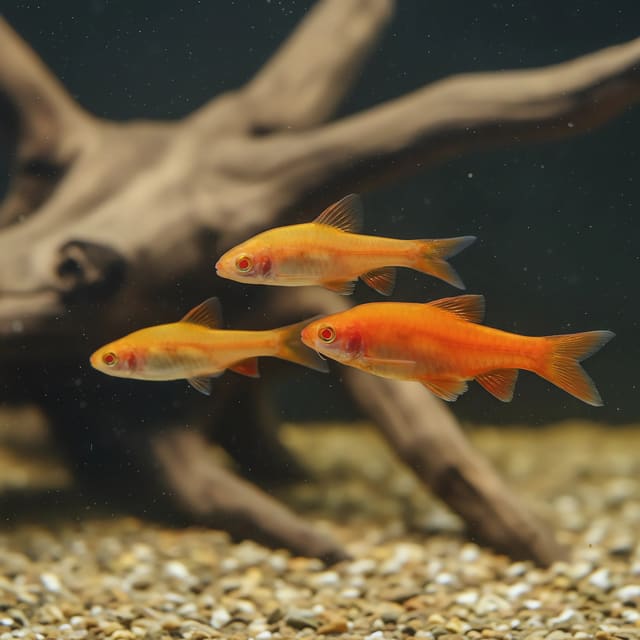
Albino Cherry Barb (Rohanella titteya)
20–27°C · pH 6–8 · 54L
£6.79£7.99

Green Tiger Barb is the green or moss form of Puntigrus tetrazona. One purchase supplies one fish in the selected size option. Plan a substantial group, an aquarium base of at least 80 × 30 cm and robust companions rather than timid, slow-moving or long-finned fish.
Adult size is the maximum length this species reaches at full maturity (scientific sources). The livestock you receive will be younger and smaller — pick a size above for the actual shipping size. Product-photo provenance and any image-specific limitations are stated on the listing.
Puntigrus tetrazona
Shoaling fish: kept in a group they feel safer, stay calmer and show their best colour.
Minimum of 2 per order.
Green Tiger Barb is the green or moss form of Puntigrus tetrazona. One purchase supplies one fish in the selected size option. Plan a substantial group, an aquarium base of at least 80 × 30 cm and robust companions rather than timid, slow-moving or long-finned fish.
Adult size is the maximum length this species reaches at full maturity (scientific sources). The livestock you receive will be younger and smaller — pick a size above for the actual shipping size. Product-photo provenance and any image-specific limitations are stated on the listing.
Maintain these water conditions for optimal health and vibrant colors
Green Tiger Barb is the green ornamental form of Puntigrus tetrazona. our stock records may call the offered fish Barbus tetrazona green or Capoeta tetrazona green; both labels refer to the Green Tiger Barb offered here. These names help identify the same trade fish when comparing supplier labels, aquarium books and current species information.
FishBase identifies Puntigrus tetrazona as a freshwater, benthopelagic tropical member of Cyprinidae, the minnow and carp family, native to Sumatra and Borneo in Asia. It records that the species has been introduced widely and reared in several countries in facilities for breeding aquarium fishes, and lists it as Least Concern under the IUCN assessment reported there. Seriously Fish's species profile explains that Green Tiger Barb and Moss Green Tiger Barb are UK trade names for a selectively bred green or moss strain. The selectively bred green or moss strain has the same care requirements as the standard Tiger Barb. Tiger Barbs have traditionally been among the most widely available aquarium fishes, while wild examples are rarely traded. Commercial aquarium strains have also accumulated some identity confusion, which is why Puntigrus tetrazona is the clearest scientific identification for this offer. Seriously Fish gives an adult standard length of 60 mm, while FishBase records a maximum of 7.0 cm total length.
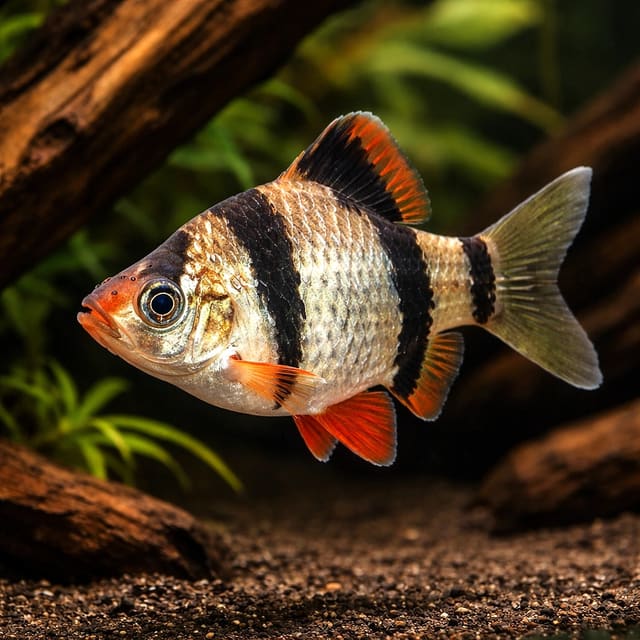
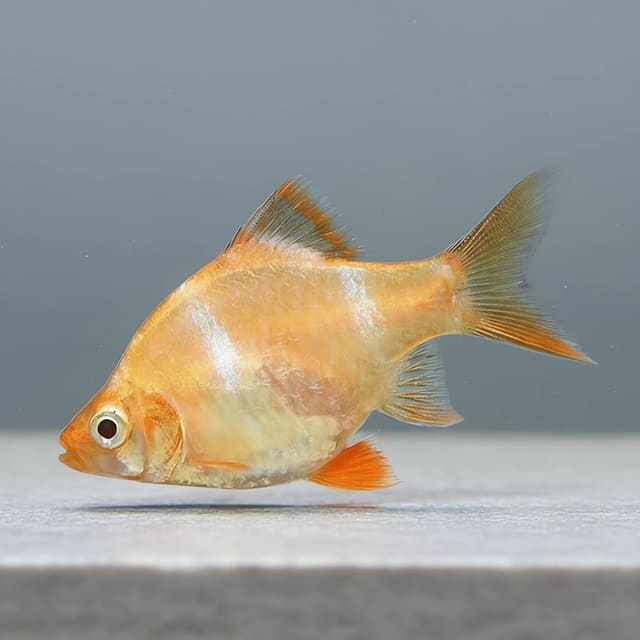
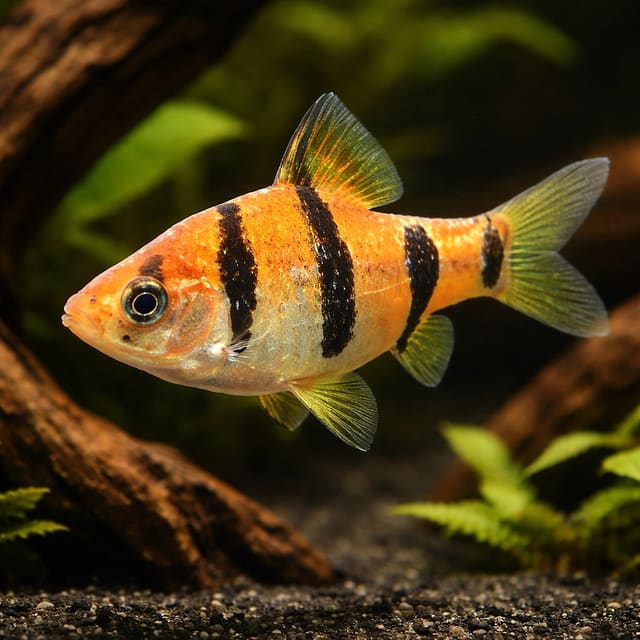
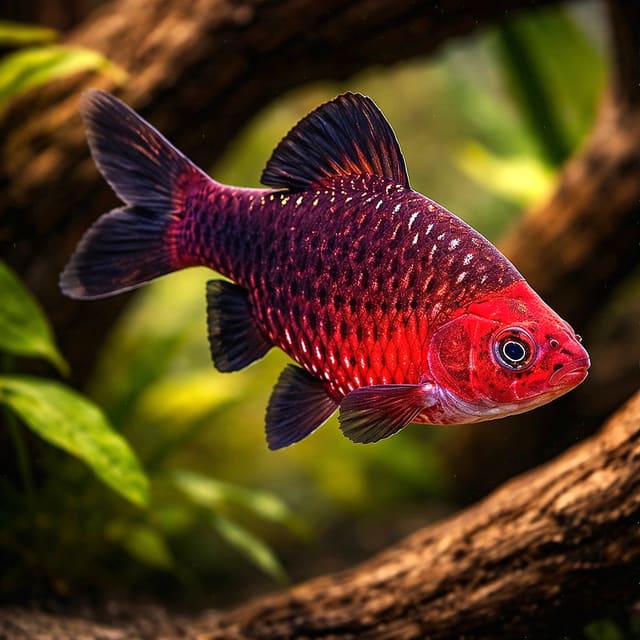
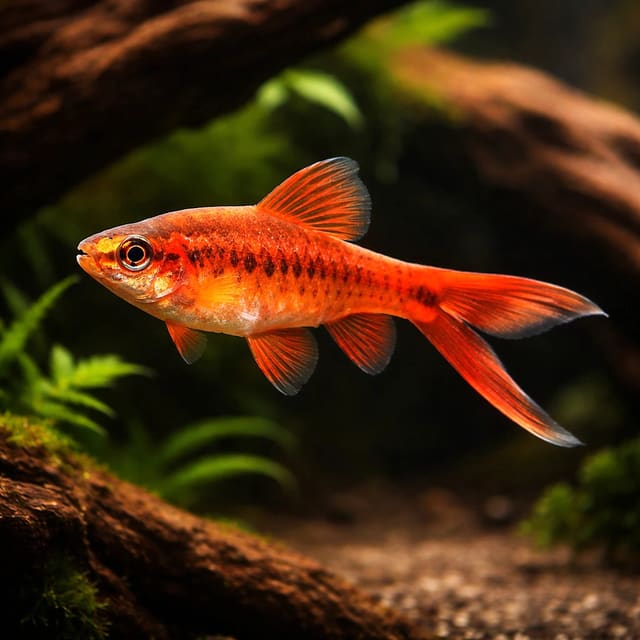
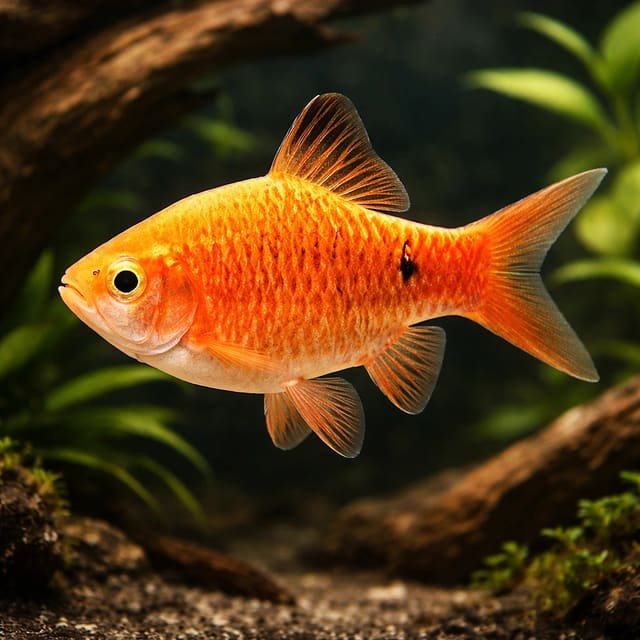
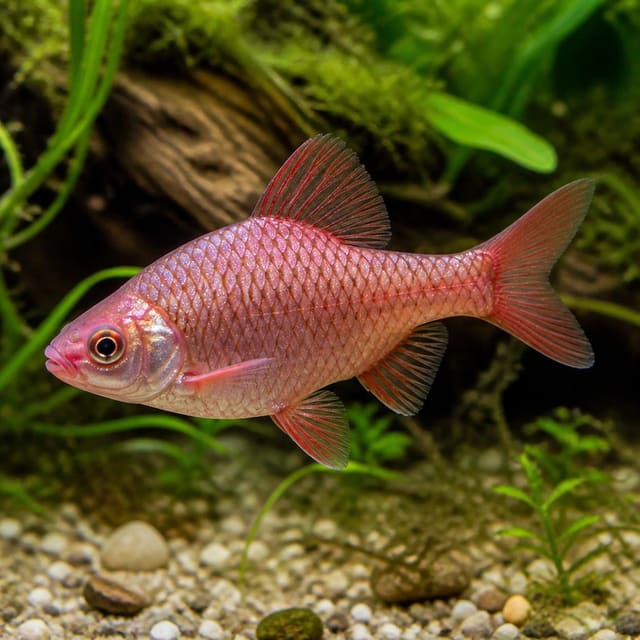
The representative gallery shows the illustrated fish with a green body, darker banding and red fin accents. Treat those features as an image-based appearance guide rather than a promise that every live fish will match each pictured detail. The ornamental colour form does not change the space, social or compatibility decisions required for the species. Plan for an active cyprinid that uses the available swimming area and interacts continually with its own kind. Its familiar trade history should not be mistaken for suitability in every community: aquarium footprint, group provision and companion choice remain the decisive requirements.
The selector contains six recurring size options: numeric dispatch grades collectively covering 1–3.5 cm, plus an XL option. Use the live product selector for the currently offered size, availability and price rather than relying on a static description.
One purchase quantity supplies one Green Tiger Barb in the selected option. Increase the cart quantity when buying several fish for the group. The size you select is the size supplied, not the adult size. Dispatch size therefore tells you which grade will be sent; plan the aquarium around the species' adult space and social requirements rather than treating a smaller supplied fish as a reason to use a smaller permanent aquarium.
Sex is guaranteed only when the selected option explicitly states male or female. This Green Tiger Barb listing has no sex-guaranteed option.
The gallery images are representative, based on reference photographs of this species, so colours can look slightly different from the live animal. Use the pictures to recognise the green form, banding and general fin pattern while allowing for normal differences between individual live fish and image presentation.
For dispatch arrangements, claim requirements and the current guarantee terms, read our delivery and Live Arrival Guarantee policy before ordering.
Choose Green Tiger Barbs only when you have room for a substantial active group and robust companions; reconsider a cramped aquarium or a community of timid, slow or long-finned fish. Their pace, social hierarchy and fin-biting reputation make them a deliberate community choice rather than a general-purpose companion for any tropical aquarium.
If this social style suits your plans, you can also browse the current barbs collection. Treat each listing as a separate care decision rather than assuming that every barb has the same behaviour or requirements.
Seriously Fish's profile gives 20–26°C, pH 5.0–8.0 and 1–20 dGH for aquarium care. Commercial strains tend to be adaptable across this aquarium range. It gives an 80 × 30 cm base or equivalent, around 72 litres, as the smallest practical starting point. For that minimum-sized setup, aim for filtration turning the aquarium volume over four to five times hourly, represented by a rating of roughly 290–360 litres per hour. The same profile estimates roughly 50 W of heating when the room is around 20°C.
Prioritise base dimensions because a group needs usable horizontal room for swimming, approaching, yielding and changing direction. An aquarium with similar volume but a notably shorter base may provide less useful movement space. An equivalent footprint may have different proportions, but it should preserve at least the practical swimming area represented by the stated base.
The filter rating is a starting point for the minimum setup. Account for the aquarium's actual volume and the way décor occupies space, then provide more capacity where the complete stocking plan requires it. Turnover must serve the occupied aquarium while leaving enough unobstructed room for the fish to move as a group.
The heating estimate is tied to a room close to 20°C. Select heating capacity for the actual aquarium and room conditions. Choose enough capacity to maintain the selected temperature dependably within the stated range rather than automatically fitting the same wattage to every setup.
Use the minimum footprint as a starting point, then assess the completed plan against the space required by the barb group and its proposed companions. If filters, heater guards, wood and planting leave too little connected horizontal movement room, choose a larger base before stocking. Judge the clear swimming route after the layout is assembled, because equipment and décor occupy different amounts of usable space.
Use the species aquarium range as the boundary for planning and choose a stable point that also suits every other fish. Compare measured conditions with the full range and with the needs of the whole community rather than assuming that a central value is automatically preferable.
Check temperature, pH and general hardness against the complete care range. Our aquarium water chemistry guide explains which values to measure and why they matter. Record readings from the aquarium rather than relying only on assumptions about the local water supply, because the fish experience the conditions inside the established system.
Use the water matcher to compare measured aquarium water with this listing's guidance. A reading inside the species range still needs to suit the proposed companions. Screen the complete community against the same temperature, pH and hardness plan before purchase.
Recheck the water plan when changing the aquarium's livestock load, filtration arrangement or water source. The adaptable commercial strain still needs known, measured conditions. Use current readings to decide whether the aquarium remains within range instead of judging suitability from appearance alone.
RSPCA aquarium guidance covers fish welfare generally, so its filtration and waste-processing advice applies alongside this species' care. Every occupied aquarium needs a well-set-up and maintained filter to remove waste and help keep the water clean. Biological filter media provides a home for beneficial bacteria that process fish waste naturally. A working biological filter converts toxic ammonia to toxic nitrite and then to the safer end product nitrate. Ammonia and nitrite are toxic fish-waste compounds; treat any build-up as a serious water-quality warning.
Prepare and mature the aquarium's biological filter before the Green Tiger Barbs arrive rather than adding them to a newly assembled system. Our first tropical aquarium guide covers setup and filter maturation before livestock is introduced.
Check equipment capacity and biological readiness separately. The 290–360 litres-per-hour example describes nominal turnover for the minimum-sized setup, while mature biological media must process the waste produced by the planned population. A newly fitted high-rated filter does not gain a mature bacterial population from its flow label, and established media does not remove the need for suitable circulation. Read the turnover figure as an equipment-sizing reference and the nitrogen sequence as a performance requirement. Water tests show how that biological process is functioning in the occupied aquarium.
Monitor ammonia, nitrite and nitrate so changes in biological filtration or stocking pressure are noticed before fish welfare deteriorates. A substantial barb group creates a collective biological load, so aquarium readiness must be assessed for the planned group rather than for the single retail unit.
Filtration also affects the space decision. The minimum footprint and turnover guidance belong together: the aquarium must provide both effective waste processing and enough horizontal room for active social movement. A powerful filter cannot replace adequate swimming area.
Décor choice is flexible, allowing the aquarium to be arranged around swimming room, cover and straightforward maintenance. A well-decorated aquarium helps this green strain show its colour to best effect, but decoration should support the group's use of the aquarium rather than filling the entire footprint.
Floating vegetation can provide shelter above the swimming area while branching wood creates structure at another level. This layered approach adds cover without requiring either feature to occupy the whole aquarium base.
Before stocking, check that several barbs can use the open area together and that a fish yielding during a chase has more than one direction available. Keep the filter and water-monitoring areas accessible. If wood or planting prevents movement or routine access, simplify the arrangement before adding the group.
Seriously Fish describes the species as gregarious, forming loose hierarchies in which chasing and display among its own kind are normal group behaviour. Keep Green Tiger Barbs in a substantial group so their social hierarchy can be expressed among their own kind. Rival adult males may spar repeatedly as the hierarchy develops. The fish are active and potentially fin-nippy, especially when kept in an undersized group, while limited aquarium space can also make fin-biting more pronounced.
Judge group provision and swimming room together. Adding fish without providing enough usable space can intensify crowding, while providing a long aquarium for only a token number does not supply the intended social setting. The group needs enough members for repeated interactions among its own kind and enough room for individuals to approach, turn away and yield.
A substantial group can direct much of the species' social attention towards its own kind. Continue to screen companion temperament and fin shape independently, and remember that limited space remains a separate factor in pronounced fin-biting.
Do not keep this fish alone. Plan a substantial group; the species guidance describes a gregarious hierarchy but gives no exact numerical minimum. Size the aquarium and filtration for the intended group as a whole, then allow separately for the space and biological load of any companions.
Allow this behaviour to influence the visual style of the aquarium as well. Green Tiger Barbs suit a keeper who wants an energetic group with frequent social movement. They are a poor fit when the desired display depends on slow, delicate fish remaining undisturbed in open water.
Seriously Fish describes Green Tiger Barbs as omnivorous. In nature, they probably feed primarily on aquatic invertebrates, with smaller amounts of plant material and organic detritus forming part of the probable natural diet. That pattern supports a varied aquarium menu rather than dependence on one food format. Offer regular meals of appropriately small food.
Use good-quality dried flakes and granules as practical staples, including some products with added plant content. Select pieces the fish can take readily so the group can feed without larger items repeatedly passing uneaten through the aquarium.
Green Tiger Barbs are generally straightforward to feed in aquaria and accept a varied prepared and frozen menu. Regular live or frozen foods alongside quality dried food help support their best condition and colour. Variety also lets you represent both the probable invertebrate emphasis and the smaller plant component of the natural diet.
Distribute food so a busy group has multiple feeding opportunities rather than forcing every fish to compete for one concentrated item. Adjust the presentation to the number and supplied size of fish while following the food manufacturer's portion guidance.
Watch whether every member is able to take the offered size and type. A food accepted by the fastest fish is not automatically accessible to the whole group. Change particle size or distribution when some individuals repeatedly fail to reach the meal, while retaining the same varied dried, plant-containing and live or frozen structure.
Use condition and feeding response to guide menu adjustments, but keep water quality in view because food contributes to the aquarium's total waste load. Feeding should support the group without replacing the filtration capacity required for the planned stocking level.
Seriously Fish's profile states that adult males tend to be smaller and slimmer than females and tend to show a more intense colour pattern. These are tendencies within an adult group, and individual appearance can vary. Green Tiger Barbs are egg-scattering free spawners with no parental care. Well-conditioned fish may spawn frequently, although frequent spawning does not guarantee surviving young. In a mature aquarium, small numbers of fry may occasionally appear without deliberate breeding intervention. Controlled breeding uses a separate mature, dimly lit aquarium with media that shelter scattered eggs from adults.
A display aquarium may occasionally produce fry, but maximising survival requires a more controlled arrangement. The separate breeding setup addresses the adults' lack of parental care rather than turning the community aquarium into a dedicated spawning system.
Conditioning refers to bringing the adult group into good reproductive condition through appropriate care and feeding. It does not guarantee that a particular pairing, spawning event or number of surviving fry will result. Even when spawning occurs often, egg and fry survival depend on circumstances beyond the act of spawning itself.
Several structures can create protected spaces for the eggs. A suitably graded mesh can allow eggs to fall through while preventing adults from reaching them. Plastic grass-type matting can serve the same function. A layer of glass marbles creates gaps into which scattered eggs can settle, while fine-leaved plants or spawning mops provide dense material around them.
Whichever medium is chosen, cover enough of the breeding area to give scattered eggs useful protection. Mesh openings need to be large enough for eggs to pass but small enough to exclude the adults. Fine-leaved plants or mops can occupy much of the aquarium when they are used as the main sheltering method. Keep the separate aquarium dimly lit and use mature water, as these conditions form part of the controlled setup.
Prepare the breeding aquarium before it is needed so the mature water, lighting and egg-sheltering medium are already in place. The adult group can be conditioned together, while the additional aquarium provides the protected environment required when the intention is to maximise the chance of eggs surviving.
Assess adult sex differences only after the group has matured and expect some overlap in appearance. Neither the chosen size grade nor visible appearance adds a sex guarantee to this offer. Build any breeding plan around an established adult group rather than assuming that a selected size grade supplies a chosen ratio.
Choose robust, comparably sized fish that suit similar water and can cope with a busy Green Tiger Barb group. Avoid timid, slow-moving or long-finned fish; the barb's boisterous behaviour and fin-biting reputation make those companions vulnerable. Screen the complete aquarium before purchase because a match on one characteristic cannot compensate for a serious conflict elsewhere.
Count the room and biological load required by each companion's normal social group. A species that appears to fit as one specimen may make the aquarium unsuitable once its own group requirement is included in the plan.
Keeping a substantial barb group can reduce redirected social attention, but it cannot make a timid or long-finned companion robust. Likewise, a large aquarium cannot change a vulnerable fin shape. Social provision, footprint and companion characteristics must each be suitable.
Consider the intended visual style of the community as well. Green Tiger Barbs create a fast, conspicuous open-water presence. Choose them when that activity complements the other fish rather than when the aquarium is designed around slow movement or delicate trailing fins.
Comparably sized, open-water cyprinids from similar habitats are among the strongest potential companions. They still need matching water, adequate room and an activity level that can cope with the Green Tiger Barb group. Compare each species individually rather than treating the whole cyprinid family as interchangeable.
Suitable balitorid, cobitid and nemacheilid loaches are possible bottom-dwelling companions in an appropriately planned aquarium. Bottom-oriented cyprinids such as suitable Crossocheilus or Garra species can also be considered. Their use of lower areas can reduce direct overlap, but adult size, group needs and water requirements still determine whether a particular combination fits.
Many rainbowfish can work when adult size, activity, water needs and available space align with the barb group. Some tetras can work when they are robust enough for this species' pace and their adult size and water needs are compatible. Assess each proposed rainbowfish or tetra species against the complete screening list.
Many livebearers, cichlids and anabantoids fall into the timid, slow-moving or long-finned categories that are poor matches for Green Tiger Barbs. Assess the actual species and form because the compatibility concern is its pace, temperament and fin shape rather than the category name alone.
Do not use a bottom-dwelling label, family name or broad community reputation as a shortcut. Check how large the candidate becomes, whether it needs a group, where it feeds, how quickly it moves and whether its fins or temperament leave it vulnerable. The final aquarium must provide enough space for all groups without forcing continual competition for the same route or feeding area.
A Green Tiger Barb is the selectively bred green or moss form of Puntigrus tetrazona, with the same care needs as the standard Tiger Barb.
One purchase supplies one Green Tiger Barb in the size option selected; increase the quantity when ordering several fish.
The Green Tiger Barb selector has six recurring size options, with numeric grades covering 1–3.5 cm plus XL.
Plan at least an 80 × 30 cm base or equivalent, around 72 litres, with suitable filtration, swimming room and structured cover.
Do not keep Green Tiger Barbs alone. Plan a substantial group; available species guidance does not set an exact minimum number.
Keep a Green Tiger Barb group at 20–26°C, pH 5.0–8.0 and 1–20 dGH in a mature, biologically filtered aquarium.
Feed Green Tiger Barbs good-quality flakes or granules with some plant content, plus small live or frozen bloodworm, Daphnia or Artemia.
Prepare and mature the biological filter before Puntigrus tetrazona arrives, and confirm that the planned water conditions and equipment are ready.
Choose robust, comparably sized companions for Green Tiger Barbs and avoid timid, slow-moving or long-finned fish that may be vulnerable.
No reviews for this item yet. Bought one? Honest reviews only, good or bad.
What customers say about ordering from us
I have a small group of long finned mountain minnows. So was delighted to be able to order ten of this variety to increase the genetics in my tank . The ones I recieved are healthy but it’s to early to give a verdict on wether they are of a long finned type since they are small currently.
Gordon Walker · 23 Sept 2026
100% success travel and "installation". Pleased with quality of purchase. The Siamese fighter a bit "shy" so have not yet seen him at his best yet but looking good. Happy customer. GG
George E Garratt · 21 Sept 2026
Reviews of our shop, collected by Judge.me, an independent third-party review collector. Newest first.