Green Tiger Barb (Puntigrus tetrazona)
20–26°C · pH 5–8 · 72L
£3.99

Five green tiger barbs (Puntigrus tetrazona), the moss-green form of the tiger barb, sent at about 2.5 to 3 cm. Lively mid-water shoalers that reach 7 cm. Keep at 20 to 26 °C in a tank of 80 cm or more, build towards 8 to 10 fish, and avoid long-finned tank mates.
Adult size is the maximum length this species reaches at full maturity (scientific sources). The livestock you receive will be younger and smaller. Product-photo provenance and any image-specific limitations are stated on the listing.
Puntigrus tetrazona
Five green tiger barbs (Puntigrus tetrazona), the moss-green form of the tiger barb, sent at about 2.5 to 3 cm. Lively mid-water shoalers that reach 7 cm. Keep at 20 to 26 °C in a tank of 80 cm or more, build towards 8 to 10 fish, and avoid long-finned tank mates.
Adult size is the maximum length this species reaches at full maturity (scientific sources). The livestock you receive will be younger and smaller. Product-photo provenance and any image-specific limitations are stated on the listing.
Maintain these water conditions for optimal health and vibrant colors
This listing is for five green tiger barbs sent together as one order. They are the moss-green colour form of the tiger barb, Puntigrus tetrazona, and they are the same fish we list singly as the Green Tiger Barb (Puntigrus tetrazona). Ordering five at once means they travel in the same consignment and go into your tank as a small group, which suits a fish that spends its whole life in a shoal.
Our stock records give a dispatch size of roughly 2.5 to 3 cm. That is a young fish. FishBase records a maximum of 7.0 cm total length for the species, measured from the snout to the tip of the tail, so these barbs still have most of their growing ahead of them. Plan the tank for the adult fish, not the ones in the bag.
The pack is not sold by sex. Any five may hold more males, more females or a fairly even split, so please don't order this listing expecting a matched breeding pair. If breeding matters to you, read the breeding section further down and be ready to add fish until you can see both sexes in the group.
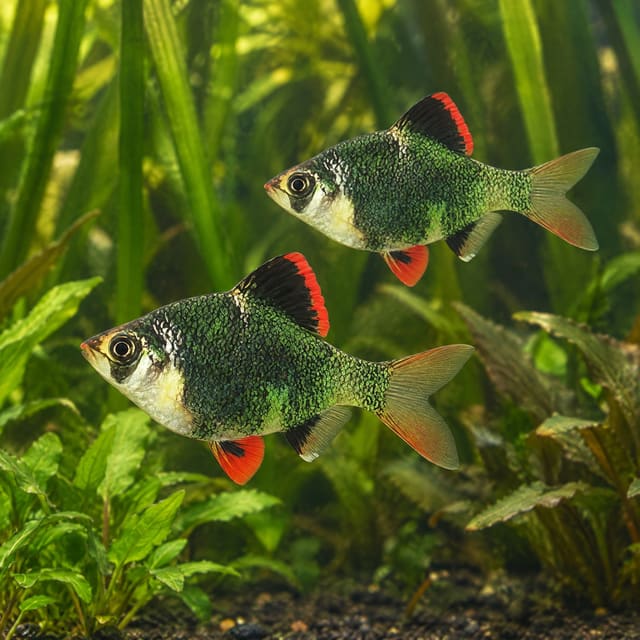
The photo at the top of the page shows a bigger shoal than this pack, swimming in front of broad green leaves. It gives a fair idea of the colour and body shape. Your order itself is five fish.
| Fact | Figure | Source |
|---|---|---|
| Maximum size | 7.0 cm total length | FishBase |
| Size when sent | About 2.5 to 3 cm | Our stock records |
| Temperature | 20 to 26 °C | FishBase, Seriously Fish |
| pH and hardness | pH 6.0 to 8.0, 5 to 19 dH | FishBase |
| Smallest tank | 60 cm long (FishBase); 80 by 30 cm base (Seriously Fish) | FishBase, Seriously Fish |
| Group size | 5 or more; 8 to 10 recommended | FishBase, Seriously Fish |
| Diet | Omnivore | FishBase, Seriously Fish |
Five is a sound start, but it sits at the bottom of the published advice rather than the middle. FishBase's aquarium note says to keep tiger barbs in groups of five or more. Wikipedia says they are usually kept in groups of six or more and are often aggressive in numbers below five. Seriously Fish sets the bar highest, calling eight to ten the minimum purchase, on the grounds that a bigger group spends its energy on its own members rather than on the other fish in the tank.
So treat these five as the core of a shoal. If the tank has room, add another five, or a few singles of the same green form, once the first group is eating well and has settled. If you already keep green tiger barbs and your group has thinned out over the years, five more is a tidy way to bring it back up to strength. Either way, the goal is a group large enough that the barbs are busy with each other.
Green tiger barbs suit a keeper who wants lively, colourful fish in the middle of the tank and is happy to pick tank mates around them. They are not a fish for a calm tank of slow, long-finned fish, and they need a tank long enough for a real group to move as one. If that matches your set-up, they give a great deal back: always moving, always interested in food, and dark enough to stand out sharply against green plants.
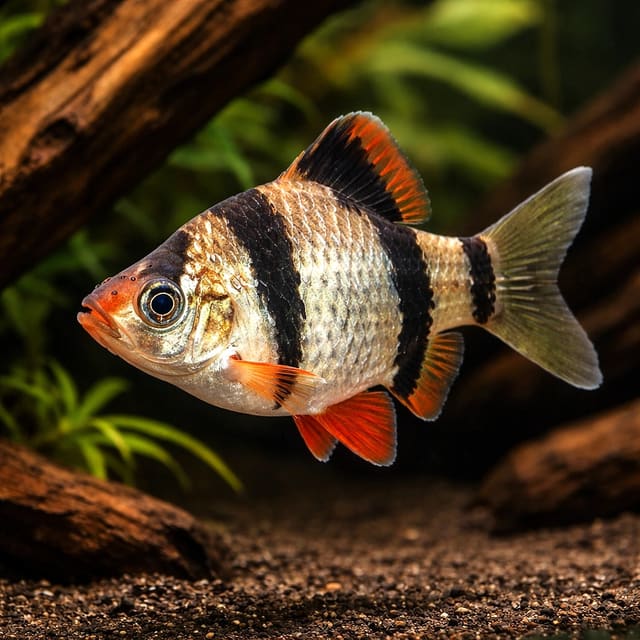
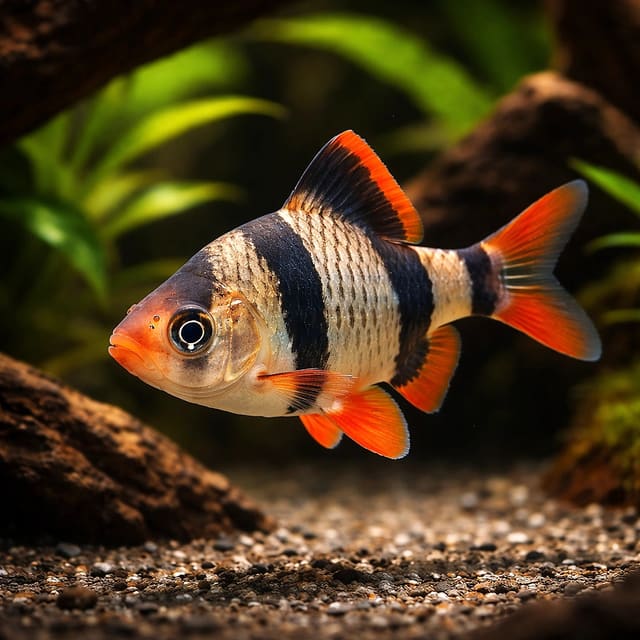
The ordinary tiger barb is easy to picture: a deep-bodied little fish with four vertical black stripes over a body that Wikipedia describes as silver to brownish yellow, with red on the fins and snout. The green form keeps that shape and that red trim, but the body is far darker. Wikipedia notes that the green tiger barb matches the normal fish in size and nature, and differs in having a green body.
How green it looks depends on the individual and on the light. Wikipedia says the moss green tiger barb can vary considerably in how green it appears, and that very melanistic fish reflect green over their black because of the Tyndall effect, a light-scattering effect. In practice a fish can look close to black from one angle and moss-green or blue-green as it turns. The fish in our photo show exactly that: charcoal bodies with a green-blue sheen, a fine net of scale edges along the flanks, and bright red-orange on the snout and along the edges of the fins. The four bars of the standard tiger barb are hard to pick out against so dark a body.
Sexing is easier with adults than with young fish. According to Wikipedia, females are larger, with a rounder belly and a mainly black dorsal fin, while males have a bright red nose and a distinct red line above the black on the dorsal fin. Seriously Fish gives the same general picture: males are smaller and slimmer than females, with a more intense colour pattern. On a green tiger barb the red nose and the red edge on the dorsal fin show up clearly against the dark body, so those are the details to look at. At dispatch size the differences are subtle, and they become easier to read as the fish fill out.
FishBase lists the accepted name as Puntigrus tetrazona (Bleeker, 1855), in the carp family Cyprinidae and the subfamily Smiliogastrinae, and gives Sumatra barb as its English common name. In shops and older books you will find it under a string of earlier genus names: Seriously Fish lists Barbus, Puntius, Capoeta and Systomus tetrazona among them. Our own older records labelled this fish "Barbus Capoeta tetrazona green", which is why that name still turns up in places. Wikipedia dates the genus Puntigrus to 2013.
Seriously Fish also points out an ongoing confusion about exactly which species the commercially bred aquarium tiger barb is. Wild fish are rarely traded, and the genus contains close relatives from Borneo and Indochina, including Puntigrus anchisporus and P. partipentazona. The care advice on this page follows the published data for P. tetrazona.
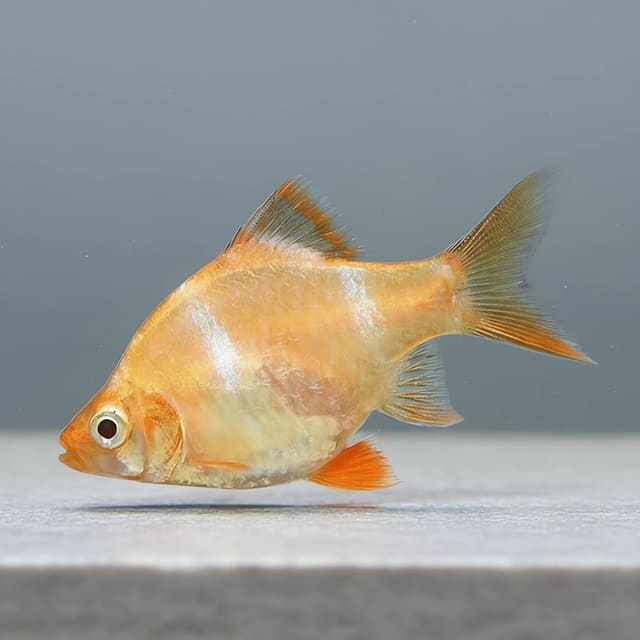
Seriously Fish describes a run of selectively bred ornamental strains. The albino, green (also called moss) and golden forms are the most popular, and platinum, blushing, black marble and coral red strains also exist. We list two of the others as well: the standard Tiger Barb (Puntigrus tetrazona) with its pale body and black bars, and the Albino Tiger Barb (Puntigrus tetrazona). All three are the same species in different colours, so the care needs on this page apply to each of them.
The tiger barb is an Asian fish, but how far its natural range runs depends on whose account you read. FishBase gives its distribution as Sumatra and Borneo. Seriously Fish takes a narrower view: the species is probably endemic to central and southern Sumatra, with records from the Indragiri, Batang Hari and Musi river systems in the provinces of Riau, Jambi and South Sumatra, and the Bornean records are thought to belong to related species. The type locality, the place the species was first described from, is Lahat in the old Palembang province. Wikipedia places it on the southern part of the eastern slope of Sumatra.
Wild habitat is less well recorded than you might expect for such a famous aquarium fish. Wikipedia reports tiger barbs from clear or turbid shallow water in moderately flowing streams. Seriously Fish says the habitat of this species is unconfirmed, and describes its Bornean relatives as living in forest streams and tributaries with fairly clear water over sand, rocks and pebbles of mixed sizes. That picture of shallow, moving water is a useful guide when you set up: room to swim, a bit of current from the filter and some cover, rather than a still, crowded pond.
FishBase notes that the species has been introduced widely and is reared in several countries in facilities that breed aquarium fish. Seriously Fish lists feral populations in Singapore, Australia, the United States, Colombia and Suriname. Those wild-living populations are a plain reminder that aquarium fish must never be released into ponds, rivers or lakes, here or anywhere else.
In the wild the species is not under pressure: FishBase shows an IUCN Red List status of Least Concern, assessed in April 2020. The green tiger barb itself is one of the selectively bred ornamental strains that Seriously Fish describes, so the fish in this pack come from aquarium breeding rather than from a river. That matters when you read about wild water chemistry, as the water section below explains.
FishBase gives 60 cm as the minimum aquarium length for tiger barbs. Seriously Fish asks for more: a base of at least 80 by 30 cm. For this pack we'd work from the larger figure. Five barbs that you go on to build into a group of eight to ten need space to move as a group, and a fish that reaches 7 cm and swims most of the day uses the length of a tank far more than its height.
A tank of that footprint also gives you room for tank mates, which matters with this species. Fin-nipping, covered in detail further down, is worst when space is tight. Seriously Fish puts it plainly: the behaviour only seems to be pronounced when too few fish are bought or space is limited. A longer tank is one of the two best tools you have against it; a bigger group is the other.
Seriously Fish says the choice of décor is not especially critical, but that tiger barbs show better colour in a well-decorated tank and seem to appreciate floating or overhanging plants together with driftwood roots or branches. Wikipedia notes that they live mainly in the middle layer of the water. Put those two points together and the layout almost designs itself:
Green tiger barbs bring their colour with them, so they don't need bright lighting to look good. A planted tank with dark wood and green leaves gives the red snouts and fin edges something to stand out against, and the moss-green sheen shows as the fish turn in and out of the light.
Run a filter that is fully matured before the fish arrive, sized for the finished group rather than the first five. Tiger barbs are active, hungry fish, and a growing shoal produces a fair amount of waste. A filter outlet that gives a gentle-to-moderate current along the tank works well, given the moderately flowing streams the species is recorded from, as long as there are calmer corners behind plants or wood. Regular partial water changes keep the water stable, and stable water is the backbone of everything else on this page.
If your tank is at the 60 cm minimum that FishBase gives, think carefully before building the group beyond five, and keep tank mates few and robust. If you have a tank of 80 cm or more, you can plan for the eight to ten fish that Seriously Fish recommends and still leave room for a group of loaches or a shoal of sturdy tetras alongside.
The three main references agree on the broad picture but differ in the detail, so here they are side by side.
| Source | Temperature | pH | Hardness |
|---|---|---|---|
| FishBase | 20 to 26 °C | 6.0 to 8.0 | 5 to 19 dH |
| Seriously Fish | 20 to 26 °C | 5.0 to 8.0 | 1 to 20 dGH |
| Wikipedia | 25 to 27.8 °C | 6.0 to 7.5 | 5 to 19 dGH |
Our care figures for this listing follow FishBase: 20 to 26 °C, pH 6.0 to 8.0 and a general hardness of 5 to 19 degrees. Seriously Fish matches the temperature range exactly. Wikipedia's figure starts higher and runs above 26 °C, so we record it as a conflict rather than a target. Setting the heater somewhere in the middle of the agreed range, around 23 to 25 °C, leaves a margin on both sides for a warm summer spell or a heater that drifts.
The pH and hardness ranges are wide. Most dechlorinated tap water that tests inside them will suit green tiger barbs without any adjustment, and chasing an exact number with chemicals tends to cause more trouble than it solves. Seriously Fish notes that commercial strains tend to be adaptable, and keeps its advice of acidic to neutral water, towards the softer end of the hardness range, for wild stock. The green form is a commercial strain, and wild fish are rarely traded. What matters more than the exact figure is that the water stays steady from week to week.
Test before the fish arrive. Ammonia and nitrite should read zero in a matured tank, and your pH, hardness and temperature should sit inside the ranges above. If your water is well outside them, ask us before ordering and we'll talk it through with you.
Do partial water changes on a regular routine, using water treated with a dechlorinator and brought close to tank temperature. Small, regular changes are far kinder than an occasional big one, because they avoid sudden swings in temperature and chemistry. Check the heater thermostat with a separate thermometer now and then; a stuck heater is one of the quickest ways to push any tank outside the 20 to 26 °C band.
FishBase records that wild adults feed on worms, small crustaceans and plant matter. That is the menu of an omnivore, and it is the best guide to feeding them at home. Seriously Fish calls the tiger barb easily fed and says it reaches its best condition with regular meals of small live and frozen foods, naming chironomid larvae (bloodworm), Daphnia and Artemia brine shrimp, alongside good-quality dried foods. Wikipedia agrees that they are omnivorous, take flakes and crisps as well as live foods, and are relatively greedy.
That greed is useful when you are settling new fish, because a hungry tiger barb is usually a healthy one. It can also cause two problems. The first is overfeeding: food that sinks and rots spoils water quality fast in a tank with an active shoal. The second is that slower tank mates can miss out. If you keep loaches or other bottom feeders with your barbs, put a little sinking food in after the barbs have had their share, ideally near the lights-off time when the barbs are less busy.
At 2.5 to 3 cm these are young barbs with growing to do. Small, frequent meals suit them better than one big feed, and crumbled flake or micro granules fit their mouths better than large pellets. As they grow, move them on to a standard small granule, and keep the live and frozen foods going: Seriously Fish ties the best condition to that kind of varied menu.
In the first day after arrival, don't feed at all, or offer only a tiny pinch. New fish often ignore food until they have settled, and anything they leave behind just fouls the water.
Tiger barbs have a reputation, and it is earned. Seriously Fish calls the species notoriously aggressive, with a reputation for biting the fins of other fishes, but adds the important part: the behaviour only seems to be pronounced when too few are bought or space is limited. FishBase's aquarium note says the same thing in fewer words: keep them in groups of five or more and do not keep them with long-finned fishes.
The green form is no gentler. Wikipedia notes that the green tiger barb has the same nature as the normal fish, so everything published about tiger barb behaviour applies to these.
Inside a decent group, tiger barbs chase, spar and display at each other. Wikipedia describes a pecking order within the pack. That constant activity is normal and is part of the appeal. With too few fish, the same energy gets turned on other species, and slow fish with trailing fins make easy targets. Seriously Fish's recommendation of at least eight to ten is about that: the more barbs, the more likely they are to be distracted by each other rather than their tank mates. Five is a workable start in a tank with no vulnerable fish; it is not a licence to mix them with delicate species.
No. A betta is a long-finned anabantoid, and both of those words matter. FishBase says tiger barbs should not be kept with long-finned fishes, and Seriously Fish names anabantoids among the groups to avoid. A male betta's flowing fins and slow swimming are about as tempting a target as a tiger barb could find. The same goes for gouramis, which are anabantoids too.
We'd advise against it. Angelfish are slow-moving cichlids with long fins, and Seriously Fish lists timid, slow-moving or long-finned species, including many cichlids, as poor companions. An angelfish's long, trailing ventral fins are exactly the kind of fins FishBase has in mind when it warns against long-finned tank mates.
Seriously Fish suggests loaches from the balitorid, cobitid and nemacheilid families, plus suitable rainbowfishes and tetras, as compatible tank mates, and robust cyprinids generally fit the same mould. The pattern is simple: fish that are fast, sturdy, short-finned and not shy.
| Good choices | Choose with care | Avoid |
|---|---|---|
| Loaches (balitorid, cobitid, nemacheilid) | Tetras and rainbowfishes: pick robust, fast species | Bettas and gouramis |
| Robust, fast barbs and other cyprinids | Any mixed tank where the barb group is still small | Angelfish and other slow cichlids |
| Sturdy, active mid-water shoaling fish | Bottom dwellers that need food to reach them | Fancy guppies and other long-finned livebearers |
Split or ragged fins on other fish, tank mates hiding all day, or one species hanging at the surface away from the shoal all suggest the barbs are bothering them. The fixes, in order, are a bigger barb group, a longer tank or re-homing the fish being picked on, and keeping the water clean while their fins recover.
A green tiger barb in good health is easy to read. It swims with the group, holds its fins open, eats eagerly and shows a clean red snout and red fin edges against the dark body. Most problems show up first as a change in one of those things.
Seriously Fish makes a frank point about the trade: many tiger barbs sold today are genetically weak, prone to disease or develop deformities because of heavy inbreeding. That applies to ornamental strains in general, and it is a good reason to look each fish over in the first days. Check for a straight spine, complete gill covers, even fins and normal swimming. A fish that is clearly compromised on arrival falls under our live-arrival claim process, explained in the arrival section below.
Wikipedia describes mature females as larger with a rounder belly. A female carrying eggs can look quite full, especially beside a slim male. If the fish is active, eating and holding its fins open, that fullness is usually normal. Swelling with raised scales, lethargy or loss of appetite is a different matter and calls for a water test and advice.
The three things you can control are water quality, stress and whatever new arrivals bring in with them. Keep the filter mature and the water changes regular, keep the group big enough that nobody is singled out, and if you can, keep any later fish in a separate tank for a couple of weeks before they join the main shoal. Wikipedia gives an average lifespan of 7 years for the tiger barb; good water and a sensible group are what give your fish the chance of a long life.
The green form is the same species as the standard tiger barb, so the published breeding notes apply to it. Seriously Fish describes these barbs, like most small cyprinids, as egg-scattering free spawners that show no parental care. In plain terms, the adults scatter eggs and then take no further interest except as food.
Seriously Fish recommends a separate tank with mature water and dim lighting, with a mesh base that lets eggs fall through out of the adults' reach. Plastic grass-type matting works well, and so does a layer of glass marbles. Water should be slightly acidic to neutral, with the temperature towards the upper end of the normal range, and an air-powered sponge filter or air stones rather than a strong power filter.
Condition the adults well first with plenty of small live and frozen foods. When the females look full of eggs, Seriously Fish suggests introducing one or two pairs to the spawning tank, and spawning should take place the following morning. Wikipedia agrees that they usually spawn in the early morning, among clumps of plants.
Wikipedia says tiger barbs lay several hundred eggs, with an average of 300 per spawn in a mature breeding population, and that once spawning is finished the adults will usually eat any eggs they can find. Remove the adults straight after spawning. According to Seriously Fish, the eggs hatch in 24 to 48 hours and the fry are swimming freely about 24 hours later. Their first food needs to be very small, of infusoria grade, before they move on to microworm or newly hatched Artemia nauplii.
Wikipedia notes that tiger barbs usually reach sexual maturity at 2 to 3 cm total length, so fish of dispatch size are not far off. This pack is not sold by sex, though, so your five may or may not include both. Once they are adult, use the signs in the recognition section above: larger, rounder females with mainly black dorsal fins; slimmer males with a bright red nose and a red line above the black on the dorsal fin. If your group turns out to be all one sex, adding more of the same form is the simple answer.
One practical note: with hundreds of fry possible from a single spawning, think about where the young fish will go before you start. Grow-out tanks fill quickly.
Have the aquarium ready before you order: the filter running and matured, the water tested and the heater holding a steady temperature inside the 20 to 26 °C range. Someone needs to be at the delivery address to receive the parcel, because these are live animals. Please read our delivery and live-arrival information before ordering.
Your fish travel in oxygen-filled bags inside insulated packaging, with heat packs when conditions call for them, carried by a tracked courier licensed to carry live animals. We email you the confirmed delivery date and tracking details.
Start a continuous unboxing video while the parcel is still sealed, then open it in the same take and show the fish in the still-sealed bag. If a fish arrives dead, dying or clearly compromised, email hello@tropicalfishco.co.uk on the day of delivery with your order number and that video. Photos alone do not meet the policy. The resolution is a replacement with your next order or a refund for the affected fish, subject to the guarantee terms.
Keep the lights low for the rest of the first day and leave the fish to explore. Over the first week, watch their breathing, appetite and behaviour. Once they have settled, a healthy group swims together through the middle of the tank and comes up eagerly at feeding time, which is the sign you are looking for.
If you plan to add more barbs to make up a bigger shoal, give these five time to settle and keep testing the water as the tank's load goes up. Add fish in stages rather than all at once, so the filter can keep pace.
These are the sources behind the facts on this page, if you want to read more:
No reviews for this item yet. Bought one? Honest reviews only, good or bad.
What customers say about ordering from us
I have a small group of long finned mountain minnows. So was delighted to be able to order ten of this variety to increase the genetics in my tank . The ones I recieved are healthy but it’s to early to give a verdict on wether they are of a long finned type since they are small currently.
Gordon Walker · 23 Sept 2026
100% success travel and "installation". Pleased with quality of purchase. The Siamese fighter a bit "shy" so have not yet seen him at his best yet but looking good. Happy customer. GG
George E Garratt · 21 Sept 2026
Reviews of our shop, collected by Judge.me, an independent third-party review collector. Newest first.