−15%
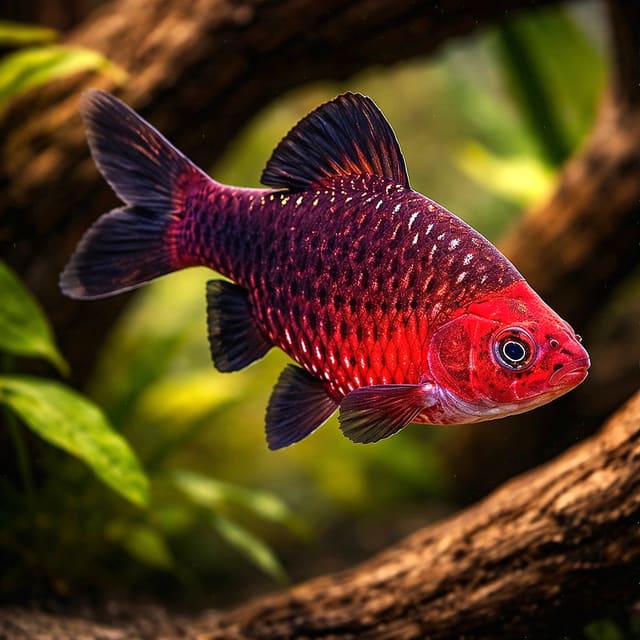
Black Ruby Barb (Pethia nigrofasciata)
22–26°C · pH 6–6.5 · 72L
£3.39£3.99

Small peaceful Myanmar Lipstick Barb for planted shoals; currently out of stock, with care guidance kept live for restock planning.
Adult size is the maximum length this species reaches at full maturity (scientific sources). The livestock you receive will be younger and smaller. Product-photo provenance and any image-specific limitations are stated on the listing.
Pethia erythromycter
Shoaling fish: kept in a group they feel safer, stay calmer and show their best colour.
Confirm your email, then we’ll send an availability message for this exact item if it returns within 180 days.
This request is only for this product—no newsletter or other promotions. A mail-provider retry may very rarely duplicate the same availability message. Unconfirmed addresses are removed after 48 hours. See our privacy policy.
Small peaceful Myanmar Lipstick Barb for planted shoals; currently out of stock, with care guidance kept live for restock planning.
Adult size is the maximum length this species reaches at full maturity (scientific sources). The livestock you receive will be younger and smaller. Product-photo provenance and any image-specific limitations are stated on the listing.
Maintain these water conditions for optimal health and vibrant colors
Lipstick Barb (Pethia erythromycter) is a small, peaceful barb from Myanmar, known for the red lip or moustache marking that gives the fish its trade name. This page had drifted toward Rosy Barb copy in older data, so the care below is written for this Lipstick Barb listing and the scientific anchor Pethia erythromycter, not Pethia conchonius.
It is best treated as a shoaling, plant-friendly community fish for mature freshwater aquariums with clean, well-oxygenated water, planted margins and open swimming room. It stays much smaller than a Rosy Barb, but it is still active enough to deserve a proper group and a tank with space rather than a tiny desk aquarium.
| Common name | Lipstick Barb, Red Lipstick Barb |
|---|---|
| Scientific name | Pethia erythromycter |
| Older synonym | Puntius erythromycter |
| Current Shopify SKU | 4230 |
| Adult size | About 3.3 cm standard length on FishBase; around 4-4.5 cm total length in aquarium trade guidance |
| Minimum aquarium | 60 litres or larger for a settled shoal; more length and cover are better |
| Temperature | 20-25 C for routine care; stable room-temperature aquariums can suit this species |
| pH and hardness | Aim around pH 6.5-7.5 and soft to moderate hardness; avoid sudden swings |
| Temperament | Peaceful, active, shoaling; males display more strongly in groups |
| Diet | Fine flakes, micro pellets and small frozen foods such as daphnia, brine shrimp and mosquito larvae |
| Current stock note |
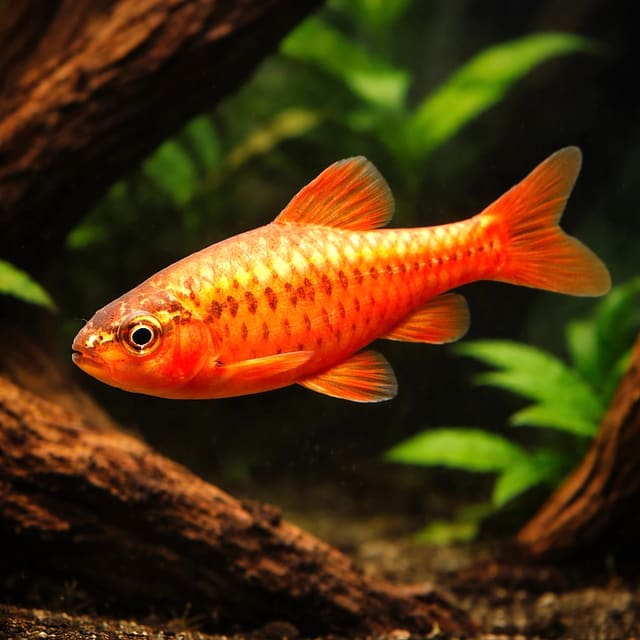
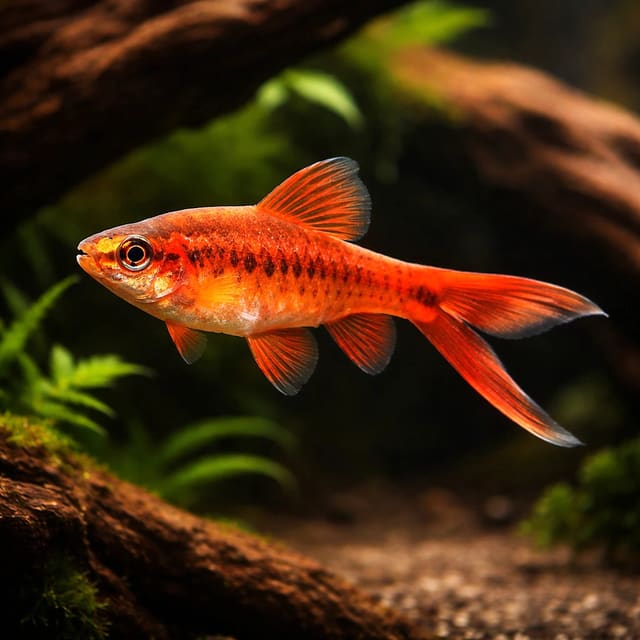
Lipstick Barbs are compact cyprinids with a silvery body, a dark caudal-peduncle spot and red pigment around the mouth, especially noticeable in mature males. Males may darken and display during courtship, while females are usually fuller-bodied and more understated. Do not expect every fish to show maximum colour immediately after transport; colour improves with settled water, a good group and varied food.
In the aquarium they are active but not rough when kept properly. A group of six is the practical starting point, while ten or more is better if space allows. A larger shoal spreads male display behaviour, improves confidence and makes the fish more visible.
Use a mature freshwater aquarium with a secure lid, reliable filtration and a steady maintenance routine. A planted layout with open swimming space works well: keep plants, wood, stones and darker retreats around the sides and back, then leave a clear middle area where the shoal can move together. Moderate flow and good oxygenation are useful, but provide calmer corners as well.
This species is often more comfortable in a calm, natural-looking aquarium than in a bare bright tank. Floating plants or tall background plants can soften the light. Weekly partial water changes are recommended, especially because small active fish are usually fed often.
Choose peaceful community fish that enjoy similar clean, moderately cool to tropical freshwater conditions. Small danios, rasboras, peaceful tetras, Corydoras and other gentle barbs can work when the aquarium is large enough and feeding is fair. Avoid keeping a tiny group of Lipstick Barbs with fast, pushy fish that take all the food.
Do not mix them with large predators, aggressive cichlids or delicate long-finned fish that may be stressed by active barbs. Maidenhead Aquatics also cautions against fancy long-finned tank mates for this species. Shrimp adults may be ignored in planted aquariums, but tiny shrimp fry can be eaten, so breeding shrimp tanks are not the safest match.
Lipstick Barbs are omnivorous micropredators and grazers. Feed small portions of quality flake, micro pellet or fine granule food, then rotate frozen or live foods such as daphnia, brine shrimp, cyclops, mosquito larvae and small bloodworm. A little algae-based or vegetable content can be useful, but heavy messy feeding is not.
Small fish lose condition quickly if they are outcompeted, so watch feeding rather than just dropping food in. The best routine is varied food, small portions and clean water. Remove uneaten food so the aquarium does not build nitrate between water changes.
This is an egg-scattering barb. Well-conditioned adults may spawn among fine plants or spawning mops, and adults should be removed if you are deliberately raising fry because barbs often eat eggs. A separate small breeding setup with mature filtration, soft clean water and fine-leaved cover gives much better control than hoping fry survive in a busy display tank.
When the listing returns to stock, eligible livestock orders are packed for UK live-fish courier delivery with oxygen, insulation and weather-aware dispatch timing, and are supported by the Tropical Fish Co Live Arrival Guarantee when the delivery and acclimation instructions are followed.
If an exact supplier or owner-approved photo becomes available later, it should be added to this SKU without deleting the existing media.
Care and identity were cross-checked against our stock records, FishBase, Aquarium Glaser and Maidenhead Aquatics.
No reviews for this item yet. Bought one? Honest reviews only, good or bad.
What customers say about ordering from us
I have a small group of long finned mountain minnows. So was delighted to be able to order ten of this variety to increase the genetics in my tank . The ones I recieved are healthy but it’s to early to give a verdict on wether they are of a long finned type since they are small currently.
Gordon Walker · 23 Sept 2026
100% success travel and "installation". Pleased with quality of purchase. The Siamese fighter a bit "shy" so have not yet seen him at his best yet but looking good. Happy customer. GG
George E Garratt · 21 Sept 2026
Reviews of our shop, collected by Judge.me, an independent third-party review collector. Newest first.