Moderate
Congo Tetra (Phenacogrammus interruptus)
23–28°C · pH 6–7.5 · 150L
£5.99

The Yellow-Tailed African Tetra (Alestopetersius caudalis) is an African tetra from the lower and middle Congo basin that reaches 6.2 cm. It suits a well-researched larger community aquarium: try to keep at least 8–10; the FishBase, Seriously Fish and OATA overlap is 22–26°C and pH 6.5–7.5, with 4–12 dGH shared by Seriously Fish and OATA. Sold individually in dispatch sizes from 2–2.5 cm to 5.5–6 cm.
Adult size is the maximum length this species reaches at full maturity (scientific sources). The livestock you receive will be younger and smaller — pick a size above for the actual shipping size. Product-photo provenance and any image-specific limitations are stated on the listing.
Alestopetersius caudalis
Shoaling fish: kept in a group they feel safer, stay calmer and show their best colour.
The Yellow-Tailed African Tetra (Alestopetersius caudalis) is an African tetra from the lower and middle Congo basin that reaches 6.2 cm. It suits a well-researched larger community aquarium: try to keep at least 8–10; the FishBase, Seriously Fish and OATA overlap is 22–26°C and pH 6.5–7.5, with 4–12 dGH shared by Seriously Fish and OATA. Sold individually in dispatch sizes from 2–2.5 cm to 5.5–6 cm.
Adult size is the maximum length this species reaches at full maturity (scientific sources). The livestock you receive will be younger and smaller — pick a size above for the actual shipping size. Product-photo provenance and any image-specific limitations are stated on the listing.
Maintain these water conditions for optimal health and vibrant colors
The Yellow-Tailed African Tetra (Alestopetersius caudalis) is a freshwater African tetra in the family Alestidae. FishBase records it from the lower and middle Congo River basin in the Democratic Republic of the Congo and Central African Republic, with a maximum recorded adult length of 6.2 cm. It suits a keeper planning a spacious, well-researched community aquarium rather than a solitary display or a small-footprint tank.
This is a lively, somewhat skittish but generally peaceful shoaling fish. Seriously Fish recommends trying to obtain at least 8–10 specimens, with a minimum aquarium base of 120 × 30 cm or equivalent and a volume of about 108 litres. Give the group open swimming room, stable filtration and enough space for social displays.
Keep the aquarium at 22–26°C, pH 6.5–7.5 and 4–12 dGH. The temperature and pH are the overlap of FishBase, Seriously Fish and OATA's broad tetra and pencilfish guidance; the hardness range is the overlap of Seriously Fish and OATA. OATA's group guidance is not a species-specific optimum, so the narrower overlap is the practical routine target.
Planted aquaria work well, but plants are not compulsory. A stream-style layout with sand, fine gravel, rounded rocks, water-worn boulders and driftwood also fits the species, provided the central swimming route remains open. Browse the current tetras collection separately when comparing other shoaling fish; shared collection placement does not establish compatibility.
Start with the adult group, not the length of the fish at dispatch. A suitable plan provides the full 120 × 30 cm minimum base or an equivalent footprint from the outset, enough biological filtration for the complete community and water that remains inside the routine range. A nominal litre figure alone is not enough if the aquarium is too short to provide the recommended swimming length.
| Suits | Not suited to |
|---|---|
| A well-researched larger community aquarium | A solitary specimen or a group below the planned shoal |
| A base of at least 120 × 30 cm or equivalent | A short aquarium chosen only by its litre label |
| Open swimming room with planted or stream-style cover | A layout filled so densely that the shoal lacks open water |
| Stable tropical water and established biological filtration | An aquarium without a well set up and maintained filter |
| Comparably sized companions screened for temperament | Companions selected without checking adult size, behaviour and water needs |
A group plan also needs spare capacity for waste and social movement. Seriously Fish notes that rival males may display and that limited space makes injury between males more likely, including loss of body scales. The correct response is more usable room and a properly sized shoal, not separating one tetra into a small aquarium.
This fish is best approached as an active community resident. Its peaceful description does not make every peaceful fish an automatic companion, and its modest adult length does not remove the need for swimming space. Decide on the aquarium footprint, group number and water range before choosing the rest of the community.
One purchase supplies one Yellow-Tailed African Tetra in the size selected. The live size selector uses the labels 2-2.5 cm, 2.5-3 cm, 3 - 4 cm, 4,5 - 5 cm and 5.5-6 cm. Use the selector on the product page to make the size decision; do not use the gallery to estimate the dispatch grade.
The size you select is the size supplied, not the adult size. Every grade therefore needs the same adult aquarium plan: a recorded adult maximum of 6.2 cm, a group of at least 8–10 and a minimum base of 120 × 30 cm or equivalent. A smaller dispatch fish is not a reason to begin with a smaller aquarium.
Sex is guaranteed only when the selected option explicitly states male or female. This Yellow-Tailed African Tetra listing has no sex-guaranteed option. Do not infer sex from dispatch length, colour, fin shape or any gallery scene.
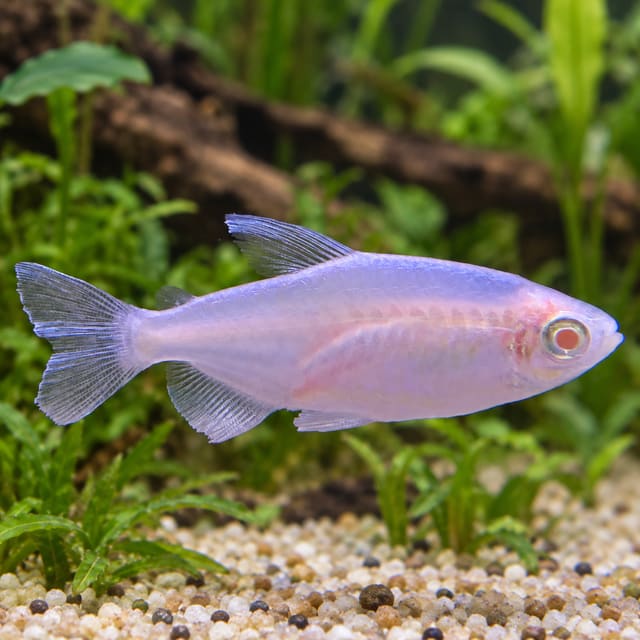
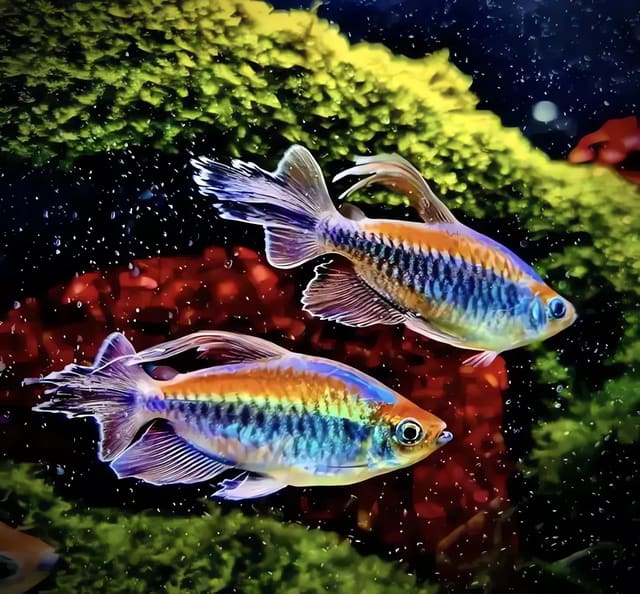
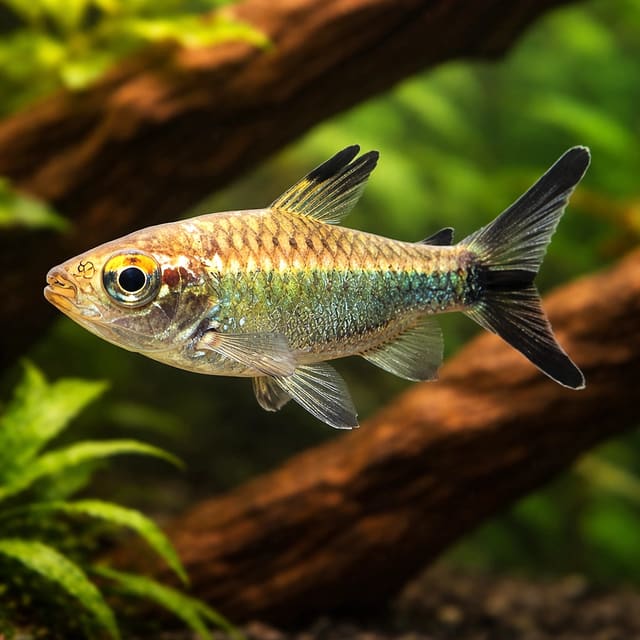
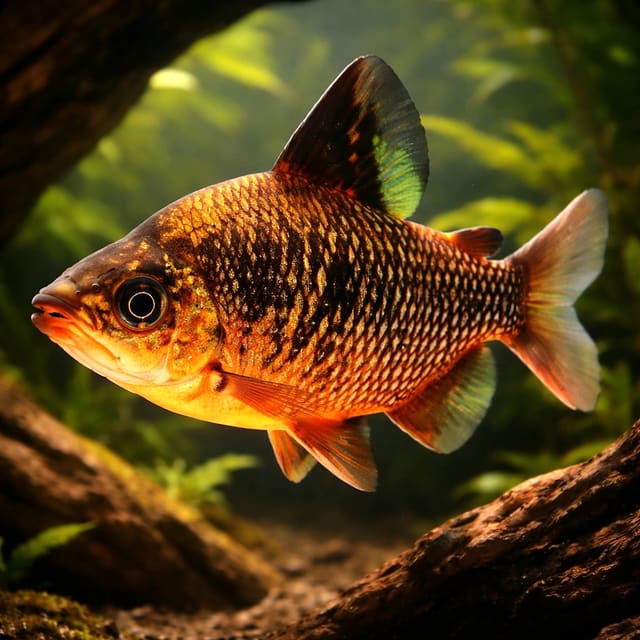
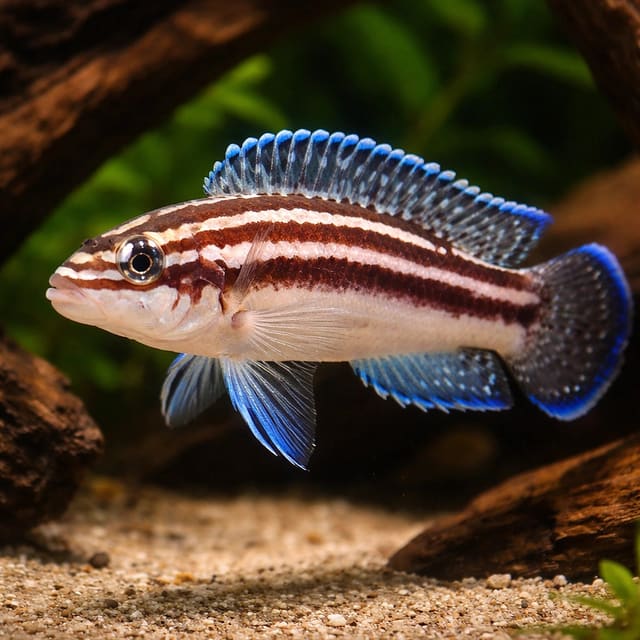
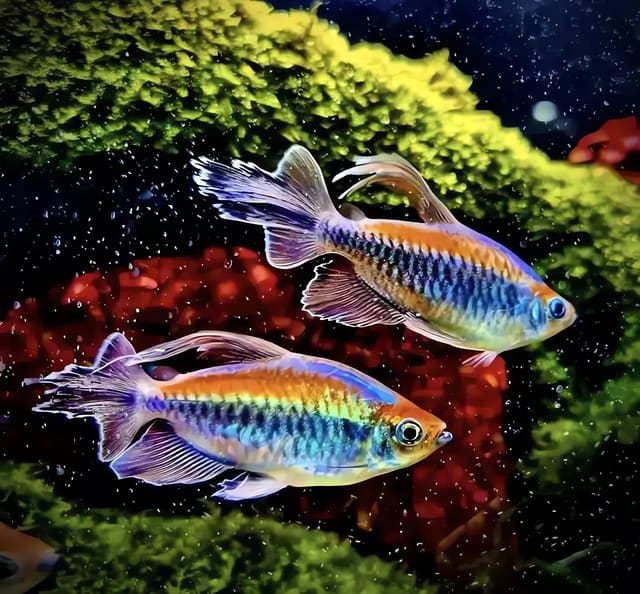
Some gallery images have been digitally enhanced to improve image quality. They show the listed type of animal rather than guaranteeing the exact markings of the individual supplied, so natural colour and pattern can vary. Some scenes show more than one fish to illustrate shoaling behaviour, but the purchase unit remains one animal. The aquarium, plants, wood and gravel shown are illustrative scenes rather than items included with the fish.
Plan around a maximum recorded adult length of 6.2 cm. Seriously Fish separately lists 60 mm standard length and recommends minimum base dimensions of 120 × 30 cm or an equivalent aquarium, with a volume of about 108 litres. Use the 6.2 cm FishBase figure consistently when estimating the space occupied by each adult fish.
The footprint is the decisive part of the recommendation because the species is lively and uses open water. For example, an aquarium marketed at roughly the right volume can still be a poor choice if its base is much shorter than 120 cm. Compare the actual internal base dimensions before treating a volume label as equivalent.
Do not count a dispatch size as growth headroom. A fish selected at 2-2.5 cm and one selected at 5.5-6 cm belong to the same adult plan. Starting with the full footprint also avoids moving an established shoal merely because the fish have grown.
When comparing differently shaped aquaria, favour the design that preserves the recommended swimming length and base area. Extra height does not replace horizontal room for a lively shoaling tetra, while a longer base creates more usable space for group movement and stream-style furnishing.
Keep the Yellow-Tailed African Tetra at 22–26°C, pH 6.5–7.5 and 4–12 dGH. The temperature and pH sit inside the FishBase environmental record, the Seriously Fish aquarium range and OATA's tetra guidance. The general hardness range is the shared portion of the Seriously Fish and OATA values.
| Parameter | Routine instruction |
|---|---|
| Temperature | Keep 22–26°C |
| pH | Keep 6.5–7.5 |
| General hardness | Keep 4–12 dGH |
| Ammonia | Maintain zero mg/l |
| Nitrite | Maintain zero mg/l |
| Nitrate | Do not exceed 20 mg/l above the normal tap-water level |
Measure the source water and mature aquarium before choosing the fish. Our water chemistry guide explains what the main readings mean, while the water matcher provides a direct way to compare measured values with this routine range.
Test at least weekly and keep the measurements together so a change can be recognised. Stability comes from an established filter, controlled stocking and regular maintenance rather than repeated corrections made without testing.
Use a well set up and maintained biological filter. The RSPCA explains that fish release toxic ammonia; filter bacteria convert it to nitrite, which is also toxic, and then to the safer nitrate. This process must be established before the tetra group is introduced.
For an aquarium of about 108 litres, Seriously Fish recommends turnover of four to five times the aquarium volume each hour and points to a filter rated around 430–540 litres per hour. That calculation is 108 litres multiplied by four or five, so it is a useful equipment check for the minimum-sized example. Consider the needs of the whole community when the aquarium is larger or more heavily occupied.
A heater in the range of roughly 75–125 W is suggested for holding 22–26°C in an aquarium of about 108 litres when the room is around 20°C. Choose equipment according to the real aquarium volume and room conditions, then confirm the result with a thermometer rather than relying on the heater dial alone.
Our first tropical aquarium guide helps organise those preparation stages. OATA warns that stocking too quickly can cause new tank syndrome when the filter bacteria cannot process the added waste, allowing ammonia and nitrite to reach harmful levels.
Arrange the aquarium around a long, open swimming route. Seriously Fish describes décor as relatively unimportant to basic success and says the species can do well in a planted aquarium, but it also suggests a flowing stream or river style as an ideal presentation.
| Layout | How to arrange it |
|---|---|
| Planted aquarium | Place plants around the edges and background while keeping the centre open for the shoal. |
| Stream-style aquarium | Use variably sized rocks, sand, fine gravel, water-worn boulders, driftwood roots and branches around an open channel. |
Whichever style you choose, make every ornament secure and preserve the usable base area. A dense wall of plants or wood through the middle may provide cover but removes the horizontal room that this lively fish needs. Shift taller features towards the rear or ends if the group repeatedly has to split around them.
Plants and structure can provide shelter without turning the aquarium into a confined maze. OATA recommends gravel or sand and ideally live plants for tetras; plastic plants and suitable ornaments can provide cover where live plants are not used. The deciding test is whether the group can move together through open water and retreat towards cover without becoming trapped in narrow gaps.
Observe how the completed shoal uses the layout. If fish repeatedly crowd into one remaining open patch, rework the décor to create a wider route. If they can cross the full aquarium together and use cover without losing swimming room, the layout is serving both movement and security.
Feed a varied omnivorous diet based on good-quality flakes or small granules, with regular small live or frozen foods. Seriously Fish describes wild fish as probable foragers taking small insects, crustaceans and fallen fruit, and recommends bloodworm, Daphnia and Artemia alongside dried foods. At least some dried food should contain additional plant or algal material.
OATA's tetra and pencilfish feeding schedule is to offer only what the fish can eat within a few minutes, once a day. Use that limit for the whole shoal rather than adding a fixed amount per fish. Remove the reason for overfeeding by starting with a small portion and watching whether every item is taken promptly.
| Food role | Suitable choices |
|---|---|
| Routine dried food | Good-quality flakes or small granules, including some plant or algal content |
| Live or frozen variety | Small bloodworm, Daphnia or Artemia |
| Portion control | Only the amount eaten within a few minutes |
Uneaten food breaks down and adds toxic waste to the water, so a larger portion is not a shortcut to better condition. Regular variety, an appropriate particle size and controlled daily portions are the supported route to maintaining condition and colour.
Carry out a partial water change of 25% at least once every week. Treat replacement tap water with conditioner to remove harmful chlorine or chloramine before adding it to the aquarium, and use a siphon to remove solid waste from the substrate where necessary.
Test ammonia and nitrite at least weekly and check the other routine values at the same time. Ammonia and nitrite should remain at zero mg/l, while nitrate should not exceed 20 mg/l above the normal tap-water level. A written sequence of results makes a gradual deterioration easier to recognise than a single isolated test.
Do not combine overfeeding, rapid stocking and neglected maintenance. OATA links these pressures to waste accumulation and new tank syndrome, while the RSPCA explains why the biological filter is essential for processing ammonia and nitrite. Feed controlled portions and increase the aquarium population slowly so the filter can adjust.
Watch for hanging at the surface, sitting on the bottom, erratic swimming, unusual hiding or aggression, faster or slower gill movement, darker or paler colour, white spots, fluffy growths, damaged fins, lost scales, ulcers, bumps, weight change or reduced feeding. If any of these changes appear, test the water first and contact us for further guidance. Keep the affected aquarium stable while the water readings and observed signs are assessed.
Prepare the mature aquarium and confirm its water readings before the parcel is received. The Tropical Fish Co delivery and Live Arrival Guarantee policy explains that livestock is hand-bagged with pure oxygen, placed in an insulated box and carried by a licensed live-animal courier, with a heat pack used when weather conditions call for it.
Keep the continuous video with your order number. The footage should show the sealed parcel, the continuous opening and the fish inside the sealed bag before release.
OATA advises checking that ammonia and nitrite are zero before any fish are added and increasing the aquarium population slowly. Do not use the new group as the first test of an immature filter. Confirm 22–26°C, pH 6.5–7.5 and 4–12 dGH before release, then keep the established feeding and maintenance schedule unchanged.
During the first week, use the daily meal as a consistent observation point. Check swimming, breathing, colour, body condition and feeding response, and complete the normal weekly water tests. A change in one of those signs is a reason to test promptly rather than adding food or altering several conditions without a measurement.
Try to keep at least 8–10 Yellow-Tailed African Tetras. Seriously Fish describes the species as lively and somewhat skittish but generally peaceful, and recommends a substantial group for more natural behaviour. OATA also warns that tetras kept singly or in groups that are too small often become stressed.
Group space matters as much as the head count. Rival males may display towards one another, and several may take part at the same time. Seriously Fish notes that males are more likely to injure one another when space is limited, with loss of body scales possible. Preserve the 120 cm swimming length, avoid filling the base with décor and leave enough open water for fish to move away from an interaction.
The offer does not provide a sex choice, so build the aquarium around the space and group recommendation rather than a planned male-to-female ratio. Do not use colour, dispatch length or an illustration to assign sex to an individual fish.
Choose companions of comparable adult size and similar temperament that share the same water conditions. Seriously Fish identifies comparably sized cyprinids and other alestids from similar environments as especially relevant candidates, while many cichlids, catfishes and loaches may also be considered in a well-researched larger community aquarium.
Those groups are starting points rather than blanket approvals. Individual species within a broad group can differ in adult size, activity, feeding behaviour and water requirements. Check each proposed species against the Yellow-Tailed African Tetra's 22–26°C, pH 6.5–7.5 and 4–12 dGH range, then calculate enough footprint and filtration for every full adult group.
| Screening question | Decision rule |
|---|---|
| Is the companion comparably sized? | Compare adult lengths, not dispatch grades. |
| Is its temperament similar? | Look for a community fish suited to a lively but generally peaceful shoal. |
| Do the water ranges overlap? | Use only values that sit inside both species' routine ranges. |
| Will every social group fit? | Count the complete adult shoal or group for each species. |
| Is there enough open water? | Keep the 120 × 30 cm minimum base or equivalent usable after décor and companions are included. |
Other schooling fish may help a skittish group feel secure, but they still need the same screening. Do not add another shoal merely as a behavioural tool if its adult group would overload the aquarium. For a mixed plan, send the aquarium dimensions, measured water, filtration, adult group numbers and proposed species when you ask us for a stocking and compatibility assessment.
FishBase records a maximum adult length of 6.2 cm total length. Plan the aquarium and complete shoal around that adult figure rather than the selected dispatch size.
Use a minimum base of 120 × 30 cm or equivalent, with a volume of about 108 litres, as Seriously Fish recommends. Preserve open horizontal swimming room after adding décor.
Seriously Fish recommends trying to keep at least 8–10 specimens. A substantial shoal supports more natural behaviour, while OATA warns that tetras kept singly or in groups that are too small will often become stressed.
It suits a prepared keeper who can provide an established filtered aquarium, a group of at least 8–10, a 120 × 30 cm minimum base and stable water inside the stated range.
Feed good-quality flakes or small granules, including some plant or algal content, with regular bloodworm, Daphnia or Artemia. OATA's group schedule is one daily portion eaten within a few minutes.
Keep it at 22–26°C and pH 6.5–7.5. These values are the overlap of FishBase, Seriously Fish and OATA; keep general hardness at the Seriously Fish and OATA overlap of 4–12 dGH.
It is lively and somewhat skittish but generally peaceful. Rival males are more likely to injure one another when space is limited, so provide the full swimming footprint and a properly sized shoal.
Consider comparably sized cyprinids, other alestids and carefully screened cichlids, catfishes or loaches. Match adult size, temperament, water needs, group space and filtration before combining any species.
Start filming the sealed parcel before opening it or floating the bag. The Tropical Fish Co policy uses oxygen-filled bags, an insulated box and a licensed live-animal courier; receive it in person and float the bag for 20–30 minutes before release.
No reviews for this item yet. Bought one? Honest reviews only, good or bad.
What customers say about ordering from us
I have a small group of long finned mountain minnows. So was delighted to be able to order ten of this variety to increase the genetics in my tank . The ones I recieved are healthy but it’s to early to give a verdict on wether they are of a long finned type since they are small currently.
Gordon Walker · 23 Sept 2026
100% success travel and "installation". Pleased with quality of purchase. The Siamese fighter a bit "shy" so have not yet seen him at his best yet but looking good. Happy customer. GG
George E Garratt · 21 Sept 2026
Reviews of our shop, collected by Judge.me, an independent third-party review collector. Newest first.