Moderate
Neon Tetra (Paracheirodon innesi)
21–25°C · pH 5–7
£1.89
X Ray Tetra (Pristella maxillaris) is a hardy, peaceful South American shoaling tetra that grows to about 4.5 cm. Keep at least six, preferably ten or more, in a planted aquarium with a base of at least 60 × 30 cm.
Adult size is the maximum length this species reaches at full maturity (scientific sources). The livestock you receive will be younger and smaller — pick a size above for the actual shipping size. Product-photo provenance and any image-specific limitations are stated on the listing.
Pristella maxillaris
Shoaling fish: kept in a group they feel safer, stay calmer and show their best colour.
Minimum of 2 per order.
X Ray Tetra (Pristella maxillaris) is a hardy, peaceful South American shoaling tetra that grows to about 4.5 cm. Keep at least six, preferably ten or more, in a planted aquarium with a base of at least 60 × 30 cm.
Adult size is the maximum length this species reaches at full maturity (scientific sources). The livestock you receive will be younger and smaller — pick a size above for the actual shipping size. Product-photo provenance and any image-specific limitations are stated on the listing.
Maintain these water conditions for optimal health and vibrant colors
The X Ray Tetra (Pristella maxillaris) is a small, peaceful South American tetra and, as Seriously Fish puts it, one of the more popular tetras in the hobby. FishBase notes that aquarists value it for its robustness, peaceful character and delicate colours, and Seriously Fish ranks it among the very best choices for anyone new to fishkeeping. Adults stay small, at about 4.5 cm, so a proper shoal is realistic in a modest aquarium.
Each purchase supplies one live fish of the size you choose, which makes the number you order the most important decision on this page. This is a shoaling species that belongs in a group of at least six, and preferably ten or more, in a tank with a base of at least 60 × 30 cm. Kept that way it swims confidently through open water and shows far more colour than a single fish or a pair ever will.
| Suits | Think twice if |
|---|---|
| A first community aquarium whose filter has fully matured | The tank is still new and ammonia or nitrite can be detected |
| Planted South American or mixed community tanks | You keep very boisterous or much larger fish |
| Keepers with room for a group of six to ten or more | You only have space or budget for one or two fish |
| Tap water from soft to fairly hard, within 2–20 dGH | Your fish include predators big enough to swallow a small tetra |
There are four dispatch sizes to choose from: 2 cm, 2.5–3 cm, 3–3.5 cm and over 3.5 cm. The size you select is the size supplied, not the adult size. The 2 cm fish are young and have plenty of growing still to do, while the largest grade is already close to the adult maximum of about 4.5 cm. Because one purchase is one fish, a group of ten means a quantity of ten in the size you prefer.
Sex is guaranteed only when the selected option explicitly states male or female. This X Ray Tetra listing has no sex-guaranteed option. Seriously Fish notes that mature females are usually bigger and noticeably stockier than males, but OATA points out that most small fish are difficult to sex until they are breeding, so young fish cannot be picked out by sex.
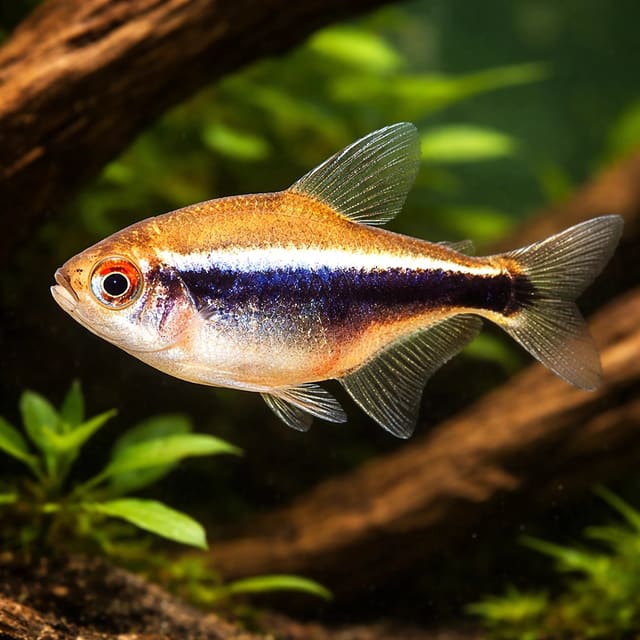
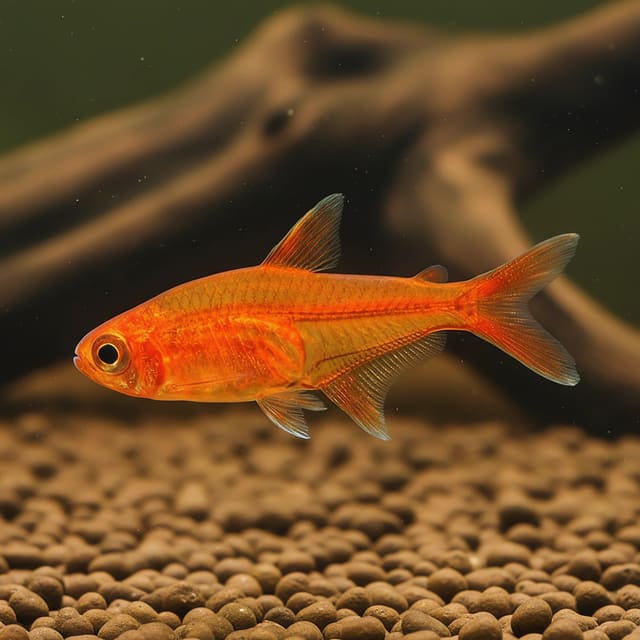
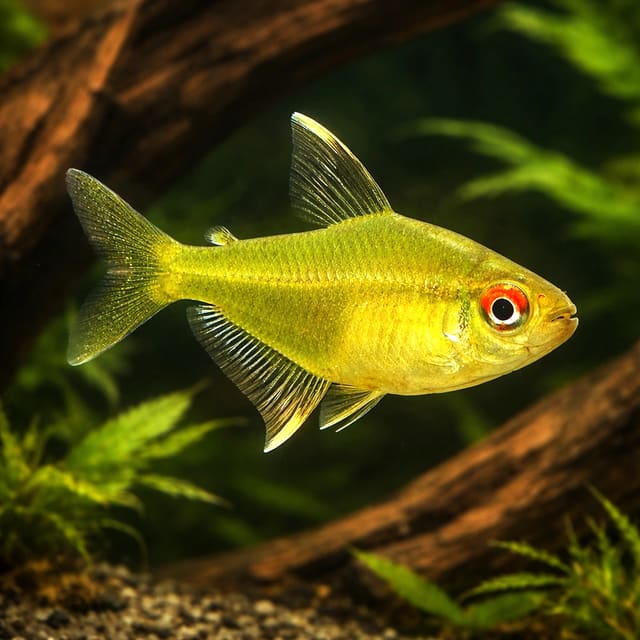
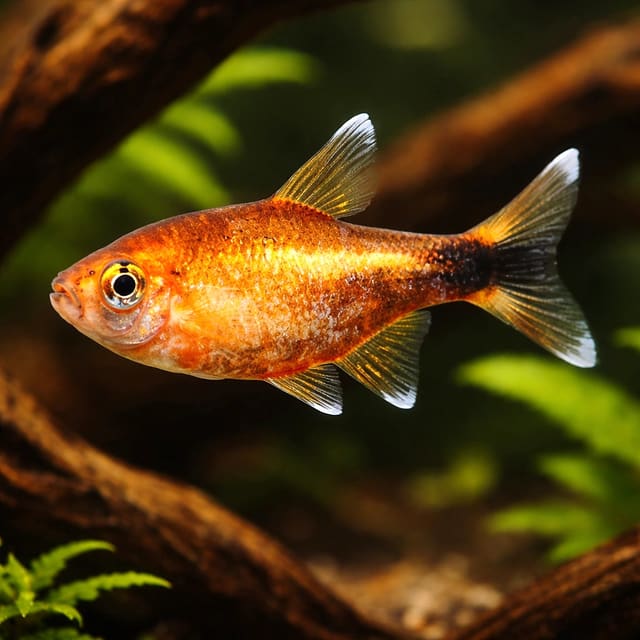
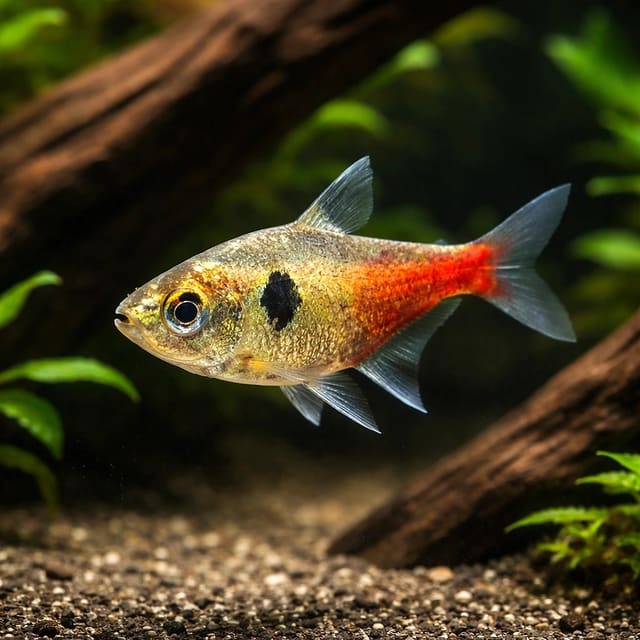
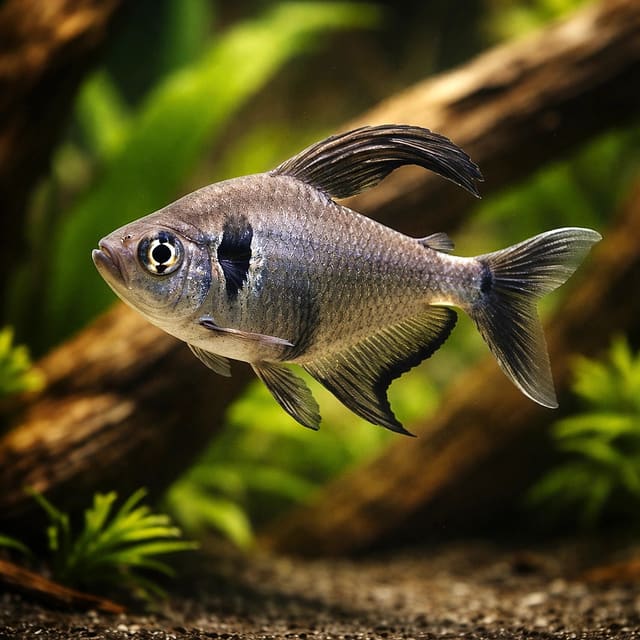
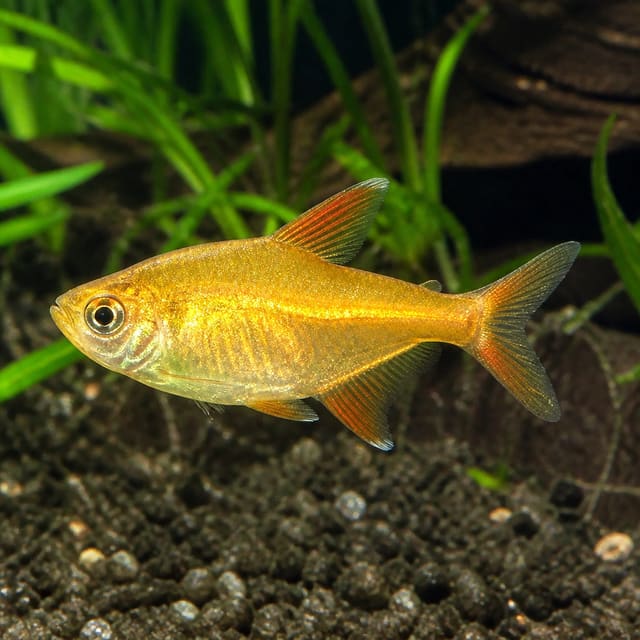
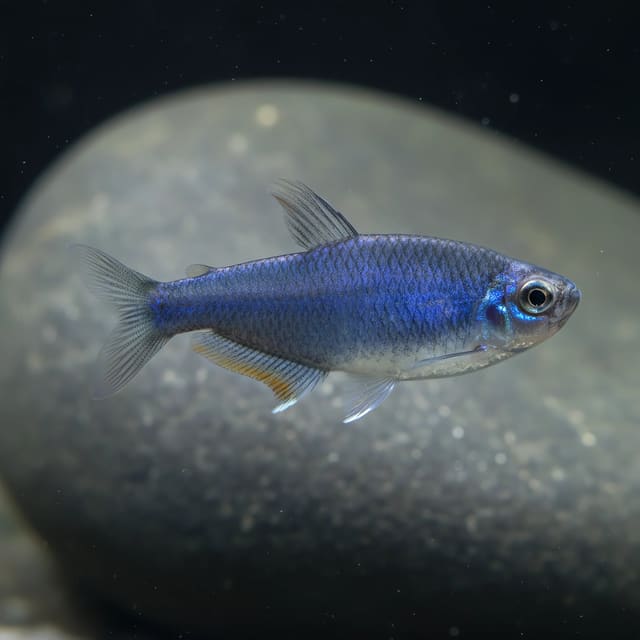
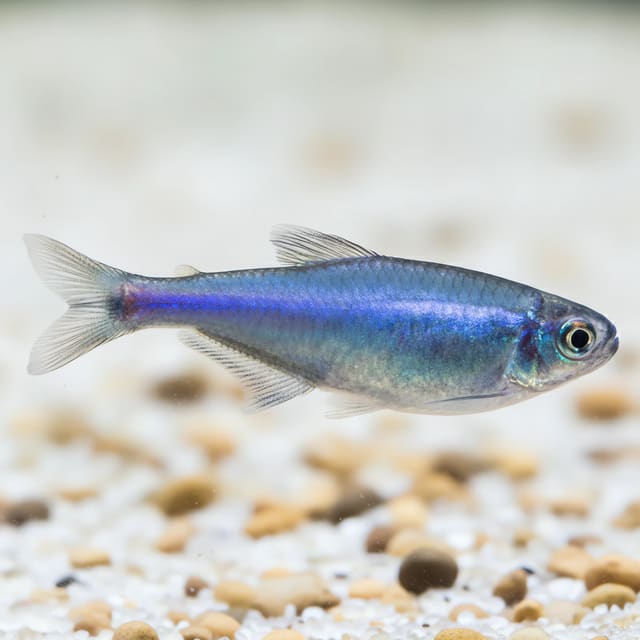
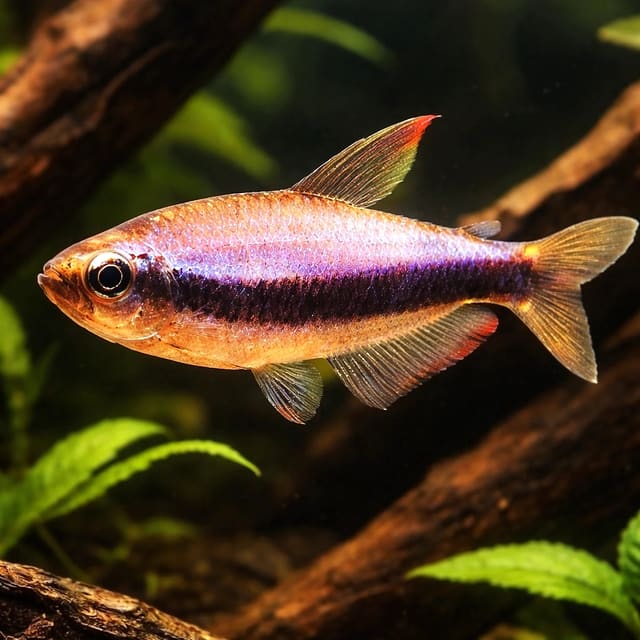
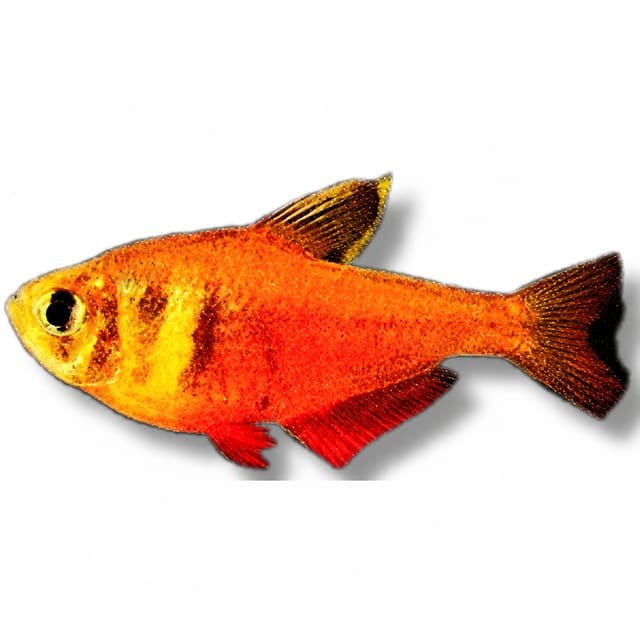
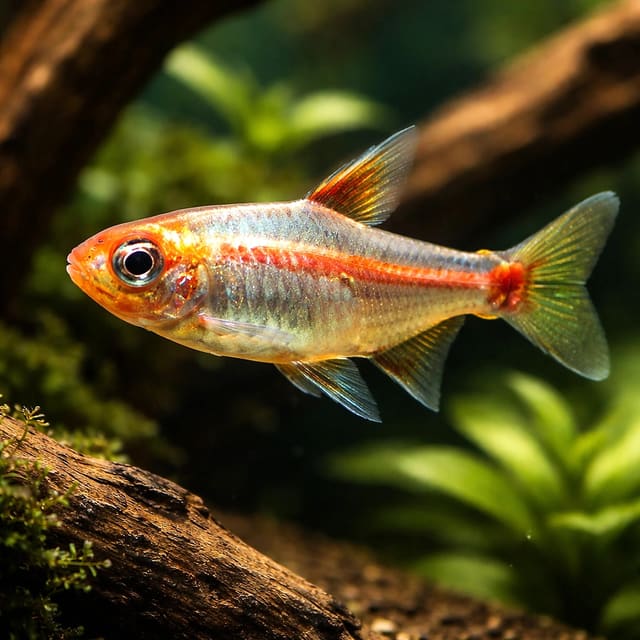
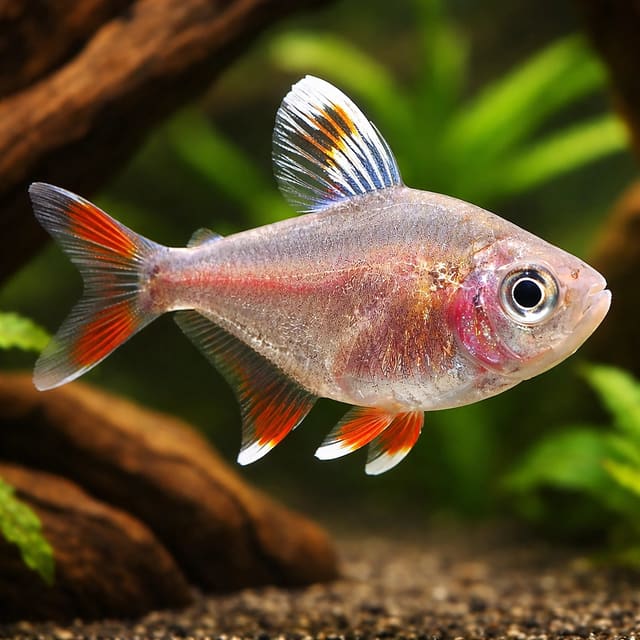
The gallery shows fish with yellow, black and white bands on the dorsal and anal fins and a reddish tail. Gallery images have been digitally enhanced to improve image quality. Natural colour, pattern, size and maturity can vary between live animals.
The smaller grades are young fish that will do their growing in your aquarium, which many keepers enjoy watching. The larger grades are nearer adult size, so they sit more comfortably alongside established community fish from the start. If you are adding to a shoal you already keep, choosing a size close to your current fish keeps the group even at feeding time. Whichever you pick, young fish need food fine enough for small mouths while they grow.
| Feature | Detail |
|---|---|
| Scientific name | Pristella maxillaris |
| Family | Acestrorhamphidae (American tetras) |
| Other names | Pristella tetra, water goldfinch |
| Native range | Amazon, Orinoco and coastal river drainages of the Guianas |
| Adult size | About 4.5 cm |
| Temperament | Peaceful, gregarious shoaling fish |
| Group size | At least 6, preferably 10 or more |
| Smallest tank | 60 × 30 cm base, about 54 litres |
| Temperature | 22–28°C |
| pH | 6.0–7.5 |
| Hardness | 2–20 dGH |
| Diet | Small invertebrate feeder that takes flakes, granules and small live or frozen foods |
The X Ray Tetra earns its reputation by settling into a wide range of community aquariums, eating readily and leaving its neighbours alone. It is not a showy fish in a bare tank, and Seriously Fish warns it can look a little washed out in a very spartan setup. Give it plants, some wood and a group of its own kind, though, and it becomes a lively, dependable shoal for the open middle of the tank.
Pristella maxillaris is the accepted name in the FishBase species summary for the X-ray tetra, which places it in the family Acestrorhamphidae, the American tetras. General tetra care sheets, including OATA's, still describe tetras as members of the family Characidae, so you may see either family on labels and in books. The fish itself is the same.
It is the only species in its genus. Seriously Fish explains that older literature often calls it Pristella riddlei, a name that is no longer valid, and that it is also sold as the pristella tetra or water goldfinch. When you see "riddlei" on a label, it echoes that older name.
A selectively bred golden form also exists. Seriously Fish describes it as a semi-albino fish whose care is much the same as the standard form. This listing is for the standard X Ray Tetra.
FishBase gives its distribution as the Amazon and Orinoco basins together with the coastal river drainages of the Guianas. It records the species in calm coastal waters and densely vegetated swamps, where it feeds on worms, small crustaceans and insects. It is listed as Least Concern on the IUCN Red List.
These waters flood every year, and Seriously Fish notes that the amount of dissolved minerals shifts with the seasons as a result. That is why hardness is not critical for this fish in the aquarium. The species breeds during the wet season, when the water is naturally softer and more acidic, which becomes relevant only if you want to spawn it.
One detail surprises many keepers: Seriously Fish points out that aquatic plants are not a feature of its natural waters. Plants in your aquarium therefore serve as cover and as a backdrop that shows the fish off, and the species looks particularly effective in a heavily planted arrangement.
The Seriously Fish species profile gives a base of 60 × 30 cm, roughly 54 litres, as the smallest aquarium to consider, and FishBase likewise gives a minimum aquarium size of 60 cm. The length of the tank matters because FishBase describes this as an open-water fish, and OATA stresses giving tetras space to swim. Keep the front and centre of the tank clear so the group can move together.
If you plan a shoal of ten or more, or want tank mates as well, go larger. OATA's general advice is to buy the largest aquarium you reasonably can, because a bigger volume keeps temperature and water quality more stable.
A filter is always essential. The RSPCA is clear that no fish should be kept without a well set up and maintained filter, and OATA says the same for tetras. Seriously Fish suggests a turnover of four to five times the tank volume an hour, which for a tank of about 54 litres means a filter rated at around 215–270 litres per hour. OATA adds that smaller species appreciate a gentle current, so angle the outlet to keep the flow soft.
To hold 22–28°C in a tank of that size, Seriously Fish estimates a heater of roughly 75–100 W, assuming a room of around 20°C. A colder room or a larger tank needs more heating power.
| Equipment | Starting point for a 60 × 30 cm tank |
|---|---|
| Tank base | 60 × 30 cm, about 54 litres, as the minimum |
| Filter | Rated around 215–270 litres per hour |
| Heater | Roughly 75–100 W in a room near 20°C |
| Substrate | Aquarium sand or gravel |
| Cover | Live plants, or artificial plants and ornaments |
Seriously Fish describes the X Ray Tetra as an adaptable, mass-produced fish that will do well in most tanks, but it looks particularly effective in a heavily planted arrangement. OATA recommends aquarium gravel or sand and, ideally, live plants to provide cover; where live plants are not used, artificial plants and suitable ornaments such as plant pots or model caves give the fish shelter.
A practical layout is dense planting along the back and sides, a few pieces of wood, and a clear swimming lane through the middle. That gives the shoal open water to swim in with cover close by.
If you want to see the species at its best, Seriously Fish suggests a simple biotope-style tank:
A biotope is optional. A well planted community tank with stable water suits the species just as well for everyday keeping.
X Ray Tetras are adaptable, but adaptable is not the same as tolerant of dirty or unstable water. Use these figures as your everyday targets:
| Water value | Aim for |
|---|---|
| Temperature | 22–28°C |
| pH | 6.0–7.5 |
| General hardness | 2–20 dGH |
| Ammonia | 0 mg per litre |
| Nitrite | 0 mg per litre |
| Nitrate | No more than 20 mg per litre above your tap water |
The temperature, pH and hardness ranges are the species aquarium figures from Seriously Fish. The ammonia, nitrite and nitrate limits come from OATA's care sheet for tetras and pencilfish, which covers the group as a whole.
FishBase records the wild environment of the species at 24–28°C and pH 6.0–8.0, with hardness up to 35 dH. Those figures describe the waters where the fish has been found; they are not a routine aquarium target, so keep to the narrower species range above for day-to-day care. OATA's broad guidance for captive-bred tetras, 22–27°C, pH 6.5–8.0 and 4–12 dH, overlaps with these figures; where they differ, follow the species range.
Seriously Fish describes hardness as not critical, with anywhere from 2 to 20 dGH acceptable. The lower end of that range is only worth aiming for if you hope to spawn your fish. Measure your own tap water rather than assuming it fits.
In a mixed aquarium, pick one temperature within 22–28°C that also suits the other species, and keep it steady rather than letting it drift with the room. A reliable heater and a thermometer you check each day make that easy.
If you are unsure what your tap water provides, our guide to which aquarium water values to test and why explains each reading, and the water parameter matcher lets you compare your own results with the ranges above.
The RSPCA's advice on aquarium environments explains the chemistry. Fish release ammonia, which is toxic. A working biological filter lets beneficial bacteria grow, and they convert ammonia to nitrite, which is also toxic, and then to nitrate, which is safer. OATA adds that tetras can be stressed by even the smallest amounts of ammonia, which is why testing and routine maintenance matter more than chasing an exact pH.
A routine like this keeps conditions steady, and steady conditions are what keep a shoal of X Ray Tetras active, feeding well and showing good colour.
In the wild the X Ray Tetra is a micropredator. FishBase records it feeding on worms, small crustaceans and insects, and Seriously Fish notes that it feeds mainly on small invertebrates in nature. In the aquarium it proves unfussy, which is one reason it settles so readily.
Rotating between dried and small live or frozen foods through the week gives variety that echoes the small invertebrates the species eats in nature.
OATA's tetra guidance is to feed only what the fish can eat within a few minutes, once a day. Take care not to overfeed: uneaten food breaks down and releases toxic waste into the water, and in a small tank that quickly undoes a good maintenance routine.
Watch the whole group at mealtimes rather than the first fish to the food. Seriously Fish notes that this species does not compete well with very boisterous or much larger tank mates, so if faster fish are clearing the food before the tetras reach it, spread the food across the surface or rethink the mix of fish.
Fish supplied at 2 cm are young and still growing. Choose the finest flake or granule you can find and include small foods such as Daphnia and Artemia, which suit small mouths. OATA lists a change in body weight or condition as one of the signs to watch, so a quick look at body shape during feeding tells you whether the group is getting enough.
Fish should only go into an aquarium whose filter has matured. If this is your first tank, our step-by-step guide to setting up and maturing a first tropical aquarium walks through the process. Before any fish arrive, check that ammonia and nitrite both read zero.
OATA also advises adding fish slowly. The beneficial bacteria in a maturing filter need time to increase each time more fish are added and feeding goes up. Overstocking or stocking too quickly can cause "new tank syndrome", where there are not enough nitrifying bacteria to cope with the extra waste, leading to unhealthy levels of ammonia and nitrite that may cause fish to become ill or die.
If you plan a shoal of ten or more together with other species for a newly matured tank, add the fish over several stages rather than all at once, and test for ammonia and nitrite between each addition, so the filter bacteria can keep pace with the growing amount of waste.
Your fish are hand-packed by our team, bagged in pure oxygen and sent in an insulated poly box, with a heat pack when the weather calls for it. A licensed live-animal courier carries the parcel, and we email you the tracking number and your confirmed delivery date so you know when to be in. Someone needs to be at the delivery address to receive the parcel, because live fish cannot be left unattended.
The parcel needs to be opened and inspected on the day it arrives. If anything has gone wrong, contact us the same day, with WhatsApp the fastest route, and include your order number and the unboxing video; we will then arrange a replacement or refund under the Live Arrival Guarantee. The full terms are on our delivery and Live Arrival Guarantee page.
OATA describes healthy fish as having clear, bright eyes, undamaged fins, intact scales and no ulcers or bumps. Keep feeding light for the first few days and test the water more often than usual while the filter adjusts to the extra waste.
All fish vary a little in behaviour and appearance, but OATA lists changes worth noticing early, before they become a real health problem:
If something looks wrong, test your water quality first, then contact us with the results. In a shoaling fish, one that hides more than normal or stays apart from the group deserves a closer look.
OATA's tetra guidance notes that although these fish are small, they can live several years in a well matured setup with good water quality. Stable water, sensible feeding and a proper group give your fish the best chance of a long life.
FishBase describes reproduction as easily carried out, with 300 to 400 eggs obtained per spawn. Seriously Fish agrees that the species is easy enough to spawn but warns that raising the tiny fry can be tricky; to raise them in decent numbers you will need a dedicated tank.
These breeding conditions apply to a dedicated spawning tank only; keep your main community aquarium within the everyday ranges in the water section.
Seriously Fish notes that mature females are usually bigger and noticeably stockier than males, which helps you pick out likely pairs once the fish are grown. Because sex cannot be chosen at purchase, anyone hoping to breed should start with a group and let the fish mature.
The X Ray Tetra is one of the easier tetras to fit into a community, but compatibility works in one direction more than the other. FishBase describes it as gregarious and non-aggressive, and Seriously Fish calls it a very peaceful species. The risk lies in what other fish do to it: Seriously Fish notes it will not compete well with very boisterous or much larger tank mates.
Before you think about other species, plan the shoal. Seriously Fish advises always buying a group of at least six, preferably ten or more, and explains that this shoaling species fares much better in the company of its own kind. OATA's guidance for tetras is blunt: fish kept singly or in too small groups will often become stressed. A proper group is also simply more rewarding to watch, because the fish move and display together, and Seriously Fish observes that, like most tetras, it looks far more effective kept this way.
Group size also shapes how well the tetras cope with tank mates: stressed fish in a group that is too small are poorly placed to compete with livelier neighbours for food and space.
Seriously Fish suggests keeping it with other South American species, such as:
If you are building a South American community, you can browse our range of tetras to compare other small species. Check each fish's own adult size and temperament before combining them.
In a more general community, Seriously Fish lists these groups as possible companions:
These are groups, not guarantees. Each contains calm and boisterous members, and OATA's rule for tetras is that they mix best with species of a similar size and temperament. Choose the smaller, calmer members of each group and make sure every fish gets food at mealtimes.
| Situation | What to do |
|---|---|
| Quiet planted community tank | An excellent fit; plan a shoal of six to ten or more |
| Mixed community with barbs or livebearers | Possible with calm, similar-sized species |
| Tank with large cichlids or predatory catfish | Avoid |
| Tank with boisterous, fin-nipping tetras | Avoid |
About 4.5 cm. FishBase records a maximum length of 4.5 cm and Seriously Fish gives 45 mm, so plan for a small, slim fish that stays under 5 cm as an adult.
Seriously Fish gives a base of 60 × 30 cm, roughly 54 litres, as the smallest aquarium to consider, and FishBase also gives a 60 cm minimum. Go larger for a shoal of ten or more or for a mixed community.
Keep at least six, and preferably ten or more. It is a shoaling species that fares much better with its own kind, and tetras kept singly or in too small groups will often become stressed.
Yes. Seriously Fish rates it among the very best choices for newcomers because it is peaceful and hardy. It still needs a matured, filtered aquarium, a proper group and a weekly maintenance routine.
In the wild they eat worms, small crustaceans and insects. In the aquarium, feed a good quality flake or granule with small live or frozen foods such as Daphnia and Artemia, offering only what they eat within a few minutes, once a day.
Aim for 22–28°C, pH 6.0–7.5 and a general hardness of 2–20 dGH. Hardness is not critical, but keep ammonia and nitrite at zero and nitrate no more than 20 mg per litre above your tap water.
No. FishBase describes the species as gregarious and non-aggressive, and Seriously Fish calls it very peaceful. The bigger risk runs the other way: it copes poorly with very boisterous or much larger tank mates.
Seriously Fish suggests small South American tetras, pencilfish, hatchetfish, Apistogramma, Corydoras and small loricariids, or smaller rasboras, barbs, livebearers, loaches, anabantoids and Pelvicachromis in a mixed community. Choose calm species of a similar size and avoid any fish large enough to eat it.
They are hand-packed in pure oxygen in an insulated box and carried by a licensed live-animal courier. Be in to receive the parcel, film a continuous unboxing video from the sealed box onwards, then float the sealed bag for 20–30 minutes before releasing the fish. Any Live Arrival Guarantee claim needs that video and must be reported the same day.
No reviews for this item yet. Bought one? Honest reviews only, good or bad.
What customers say about ordering from us
Easy website plenty of info on fish your buying great to pick a time slot
TRACEY DURRANT · 7 Oct 2026
Got some lovely fish thank you
Kevin Mackie · 7 Oct 2026
Reviews of our shop, collected by Judge.me, an independent third-party review collector. Newest first.