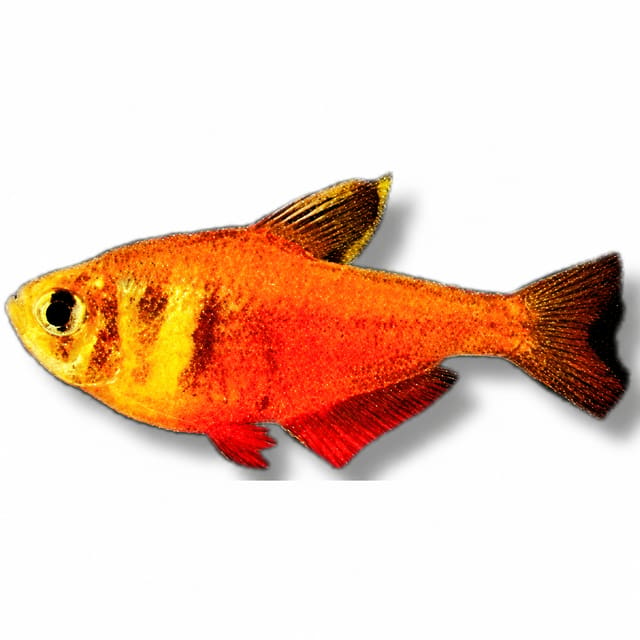
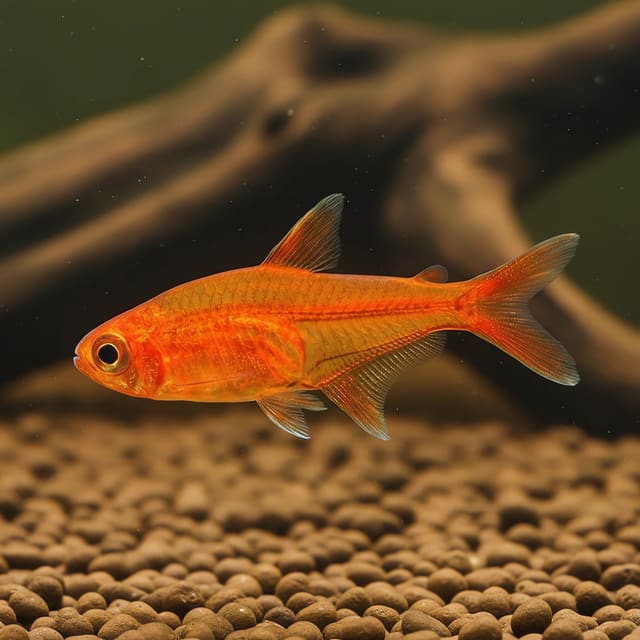
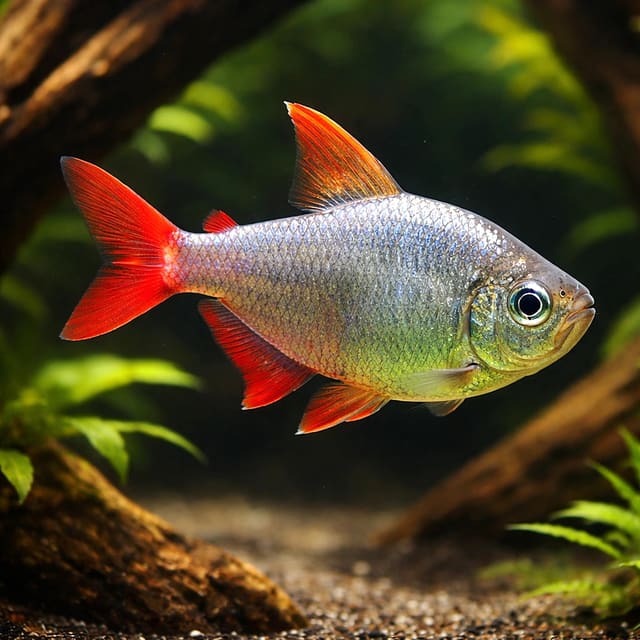
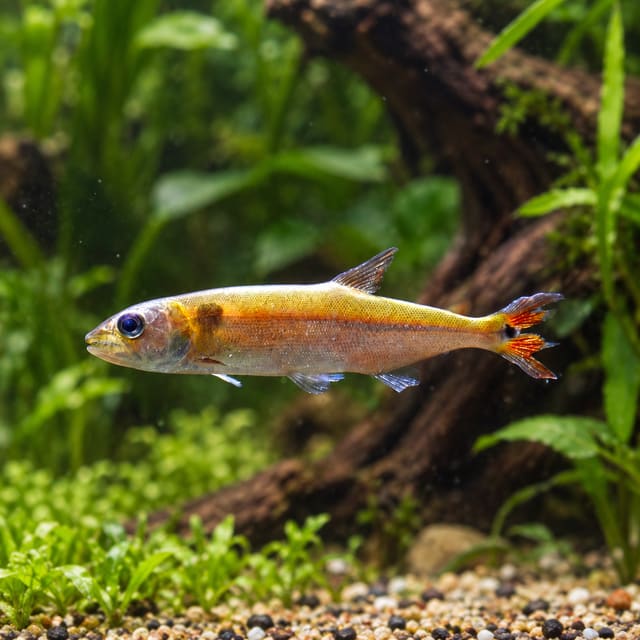
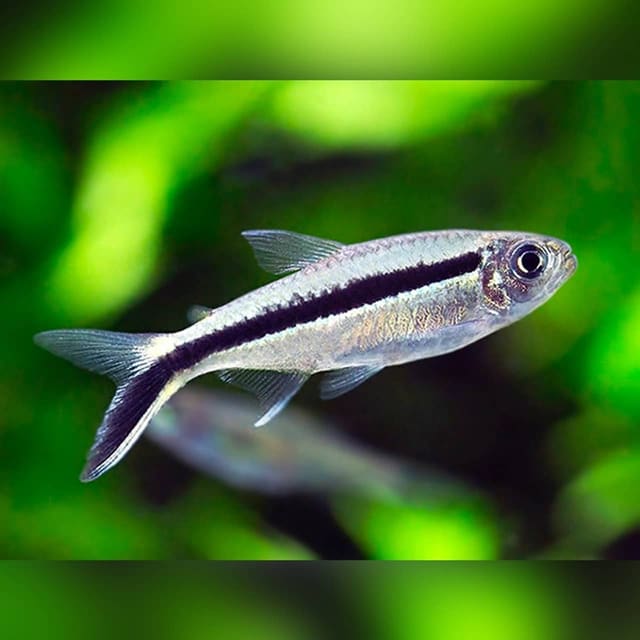
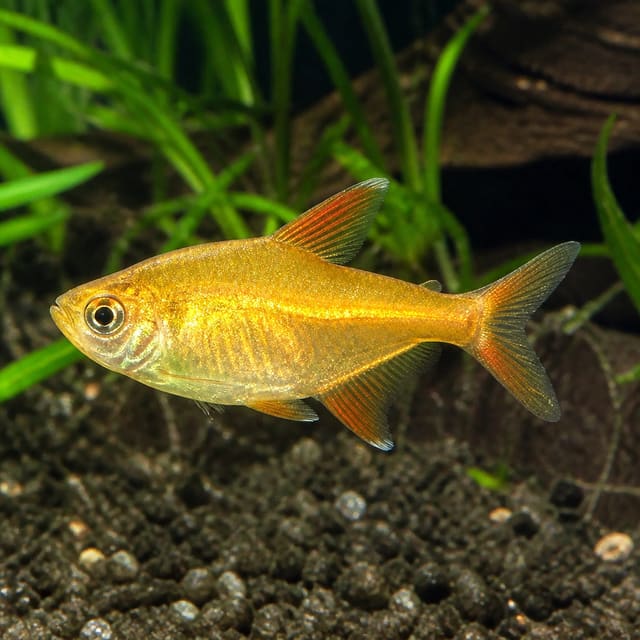
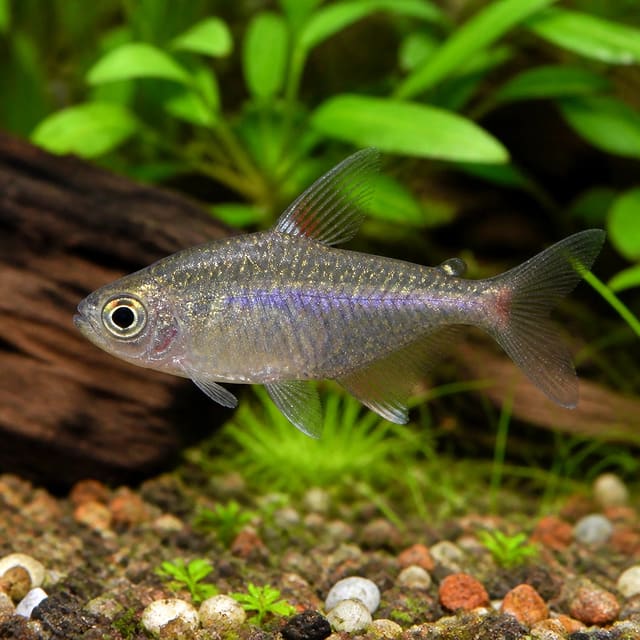
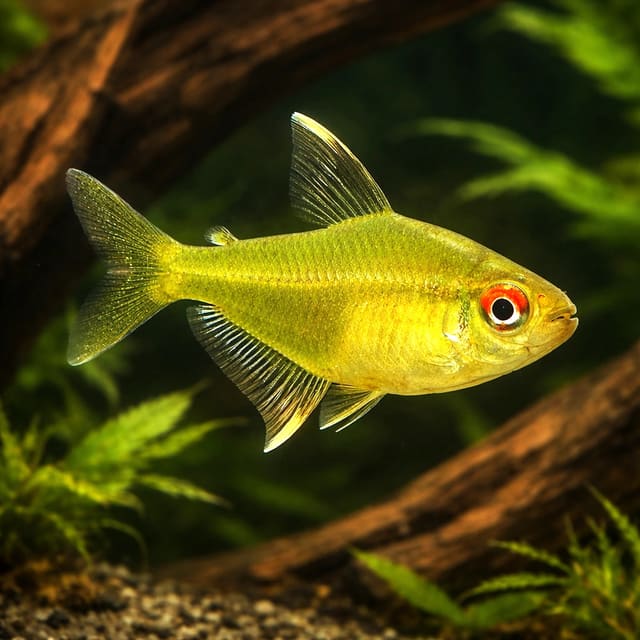
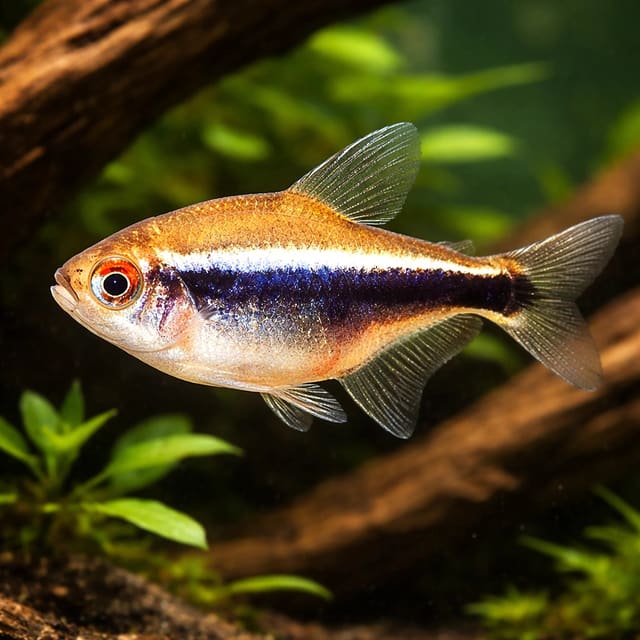
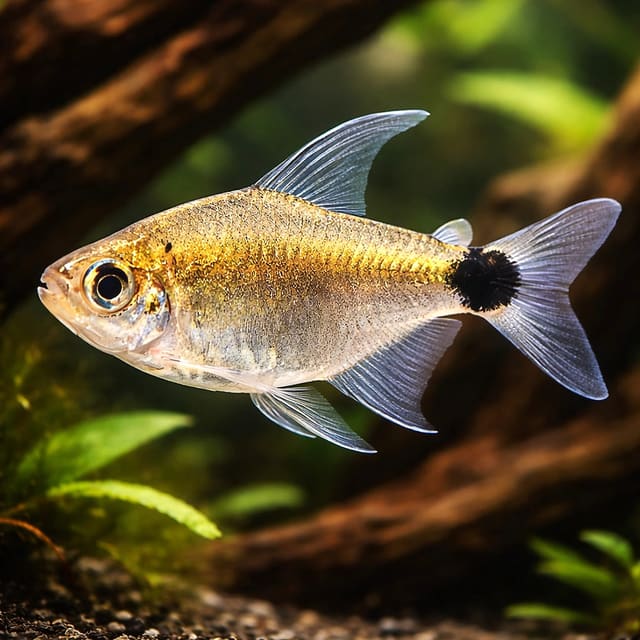
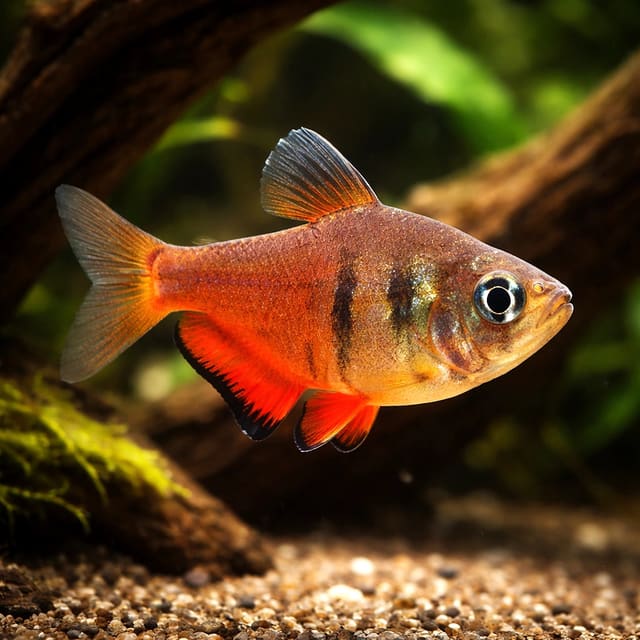
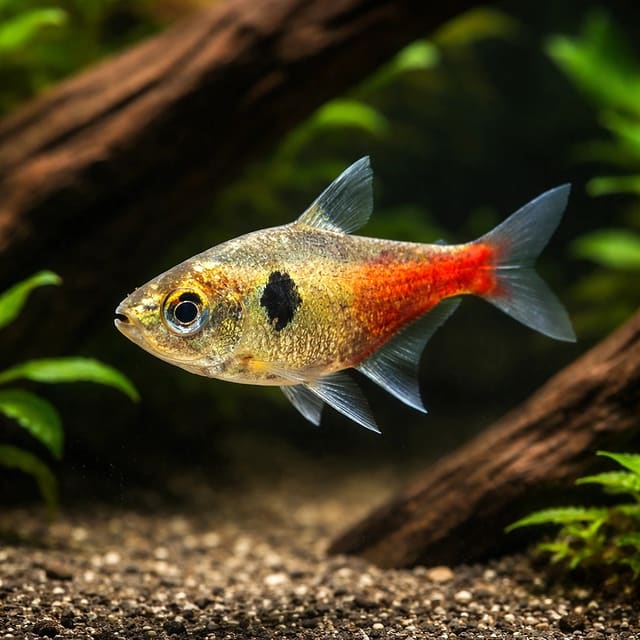
Bleeding Heart Tetra (Megalamphodus erythrostigma)
23–27°C · pH 6.5–7.2 · 81L
£12.99
Photo coming soon
The size, price and care details on this page are for this listing.
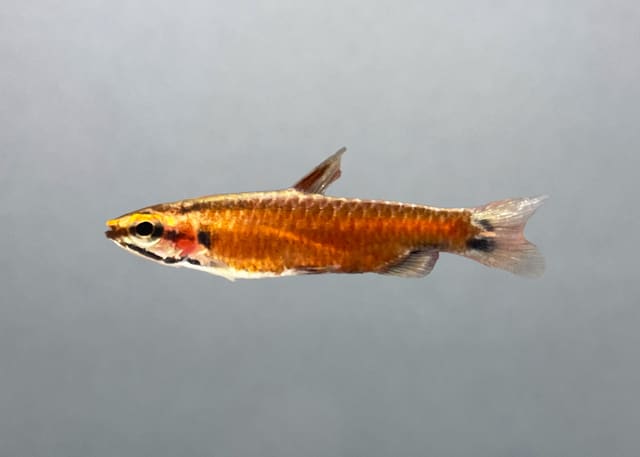
Peugeot's tetra (Hyphessobrycon peugeoti) is a tiny carmine-red tetra described in 2013 from the middle rio Juruena in Brazil. Mature males grow a long dorsal filament and adults reach 3.2 cm SL. Each unit is one fish in a 2–3 cm or 3–4 cm dispatch grade; keep a group of five or more.
Adult size is the maximum length this species reaches at full maturity (scientific sources). The livestock you receive will be younger and smaller — pick a size above for the actual shipping size. Product-photo provenance and any image-specific limitations are stated on the listing.
Hyphessobrycon peugeoti
Shoaling fish: kept in a group they feel safer, stay calmer and show their best colour.
Peugeot's tetra (Hyphessobrycon peugeoti) is a tiny carmine-red tetra described in 2013 from the middle rio Juruena in Brazil. Mature males grow a long dorsal filament and adults reach 3.2 cm SL. Each unit is one fish in a 2–3 cm or 3–4 cm dispatch grade; keep a group of five or more.
Adult size is the maximum length this species reaches at full maturity (scientific sources). The livestock you receive will be younger and smaller — pick a size above for the actual shipping size. Product-photo provenance and any image-specific limitations are stated on the listing.
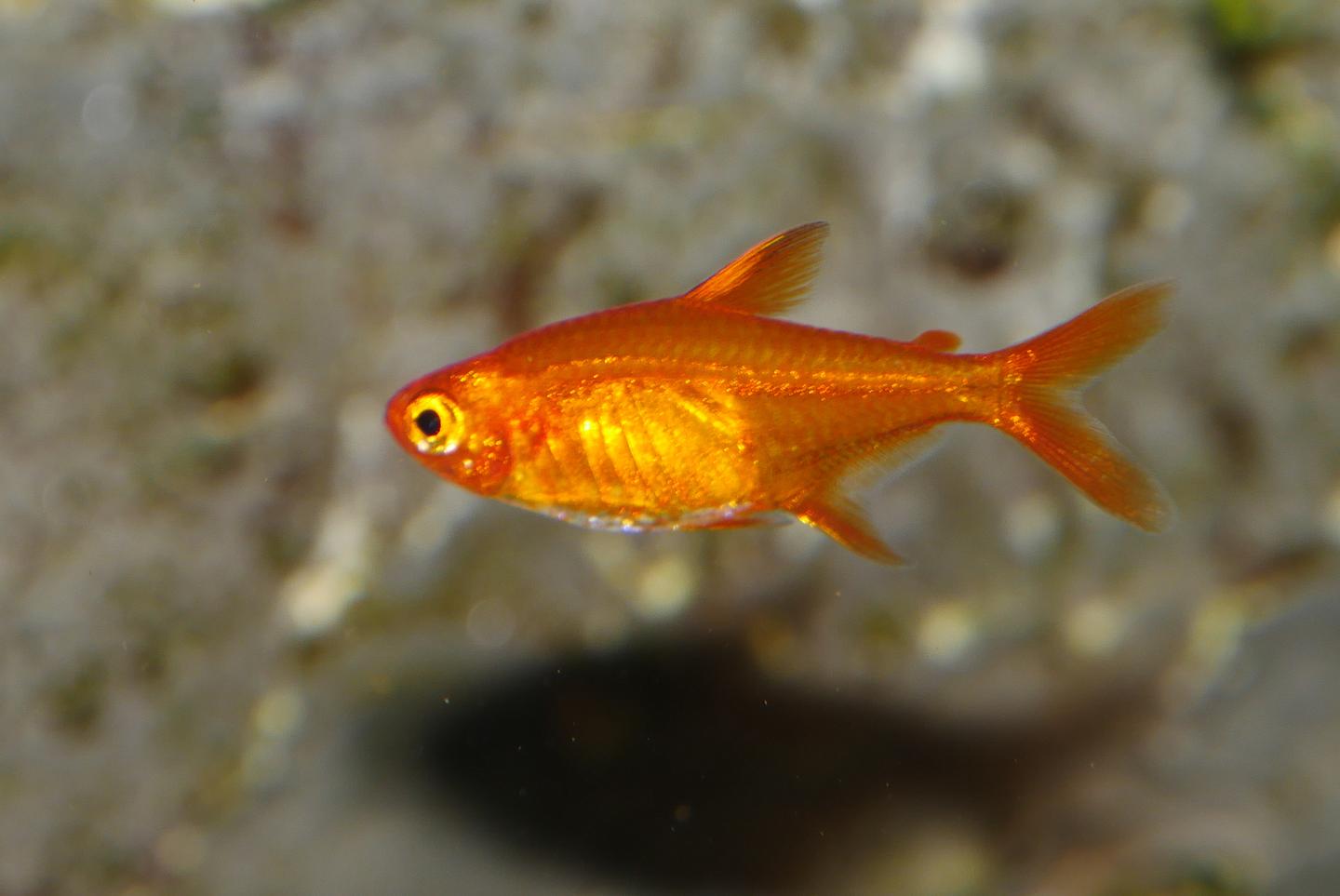
Ember tetras are very small Brazilian social fish, with a maximum recorded length of 2.0 cm excluding the tail. Keep them only in a fully cycled, stable aquarium. We recommend a group of at least 10 and about 45 litres with a 45 × 30 cm footprint rather than using a litres-per-fish formula.
Maintain these water conditions for optimal health and vibrant colors
Peugeot's tetra, Hyphessobrycon peugeoti, is a small carmine-red tetra from the middle rio Juruena in Mato Grosso, central Brazil. Scientists only described it in 2013, so it has none of the long aquarium history of the neon or the flame tetra. FishBase gives its English name as the Peugeot tetra. We keep the possessive "Peugeot's" in our title because the fish is named after the Peugeot family, and both spellings mean exactly the same animal.
Each unit on this page is a single fish. Size is the only option, and there are two dispatch grades:
Those figures describe the fish as it leaves us, not the size it will reach. FishBase records a maximum length of 3.2 cm standard length (SL). Standard length runs from the tip of the snout to the end of the body, where the tail fin begins, so the tail is left out. The largest fish measured in the original scientific description was 31.7 mm SL, and the holotype, the single male specimen the name is formally tied to, measured 30.5 mm SL. A dispatch grade is an approximate band for the whole fish as you see it, so don't read the 3–4 cm option as a fish that outgrows its species. Plan the aquarium around a shoal of adults a little over 3 cm long.
This listing does not sell a particular sex. Males and females differ in their fins once they mature, as the next section explains, but the options here are size grades only, and we make no promise about how many of either sex an order contains.
Tetras are shoaling fish, so buy a group rather than one or two. The Ornamental Aquatic Trade Association (OATA), the UK trade body for the aquatic industry, advises keeping tetras in groups of at least five and says that more is better. With a fish this small, a larger group is also simply easier to enjoy: a single 3 cm fish is easy to lose among the plants, while a group of red fish is hard to miss.
Who suits it? Someone with a settled, planted tank who wants a red tetra that few other people keep, and who is comfortable working from general tetra care guidance, because this species has very little written about it in captivity. We say that plainly throughout this guide. Where the scientific record is silent, we tell you so rather than filling the space with guesswork.
The original description, by Leonardo Ingenito, Flávio Lima and Paulo Buckup, paints a clear picture of the living fish. The top of the head and the back are dark red. The flanks and belly are silvery, but so heavily dusted with red pigment cells that the whole fish reads as carmine red. The dorsal, pectoral, pelvic and anal fins are carmine red as well. That all-over red is one of the features the authors used to separate it from its nearest look-alikes. The describers recorded the colour of living fish without setting out a separate description for females, so we can't tell you how much the sexes differ in colour.
The body is moderately deep and flattened from side to side, with a convex profile over the head. The mouth is terminal, opening at the very front of the snout rather than pointing up or down, and the tail fin is forked with upper and lower lobes of similar size. Like many small tetras it has an incomplete lateral line: only four to eight scales behind the head carry the pores of the sensory canal that runs along the side of most fish. For anyone who likes the detail, the dorsal fin has two unbranched and nine branched rays, and there are 32 or 33 vertebrae.
The feature that sets this tetra apart sits on the mature male. His dorsal fin lengthens into a filament which, in fully grown fish, reaches back as far as the base of the tail fin. Mature males also have an anal fin with a roughly straight lower edge. Females keep a normally shaped dorsal fin and a lobed anal fin, where the front rays are longer and form a curved lobe. The describers also noted that the dark blotch at the root of the tail is more developed in males.
The authors recorded the filament in mature, fully grown males, so expect it to develop as a male grows rather than to be present on every young fish in the smaller grade. If you are buying a group partly to see the males' fins, the larger grade gives you more chance of fish that are already well on the way. It cannot guarantee males, because sex is not an option on this listing.
Museum specimens kept in alcohol lose their red, and the description sets out the pattern that remains: a pale yellowish ground colour; a vertically stretched, roughly rectangular dark blotch on the shoulder, known as the humeral blotch, three to three and a half scales high; a narrow line of dark pigment along the middle of the side, most obvious behind the dorsal fin; and a black blotch on the caudal peduncle, the narrow stem in front of the tail, which spreads wider in larger specimens. These are the marks scientists use to confirm the species from preserved material.
The long dorsal filament of mature males, together with their straight-edged anal fin, separates Peugeot's tetra from nearly every other Hyphessobrycon. The authors compared it most closely with a handful of species:
You won't need scale counts at home. They simply explain why a small red tetra with a long-finned male is a species in its own right and not a colour form of something better known.
The name sounds like a joke until you read the paper. The species name peugeoti honours the Peugeot family, who invented the Peugeot pepper mill mechanism in 1842. Their manufacturing business led to a carbon-sink reforestation project at the Fazenda São Nicolau in central Brazil, and that project eventually led to the discovery of this tetra. The describers wrote all of that into the etymology of the paper, which is how a fish from a remote Amazon tributary came to share a name most people connect with cars and kitchen tables.
The formal description was published in 2013 in the journal Neotropical Ichthyology (volume 11, issue 1, pages 33–44) under the title "A new species of Hyphessobrycon Durbin (Characiformes: Characidae) from the rio Juruena basin, Central Brazil, with notes on H. loweae Costa & Géry". The holotype is a male of 30.5 mm SL, and the paratypes, the additional specimens the authors examined, range from 12.6 to 31.7 mm SL. FishBase still lists Hyphessobrycon peugeoti as the accepted name, with no synonyms.
Hyphessobrycon is one of the largest groups of small South American tetras. Wikipedia puts it at nearly 150 species, spread from southern Mexico to the Río de la Plata in Argentina, with most of them in South America and adults reaching roughly 1.7 to 9.6 cm. Even the name is a puzzle: the "brycon" part comes from a Greek word meaning to bite, while the first part may be a garbled version of a Greek word for "slightly smaller".
The genus has never been a tidy natural group, and the classification around it has been reshuffled in recent years. The 2013 paper placed the species in the family Characidae; FishBase now lists it in Acestrorhamphidae, the American tetras, which is also where Wikipedia places the whole genus. In 2024 the rosy tetra group was split off into the revived genus Megalamphodus, which is why some familiar fish, such as our bleeding heart tetra (Megalamphodus erythrostigma), now carry a different genus name from the one printed in older books. Peugeot's tetra stays in Hyphessobrycon, alongside aquarium staples such as the flame tetra (Hyphessobrycon flammeus) and the tiny ember tetra (Hyphessobrycon amandae).
FishBase reports an IUCN Red List assessment of Least Concern, dated 7 November 2018. That is reassuring, but the known range is small: so far the species has only been recorded from tributaries of one stretch of one river, which is another reason to keep good records if you keep it.
The Juruena is a big river that few fishkeepers could place on a map. It rises on the Parecis plateau in Mato Grosso, at about 653 metres above sea level, and runs for roughly 1,240 km before it meets the Teles Pires. Together the two form the Tapajós, one of the largest tributaries of the Amazon. For its last 190 km the Juruena marks the border between the states of Mato Grosso and Amazonas, and its course is broken by waterfalls and rapids, including the Salto Augusto falls, so it can't be navigated from end to end. Several protected areas sit along its banks, among them Juruena National Park and the Igarapés do Juruena State Park.
Peugeot's tetra is known only from tributaries of the middle Juruena, in the upper Tapajós basin. The collecting notes in the original description are brief, but they are the most useful thing we have for setting up a tank:
Put together, that describes a fish of shallow, well-vegetated edges: grassy margins, flooded ground and clear sandy streams, rather than the open channel of the river. FishBase classes it as benthopelagic, the term for fish that live and feed near the bottom as well as in mid-water rather than at the surface.
What the record does not give is water chemistry. The describers did not publish temperature, pH or hardness for the collecting sites, and FishBase lists no water values for the species, so nobody can honestly tell you the readings on the day these fish were caught. What we can say is that this is a tropical freshwater fish from shallow, plant-choked water, and that a planted tank with a sandy floor, cover along the back and sides, and calm areas among the plants is a sensible place to start.
OATA's guidance for tetras and pencilfish sets a minimum of 45 litres for small shoals of the smaller species, and at 3.2 cm SL Peugeot's tetra is firmly one of the smaller species. Treat 45 litres as the floor, not the goal. OATA also points out that a larger aquarium keeps temperature and water quality more stable, and stability matters more than usual with a fish that has so little captive history behind it. Given the choice between a 45-litre cube and a 60 cm tank of 60 litres or more, we'd take the longer tank: it gives a shoal room to swim along the front glass and leaves space for the planting this species clearly lives among in the wild.
Peugeot's tetras are a good centrepiece for a small, quiet tank because they are the colour in it. A simple plan for a 60-litre aquarium might be the tetra shoal as the main group, a planted background, and only a few other small, peaceful fish chosen with the guidance in the tank mates section further down. Resist the urge to add a second showy shoal straight away. With a little-known species, it pays to watch how your group settles before you change the tank around it.
Get the tank fully running before you order. OATA's water quality targets for tetras are zero ammonia and zero nitrite, with nitrate no more than 20 mg per litre above your tap-water level. A new tank only reaches those figures once the filter has matured, which takes weeks rather than days, so set it up, let it run and keep testing until the readings hold steady. Adding fish to an unmatured tank invites the ammonia and nitrite that those targets exist to prevent.
Here is the honest position. Nobody has published water measurements from the places this fish was collected, and there is no species-specific aquarium study we can point you to. FishBase lists it as a tropical freshwater fish but gives no temperature, pH or hardness range. Rather than make up precise numbers, we work from OATA's published guidance for tetras and pencilfish, the UK trade association's general care sheet for this group:
| Measure | OATA guidance for tetras |
|---|---|
| Temperature | 22–27 °C |
| pH | 6.5–8.0 |
| General hardness (GH) | soft to medium, 4–12 °dH |
| Carbonate hardness (KH) | soft to medium, 3–10 °dKH |
| Ammonia | zero |
| Nitrite | zero |
| Nitrate | no more than 20 mg/l above your tap water |
Within those bands, steadiness counts for more than any particular figure. Choose a temperature towards the middle of the range, around 24–25 °C, set the heater and leave it alone. If your tap water sits comfortably inside the pH and hardness ranges, use it as it is rather than adjusting it with chemicals; a reading that stays put from one water change to the next is kinder to small fish than one that is pushed about.
General hardness is mostly the calcium and magnesium dissolved in your water. Carbonate hardness is the buffer that holds pH steady. Soft water with very little KH can see its pH drift downwards between water changes, while hard water with plenty of KH tends to sit at a higher, steadier pH. Much of the UK has hard tap water and some areas have very soft water, so test yours before you buy rather than assuming. Your water company also publishes hardness figures for your postcode, which is a quick first check.
OATA adds that wild-caught tetras may need different conditions and advises asking your retailer what they recommend. If your tap water lands at either end of the ranges above, email us before you order and tell us your readings; we would rather talk it through first than have fish arrive into water that is a long way from what they left.
OATA's routine for tetras is simple and worth sticking to:
Our own habit on top of that is to treat new water with a tap-water conditioner and bring it close to tank temperature before it goes in. Keep a simple log of your test results too. With a species this little studied, your own records are the best guide you have to how your fish are doing, and if something does go wrong, a log makes it far easier for us or a vet to help.
OATA describes tetras as omnivores that take most food types, and recommends a good-quality flake or granule as the staple, with small live or frozen foods such as daphnia, small bloodworm or tubifex as extras. Nothing in the scientific record on Peugeot's tetra points to a special diet, and the original description does not cover what it eats in the wild, so that general advice is the right starting point. The fish's size is what shapes the detail.
Uneaten food rots and feeds straight into the nitrate reading between water changes. OATA's nitrate ceiling is a useful reminder that a heavy hand with the food tub shows up in the test kit before it shows up in the fish. If someone else is feeding while you're away, measure out daily portions in advance so the tank isn't overfed in your absence.
With new arrivals, offer a very small amount once they are swimming normally and remove anything they ignore. Their appetite over the first week is one of the best signs of how well they are settling, so it's worth watching each feed closely.
Keep Peugeot's tetra the way OATA recommends for all tetras: as a group of at least five, and preferably more. In a tank of 60 litres or more we'd suggest eight to twelve fish for a species this small, and a group of that size gives you a fair chance of several males once the fish mature.
Very little has been written about how this species behaves in aquariums, so we'll stick to what is known. It is a small shoaling tetra from shallow, vegetated water, and FishBase places it in the lower and middle layers of the water rather than at the surface. Give the group cover and calm company and you are giving it what the wild habitat suggests it needs. Anything beyond that you will learn by watching your own fish, and we'd be glad to hear what you see.
OATA's compatibility advice for small tetras is short: don't keep them with any fish large enough to eat them. For larger and more boisterous tetras the warning runs the other way, as they may nip the fins of timid or long-finned fish. Both points matter here. At around 3 cm, Peugeot's tetra is small enough to be eaten by many popular community fish, and the males' long dorsal filament is exactly the kind of fin a nippy tank mate goes for.
Good companions are other small, calm fish that suit the same water and won't treat a 3 cm tetra as food. Choose them for your own water and tank, and ask us about a particular combination if you're unsure. Leave out:
Sexing grown fish is straightforward once you know where to look, because the differences are in the fins. Mature males develop the long dorsal filament reaching back towards the tail and an anal fin with an almost straight lower edge. Females keep an ordinary dorsal fin and a lobed anal fin. The blotch at the root of the tail is also more developed in males. The describers found no fin hooks, the tiny bony hooks some male tetras carry on their fins, in this species.
We haven't found a published account of Peugeot's tetra spawning, either in the aquarium or in the wild, in the sources we use for this guide, and we won't fill that gap with guesses borrowed from other tetras. If you manage it, keep notes and photographs: you would be adding real knowledge about a fish that only received its scientific name in 2013.
OATA's description of a healthy tetra makes a good checklist for the day your fish arrive and every feed afterwards: clear, bright eyes; undamaged fins; intact scales; no ulcers or lumps; normal swimming; and steady breathing. For Peugeot's tetra we'd add colour. The description of living fish is an even carmine red over the body and fins, so a settled fish that stays washed out for days is telling you something.
OATA also lists the changes worth noticing in any tetra:
None of these signs is specific to this species, but with a fish that has almost no captive health record of its own, those general signs are what you have to go on. Neither FishBase nor the original description gives a lifespan figure, so we can't quote one either.
If something does go wrong, a fish vet with aquatic experience is the right person to diagnose it. Take your water test log with you.
Before you order, read our delivery and live-arrival information. A few things need to be in place before the parcel arrives:
The fish travel in oxygen-filled bags inside insulated packaging, with heat packs when the weather calls for them, and are carried by a tracked courier licensed to carry live animals.
Our live-arrival policy depends on one simple habit. Start a continuous video while the parcel is still sealed, open it in the same take, and show the fish in the bag before the bag is opened. If any fish arrives dead, dying or clearly compromised, email hello@tropicalfishco.co.uk on the day of delivery with your order number and that video. Photos alone don't meet the policy. The resolution is a replacement with your next order or a refund for the affected fish, subject to our guarantee terms.
If the fish make for the plants on release, that is exactly what the planting is there for. Keep the lights low for the rest of the day and leave the group in peace.
Watch breathing, appetite and behaviour over the first seven days. Fast, laboured breathing, fish hanging at the surface or lying on the bottom, or a refusal to feed after the first couple of days are all reasons to test the water straight away. Offer small feeds, keep up your normal weekly water change, and hold off adding any other new fish until the shoal is eating well and moving about as a group. Compare their colour with the description earlier in this guide: settled fish should show the carmine red over the body and fins.
These are the sources behind this guide. They are worth reading if you want the detail first-hand:
No reviews for this item yet. Bought one? Honest reviews only, good or bad.
What customers say about ordering from us
Easy website plenty of info on fish your buying great to pick a time slot
TRACEY DURRANT · 7 Oct 2026
Got some lovely fish thank you
Kevin Mackie · 7 Oct 2026
Reviews of our shop, collected by Judge.me, an independent third-party review collector. Newest first.