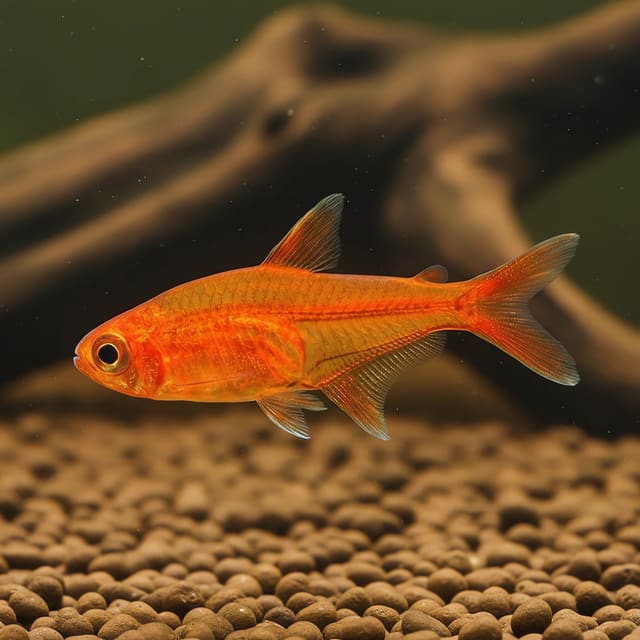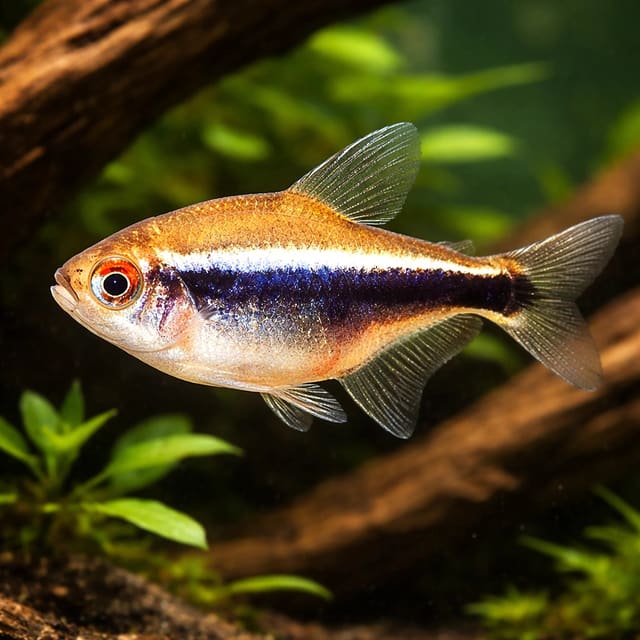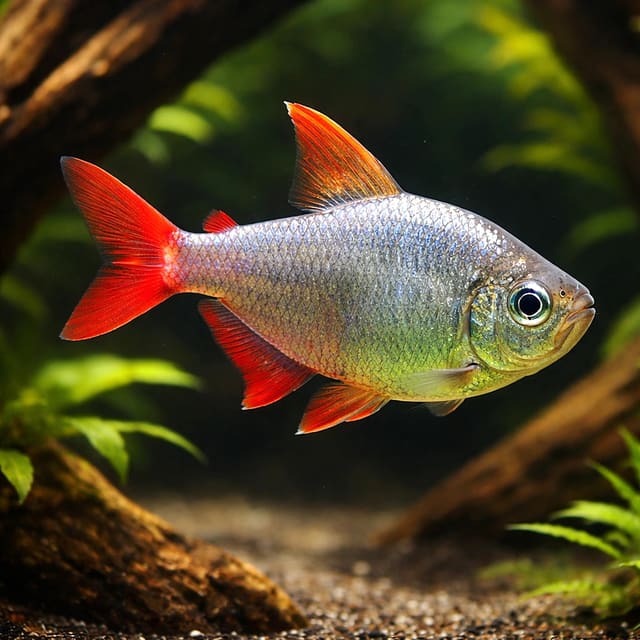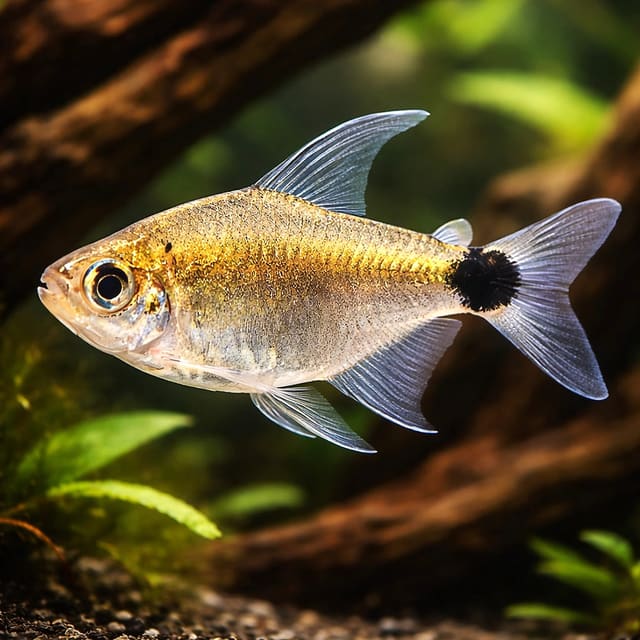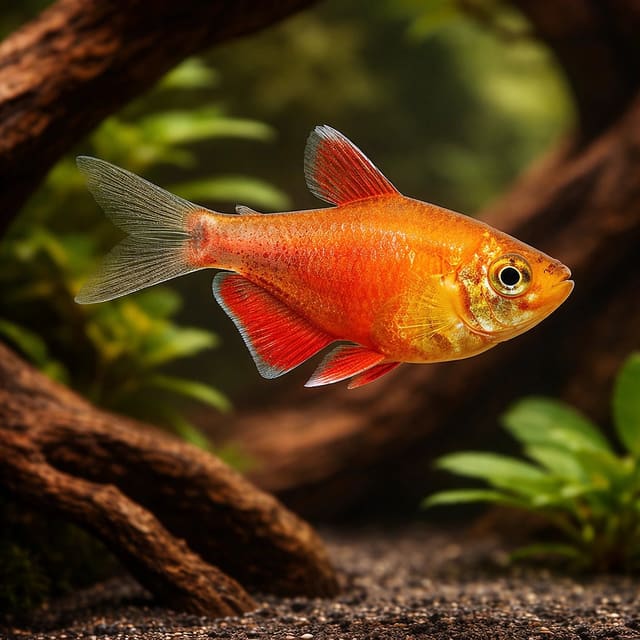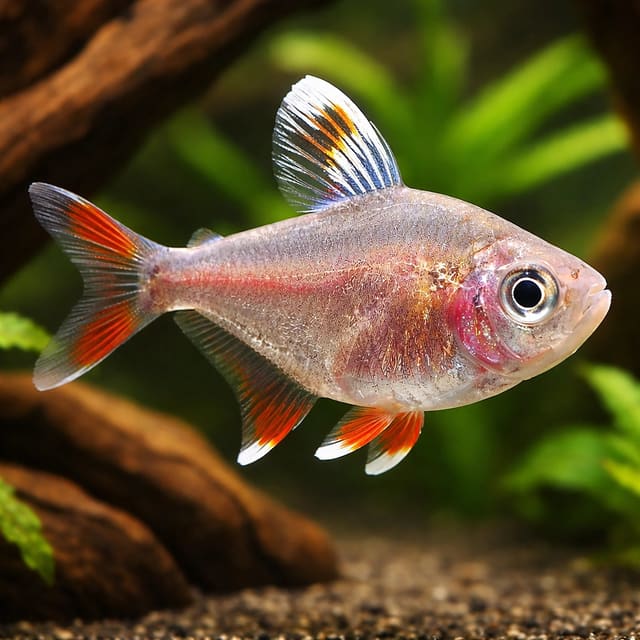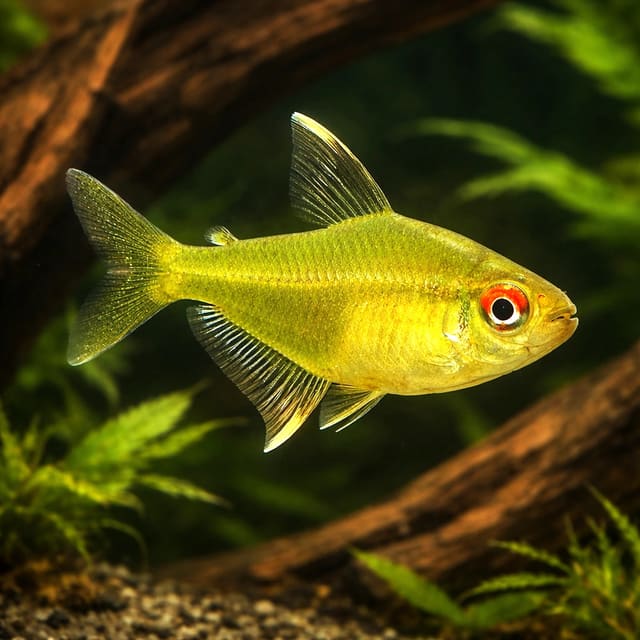
Lemon Tetra (Hyphessobrycon pulchripinnis)
22–27°C · pH 6.5–7.5 · 72L
£3.99
Photo coming soon
The size, price and care details on this page are for this listing.
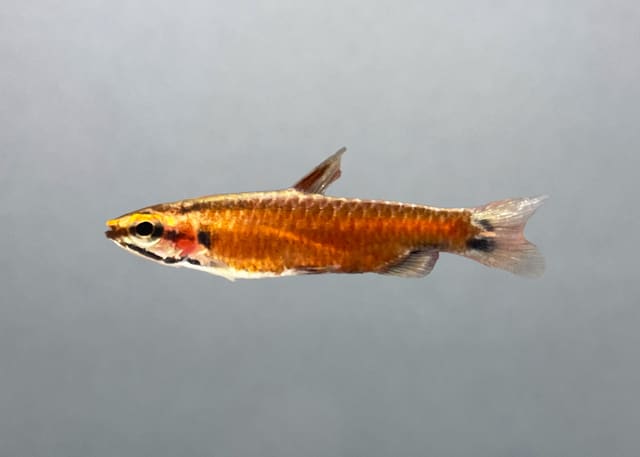
Procyon tetra (Hyphessobrycon procyon), a small Brazilian tetra described in 2016 from the Rio Juma in the Rio Aripuanã drainage. It reaches 3.2 cm SL, and mature males grow a long dorsal fin with red at the tail base. Sold per fish; sex cannot be chosen. Keep a group of five or more in clean, moving water.
Adult size is the maximum length this species reaches at full maturity (scientific sources). The livestock you receive will be younger and smaller. Product-photo provenance and any image-specific limitations are stated on the listing.
Hyphessobrycon procyon
Shoaling fish: kept in a group they feel safer, stay calmer and show their best colour.
Procyon tetra (Hyphessobrycon procyon), a small Brazilian tetra described in 2016 from the Rio Juma in the Rio Aripuanã drainage. It reaches 3.2 cm SL, and mature males grow a long dorsal fin with red at the tail base. Sold per fish; sex cannot be chosen. Keep a group of five or more in clean, moving water.
Adult size is the maximum length this species reaches at full maturity (scientific sources). The livestock you receive will be younger and smaller. Product-photo provenance and any image-specific limitations are stated on the listing.
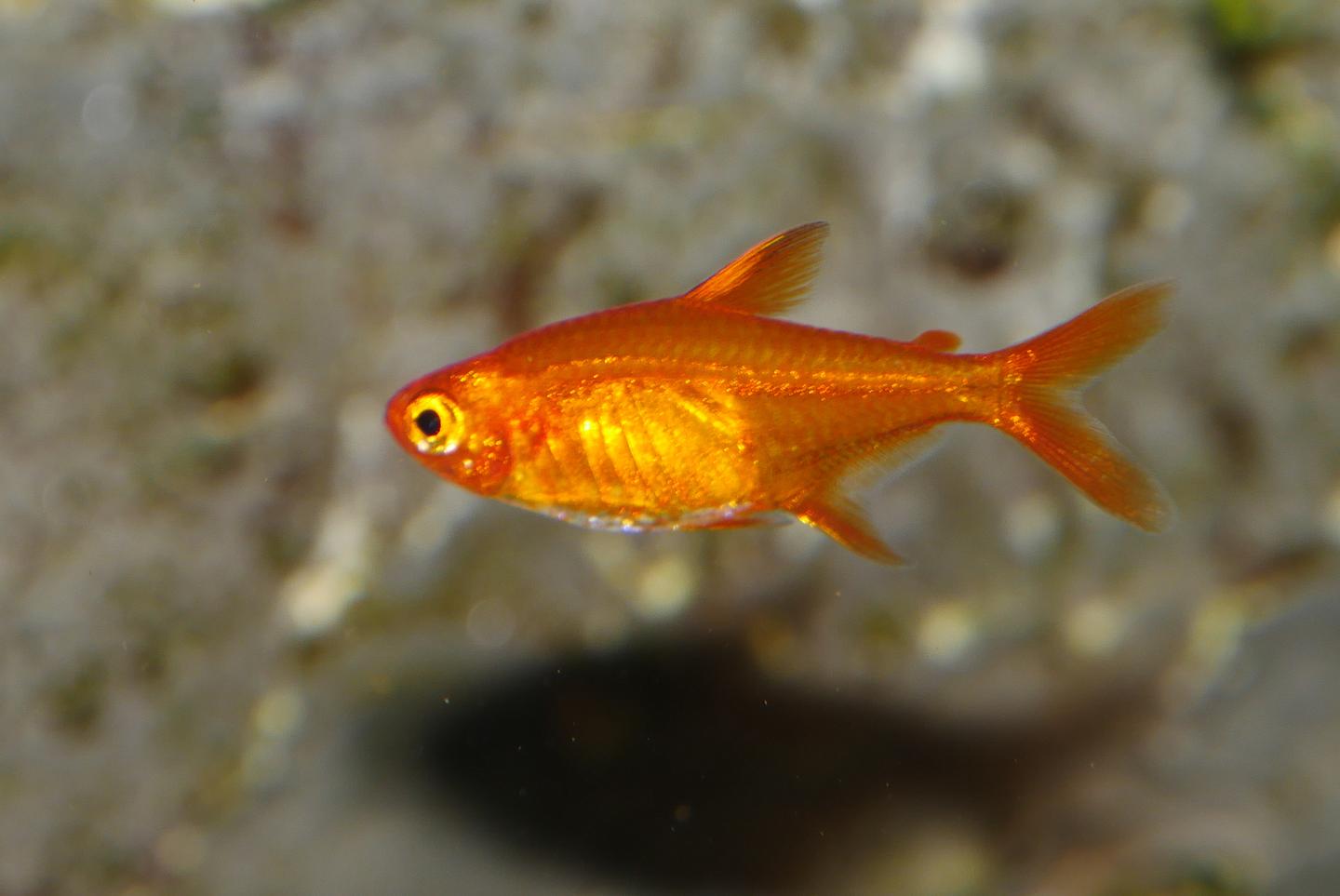
Ember tetras are very small Brazilian social fish, with a maximum recorded length of 2.0 cm excluding the tail. Keep them only in a fully cycled, stable aquarium. We recommend a group of at least 10 and about 45 litres with a 45 × 30 cm footprint rather than using a litres-per-fish formula.
Maintain these water conditions for optimal health and vibrant colors
The Procyon tetra, Hyphessobrycon procyon, is a small South American tetra that was only given its scientific name in 2016. Pastana and Ohara described it in the journal Zootaxa, working from fish collected in the Rio Juma, a clear, fast-flowing river in the Rio Aripuanã drainage near the town of Apuí, in Amazonas State, Brazil. The holotype, the single preserved specimen the name is formally tied to, was collected in June 2015 and measures 32.2 mm standard length.
The name is worth a sentence, because people ask about it. Procyon is the alpha star of the small constellation Canis Minor, and on the Brazilian national flag it is the star that represents the state of Amazonas. The authors chose it as a nod to the state the fish comes from. So the word on the label refers to a star, and the star refers to the fish's home state.
FishBase gives the maximum recorded length as 3.2 cm standard length (SL). Standard length runs from the tip of the snout to the end of the body and leaves out the tail fin, so a fully grown fish looks a little longer than that figure once it is swimming in front of you. Either way, it is a small fish, and the tank, the food and the choice of company all need to be planned around an adult of roughly that size rather than around the size that arrives.
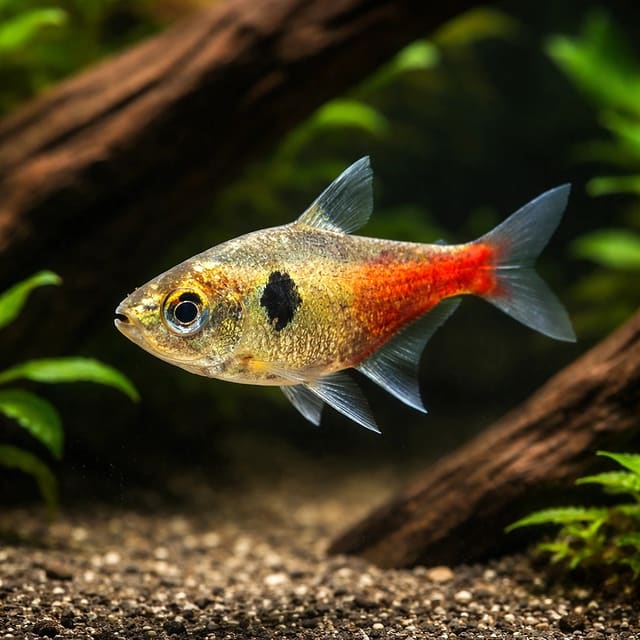
FishBase and WoRMS now list it in the family Acestrorhamphidae, the American tetras. The 2016 paper placed it in Characidae, so you will see both family names in print. Either way it sits in Hyphessobrycon, the same genus as the better-known Lemon Tetra (Hyphessobrycon pulchripinnis) and Ember Tetra (Hyphessobrycon amandae).
This listing sells live Hyphessobrycon procyon by the individual fish, so the quantity you choose is the number of fish you receive. There is no option to pick males or females, and we do not promise any particular mix within a group.
Because the species is so new to science, very little has been written about it in the hobby. We have kept this guide to what is actually published: the original description, FishBase, and the general advice for small tetras from OATA, the UK's ornamental aquatic trade association. Where a recommendation is general small-tetra husbandry rather than something measured on this species, we say so plainly. That is less tidy than a neat card of numbers, but it is the honest position, and it lets you make sensible decisions instead of following figures nobody has tested.
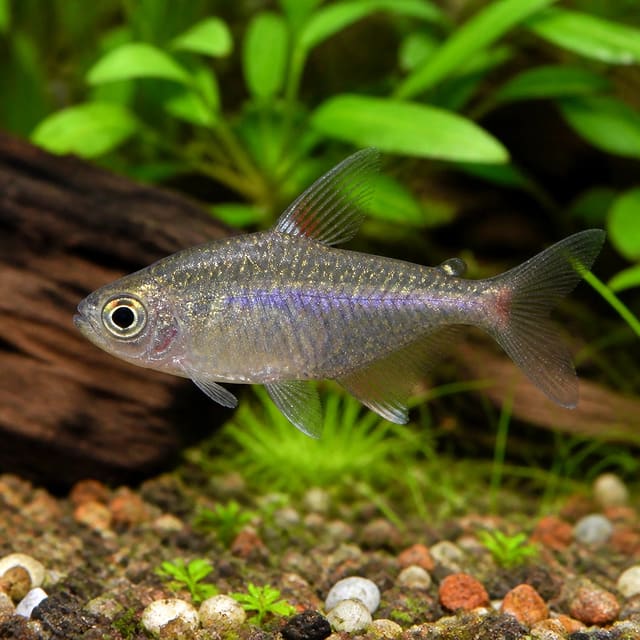
In life this is a slim fish, flattened from side to side (FishBase describes the body as laterally compressed). The original description gives the head and back as tan to brown, with the flanks and belly mostly silvery. Most of the colour sits in the fins: the pectoral, pelvic and anal fins are yellow to orange, the tail fin is mainly yellow with darker rays through its middle, and the dorsal fin is yellow in females and young fish. Mature males are described overall as silvery to yellowish.
The most useful mark sits just behind the gill cover. A dark shoulder spot of this kind is called a humeral blotch, and the description separates H. procyon from other Hyphessobrycon by its having two. In preserved fish the first is tall and narrow, covering roughly three scales across and six scales top to bottom; the second, behind it, is smaller and fainter. A thin dark line runs along the middle of the body, and FishBase notes that there are no dark chevron-shaped marks along that midline.
Further back, adult males have a dark blotch on the caudal peduncle, the narrow part of the body just in front of the tail. In preserved males it spreads up and down until it covers the whole peduncle. The adipose fin, the small fleshy fin between the dorsal fin and the tail, is mostly clear, with a little dark pigment only where it joins the body.
The description compares it with several similar species. These are the differences it gives:
Against those, H. procyon has 23 to 26 branched anal-fin rays, and an incomplete lateral line: of the 30 to 33 scales in a row along the side, only 7 to 10 carry lateral-line pores. Those are laboratory characters for a microscope, not something to count on a live fish, but they explain why the authors were confident it is a separate species.
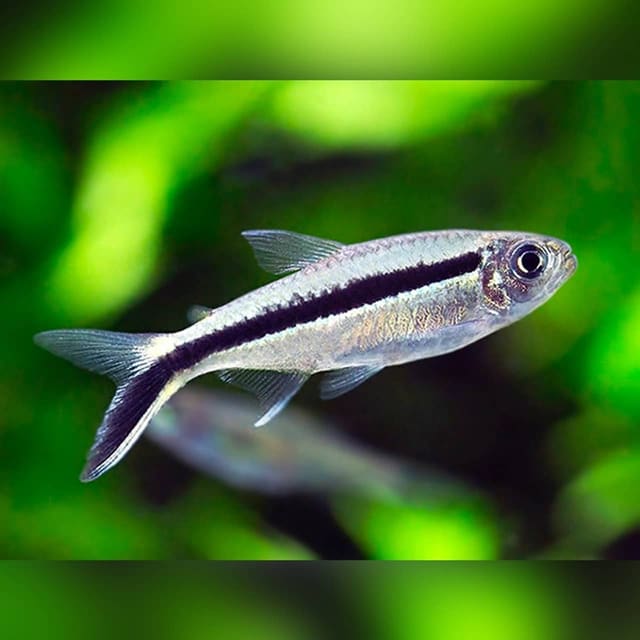
In a shop tank or your own aquarium, the practical checklist is short: two shoulder blotches, a silvery body with a brownish back, yellow-to-orange lower fins, and, in older males, the long dorsal fin covered in the next section. It shares a genus with the Black Neon Tetra (Hyphessobrycon herbertaxelrodi), but this is a subtler fish: its interest lies in the fins of mature males rather than in bold body colour.
Adults are easy to sex once they mature, and the description sets out the differences clearly. Mature males grow an elongated dorsal fin. Laid flat against the back, it reaches past the adipose fin and ends somewhere between that fin and the base of the tail. The first four rays of a mature male's dorsal fin turn dark while the rest of the fin stays yellow, which gives the fin a two-tone look when it is raised.
Males also have longer pelvic fins, reaching back as far as the second to fourth branched ray of the anal fin, and the front rays of their anal fin have thickened, rounded segments. In living males the description notes a concentration of red pigment at the bases of the upper and lower tail-fin rays, which sits against the yellow of the rest of the tail.
Females and immature fish keep a short dorsal fin that stays yellow, and their anal fin shows a distinct lobe at the front. The males' longer pelvic fins are still not drawn out into filaments; that is one of the ways the description separates this species from H. heliacus.
The fish examined for the description ranged widely in size. The holotype measures 32.2 mm SL, the paratypes (the supporting specimens) run from 12.5 to 30.4 mm SL, and other specimens examined were 12.9 to 21.4 mm SL. FishBase's 3.2 cm SL maximum matches that holotype.
The long dorsal fin, the dark front dorsal rays and the red at the tail base are features of mature males. Young fish of both sexes have the short yellow dorsal fin described for females and immatures, so a group of small fish can look very uniform at first. That is normal, not a sign of poor condition, and the differences show as the fish grow on.
We have not found a published account of this species spawning in aquariums, and the original description does not cover its reproduction. We are not going to fill that gap with a method borrowed from other tetras and present it as fact. If you see courtship or eggs in your own tank, keep notes and photographs: records for a species described this recently are genuinely useful to other keepers.
Because you cannot choose the sex of the fish you order, a larger group is the straightforward way to give yourself a good chance of having both. It is also the way to see the species at its best: a group with mature males showing their tall, dark-fronted dorsal fins looks quite different from a handful of uniform young fish.
FishBase gives the distribution simply as Brazil: the Rio Aripuanã, in the Rio Madeira basin. The original description is more precise. At the time of writing the species was known only from the Rio Juma and one of its tributaries, in the Rio Aripuanã drainage near the town of Apuí, in Amazonas State. That is a very small known range.
The authors describe the type locality, the place the holotype was collected, as a clear water river about 40 metres wide and 0.5 to 2 metres deep, with a swift current, a rocky bottom and reduced riparian (bankside) vegetation. FishBase records the species as freshwater and benthopelagic, with a depth range of 0 to 2 metres. Benthopelagic means it lives in the water near the bottom as well as in midwater, rather than at the surface or buried in the bed.
Put together, that paints a picture: shallow, clear water running quickly over rock, with less bankside cover than you might expect of a forest stream. It is not the still, tea-coloured water many people picture for small Amazon tetras, and it is the best guide we have to what this fish is built for.
The description lists the other fish collected alongside it at the type locality. They include:
Please do not read that as a list of recommended tank mates. A pike cichlid is a predator, and a home aquarium gives a 3 cm fish nowhere to escape it. What the list does show is the setting: fast, clear water over rock, shared with grazing catfish, other small characins and a few predators. That is the environment this tetra is adapted to, and it shapes the advice on flow, oxygen and cleanliness in the sections that follow.
FishBase shows the IUCN Red List status as Not Evaluated. In the original description the authors suggested a status of Least Concern, because they found no imminent threats in the area where the species occurs. Even so, a fish known from one river and one tributary is not a species to treat casually. Keeping it well, in a stable tank and in a proper group, is the least it deserves.
OATA's general guidance for tetras is at least 45 litres for a small shoal of a smaller species, and at least 80 litres for the larger species of 5 cm and over. At a maximum of 3.2 cm SL, the Procyon tetra falls in the smaller bracket, so 45 litres is the minimum for a small group. We treat that figure as a floor rather than a target.
The reason is the habitat. This fish comes from a river about 40 metres wide with a swift current, and a fish from open, moving water makes more use of swimming length than of height. Given the choice between a tall cube and a longer, lower tank of the same volume, we would pick the longer tank every time. It gives the group room to move together without crowding.
The wild river has a rocky bottom. Sand or fine, rounded gravel with a scatter of smooth river stones, and a few larger rocks arranged to break the current, gives a convincing impression of that bed and creates sheltered pockets where small fish can rest out of the flow. A piece or two of wood adds shade and visual cover. OATA's checklist for tetras includes gravel or sand, live or artificial plants, and decor for shelter, so this layout covers all three.
Choose rock with smooth faces and rounded edges, and stack it so it cannot shift when you siphon the substrate. Leave a clear swimming lane along the front of the tank; it lets the group move as a unit and lets you see the fins properly.
OATA treats a filter as essential for any tetra tank. For this species, think about where the outlet points as well as how big the filter is. Running the outflow along the length of the tank produces a gentle current down one side, with calmer water behind the rocks and in the corners. That combination of moving and quiet water suits a small fish from a fast river far better than either a still tank or one where the whole volume is churning.
A 3 cm tetra is small, and strong flow in a small tank leaves it nowhere to rest. If the fish are constantly pushed into one corner, or hang behind the heater to get out of the current, turn the flow down or spread it with a spray bar. The aim is a clear current with somewhere to retreat to, not a test of stamina.
Plants that grip rock and wood, such as Java fern and Anubias, cope well with moving water and fit the rocky style. Stem plants can go in the calmer areas. Ordinary aquarium lighting is fine; just make sure there are shaded spots under wood or broad leaves so the fish can choose where to sit.
OATA advises positioning a tetra tank away from draughts, heat sources, direct sunlight and noise. A steady spot keeps the temperature stable, limits algae, and means the fish are not startled every time a door slams. Fit a heater with a thermostat, and keep a separate thermometer where you can read it at a glance.
Set the aquarium up and run it until the filter is biologically established before any fish go in. OATA's targets for ammonia and nitrite are zero, and a new filter cannot hold them there until its bacteria have built up. Test the water, and only add fish once those two readings are reliably zero. Adding small, sensitive fish to an immature tank is the single most avoidable way to lose them.
Here is what is actually known. FishBase lists the climate as tropical but gives no temperature, pH or hardness range for this species, and the original description records the habitat (clear water, swift current, rocky bottom) without water chemistry. Nobody has published measured preferences for Hyphessobrycon procyon in the aquarium.
So the figures below are OATA's general ranges for tetras and pencilfish. They are the sensible frame for a small South American tetra with no species-specific data, and we would rather tell you exactly where they come from than print a precise-looking range that has never been measured.
| Parameter | Range | Source |
|---|---|---|
| Temperature | 22 to 27°C | OATA, tetras and pencilfish |
| pH | 6.5 to 8.0 | OATA, tetras and pencilfish |
| General hardness | 4 to 12°dH (soft to medium) | OATA, tetras and pencilfish |
| Carbonate hardness | 3 to 10°dKH | OATA, tetras and pencilfish |
| Ammonia | 0 mg per litre | OATA |
| Nitrite | 0 mg per litre | OATA |
| Nitrate | no more than 20 mg per litre above your tap water | OATA |
Within those ranges, the thing that keeps small fish healthy is consistency. Set the heater once, check the thermometer daily, and avoid big swings when you change water. Bring new water to roughly the tank's temperature before it goes in, and treat it with a tap-water conditioner.
Tap water across the UK varies a great deal from one area to the next, so test yours rather than assuming. If your pH and hardness already sit inside the ranges above, there is usually no benefit in chasing a different figure with chemicals; a stable reading is worth more than a theoretical ideal. If your water sits well outside them, talk to us before you buy, and we will give you an honest view.
OATA recommends a partial water change of 25% every week, with the water tested at the same time. Siphon the substrate as you go, especially in the calm corners where waste settles. When the filter needs cleaning, rinse the sponge or media in water you have just taken out of the tank rather than under the tap; OATA advises this because it preserves the beneficial bacteria.
The wild fish live in clear water with a swift current. You cannot copy a river in a glass box, but you can keep the qualities that matter: good surface movement for gas exchange, efficient mechanical filtration, and a stocking level the filter can comfortably handle. Cloudy water, a surface film or fish gathering near the top are all signs to test the water and look at the filter before anything else.
Keep a simple log of test results and water changes. With a species this poorly documented, your own records are some of the best information you will have, and they make it far easier to spot a slow drift before it becomes a problem.
The best evidence of what this tetra eats in the wild comes from the original description. The stomachs of two specimens contained nematodes (tiny roundworms), chironomid larvae (the larvae of non-biting midges), unidentified plant fragments and sediment. FishBase gives its trophic level as 2.9, plus or minus 0.3.
Trophic level is a scale of where an animal feeds in the food chain. Plant-eaters sit at 2, and animals that eat small plant-eating creatures sit around 3. A value of 2.9 points to a diet made up mostly of small invertebrates with some plant material, which matches the stomach contents. The sediment suggests at least some food was picked up from the bed or from surfaces rather than taken only in midwater.
Two stomachs is a very small sample, so we would not build a rigid menu on it. What it does tell you is that this is an omnivore that takes small live prey, and that a varied diet is the sensible approach.
OATA's advice for tetras is a good quality flake or granule as the staple, supplemented with frozen foods such as daphnia and bloodworm. Bloodworm is a neat fit for this species: Wikipedia notes that the bright red larvae of some chironomid midges are what are known as bloodworms, and chironomid larvae are exactly what turned up in the wild fish's stomachs.
Size matters with a fish this small. Crumble flake between your fingers before it goes in, use the smallest granules you can find, and choose frozen daphnia or other small frozen foods over large bloodworm, or chop bloodworm finely. Thaw frozen food in a little tank water first, so that the fish get the food and the tank does not get the thawing liquid.
OATA recommends feeding only what the fish can eat within a few minutes, once a day. Small fish have small stomachs, and anything left after those few minutes sinks into the substrate and turns into waste the filter has to deal with. If food is still drifting about after three or four minutes, you are giving too much.
A healthy, well-fed Procyon tetra should have a gently rounded belly after feeding, never a pinched or hollow one. Watch the whole group at mealtimes for the first few weeks. It is the easiest moment to count heads and check that every fish is eating.
In a tank with faster or bolder feeders, small tetras can lose out. Feed at two points at once, or let food drop into the current near the filter outlet so it drifts along the tank and every fish gets a chance. Sinking granules help the fish that feed lower down, which suits a species FishBase classes as benthopelagic. If one or two fish are consistently thinner than the rest, look at competition at feeding time before you assume illness.
OATA's guidance is that tetras should be kept in groups of at least five, and that more is better; in smaller groups they become stressed. For the Procyon tetra there is a second reason to keep a proper group. You cannot choose the sex of the fish you order, and the most striking feature of this species is the long dorsal fin of mature males, so a larger group gives you a better chance of having several males among females and young fish.
Published notes on this species' behaviour in aquariums are scarce, so we will stick to what the evidence supports. FishBase classes it as benthopelagic, using the water near the bottom as well as midwater. The type locality is a shallow, fast river over rock. In a tank laid out as described above, that points to a fish that spends its time in the lower and middle levels, in and around the current, rather than hanging at the surface.
Give a new group time. Small tetras are often cautious in their first days in a new tank, and they become more confident once they have settled and learned that the shadow over the glass means food. Low light for the first evenings and a calm, consistent routine help.
OATA's rule for tetras is simple: keep them with similarly sized, peaceful species, and do not house small tetras with larger predatory fish. With an adult maximum of 3.2 cm SL, "larger" arrives quickly. Any fish with a mouth big enough to take a 3 cm tetra is a risk, however calm it seems in the shop.
We would add two cautions of our own. First, mature males carry a long dorsal fin, so avoid species with a reputation for nipping fins. Second, very fast or pushy feeders can leave a small, slightly cautious fish short of food, so if you mix them, use the feeding approach in the previous section and watch body condition.
The wild neighbours listed earlier include small grazing catfish as well as predators. That shows what the fish copes with in a river, not what it should live with in a tank. If you are unsure about a particular combination, ask us before you order rather than after.
Keep the number of fish in proportion to the tank and filter. A well-planned, moderately stocked tank with a good group of Procyon tetras will show the fish far better than a crowded one where they compete for space and food.
OATA lists the things worth watching in any tetra: changes in swimming, colour, temperament or breathing rate, changes in appearance such as white spots or missing scales, loss of body condition, and changes in feeding. With a group of small fish, the easiest way to cover all of that is a quick routine at feeding time.
When something looks wrong, test the water before you reach for a medicine. Ammonia and nitrite should both read zero, and nitrate should be no more than 20 mg per litre above your tap water (OATA). If any of those are out, a partial water change and a look at the filter come before anything else, and they cure more problems than any bottle.
Do not mistake ordinary features for problems. Young fish of both sexes have the short yellow dorsal fin, and only mature males develop the long fin, the dark front dorsal rays and the red at the tail base. A group of small fish without those features is simply young. The second shoulder blotch is described as smaller and fainter than the first, so a faint second mark is normal too.
If you have a spare tank, holding new fish separately for a few weeks before they join an established community lets you watch them closely and protects the fish you already have. It is good practice with any new arrival.
If treatment is needed, dose by the real volume of water in the tank, not the nominal size printed on the box, because rock, gravel and decor take up space and small fish are easily overdosed. Remove carbon from the filter if the medicine's instructions say so. If you are unsure what you are looking at, send us a clear description or a short video and we will help you work out the next step.
Have the aquarium ready before you order: the filter running and established, the water tested, and the heater holding a steady temperature. Please read our delivery and live-arrival information before you place the order, so you know exactly how it works.
Your fish travel in oxygen-filled bags inside insulated packaging, with heat packs when conditions call for them, via a tracked courier licensed to carry live animals. We email you the confirmed delivery date and the tracking details. Someone must be at the delivery address to receive the parcel, because it contains live animals.
Start a continuous video while the parcel is still sealed, and keep recording in the same take as you open it, so the video shows the fish in their still-sealed bag. If a fish arrives dead, dying or clearly compromised, email hello@tropicalfishco.co.uk on the day of delivery with your order number and that video. Photographs alone do not meet the policy. Under the guarantee terms, the resolution is a replacement with your next order or a refund for the affected fish.
Keep the lights low for the rest of the first day and leave the fish in peace. Offer a small amount of food the next day, crumbled finely, and remove anything they do not take within a few minutes. Over the first week, watch their breathing, appetite and behaviour, and count the group at each feed.
Give the group a few days to settle before you judge how they are doing. Hold off on further additions to the tank for a while so the filter can adjust to the new fish, and keep up the weekly water tests. If anything worries you in that first week, get in touch with us straight away; the earlier we hear about a problem, the more we can help.
These are the sources used for this guide. They are worth reading in full if you want to understand the species in more depth. The general water ranges, tank size, group size and feeding advice come from OATA's care sheet How to look after tetras and pencilfish, published on the Ornamental Aquatic Trade Association's website.
No reviews for this item yet. Bought one? Honest reviews only, good or bad.
What customers say about ordering from us
Easy website plenty of info on fish your buying great to pick a time slot
TRACEY DURRANT · 7 Oct 2026
Got some lovely fish thank you
Kevin Mackie · 7 Oct 2026
Reviews of our shop, collected by Judge.me, an independent third-party review collector. Newest first.