Moderate
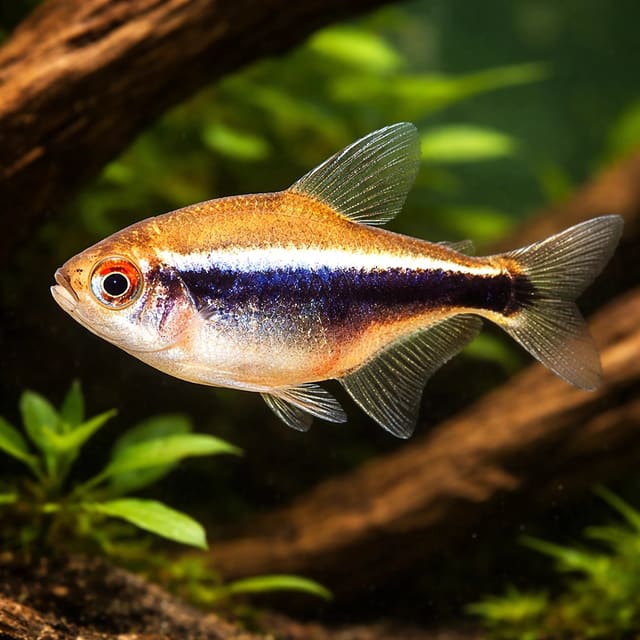
Neon Tetra (Paracheirodon innesi)
21–25°C · pH 5–7
£2.99

The Bleeding Heart Tetra (Megalamphodus erythrostigma) is an American tetra from the upper Amazon River basin that reaches 6.1 cm standard length. It suits a well-researched community aquarium: keep at least 8–10, with routine water at 23–27°C, pH 6.5–7.2 and 4–12 dGH—the overlap of FishBase, Seriously Fish and OATA guidance. Sold individually in sizes from 2-3 cm to 4-5 cm.
Adult size is the maximum length this species reaches at full maturity (scientific sources). The livestock you receive will be younger and smaller — pick a size above for the actual shipping size. Product-photo provenance and any image-specific limitations are stated on the listing.
Megalamphodus erythrostigma
Shoaling fish: kept in a group they feel safer, stay calmer and show their best colour.
Confirm your email, then we’ll send an availability message for this exact item if it returns within 180 days.
This request is only for this product—no newsletter or other promotions. A mail-provider retry may very rarely duplicate the same availability message. Unconfirmed addresses are removed after 48 hours. See our privacy policy.
The Bleeding Heart Tetra (Megalamphodus erythrostigma) is an American tetra from the upper Amazon River basin that reaches 6.1 cm standard length. It suits a well-researched community aquarium: keep at least 8–10, with routine water at 23–27°C, pH 6.5–7.2 and 4–12 dGH—the overlap of FishBase, Seriously Fish and OATA guidance. Sold individually in sizes from 2-3 cm to 4-5 cm.
Adult size is the maximum length this species reaches at full maturity (scientific sources). The livestock you receive will be younger and smaller — pick a size above for the actual shipping size. Product-photo provenance and any image-specific limitations are stated on the listing.
Maintain these water conditions for optimal health and vibrant colors
The Bleeding Heart Tetra (Megalamphodus erythrostigma) is a freshwater American tetra from the upper Amazon River basin in South America. FishBase places it in Acestrorhamphidae and records a maximum of 6.1 cm standard length. Its generally peaceful nature and social behaviour suit a keeper planning a well-researched community aquarium rather than a small, sparsely furnished tank.
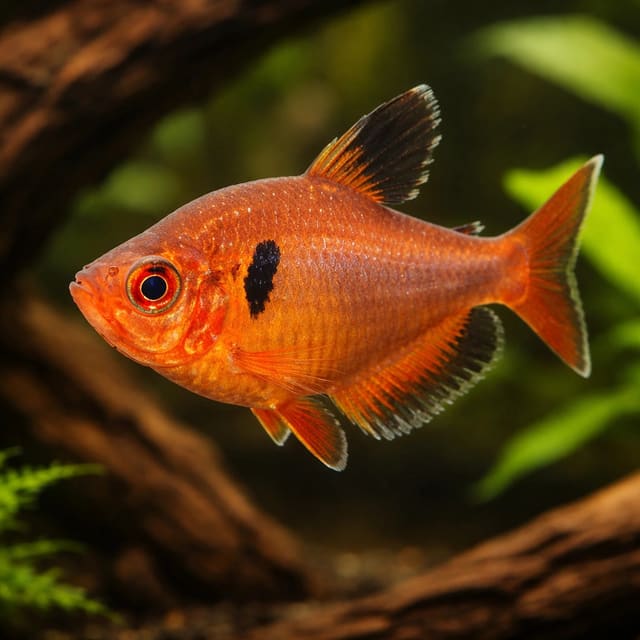
The red humeral or shoulder mark gives this tetra its familiar common name. Adult males are territorial to an extent, and this may sometimes extend to similarly shaped fish, so the aquarium needs enough floor area, structure and group space for normal interaction. This is not a solitary display fish: plan for a substantial group and assess every companion against its adult size, temperament and water requirements.
Seriously Fish recommends a 90 × 30 cm base or equivalent as the smallest aquarium considered and describes a group of at least 8–10. The long base matters because a social group needs useful swimming room as well as litres; a tall aquarium with a cramped footprint is not an equal substitute.
| Suits | Not suited to |
|---|---|
| A well-researched community aquarium | A solitary or undersized group |
| A 90 × 30 cm base or larger | A cramped footprint chosen only by volume |
| Similarly sized, peaceful fish after screening | Predatory companions |
| Plants, shaded areas and open swimming room | A bright, bare layout without cover |
One purchase supplies one Bleeding Heart Tetra. The live size selector may show the labels 2-3 cm, 3-4 cm and 4-5 cm; use it to choose the dispatch size for each fish in your order. The size you select is the size supplied, not the adult size. Every aquarium decision must therefore allow for a fish that can reach 6.1 cm standard length.
Dispatch size describes the fish when supplied and does not change the species’ adult requirements. For example, a group selected at 2-3 cm still needs an aquarium with a base of at least 90 × 30 cm rather than a temporary small tank. Starting with the adult plan avoids moving the group later and gives the biological filter, planting and companions one stable layout.
Plan for at least 8–10 specimens. Because each purchase supplies one animal, a planned group of eight requires a purchase quantity of eight, while a group of ten requires ten. Count animals, not centimetres: choosing a larger dispatch label does not reduce the social group needed.
Sex is guaranteed only when the selected option explicitly states male or female. This Bleeding Heart Tetra listing has no sex-guaranteed option.
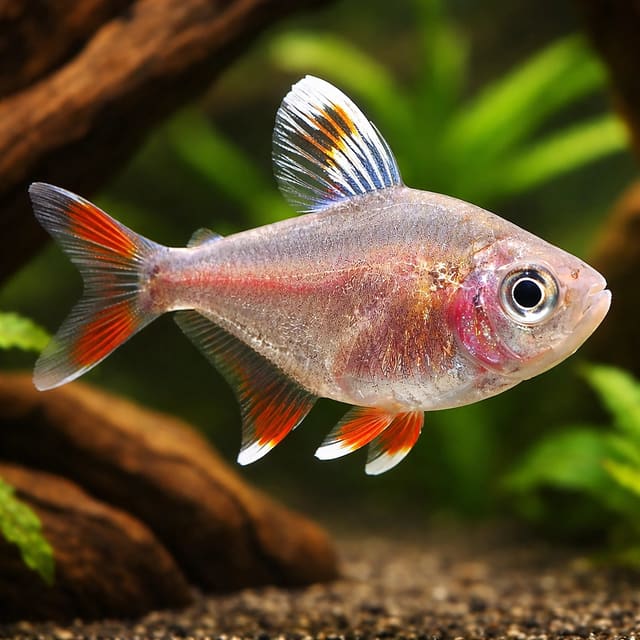
The gallery images are representative, based on reference photographs of this species, so colours can look slightly different from the live animal.
Choose it when you can provide the full footprint, a mature biological filter, stable water and a suitable group. If the aquarium is still being prepared, follow our guide to maturing a first tropical aquarium before livestock is introduced. A mature aquarium means that its biological filter can process waste; it does not mean water that has simply stood for a set time.
To compare other tetras, browse the current tetra collection. Treat each species as a separate stocking decision rather than assuming that all tetras share the same adult size, behaviour or water requirements.
Use an aquarium with a base of at least 90 × 30 cm and a volume of approximately 81 litres or an equivalent footprint. Seriously Fish describes that as the smallest arrangement considered for this species. FishBase separately gives a minimum aquarium length of 80 cm, but the 90 × 30 cm species profile is the more complete planning reference because it states both base dimensions and approximate volume.
The adult planning figure is 6.1 cm standard length from FishBase. Plan the aquarium and group for that adult length, not for the size supplied. Standard length excludes the tail, so leave room for the whole fish to turn, feed and interact without treating the recorded body length as its total occupied space.
Start with the Bleeding Heart Tetra group, then assess remaining capacity. At least 8–10 fish need open swimming space as well as planted or shaded areas. An aquarium that physically holds the minimum volume may still be a poor choice if bulky décor removes most of the usable base or if existing fish already occupy the same swimming area.
| Planning question | Decision |
|---|---|
| Is the base at least 90 × 30 cm? | Proceed to water and stocking checks only if it is. |
| Can it hold 8–10 adults? | Reserve group space before considering companions. |
| Is there open swimming room? | Keep the central or front area usable. |
| Does décor create shade? | Use plants, wood and floating cover without filling the whole base. |
Do not use dispatch size to justify a smaller starter aquarium. A 2-3 cm fish is still the same species and should enter the aquarium planned for adulthood. This also avoids repeatedly catching and relocating a social group as it grows.
Larger aquariums generally offer more stable temperature and water quality, but extra volume does not replace maintenance or compatibility screening. Stock slowly so the beneficial bacteria in the filter can respond as fish numbers and feeding increase.
Keep routine aquarium water at 23–27°C, pH 6.5–7.2 and 4–12 dGH. These figures are the overlap of FishBase’s species environment, Seriously Fish’s species husbandry range and OATA’s tetra group guidance. The overlap gives a practical routine target without extending beyond the species-level limits.
Set a target inside each range and keep it steady. Choose targets that your tap water and maintenance routine can hold steadily, then keep them there. Do not chase a particular number with abrupt changes; measure the aquarium and replacement water, then make any necessary adjustment gradually through a consistent maintenance routine.
Use the same tests before introduction and during routine care. Our water chemistry guide explains what the main readings mean, while the water matcher helps compare your measured values with this routine range.
If ammonia or nitrite is detectable, postpone adding fish. Increasing stock while either is present adds waste before the biological filter is ready. If nitrate is rising beyond the stated limit, review water changes, feeding and stocking rather than treating nitrate as an isolated number.
Recheck the aquarium after maintenance and before major stocking changes. Stability comes from a working filter, controlled feeding and repeatable water changes; clear-looking water alone does not show whether ammonia and nitrite are safe.
Furnish the aquarium with live plants, a dark substrate, wood and shaded areas while retaining open room for the group to swim. Seriously Fish notes that décor is not especially critical, but the species tends to show better colour in a well-furnished arrangement with live plants and dark substrate. Keep the lighting relatively dim and add floating vegetation, as this species seems to do best under dim light.
A natural-looking layout can use soft sand with wood roots or branches arranged to form shade. Dried leaf litter may be added for a biotope-style effect; beneficial microbial colonies can develop as leaves decompose, and tannins released by the leaves help simulate natural conditions. Leaves may be left to break down fully or removed and replaced every few weeks.
| Area | Purpose |
|---|---|
| Open swimming area | Allows the group to move and feed without weaving through dense décor. |
| Planted margins | Provide cover and break up exposed edges. |
| Shaded zones | Offer retreat under floating plants, branches or subdued lighting. |
Place tall planting and branches around the sides or rear rather than filling the whole footprint. This creates a choice between cover and open water. Where rival adult males display, check that the aquarium size, group and layout still leave both cover and swimming room.
Do not rely on colour alone to judge whether the layout works. Watch whether the fish use the aquarium, approach food and hold their fins normally. Persistent hiding, unusual aggression or refusal to feed calls for checks of water quality, group structure and companions as well as the lighting and cover.
When adding leaf litter, inspect it during normal maintenance and remove material if it obstructs equipment. The aim is a structured, manageable aquarium, not a base so crowded that waste cannot be siphoned or the group loses swimming space.
Use a well-established, maintained filter in every aquarium. The RSPCA explains that fish release toxic ammonia and that a working biological filter supports bacteria which convert ammonia to nitrite and then to the safer nitrate. Filtration is therefore a waste-processing system, not simply a way to make the water look clear.
For an aquarium of approximately 81 litres, Seriously Fish gives a turnover of four to five times the aquarium volume per hour and suggests a filter rated around 325–405 litres per hour. Treat the manufacturer’s rating as a starting point: media, pipework and accumulated debris can affect actual flow, so check that water continues to circulate throughout the aquarium.
OATA warns that stocking too quickly can cause new tank syndrome because too few nitrifying bacteria are present to process the increased waste. The result can be unhealthy ammonia and nitrite levels that may make fish ill or cause death. Test rather than assuming the filter has adjusted.
If a test detects ammonia or nitrite, stop further stocking and review feeding, filter operation and maintenance. Remove uneaten food and follow the normal water-change procedure while continuing to monitor the readings. Do not respond by washing all filter media aggressively, because that can remove the bacteria needed to restore biological processing.
Choose equipment that leaves space for maintenance. A filter that is difficult to reach is more likely to remain blocked, while one that can be checked and rinsed correctly supports a consistent routine.
Feed a quality flake or small granule as the routine prepared food, supported by varied live or frozen items. FishBase records worms, crustaceans and plants in the wild diet, while Seriously Fish describes the species as an opportunistic omnivore and recommends small live and frozen foods alongside good dried foods, including some plant or algal content.
Suitable supplementary foods named for this fish include chironomid larvae or bloodworm, Daphnia and Artemia. Match every item to the fish’s mouth and distribute it so members of the group can feed. Variety matters because the recorded diet includes both animal and plant material rather than one narrow food type.
OATA’s tetra guidance says to feed only what the fish can eat within a few minutes, once a day. Start with a small amount, watch the whole group and stop before food is left to decay. If particles remain after the feeding period, remove them and reduce the next portion.
| What you see | What to do |
|---|---|
| Food remains after a few minutes | Remove it and reduce the next feed. |
| Only the quickest fish feed | Spread suitably sized food across more than one point. |
| The group loses interest in food | Test water and check behaviour before offering more. |
| Waste rises after feeding | Review portions, stocking and filter performance. |
Seriously Fish also notes that submerged pieces of fresh fruit will be grazed. Leave fruit in the aquarium for only a few hours, then remove it so it does not deteriorate in the water. This is an occasional element of variety, not a replacement for the balanced routine above.
Reduced feeding interest can be an early sign that conditions have changed. Check ammonia, nitrite, temperature and the behaviour of companions before repeatedly changing foods. Overfeeding to tempt one fish can worsen water quality for the entire group.
At least once every week, change 25% of the aquarium water. OATA recommends this frequency and amount for tetras and pencilfish, together with water testing at least weekly. Use a siphon to remove solid waste from the substrate where needed.
Treat replacement tap water with a suitable conditioner to remove harmful chlorine or chloramine before it enters the aquarium. Match the replacement water closely enough to preserve the established temperature and chemistry rather than causing an abrupt change. Refill carefully so the substrate and accumulated debris are not scattered around the tank.
Keep ammonia and nitrite at 0 mg per litre. Nitrate should not exceed 20 mg per litre above the normal level in the tap water. Recording results makes gradual change easier to see; a single acceptable test does not replace the next scheduled check.
After adding the group, watch feeding, breathing, swimming position and social interaction closely while keeping the normal test schedule. Compare those observations with the water readings and the amount eaten. This creates a useful picture of normal behaviour for your aquarium.
If results begin to drift, address the cause before adding more fish. Check portions, filter flow, blocked media, accumulated waste and the rate at which livestock was introduced. A larger emergency clean is not a substitute for steady weekly work and can create additional instability if filter media is handled incorrectly.
Be present to receive the parcel because live fish cannot be left unattended. Prepare the aquarium before arrival: confirm that the filter is working and that temperature, pH, hardness, ammonia and nitrite are within the planned values.
Read the current delivery and Live Arrival Guarantee policy before the parcel arrives. Fish are hand-bagged in pure oxygen and placed in an insulated poly box, with a heat pack used when the weather calls for it.
OATA advises checking that ammonia and nitrite are zero before adding fish and increasing aquarium population slowly. Beneficial bacteria need to increase when more fish and feeding add extra waste. Do not combine the arrival of this group with several unrelated stocking changes if that would overload the established biological filter.
After release, watch the group closely. Check that fish maintain balance, breathe normally and begin using the available cover and swimming space. Continue with the established feeding and testing routine rather than compensating for transport by overfeeding.
If ammonia or nitrite appears after introduction, stop further stocking and deal with water quality immediately. The filter, controlled feeding and planned partial water changes are the main tools for keeping the aquarium stable while its biological load changes.
Expect a generally peaceful, social fish that benefits from a group of at least 8–10. Adult males are territorial to an extent and may direct this behaviour towards similarly shaped species. Displays between rivals can occur without making the species broadly aggressive, but persistent pressure on one fish calls for a review of space, group structure and companions.
Healthy fish should have clear, bright eyes, undamaged fins, intact scales and an appropriate swimming response. Learn how the group normally feeds, uses cover and moves through the aquarium so a change is noticed early.
The red shoulder mark is normal colouration. Judge possible injury by a new change in the skin, fins, scales, behaviour or condition rather than by the species’ characteristic mark.
Test ammonia, nitrite, nitrate, temperature and pH first, then check filter operation and recent changes to stocking or feeding. Correct maintenance problems without making several abrupt changes at once. If you remain concerned about the health of the fish, contact us for further guidance.
No single symptom identifies a treatment. Avoid adding medication merely because colour or appetite has changed; check water quality and the aquarium conditions that affect the whole group first.
Choose similarly sized fish with a peaceful temperament and overlapping water requirements. Seriously Fish describes the Bleeding Heart Tetra as generally peaceful and names similarly sized characids, gasteropelecids, lebiasinids, smaller callichthyid or loricariid catfishes and non-predatory medium-sized cichlids as suitable kinds to consider.
These categories are a screening starting point, not an automatic approval for every species within them. Compare adult size, temperament, preferred temperature, pH, hardness, swimming space and feeding behaviour before combining fish. The proposed aquarium must meet the needs of every resident at the same time.
| Decision | Rule |
|---|---|
| Suitable to assess | Similarly sized named groups with peaceful behaviour and overlapping water needs. |
| Use caution | Similarly shaped species because adult males may show territorial behaviour. |
| Avoid | Predatory cichlids; the named cichlid companions are specifically non-predatory. |
For similarly sized characids, do not assume that sharing a family guarantees matching behaviour. Check the prospective species separately for fin nipping, aggression, group requirements and adult size. The same applies to catfish: choose only smaller callichthyid or loricariid species and check each one separately.
Assess feeding access as well. A peaceful fish may still be a poor companion if it prevents the tetra group from receiving suitably sized food. Watch the first feeds after any stocking change and make sure food reaches the whole group without excessive competition.
Compatibility remains an aquarium-level decision because individual layout, group sizes and existing residents alter the result. Before adding any companion, check the aquarium dimensions, measured water values, filter capacity and the adult numbers of every species together.
Establish a group of at least 8–10 Bleeding Heart Tetras before using the remaining aquarium capacity for other fish. Seriously Fish recommends trying to obtain a mixed-sex group of that size, but this offer does not guarantee sex. Plan by total group number and aquarium capacity rather than depending on a particular sex ratio.
FishBase gives a minimum group of five or more, while the species husbandry profile recommends at least 8–10. Use 8–10 as the practical plan because it is the more detailed species aquarium recommendation. Do not reduce the number because other schooling fish are present; each species retains its own social requirement.
When a problem appears, first check whether the aquarium still meets the 90 × 30 cm minimum base, whether the tetra group is large enough and whether décor leaves both cover and swimming room. Then check water readings and feeding access. These decisions are more useful than assigning every chase to a fixed temperament label.
Confirm ammonia and nitrite are zero before each stocking change. Add animals slowly enough for the filter bacteria to respond to extra waste and feeding, then observe behaviour and water quality before the next change. This reduces the chance that a compatibility problem and a water-quality problem appear at the same time.
Do not use the minimum aquarium as a target for the maximum possible number of species. The stated footprint is the smallest considered for this tetra; every additional group must have its own social space, adult-size allowance and compatible water range.
FishBase records a maximum of 6.1 cm standard length for the Bleeding Heart Tetra. Standard length excludes the tail, so plan the aquarium around the adult fish rather than its dispatch size.
Use an aquarium with a base of at least 90 × 30 cm and a volume of approximately 81 litres or equivalent. Seriously Fish describes this as the smallest aquarium that should be considered.
Plan for at least 8–10 Bleeding Heart Tetras. Seriously Fish recommends a group of at least 8–10, while FishBase gives a lower minimum of five or more; use the larger group plan for the aquarium.
Choose it only when you can provide a mature filtered aquarium with at least a 90 × 30 cm base, a group of at least 8–10, weekly water tests and ammonia and nitrite held at 0 mg per litre.
The Bleeding Heart Tetra is an opportunistic omnivore. Feed quality flake or small granules once daily in an amount eaten within a few minutes, with varied bloodworm, Daphnia or Artemia and some plant or algal content.
Keep it at 23–27°C and pH 6.5–7.2, with hardness at 4–12 dGH. These routine values are the overlap of FishBase, Seriously Fish and OATA guidance.
The Bleeding Heart Tetra is generally peaceful, although adult males are territorial to an extent and may direct this behaviour towards similarly shaped species. Screen companions carefully and watch for persistent pursuit or restricted feeding.
Consider similarly sized characids, gasteropelecids, lebiasinids, smaller callichthyid or loricariid catfishes and non-predatory medium-sized cichlids when their water and space needs also match.
Tropical Fish Co hand-packs it in pure oxygen in an insulated poly box, adding a heat pack when the weather calls for it. Be present to receive the parcel, film continuously from the sealed parcel, inspect it the same day and float the bag for 20–30 minutes before releasing the fish.
No reviews for this item yet. Bought one? Honest reviews only, good or bad.
What customers say about ordering from us
I have a small group of long finned mountain minnows. So was delighted to be able to order ten of this variety to increase the genetics in my tank . The ones I recieved are healthy but it’s to early to give a verdict on wether they are of a long finned type since they are small currently.
Gordon Walker · 23 Sept 2026
100% success travel and "installation". Pleased with quality of purchase. The Siamese fighter a bit "shy" so have not yet seen him at his best yet but looking good. Happy customer. GG
George E Garratt · 21 Sept 2026
Reviews of our shop, collected by Judge.me, an independent third-party review collector. Newest first.