Moderate
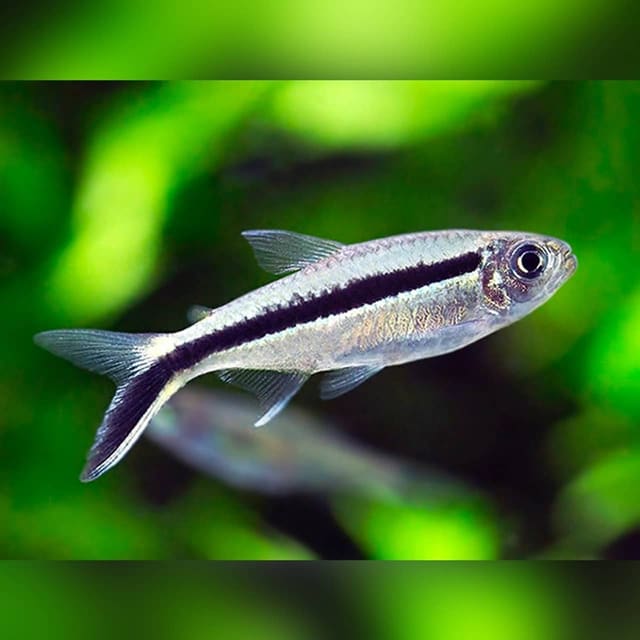
Neon Tetra (Paracheirodon innesi)
21–25°C · pH 5–7
£1.89
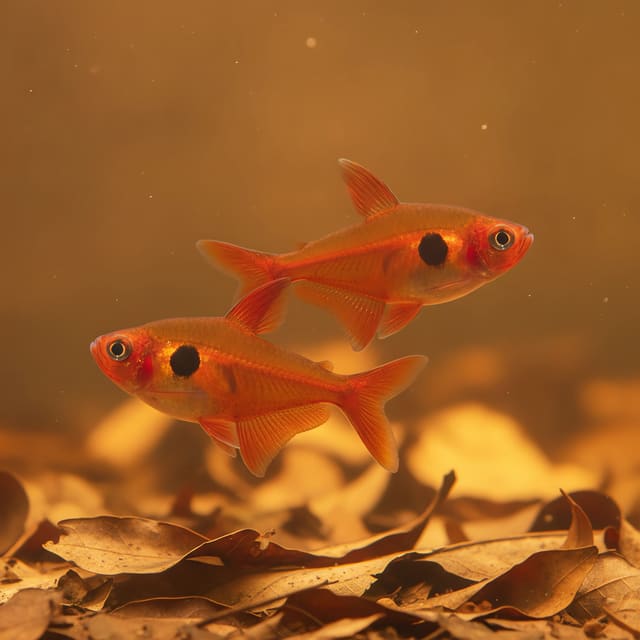
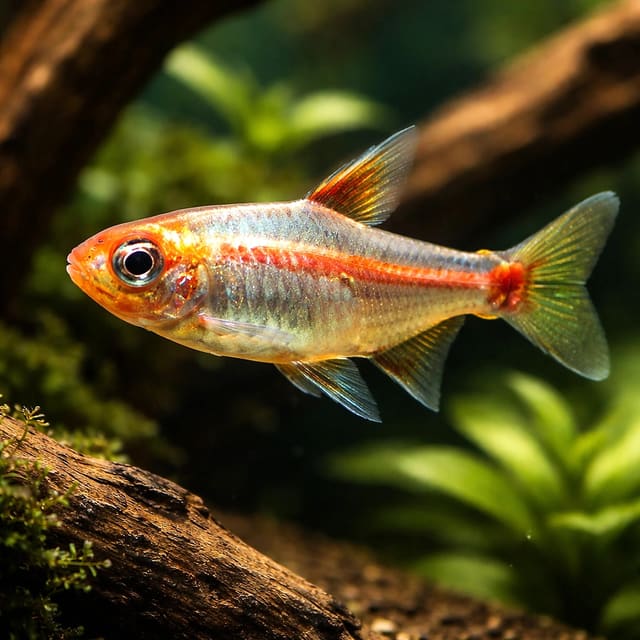
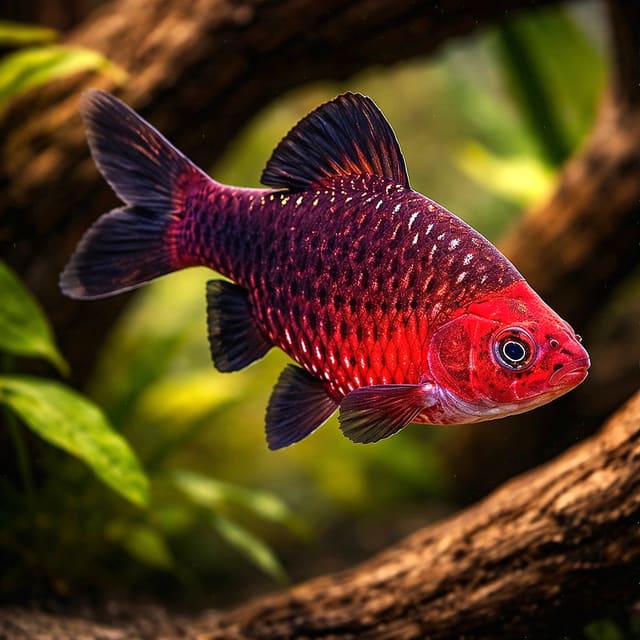
The Rathbun's Bloodfin (Aphyocharax rathbuni) is a characin tetra from South America's Paraguay River basin that reaches 7.1 cm. It suits a mature, filtered community aquarium of about 54 litres with a 60 × 30 cm base; the overlap of Seriously Fish and OATA guidance is 22–26°C and pH 6.5–7.5, and at least six should be kept together. Sold individually in sizes from 1.5–2 cm to 2.5–3.5 cm.
Adult size is the maximum length this species reaches at full maturity (scientific sources). The livestock you receive will be younger and smaller — pick a size above for the actual shipping size. Product-photo provenance and any image-specific limitations are stated on the listing.
Aphyocharax rathbuni
Shoaling fish: kept in a group they feel safer, stay calmer and show their best colour.
Minimum of 2 per order.
The Rathbun's Bloodfin (Aphyocharax rathbuni) is a characin tetra from South America's Paraguay River basin that reaches 7.1 cm. It suits a mature, filtered community aquarium of about 54 litres with a 60 × 30 cm base; the overlap of Seriously Fish and OATA guidance is 22–26°C and pH 6.5–7.5, and at least six should be kept together. Sold individually in sizes from 1.5–2 cm to 2.5–3.5 cm.
Adult size is the maximum length this species reaches at full maturity (scientific sources). The livestock you receive will be younger and smaller — pick a size above for the actual shipping size. Product-photo provenance and any image-specific limitations are stated on the listing.
Maintain these water conditions for optimal health and vibrant colors
Rathbun's Bloodfin (Aphyocharax rathbuni) is a freshwater characin tetra from South America's Paraguay River basin. FishBase records a maximum length of 7.1 cm standard length, so plan its aquarium and community around a small but active adult tetra rather than its dispatch size. It suits a keeper who can maintain a mature, filtered aquarium, keep a proper group and screen companions carefully because this species has a reputation as a fin-nipper.
This is a shoaling fish. Keep at least six individuals together, following the species guidance from Seriously Fish. A suitable starting footprint for a small group is 60 × 30 cm, with a volume of approximately 54 litres. Use planting and aquarium furniture to provide cover while retaining clear swimming room.
The aquarium should be mature before the group is introduced. A working biological filter processes toxic ammonia through nitrite into the safer end product nitrate, while regular testing shows whether the system is coping with the waste produced by the fish. The combination of adequate space, an established filter and compatible companions matters more than creating a decorative theme.
Rathbun's Bloodfin is also known as the green fire tetra. Both names refer here to Aphyocharax rathbuni, a member of the family Characidae. You can compare it with other fish in our tetras collection, but assess every proposed companion on its own adult size, temperament, swimming pace and water requirements.
One purchase supplies one Rathbun's Bloodfin in the size selected on the live selector. The selector uses the labels 1,5-2 cm and 2,5 - 3,5 cm. These measurements describe the fish at dispatch and do not change the adult aquarium plan.
The size you select is the size supplied, not the adult size. Use the recorded 7.1 cm maximum when deciding whether the aquarium has enough room, whether the filter can support the intended group and whether companions remain appropriate as the fish grows. A smaller dispatch fish is not a reason to begin with an undersized aquarium.
Sex is guaranteed only when the selected option explicitly states male or female. This Rathbun's Bloodfin listing has no sex-guaranteed option.
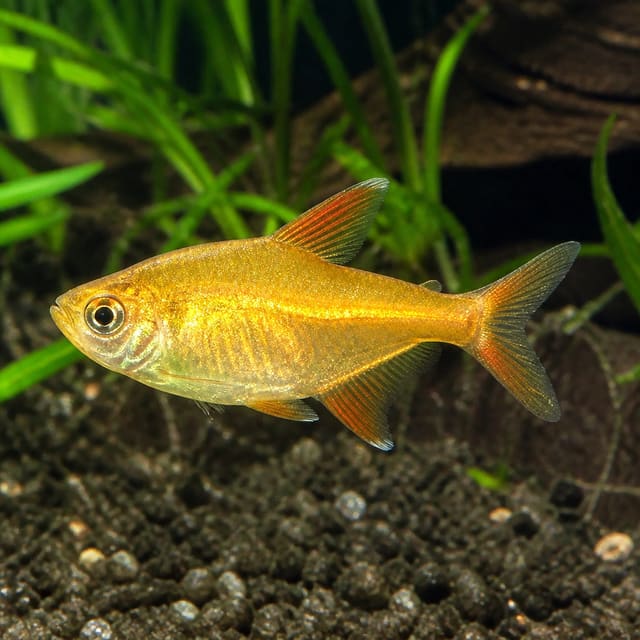
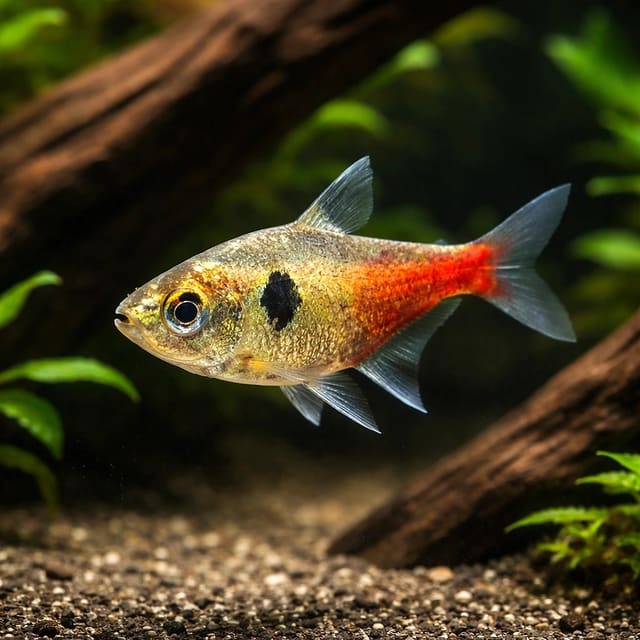
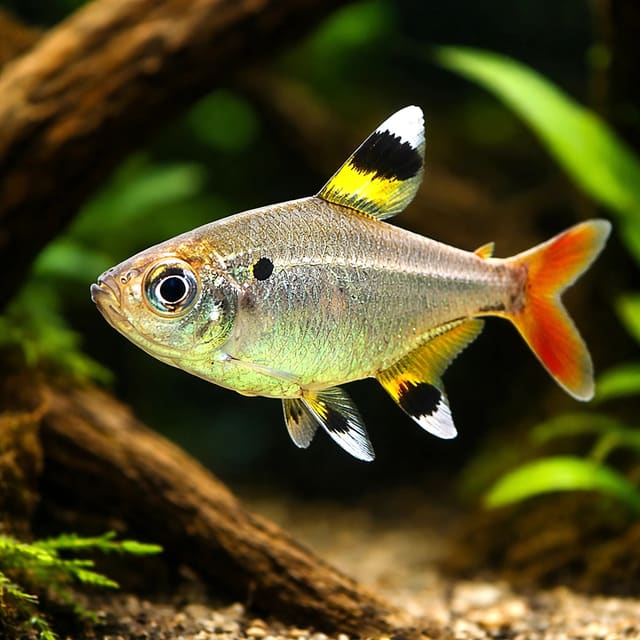
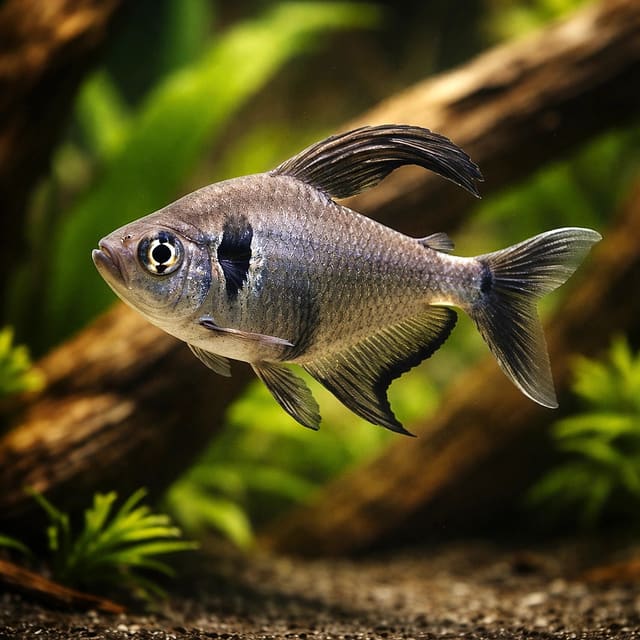
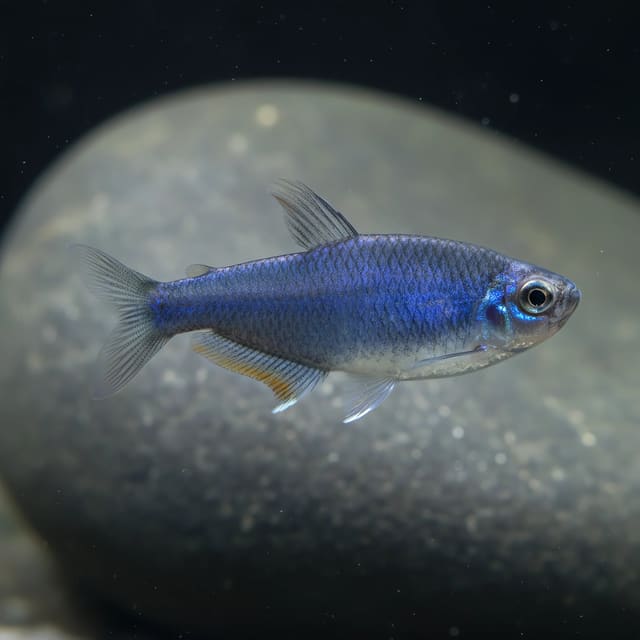
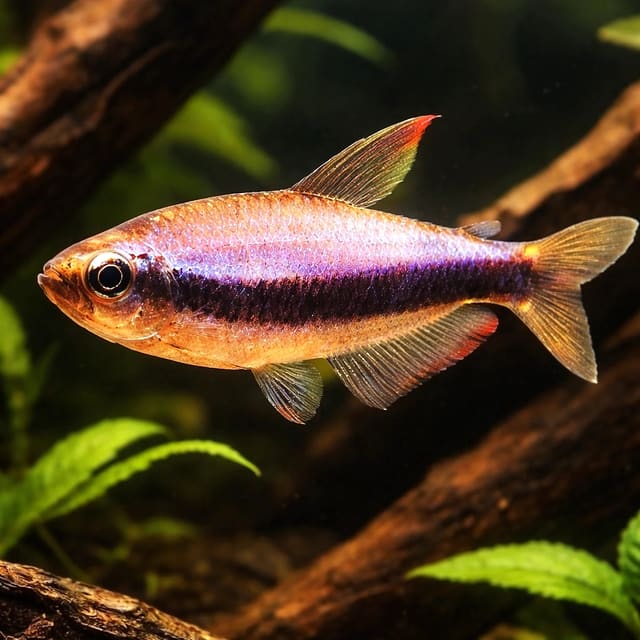
Some gallery images have been digitally enhanced to improve image quality. They show the listed type of animal rather than guaranteeing the exact markings of the individual supplied, so natural colour and pattern can vary.
Do not use gallery colour, body shape or a dispatch measurement to infer sex. Seriously Fish notes that females are fuller-bodied when in spawning condition, but this is not a sex guarantee for an individual fish. Plan the group without relying on a particular sex ratio.
Before choosing a dispatch size, make sure the aquarium already meets the same adult requirements: a mature biological filter, approximately 54 litres with a 60 × 30 cm base, suitable water and enough capacity for at least six fish. Changing the selected size does not reduce any of those requirements.
Use the adult group as the basis of the decision. A Rathbun's Bloodfin community needs swimming room, planted cover, stable water and companions able to live alongside a tetra with a fin-nipping reputation. The table separates the strongest matches from situations that need a different plan.
| Suits | Not suited to |
|---|---|
| A mature, biologically filtered freshwater aquarium | A newly filled or unfiltered aquarium |
| A group of at least six Rathbun's Bloodfins | Keeping this shoaling fish alone or below six |
| A base of at least 60 × 30 cm and about 54 litres for a small group | An aquarium chosen only around the dispatch measurement |
| Robust, faster-moving community fish with overlapping water requirements | Long-finned species such as many cichlids and anabantoids |
| A planted layout with sand, wood, roots or pebbles and swimming space | A community assembled without checking adult size, pace and temperament |
Keep the aquarium at 22–26°C, pH 6.5–7.5 and 4–12 dGH. These values are the overlap between Seriously Fish's species guidance and OATA's tetra group guidance; OATA's figures are group-level guidance, not a species-specific optimum. Maintain ammonia and nitrite at zero.
Approximately 54 litres is the species profile's volume for a small group, not permission to fill every remaining part of the aquarium with additional fish. Decorations, substrate, filter capacity and every companion contribute to the practical stocking decision. Make room for at least six Rathbun's Bloodfins first, then assess any wider community.
This fish is a possible community resident, but “community fish” does not mean universally compatible. Its reputation for fin-nipping makes fin shape and swimming pace decisive. A robust, faster-moving companion is a better candidate than a slow, long-finned fish, provided its water and space requirements also overlap.
Plan for an adult maximum of 7.1 cm standard length. FishBase records that figure for a male or unsexed fish, and it is the planning size used throughout this care plan. Standard length excludes the tail, so do not treat 7.1 cm as a nose-to-tail dispatch measurement.
Seriously Fish uses a shorter figure of 45 mm standard length in its profile. Keep the larger FishBase maximum at the centre of the long-term plan, while using the species profile's aquarium dimensions: a 60 × 30 cm base and approximately 54 litres for a small group.
A fish selected at 1,5-2 cm requires the same adult plan as one selected at 2,5 - 3,5 cm. Starting with the mature aquarium prevents an early move caused solely by growth and gives the biological filter one stable environment in which to establish.
Measure usable aquarium space by more than the volume printed on the tank. The cited species profile combines volume with a base dimension because horizontal room matters to a moving group. A tall aquarium with a restricted footprint should not be treated as equivalent merely because it contains a similar number of litres.
Keep planting and furniture proportionate. Plants, roots, bogwood and pebbles can create shelter and visual structure, but the group also needs unobstructed swimming room. If decoration leaves little open space across the 60 cm length, simplify the layout before adding the fish rather than counting the nominal volume alone.
Keep Rathbun's Bloodfin at 22–26°C, pH 6.5–7.5 and 4–12 dGH. These routine values are the overlap between the species aquarium range from Seriously Fish and the broader tetra guidance from OATA. FishBase records 20–26°C, pH 6.0–7.5 and hardness up to 20 dH for the species' environment, so the routine aquarium targets remain within those recorded limits.
Test the aquarium rather than estimating from tap-water reputation or appearance. Our water chemistry guide explains the values to measure, while the water matcher helps compare actual readings with the target range.
Take the tap-water nitrate reading into account when interpreting the aquarium result. The OATA limit is 20 mg per litre above that starting level, not an absolute aquarium reading of 20 mg per litre.
If a reading falls outside the target range, identify which value has changed before altering the water. Test temperature, pH, hardness, ammonia, nitrite and nitrate as separate measurements. This prevents a correction aimed at one value from obscuring a filtration or maintenance problem shown by another.
Temperature equipment must match the actual aquarium and room. Seriously Fish estimates about 50 W for an approximately 54-litre aquarium when the room is around 20°C. Treat that as a size-specific example and confirm that the chosen heater can hold 22–26°C in the aquarium's real position.
Use a mature aquarium with a working biological filter. The RSPCA explains that fish release toxic ammonia, which beneficial filter bacteria process into nitrite and then nitrate. Ammonia and nitrite are both toxic, so the fish should not be introduced until tests show zero mg per litre for each.
For an aquarium of approximately 54 litres, Seriously Fish recommends turnover of four to five times the volume each hour. That corresponds to a filter rated at roughly 215–270 litres per hour. Check the manufacturer's flow rating, allow for the effect of filter media and keep the outlet arranged so the group receives moderate rather than stagnant water movement.
Our first tropical aquarium guide can help organise the preparation and maturation stages before the fish arrive.
A filter's rated flow does not replace water testing. A blocked intake, clogged media or reduced circulation can change its performance even when the model is correctly sized. Check for blockages during routine maintenance and observe whether water continues to move across the aquarium.
Do not clean biological filter media under the tap. OATA advises rinsing it lightly in aquarium water removed during a partial water change, reducing the loss of beneficial bacteria. Replacement water must be treated with tap-water conditioner before it enters the aquarium so chlorine or chloramine does not harm fish or filter bacteria.
Increase the total aquarium population gradually. OATA warns that stocking too quickly can leave too few nitrifying bacteria to process the extra waste, causing new tank syndrome and unhealthy ammonia or nitrite levels. A mature filter remains a living system whose capacity must adjust whenever fish numbers and feeding rise.
Use a well-planted aquarium with a sandy substrate. Seriously Fish recommends decorating with bogwood, roots and pebbles, while OATA advises plants or suitable ornaments to provide cover. Arrange those features around the group's movement instead of filling every part of the footprint.
Lighting is not critical for this species, so choose it around the needs of the plants and the practical requirement to observe the fish. Moderate water flow is appreciated. Position the filter outlet to move water through the aquarium without removing all sheltered areas among the plants and wood.
The 60 × 30 cm base is the starting point for a small group, so layout decisions should preserve as much useful horizontal room as possible. If dense planting divides the aquarium into isolated pockets, thin or reposition it until the group can move through the full length.
Cover and open space serve different purposes. Shelter gives fish places to move around and behind, while open water allows the shoal to travel without repeatedly turning around decorations. A practical layout supplies both rather than maximising one at the expense of the other.
Choose aquarium-safe materials and position them securely before adding fish. The supported layout uses sand, plants, bogwood, roots and pebbles; it does not depend on creating blackwater, adding tannin products or reproducing a claimed wild stream scene. Concentrate on cleanable surfaces, stable furniture, cover and swimming room.
Watch how water moves after planting. If debris repeatedly settles in one area, adjust the position of wood, plants or the filter outlet while preserving moderate flow. This makes weekly siphoning more effective and helps the filter receive suspended waste.
Feed Rathbun's Bloodfin once a day, offering only what the group can eat within a few minutes. OATA's tetra guidance recommends a good-quality flake or granule as the routine food and small live or frozen items for variety. Seriously Fish also notes that the species accepts most aquarium foods and should receive live or frozen foods regularly.
Choose pieces small enough for the fish to take readily. If large flakes or granules are ignored because they cannot be handled, use a smaller format at the next feed rather than leaving the uneaten food in the aquarium.
Observe the whole group while feeding. The useful check is whether food is being taken within the stated few minutes and whether any fish shows reduced intake or no interest. A change in feeding response can accompany changes in health, water quality or behaviour, so test the water and inspect the fish if appetite declines.
Remove the cause of persistent leftovers rather than compensating with extra filtration. OATA warns that overfeeding allows uneaten food to break down and release toxic waste. Reduce the next portion if food remains after the feeding period, and include the affected area when siphoning during the weekly partial water change.
Live and frozen food adds variety but does not change the once-daily schedule or the portion limit. Offer a small amount that the group can finish promptly. There is no need to add separate plant-based food or colour-enhancing products to meet the supported diet plan.
When several species share the aquarium, watch whether the robust, faster-moving companions chosen for compatibility take most of the food. Adjust where the same portion is placed so the Rathbun's Bloodfin group can feed, but do not increase the total until uneaten food and water tests show the aquarium can accommodate it.
At least once every week, change 25% of the aquarium water. OATA recommends using a siphon to remove solid waste from the substrate and testing the water at least weekly so ammonia and nitrite do not build up.
Do not run filter media under the tap. Chlorine or chloramine may kill part of the beneficial bacterial population established in the media. The water removed during the partial change provides a safer medium for a light rinse.
Use repeated results to spot change. A single reading shows the aquarium at that moment; a consistent weekly routine shows whether nitrate is rising faster, temperature is drifting or filter performance has altered. Act on a trend before it becomes a visible welfare problem.
Look for changes in swimming, colour, temperament, breathing, body condition, feeding, fins or scales. OATA highlights warning signs including hanging at the surface, sitting on the bottom, erratic swimming, unusually fast or slow gill movement, increased hiding, altered aggression, white spots, fluffy growths, damaged fins, lost scales and reduced interest in food.
If you see a concerning change, test the water first and contact us for further guidance. Keep the actual temperature, pH, hardness, ammonia, nitrite and nitrate readings ready because they help separate a water-quality problem from a change that needs closer health assessment.
Do not add medication or alter several water values simply because behaviour changes. Begin with observation and measured water results, continue the weekly maintenance routine and seek help for persistent or severe signs.
Prepare the mature aquarium before the parcel arrives, with the filter running and the water already at 22–26°C, pH 6.5–7.5 and 4–12 dGH. The arrival procedure itself follows our delivery and Live Arrival Guarantee policy.
Fish are hand-bagged in pure oxygen and placed in an insulated poly box, with a heat pack when the weather calls for it. Someone must be present to receive the parcel, and it must be opened and inspected on the same day it arrives.
Film every delivery continuously from the sealed parcel onward. For a Live Arrival Guarantee claim, the video must show the sealed parcel, the opening and the fish still inside the sealed bag. Report the issue on the day the fish arrive with the order number and video.
OATA's settling guidance is separate from the parcel steps: confirm that ammonia and nitrite are zero, verify the temperature and other water values, and add livestock gradually so the filter bacteria can respond to increased waste. Do not add further fish quickly after introducing the Rathbun's Bloodfin group.
During the first feeding opportunities, use the normal once-daily schedule and offer only what the group can eat within a few minutes. Observe whether each fish swims, breathes and feeds normally. If behaviour or appetite changes, test the water rather than increasing food.
Continue at least weekly tests and a 25% partial water change at least once every week. The first maintenance checkpoint is the same as the long-term routine: zero ammonia, zero nitrite, controlled nitrate, treated replacement water and a clear filter flow path.
Choose robust, faster-moving fish as possible companions. Seriously Fish describes Rathbun's Bloodfin as suitable for a community aquarium but gives the species a reputation for fin-nipping. That makes swimming pace and fin shape essential screening points rather than optional refinements.
An avoid remains an avoid even if the aquarium is large or densely planted. More cover does not turn a long-finned fish into a supported companion for a known fin-nipping risk.
OATA's broader tetra guidance says these fish mix best with species of similar size and temperament. Treat that as an initial screening rule, then apply the species-specific warning about long fins. Similar size alone is not enough if the proposed fish has flowing fins or moves too slowly.
No named fish is a universal tank mate. Aquarium volume, group numbers, water overlap and the other species' behaviour all affect the decision. For a mixed stocking plan, ask us for one compatibility assessment covering the aquarium dimensions, current residents, proposed adult group sizes and recent water readings.
Do not assume that two tetra species are compatible merely because they share a collection category. Each may require its own group, and both groups must fit the aquarium after substrate, decoration and existing residents are considered.
Keep at least six Rathbun's Bloodfins together. Seriously Fish sets six as the species minimum, while OATA explains more broadly that tetras are shoaling fish and will often become stressed when kept singly or in groups that are too small.
Meeting the group minimum does not remove the separate instruction to avoid long-finned fish. Group welfare and companion choice are two different checks: provide at least six of this species, then screen every other fish for water requirements, size, temperament, pace and fin shape.
| If you see | Do this |
|---|---|
| Repeated attention to a companion's long fins | Separate the incompatible fish; long-finned species are on the avoid list |
| A group smaller than six | Rework the stocking plan around at least six, provided the aquarium has capacity |
| Increased hiding or altered aggression | Test water and review group size, swimming pace and companion choice |
| Damaged or lost fin tissue | Separate the affected compatibility problem and assess the fish's condition |
| Ammonia or nitrite above zero | Stop adding livestock and address the water-quality problem |
A 60 × 30 cm base and approximately 54 litres is suitable for a small group, but a community requires capacity beyond the Rathbun's Bloodfins alone. Every added shoaling species brings its own group requirement and biological load. Do not count individual fish without accounting for the complete groups they need.
Observe the aquarium at feeding time and during normal swimming. Feeding shows whether one species is consistently displaced, while ordinary movement reveals whether slower fish are repeatedly pursued or prevented from using the aquarium. A compatible community should allow every species to feed and occupy space without persistent fin damage.
Snails, shrimp and other invertebrates are not included in the supported companion recommendation. Build the plan around the robust, faster-moving fish rule and avoid presenting any invertebrate as automatically suitable.
Rathbun's Bloodfin reaches a recorded maximum of 7.1 cm standard length. Plan the aquarium around that adult figure, not the 1.5–2 cm or 2.5–3.5 cm dispatch measurements.
Rathbun's Bloodfin needs a base of at least 60 × 30 cm and approximately 54 litres for a small group, following the species profile from Seriously Fish. Allow additional capacity for any wider community.
Keep at least six Rathbun's Bloodfins together. Seriously Fish sets six as the species minimum, and the aquarium should be planned around the complete group from the beginning.
It suits a keeper prepared to mature and test the aquarium, maintain at least six fish in about 54 litres, change 25% of the water at least weekly and screen companions for fin shape and swimming pace.
Feed Rathbun's Bloodfin once a day with a good-quality, appropriately sized flake or granule, offering only what it can eat within a few minutes. Regularly include small live or frozen foods such as daphnia, small bloodworm or tubifex.
Keep Rathbun's Bloodfin at 22–26°C, pH 6.5–7.5 and 4–12 dGH. These targets are the overlap between Seriously Fish's species range and OATA's tetra group guidance; ammonia and nitrite must remain at zero mg per litre.
It has a reputation as a fin-nipper. Keep at least six, choose robust, faster-moving companions and avoid long-finned species such as many cichlids and anabantoids.
Choose robust, faster-moving fish of similar size and temperament whose water requirements overlap 22–26°C, pH 6.5–7.5 and 4–12 dGH. Avoid long-finned species, including many cichlids and anabantoids.
Start filming while the parcel is still sealed, before floating the bag. Open it in one continuous take, show the fish inside the sealed bag, float the bag for 20–30 minutes before release and never pour the bag water into the aquarium. Fish are packed in pure oxygen inside an insulated poly box, with a heat pack when the weather calls for it.
No reviews for this item yet. Bought one? Honest reviews only, good or bad.
What customers say about ordering from us
Easy website plenty of info on fish your buying great to pick a time slot
TRACEY DURRANT · 7 Oct 2026
Got some lovely fish thank you
Kevin Mackie · 7 Oct 2026
Reviews of our shop, collected by Judge.me, an independent third-party review collector. Newest first.