Moderate
Neon Tetra (Paracheirodon innesi)
21–25°C · pH 5–7
£2.99

The Blackline Tail Tetra (Moenkhausia costae) is a freshwater South American tetra from the São Francisco and Itapicuru river systems that reaches 7 cm standard length. It suits a filtered aquarium of at least 80 litres planned for at least five fish, using OATA’s tetra-group guidance of 22–27°C, pH 6.5–8.0 and 4–12°dH. Sold individually in sizes from 3–3.5 cm to 5–7 cm.
Adult size is the maximum length this species reaches at full maturity (scientific sources). The livestock you receive will be younger and smaller — pick a size above for the actual shipping size. Product-photo provenance and any image-specific limitations are stated on the listing.
Moenkhausia costae
Save when buying multiple fish. Each quantity is one fish; sex and pair formation are not guaranteed unless the selected variant explicitly states them.
Minimum of 2 per order.
The Blackline Tail Tetra (Moenkhausia costae) is a freshwater South American tetra from the São Francisco and Itapicuru river systems that reaches 7 cm standard length. It suits a filtered aquarium of at least 80 litres planned for at least five fish, using OATA’s tetra-group guidance of 22–27°C, pH 6.5–8.0 and 4–12°dH. Sold individually in sizes from 3–3.5 cm to 5–7 cm.
Adult size is the maximum length this species reaches at full maturity (scientific sources). The livestock you receive will be younger and smaller — pick a size above for the actual shipping size. Product-photo provenance and any image-specific limitations are stated on the listing.
Maintain these water conditions for optimal health and vibrant colors
Blackline Tail Tetra is the trade name used here for Moenkhausia costae, a freshwater South American tetra. FishBase records the species from the São Francisco and Itapicuru river systems, describes it as benthopelagic and gives a maximum recorded length of 7 cm standard length. Treat that 7 cm figure as the decisive size when planning space, group numbers and tank mates.
The species belongs to a South American group of freshwater ray-finned fishes commonly called American characins. A natural-history summary of the genus Moenkhausia places it in the family Acestrorhamphidae and describes members of the genus as medium-sized tetras from tropical and subtropical South America. The species-level 7 cm record is the relevant planning figure for this fish rather than the larger genus-wide figure.
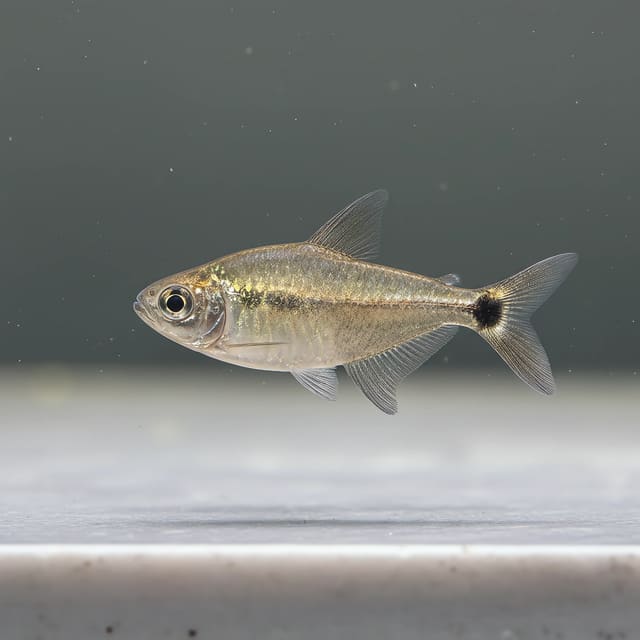
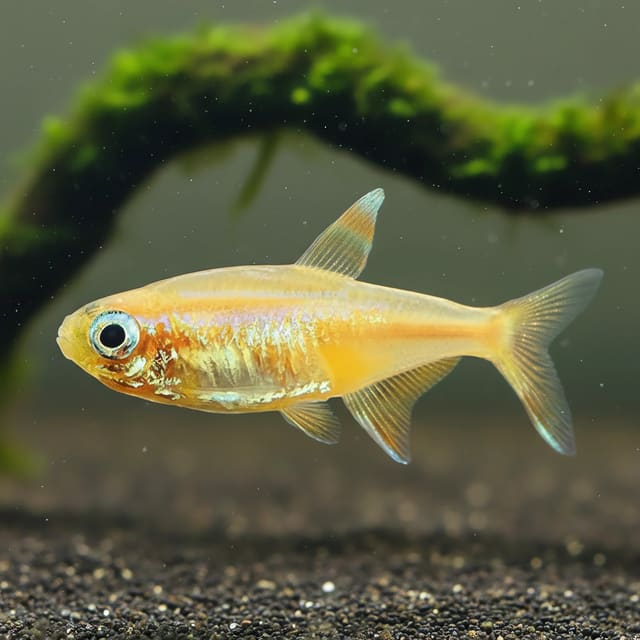
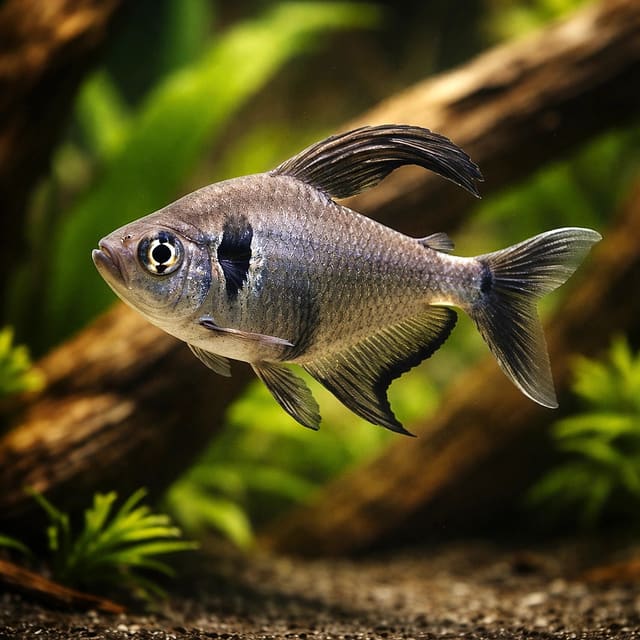
The gallery shows one silvery, laterally compressed fish with translucent fins, an iridescent side stripe and a distinct dark line extending into a forked tail. It is swimming above black gravel beneath moss-covered wood, illustrating how its restrained markings stand out against a darker setting.
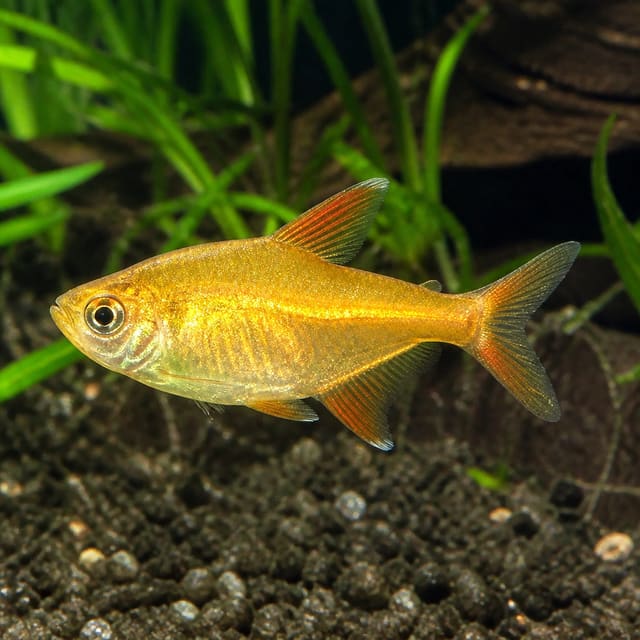
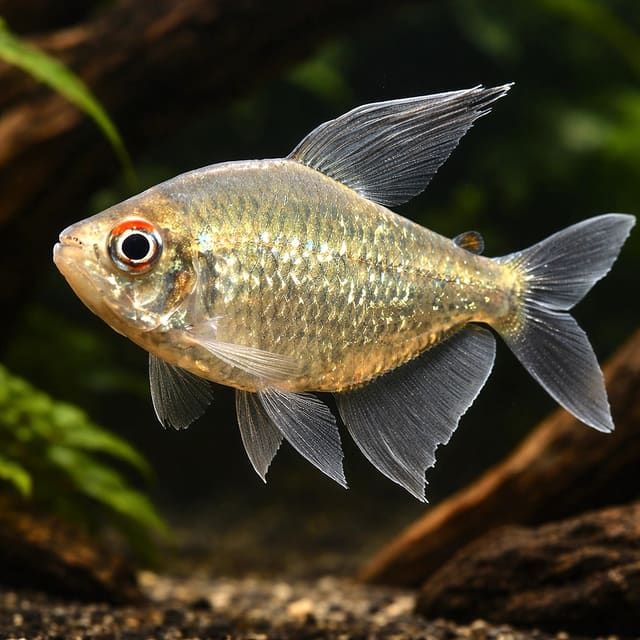
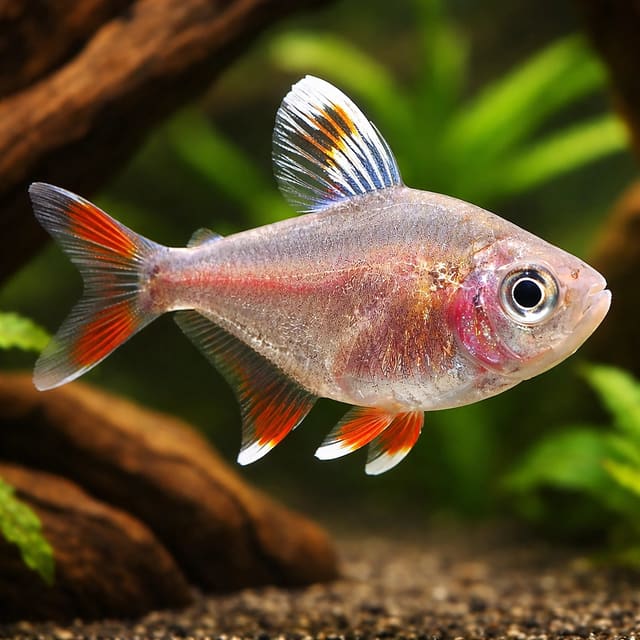
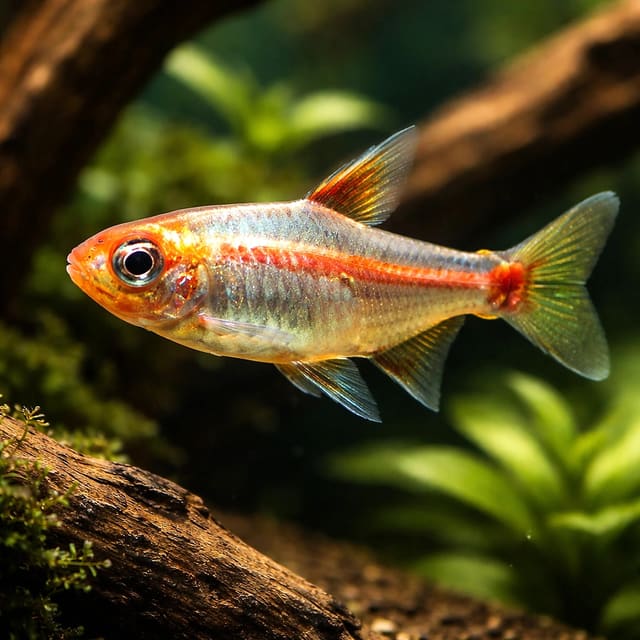
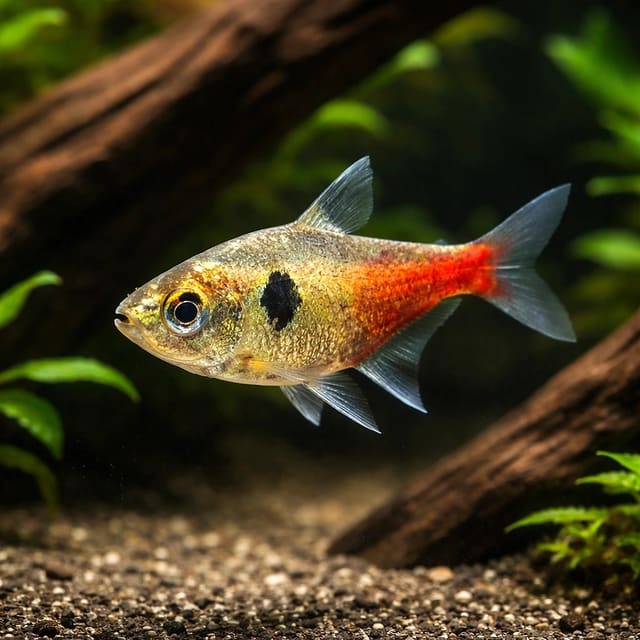
The gallery images are representative of this type of animal rather than photographs of the exact animal supplied, so colours can look slightly different from the live animal.
| Suits | Not suited to |
|---|---|
| A filtered aquarium planned for a group of at least five | Being kept singly or in a group that is too small |
| At least 80 litres for this larger tetra group | An aquarium without enough adult swimming room |
| Open swimming space with plants or ornaments for cover | A layout with no clear swimming area or shelter |
| Fish of similar size and temperament after screening | Fish large enough to eat it, or timid and long-finned fish |
This fish suits an aquarium planned around group swimming, reliable biological filtration and carefully screened companions. Its silver body and dark tail line give the group a coherent appearance without relying on intense body colour.
One purchase quantity supplies one animal of the selected option. The size choices are labelled 3–3.5 cm, 3–4 cm and 5–7 cm; use the live size selector to see which choices can be selected when ordering. The size you select is the size supplied, not the adult size.
A 3–4 cm fish therefore still needs an aquarium planned around the FishBase maximum of 7 cm standard length. The 5–7 cm choice may already be close to that recorded maximum, but its size does not establish its sex, life stage or origin. Select by the size that works for your planned introduction and existing community, then reserve enough adult swimming room for the full group.
OATA advises keeping tetras in groups of at least five because single fish and undersized groups will often become stressed; more is better when aquarium capacity permits. Starting a new group with no Blackline Tail Tetras therefore means planning for at least five animals. Because each purchase quantity represents one animal, a quantity of five represents five animals of the chosen size option.
If the aquarium already contains members of this species, calculate the final group rather than treating the new fish as an isolated addition. Increase livestock gradually so the biological filter can adjust to the additional waste and feeding load. The group target does not override aquarium capacity, adult size or compatibility screening.
| Selector choice | How to plan |
|---|---|
| 3–3.5 cm | Dispatch size; reserve room for growth towards 7 cm SL |
| 3–4 cm | Dispatch size; assess established tank mates before introduction |
| 5–7 cm | Larger dispatch size; screen companions against a fish up to 7 cm SL |
Sex is guaranteed only when the selected option explicitly states male or female. This Blackline Tail Tetra listing has no sex-guaranteed option.
For another group-oriented freshwater option, you can also browse the current tetras collection. Compare adult size, water range and temperament rather than selecting solely by dispatch size or colour.
OATA’s tetra and pencilfish guidance gives 22–27°C, pH 6.5–8.0 and 4–12°dH as broad group guidance rather than a species-specific optimum. It also gives carbonate hardness of 3–10°dKH. Use those figures as the routine planning range for this aquarium, and favour a stable measured point within the range over repeated adjustments.
| Measurement | Routine target |
|---|---|
| Temperature | 22–27°C |
| pH | 6.5–8.0 |
| General hardness | 4–12°dH |
| Carbonate hardness | 3–10°dKH |
| Ammonia | 0 mg per litre |
| Nitrite | 0 mg per litre |
| Nitrate | No more than 20 mg per litre above the normal tap-water level |
Test the aquarium rather than estimating from appearance. A reading of 24°C, pH 7.4 and 8°dH sits within all three routine ranges. By contrast, pH 6.2 falls outside the stated group range even when temperature and hardness fit. Resolve that mismatch before adding the fish rather than relying on acclimatisation to bridge unsuitable routine conditions.
Our water chemistry guide explains what each reading means, while the water matcher provides a direct way to compare measured aquarium values with these targets. Record the actual readings so later changes in behaviour or feeding can be checked against a known baseline.
Take a complete set of readings before choosing an introduction date, then repeat the measurements at the same point in the weekly maintenance cycle. If the first test shows 24°C, pH 7.4, 8°dH, zero ammonia and zero nitrite, write those figures down rather than relying on memory. A later pH reading of 7.0 remains inside the routine range, but the change still deserves comparison with recent water changes, tap-water readings and filter maintenance.
Judge the whole set together. A suitable temperature does not cancel detectable ammonia, and a suitable pH does not make nitrite acceptable. When one reading falls outside its target, delay additional livestock, check the filter and repeat the test after addressing the cause. This sequence keeps the decision tied to measured conditions rather than the clear appearance of the water.
Ammonia and nitrite must remain at zero. Fish release ammonia, and the biological filter converts it first to nitrite and then to safer nitrate. Any detectable ammonia or nitrite means the aquarium needs attention before additional livestock increases the waste load. Test at least weekly and after a concern such as unusual breathing, erratic swimming or reduced feeding.
The OATA group guide recommends an aquarium of at least 80 litres for larger tetra species measuring 5 cm or more. Because Moenkhausia costae is recorded at up to 7 cm standard length, use at least 80 litres as the starting aquarium plan for a small group. More volume can make temperature and water quality more stable, but volume alone does not compensate for poor filtration or unsuitable companions.
Assess usable swimming room as well as the litre figure. A shoal needs open space in which members can move without repeatedly meeting ornaments, glass or territorial tank mates. Arrange cover around that swimming area instead of filling the whole aquarium with decoration.
| Area | Purpose |
|---|---|
| Open swimming zone | Allows the group to move together without constant obstruction |
| Planted or decorated zone | Provides cover and a place to withdraw |
| Gravel or sand substrate | Creates the base recommended for a tetra aquarium |
| Accessible filter area | Allows regular blockage checks and safe maintenance |
Live plants are a useful way to provide cover. Where live plants do not suit the aquarium, plastic plants and suitable ornaments can provide shelter instead. Keep every object stable and leave a clear route through the central or front part of the aquarium.
View the aquarium as a fish would use it rather than as a litre figure alone. Trace an open route through the central or front swimming area and check that plants, wood or ornaments do not reduce it to a narrow gap. Then identify at least one covered area where fish can withdraw without entering another animal’s defended space.
A layout can meet the 80-litre starting point yet still be poorly arranged if decoration blocks group movement. Move cover towards the edges when the central route is crowded, while retaining shelter rather than stripping the aquarium bare. Keep access to the filter clear enough to check flow and remove a blockage without dismantling the whole layout.
Repeat this assessment after plants grow or ornaments move. Usable space can change even when aquarium volume stays fixed, so the adult group plan should reflect the tank as it functions now. If the aquarium also contains other animals, include the areas they occupy when deciding whether the tetra group has adequate swimming and retreat space.
The RSPCA’s aquarium welfare advice explains that a working biological filter houses beneficial bacteria that process toxic ammonia and nitrite. Set up and mature that filter before livestock arrives; our first tropical tank guide covers the preparation sequence.
Check the final stocking plan rather than assuming 80 litres automatically accommodates every proposed fish. Five Blackline Tail Tetras already create an adult planning total of up to 35 cm standard length, although that arithmetic is only a way to visualise the group’s scale, not a stocking formula. Account separately for every other animal, its waste, temperament and swimming needs.
OATA’s feeding routine for tetras and pencilfish uses a good-quality flake or granule as the daily base. Small live or frozen items such as daphnia, small bloodworm or tubifex can add variety. Match the physical size of each item to the fish’s mouth and observe whether the group can take it readily.
Offer only what the fish can eat within a few minutes, once a day. This time limit is more useful than an arbitrary pinch because fish number, dispatch size and food density differ. Watch the whole group during the meal so dominant or faster individuals do not conceal a fish that has stopped eating.
| What happens | What to do next |
|---|---|
| Food is eaten within a few minutes | Keep the portion similar and continue observing body condition |
| Food remains after a few minutes | Reduce the next portion and remove excess before it breaks down |
| Several fish miss the meal | Check behaviour, breathing and water quality before changing the diet |
| One fish repeatedly fails to feed | Compare it with the group and check for hiding, damage or changed condition |
Use the first measured portion as a starting point, not a fixed allowance. If food remains after the few-minute window, reduce the following day’s amount. If every item disappears immediately, continue watching long enough to establish whether all fish fed rather than assuming the fastest individuals represent the whole group.
When the number of fish increases, do not automatically multiply the portion before checking how the enlarged group feeds. Offer a controlled amount, observe consumption and adjust gradually while keeping the once-daily schedule. This gives the biological filter time to respond to any increase in waste and makes leftover food easier to detect.
Compare individuals during each meal. A fish that approaches food but repeatedly fails to take it needs a different check from an entire group that loses interest. For one fish, look at access, hiding, damage and body condition. For a group-wide change, test the water and compare swimming and breathing before changing food type.
Uneaten food breaks down and releases waste into the aquarium. Overfeeding therefore creates a water-quality problem rather than simply producing a fuller fish. Keep the daily portion within the few-minute limit and use the weekly partial water change to remove settled solid waste from the substrate.
Variety means rotating suitable foods within the same controlled allowance, not adding an extra full meal. For example, use flake or granule as the base on most days and substitute a small live or frozen item for part of the allowance when desired. Continue to feed once daily and judge the amount by what the group consumes within a few minutes.
Carry out a partial water change of 25% at least once every week. Use a siphon to remove solid waste from the gravel or sand, and treat replacement tap water with a suitable conditioner before it enters the aquarium so chlorine or chloramine does not harm the fish or biological filter.
Do not rinse biological filter media under the tap. Chlorine or chloramine can kill the beneficial bacterial population that processes ammonia and nitrite. If the media needs cleaning, rinse it lightly in aquarium water removed during the partial water change. Clean only when needed to clear debris or a blockage rather than treating every water change as a reason to scour the filter.
A working filter must remain matched to the fish population. Add livestock gradually because the bacterial population needs time to respond whenever fish numbers and feeding increase. Adding too many fish too quickly can produce new tank syndrome, in which ammonia or nitrite rises because waste production exceeds the filter’s processing capacity.
During the first week, record water readings and observe the group daily. Repeat the 25% change and full test at the weekly point even when the water looks clear. During subsequent weeks, keep the same schedule and compare each result with the previous reading. A trend towards detectable ammonia, nitrite or rising nitrate calls for action before another fish is introduced.
Arrange for someone to receive the live-fish parcel within the delivery window rather than leaving it unattended. Follow the tracking details and prepare the aquarium before the parcel arrives: confirm the filter is running, temperature is within 22–27°C, and ammonia and nitrite both read 0 mg per litre.
These steps follow our delivery and Live Arrival Guarantee policy, which also explains the delivery window, tracking and claim requirements. The store’s 20–30 minute float time is the acclimatisation timing to use for this order.
Immediately after release, count the introduced fish and note where each one settles. Check whether every fish maintains a normal swimming posture and whether established inhabitants crowd, chase or block access to the open swimming area. This first observation gives you a reference for changes later in the day.
At the daily meal, confirm that each newcomer can approach and take appropriately sized food within the few-minute feeding window. A fish that remains apart should prompt a check of breathing, damage, hiding pressure and water readings rather than an extra meal. Remove uneaten food so the introduction does not create an avoidable waste increase.
At the first weekly checkpoint, test ammonia and nitrite before considering any further livestock. Both must remain at 0 mg per litre. Complete the planned 25% water change, compare behaviour with the first-day notes and continue the same observation routine if any fish is still hiding or failing to feed.
During the first day, concentrate on posture, breathing and whether established fish chase or crowd the newcomer. Continue the normal once-daily feeding routine, offering only what the fish can consume within a few minutes, and confirm that each new fish participates.
For the rest of the first week, compare the group at the same general time each day. Look for a fish hanging at the surface, sitting on the bottom, swimming erratically, breathing faster or slower than its companions, hiding more than usual or losing interest in food. Test the water whenever one of these changes appears rather than waiting for the regular weekly check.
Do not expand the population again until the introduced fish are feeding and the weekly test still shows zero ammonia and zero nitrite. This pause gives the biological filter time to respond to the added waste and makes it easier to identify whether a later change follows another stocking step.
Learn the group’s normal pattern while the fish are settling. Individual fish can differ slightly, so the useful warning is a change from their usual swimming, colour, temperament, breathing, appearance, body condition or feeding response.
| If you see this | Take this first step |
|---|---|
| Hanging at the surface, sitting on the bottom or erratic swimming | Test ammonia, nitrite and temperature immediately |
| Faster or slower gill movement | Check water quality and compare all members of the group |
| Darker or paler colour | Look for chasing, hiding and a recent environmental change |
| More aggression or hiding | Reassess group size, shelter, swimming room and tank mates |
| White spots, fluffy growths, damaged fins or missing scales | Record the appearance and test the water before choosing any response |
| Reduced food intake or changing body condition | Observe the next measured meal and check whether one or several fish are affected |
Ammonia and nitrite can harm fish at low levels, so confirm both remain at zero whenever behaviour or appearance changes. Also compare temperature with the 22–27°C routine range and nitrate with the tap-water baseline. Correcting a husbandry problem begins with identifying the reading that has changed rather than adding products at random.
Check the filter for a blockage and review whether fish or feeding were added recently. If media requires cleaning, rinse it lightly in removed aquarium water rather than under the tap. Continue to observe every member because a group-wide change points to a different immediate concern from damage or appetite loss affecting one fish.
If you remain concerned about a health change, contact us with the test results and a clear description of swimming, breathing, appearance and feeding. Avoid choosing a disease treatment solely from one visible sign because similar signs can accompany different water-quality or compatibility problems.
Blackline Tail Tetras should be kept in a group of at least five, and more is better when the aquarium can support them. OATA explains that tetras kept singly or in groups that are too small will often become stressed. Treat five as the minimum social plan, not as a promise that five will fit alongside any existing stock.
Begin with the FishBase maximum of 7 cm standard length for each fish. A minimum group of five represents five animals that may each approach that recorded size. Use at least an 80-litre aquarium for this larger-tetra group, then account for the adult size, waste and behaviour of every other inhabitant separately.
| Starting position | Decision |
|---|---|
| No Blackline Tail Tetras | Plan aquarium capacity for at least five before starting the group |
| One to four already present | Assess whether the aquarium can support a group of at least five adults |
| Five or more already present | Add only where filtration, water quality and swimming space support a larger group |
Do not correct a small group by adding many fish in one sudden step when the filter has not been prepared for the extra waste. Increase livestock slowly, test ammonia and nitrite, and allow the beneficial bacterial population to respond to the higher feeding and waste load.
The group recommendation concerns shoaling and stress reduction; it does not depend on identifying males or females. Build the group around total fish number, adult space and compatible behaviour. Do not infer sex from dispatch size, colour intensity or the representative gallery image.
Observe whether every member can join the group, feed and use the open swimming area. Persistent isolation, hiding or chasing is a reason to reassess shelter, group structure and companions rather than assuming that simply adding another fish will solve the problem.
OATA advises pairing tetras with fish of a similar size and temperament. It also warns against combining smaller tetras with fish large enough to eat them and against keeping larger or more boisterous tetras with timid or long-finned fish because of potential fin nipping. At up to 7 cm standard length, Blackline Tail Tetra belongs in the larger-size planning category.
| Screen result | Decision |
|---|---|
| Similar size and temperament, overlapping water range | Potentially suitable; continue with the space and stocking check |
| Timid, slow or long-finned | Avoid because larger or boisterous tetras may disturb or nip them |
| Large enough to eat the tetra | Avoid |
| Different water requirements | Choose a pairing with an overlapping routine range |
Start with adult size rather than the size seen on the day of purchase. If a proposed companion could swallow a tetra approaching 7 cm standard length, reject the pairing at the predation screen. If it cannot, move to temperament and ask whether an active tetra group could repeatedly displace a timid fish from food, shelter or swimming space.
Next, examine fin shape and behaviour. A slow, long-finned fish remains a poor choice where a larger or boisterous tetra may disturb or nip it, even when both animals fit the aquarium’s water range. Passing the water screen is necessary, but it does not cancel a behavioural conflict identified earlier.
Finally, account for the whole group rather than one tetra and one candidate. At least five Blackline Tail Tetras need swimming room and contribute waste together. Add the proposed companion’s adult requirements to that plan, then check filter maturity, recent ammonia and nitrite results and whether the layout still offers both open movement and cover.
A candidate that passes all four screens is potentially suitable, not guaranteed. Observe actual interactions after introduction because individual behaviour and the established community can alter the result. Chasing, persistent hiding, missed meals or damaged fins are reasons to reassess the combination promptly.
A candidate can pass the size screen but still fail because it occupies the same swimming space, needs different water or increases the total waste beyond the filter’s capacity. Review the adult community, not just the fish being added. Maintain cover as well as an unobstructed swimming zone so fish can withdraw without forcing the shoal into a cramped route.
No universal pairing covers every individual fish or aquarium. If a planned combination falls between these screens, contact us with the aquarium volume, measured water values, filter maturity, current fish numbers and adult sizes for a stocking and compatibility assessment.
It is a freshwater South American tetra recorded from the São Francisco and Itapicuru river systems. FishBase records a maximum length of 7 cm standard length.
One purchase quantity supplies one animal of the selected size option. A quantity of five therefore represents five animals.
The selector uses 3–3.5 cm, 3–4 cm and 5–7 cm size labels. These are dispatch sizes; plan every choice around the recorded maximum of 7 cm standard length.
Plan at least 80 litres for a small group, with a mature biological filter, gravel or sand, cover from plants or ornaments and open swimming space.
Keep it in a group of at least five because OATA’s tetra-group guidance says single fish and undersized groups will often become stressed; more is better when aquarium capacity permits.
OATA’s tetra-group guidance gives 22–27°C, pH 6.5–8.0 and 4–12°dH. Keep ammonia and nitrite at 0 mg per litre and nitrate no more than 20 mg per litre above the normal tap-water level.
Feed good-quality flake or granule once daily, offering only what it can eat within a few minutes. Small live or frozen daphnia, bloodworm or tubifex can provide variety.
Start filming before opening the sealed parcel, continue in one take as it is opened, and show the fish still inside the sealed bag. Then float the bag for 20–30 minutes before releasing the fish, without pouring the bag water into the aquarium.
Choose fish of a similar size and temperament with overlapping water needs. Avoid fish capable of eating a 7 cm tetra, along with timid or long-finned fish vulnerable to disturbance or fin nipping.
No reviews for this item yet. Bought one? Honest reviews only, good or bad.
What customers say about ordering from us
I have a small group of long finned mountain minnows. So was delighted to be able to order ten of this variety to increase the genetics in my tank . The ones I recieved are healthy but it’s to early to give a verdict on wether they are of a long finned type since they are small currently.
Gordon Walker · 23 Sept 2026
100% success travel and "installation". Pleased with quality of purchase. The Siamese fighter a bit "shy" so have not yet seen him at his best yet but looking good. Happy customer. GG
George E Garratt · 21 Sept 2026
Reviews of our shop, collected by Judge.me, an independent third-party review collector. Newest first.