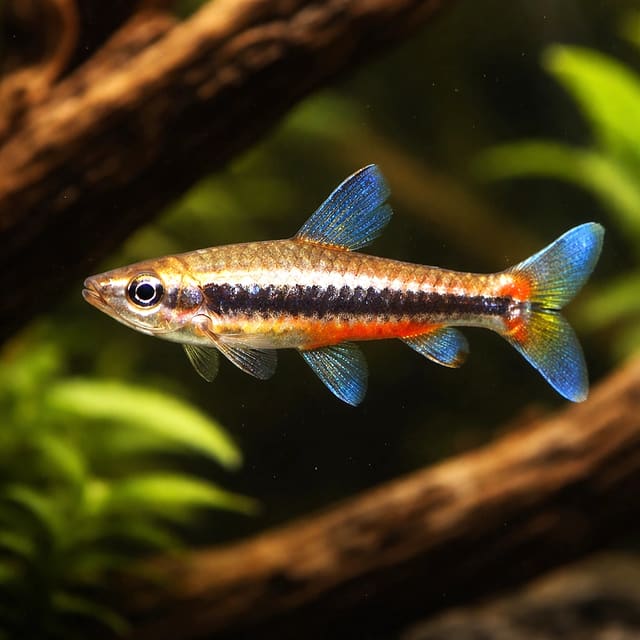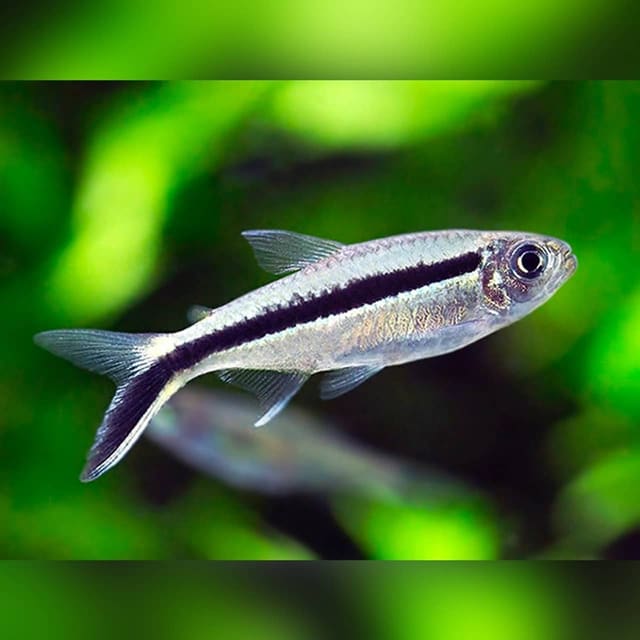
Blackline Penguin Tetra (Thayeria boehlkei)
22–27°C · pH 6.5–8 · 68L
£34.99
Blackline Tail Tetra (Moenkhausia costae) is a silvery shoaling tetra from Brazil's São Francisco and Itapicuru rivers with a black tail marking, reaching 7 cm standard length. Sold one fish per unit at 2–3 cm or 4–5 cm. Keep five or more in at least 80 litres at 22–27°C.
Adult size is the maximum length this species reaches at full maturity (scientific sources). The livestock you receive will be younger and smaller — pick a size above for the actual shipping size. Product-photo provenance and any image-specific limitations are stated on the listing.
Moenkhausia costae
Save when buying multiple fish. Each quantity is one fish; sex and pair formation are not guaranteed unless the selected variant explicitly states them.
Blackline Tail Tetra (Moenkhausia costae) is a silvery shoaling tetra from Brazil's São Francisco and Itapicuru rivers with a black tail marking, reaching 7 cm standard length. Sold one fish per unit at 2–3 cm or 4–5 cm. Keep five or more in at least 80 litres at 22–27°C.
Adult size is the maximum length this species reaches at full maturity (scientific sources). The livestock you receive will be younger and smaller — pick a size above for the actual shipping size. Product-photo provenance and any image-specific limitations are stated on the listing.
Maintain these water conditions for optimal health and vibrant colors
This page sells the Blackline Tail Tetra one fish at a time. Each unit you add to your basket is a single fish, and you choose between two dispatch grades: 2–3 cm or 4–5 cm. Those figures describe the fish on the day it leaves us, not the size it will finish at, which is covered further down. We do not select males or females for this listing, so the sex of each fish is neither chosen nor guaranteed.
Because this is a shoaling fish, most people will want several. The Ornamental Aquatic Trade Association (OATA), the UK trade body, advises keeping tetras in groups of at least five and says that more is better, so plan your order around a group rather than buying one or two to see how they get on. If you would rather buy a ready-made group as a single item, we also list six Blackline Tail Tetras together.
Blackline Tail Tetra is the trade name we use. The scientific name is Moenkhausia costae, and FishBase gives the author and date as Steindachner, 1907. Steindachner first described the fish as Tetragonopterus costae. The syntypes, the original specimens the name rests on, were collected at Juazeiro in Bahia on the Rio São Francisco, with a further batch from Palmeira and Sambaia, as listed in the comparative material of a 2014 study by Carvalho and colleagues. Portuguese Wikipedia gives the names piabinha and tetra fortuna.
You may also find it filed under the family Characidae in older books and on older tank labels. That very large family was split into several smaller ones in 2024, and FishBase and Wikipedia now place Moenkhausia in the family Acestrorhamphidae, subfamily Stichonodontinae. The fish has not changed at all; only its place in the filing system has.
One mix-up is worth heading off early. The similarly named Blackline Penguin Tetra (Thayeria boehlkei) is a different fish in a different genus. If the penguin tetra is what you are after, that is the listing you want. This one is Moenkhausia costae and nothing else.
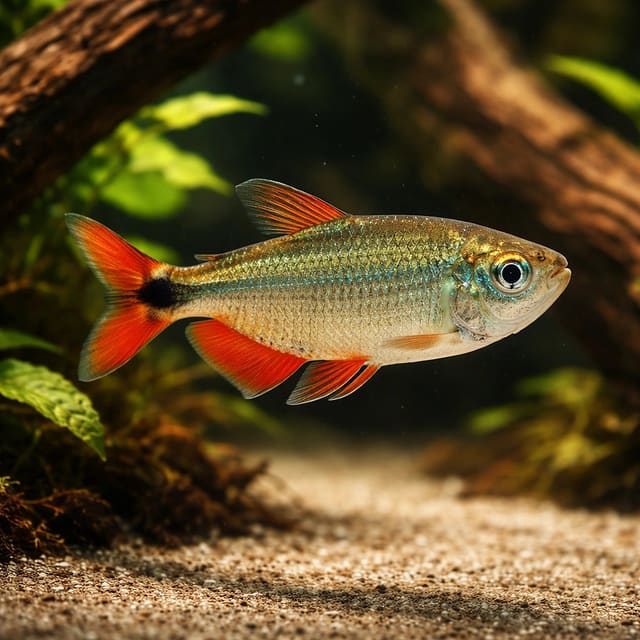
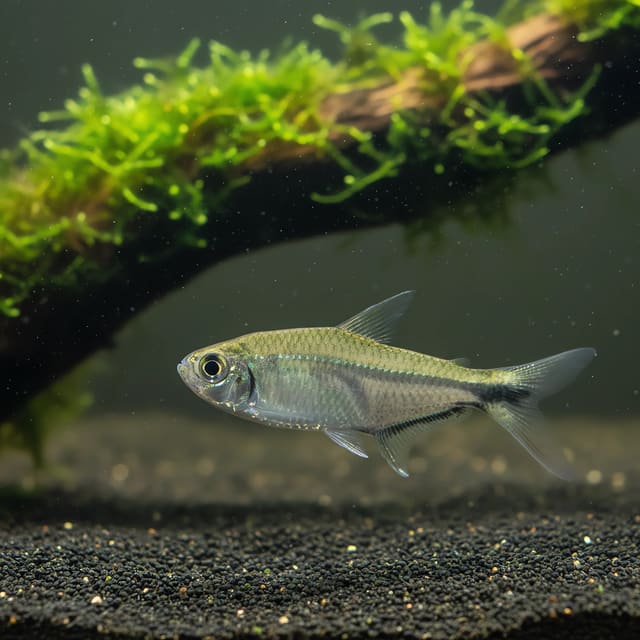
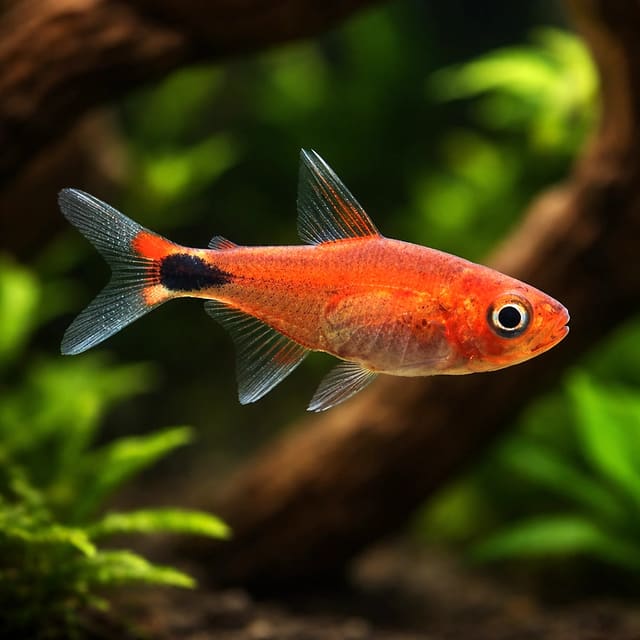
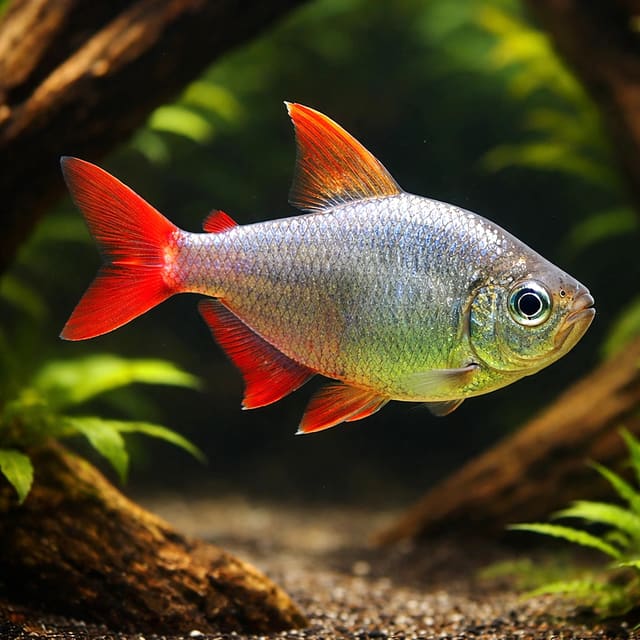
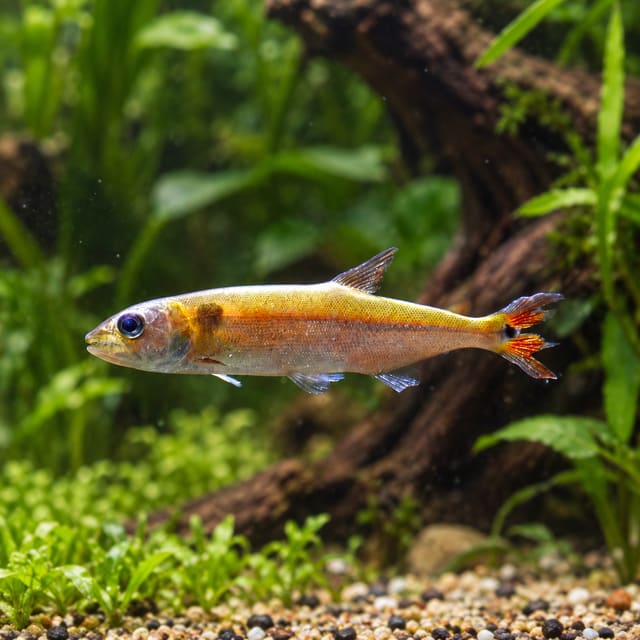
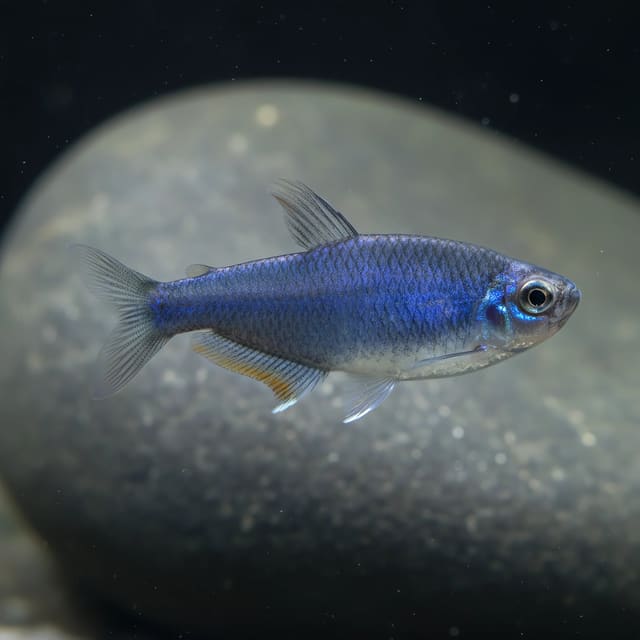
In our photograph the fish has a slim, silvery body with a soft gold sheen over the flank, a large dark eye, clear fins and one bold feature: a solid black blotch at the base of the tail. A fainter dark line runs forward from that blotch along the rear half of the body. A plain silver fish with a strong dark mark at the tail is the simplest way to describe it, and it is where the trade name comes from.
The scientific literature describes the marking more precisely. In their 2014 redescription of a related species, Moenkhausia doceana, Carvalho, Sarmento-Soares and Martins-Pinheiro separate the two mainly by the tail. M. doceana has a hyaline, meaning clear, caudal fin. M. costae instead carries what the authors call a conspicuous black stripe, running from the level of the anal-fin origin to the tip of the upper lobe of the tail fin. That is a handy test if you ever meet silvery tetras with vague labels: a completely clear tail points away from this species. In our photo the darkest part of the marking is the blotch at the tail base.
FishBase records a maximum length of 7.0 cm standard length (SL). Standard length runs from the tip of the snout to the end of the scaled body and leaves the tail fin out, so a fish at that standard length looks a little longer in the tank once you add the tail. Portuguese Wikipedia gives a lower maximum of 5.9 cm for males. We use the FishBase figure in the care details on this page, and we treat 7 cm as a ceiling rather than a size every fish will reach.
Field measurements help put that ceiling in proportion. Silva and colleagues, publishing in Neotropical Ichthyology in 2022, measured wild fish of between 20 and 56 mm SL at their main sampling site, and the original syntypes listed by Carvalho and colleagues run from 23.0 to 40.0 mm SL. Most of the fish scientists have actually handled, then, were well short of the published maximum. Within its own genus it sits in the middle of the range: Wikipedia counts 84 recognised Moenkhausia species and notes that even the largest only reach about 12 cm.
The 2–3 cm grade are young fish with plenty of growing still to do. They suit a customer who enjoys watching a group fill out and who is happy to feed small foods for a while. The 4–5 cm grade are larger, closer in size to the wild fish found in breeding condition in the 2022 study, where the smallest mature male measured 32 mm SL and the smallest mature female 38 mm SL. A dispatch grade is a size band, not a scientific standard-length measurement, so treat that comparison as rough and not as a promise that any fish is ready to spawn. Either grade will grow on in a well-kept aquarium; the choice is mostly about how finished you want the group to look on day one.
FishBase lists Moenkhausia costae as a freshwater, benthopelagic fish of the São Francisco and Itapicuru rivers in South America, and places it in its subtropical climate band. Benthopelagic is FishBase's term for fish that live near the bottom as well as in midwater, rather than at the surface or in the substrate.
The São Francisco is a big river by any standard. Wikipedia gives its length as 2,914 km, which makes it the longest river running entirely within Brazil. It rises at 1,450 m in the Canastra Mountains at São Roque de Minas in Minas Gerais, then flows through five states, Minas Gerais, Bahia, Pernambuco, Alagoas and Sergipe, before reaching the Atlantic near Piaçabuçu. Locally it is called the Velho Chico. Along the way it crosses the semi-arid interior of the country, a region long marked by drought and water shortage. Wikipedia counts more than 200 fish species in the basin, around 64% of them found nowhere else.
It is also a heavily engineered river. Five major hydroelectric schemes sit along it: Três Marias, Sobradinho, Paulo Afonso, Luiz Gonzaga (Itaparica) and Xingó. The Sobradinho reservoir alone covers 4,214 square kilometres and is one of the largest artificial lakes on Earth. The original specimens of this tetra came from Juazeiro, Bahia, on the São Francisco itself. The second river FishBase names, the Itapicuru, is a separate river of Bahia which, according to Wikipedia, rises in the north of the state and flows east to the Atlantic.
The most recent field work on the species is unusual because it follows the fish out of its home range. Brazil's São Francisco Interbasin Water Transfer Project carries river water through canals and reservoirs into neighbouring basins. Silva and colleagues recorded M. costae moving along the project's East Axis into the Paraíba do Norte basin, where they caught it at two sampling sites in the receiving basin. Portuguese Wikipedia adds that it was first detected there in 2018 and had become the third most captured species by January 2022. The authors suggest that breeding all year round helps explain how well it has colonised the new water, although at their main site its numbers fell gradually between August 2018 and December 2021.
There is a plain lesson in that for anyone who keeps fish. A small shoaling tetra that can establish itself in new water this readily is exactly the kind of animal that must never be released. Unwanted fish should go back to a shop or to another keeper, and old tank water belongs down the drain, never in a pond, ditch or stream.
In its native range the species is not a conservation concern. FishBase shows an IUCN Red List assessment of Least Concern, dated 7 November 2018.
Start with the volume. OATA's tetra care sheet asks for at least 45 litres for small species and at least 80 litres for larger tetras of 5 cm and over. With a published maximum of 7 cm standard length, the Blackline Tail Tetra belongs in the second group, so 80 litres is our minimum for a group, and more room is better if you want a bigger shoal or plan to keep other fish alongside. A shoal needs room to turn as a unit, so if you are choosing between two tanks of the same volume, take the longer one.
OATA lists the essentials plainly. A filter is always essential. A heater keeps the temperature steady through the year, which matters in a British house where the room can swing several degrees between a summer afternoon and a January night. Overhead lighting, a floor of aquarium gravel or sand, and a water test kit complete the list. OATA recommends live plants and accepts plastic plants and ornaments such as caves.
Because FishBase classes this species as benthopelagic, plan the layout around the lower and middle water rather than the surface. A practical arrangement is planting along the back and sides, a few pieces of wood or smooth stone to break up the view, and a clear run of open water through the middle and front where the group can move together. Sand or small rounded gravel is easy to keep clean and kind to any bottom-dwelling companions you add later.
Live plants are worth the bother. They use some of the waste the fish produce, give new arrivals somewhere to sit out of sight while they settle, and make a group of silver fish look far better than a bare tank does. Hardy, slow-growing plants are the easiest place to start, and they leave the middle of the tank open for swimming.
Think about where you will stand to watch. A group of silver fish shows best against a darker background, with light falling from above and slightly in front. You will also want an easy view of the whole tank at feeding time, because counting heads and checking that everyone eats is the quickest health check there is.
The tank must be fully set up and stable before any fish arrive. That means the filter has been running long enough to process waste, your tests show zero ammonia and zero nitrite, and the heater is holding a steady temperature. If the aquarium is brand new, let it mature first and order the fish afterwards, never the other way round. Fish added to an unready tank face rising ammonia at the very moment they are least able to cope with it.
If you already keep fish, check that there is room in the stocking for a group of five or more mid-sized tetras before adding them. A tank that is already busy will not become less busy, and a shoaling fish squeezed into a crowded tank never shows its best.
FishBase does not publish a temperature, pH or hardness range for Moenkhausia costae, and none of the other sources we read gives one for this species. Rather than invent figures, we use OATA's guidance for tetras, which is written for captive-bred fish, and we have set the care details on this page to match it.
| Measure | Target |
|---|---|
| Temperature | 22–27°C |
| pH | 6.5–8.0 |
| General hardness | 4–12°dH (soft to medium) |
| Carbonate hardness | 3–10°dKH (soft to medium) |
| Ammonia | 0 mg per litre |
| Nitrite | 0 mg per litre |
| Nitrate | no more than 20 mg per litre above your tap water |
Within those limits, steadiness matters more than any single number. A tank that sits at the same temperature and the same pH week after week is a better home than one nudged up and down in pursuit of a target. A setting around the middle of the temperature range, 24 or 25°C, gives you a margin either side if the room warms up in summer or the heater struggles on a cold night.
Tap water differs from one area to the next, especially in hardness, so test your own supply before you buy rather than assuming. If your tap water already sits inside the table, there is nothing to adjust. If it falls well outside, talk to us before ordering; it is much easier to choose suitable fish for your water than to fight your water to suit the fish.
OATA recommends testing at least once a week and changing 25% of the water weekly. When you clean the filter, rinse the sponge or media in water taken out of the tank, never under the tap. Treat new water with a tap-water conditioner and bring it close to tank temperature before it goes in.
Your test results tell a story if you read them in order. Ammonia or nitrite above zero means the filter is not coping, whether because the tank is too new, too heavily fed or recently disturbed; the answer is extra partial water changes and lighter feeding until both read zero again. Nitrate creeping up week on week means the water changes are too small or too far apart. Write the readings down. A simple notebook beside the tank will show you a slow drift long before the fish do.
The best evidence on the natural diet comes from the 2022 field study. Silva and colleagues examined the stomachs of 60 fish and found only three empty. The diet was built on zooplankton. Ostracods were the most important item, scoring between 78.81% and 91.30% on the alimentary index the authors used, followed by unidentified zooplankton and then cladocerans. In plain English, this tetra eats tiny animals taken from the water.
Ostracods, sometimes called seed shrimp, are small crustaceans protected by a two-part shell that looks like a miniature clam; Wikipedia gives a typical size of about 1 mm. Cladocerans include Daphnia, the water fleas familiar to anyone who has bought frozen fish food, and Wikipedia puts those at 0.2–6.0 mm. That makes daphnia one of the closest matches to the wild diet you can easily buy.
OATA describes tetras as omnivores and recommends a good-quality flake or granule as the staple, supplemented with live or frozen foods such as daphnia and bloodworm. Its rule on quantity is simple: feed only what the fish can eat within a few minutes, once a day.
A practical week might look like this:
Food size matters with the smaller grade. Fish of 2–3 cm do better with flake crumbled between your fingers or the smallest granules, and daphnia suits them well. The 4–5 cm fish manage ordinary flake and small granules without trouble.
Feed in the same spot each time, near the front, and use those few minutes to count the group and look at every fish. A healthy fish comes forward for food. One that hangs back, spits food out or loses condition over several days is worth a closer look, and is often the first sign that something in the tank has changed.
Overfeeding is an easy mistake to make in any community tank. Uneaten food breaks down, raises ammonia and works against everything the filter is doing. If food is still drifting about after a few minutes, you have given too much; net out the excess and feed less next time. In a new group the fish may be shy for the first few days, so start with very small amounts and increase as their confidence grows.
OATA describes tetras as shoaling fish that should be kept in groups of at least five in the home aquarium, and warns that fish kept alone or in groups that are too small become stressed. We would treat five as the floor rather than the goal. A larger group gives shy individuals company to hide among and simply looks better, as a shoal of silver fish turning together is the whole point of keeping them.
It is worth being honest about the evidence here. FishBase, the scientific papers and Wikipedia between them cover this tetra's range, size, wild diet and breeding, but none of them describes how it behaves in an aquarium. There is no detailed published account of its temperament for us to quote. The advice below is therefore the general advice for a mid-sized shoaling tetra, applied with a sensible margin of caution, rather than a claim about this species in particular.
In practice that points towards other mid-sized community tetras with similar water needs, and peaceful bottom-dwelling fish that keep to the floor while the tetras use the water above. Check each species' own requirements before buying; a companion that needs very soft, acidic water or a much warmer tank is a poor match however peaceful it is.
Introduce companions in a planned order rather than all at once. Your filter needs time to catch up with each new addition, and the existing group settles faster when new fish arrive into a calm, stable tank. If you add Blackline Tail Tetras to an established community, watch the first few feeds closely: you want to see the newcomers eating and the residents ignoring them.
If you order both grades, the smaller fish will be competing with larger relatives at feeding time. Spread food over a wider area so that the youngsters get their share, and check that they are filling out over the following weeks. Once they have grown on, the difference largely disappears.
Most health problems in a community aquarium are easier to prevent than to treat, and the best prevention is the routine already described: stable, clean water, sensible feeding and a group of the right size. OATA lists the signs to watch for in tetras, and they make a good daily checklist:
Test the water first, every time. Ammonia, nitrite, nitrate, pH and temperature take five minutes to check and explain a surprising number of problems. If a reading is off, correct it with partial water changes before you consider anything else, and keep feeding light until the tank is back on track.
Avoid reaching for medication before you know what you are treating. Many treatments affect filter bacteria, plants or invertebrates, and dosing for the wrong problem adds stress without helping. If you are unsure, take clear photos, note your test results and ask for advice; we would much rather talk through a problem early than hear about it a fortnight later.
If you already keep fish, a simple quarantine tank is good practice for any new arrivals, this tetra included. A bare tank with a heater, a mature sponge filter and a couple of hiding places is enough. Two to three weeks of observation there lets you spot any problem before it reaches your main aquarium. If you are setting up a new tank for Blackline Tail Tetras alone, the main tank does the same job, as long as you keep it calm and watch closely.
The only detailed breeding information we have found for this tetra comes from wild fish, again from Silva and colleagues' 2022 study in the Paraíba do Norte basin. The authors describe year-round reproduction and fractional spawning, meaning females release their eggs in batches rather than all at once.
The seasonal pattern is clear in their numbers. In the dry season, 53.3% of the fish examined were immature, 40% were maturing and only 6.7% were mature, and juveniles were present. In the rainy season, 64.45% were mature, 33.33% maturing and 2.22% partly spent. The gonadosomatic index, the weight of the reproductive organs as a share of body weight, rose with the rains: females averaged 6.34 in the rainy season against 1.42 in the dry season, and males 2.28 against 0.98.
Size at maturity is useful to know as well. The smallest mature female in the study measured 38 mm SL and the smallest mature male 32 mm SL, so wild fish were breeding well below the 7 cm maximum.
None of the sources we read sets out how to breed this species in an aquarium, describes reliable outward differences between males and females, or records its eggs and fry being raised at home. We would rather say that plainly than borrow instructions written for other fish. This listing does not sell sexed fish, and we cannot promise that any group will spawn.
If you do see breeding behaviour in a well-kept group, it is a good sign that the fish are settled and in condition. Keep the water stable, keep the feeding varied, and enjoy it as a bonus rather than a target.
Have the aquarium ready before you order: filter running, water tested and the temperature steady. Someone needs to be at the delivery address to receive the parcel, because live fish cannot simply be left on a doorstep. Please read our delivery and live-arrival information before you place your order, so you know exactly what to expect.
Your fish travel in oxygen-filled bags inside insulated packaging, with heat packs when conditions call for them, carried by a tracked courier licensed to carry live animals. We email you the confirmed delivery date and the tracking details, so you can plan to be in.
Before you open the box, start a continuous video while the parcel is still sealed, then open it in the same take and show the fish in their bags before any bag is opened. If a fish arrives dead, dying or clearly in poor condition, email hello@tropicalfishco.co.uk on the day of delivery with your order number and that video. Photos alone do not meet the policy. Under the terms of our live-arrival guarantee, the affected fish are replaced with your next order or refunded.
Keep the lights low for the rest of the first day and hold off feeding until the next day. After that, feed small amounts and build up as the group gains confidence. Over the first week, watch breathing, appetite and behaviour. Expect new fish to stay close together and use the plants at first; as they settle they will spread out into the open water and start coming forward at feeding time.
Make no other big changes in that first week: no rescaping, no new equipment and no large water changes beyond your normal routine. A calm tank gives you the clearest view of how the new group is doing, and gives the fish the easiest start.
These are the sources behind this guide, if you would like to read further:
No reviews for this item yet. Bought one? Honest reviews only, good or bad.
What customers say about ordering from us
Easy website plenty of info on fish your buying great to pick a time slot
TRACEY DURRANT · 7 Oct 2026
Got some lovely fish thank you
Kevin Mackie · 7 Oct 2026
Reviews of our shop, collected by Judge.me, an independent third-party review collector. Newest first.