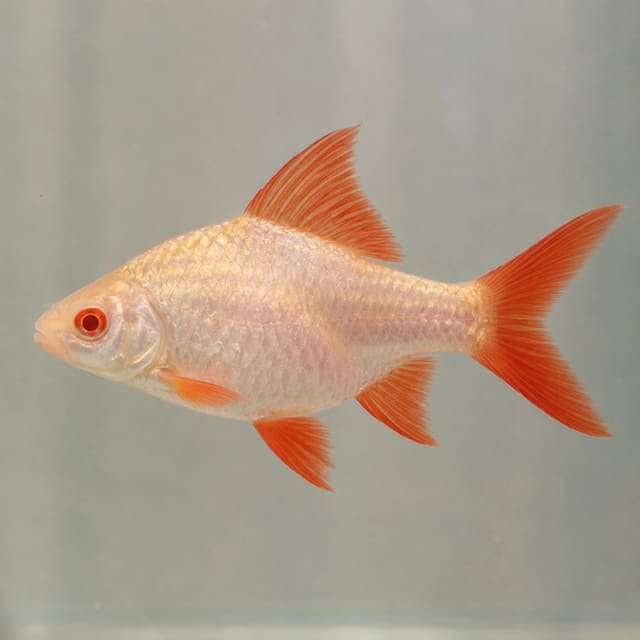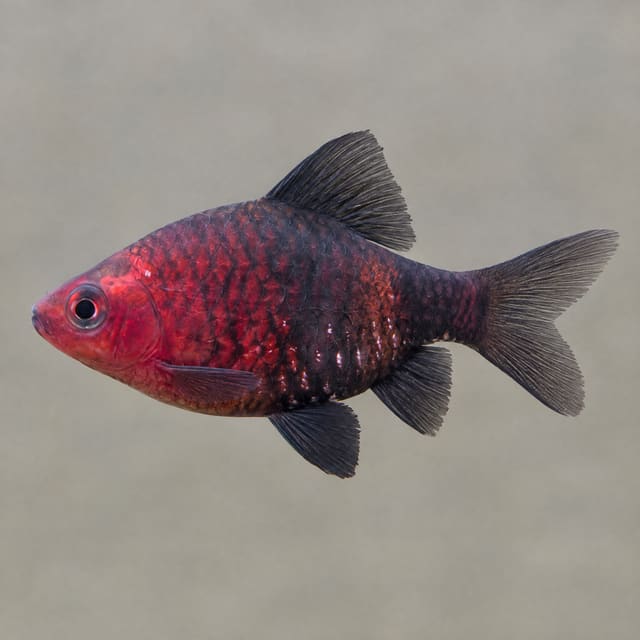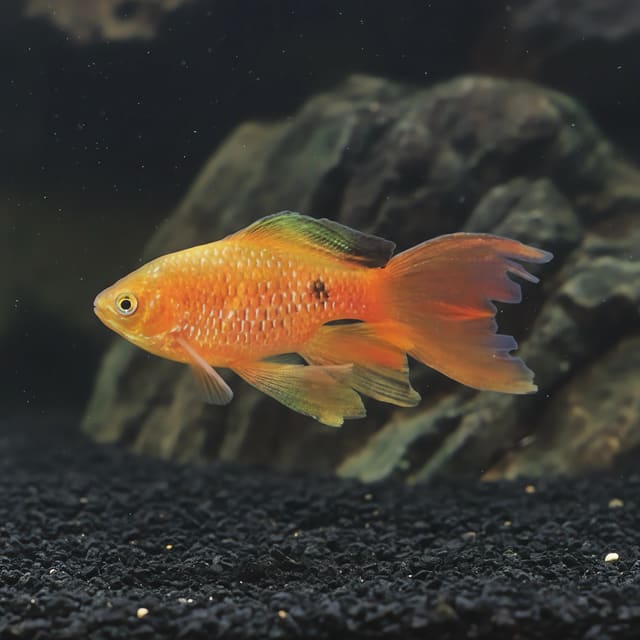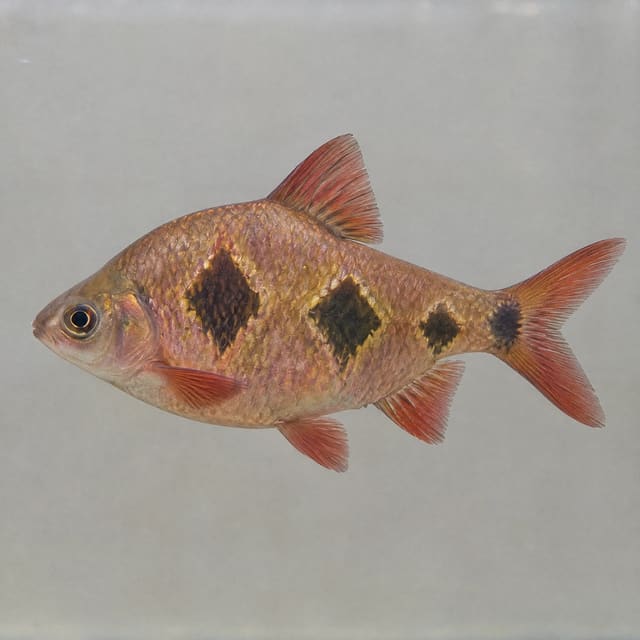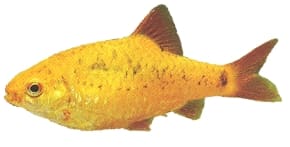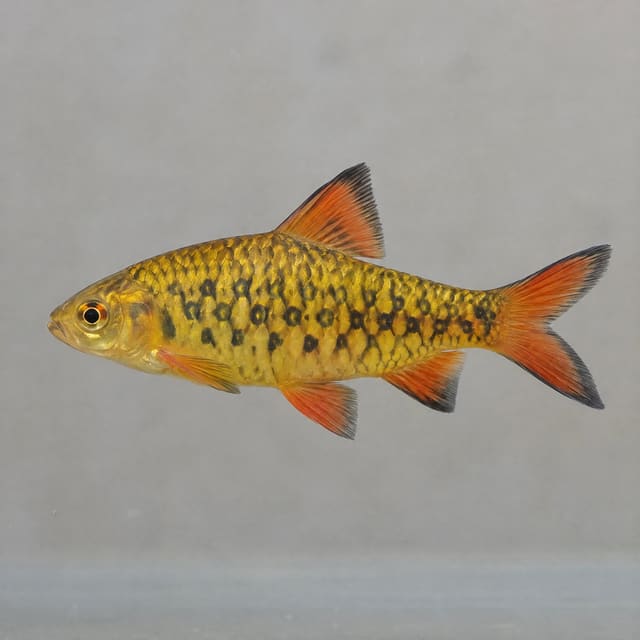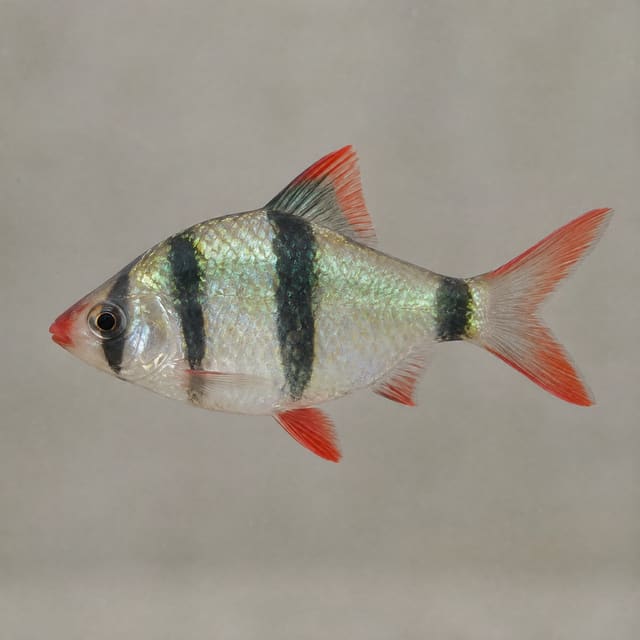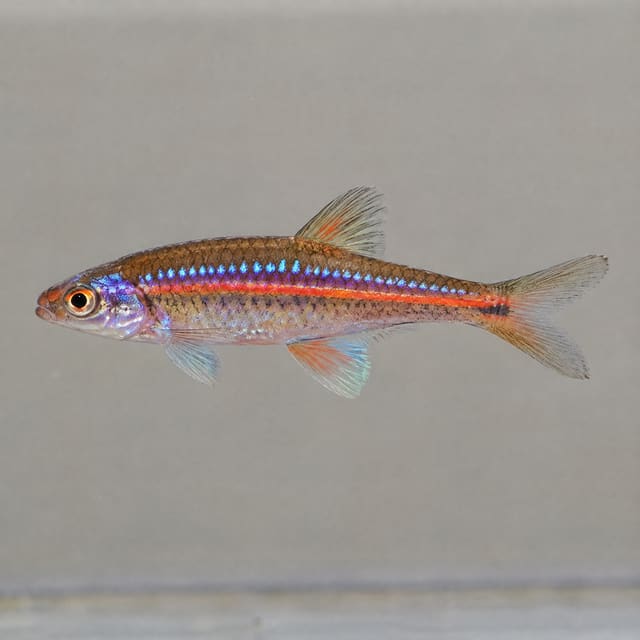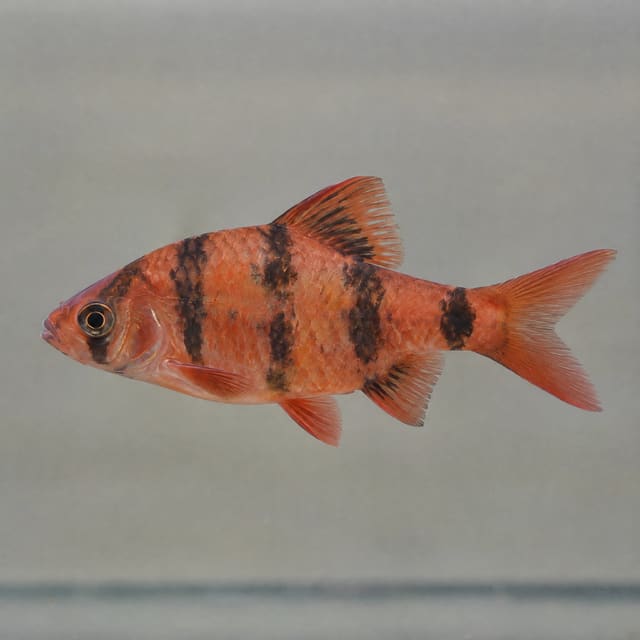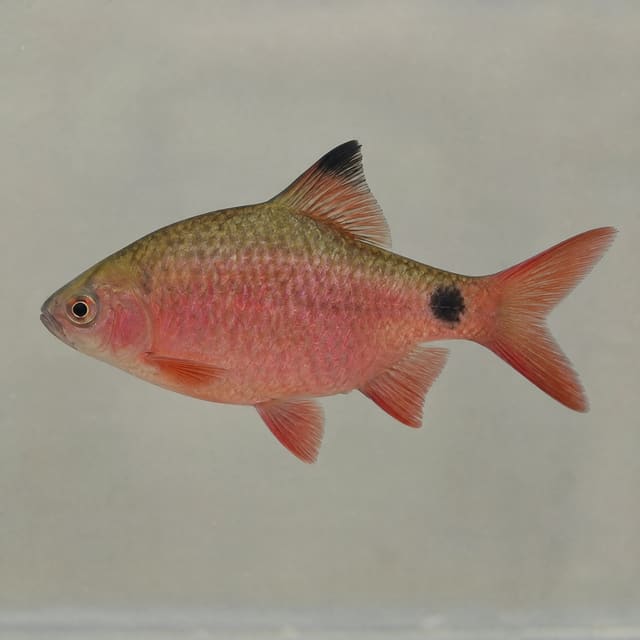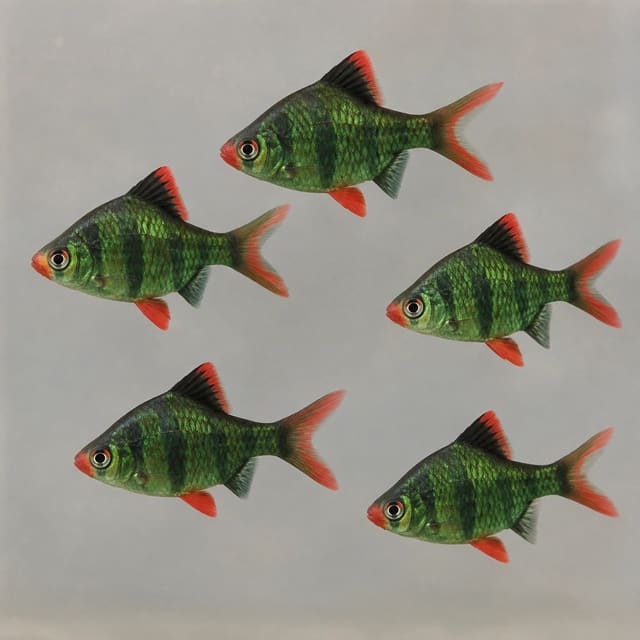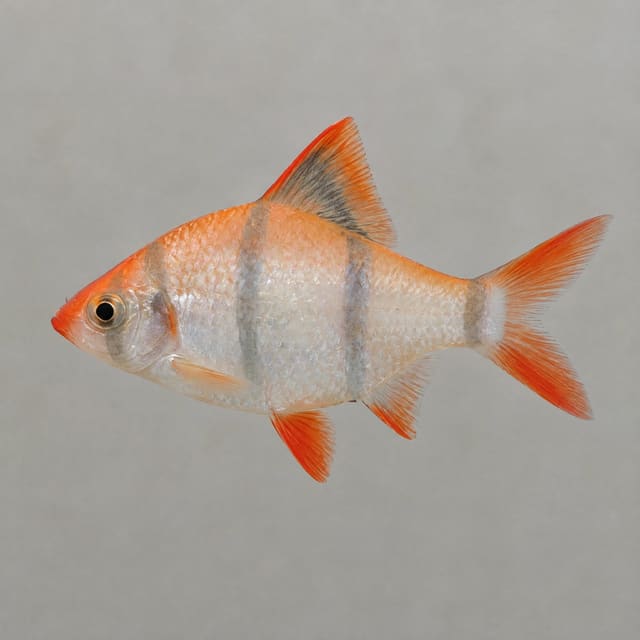
Platinum Orange Tiger Barb (Barbus tetrazona)
20–26°C · pH 6–8 · 72L
£4.99
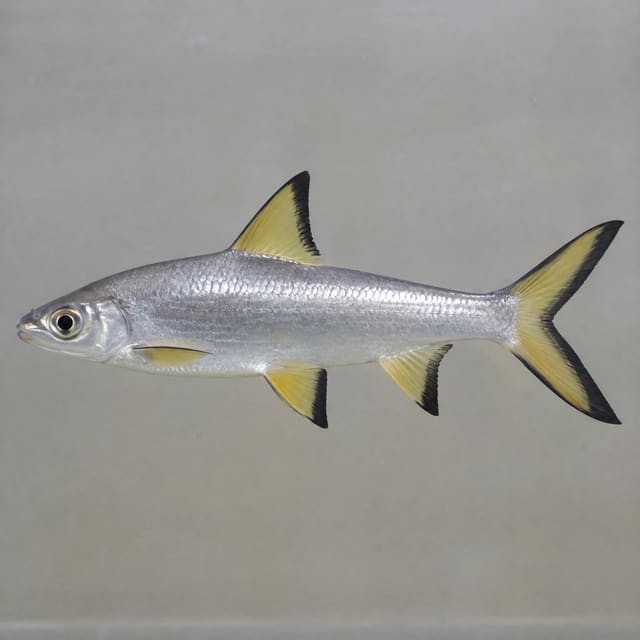
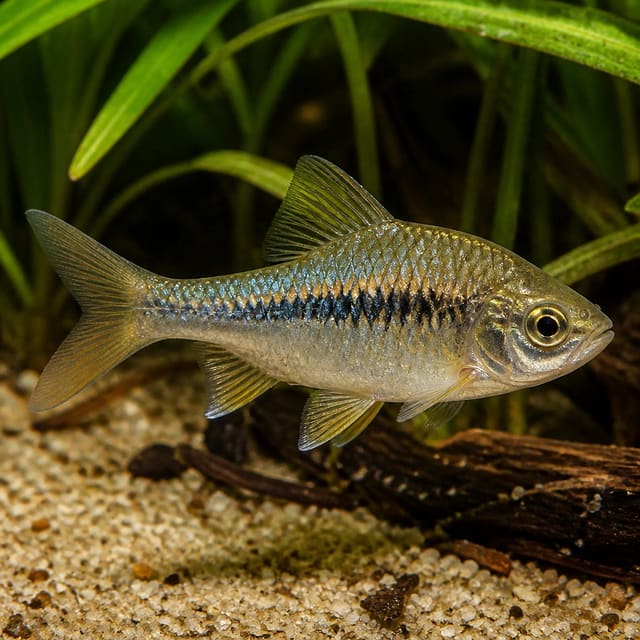
The Apollo Shark (Luciosoma setigerum) is not a shark but a long, slim, silver cyprinid from Southeast Asian rivers, with a dark side stripe and long pelvic-fin filaments. It grows to 22–26 cm standard length, hunts at the surface, jumps readily and needs a very large, tightly covered aquarium (240 × 60 cm base or more) at 20–26°C, kept in a group with large companions. Sold individually as one live fish.
Luciosoma setigerum
Quantity discounts are pricing offers, not a group-size recommendation. Check the full care guidance and your existing animals before choosing a quantity.
The Apollo Shark (Luciosoma setigerum) is not a shark but a long, slim, silver cyprinid from Southeast Asian rivers, with a dark side stripe and long pelvic-fin filaments. It grows to 22–26 cm standard length, hunts at the surface, jumps readily and needs a very large, tightly covered aquarium (240 × 60 cm base or more) at 20–26°C, kept in a group with large companions. Sold individually as one live fish.
Read the full care guidance when planning conditions for your aquarium.
The Apollo Shark (Luciosoma setigerum) is a long, slim, silver fish from the rivers of Southeast Asia, with a dark stripe along its side and long thread-like extensions on its pelvic fins. Despite the trade name, it is not a shark. It belongs to the carp and minnow group: FishBase places it in the family Danionidae, subfamily Chedrinae, while the Seriously Fish species profile still lists it under Cyprinidae.
Its genus name joins the Latin lucius, probably the pike, with the Greek sôma, body, a fair description of its long, pike-like shape. The species name setigerum means "bristly" and presumably refers to the first pelvic-fin ray, which is drawn out into a long filament. Older names you may find attached to it include Barbus setigerus, Barbus podonemus and Luciosoma weberii, and shops also call it the Apollo shark minnow.
| Suits | Not suited to |
|---|---|
| An aquarium with a base of at least 240 × 60 cm | Standard community tanks, even large ones under 2 m long |
| A group of its own kind | Keeping a single fish |
| A tightly fitted lid with no gaps | Open-topped tanks or lids with cable and pipe gaps |
| Large, robust companions | Small fish that fit in its mouth |
| 20–26°C, pH 6.0–8.0 and 2–12 dGH with plenty of oxygen | Warm, still or poorly oxygenated water |
Seriously Fish rates it difficult for one reason above all: it needs a tank at least 2 m long. This is a fish for keepers who already own, or are ready to buy, a very large aquarium, and who want a fast, sleek surface swimmer as the main feature of it.
One purchase supplies one live Apollo Shark. It is sold in one standard size with no size grade; whatever its size on arrival, plan the aquarium for the adult size given below. Sex is not selected, and Seriously Fish notes only that mature females are likely to be deeper-bodied than males. Choose the quantity in the basket to buy a group in one delivery, and check our delivery page for dispatch days and arrival terms.
The photographs show the species, not the individual you will receive. That matters more than usual with Luciosoma: Seriously Fish reports that young L. setigerum, L. bleekeri and an unidentified L. cf. setigerum all reach the trade regularly, often under the wrong scientific name. The name L. spilopleura is widely used for traded fish although that species may never have been collected for aquariums, and the name L. pellegrinii is regularly misapplied.
| Feature | Luciosoma setigerum |
|---|---|
| Side pattern | A row of roundish dark spots, often fused into a stripe, with spots on the lateral-line scales |
| Tail | The stripe continues onto the caudal peduncle and upper tail lobe, ending in a black blotch at its base; a dark stripe runs just inside the edge of the lower lobe, and the middle rays are colourless |
| Pelvic fins | First ray drawn out into a long filament |
| Head | Well-developed barbels and no tubercles on the snout tip |
| Lookalike: L. bleekeri | Lacks the spots on the lateral-line scales |
| Lookalike: L. cf. setigerum | Matches most features, but the dark stripe is missing on the front of the body and is not made of joined spots |
These features come from Seriously Fish and the FishBase species summary. Judge the markings once the fish has settled, under normal aquarium lighting.
Seriously Fish gives a maximum of 220 mm standard length, measured without the tail; FishBase records 26.0 cm standard length. Either way, the body alone of a grown fish can exceed 20 cm, and it spends its life cruising at speed.
Seriously Fish's minimum base is 240 × 60 cm, about 864 litres, and it describes that as the smallest that should be considered; it adds that Luciosoma species are only suitable for the largest private aquariums. Our tank volume calculator converts length, width and height into litres.
Buy and mature the final aquarium before you buy the fish. A fast swimmer that hunts at the surface needs length to turn and cruise, and moving a group of long, nervous fish into a bigger tank later adds stress for them and work for you. Our tank set-up guide explains how to mature a new aquarium before stocking it.
FishBase describes it living at the surface of flowing water, in river main channels and gently sloping tributaries with logs and leaf litter on the bottom. Seriously Fish describes slow-flowing lowland rivers with leaf litter and sunken wood, and notes that the fish moves into swamps and flooded forest in the wet season. Its range covers the Mekong basin (Thailand, Laos, Cambodia and Vietnam), the Chao Phraya and Mae Klong, peninsular Thailand and Malaysia, Borneo, Sumatra and Java; records from eastern Myanmar still need confirmation.
Seriously Fish says décor matters less than water quality and open swimming space, and suggests a stream-style tank with water-worn rocks, sand, fine gravel, perhaps a few small boulders, and driftwood roots or branches. Hardy plants such as Java fern (Microsorum), Bolbitis and Anubias can be tied to the décor; most other aquatic plants will not thrive.
| Area | Purpose |
|---|---|
| Upper half of the tank, clear from end to end | The swimming and feeding zone of a fish that lives near the surface |
| Rocks, sand and wood along the bottom and back | A natural river look and some shade, without crowding the open water |
| Java fern, Bolbitis and Anubias on wood and stone | Greenery that copes with river conditions |
| Gentle current along the length | Moderate water movement and well-oxygenated water |
Seriously Fish is blunt: every Luciosoma species is an accomplished jumper, and the tank must have a very tightly fitting cover. A fast fish that spends its time just below the surface has every chance to find a gap, so make the lid escape-proof before the fish is in the tank, not after the first jump.
Keep the lid in place during maintenance as far as you can. We also suggest switching the room lights on before the tank lights, so the fish is not startled by sudden brightness.
| Measure | Target | Source |
|---|---|---|
| Temperature | 20–26°C | Seriously Fish |
| pH | 6.0–8.0 | Seriously Fish |
| General hardness | 2–12 dGH | Seriously Fish |
| Ammonia and nitrite | Zero | OATA |
| Nitrate | No more than 20 mg per litre above your tap water | OATA |
The upper hardness limit is the one to check in the UK. Tap water ranges from soft to very hard depending on the region, and in hard-water areas it can exceed 12 dGH. Test yours and, if needed, blend it with reverse-osmosis water to bring it into range. Our water matcher compares your water with each fish's needs, and our water chemistry guide explains hardness and pH.
Seriously Fish says very fast flow is unnecessary, but the water must hold a relatively high level of dissolved oxygen with moderate movement. Filter outlets that ripple the surface help with that.
Temperature, pH and hardness describe the habitat and can sit anywhere inside the range. Ammonia, nitrite and nitrate measure waste and have fixed targets whatever the habitat values. In a tank of this size, with large fish eating meaty food, waste builds up quickly, so test weekly and act on any reading above target.
Seriously Fish recommends weekly water changes of 30–50% for this species; OATA's general guidance for freshwater sharks is at least 25% every week. On a tank of 800 litres or more that means moving a lot of water, so plan the method, such as a long hose, a pump and a dechlorinator dosed for the full volume, before the fish arrives. Seriously Fish's equipment suggestion for a tank this size is three external filters rated 1,150–1,440 litres per hour each, with the heating split across three heaters. Our guide to aquarium filtration explains how to size a filter.
The sources disagree on its natural diet. Seriously Fish says it feeds mainly on land insects taken at the water's surface, and presumably also on aquatic invertebrates and fish fry. FishBase, citing the FAO field guide to the fishes of the Cambodian Mekong, says it feeds mostly on fish. Either way, it is a surface-feeding predator, and small fish are at risk.
In the aquarium, offer foods that stay at or near the surface: floating pellets or sticks sized for its mouth, insect-based dried foods, and thawed frozen foods such as bloodworm, brine shrimp and krill. OATA's general rule is to feed once a day and give only what is eaten within a few minutes, because uneaten food fouls the water.
Add Apollo Sharks only to a fully mature tank: OATA says ammonia and nitrite must read zero before any fish go in. Introduce the whole group together where you can, so the fish settle as a group rather than one at a time.
OATA's floating-bag method works well: switch off the aquarium lights, float the sealed bag for about 10 minutes to equalise the temperature, then add small amounts of tank water to the bag over up to 20 minutes before netting the fish into the tank, keeping bag water out. With this fish, close the lid immediately after each one goes in. Our acclimatisation guide covers the same steps in more detail.
| When | Check | Action |
|---|---|---|
| Day 1 | Lid fully closed; fish swimming, not hiding | Keep the tank lights off for the rest of the day |
| Day 2 | Interest in a small first meal | Offer a little floating food; remove what is not eaten |
| Days 3–5 | Ammonia and nitrite | Change water at once if either is above zero |
| Day 7 | Full test, feeding and behaviour of every fish | Move to the normal routine if everything is on target |
Seriously Fish says it needs to be kept in a group and is fine with other fish, but its diet means small companions can become food. Pick tank mates that are too large to swallow, robust enough not to be stressed by fast swimmers, and happy in the same 20–26°C range.
| Suits | Avoid |
|---|---|
| The Bala Shark, another large, active silver cyprinid for very big tanks | Small schooling fish such as tetras, rasboras and small danios |
| The Tinfoil Barb, a robust, fast-swimming barb | Slow, timid or long-finned fish |
| The Giant Danio, a fast relative from the same family that holds its own in open water | Fish that need water outside 20–26°C |
| The Silver Dollar, a large, peaceful schooling fish, if its water range overlaps | Aggressive fish that chase others around the tank |
Our tank mates tool checks a planned mix for you. For more large, active fish, browse our barbs and shark-type cyprinids, the Barbs category page, our schooling fish and our rare and collector fish.
OATA lists the signs of a healthy fish as clear, bright eyes, undamaged fins, intact scales, no ulcers or bumps, normal swimming and steady breathing. Signs of trouble include clamped fins, flicking against objects, white spots or fluffy growths, hiding more than usual, faster or slower gill movement and a reduced appetite. Because this fish lives at the surface, its position alone is not a warning sign; watch its breathing and feeding instead.
| Observation | First action |
|---|---|
| Rapid gill movement in several fish | Test ammonia and nitrite, check the temperature and increase surface movement |
| Grazes on the snout or a fish found on the floor | Find and close the lid gap; reduce sudden light changes |
| One fish hiding and not feeding | Test the water, then watch for chasing by tank mates |
| White spots or fluffy growths | Identify the problem before choosing any treatment |
No. It is a cyprinid (Danionidae in FishBase, Cyprinidae in Seriously Fish), related to danios and barbs. "Shark" is only a trade name.
Seriously Fish gives 220 mm standard length and FishBase 26.0 cm standard length, both measured without the tail.
A base of at least 240 × 60 cm, about 864 litres, which Seriously Fish describes as the smallest that should be considered.
Seriously Fish says it needs to be kept in a group, so plan for several fish in a tank large enough for all of them.
It may. FishBase says it feeds mostly on fish, and Seriously Fish expects it to take fry. Keep it only with fish too big to swallow.
Yes. Seriously Fish calls all Luciosoma accomplished jumpers and says the tank needs a very tightly fitting cover.
20–26°C, pH 6.0–8.0 and 2–12 dGH, with moderate movement and plenty of dissolved oxygen, plus zero ammonia and nitrite.
Look for spots on the lateral-line scales, a stripe ending in a black blotch at the base of the upper tail lobe and a dark stripe inside the edge of the lower lobe. L. bleekeri lacks the lateral-line spots.
One live fish in our standard size. It is sold without a size grade and is not an adult, so plan for the full adult size.
No reviews for this item yet. Bought one? Honest reviews only, good or bad.
What customers say about ordering from us
Easy website plenty of info on fish your buying great to pick a time slot
TRACEY DURRANT · 7 Oct 2026
Got some lovely fish thank you
Kevin Mackie · 7 Oct 2026
Reviews of our shop, collected by Judge.me, an independent third-party review collector. Newest first.
Moved by UK carriers licensed to handle live animals
Hand-packed with oxygen bags, poly box, heat pack
Email photos the same day; an optional unboxing video helps us review problems faster — claim terms apply
Klarna & PayPal Pay in 3 at checkout