Moderate
5 × Rainbow Shiners (Hydrophlox chrosomus)
£23.99

Six live Rainbow Shiners for a mature aquarium with open swimming room, clean water and gentle flow. These peaceful shoaling fish show changing metallic colour and need a compatible cooler-water community. Sex is not guaranteed.
Adult size is the maximum length this species reaches at full maturity (scientific sources). The livestock you receive will be younger and smaller. Product-photo provenance and any image-specific limitations are stated on the listing.
Hydrophlox chrosomus
Six live Rainbow Shiners for a mature aquarium with open swimming room, clean water and gentle flow. These peaceful shoaling fish show changing metallic colour and need a compatible cooler-water community. Sex is not guaranteed.
Adult size is the maximum length this species reaches at full maturity (scientific sources). The livestock you receive will be younger and smaller. Product-photo provenance and any image-specific limitations are stated on the listing.
This listing supplies six live Rainbow Shiners (Hydrophlox chrosomus). They are peaceful, active freshwater fish whose appeal comes as much from movement as colour. A group moving through an open stretch of water gives the aquarium a different feel from a collection of solitary centrepiece fish. Choose them for a mature aquarium with room for the whole shoal, suitable cooler conditions and a steady maintenance routine.
Six is the quantity supplied with one purchase. It also meets the specialist recommendation to keep at least six together, but the number of fish alone does not make a tank suitable. Their adult growth, the space taken by existing residents, filtration and access to food all matter. If you already keep this species, plan for the combined group rather than counting the new pack in isolation.
The accepted scientific name is Hydrophlox chrosomus. Older fishkeeping literature often uses Notropis chrosomus for the same species. That name change can be useful to recognise when reading care advice; it does not describe a different colour form or a different fish. Rainbow Shiners belong to the family Leuciscidae and come from southeastern North America, where their habitats include clear streams with sandy or gravelly beds, riffles and pools.
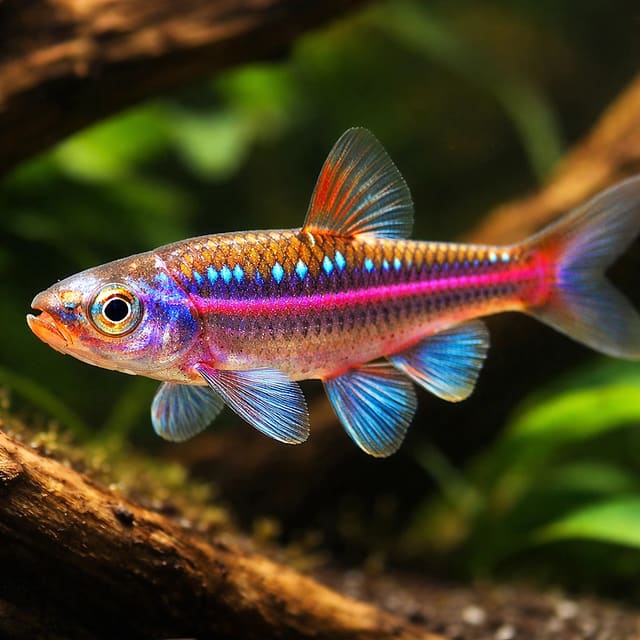
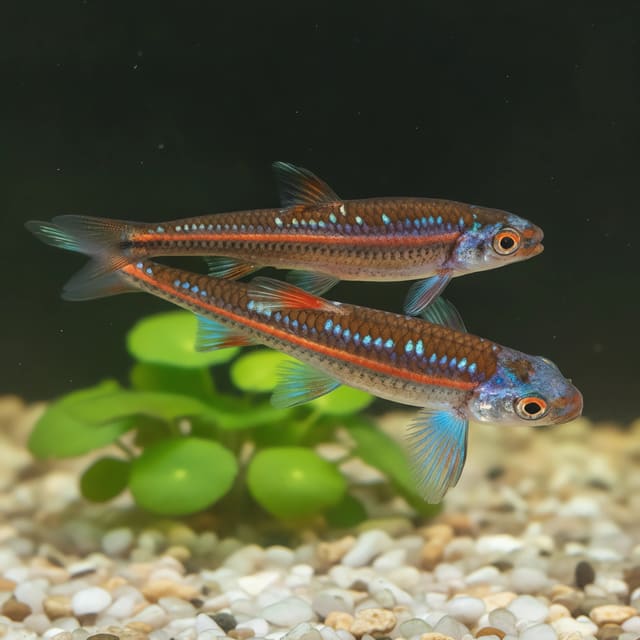
Expect an iridescent fish rather than a permanently fixed display of colour. The underlying reddish or pink-silver appearance can be overlaid by flashes of blue and violet as the fish turns. Reflected light changes what you see, and breeding condition can also affect the display. A fish photographed at a particular angle may look quite different when resting under your own aquarium lighting. Colour is enjoyable to watch, but it should be considered alongside feeding, breathing and behaviour when assessing how a fish is settling.
Specialist accounts report a maximum adult length of around 8 cm, with many individuals remaining smaller. Allow for the reported maximum when choosing space and companions. Adult length is separate from the size at which a fish is supplied. If a particular current size is important for your aquarium, ask before ordering. Sex is guaranteed only when the selected option explicitly states male or female. This Rainbow Shiner listing has no sex-guaranteed option.
Our aquarium planning guidance is at least 120 litres, with open swimming space, established biological filtration and room around the decor. Use 15–24°C, pH 6.5–7.5 and hardness 5–15 dGH as the planning bounds on this page. These are aquarium planning values, not a reason to move fish repeatedly between the ends of a range. A stable, well-maintained aquarium is more useful than a tank whose readings are continually adjusted to chase a single number.
Choose the footprint as carefully as the volume. A tall tank with little horizontal room may be less useful for a swimming shoal than a longer aquarium of similar capacity. Gravel or sand, smooth stones and some planted cover can frame an open route through the middle water. Flow should give movement to the water while leaving places where the fish can pause without struggling against an outlet.
We assess suitability as intermediate: the main task is keeping a group of active fish in a mature, appropriately stocked aquarium, with water testing and careful observation. A beginner who has prepared that environment can make a thoughtful choice; an uncycled new tank is unsuitable regardless of enthusiasm. The care section below explains how to turn the basic requirements into an everyday routine.
Choose purchase quantities around the total group your aquarium can house, including any Rainbow Shiners already living there. The recommendation to keep at least six concerns their care; the number in a purchase tells you how many new fish must be accommodated.
Begin with the way the fish will use the aquarium. Rainbow Shiners are shoaling swimmers, so the central space deserves attention before you fill the tank with ornaments. Look across the aquarium from one end to the other and identify a clear route through the middle water. It need not be bare, but there should be enough continuity for the group to move without constantly splitting around a solid wall of decor.
Place some cover at the edges or behind that route. Plants, smooth stones and carefully positioned wood can create quieter areas while leaving the front or central portion open. A layout that provides both shelter and space is more flexible than one that makes the fish choose between hiding in a crowded corner and remaining fully exposed. Check the final arrangement with the filter running, because the current may change where food and loose debris collect.
Sand and gravel reflect the kinds of beds associated with the species' stream habitats. Choose aquarium-safe material that you can maintain easily, and keep rocks stable. Smooth surfaces are sensible where active fish will pass close to the decor. The purpose is a usable environment, so a convincing stream appearance should not come at the expense of access for cleaning or safe swimming space.
Plants can help define the layout. The specialist account describes Rainbow Shiners as leaving plants alone, making a planted aquarium an option when the rest of the conditions fit. Leave room for plant growth in your original design. A clear corridor on the day of planting can disappear as stems fill out, so pruning is part of maintaining swimming space rather than simply making the tank look tidy.
Use a secure cover and check openings around equipment as part of ordinary aquarium safety. Make sure cables and hoses do not prevent the lid from sitting correctly. When servicing the tank, arrange everything you need before opening it so that the fish are disturbed for as little time as practical. Do not create a cramped display by increasing decor simply because the supplied fish initially look small.
The species appreciates flow, but an aquarium is a confined space. Arrange the filter outlet to move water through the tank and disturb the surface, then assess the result by watching the fish. They should be able to choose where they swim. If the only comfortable area is behind a single ornament, the layout or outlet position needs attention.
A current can be useful at feeding time because these fish take small drifting items. It can also push food rapidly away from them. Watch the path of a small portion before adding more. An outlet that sweeps everything straight into the filter gives the keeper little control and may leave slower individuals without a fair chance to feed.
Keep a gentler area as well as the main flowing route. You do not need to reproduce a wild riffle exactly to provide useful movement in an aquarium. A practical setup gives circulation through the tank, access to food and room to rest. Treat the response of the group as part of your equipment check, alongside the filter's normal operation.
Good circulation complements biological filtration and maintenance; it cannot substitute for them. A powerful pump does not remove the need to test water or manage stocking. Equally, reducing movement just to prevent visible ripples can remove a useful feature of the environment. Aim for a working balance and reassess it after moving decor, changing an outlet or adding fish.
A mature aquarium has functioning biological filtration that can support its residents. Clear water alone does not show that the tank is ready. Establish the system and confirm its condition with appropriate aquarium tests before arranging the introduction. The guide to preparing a mature aquarium explains the preparation steps for a new setup; use the species requirements here when planning its eventual inhabitants.
Introducing six fish adds a group at once. Consider what the filter is already supporting, rather than assuming that an aquarium is ready merely because it has been running for a while. If the tank has only recently been established or has undergone a major clean, postpone the purchase until you can assess it confidently. A stable tank provides a much better starting point for judging how new fish are settling.
Test ammonia and nitrite as part of checking that filtration is functioning, and follow nitrate and the other readings relevant to your water. Keep a simple record of results so that you can recognise a change. If fish behave unusually, a recent record lets you compare the present conditions with their normal environment instead of relying on memory or the appearance of the water.
Maintain the filter according to its instructions while protecting its biological function. The aquarium needs a consistent system, not repeated complete overhauls. Plan maintenance so that the tank remains habitable throughout the work, and avoid combining several major changes immediately before adding livestock. Preparation is easier to assess when each change has time to settle.
The planning range on this page is 15–24°C, with pH 6.5–7.5 and hardness 5–15 dGH. Keep these figures together when assessing an aquarium. A temperature match does not cancel out unsuitable water chemistry, and a matching pH does not show that an overcrowded tank has sufficient space or filtration. They are parts of a whole environment.
Measure the aquarium rather than relying on the setting printed on equipment or a general description of your tap water. An unheated aquarium can still become warm in a sunny room, while a heater setting tells you little without a thermometer reading. Check the actual temperature under the conditions in which the tank normally runs and consider how the room changes through the year.
The cooler-water suitability described for this species does not mean any unheated container is an appropriate home. It still needs suitable water, established filtration, stable conditions and sufficient room. Decide whether your room and equipment can maintain the planned environment before ordering. If they cannot, changing the stocking plan is more useful than repeatedly making emergency adjustments after the fish arrive.
For pH and hardness, understand what your measurements represent and how your normal water-change routine affects them. The guide to understanding aquarium water chemistry can help you interpret the readings. Avoid a sequence of rapid corrections made without understanding their effect. Prepare replacement water appropriately and make changes in a controlled way.
There is no benefit in treating the lowest and highest figures as a seasonal programme to impose on the fish. They are planning bounds for the aquarium described here, not a breeding recipe or a tolerance challenge. Use a stable routine and assess the residents together. If the existing community requires conditions that do not fit this plan, choose a different combination rather than trying to make every fish compromise.
Rainbow Shiners feed on small items carried in the water, including invertebrates and plant material, and captive fish accept flakes and frozen foods. Offer a varied diet in pieces that the fish can take comfortably. Watch the response to each food rather than assuming that everything sold as fish food will be equally convenient for this shoal.
A feeding routine should let you see individuals eating. Start with a small portion and observe the group as the food moves through the tank. Spread the opportunity to feed instead of repeatedly dropping everything into one contested spot. Where other residents rush to the food, placement can matter as much as the amount offered.
Check whether the whole group participates. One fish hanging back may be settling, avoiding a companion or failing to find food in the current; the observation tells you to look more closely, not which explanation is correct. Follow its condition over subsequent feeds and consider water, layout and social behaviour together. Additions to the diet should solve a real feeding difficulty rather than simply increase the quantity entering the aquarium.
Remove uneaten food and avoid allowing it to collect out of sight behind the decor. Small fish do not need a large pile of food simply because they live in a group. Keep portions controlled and use the fish's feeding response to guide your routine. Leftover food makes it harder to keep the aquarium clean and can conceal the difference between offering food and the fish actually eating it.
Vary suitable flakes and frozen foods rather than relying on one treat as the entire diet. Prepare and store foods according to their packaging. If you change the food, begin with an amount you can monitor closely. Keep the feeding method practical enough that another person can follow it accurately when you are away, especially in a community where several species feed differently.
Build a routine that includes observing the fish, checking equipment, testing water and carrying out appropriate water changes. The schedule should suit your aquarium and its measured condition. A fixed calendar is useful for remembering tasks, but it should not replace attention to what the tests and residents are showing.
Look for debris in the quieter corners of a flowing tank. A current can keep some material moving while leaving other areas untouched. Clean accessible substrate and remove accumulated waste without dismantling the entire aquarium every time. If debris repeatedly settles in the same awkward place, a small layout adjustment may make routine care easier.
Watch the outlet and intake for changes in operation. Plant growth or debris can alter the current, so the flow you arranged initially may not remain the same. Check that the shoal still has usable space and that quieter areas remain available. Observing the aquarium after maintenance can reveal a problem that is difficult to spot while your hands are in it.
Keep records short enough that you will continue using them. Note test results, significant maintenance and unusual behaviour. This is particularly helpful after adding fish, changing food or rearranging the tank. When asking for advice, an actual temperature, recent water results and a description of the changes are more useful than saying that the water seems fine.
Have the aquarium ready before the parcel arrives. Confirm that the filter is running, the water is appropriate and the tank has room for the incoming group. Set aside time to receive the delivery and introduce the fish carefully, rather than trying to complete a major aquarium change while they wait in their transport bags.
The current Tropical Fish Co policy describes oxygen-filled bags, insulated packaging and a tracked service carried by a licensed live-animal courier. Someone must be present to receive the parcel. Read the delivery and live arrival information before ordering for the applicable arrangements and claim conditions. Keep those arrangements separate from the aquarium care needed after arrival.
For an arrival claim, the policy requires a continuous unboxing video showing the parcel still sealed, its opening and the fish still in the bag. Inspect the delivery that day and contact the shop with your order number and video if an animal arrives dead, dying or clearly compromised. The policy describes replacement fish with a later order or a refund of the affected fish. Recording the delivery is part of documenting its condition; it does not replace prompt attention to the live animals.
Allow the bag temperature to approach the receiving water temperature, then introduce the fish gradually using the applicable acclimation guidance. Floating addresses temperature only, so it is not a substitute for considering water chemistry. If the transport conditions differ markedly or the fish look distressed, seek advice about the particular situation rather than applying an inflexible timetable.
Transfer the fish carefully and avoid pouring transport water into the aquarium. Keep handling to the minimum needed for a safe introduction. Do not add a large meal immediately to encourage a display: the first task is allowing the group to settle into suitable water. Observe breathing, balance, swimming and the way they use the tank before establishing the normal feeding routine.
In the first week, look at all six individuals as well as the group. Check that each can reach food and that none is persistently isolated or pressed into a corner. Make observations at different times, because a single glance during feeding can miss how the fish behave for the rest of the day. Keep disturbance low while you learn their normal pattern.
Changing colour alone cannot diagnose a problem. Reflected light and breeding condition influence the display, and the way a fish turns can make its appearance change abruptly. Check colour together with posture, breathing, appetite and interaction. If several fish are affected at once, inspect water and equipment promptly as part of understanding the situation.
Where a fish continues to look unwell, obtain advice from an experienced aquatic professional or a vet with fish expertise. Describe what you see and provide measured water results. Avoid choosing a medicine simply because an internet photograph looks similar. This guide supports preparation and routine care; an individual health problem needs assessment of that fish and its environment.
Rainbow Shiners are described as peaceful shoaling fish. That is a useful starting point, but peaceful temperament does not make them a universal addition. A successful community must meet the needs of the shoal and every existing resident at the same time. Begin with water conditions, then consider adult size, swimming space, behaviour and access to food.
Use the temperature and chemistry planning bounds in the care section to compare the aquarium as a whole. Do not select a companion only because two range tables overlap at one extreme. Consider the conditions in which you intend to maintain the tank consistently. If one species needs a substantially warmer setup or a very different water arrangement, its needs are a reason to revise the combination.
Think in terms of the space each resident will actually use. These fish commonly occupy the middle water and need a route through it. Another active group may compete for that same space, even where neither species is deliberately aggressive. Tank volume is a starting measure; the usable footprint and the arrangement of cover determine how much of it the fish can comfortably use.
Keep Rainbow Shiners together rather than spreading the six fish across separate displays. The keeping recommendation is at least six, and a group lets you observe their social swimming. Larger groups need correspondingly appropriate space and filtration. Adding more fish should follow an assessment of the aquarium, not an assumption that increasing a shoal is always harmless.
Look for sustained exclusion, repeated pursuit or a fish unable to join the feeding area. A peaceful species can still be stressed by its surroundings or the behaviour of another resident. If the shoal spends all its time compressed into a small refuge, assess the community and layout. Simply adding more cover may hide the immediate problem without resolving competition for space.
Do not split a healthy group merely to get a preferred colour arrangement or an apparent male-to-female ratio. This offer is unsexed, and appearance changes with condition and lighting. The practical goal is a group able to swim and feed in suitable water, rather than six fish selected to recreate a photograph.
Plan with adult size in mind. A fish that appears an acceptable companion while young may create a different situation as it grows. Consider whether any existing resident treats smaller fish as food or behaves territorially towards swimmers entering its space. Where you already observe those behaviours, they are concrete reasons to avoid that combination.
At the other end of the scale, a small or timid resident can be overwhelmed by an active group at feeding time. This does not require deliberate aggression: food may simply disappear before the quieter fish takes it. Watch who eats, how quickly they eat and which parts of the aquarium the food reaches. A community is working only when its individual residents can maintain themselves.
Use caution with any animal whose welfare depends on food reaching a very specific place or whose behaviour makes feeding difficult to monitor. Arrange meals to suit the complete stocking plan. If that requires constant rescue feeding or repeated intervention to prevent competition, reassess the combination rather than assuming the aquarium has enough room because its volume meets a minimum.
No named tank mate is guaranteed here. Look for residents with compatible conditions and behaviour, and assess the particular aquarium before making a choice. If you are unsure, ask with the tank dimensions, current stocking, actual temperature and water measurements. Those details make it possible to discuss the proposed combination meaningfully.
Continue observing after the community has settled. Plant growth, adult growth and changes to the layout can alter how the fish share space. A combination that seemed comfortable when everything was small should be reconsidered as the aquarium develops. Maintain room for the shoal and review any persistent change in its swimming or feeding pattern.
Specialist accounts report a maximum adult length of around 8 cm, although many individuals remain smaller. Plan swimming space and companions around that reported maximum, rather than the size of a newly supplied fish.
Our aquarium planning guidance starts at 120 litres, with a useful horizontal swimming route, mature filtration, cover and room for the complete stocking plan. Volume alone does not establish suitability.
Keep at least six together, following the specialist shoaling recommendation. A larger group requires suitable space and filtration; judge the aquarium before increasing its inhabitants.
We assess suitability as intermediate because a mature aquarium, stable water, room for an active group and routine testing are important. A well-prepared beginner may provide this, but a newly filled or uncycled tank is unsuitable.
They take small drifting foods and accept flakes and frozen foods in aquaria. Offer a varied diet in manageable portions, watch each fish feeding and remove leftovers.
Use the aquarium planning bounds on this page: 15–24°C, pH 6.5–7.5 and hardness 5–15 dGH. Maintain stable conditions rather than repeatedly moving the water between the ends of these ranges.
The specialist care account describes them as peaceful shoaling fish. This does not guarantee every community combination: watch for persistent pursuit, exclusion and feeding competition, and assess the aquarium if these occur.
Choose residents whose water conditions, adult size, behaviour and feeding needs fit the same aquarium. No particular tank mate is guaranteed; assess the complete community and preserve the shoal's swimming space.
Tropical Fish Co uses oxygen-filled bags, insulated packaging and a tracked licensed live-animal courier. Someone must receive the parcel. The Live Arrival Guarantee has conditions: inspect on arrival day and email your order number and a continuous sealed-parcel unboxing video for a claim. The current delivery policy explains the arrangements and remedies.
The California Academy of Sciences Catalog of Fishes entry provides the accepted scientific name and its naming history. It is a taxonomy reference, rather than a set of aquarium care targets.
Matt Clarke's Practical Fishkeeping Rainbow Shiner feature discusses habitat, flow, feeding, shoaling, colour and reported adult size. Its older naming can be read alongside the accepted Hydrophlox name explained above; dated prices and availability should not be used for present purchasing decisions.
The RSPCA guidance on a suitable fish environment explains general aquarium welfare and the importance of appropriate water, established filtration and ongoing care. Apply general guidance to the actual aquarium and its residents rather than treating it as a species-specific breeding or treatment recipe.
No reviews for this item yet. Bought one? Honest reviews only, good or bad.
What customers say about ordering from us
I have a small group of long finned mountain minnows. So was delighted to be able to order ten of this variety to increase the genetics in my tank . The ones I recieved are healthy but it’s to early to give a verdict on wether they are of a long finned type since they are small currently.
Gordon Walker · 23 Sept 2026
100% success travel and "installation". Pleased with quality of purchase. The Siamese fighter a bit "shy" so have not yet seen him at his best yet but looking good. Happy customer. GG
George E Garratt · 21 Sept 2026
Reviews of our shop, collected by Judge.me, an independent third-party review collector. Newest first.