Moderate
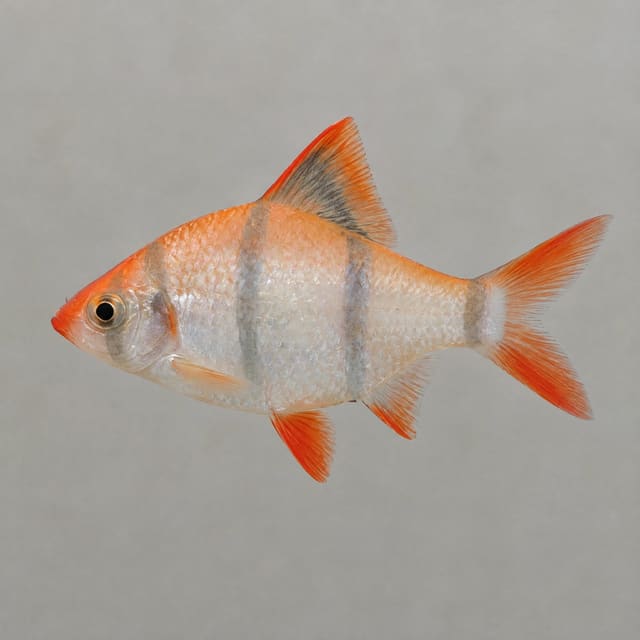
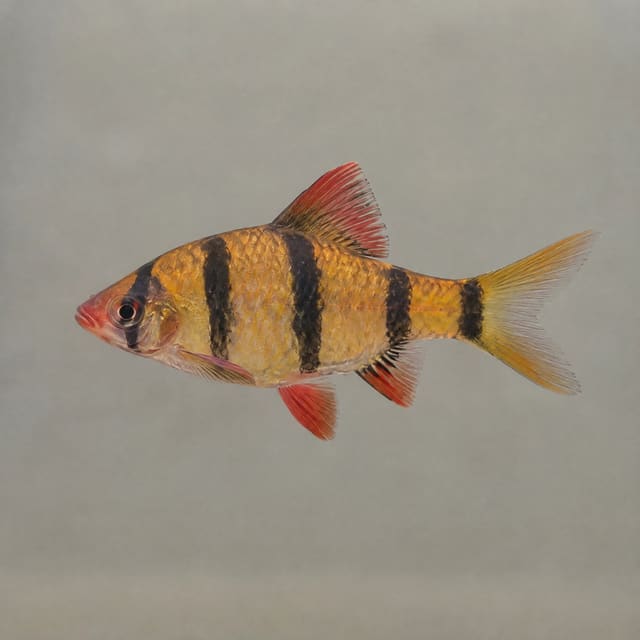
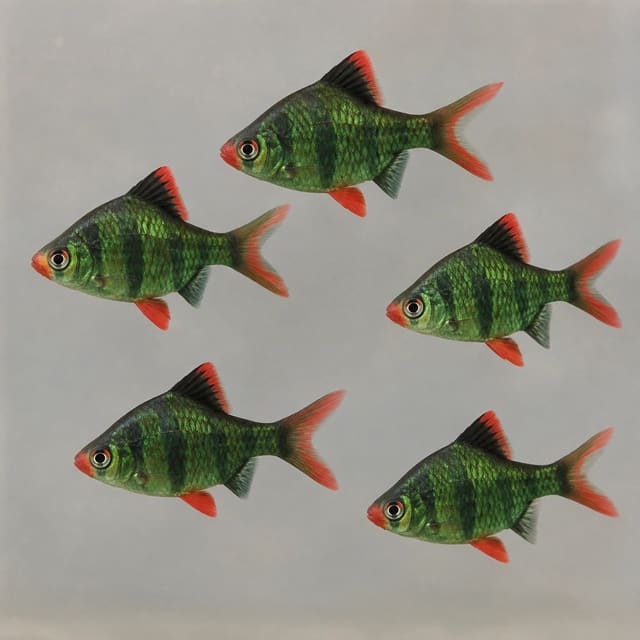
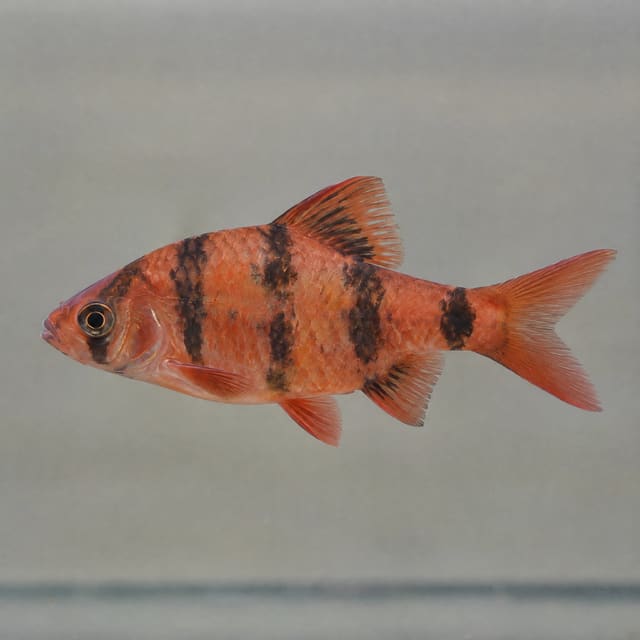
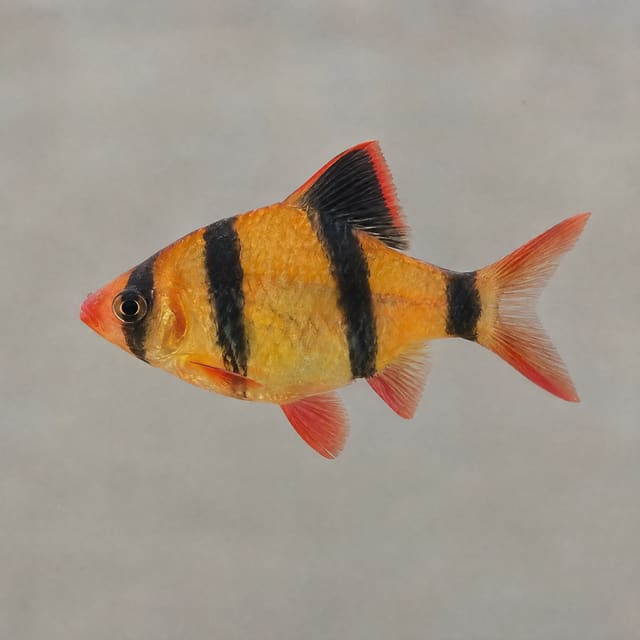
Tiger Barb (Puntigrus tetrazona)
23–27°C · pH 6–8 · 80L
£1.89
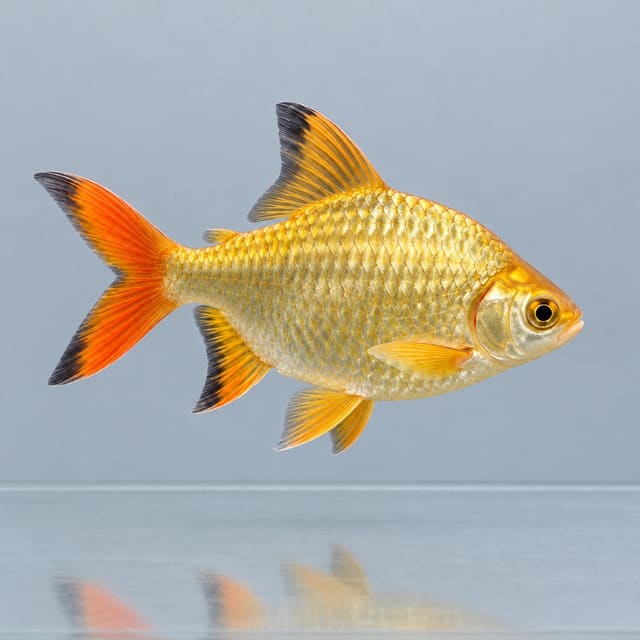
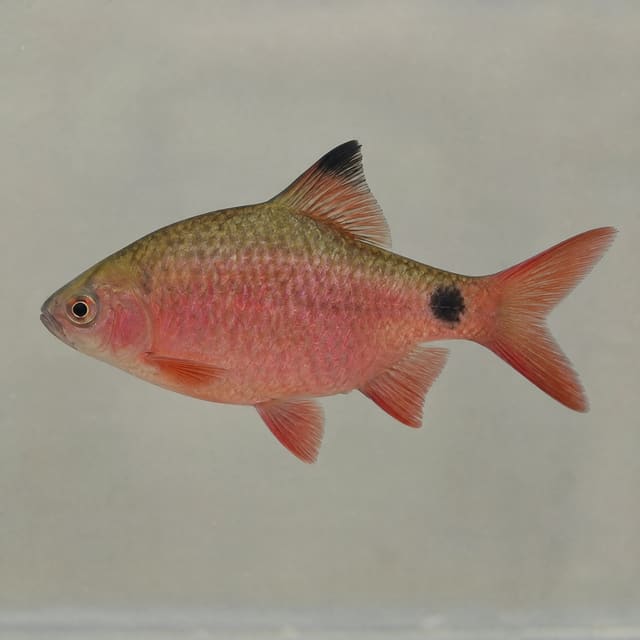
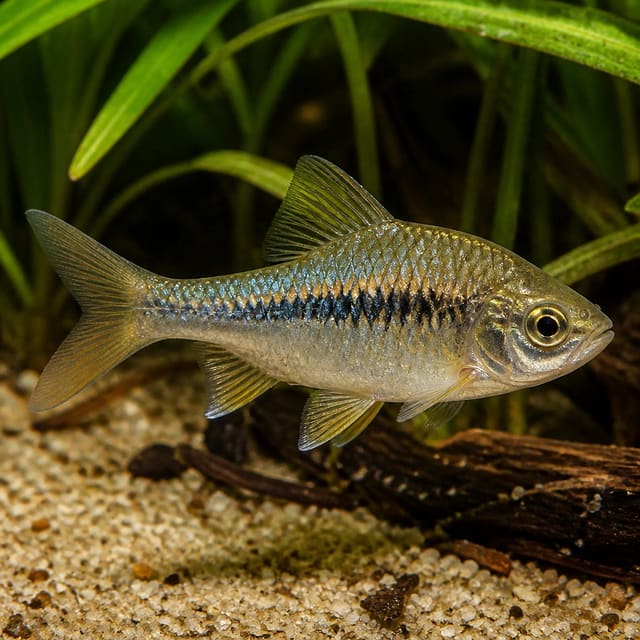
The Diamond Shark (Hypsibarbus wetmorei) is not a shark but a large, peaceful schooling barb from the rivers of mainland Southeast Asia, with big mirror-like scales and orange to red lower fins. It reaches about 25 cm standard length and needs a very large aquarium (240 × 60 cm base or more) at 22–26°C, kept in a school of six or more. Sold individually as one live fish.
Hypsibarbus wetmorei
Quantity discounts are pricing offers, not a group-size recommendation. Check the full care guidance and your existing animals before choosing a quantity.
The Diamond Shark (Hypsibarbus wetmorei) is not a shark but a large, peaceful schooling barb from the rivers of mainland Southeast Asia, with big mirror-like scales and orange to red lower fins. It reaches about 25 cm standard length and needs a very large aquarium (240 × 60 cm base or more) at 22–26°C, kept in a school of six or more. Sold individually as one live fish.
Read the full care guidance when planning conditions for your aquarium.
The Diamond Shark is a trade name for Hypsibarbus wetmorei, a large schooling barb from the rivers of mainland Southeast Asia. It is not a shark at all. It belongs to the carp and barb family, Cyprinidae, and the "shark" in its name comes from its tall, pointed dorsal fin, deeply forked tail and fast, open-water swimming. Its large, mirror-like scales give the "diamond" half of the name. You may also see this Diamond Shark fish sold as the Lemon Fin Barb, Lemon Fin Diamond Shark or Golden Belly Barb, and older books use Puntius wetmorei or Puntius daruphani.
Please plan for the adult before you buy. Seriously Fish gives a maximum of 25 cm standard length, which is body length without the tail, and FishBase records wild fish up to 46 cm total length and 1.4 kg. Seriously Fish rates the species difficult for one main reason: it needs an aquarium at least 2 m long. That is far larger than most home aquariums, and we would rather say so plainly than sell a fish you cannot house.
| Suits | Not suited to |
|---|---|
| A school of six or more adults | One or two fish kept on their own |
| An aquarium base of at least 240 × 60 cm (about 864 litres) | Any aquarium under 2 m long, even as a "temporary" home |
| Strong filtration, high oxygen and open swimming water | Still, crowded or poorly oxygenated water |
| Large, robust tank mates too big to swallow | Small fish, slow fish and timid fish |
| A river layout of rock, gravel and wood | A delicate planted display you want to keep intact |
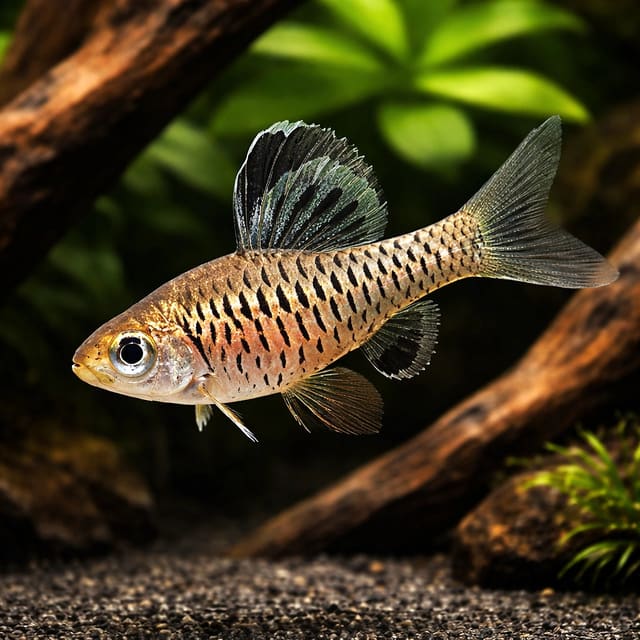
If your aquarium is smaller, you will find barbs that genuinely fit it in our barbs collection and the wider barb fish category. For other large, eye-catching species, compare the centrepiece fish we sell. Our photographs are representative images of this species, not the individual fish supplied, so colours can differ slightly from the live animal.
One purchase quantity supplies one live Diamond Shark Barb. This listing has a single Standard option because no size grade is given for it, and the sex is not specified. Whatever size arrives, it is a young fish, not an adult: plan for a fish of about 25 cm standard length.
Seriously Fish suggests that sexually mature females are probably deeper-bodied than males and may grow larger. Young fish cannot be sexed reliably, so plan the school without counting on a particular mix of males and females.
Two very similar large barbs reach UK shops under the same trade names. Seriously Fish separates them by fin colour: Hypsibarbus wetmorei has orange to red pectoral, pelvic and anal fins, while Hypsibarbus vernayi has yellow ones. It adds that yellow-finned fish sold as "lemon fin barbs" are probably H. vernayi, and that both species are traded regularly and may be collected together.
| Feature | H. wetmorei | H. vernayi |
|---|---|---|
| Pectoral, pelvic and anal fins | Orange to red | Yellow |
| Maximum size (Seriously Fish) | 25 cm standard length | 21.6 cm standard length |
| Minimum aquarium base | 240 × 60 cm | 240 × 60 cm |
| Temperature | 20–26°C | 20–26°C |
| pH | 6.0–8.0 | 6.0–8.0 |
The practical point is that the care plan does not change. Both are big, fast, schooling barbs that need the same very large aquarium and the same water. Fin colour can be pale in a young or newly delivered fish, so judge it after a few weeks of good feeding, and photograph the fish side-on if you want a record of which species you have.
Seriously Fish gives a minimum base of 240 × 60 cm, about 864 litres, and says the species needs a tank at least 2 m long. A tall aquarium with the same volume does not do the same job. These barbs cruise the full length of the tank all day, so length and front-to-back width matter more than height.
Some hobby and retail pages quote much smaller tanks for this fish. We follow the larger figure because it is the only one that allows for a group of adults, their constant swimming and their need for clean, oxygen-rich water. A juvenile in a 120 cm aquarium may look comfortable at first, but it keeps growing; fish do not simply stop growing to fit the tank they are in.
Our tank volume calculator converts your aquarium's dimensions to litres, and the stocking calculator helps you check whether an adult school and its tank mates fit together.
Seriously Fish describes wild Diamond Sharks in flowing rivers with plenty of bankside vegetation, from the lower Mekong in Laos, Thailand and Cambodia, through the Chao Phraya, Mae Klong and Tapi systems of Thailand, to northern Peninsular Malaysia as far south as the Pahang River. It does not occur in reservoirs or other standing water. FishBase places it from midwater to the bottom in medium-sized forest streams.
The sources differ on movement: Seriously Fish describes the species as seasonally migratory, while FishBase says it is not known to migrate but may move upstream when the water is high. Either way, this is a fish of moving water, and the aquarium should feel like a river rather than a pond.
| Area | Purpose |
|---|---|
| Long open lane along the front | Lets the school swim the full length together |
| Rocks and driftwood at the back and ends | Breaks sight lines and gives resting places out of the current |
| Smooth gravel or sand | Safe ground for foraging; wild fish eat shrimps and snails, which suggests they feed on the bottom |
| Heavy, stable hardscape | Nothing a 25 cm fish can knock over when it turns at speed |
Seriously Fish says décor matters less than water quality and open swimming space, and suggests a river-style set-up of variably sized rocks, gravel, water-worn boulders and driftwood. Bed rocks and wood firmly on the base glass, and keep them to the back and sides so the centre and front stay clear.
Be realistic about plants. In a TFH Magazine account of the lemon-fin barb, sold under the same trade names, the author found these barbs ate aquarium plants, even tough Anubias. If you want greenery, use sturdy plants you are prepared to replace, or keep the aquarium unplanted and rely on wood and rock. Fit a secure, close-fitting cover, as you would for any large, fast fish.
Seriously Fish gives 20–26°C and pH 6.0–8.0 and does not record a hardness range. FishBase gives 22–25°C, a pH up to 7.0 and hardness up to 15 dH. Where the two sources differ, the safest target is the overlap: a steady 22–25°C, with pH kept stable rather than pushed toward either end of the range.
UK tap water ranges from soft to very hard depending on where you live, so measure yours rather than guess. Our water matcher compares your readings with this fish's range, and the water chemistry guide explains what pH, general hardness and carbonate hardness mean for fish.
| Reading | Action point |
|---|---|
| Temperature | Keep a steady 22–25°C (Seriously Fish allows 20–26°C) |
| pH | Keep stable within 6.0–8.0 (Seriously Fish) |
| Hardness | Not recorded by Seriously Fish; FishBase gives up to 15 dH |
| Ammonia | Maintain at zero mg/l |
| Nitrite | Maintain at zero mg/l |
| Nitrate | No more than 20 mg/l above your normal tap-water level |
OATA, the UK ornamental fish trade association, sets the ammonia, nitrite and nitrate limits in its barb care sheet. Seriously Fish adds that this species is probably intolerant of organic waste and needs high levels of dissolved oxygen. A tank can sit perfectly inside the pH range and still be unsafe if waste has built up, so test both kinds of reading.
A school of large barbs eats a lot and produces a lot of waste. Use a large, well-established biological filter, which on an aquarium of this size usually means a sump or several large external filters, and add surface movement or a current so the water stays rich in oxygen. Leave quieter water behind rocks where fish can rest out of the flow.
Our guide to how aquarium filtration works explains the biological and mechanical stages, and the fish tank nitrogen cycle guide explains why a new aquarium must mature before fish go in. Stock a new large system gradually and retest after each addition.
In the wild, Diamond Sharks eat shrimps and snails. In the aquarium, Seriously Fish recommends a varied diet of good dried flakes or granules, live and frozen foods such as bloodworm (chironomid larvae), Daphnia and brine shrimp, and plenty of vegetable matter. A school of these barbs feeds vigorously, which is when slow or shy tank mates lose out.
Spread each meal along the length of the aquarium so the whole school feeds and no single fish takes most of it. Remove anything left uneaten after a few minutes, because rotting food adds to the waste load in a fish that is sensitive to it.
Before the fish arrives, confirm that the filter is mature, ammonia and nitrite read zero, the temperature is 22–25°C and the cover is secure. OATA recommends the floating-bag method: switch the aquarium lights off, float the sealed bag for 10 minutes so the temperatures match, then add small amounts of aquarium water to the bag over up to 20 minutes. Net the fish into the aquarium and throw the bag water away rather than adding it to the tank.
| Checkpoint | What to do |
|---|---|
| Before arrival | Test the water; check the cover, heater guard and filter flow |
| Arrival day | Acclimatise with the lights off and keep the room quiet |
| First feeds | Offer small portions and check that every fish reaches food |
| Every day | Compare swimming, breathing, colour and fin position with the day before |
| End of week | Retest ammonia and nitrite and carry out the normal maintenance |
Our step-by-step guide to acclimatising new fish covers the method in more detail. Choose a delivery day when you will be at home, and read our delivery and live arrival terms before you order.
Learn what normal looks like in the first month: where the school rests, how quickly it comes to food and how each fish holds its fins. Changes are then easier to spot early, when they are easiest to fix.
| If you see | Do this |
|---|---|
| Gasping at the surface or fast gill movement | Test ammonia, nitrite and temperature; increase surface movement |
| Clamped fins, flicking against décor or shimmying | Test the water and look closely for white spots or other parasites |
| Darker or paler colour than usual, or more hiding | Check for bullying, temperature changes and water quality |
| White spots, fluffy growths, lost scales or torn fins | Test the water and seek fish-health advice |
| One fish losing weight | Check that it reaches food; spread meals more widely |
| Damaged snouts or scrapes | Look for sharp décor and for panic swimming in a tank that is too small |
These warning signs follow OATA's barb care sheet. Do not diagnose a disease from one sign alone: similar behaviour can follow poor water, a temperature swing or bullying. Test first, write down the readings and recent changes, and act on the cause.
Seriously Fish describes the Diamond Shark as a schooling species, ideally kept in groups of half a dozen or more, and says it is not aggressive unless space is confined. OATA advises at least five for barbs in general and warns that barbs kept singly or in too small a group often become stressed. A single Diamond Shark kept as a "feature fish" is the wrong plan for this species.
Breeding in aquariums has not been reported, and Seriously Fish notes that most Hypsibarbus species are thought to be declining in the wild because of dam building and farming. FishBase lists H. wetmorei as Least Concern (assessed 2011).
If you cannot meet all three, choose a smaller barb instead. Trading one welfare problem for another, such as a full school in too small a tank, helps neither the fish nor you.
Seriously Fish warns that the Diamond Shark may eat small fish and can harass slow or timid tank mates. In TFH Magazine, the author describes the lemon-fin barb as completely peaceful towards anything too big to eat, and as a good dither fish for many medium-sized cichlids. Choose companions that are large, quick and comfortable in moving water.
| Suits | Avoid |
|---|---|
| Other large schooling cyprinids such as the Tinfoil Barb, Albino Tinfoil Barb and Bala Shark | Small tetras, rasboras, danios and dwarf shrimp, which can be eaten |
| Robust medium-sized cichlids whose water needs overlap | Slow, long-finned or timid fish that lose out at feeding time |
| Large, peaceful bottom-dwelling catfish | Coldwater fish and fish that need very soft, very warm water |
| Fish that like 22–25°C and moving water | Delicate planted-tank species that need calm water |
Remember that tinfoil barbs and bala sharks are themselves large: OATA gives at least 400 litres for larger barbs such as the tinfoil barb, and each extra school needs its own share of the 240 cm length. You can compare their genus in our Barbonymus barbs category, and check any mix with our tank mates tool before you buy.
No. It is a large barb, Hypsibarbus wetmorei, in the carp and barb family Cyprinidae. "Shark" is only part of the trade name and refers to its tall dorsal fin, forked tail and fast, open-water swimming.
Seriously Fish gives a maximum of 25 cm standard length, measured without the tail. FishBase records wild fish up to 46 cm total length and 1.4 kg. Plan for a fish of at least 25 cm whatever size you buy.
Seriously Fish gives a minimum base of 240 × 60 cm, about 864 litres, and says it needs a tank at least 2 m long. It is not suitable for an average community aquarium.
Keep a school of six or more. Seriously Fish recommends half a dozen or more, and OATA advises at least five for barbs in general. Every purchase quantity supplies one fish, so order the full group only when the aquarium can hold six adults.
Seriously Fish gives 20–26°C and pH 6.0–8.0; FishBase gives 22–25°C. Aim for a steady 22–25°C, keep ammonia and nitrite at zero, nitrate no more than 20 mg/l above your tap water, and keep the water well oxygenated.
It may eat any fish small enough to swallow, and Seriously Fish warns it can harass slow or timid fish. A TFH Magazine account of the lemon-fin barb, sold under the same names, reports that it eats aquarium plants, even Anubias.
The names overlap. Seriously Fish says H. wetmorei has orange to red lower fins, while yellow-finned fish sold as lemon fin barbs are probably the very similar H. vernayi. Both need the same very large aquarium.
No. It is a tropical river fish that needs 20–26°C. The genus is on the government list of fish kept under a general licence that allows indoor aquaria only, in England and Wales. Never put it in a garden pond or release it.
No reviews for this item yet. Bought one? Honest reviews only, good or bad.
What customers say about ordering from us
Easy website plenty of info on fish your buying great to pick a time slot
TRACEY DURRANT · 7 Oct 2026
Got some lovely fish thank you
Kevin Mackie · 7 Oct 2026
Reviews of our shop, collected by Judge.me, an independent third-party review collector. Newest first.
Moved by UK carriers licensed to handle live animals
Hand-packed with oxygen bags, poly box, heat pack
Email photos the same day; an optional unboxing video helps us review problems faster — claim terms apply
Klarna & PayPal Pay in 3 at checkout