Moderate
Tinfoil Barb (Barbonymus schwanefeldii)
20–28°C · pH 6–8 · 756L
£8.99
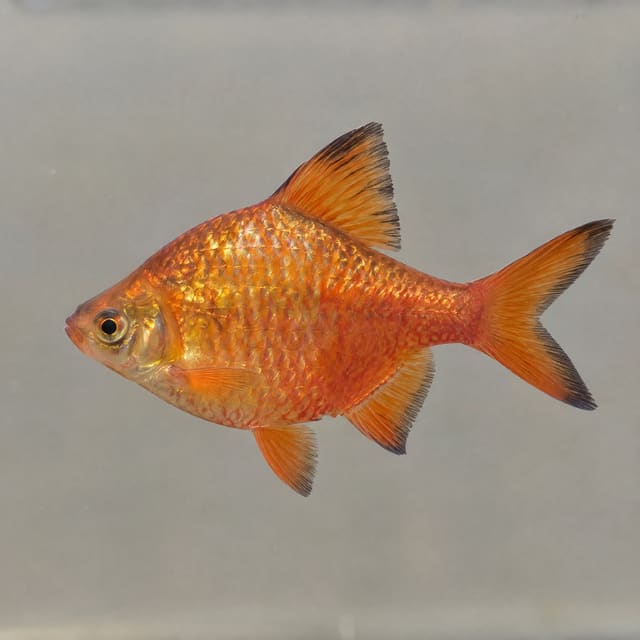
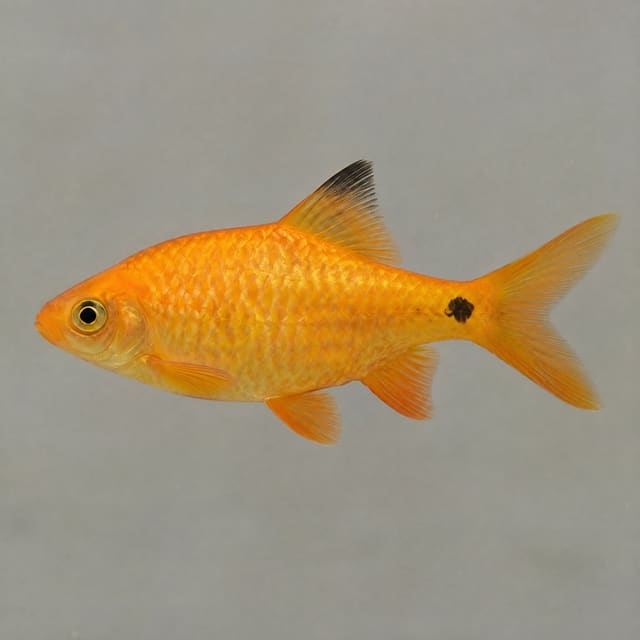
The Gold Tinfoil Barb is a selectively bred golden form of the tinfoil barb, Barbonymus schwanefeldii, a peaceful but very large schooling cyprinid from Southeast Asia. It is sold at 4–5 cm but grows to about 35 cm, so it needs an aquarium with a base of at least 210 × 60 cm and a group of six or more. One live fish per purchase.
Barbonymus schwanefeldii
Quantity discounts are pricing offers, not a group-size recommendation. Check the full care guidance and your existing animals before choosing a quantity.
The Gold Tinfoil Barb is a selectively bred golden form of the tinfoil barb, Barbonymus schwanefeldii, a peaceful but very large schooling cyprinid from Southeast Asia. It is sold at 4–5 cm but grows to about 35 cm, so it needs an aquarium with a base of at least 210 × 60 cm and a group of six or more. One live fish per purchase.
Read the full care guidance when planning conditions for your aquarium.
The Gold Tinfoil Barb is a selectively bred golden form of the tinfoil barb, Barbonymus schwanefeldii, one of the largest barbs in the aquarium trade. It is sold here at 4–5 cm, but Seriously Fish gives a maximum of 355 mm standard length, measured without the tail, and FishBase gives 35 cm. That is roughly seven times the length of the fish you receive. Please read the space section below before you buy: most home aquariums are far too small for an adult school.
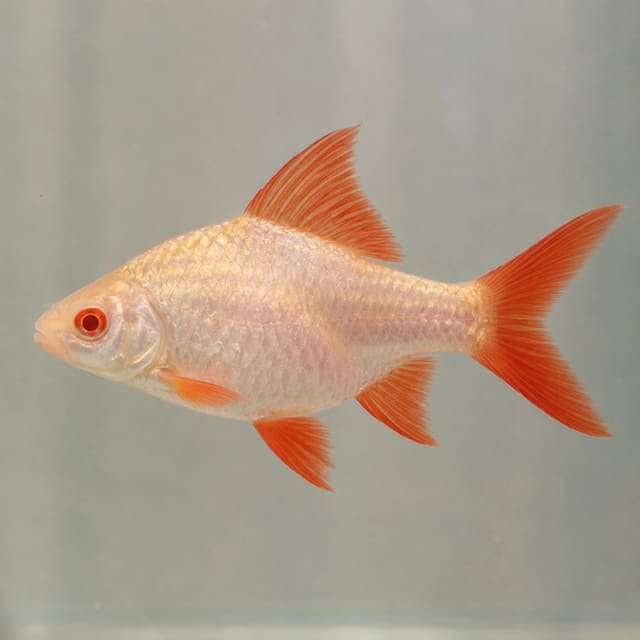
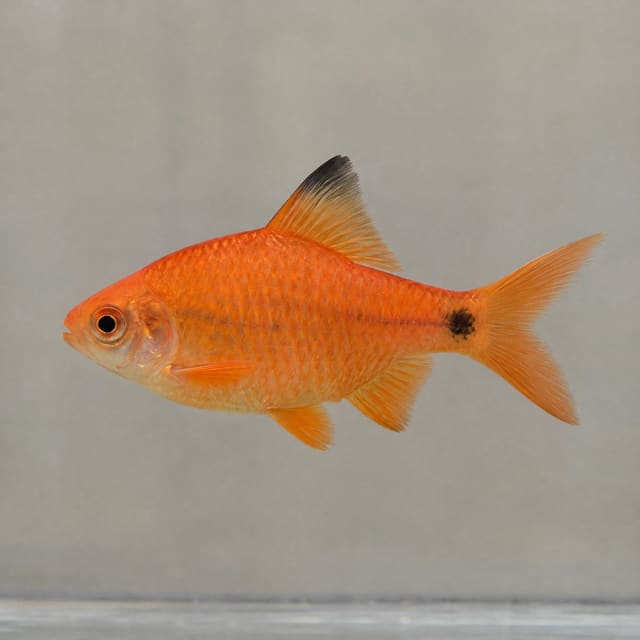
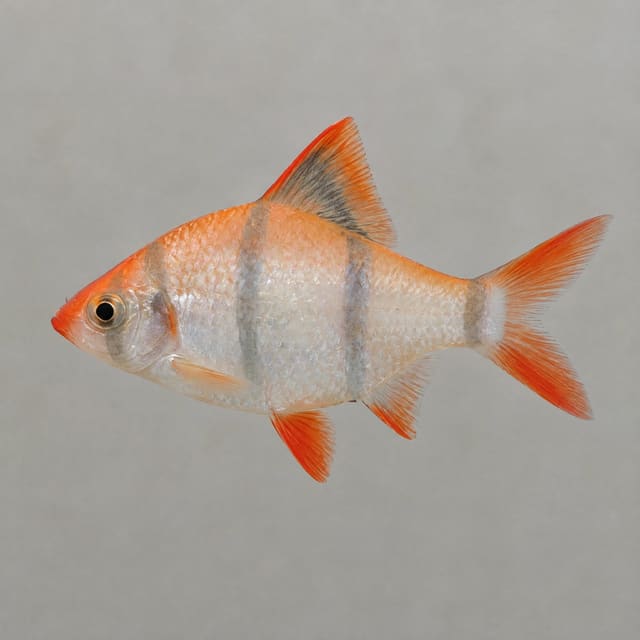
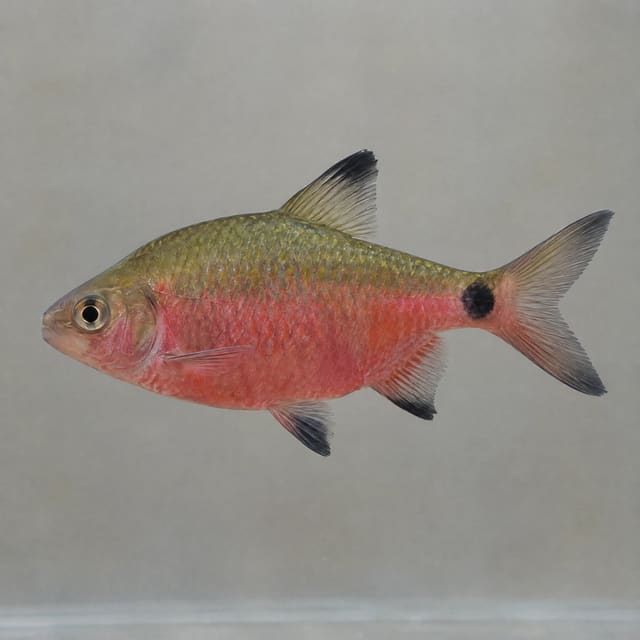
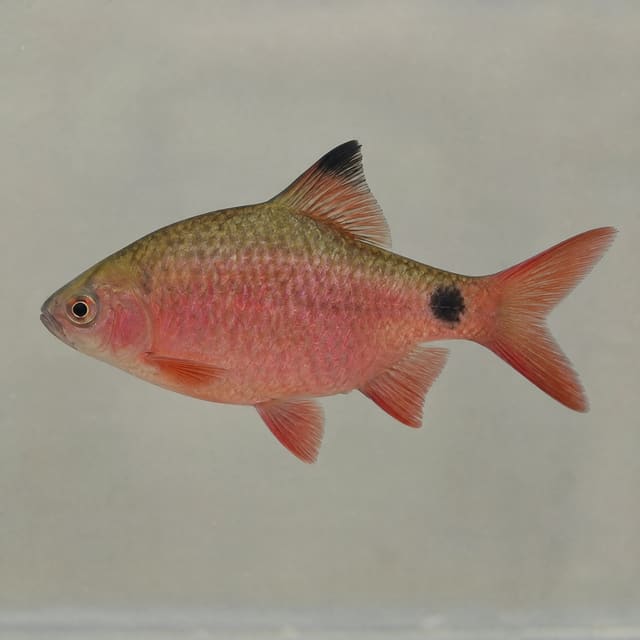
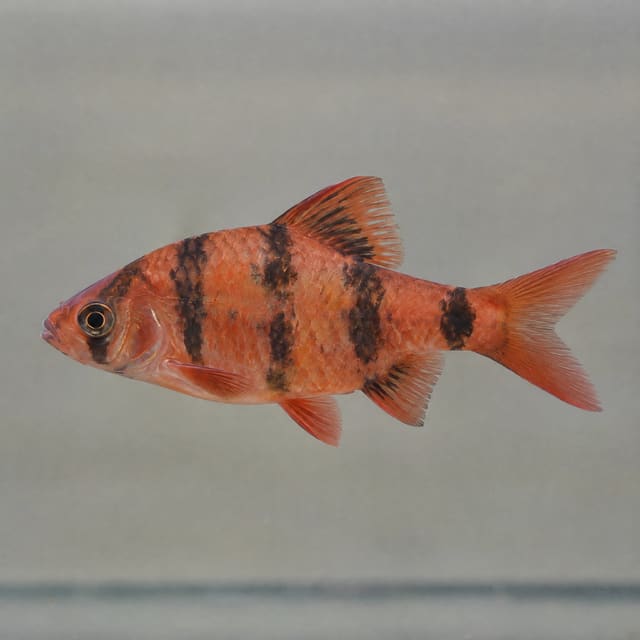
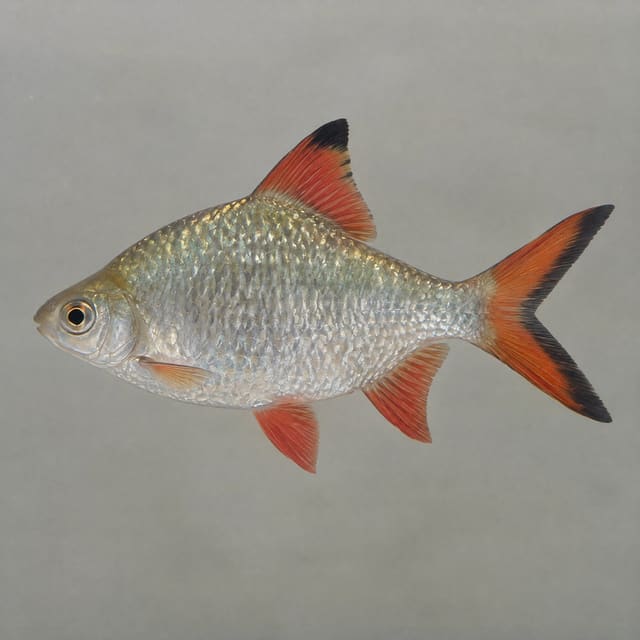
The species lives in the Mekong and Chao Phraya basins, the Malay Peninsula, Sumatra and Borneo. Seriously Fish describes its habitat as medium-sized river channels that flood in the wet season and the surrounding floodplains, and increasingly man-made canals and lakes; FishBase adds that adults use medium to large rivers and move into flooded fields. Wild fish are silver with red fins, a black blotch at the tip of the dorsal fin and a black stripe along the edge of each tail lobe. Seriously Fish mentions selectively bred "golden" strains, as well as leucistic and albino forms, all the same species with the same care.
| Suits | Not suited to |
|---|---|
| A school of six or more | Keeping one or two fish |
| An aquarium with a base of at least 210 × 60 cm | A standard community aquarium |
| Large, robust tank mates | Small fish, which it may eat |
| Very strong filtration and a heavy lid | An open-topped or lightly filtered tank |
The name is spelled two ways. Bleeker's original spelling was emended by Kottelat in 2013, so both schwanefeldii and schwanenfeldii appear in books and on labels, and older sources may file it under Puntius, Barbodes or Barbus.
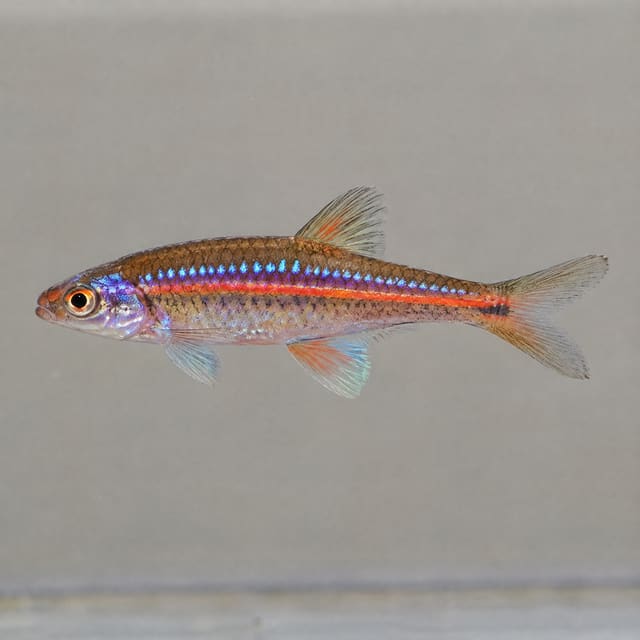
One purchase quantity supplies one live Gold Tinfoil Barb of 4–5 cm. Sex is not specified; Seriously Fish notes that mature females are usually deeper-bodied than males, especially when full of eggs, but young fish look the same. Gold tone and fin colour vary from fish to fish, and the gallery images are representative, prepared from a reference photograph, rather than photographs of the exact fish supplied.
Golden tinfoil barbs are a selectively bred colour strain, not a dyed fish. Seriously Fish describes the artificial dyeing of fish as harmful.
Tinfoil barbs are also confused with a close relative. Seriously Fish notes that both B. schwanefeldii and the less common B. altus are sold as "tinfoil barb"; the black stripe along each tail lobe marks B. schwanefeldii, while adult B. altus tend to be more golden or bronze.
Check our current delivery and Live Arrival Guarantee policy before ordering.
Seriously Fish gives a minimum base of 210 × 60 cm, about 756 litres, for this species and rates it difficult for that reason alone: it needs a tank at least two metres long. FishBase gives a common length of 20 cm and a maximum of 35 cm standard length. A school of fast, deep-bodied fish this size needs a long, open swimming lane, not just a large number of litres.
Seriously Fish gives a typical sale size of 50–75 mm, so this fish is still very young. Do not buy it for a smaller tank with a plan to upgrade later unless the final aquarium already exists or is definitely coming; tinfoil barbs grow quickly when well fed. Our tank volume calculator and stocking calculator help you check the numbers.
If your aquarium cannot meet this, choose a smaller species from our barbs or the wider barbs category. For a large centrepiece in a smaller tank, browse our centrepiece fish and check each one's adult size.
Seriously Fish says decor matters less than water quality and open swimming space, and healthy fish have been kept in bare set-ups. Give the school a long, clear lane through the middle, with smooth rocks and driftwood at the ends and back. FishBase records aquatic plants and filamentous algae as a major part of the wild diet, so expect soft plants to be eaten; use tough plants attached to wood, or none.
Tinfoil barbs are skittish and have a powerful leap, so Seriously Fish calls for a heavy, tight-fitting lid. Weigh it down or clip it shut, and close the gaps around pipes and cables.
| Area | Purpose |
|---|---|
| Long open central lane | Fast schooling and feeding |
| Rocks and wood at the ends | Turning points and visual breaks |
| Sand or smooth gravel | Easy cleaning under a heavy waste load |
| Weighted lid | Stops a startled fish leaping out |
Fix rocks firmly so that a large fish cannot knock them into the glass, and avoid sharp-edged decor that could injure a fish that bolts when startled.
The main sources give slightly different ranges. Keeping within the band where Seriously Fish and OATA overlap suits the fish, and FishBase's narrower wild figures sit inside it.
| Value | Seriously Fish | OATA (barbs) | FishBase (wild) | Target |
|---|---|---|---|---|
| Temperature | 20–28°C | 20–27°C | 22–25°C | 20–27°C, kept steady |
| pH | 6.0–8.0 | 6.0–7.5 | 6.5–7.0 | 6.0–7.5 |
| General hardness | 2–15 dGH | 4–12 dGH | up to 10 dH | 4–12 dGH |
Most UK tap water can be brought into this range with a dechlorinator alone, but hardness differs a lot between regions, so check your water company's figures. Our water chemistry guide explains each reading.
| Reading | Target |
|---|---|
| Ammonia | Zero mg/l |
| Nitrite | Zero mg/l |
| Nitrate | No more than 20 mg/l above your tap water |
These limits come from OATA's barb care sheet. Large, hungry fish produce a lot of waste, so test every week.
Seriously Fish recommends one or two very large external-style filters to provide oxygen, flow and plenty of surface for filter bacteria. For a 756 litre aquarium, its equipment guide works out two filters rated about 1,510–1,890 litres per hour each, a turnover of four to five times the volume per hour, and about 125–200 W of heating split across three heaters for a room at around 20°C. Our filtration guide explains how to set up mechanical and biological filtration.
Cleaning the filters on different weeks keeps enough bacteria in the system to process the waste of a large school.
FishBase describes the tinfoil barb as mainly herbivorous in the wild, eating aquatic plants and filamentous algae with occasional insects, small fish, worms and crustaceans. Seriously Fish calls it omnivorous and opportunistic but mainly herbivorous, and OATA notes that tinfoil barbs need vegetable matter in their diet.
Feed a good-quality dried food as a staple, with live and frozen foods and plenty of vegetables such as shelled peas, blanched courgette, spinach and chopped fruit. Larger fish can also take chopped earthworm, prawn or mussel. Seriously Fish warns against overfeeding.
Confirm a mature filter, zero ammonia and nitrite, and a temperature within 20–27°C before the fish arrive. Use OATA's floating bag method: switch off the lights, float the bag for about 10 minutes, add small amounts of tank water over up to 20 minutes, then release the fish and keep the bag water out of the tank. Keep the lid on and the room quiet, because a startled tinfoil barb can leap.
| Checkpoint | What to do |
|---|---|
| Before introduction | Test the water and check the lid is secure |
| First feeding | Offer a small portion including some vegetable food |
| Every day | Watch that the school swims together and every fish feeds |
| After stocking | Retest ammonia and nitrite |
| End of week | Full test and at least a 25% water change |
A settled school swims together in the open, feeds eagerly and shows bright fins. Learn what normal looks like so that changes stand out early.
| If you see | Do this |
|---|---|
| Fish dashing into the glass or jumping at the lid | Check for disturbance, add cover at the ends and review school size |
| Hanging at the surface or fast breathing | Test ammonia, nitrite and temperature at once and increase aeration |
| White spots, fluffy growths or damaged fins | Test the water and seek fish-health advice |
| One fish chasing the others | Check that the school has at least six fish and enough space |
| Reduced appetite | Check water readings, temperature and the diet |
Record readings and observations before treating anything, and contact us with them if a problem continues.
Seriously Fish describes the tinfoil barb as not usually aggressive, but it will eat small fish and can stress slow or timid tank mates. It suits only very large aquariums with robust fish of similar size, and Seriously Fish names cichlids, catfish, other cyprinids and characins as suitable groups.
| Suits | Avoid |
|---|---|
| Other large, active cyprinids | Small fish that fit in its mouth |
| Large characins such as silver dollars | Slow, timid or long-finned fish |
| Robust catfish and large loaches | Delicate soft-leaved plants |
From our range, it can school with the silver Tinfoil Barb and the Albino Tinfoil Barb, which are the same species. In a big enough aquarium, consider the Bala Shark and the Silver Dollar in open water and a group of Clown Loaches on the bottom. See all our Barbonymus barbs, and check every mix with our tank mates tool.
Seriously Fish knows of no breeding in private aquariums. The species is farmed in its native countries and elsewhere, and in Hawaii spawning is induced with hormones. It is an egg-scatterer with no parental care, and a single female can release thousands of eggs at once. FishBase lists it as Least Concern on the IUCN Red List (assessed 2019).
Very big. Seriously Fish gives a maximum of 355 mm standard length and FishBase 35 cm, measured without the tail. The 4–5 cm fish you receive will grow far beyond the size of most home aquariums.
Seriously Fish gives a minimum base of 210 × 60 cm, about 756 litres, for a group. If your aquarium is shorter than about two metres, choose a smaller barb instead.
No. It is a selectively bred golden strain of the same species, Barbonymus schwanefeldii, and needs exactly the same care as the silver and albino forms.
At least six. Seriously Fish warns that tinfoil barbs kept in smaller numbers may become skittish or aggressive.
Probably. FishBase records a mainly plant-based wild diet, and Seriously Fish warns that tinfoil barbs will eat small fish, so keep only large, robust tank mates and tough or no plants.
Keep it within 20–27°C, pH 6.0–7.5 and 4–12 dGH, where the Seriously Fish and OATA ranges overlap, with zero ammonia and nitrite and very strong filtration.
Plenty of vegetable matter such as shelled peas, blanched courgette and spinach, alongside good dried foods and live or frozen foods. Feed once a day and avoid overfeeding.
Seriously Fish knows of no breeding in private aquariums. It is an egg-scatterer bred in fish farms, so plan to keep your group for its whole life.
No reviews for this item yet. Bought one? Honest reviews only, good or bad.
What customers say about ordering from us
Easy website plenty of info on fish your buying great to pick a time slot
TRACEY DURRANT · 7 Oct 2026
Got some lovely fish thank you
Kevin Mackie · 7 Oct 2026
Reviews of our shop, collected by Judge.me, an independent third-party review collector. Newest first.
Moved by UK carriers licensed to handle live animals
Hand-packed with oxygen bags, poly box, heat pack
Email photos the same day; an optional unboxing video helps us review problems faster — claim terms apply
Klarna & PayPal Pay in 3 at checkout