Moderate
Least Rasbora (Boraras urophthalmoides)
22–28°C · pH 5–7.5 · 40L
£2.99

Ten chili rasboras (Boraras brigittae), a ready-made shoal of one of the smallest fish in the hobby: adults are usually about 2 cm. They come from soft, acidic blackwater swamps in Borneo and need a mature, densely planted tank with gentle flow, dim light and very small foods.
Adult size is the maximum length this species reaches at full maturity (scientific sources). The livestock you receive will be younger and smaller. Product-photo provenance and any image-specific limitations are stated on the listing.
Boraras brigittae
Ten chili rasboras (Boraras brigittae), a ready-made shoal of one of the smallest fish in the hobby: adults are usually about 2 cm. They come from soft, acidic blackwater swamps in Borneo and need a mature, densely planted tank with gentle flow, dim light and very small foods.
Adult size is the maximum length this species reaches at full maturity (scientific sources). The livestock you receive will be younger and smaller. Product-photo provenance and any image-specific limitations are stated on the listing.
Maintain these water conditions for optimal health and vibrant colors
This listing is for ten chili rasboras, Boraras brigittae, sent together as one shoal. You may also see the name spelled chilli rasbora, and the species is just as well known as the mosquito rasbora; we also list it singly as the Mosquito Rasbora. Whichever name you use, it is the same tiny red fish from Borneo, and ten of them is enough to start a proper group in a small, well-planted aquarium.
Our stock records give the supplied size as roughly 1 to 1.5 cm. That is the size at dispatch, not the adult size, although with a fish this small the gap between the two is not large. The pack is ten fish. It is not sold as a set number of males and females, so expect a natural mix rather than a guaranteed ratio.
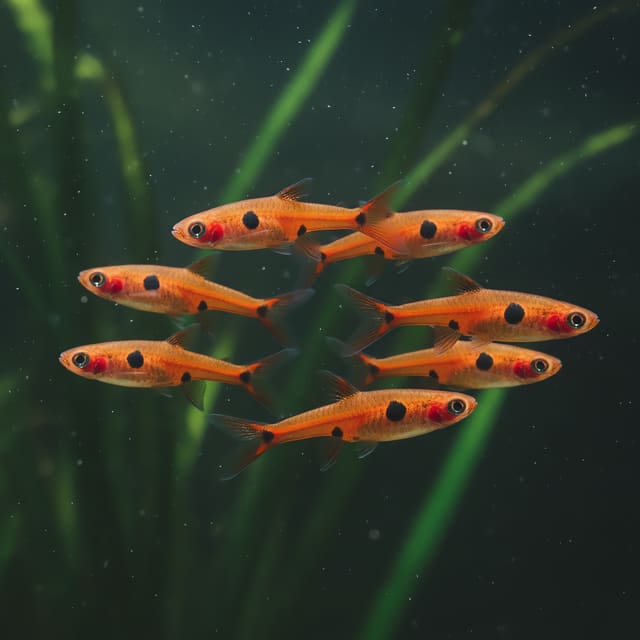
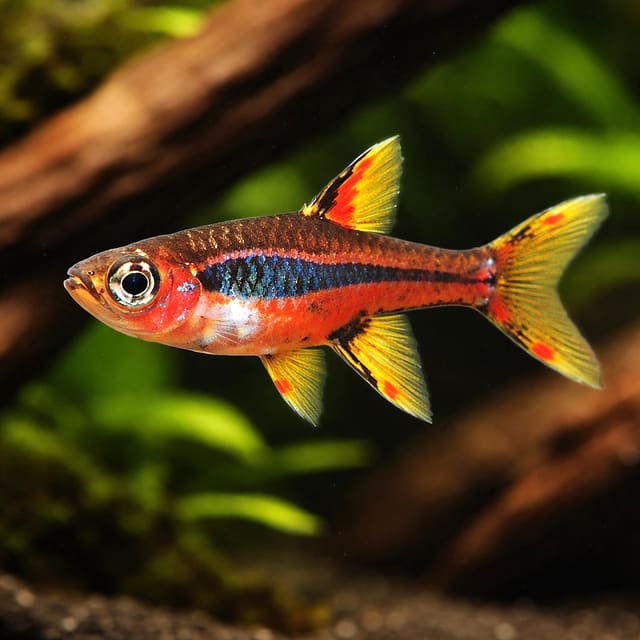
Wikipedia describes the body colour as anything from a light, rusty orange-red to a vibrant red, with a distinctive black stripe running along the lateral line. Males are smaller and more brightly coloured than females, and Seriously Fish adds that dominant males often show the most intense colour of all. Females are rounder in the belly and paler. Seriously Fish links the best colour to a varied diet of small live and frozen foods, and to keeping a proper group in which the males compete and show off, which is one reason the set-up and feeding advice further down matters so much.
The photograph on this page shows a single fish with a red-orange body, orange-tipped fins and a shimmering green and blue sheen along the side. Use the written description above as the guide to what your own fish will look like.
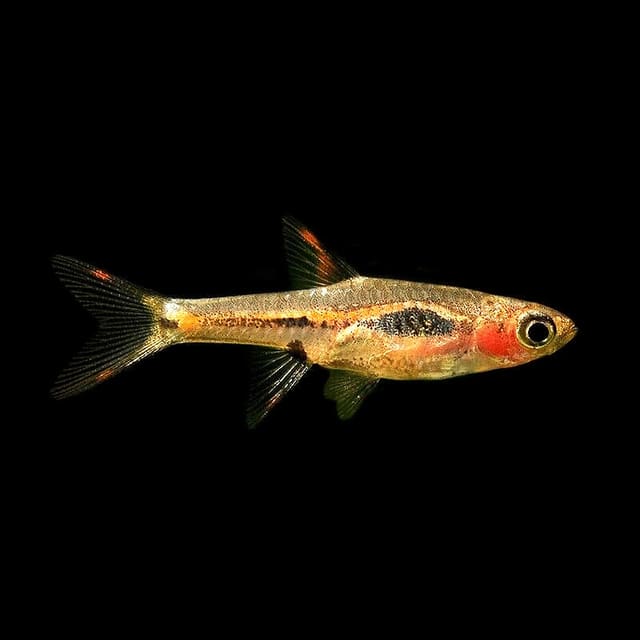
Seriously Fish points out that chili rasboras are often confused with two close relatives. The least rasbora, Boraras urophthalmoides, is smaller, duller and has a distinct dark blotch on the caudal peduncle, the narrow part of the body just before the tail. B. brigittae is larger as an adult and lacks that blotch. Boraras merah is also similar, but much of its body lacks colour, with the red concentrated around the dark body markings rather than spread over the whole fish.
The species was described by Dieter Vogt in 1978 and, according to Wikipedia, named in honour of his wife, Brigitte. Older names you may meet in books are Rasbora urophthalma brigittae and Rasbora brigittae; the species now sits in the genus Boraras. FishBase and Wikipedia now place it in the family Danionidae; Seriously Fish still files it under Cyprinidae, the older, broader grouping. The accepted name is Boraras brigittae (Vogt, 1978).
This is one of the smallest fish most keepers will ever own, so size deserves a closer look. The sources agree on the ordinary adult and differ only on the record. Seriously Fish gives a maximum standard length of 20 mm, measured from the snout to the base of the tail. FishBase lists a common length of 1.8 cm standard length. Wikipedia puts the usual size at 10 to 20 mm. Plan, then, for adults of about 2 cm.
The records are larger. Wikipedia notes that the largest known specimen measured 3.1 cm in total length, tail included, and FishBase gives a maximum of 3.5 cm total length. Those are exceptional fish, not what you should expect your ten to reach.
A 2 cm adult changes almost every decision you make about the aquarium:
The upside of a fish this small is that a group of ten fills a modest aquarium with movement and colour without overloading it. Seriously Fish's aquarium advice is built around a group, not a single fish, and that is how this pack is meant to be kept.
Chili rasboras are endemic to south-western Borneo, in Indonesia. Seriously Fish gives the type locality as Bandjarmasin, now usually written Banjarmasin, in South Kalimantan province, with the range running westward as far as the Jelai Bila river basin near Sukamara. Wikipedia describes the species as endemic to the swamps of south-west Borneo.
The habitat is distinctive. Seriously Fish describes black water streams and pools associated with ancient forest peat swamps. The water is stained brown by tannins and other chemicals released by decomposing plant matter, it is very soft, with negligible hardness, and it is acidic, with a pH as low as 4.0. The bottom is covered with fallen leaves and branches, and the vegetation is dense. FishBase describes the species as benthopelagic, a term for fish that live and feed near the bottom as well as in open water, and notes that it lives in schools.
That picture explains most of the care advice for this fish. Dim light, shelter among plants and leaves, gentle water movement and soft, slightly acidic water are not luxuries for a chili rasbora. They are the conditions it comes from, and Wikipedia notes that the species prefers an aquarium set up to resemble its natural habitat.
Seriously Fish notes that the peat swamp forests where chili rasboras live are threatened by rubber and palm oil plantations, building developments and other human activities. The IUCN lists the species as Data Deficient (assessed in 2019), which means there is not enough information to judge how threatened it is, rather than meaning it is safe. FishBase records that it is of no interest to fisheries.
For a keeper in the UK, the practical point is simple. These are small fish from a fragile place, and they repay a little extra care in the set-up and the routine. A well-planned nano tank that suits them is the best way to enjoy them for years.
Seriously Fish recommends an aquarium with base dimensions of at least 45 × 30 cm for a group, because although the fish is small it still needs space to swim, and dominant males form temporary territories when they spawn. OATA's care sheet for rasboras recommends at least 45 litres for a shoal of the smallest species. Those two figures fit together: a 45 × 30 cm tank with a typical height of around 30 to 35 cm holds roughly 40 to 47 litres. For ten chili rasboras we would treat about 45 litres as the starting point and see anything larger as a bonus, especially if you plan to add other small fish or shrimps.
Seriously Fish describes a densely planted set-up with floating plants, driftwood and leaf litter as ideal, with fairly dim lighting to match the shaded water of the peat swamps. In practice that means:
OATA advises gravel or sand with live plants for cover. Cover is the important part: it gives a timid fish somewhere to retreat, and the set-up Seriously Fish recommends is built around it.
Seriously Fish says filtration should be gentle, as the fish is sensitive to strong currents. OATA reminds keepers that a filter is always essential, so the aim is a filter that cleans the water well while barely moving it. A sponge filter, or a small external or internal filter with its outflow turned towards the glass or spread through a spray bar, suits this kind of tank. Cover the intake with fine sponge, as mentioned above.
Keep the lighting moderate to dim. If you grow demanding plants under strong light, let the floating plants shade at least part of the surface so the fish can choose a darker area. A heater is required to hold a suitable temperature all year round, and OATA describes a secure lid as optional but recommended.
This is the most important rule in this listing. Seriously Fish warns against introducing any Boraras species to a biologically immature aquarium, as they can be susceptible to swings in water chemistry. The tank should be fully cycled, with stable test results over several weeks, before ten chili rasboras go in.
A new aquarium has no established colony of the filter bacteria that turn fish waste into less harmful compounds. Ammonia from waste is converted to nitrite and then to nitrate, and it takes weeks for those bacteria to build up. Until they have, ammonia and nitrite can appear in the water, and OATA's target for both is zero. A tank is ready for chili rasboras when it reads zero ammonia and zero nitrite week after week, with some nitrate showing that the cycle is complete, and when pH and hardness hold steady between water changes. Growing plants help, as they use some of the nitrate. If you are setting up a tank especially for this pack, build in that waiting time before you order, and use it to get the plants growing and the leaf litter settled.
The numbers below come from three sources, and they don't all say the same thing, so here is each one with an explanation of how we use it.
| Parameter | Range | Source |
|---|---|---|
| Temperature | 25 to 28°C | FishBase |
| Temperature (wider tolerance) | 20 to 28°C | Seriously Fish |
| pH | 4.0 to 7.0 | Seriously Fish |
| pH (narrower) | 6.5 to 7.0 | FishBase |
| General hardness | 1 to 10 dGH | Seriously Fish (FishBase: up to 10 dH) |
| Ammonia and nitrite | 0 mg per litre | OATA |
| Nitrate | no more than 20 mg per litre above your tap water | OATA |
FishBase gives 25 to 28°C for this tropical fish, while Seriously Fish lists a wider 20 to 28°C. We use FishBase's range as the target and read the lower end of the Seriously Fish range as tolerance rather than a goal. A steady temperature within 25 to 28°C, held by a reliable heater, is what to aim for.
In the wild the water is very soft and acidic, with a pH that can fall as low as 4.0. Seriously Fish gives 4.0 to 7.0 for the aquarium. FishBase's 6.5 to 7.0 sits at the top of that span. Both agree on soft water, with hardness up to about 10 degrees. You do not need to chase the extreme acidity of a peat swamp to keep chili rasboras well; what matters is soft water that stays steady, on the acidic side of neutral rather than the alkaline side.
OATA's general rasbora care sheet allows a wider pH of 6.5 to 8.0 and hardness of 4 to 12 dH, because it covers the whole group, including larger and more adaptable species. For Boraras, the softer, more acidic end is the one to aim for.
If your tap water is hard, the usual approach is to mix it with reverse osmosis or other soft water until hardness falls into range. Leaf litter and driftwood add tannins that can nudge pH downwards over time. Whatever method you use, make changes slowly and keep new water close to the tank's existing chemistry, so each water change does not swing pH or hardness.
OATA's targets are zero ammonia, zero nitrite and nitrate no more than 20 mg per litre above the level in your tap water. In a small aquarium those numbers can change quickly, which is why the weekly routine below matters.
In the wild, chili rasboras are micropredators. Wikipedia describes a diet of small insects, worms, crustaceans and other zooplankton, and Seriously Fish says much the same, noting that it is likely to feed in the way of other Boraras species. These are tiny prey animals, and the aquarium diet should copy that as closely as practical.
Seriously Fish says chili rasboras will accept dried foods of a suitable size, but should not be fed on them alone. Its recommendation is daily meals of small live and frozen foods such as Daphnia and Artemia (brine shrimp), along with good-quality flakes and granules. Wikipedia lists pellets, frozen food, flakes, young brine shrimp and worms. A good routine combines the two:
Size is the thing to watch. A food that looks small to you may be too big for a fish of 2 cm. If the rasboras take a piece, spit it out and try again, it is too large. Rub flake between your fingers until it is close to powder, and choose frozen foods that are marketed as small or nano sizes.
Seriously Fish recommends daily meals, and OATA's rasbora care sheet says to feed only what the fish can eat within a few minutes. In a small aquarium, uneaten food quickly turns into ammonia and nitrate, so err on the side of too little. One or two small feeds a day, each finished within a couple of minutes, is plenty. A light feeding routine also helps keep algae down in a planted nano tank.
Chili rasboras are timid feeders and easily outcompeted, so think about where the food goes. Feed at the front of the tank in the open area, away from the strongest flow, so the food drifts slowly through the shoal rather than being blown into the plants. If you keep shrimps or other small fish alongside them, watch the first few feeds to make sure the rasboras are getting their share.
Seriously Fish notes that a varied diet of live and frozen foods results in the best colour and encourages the fish to come into breeding condition. If your group looks pale, a better diet is one of the first things to try, alongside checking the water and the light.
Ask whether chili rasboras are schooling fish and the answer from the sources is yes. FishBase notes that the species lives in schools, and Seriously Fish describes it as a schooling species by nature that really should be kept in a group of at least 8 to 10. A group of ten meets that recommendation, which is why this pack exists.
Seriously Fish gives three reasons for keeping a proper group. The fish become less nervous, the display looks more natural and effective, and the males show their best colours and some interesting behaviour as they compete with one another. Watch a settled group for a while and you will see males break off to display to one another, which is the competition Seriously Fish describes.
OATA's general rasbora advice is a minimum of five, with larger groups preferred, because rasboras are social fish that are prone to stress when kept singly or in small numbers. For Boraras, the higher figure from Seriously Fish is the one to follow, and you can add more over time if the tank allows.
Chili rasboras are very peaceful but timid. Seriously Fish says this combination, together with the tiny size, makes the species a poor fit for a typical community aquarium. Larger fish may eat them, and lively mid-sized fish tend to take all the food and keep the rasboras hiding. They are at their best in a tank planned around them.
Seriously Fish names the kinds of fish and invertebrates that suit chili rasboras:
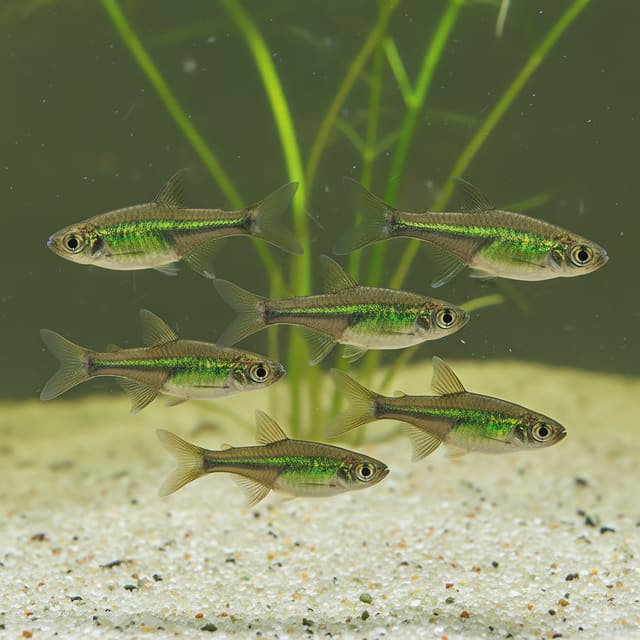
Of the fish we list, the neon green rasbora, Microdevario kubotai, belongs to one of the genera on that list. As with any pairing, check that its own water and space needs fit your tank before you add it.
People often ask whether chili rasboras can live with a betta. Seriously Fish lists the small Betta species as suitable companions. It does not specifically name the common Siamese fighting fish, which is a much larger fish than a 2 cm rasbora. If you are considering that combination, treat it with caution: give the tank plenty of plants, watch closely at first, and have a plan to separate them if the betta shows interest in the rasboras.
Leave out anything big enough to eat a 2 cm fish, along with boisterous or fast-feeding species that will outcompete a shy shoal. That rules out most standard community fish, including many larger tetras, barbs, danios and rasboras, even ones sold as peaceful. Peaceful is not the same as suitable; choose companions by adult size, feeding speed and water needs.
Telling the sexes apart is straightforward once the fish are mature. Seriously Fish says mature females are noticeably rounder-bellied and often a little larger than males. Males are generally more colourful, and dominant males often show intense colour. Wikipedia agrees that males are smaller and more vibrant. In a group of ten you will usually be able to pick out the brightest males within a few weeks of the fish settling.
Seriously Fish describes the chili rasbora as an egg-scattering, continuous spawner that shows no parental care at all. Well-conditioned fish can spawn every day, and FishBase records that up to 50 eggs are laid on the underside of leaves and that the larvae hatch after 48 hours.
If you want to raise fry, Seriously Fish describes a simple method:
Removing the adults matters because, with no parental care, they will not protect eggs or fry. Conditioning beforehand is mostly a matter of feeding, as covered above: daily small live and frozen foods help bring the fish into breeding condition.
Raising fry this small takes patience and a steady supply of tiny live food. It is a rewarding project, but not a necessary one for enjoying the fish.
With fish this small, problems can develop fast and are easy to miss, so a short daily look at the group pays off. OATA describes healthy rasboras as having clear, bright eyes, undamaged fins, intact scales and normal swimming behaviour. Count your fish when you feed them. With a shoal of ten, that takes seconds and is the quickest way to spot a fish that is hiding, missing or not feeding.
OATA lists the changes that should make you look more closely:
Some colour variation is normal, because males brighten as they display and compete, and Seriously Fish notes that dominant males show the most intense colour. What matters is colour that stays poor for days, especially alongside other signs on the list.
Seriously Fish warns that Boraras are susceptible to swings in water chemistry, and in a small aquarium those swings come from three main sources: overfeeding, an immature or overcleaned filter, and large water changes with water that differs from the tank. If something looks wrong, test for ammonia, nitrite, nitrate, pH and hardness before doing anything else. With fish this small, water is always the first thing to rule out.
Ten is a good start, and Seriously Fish's minimum is 8 to 10, so a larger shoal is fine if the tank allows it. If you add more chili rasboras later, add them in a batch rather than one or two at a time, so the newcomers join a group rather than arriving alone, and check that the tank's filtration and maintenance can carry the extra fish. Keep a close eye on feeding for the first week after any addition, as a bigger shoal means more competition for small foods.
Ask for advice before using any medication. Some treatments are dosed with larger fish in mind, and some can harm the shrimps that are often kept with chili rasboras.
Wikipedia notes that chili rasboras can live up to eight years if properly cared for. Treat that as the top end rather than a promise, but it is a good reminder that this pack is a long-term commitment. A stable tank, a varied diet and a weekly routine are what get small fish to old age.
Please read our delivery and live-arrival information before ordering so you know what to expect on the day.
The aquarium must be ready before the parcel arrives: filter running, water tested and the temperature matched. For chili rasboras, that also means a mature tank with stable test results, as described above. Someone must be at the delivery address to receive live animals. We send the confirmed delivery date and tracking by email.
Your ten rasboras travel in an oxygen-filled bag inside insulated packaging, with heat packs when conditions call for them. They are carried by a tracked courier licensed to carry live animals.
Before you open the parcel, start a continuous video while it is still sealed. Open it in the same take and show the fish in the still-sealed bag. Ten tiny fish can be hard to see, so hold the bag up to the light and take your time. If any fish arrive dead, dying or clearly compromised, email hello@tropicalfishco.co.uk on the day of delivery with your order number and that video. Photographs alone do not meet the policy. The resolution is a replacement with your next order or a refund for the affected fish, subject to the guarantee terms.
Keep the lights low for the rest of the day and leave the group to find the plants. Over the first week, watch their breathing, appetite and behaviour. Offer small amounts of fine food from the second day and remove anything left uneaten. As they settle, they should begin to shoal in the open. If one or two still hide or refuse food after several days, check the water before anything else.
These are the sources used for this page. They are well worth reading if you want to set up a tank around chili rasboras.
No reviews for this item yet. Bought one? Honest reviews only, good or bad.
What customers say about ordering from us
I have a small group of long finned mountain minnows. So was delighted to be able to order ten of this variety to increase the genetics in my tank . The ones I recieved are healthy but it’s to early to give a verdict on wether they are of a long finned type since they are small currently.
Gordon Walker · 23 Sept 2026
100% success travel and "installation". Pleased with quality of purchase. The Siamese fighter a bit "shy" so have not yet seen him at his best yet but looking good. Happy customer. GG
George E Garratt · 21 Sept 2026
Reviews of our shop, collected by Judge.me, an independent third-party review collector. Newest first.