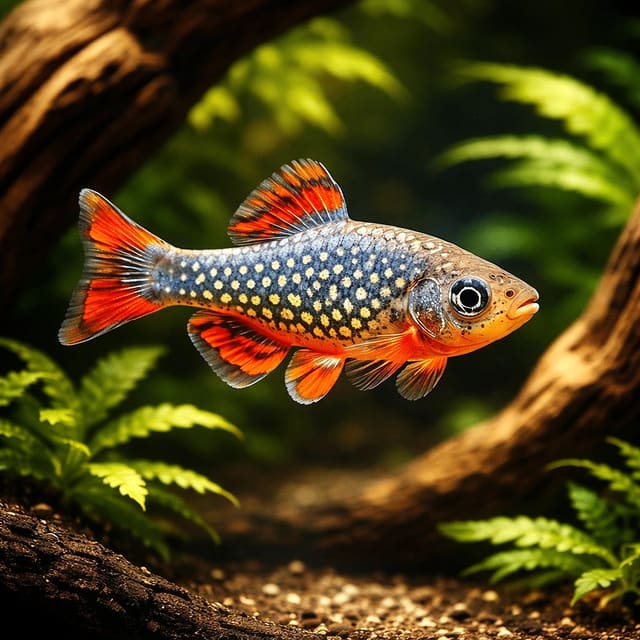
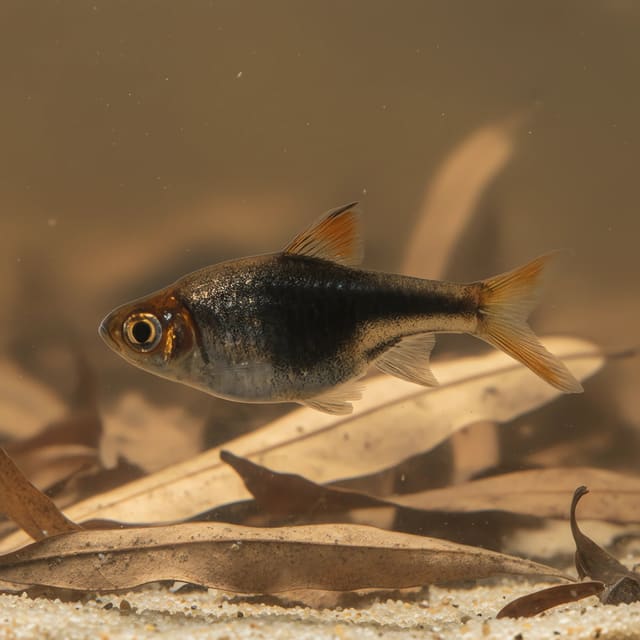
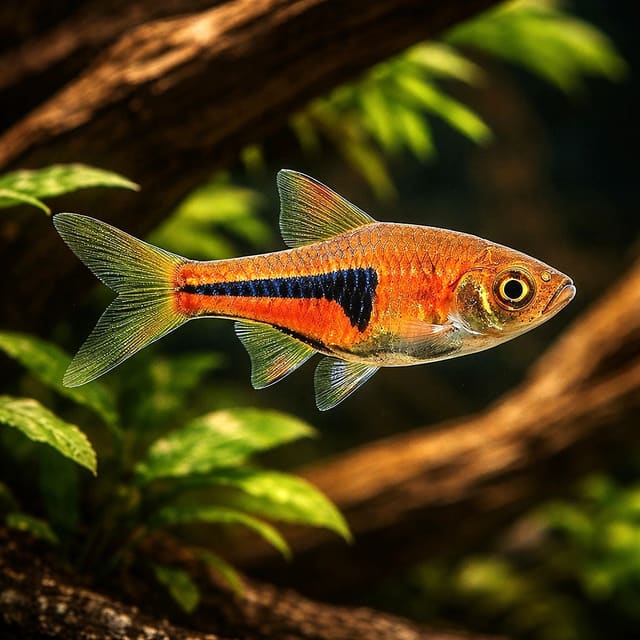
Dwarf Rasbora (Boraras maculatus)
24–26°C · pH 5–6
£4.99

Glowlight Carplet is a tiny, peaceful Sri Lankan shoaling fish for a mature planted aquarium. Plan at least 8-10 fish, fine foods, gentle filtration and stable 24-26 C water.
Adult size is the maximum length this species reaches at full maturity (scientific sources). The livestock you receive will be younger and smaller. Product-photo provenance and any image-specific limitations are stated on the listing.
Horadandia atukorali
Save when buying multiple fish. Each quantity is one fish; sex and pair formation are not guaranteed unless the selected variant explicitly states them.
Confirm your email, then we’ll send an availability message for this exact item if it returns within 180 days.
This request is only for this product—no newsletter or other promotions. A mail-provider retry may very rarely duplicate the same availability message. Unconfirmed addresses are removed after 48 hours. See our privacy policy.
Glowlight Carplet is a tiny, peaceful Sri Lankan shoaling fish for a mature planted aquarium. Plan at least 8-10 fish, fine foods, gentle filtration and stable 24-26 C water.
Adult size is the maximum length this species reaches at full maturity (scientific sources). The livestock you receive will be younger and smaller. Product-photo provenance and any image-specific limitations are stated on the listing.
Maintain these water conditions for optimal health and vibrant colors
Glowlight Carplet (Horadandia atukorali) is a genuinely tiny Sri Lankan shoaling fish for a calm, mature and well-planted aquarium. Its appeal is subtle: a slender translucent body, a soft yellow-green cast and a fine luminous line that catches the light as the group changes direction. It does not need exaggerated colour to hold attention. In the right layout, a settled group creates a delicate moving layer among moss, fine-leaved stems and shaded open water.
This is not the Glowlight Tetra or the Glowlight Danio. It is a separate South Asian species in the danio family, with a maximum published length of about 3 cm. Its very small mouth, gentle nature and preference for quiet vegetated water shape every part of its care. Food must be fine enough to swallow, filter intakes must be protected, and companions must be too small and peaceful to frighten or outcompete it.
Each quantity is one unsexed live fish. The current listed size is approximately 1-1.5 cm, with normal variation between living animals. A chosen sex, male-female pair, exact colour intensity or the exact individual shown in the gallery is not guaranteed. The gallery image is representative rather than a photograph of the animal that will be dispatched.
If you are considering a Glowlight Carplet for sale in the UK, plan the group and aquarium before choosing the quantity. A practical starting point is at least 8-10 fish, with 10 or more preferred in a stable aquarium of roughly 45-54 litres or larger and around 60 cm of swimming length. Current availability and price are shown by the live product controls. Eligible orders are covered by our Live Arrival Guarantee, and first-time customers can use WELCOME10 for 10% off their first order.
| Accepted name | Horadandia atukorali Deraniyagala, 1943 |
|---|---|
| Common names | Glowlight Carplet, Green Carplet, Horadandia |
| Family | Danionidae, subfamily Rasborinae |
| Natural range | Sri Lanka, especially western coastal floodplains |
| Conservation status | Vulnerable on the global IUCN Red List |
| Current listed size | Approximately 1-1.5 cm, with natural variation |
| Maximum published size | About 3 cm total length |
| Practical group | At least 8-10; 10 or more preferred where space allows |
| Practical aquarium | About 45-54 litres or larger, with roughly 60 cm frontage |
| Temperature | 24-26 C |
| pH | 6.0-6.5 |
| Hardness | Soft to moderately hard, up to about 12 dGH |
| Temperament | Peaceful, social and easily intimidated |
| Diet | Tiny dry foods plus appropriately small live and frozen foods |
| Care level | Intermediate because of size, feeding and stability needs |
The accepted scientific name for this listing is Horadandia atukorali. FishBase places it in Danionidae, the family containing danios and several related small Asian fishes, and in the subfamily Rasborinae. The name Green Carplet is the established English common name, while Glowlight Carplet is widely used in the aquarium trade because of the fine reflective line along the body.
Common names can cause confusion. Glowlight Tetra refers to Hemigrammus erythrozonus from South America, while Glowlight Danio refers to Danio choprai from Myanmar. Those fish differ in appearance, adult size, activity and care. Searching or shopping by the scientific name prevents an attractive common word from placing the wrong animal in the wrong aquarium.
| Trade name | Scientific name | Key distinction |
|---|---|---|
| Glowlight Carplet | Horadandia atukorali | Tiny Sri Lankan danionid, about 3 cm maximum |
| Glowlight Tetra | Hemigrammus erythrozonus | South American tetra with a stronger orange stripe |
| Glowlight Danio | Danio choprai | Larger, more active Myanmar danio with different care needs |
| Glowlight Rasbora | Trigonostigma hengeli | Different Southeast Asian rasbora with a distinctive flank mark |
Older literature treated Indian and Sri Lankan Horadandia as one widespread species. A modern taxonomic review recognises H. brittani from southern India as a separate valid species. H. atukorali is the Sri Lankan species attached to this listing. The distinction matters for accurate naming, conservation records and any attempt to maintain a known breeding line.
The published diagnostic differences include eye proportions, body depth, fin positions and internal skeletal characters. Those are specialist features, not a promise that a casual glance at one trade photograph can confirm locality. The gallery therefore supports shopping and care planning but should not be treated as a taxonomic voucher. Keep the product label with your aquarium records and avoid mixing named Horadandia populations for breeding.
A Glowlight Carplet has a narrow, lightly compressed body with clear fins and a restrained yellow, green or golden sheen. Its lateral glow is finer and less theatrical than the stripe of a Glowlight Tetra. Colour can change with lighting, background, stress, diet, maturity and the angle from which the fish is viewed. Newly arrived juveniles may look almost transparent before settling.
The best display comes from contrast and movement. A dark substrate, shaded side areas and green planting make the pale body easier to see. Leave an open corridor through the middle of the aquarium so the group can move as a unit, but place cover close enough that it never feels exposed. Strong white light over a bare pale base can make these small fish look washed out and nervous.
FishBase gives a maximum published length of about 3 cm total length and a common length of about 1.5 cm. Total length includes the tail. The current listed size of approximately 1-1.5 cm therefore describes very small fish that may still be developing. Normal batches can include individuals a little below or above the stated range.
Small size does not mean that a glass jar or unstable desktop container is suitable. Water temperature and waste concentration change quickly in low volumes, and a proper group needs horizontal room. The limiting factors are group welfare, stable water and feeding access, not the length of one fish.
| Feature | Practical consequence |
|---|---|
| Approximately 1-1.5 cm on the listing | Use a covered intake and food particles the fish can swallow |
| About 3 cm maximum published length | Choose tiny, calm companions with no predatory mouth size |
| Social shoaling behaviour | Plan tank volume for a group rather than one isolated fish |
| Low individual waste | Still requires a mature filter and stable routine |
| Subtle colour | Use planting, shade and a darker background for visibility |
Horadandia atukorali is a Sri Lankan fish associated with western coastal floodplains. Recorded habitats include still or slow-moving water, swamps, rice fields, weedy ponds, lower-salinity mangrove swamps and cleaner canals. Dense marginal vegetation, warm water and abundant tiny prey are more representative than a fast, exposed river channel.
Some records describe freshwater and mildly brackish occurrence. That ecological tolerance is not a reason to add salt routinely. A planted freshwater aquarium is the sensible default, and salt should never be added to a mixed aquarium unless every inhabitant, plant and biological process has been considered. Replicate shelter, gentle movement and food scale rather than trying to reproduce every extreme in the species' range.
FishBase reports the species as Vulnerable on the global IUCN Red List, assessed in 2019 under criteria linked to restricted distribution and continuing habitat decline. This does not mean that every aquarium specimen came from the wild, and the listing does not make a collection-origin claim. It does mean that accurate identity, good survival and responsible rehoming matter.
Never release aquarium fish or water outdoors. If you breed the fish, record the scientific name and source, avoid mixing it with H. brittani, and pass the identity information to the next keeper. A captive group only has conservation value when the label remains honest and the fish are maintained well.
There is no single published litre threshold that guarantees welfare. For ordinary home care, about 45-54 litres with roughly 60 cm of frontage is a cautious practical starting point for 8-10 small fish. Ten or more usually gives a more coherent display and greater social confidence when the aquarium can support them. A larger planted tank is often easier to stabilise and gives more feeding space.
Do not buy one as a decorative afterthought. An isolated fish may hide, feed poorly or behave unnaturally. Equally, do not crowd a very small aquarium simply to reach a group number. Choose the aquarium first, allow it to mature, calculate the final community, then choose a group that fits the whole system.
| Plan | Assessment | Reason |
|---|---|---|
| One to three fish in a tiny tank | Avoid | Weak social security and unstable water |
| Eight to ten in about 45-54 litres | Practical starting point | Balances group behaviour with useful water volume |
| Ten or more in a larger planted aquarium | Preferred where appropriate | More natural display and better distribution of feeding pressure |
| Dense mixed community | Review carefully | Tiny fish can be outcompeted even when nobody attacks them |
Use the aquarium care planner to organise temperature, water and community needs before ordering. New keepers should also work through the beginner aquarium setup guide rather than adding this delicate species to a newly filled tank.
The evidence-led core range is 24-26 C, pH 6.0-6.5 and soft to moderately hard water up to about 12 dGH. These values describe a useful range, not a demand for constant chemical adjustment. A stable aquarium near the middle of the range is safer than repeated rapid changes made to chase a number.
Ammonia and nitrite should remain at 0 mg/L. Keep nitrate low through sensible stocking, plant growth, restrained feeding and regular water changes. Test the replacement water as well as the aquarium when tap-water chemistry varies seasonally. Our water chemistry guide explains pH, hardness and nitrogen compounds in practical terms.
| Measure | Working target | Important note |
|---|---|---|
| Temperature | 24-26 C | Avoid abrupt change during transfer or maintenance |
| pH | 6.0-6.5 | Stable slightly acidic water is preferable to constant correction |
| General hardness | Soft to moderately hard, up to about 12 dGH | Match replacement water gradually |
| Ammonia | 0 mg/L | Any detectable reading requires immediate investigation |
| Nitrite | 0 mg/L | Any detectable reading is unsafe |
| Nitrate | Keep low and stable | Use testing and routine changes rather than a universal slogan |
Use a mature filter that provides dependable biological processing without turning the aquarium into a fast channel. A sponge filter, air-driven unit or carefully baffled internal filter can work well. If the intake has openings large enough to take a 1 cm fish, fit a fine pre-filter sponge and inspect it often so blockage does not reduce circulation.
Gentle does not mean stagnant. Maintain visible surface movement and good oxygen exchange, particularly at 26 C when warm water carries less dissolved oxygen. Arrange the outlet so there are both calm planted margins and a mild circulation path. The fish should be able to hold position and feed without fighting a current.
Fine-leaved plants, moss, floating cover and thin branches suit this species. Use dense refuge at the back and sides, then retain open midwater through the front or centre. Floating plants soften overhead light, while a dark background helps the luminous line remain visible. The beginner live-plant guide can help build cover without overcomplicating the layout.
Leaf litter can add shelter and microscopic grazing life, but it should be clean, aquarium-safe and replaced gradually. Avoid sharp plastic plants and narrow ornaments that can trap tiny fish. Fit a secure lid and close cable gaps; small danionids can pass through surprisingly modest openings.
Wild records include insects, and specialist aquarium sources describe tiny crustaceans and insect larvae as natural-style foods. In the aquarium, use fine crushed flake, quality micro-granules, powdered foods, Cyclops, Daphnia, Artemia nauplii and other suitably small live or frozen items. A varied rotation is better than relying on one powder.
Particle size is as important as ingredients. Watch the fish take and swallow the food rather than assuming a cloud of particles equals a meal. Feed small portions in more than one area so timid fish can reach them. Several controlled light feeds may suit a tiny group better than one large feed, but total food must still match filtration and maintenance.
| Food | Use | Caution |
|---|---|---|
| Finely crushed quality flake | Useful rotating staple | Crush immediately before feeding and avoid dusty excess |
| Micro-granules or soft micro pellets | Measured dry option | Confirm the smallest fish can swallow them |
| Cyclops and small Daphnia | Natural movement and variety | Choose a size suitable for juveniles |
| Artemia nauplii | Excellent small live food | Rinse hatch water and feed modestly |
| Large bloodworm or large pellets | Unsuitable whole | Too large and can foul the aquarium |
Glowlight Carplets are peaceful and social. They may hold a fairly tight group when unsettled, then spread into loose feeding positions once secure. That change is normal. Persistent hiding, surface clustering, rapid breathing or refusal to feed is not simply shyness and should prompt checks of water quality, flow, oxygen, group size and companions.
A larger group usually makes the fish easier to see because individuals gain confidence from one another. The goal is not forced crowding; it is enough conspecific company in enough space. Observe the whole group at feeding time so one weak fish is not hidden behind the apparent success of the others.
Temperament alone does not decide compatibility. A peaceful 8 cm fish may still swallow a 1.5 cm carplet, while a harmless but frantic feeder may leave it hungry. Choose diminutive species that share warm, slightly acidic water and do not monopolise food. A species-focused planted aquarium is the simplest option.
Potential companions include carefully selected small rasboras and micro-danios with overlapping requirements. Adult dwarf shrimp may coexist in a mature planted tank, but no tiny fish is safe for newborn shrimplets. Snails are generally unobtrusive when their water needs match. Avoid large tetras, barbs, cichlids, gouramis, predatory catfish, fin nippers and fish with mouths large enough to take a carplet.
| Category | Examples or conditions | Decision |
|---|---|---|
| Same species | A proper Glowlight Carplet group | Preferred starting point |
| Tiny peaceful fish | Only with matching temperature, pH, food and flow | Potentially suitable |
| Adult dwarf shrimp | Dense cover and acceptance of possible shrimplet loss | Conditional |
| Fast feeders | Fish that clear the water before carplets can feed | Avoid |
| Large or predatory fish | Any fish able to swallow or continually frighten them | Avoid |
| Uncycled aquarium | Unstable biological filtration | Never suitable |
These links are useful for comparing size, colour and aquarium style; they are not automatic tank-mate approval. Recheck the care range and adult size of every species before combining them.
The Harlequin Rasbora care guide illustrates why similarly shaped fish can still require a different group size and space plan. Compare the whole care profile rather than choosing only by photograph.
Prepare the aquarium before delivery. It should be mature, heated, covered and tested, with the light dimmed and the intake protected. Follow the acclimation instructions provided with the order because travel time, bag water and the receiving aquarium all matter. Do not leave the bag unopened for an extended period while trying to follow a generic ritual.
Release the fish near plant cover, not into the strongest flow. Keep the aquarium quiet and the lighting low for the rest of the day. Offer only a very small food once the group is oriented; uneaten food is especially risky in a small aquarium. Our delivery page explains the current live-animal service and guarantee process.
| Time | Look for | Response |
|---|---|---|
| Arrival day | Normal breathing, orientation and use of cover | Keep light low and disturbance minimal |
| Days 1-2 | Every fish taking suitably small food | Adjust particle size and feeding positions |
| Days 2-4 | Stable ammonia, nitrite and temperature | Test promptly if behaviour changes |
| Days 4-7 | Relaxed group movement and normal body condition | Review companions and flow if hiding persists |
Use regular modest water changes with dechlorinated replacement water matched reasonably for temperature and chemistry. Vacuum exposed waste without stripping every planted area at once. Rinse filter media only when flow falls, using removed aquarium water where practical, and never replace all biological media together.
Check a pre-filter sponge frequently because fine food and plant fragments can block it. Trim plants in stages so the group retains cover. Keep a simple log of temperature, test results, water changes and unusual behaviour; trends are more useful than trying to remember whether a fish looked different last week.
| Frequency | Task | Purpose |
|---|---|---|
| Daily | Count fish, watch breathing and observe feeding | Find small problems before body condition declines |
| Several times weekly | Check temperature and filter flow | Catch heater or intake problems early |
| Weekly or as testing indicates | Partial water change and light cleaning | Control dissolved waste without sudden disruption |
| Periodically | Test source and aquarium water | Identify seasonal chemistry changes |
Healthy fish should hold a normal position, breathe steadily, react to food and remain integrated with the group. Pale colour on arrival can be stress-related, but colour alone is not a diagnosis. More useful warning signs include persistent rapid breathing, clamped fins, loss of balance, repeated surface gasping, failure to eat, white spots, sores or a fish separating from the group.
Begin with water and environment: test ammonia and nitrite, verify temperature, inspect flow and oxygen, and check whether larger fish are intimidating the group. Do not add medication merely because a tiny fish is shy. If disease is suspected, identify the problem and check that any treatment is appropriate for the species, plants, invertebrates and filter.
Glowlight Carplets are egg scatterers rather than livebearers. Specialist accounts describe eggs scattered among dense vegetation. A developmental study of captive Horadandia recorded small demersal eggs and hatching after roughly 47-54 hours at 26.3-27.5 C. Because that work predates the current separation of Indian and Sri Lankan species and used aquarium-trade parents, treat the figures as documented observations rather than a guarantee for every group.
A mature planted group may produce occasional fry, but adults and tank mates can eat eggs or larvae. Deliberate breeding needs a separate, biologically mature setup, very fine cover, gentle aeration and microscopic first foods. Keep clear identity records and do not mix H. atukorali with H. brittani when the aim is to maintain a known line.
Sex differences can be difficult to judge at small sale size. Mature females may look fuller when carrying eggs, but body shape after travel or feeding is not a reliable guarantee. Each quantity is one unsexed fish. Ordering several increases group size but does not guarantee a chosen sex ratio or a breeding pair.
| Live animal | One Glowlight Carplet |
|---|---|
| Approximate listed size | About 1-1.5 cm, with natural variation |
| Sex | Unsexed; no chosen sex guaranteed |
| Pair | No male-female pair guaranteed |
| Appearance | Natural variation; not the exact gallery individual |
| Group | Select multiple quantities only after confirming suitable aquarium capacity |
Choose this species if you enjoy small details, planted aquariums and group behaviour. It suits a keeper willing to provide a mature tank, fine foods, gentle companions and close observation. It is not a robust filler fish for a newly cycled mixed community, and its small body makes mistakes in filtration, food size and tank-mate choice less forgiving.
| Good fit | Poor fit |
|---|---|
| Mature planted aquarium | New or unstable aquarium |
| Planned group of tiny fish | One isolated specimen |
| Fine food and careful observation | Large pellets and one rushed daily feed |
| Gentle flow with a protected intake | Open intake or relentless strong current |
| Tiny peaceful companions | Large, boisterous or predatory community |
| Interest in subtle natural colour | Expectation of a fluorescent show fish |
The species identity, distribution, size, habitat, water range, diet record and current global conservation status were checked against FishBase. Separation of the Sri Lankan and Indian species follows the 2013 taxonomic review of Horadandia. Breeding evidence is qualified against the peer-reviewed developmental study. Practical planted-aquarium and food context was cross-checked with Quality Marine's species overview.
Published biological facts and practical aquarium recommendations are deliberately distinguished. Tank volume and group-number guidance are cautious husbandry judgements built around water stability, social behaviour and feeding access; they are not presented as measurements taken from the wild.
The accepted name for this listing is Horadandia atukorali Deraniyagala, 1943, a Sri Lankan member of Danionidae.
Yes. Green Carplet and Glowlight Carplet are common names used for H. atukorali. Horadandia is also used as a short trade name.
No. Glowlight Tetra is Hemigrammus erythrozonus, a different South American fish. The carplet is a tiny Sri Lankan danionid.
No. Modern taxonomy recognises H. brittani from southern India as a separate valid species. This listing is identified as the Sri Lankan H. atukorali.
FishBase records a maximum of about 3 cm total length. The current listed size is approximately 1-1.5 cm, with normal variation between individual fish.
About 45-54 litres with around 60 cm frontage is a cautious practical starting point for a group. A larger planted aquarium is easier to stabilise and gives more feeding room.
Plan for at least 8-10, with 10 or more preferred where the aquarium can support them. Do not crowd an undersized tank simply to reach a number.
Use 24-26 C as the evidence-led core range and avoid abrupt temperature changes during water changes or acclimation.
A useful target is pH 6.0-6.5 in soft to moderately hard water up to about 12 dGH. Stable water is more important than constant chemical adjustment.
No. Use gentle broad circulation with good surface movement and calm planted margins. Protect any intake that could take a 1 cm fish.
Offer finely crushed quality flake or micro-granules plus tiny live and frozen foods such as Cyclops, small Daphnia and Artemia nauplii.
No. Its small size makes it vulnerable to unstable water and feeding problems. Use a biologically mature aquarium with tested zero ammonia and nitrite.
They may coexist with adult dwarf shrimp in a mature planted aquarium, but newborn shrimplets can be eaten. Match water conditions for both animals.
Avoid large, predatory, boisterous or very fast-feeding fish, including companions that are peaceful but have a mouth large enough to swallow a carplet.
They can scatter eggs among dense plants, but deliberate breeding needs a mature separate setup, protection from egg predation and microscopic first foods for tiny fry.
No. Each fish is sold unsexed, especially at small size. Ordering several does not guarantee a chosen ratio or a breeding pair.
No. The image is representative. Living fish vary with age, condition, lighting and individual colour, and the pictured animal is not the exact one dispatched.
Its current global IUCN category is Vulnerable. Keep identity records, never release aquarium fish outdoors and avoid mixing named Horadandia species for breeding.
No reviews for this item yet. Bought one? Honest reviews only, good or bad.
What customers say about ordering from us
I have a small group of long finned mountain minnows. So was delighted to be able to order ten of this variety to increase the genetics in my tank . The ones I recieved are healthy but it’s to early to give a verdict on wether they are of a long finned type since they are small currently.
Gordon Walker · 23 Sept 2026
100% success travel and "installation". Pleased with quality of purchase. The Siamese fighter a bit "shy" so have not yet seen him at his best yet but looking good. Happy customer. GG
George E Garratt · 21 Sept 2026
Reviews of our shop, collected by Judge.me, an independent third-party review collector. Newest first.