Frozen Cyclops is a flash-frozen compound feed for ornamental fish supplied here as six 100g blister packs, giving 600g in total. The preserved front label declares 50% cyclop and other lower crustaceans, salmon oil, additional additives listed on the reverse, and 93% moisture. Each labelled unit has a net weight of 100g and must be stored at -18°C. This is a precise frozen-food offer, not a claim that the pack contains 100% Cyclops or that it is a complete sole diet for every aquarium fish.
The fine food is useful for ornamental fish that naturally take small crustacean prey and can swallow the thawed particles. It can help distribute food among small midwater fish, juveniles and selected fry that are already large enough to feed on it. Suitability still depends on species, developmental stage, mouth size and the rest of the diet. Newly hatched larvae may require infusoria, rotifers, newly hatched Artemia or another first food, while large fish may find Cyclops too fine to use efficiently.
Frozen Cyclops at a Glance
| Product | Cyclop flash-frozen compound feed for ornamental fish |
|---|---|
| Offer size | 6 x 100g blister packs |
| Total net weight | 600g |
| Declared composition | 50% cyclop and other lower crustaceans, salmon oil, plus additives identified on the reverse label |
| Declared moisture | 93% |
| Storage | Keep frozen at -18°C |
| Intended use | Compound feed for ornamental fish whose diet and mouth size suit fine crustacean food |
| Human consumption | Not for human consumption |
| Label EAN | 4038358199622 per 100g labelled unit |
Important Label and Delivery Notice
The gallery shows the authentic front label, not the reverse or the individual frozen portions at life size. The visible label says that additional additives are listed overleaf, so this page does not invent or complete that missing declaration. Check the physical pack on arrival because the supplied label and best-before information take priority if a later production batch differs. Frozen-goods delivery is subject to the current checkout and dispatch terms. Transfer the food to a working freezer immediately; if it arrives thawed or the packaging is damaged, photograph it and contact us before feeding or refreezing.
What Exactly Is Included?
Our stock records name this product "Cyclops frozen-blister 6x100g" and states a minimum order quantity of six. The front label shown in the gallery is for one 100g unit. The customer offer therefore contains six 100g blister packs, not one 600g slab and not six 600g packs. Total declared food weight is 600g.
The listing does not state how many cavities or portions are moulded into each blister, and the front label does not show that detail. For that reason, the page avoids promising a cube count. Portion by the physical format supplied and by the fish in front of you, rather than assuming one cavity is automatically one meal.
| Pack statement | Meaning | Not promised |
|---|---|---|
| 6 x 100g | Six labelled 100g packs, 600g total | Six 600g packs |
| Frozen blister | Frozen food in blister-pack format | A fixed cavity or cube count |
| Cyclop | Product name used on the label | 100% single-species Cyclops |
| Compound feed | A formulated ornamental-fish feed | A complete sole diet for every species |
Verified Composition, Not a 100% Cyclops Claim
The English label declares: 50% cyclop and other lower crustaceans, salmon oil, and additives listed overleaf. This wording must be read carefully. It does not say that Cyclops alone makes up the entire pack, and it does not separate the precise percentage of Cyclops from the other lower crustaceans within that 50% declaration. The remaining formulation cannot be reconstructed safely from the front image.
Salmon oil is a declared ingredient. Exact additive names and quantities should be checked on the reverse of the supplied pack. If a particular ingredient, preservative or additive matters for a sensitive species, breeding programme or research setup, read the physical declaration before use or contact us for a current reverse-label check.
| Declared item | What the label confirms | Responsible interpretation |
|---|---|---|
| Cyclop and other lower crustaceans | 50% | The combined declaration is 50%; Cyclops alone is not quantified |
| Salmon oil | Present | No percentage is visible on the front label |
| Additives | Present; see overleaf | Do not invent an additive list from another product |
| Moisture | 93% | The food is predominantly water by analytical declaration |
What Does "From Ecological Origins" Mean?
The pack carries the wording "natural feed for ornamental fish from ecological origins." This is manufacturer or importer label language. The visible front does not show a recognised organic-certification mark or certification number, so this page reports the wording without turning it into a certified-organic claim. "Natural" also does not mean the food is pathogen-free, nutritionally complete or suitable for every fish.
Flash freezing helps preserve a perishable feed in a convenient form, but safe handling remains essential. Keep the cold chain, use clean tools, thaw only what is needed and discard food that has been left warm.
What Are Cyclops?
Cyclops are tiny copepod crustaceans found in freshwater plankton communities. Their small size and swimming form make them recognisable prey for many small fish. In a frozen product, the animals are no longer live and cannot display escape movement, but their fine size can still stimulate active midwater feeding when the thawed food is dispersed.
The word Cyclops covers a broad biological group rather than proving one exact species in the pack. The label uses the product spelling "Cyclop" and combines it with other lower crustaceans. Customers searching for "Cyclops fish food" and "frozen Cyclops fish food" can therefore find the correct offer without the page manufacturing a species-level identification.
Which Fish May Benefit?
This food can suit ornamental fish that take fine animal prey: many small tetras, rasboras, danios, livebearers, killifish, dwarf cichlids and suitably sized juvenile fish. It can also help in a mixed aquarium where large chunks are monopolised by dominant animals. The thawed particles spread through the water column, giving smaller fish more opportunities to feed.
That is a suitability guide, not a universal species list. Confirm whether the fish is herbivorous, omnivorous or carnivorous, where it feeds, and whether its mouth can take the actual particles. Specialist algae grazers may accept Cyclops enthusiastically while still needing a plant-rich staple. Large predators may eat it but gain little from chasing very fine particles.
| Fish or use case | General fit | Important check |
|---|---|---|
| Small midwater community fish | Often useful | Ensure their long-term diet remains balanced |
| Juvenile ornamental fish | Often useful | Match particle size and feeding frequency to growth stage |
| Newly hatched fry | Not automatically suitable | Some require much smaller live or prepared first foods |
| Large adult fish | Limited efficiency | Use a food sized for the animal |
| Strict herbivores | Supplement only if appropriate | Do not displace their required plant-rich staple |
| Marine fish | Species dependent | Confirm diet, particle capture and nutrient plan |
Fry and Juvenile Feeding
Fry is a developmental category, not one mouth size. Some livebearer fry and larger cichlid fry may take fine thawed Cyclops readily, while newly hatched egg-layer larvae may be unable to recognise or swallow it. Observe actual capture and swallowing rather than assuming that food disappearing into a rearing tank has been eaten.
Start with a very small test portion. Use a pipette to place a cloud near the fry and watch through the glass. If the particles are ignored, too large or settling before capture, move to a suitable first food. In a bare-bottom rearing tank, remove uneaten residue after the feeding window. Small frequent feeds can support growth only when filtration and water changes keep pace.
How to Thaw and Feed It
- Keep the main packs frozen while removing only the amount required.
- Place the frozen portion in a clean dedicated cup with a little aquarium water.
- Allow it to loosen, then stir gently so the fine particles separate.
- Add a small first portion with a pipette, spoon or baster.
- Watch the fish capture and swallow it before adding more.
- Discard unused thawed food; do not return it to the freezer.
Thawing gives better control than releasing a large frozen piece. It also lets the keeper distribute the fine food across several feeding zones. Rinsing is optional rather than mandatory: a fine net may remove packing liquid, but an unsuitable mesh can also wash away much of the Cyclops. Base that decision on nutrient control and the actual particle size.
A Controlled First Feed
- Thaw a small piece, not an assumed full cavity.
- Feed one area first and observe response.
- Spread the next portion only if the first is consumed.
- Stop before fine food begins settling unused.
- Record how much the aquarium actually consumes.
Portion Size and Feeding Frequency
The front label does not provide a universal portion or daily schedule, and aquarium stocking varies too widely for one. Start with less than you expect and offer only what the fish consume promptly. A small nano aquarium may need only a shaved fragment, while a large grow-on system may use much more. The physical blister cavity is packaging, not a scientifically calibrated meal.
Use frozen Cyclops as one part of a species-appropriate feeding plan unless the reverse label and the fish's established nutrition say otherwise. Many home aquariums use frozen food several times weekly for variety. Breeding or grow-on systems may feed it more often, but increased feeding requires more observation, siphoning and water changes.
| Observation | Likely meaning | Adjustment |
|---|---|---|
| All particles taken quickly | Portion may be appropriate | Add only a little more if every fish still needs food |
| Food settles into plants or substrate | Portion too large or distribution poor | Reduce amount and use targeted feeding |
| Large fish ignore the cloud | Food may be too fine | Choose a larger prey format |
| Fry strike but spit particles | Particle may be too large or unsuitable | Use a smaller first food |
| Water clouds after feeding | Excess fine material or inadequate removal | Stop, siphon residue and reassess the portion |
Water Quality and Fine Frozen Food
Fine particles can reach fish that miss larger foods, but the same property lets leftovers settle into moss, gravel, sponge filters and rock gaps. Overfeeding raises organic waste and can contribute to ammonia, nitrite, bacterial growth and algae. Frozen food does not keep a tank clean merely because it is a natural prey product.
Feed in two or three small passes, not one cloud large enough to disappear from view. Check the substrate after five to ten minutes and siphon obvious residue. In fry systems, keep a turkey baster or narrow hose for spot cleaning. Test water more often when increasing food frequency.
Storage at -18C
The label specifies storage at -18°C. Use a stable freezer, keep the packs sealed away from household odours and return them immediately after portioning. Mark the opening date if that helps rotation, but always use the printed best-before and batch information on the physical unit as the governing limit.
Do not refreeze food that has thawed. Repeated temperature cycling damages texture and creates avoidable hygiene risk. If a freezer fails, assess how long the product was above safe frozen storage rather than judging only by whether the centre still feels cool.
| Handling state | Action | Reason |
|---|---|---|
| Fully frozen, intact pack | Store at -18°C | Maintains the labelled storage condition |
| Small portion removed | Return the remaining pack immediately | Protects the rest from temperature cycling |
| Portion thawed for feeding | Use promptly or discard | Do not refreeze thawed feed |
| Delivery arrives thawed or damaged | Photograph and contact us before use | Preserves evidence and avoids unsafe assumptions |
| Best-before or batch differs online | Follow the physical label | The supplied production unit is authoritative |
Frozen Delivery and the Cold Chain
Frozen food is different from dry goods and from live-fish delivery. The live arrival guarantee applies to livestock under its terms; it is not a frozen-food guarantee. Current frozen-goods dispatch availability, packaging and charges should be checked at checkout or confirmed before ordering, especially during severe weather or when nobody can receive the parcel.
Be available for delivery and move the product to a freezer immediately. A cold or partly firm pack is not enough information to make a universal safety decision. If the food has thawed, leaked or arrived with damaged seals, keep the packaging, take clear photographs and contact customer support before feeding or refreezing it.
Cyclops, Artemia, Daphnia or Microplankton?
Choose frozen food by the animal's diet and mouth size, not by which product sounds most premium. Cyclops offers a very fine lower-crustacean food. Artemia is usually larger and can be easier for medium community fish to see. Daphnia-based products can provide a different prey profile. Microplankton products are designed for very fine feeding situations but may have a different declared formula.
| Food type | Relative use | When to compare it |
|---|---|---|
| Frozen Cyclops | Fine crustacean feed | Small mouths, juveniles and distributed midwater feeding |
| Frozen Artemia 6 x 100g | Small-to-medium brine shrimp food | Broader community and grow-on feeding |
| Daphnia and Spirulina 6 x 100g | Crustacean plus plant ingredient product | When a different formula suits the species |
| Microplankton 6 x 100g | Very fine frozen feed | Small-particle feeding where its label fits |
Other Cyclops Formats
This is the standard six-pack Cyclop formula. It should not be confused with Cyclop Intensive Red 6 x 100g, Cyclops Spirulina Plus 6 x 100g or the Cyclops Frozen Flat Plate 500g. Those are separate listings with different formats or formulations. Read each label rather than transferring the ingredients or claimed benefits from one to another.
The 6 x 100g offer suits customers who want multiple individually labelled packs. The 500g flat plate may suit keepers who prefer breaking pieces from a resealable slab. Format preference should not override storage capacity or feeding suitability.
Common Mistakes to Avoid
- Calling the product 100% Cyclops when the visible combined crustacean declaration is 50%.
- Promising a cube count that neither the supplier record nor front label states.
- Assuming one blister cavity is one meal for every aquarium.
- Using it as the sole diet without checking the species and reverse label.
- Calling it suitable for every fry stage.
- Leaving the main pack out while feeding several tanks.
- Refreezing thawed food.
- Adding a large frozen piece and letting fine leftovers disappear into the substrate.
- Copying the ingredients of Intensive Red, Spirulina Plus or another Cyclops product.
- Assuming the livestock live arrival guarantee is a frozen-food policy.
Image and Label Transparency
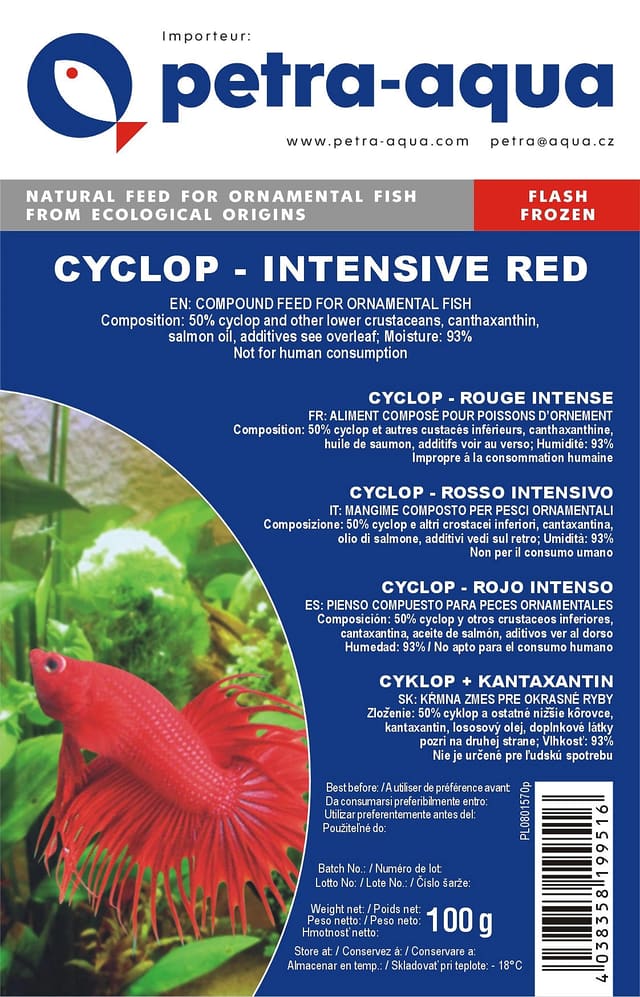
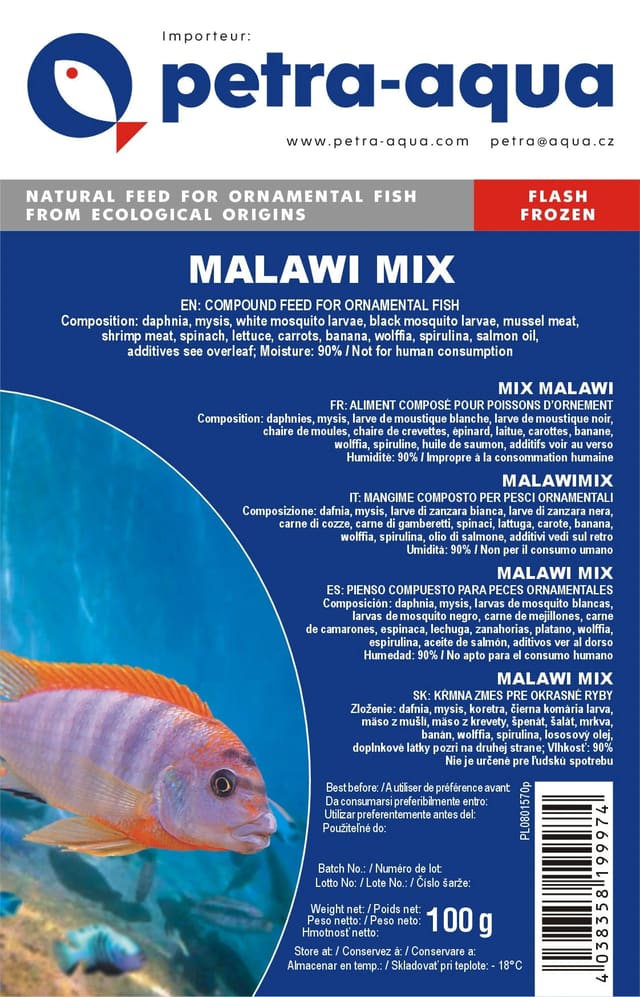
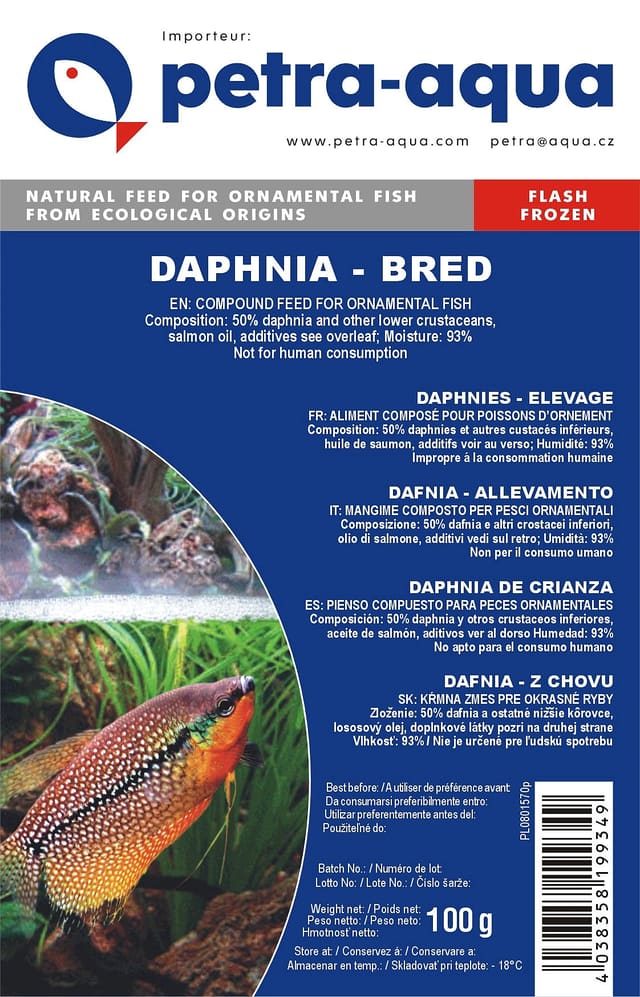
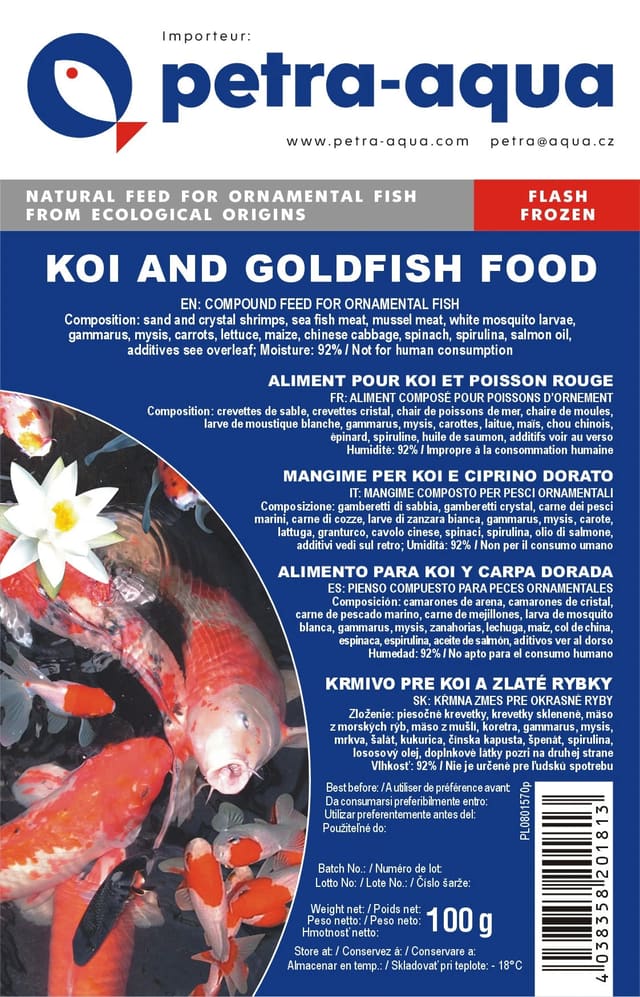
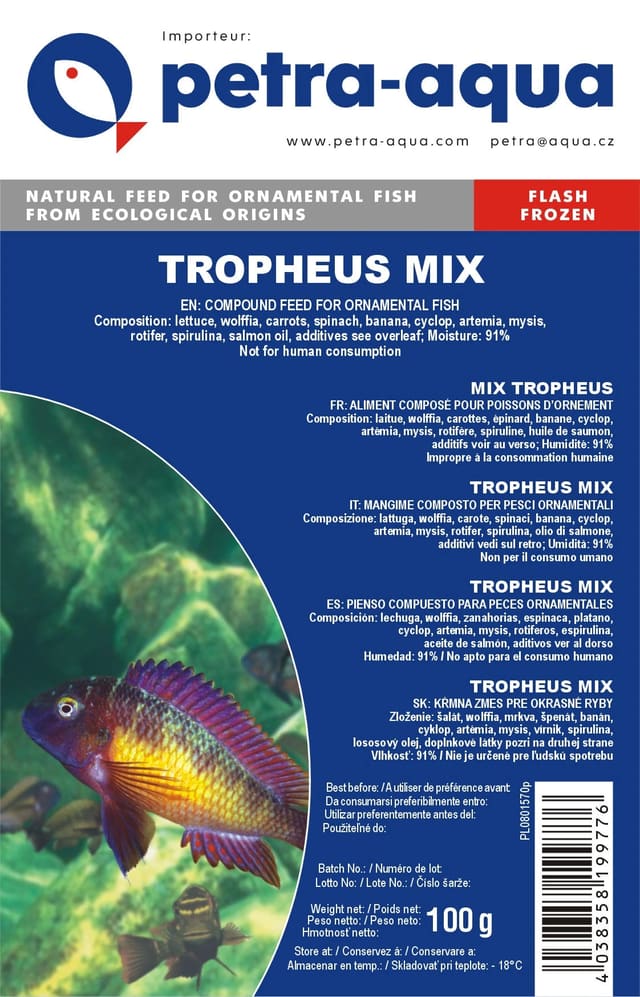
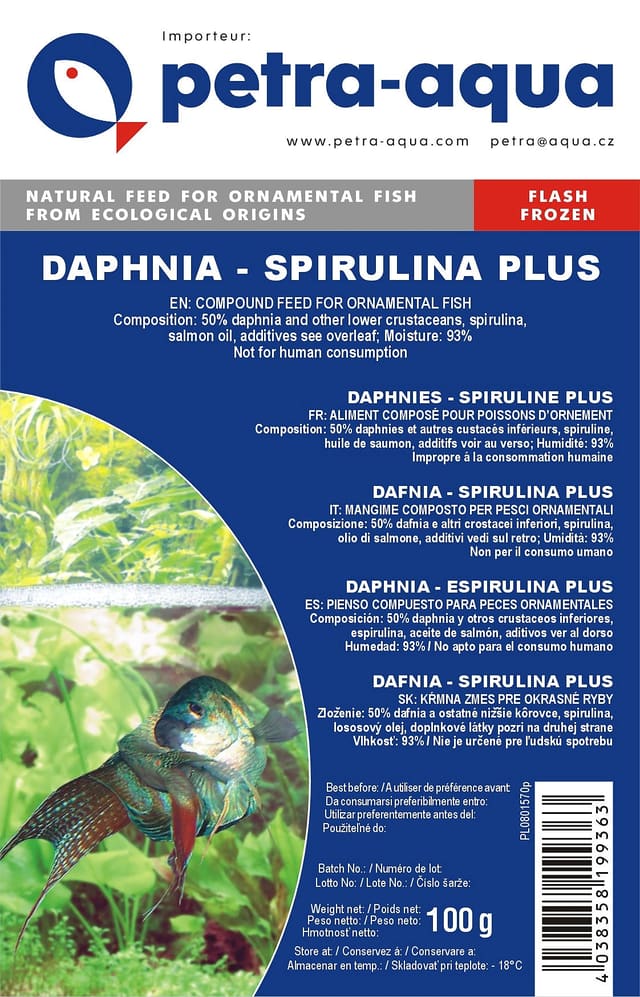
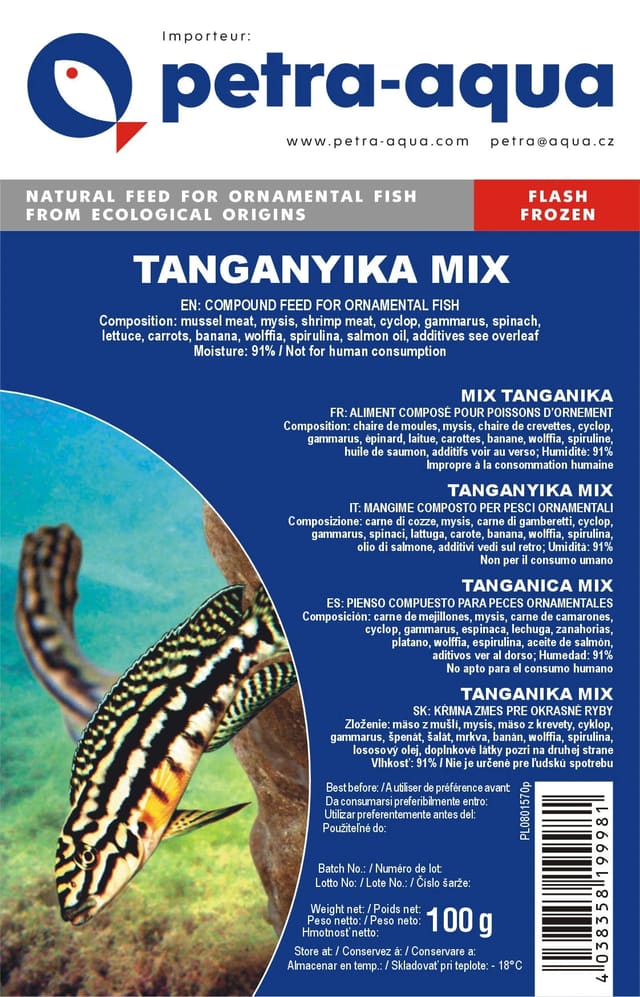
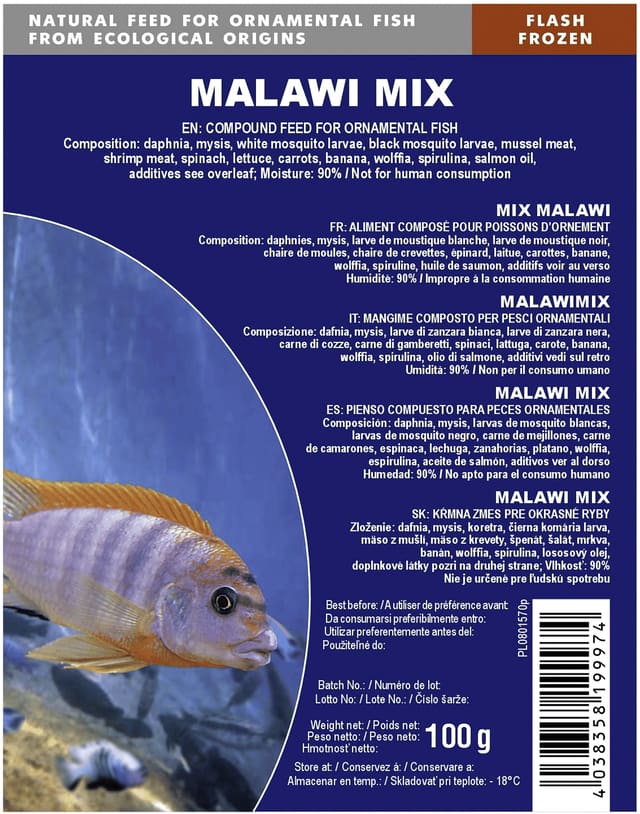
The existing 1122 x 1748 gallery image is an authentic front-label reference. It shows Cyclop, the English compound-feed description, composition, moisture, 100g net weight, storage temperature and EAN. It also contains importer branding because that is part of the physical label, not a decorative watermark added by Tropical Fish Co.
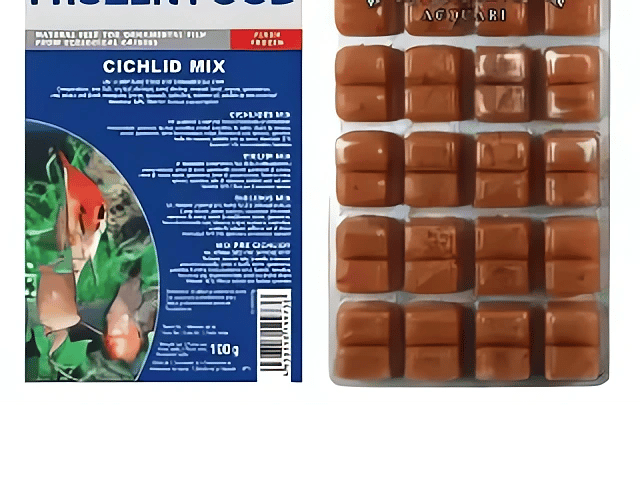
The image does not show the reverse additives, current batch number, filled best-before field, frozen food itself at life size or the full six-pack bundle. Those details are not inferred.
Ordering and Current Offer
The product contains six 100g packs and is sold as one 600g offer at the price shown in the buy box. Stock and price can change, so the live buy box is authoritative. Confirm freezer space and frozen-goods delivery availability before ordering. Eligible first-time customers can use WELCOME10 for 10% off their first order under the current promotion terms.
For a well-planned frozen rotation, compare the related products above by their actual formula and particle size. Ordering several foods is useful only if they remain frozen, are used before their labelled dates and genuinely suit the fish.
Frequently Asked Questions
Is this one 100g pack or six?
The offer contains six 100g blister packs, giving 600g total. The gallery front label is for one 100g unit.
Is the food 100% Cyclops?
No. The visible label declares 50% cyclop and other lower crustaceans combined, plus salmon oil and additives listed on the reverse.
What is the moisture content?
The front label declares 93% moisture.
How should I store frozen Cyclops?
Keep it frozen at -18°C, return unused packs to the freezer immediately and never refreeze a thawed portion.
Should I thaw it before feeding?
Thawing a small measured portion in a dedicated cup gives better distribution and control. Feed gradually and discard any unused thawed food.
How much should I feed?
There is no universal cavity or cube dose. Start with a small piece and stop when the fish have consumed the food promptly without residue settling.
Can newly hatched fry eat it?
Not always. Some fry can take fine Cyclops, while newly hatched larvae may need infusoria, rotifers, Artemia nauplii or another smaller first food.
Can marine fish eat frozen Cyclops?
Some marine fish may accept fine crustacean prey, but suitability depends on species, mouth size and the complete diet. The front label does not promise universal marine use.
Is this a complete food?
The front says compound feed for ornamental fish, not complete feed for every species. Use it within a species-appropriate diet unless the full physical label says otherwise.
What additives are included?
The visible front says additives are listed overleaf. This page does not guess the missing reverse-label declaration; check the supplied pack.
What if it arrives thawed?
Do not refreeze or feed it automatically. Keep the packaging, take clear photographs and contact us promptly for guidance.
Is the gallery image the exact full bundle?
No. It is the authentic front label for one 100g unit. It does not show all six packs, the reverse label, current batch or frozen portions at life size.
What is the EAN?
The visible 100g front label carries EAN 4038358199622. Check the supplied pack if traceability is essential because packaging can change.
Does WELCOME10 apply?
Eligible first-time customers can use WELCOME10 for 10% off their first order under the current promotion terms.
Evidence and Specification Basis
Pack configuration was checked against the current product record for "Cyclops frozen-blister 6x100g", which lists one order unit as six 100g packs. Composition, moisture, storage, net weight, product type and EAN were transcribed from the preserved authentic front label. The physical supplied label, reverse declaration, best-before date and batch code take priority if a later unit differs.