Tropical Red Mico Freeze-Dried Bloodworms 100ml/8g – Natural Fish Food
£17.99

One 100ml / 8g tub of Tropical FD Brine Shrimp per quantity. This single-ingredient food contains freeze-dried adult Artemia salina pieces for suitable omnivorous and carnivorous freshwater or marine ornamental fish. Declared analysis: 54.0% crude protein, 4.5% crude oils and fats, 2.0% crude fibre and 10.0% moisture. Feed small portions dry or pre-soaked as part of a species-appropriate varied diet.
One 100ml / 8g tub of Tropical FD Brine Shrimp per quantity. This single-ingredient food contains freeze-dried adult Artemia salina pieces for suitable omnivorous and carnivorous freshwater or marine ornamental fish. Declared analysis: 54.0% crude protein, 4.5% crude oils and fats, 2.0% crude fibre and 10.0% moisture. Feed small portions dry or pre-soaked as part of a species-appropriate varied diet.
Tropical FD Brine Shrimp 100 ml / 8 g is a single-ingredient natural fish food made from freeze-dried adult brine shrimp (Artemia salina). The light pieces can be offered dry or softened in aquarium water first, giving fishkeepers a cupboard-stable way to add Artemia to a varied feeding plan without storing a frozen pack or maintaining a live culture.
Each quantity is one sealed 100 ml tub with an 8 g net weight. Tropical intends this food for omnivorous and carnivorous freshwater and marine ornamental fish. That description is about feeding ecology, not a promise that one product suits every species: check the normal diet and mouth size of your fish, break the food into an appropriate portion and watch how the group responds.
The declared analysis is unusually clear for a natural food: 54.0% crude protein, 4.5% crude oils and fats, 2.0% crude fibre and 10.0% moisture. These figures describe this exact product; they do not make it a complete diet on their own. Use it as one useful element in a species-appropriate menu, alongside a suitable complete food where required.
| What is supplied? | One sealed tub per quantity |
|---|---|
| Pack size | 100 ml / 8 g net weight |
| Feed material | Freeze-dried adult Artemia salina |
| Physical form | Light, dry brine shrimp pieces |
| Intended fish | Omnivorous and carnivorous freshwater and marine ornamental fish |
| How to offer it | Dry, crumbled, or pre-soaked in aquarium water |
| Manufacturer feeding direction | Small portions, consumed within 2-3 minutes |
| Important handling note | May cause an allergic reaction in people |
The letters FD mean freeze-dried. Tropical starts with adult Artemia salina and removes moisture through freeze-drying, leaving a very light natural food in compact pieces. This is why the tub is labelled by both volume and weight: 100 ml describes the container volume, while 8 g is the net weight of the dry contents.
This is not frozen Artemia that needs thawing, live brine shrimp that continue to swim, or brine shrimp eggs that can be hatched. It is a finished, preserved food ready to portion. That distinction matters when comparing products online, because searches for brine shrimp fish food often mix four quite different formats: live adults, newly hatched nauplii, frozen blocks and freeze-dried pieces.
Tropical describes the product as pieces rather than a uniform flake or granule. Natural batches can vary slightly in appearance, texture and aroma. Variation of that kind is normal for a food made from an invertebrate feed material; it does not mean that every piece will have the same dimensions or density.
The declared feed material is straightforward: freeze-dried brine shrimp, identified by Tropical as Artemia salina. The manufacturer does not list cereals, fish meal, colour additives or a vitamin premix for this product. It therefore provides the characteristics of the Artemia material itself rather than the broad nutrient design of a formulated complete flake or pellet.
Tropical also describes adult Artemia as a source of digestible protein and natural carotenoids. It is reasonable to report those declared characteristics, but not to turn them into guaranteed outcomes. The food may contribute variety and naturally occurring pigments; it cannot promise brighter colour, faster growth, stronger immunity or breeding success for every fish. Water quality, species, age, health and the rest of the diet all matter.
The following values come from Tropical's declaration for this exact 100 ml / 8 g product. They are the appropriate figures to use when comparing it with another food; generic online values for brine shrimp may describe a different life stage, culture method, moisture level or brand.
| Declared component | Amount | How to read it |
|---|---|---|
| Crude protein | 54.0% | A high dry-matter protein declaration for this natural feed material |
| Crude oils and fats | 4.5% | The declared fat fraction; it does not describe the full fatty-acid profile |
| Crude fibre | 2.0% | The declared fibre fraction, including material associated with the crustacean body |
| Moisture | 10.0% | Consistent with a dry, shelf-stable format when stored correctly |
Crude analysis is useful, but it is not the same as a complete nutritional specification. It does not list every amino acid, fatty acid, mineral or vitamin, and it does not show whether the total diet meets the needs of a particular species. FAO's technical work on adult Artemia also notes that lipid quantity and quality can vary with the diet used to culture the Artemia. For that reason, the exact label should guide product comparison and a varied, species-appropriate feeding plan should guide everyday use.
Tropical's intended group is omnivorous and carnivorous freshwater and marine ornamental fish. This is more precise than saying "all tropical fish". Fish sold under the broad tropical, coldwater or marine labels can have very different digestive adaptations, mouth sizes and feeding behaviours. A food that suits one may be too rich, too large or simply outside the natural diet of another.
Start with the fish's feeding ecology. An omnivore that normally accepts animal foods may use freeze-dried Artemia as one part of a mixed menu. A carnivore may also accept it where the piece size is suitable. A strongly herbivorous or highly specialised feeder still needs food designed around its own requirements; adding brine shrimp does not replace that.
| Fish profile | Practical fit | What to check first |
|---|---|---|
| Omnivorous freshwater fish | Often useful as dietary variety | Mouth size, normal staple and response to animal foods |
| Carnivorous freshwater fish | May suit as one natural-food component | Piece size and whether the species feeds at the surface or below |
| Omnivorous or carnivorous marine fish | Manufacturer-intended where diets overlap | Species-specific marine nutrition and feeding position |
| Strongly herbivorous fish | Not a replacement for plant-focused nutrition | Use only if the species' established diet includes animal material |
| Very small fry or specialist micro-feeders | Adult pieces may be too coarse | Use an appropriately sized dedicated fry or micro food instead |
Examples such as bettas, tetras or cichlids should never be treated as one nutritional category. Some individuals may take a small, softened fragment readily, while another species in the same broad group may need a different food. Observe feeding rather than relying on a long marketing list.
Tropical's direction is to feed several times during the day in small portions that the animals consume within 2-3 minutes. That is a consumption limit, not a fixed prescription for every aquarium. The appropriate amount depends on fish size, number of fish, temperature, the rest of the day's food and how quickly this particular group eats.
For a fish or aquarium that has not had this food before, begin with a small crumbled portion. This shows whether the fish recognise it, whether the particle size works and where the pieces travel in your flow pattern before you offer more.
The manufacturer allows both methods. Neither is automatically correct for every tank. The best choice depends on where the fish feed and how readily they handle the pieces. If you soak the food, use clean aquarium water and feed it promptly rather than leaving it standing for a long period.
| Method | Useful when | Points to manage |
|---|---|---|
| Feed dry | Fish take food confidently at or near the surface | Break large pieces and prevent one fish taking the entire portion |
| Crumble dry | Several small fish need access across a wider area | Avoid turning the food into excess dust that drifts uneaten |
| Pre-soak briefly | You want softer, separable pieces or lower-water distribution | Use only the amount needed and add the food, not a large cup of stale soak water |
| Target release | Shy midwater fish miss food taken by surface feeders | Release small softened fragments near, but not directly onto, the fish |
There is no manufacturer requirement to soak for a particular number of minutes, and the current package declaration does not support claims that every dry piece will swell dangerously inside a fish. Pre-soaking is a handling option, not a medical treatment. Portion size and observation remain more important than repeating a fixed internet rule.
A useful portion cannot be expressed as one pinch per tank or a fixed amount per litre. A pinch varies between people, and two aquariums of the same volume can contain completely different fish. Use Tropical's 2-3 minute consumption window as the upper observation guide, but make the first portion small enough that you can still correct course.
Watch for three things: whether all intended fish can reach a piece, whether fragments remain after active feeding stops, and whether the rest of the feeding plan already supplies enough animal material. If food repeatedly reaches the substrate uneaten, reduce the next portion or change the release method. If only the dominant fish eats, distribute smaller fragments rather than increasing the total amount.
Several small manufacturer-directed feeds may suit some managed systems, while many home aquariums use a different schedule built around a complete staple. Do not add multiple Artemia feeds on top of an unchanged daily ration. Count this food as part of the total menu and adjust the other foods accordingly.
Tropical declares one feed material: freeze-dried Artemia salina. That makes the ingredient easy to understand, but it does not establish that the product alone supplies every nutrient needed by every ornamental fish. Protein percentage is only one part of nutrition, and the needs of an omnivorous community fish are not identical to those of a specialist carnivore or marine species.
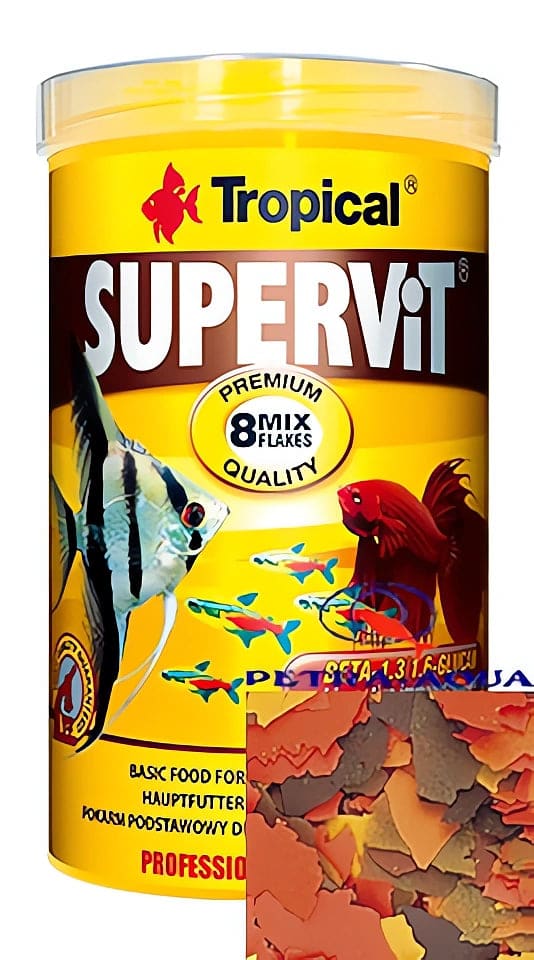
For most home aquariums, the clearest role is as a natural-food component in a varied programme. Pair it with a reputable complete food selected for the fish you keep. For a general omnivorous community where a flake is appropriate, Tropical Supervit Flakes is one possible complete-food direction to compare; always read that product's own suitability information before choosing it.
54% crude protein describes the declared protein fraction of this product. It does not prove complete nutrition, an ideal daily frequency or suitability for every species. A balanced feeding plan considers the whole nutrient profile and the biology of the fish.
A betta is an animal-feeding fish with a small mouth, so an appropriately sized Artemia fragment may fit into a varied betta diet. The important words are appropriately sized and varied. Break the piece down, offer a very small amount and observe the individual rather than pressing an intact block into the water.
This page does not prescribe a universal betta schedule, claim that soaking prevents disease or suggest replacing a complete betta food. Individual feeding response, body condition and water quality should guide ongoing use. If a fish has a health or buoyancy problem, seek qualified aquatic-veterinary advice instead of treating a food preparation method as a cure.
Many omnivorous or carnivorous cichlids and community fish may accept adult Artemia, but these labels cover hundreds of species. Some cichlids are strongly herbivorous; some community fish have tiny mouths; some feed from the surface and others wait lower down. Check the species rather than using the word "cichlid" or "community" as the nutritional evidence.
In a mixed aquarium, food distribution can matter as much as food choice. Crumble a small portion, release it at several points and make sure quieter fish receive their normal appropriate food. A strong response from one fish is not proof that the entire tank should receive more.
Tropical includes omnivorous and carnivorous marine ornamental fish in its intended group. That supports use where the species' established diet includes Artemia-sized animal material. It does not make this a complete marine formula or guarantee acceptance by every reef fish.
Marine fish can have exacting requirements for particle size, fatty-acid profile and feeding behaviour. Use the product as one component only when it fits those requirements. The 4.5% crude oils and fats declaration does not provide a detailed marine fatty-acid analysis, so do not infer that it replaces a formulated marine diet.
This product is made from adult Artemia in pieces. It is not newly hatched baby brine shrimp, Artemia cysts or a powdered micro food. Very small fry may be unable to take it even when it is crumbled, and fine dust is not the same as a purpose-designed food with a controlled particle size.
Use a food matched to the fry's mouth size and development stage. Larger juveniles may be able to take carefully crushed fragments, but the package declaration does not promise fry suitability. If fry rearing is the goal, choose a dedicated product or live-food method with clear instructions for that species and stage.
These formats share the familiar name brine shrimp, but they are not interchangeable in storage, preparation or use. Choose by the needs of the fish and the practical limits of the aquarium, not by assuming one format is always nutritionally superior.
| Feature | Tropical freeze-dried Artemia | Frozen Artemia | Live Artemia |
|---|---|---|---|
| Storage | Dry cupboard; keep the tub sealed | Continuous freezer storage | Live holding or a culture/hatching system |
| Preparation | Portion dry, crumble or pre-soak | Thaw and portion according to pack directions | Harvest, separate and feed according to the culture method |
| Movement | No movement | No movement after thawing | Moving prey while alive |
| Particle control | Break pieces to suit the fish | Depends on the frozen grade or block | Depends on life stage and size |
| Hatchable? | No | No | Already living; cyst products are separate |
| Main practical advantage | Immediate dry storage and simple portioning | Moist food without maintaining a culture | Live-prey behaviour where appropriate |
The correct comparison is therefore not "freeze-dried versus frozen" in the abstract. Compare the exact declared product, the life stage, the nutritional data available, the species being fed and whether you can store and portion the food safely.
Rotating foods should be purposeful rather than a way to add more of the same nutrient. Different natural feed materials have different particle forms and declarations. Read each label separately and avoid assuming that daphnia, bloodworms, tubifex, calanus and brine shrimp are direct nutritional equivalents.
| Product to compare | Natural material | Reason to compare it |
|---|---|---|
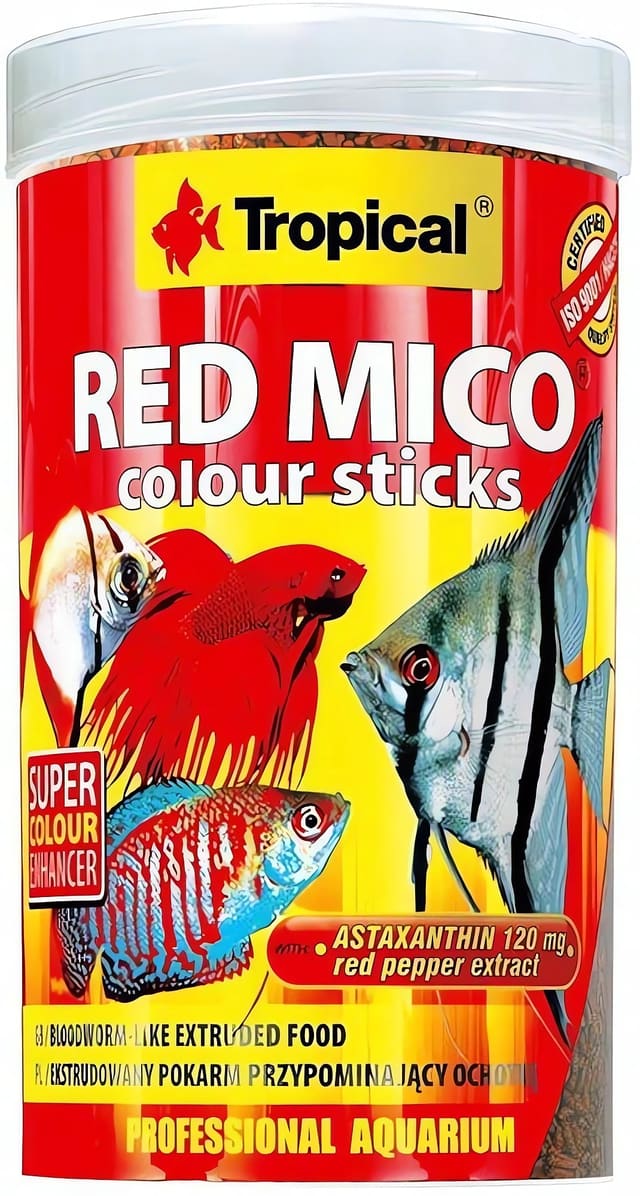
| Tropical Red Mico | Freeze-dried bloodworm-type larvae | A different animal feed material and piece character |
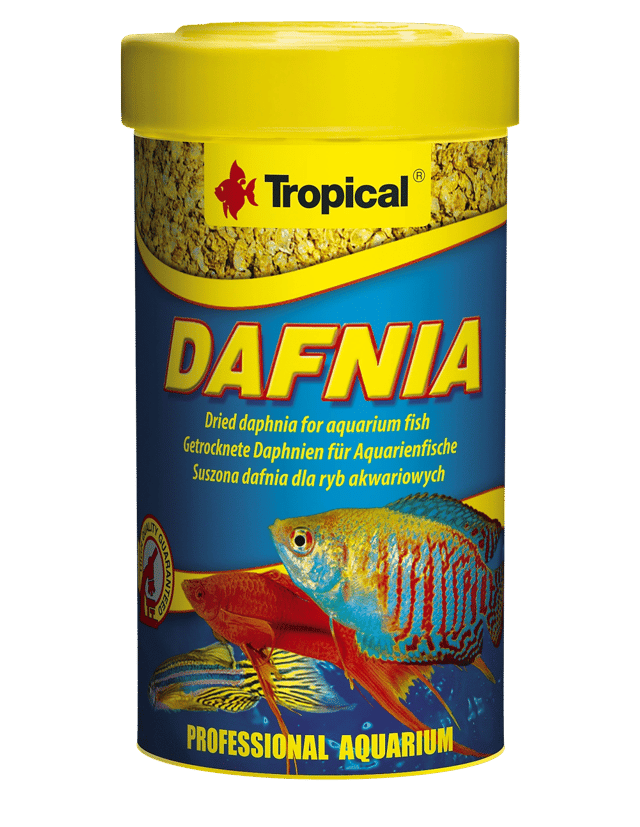
| Tropical Dafnia Natural | Dried daphnia | A freshwater crustacean option with its own declaration |
| Tropical FD Calanus | Freeze-dried calanoid copepods | Another marine-origin natural feed material to assess by species |
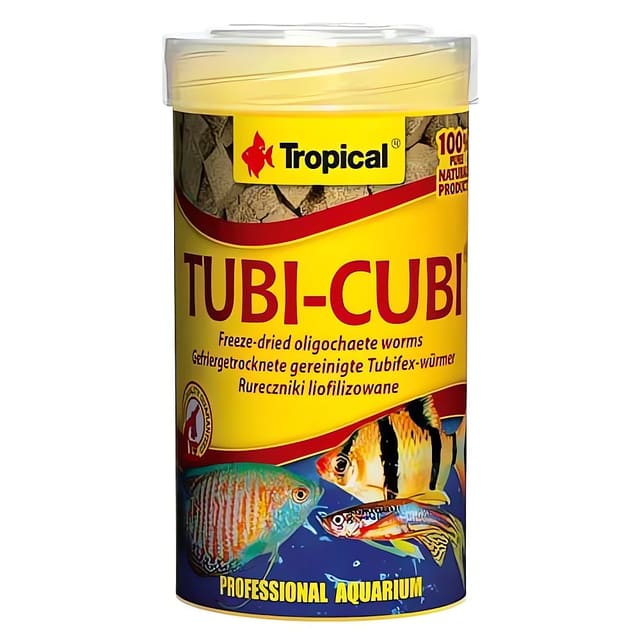
| Tropical Tubi Cubi | Freeze-dried tubifex pieces | A separate natural food recommended within Tropical's FD range |
For a broader view, browse the aquarium fish food range. Select the complete staple first where one is needed, then choose natural foods that add appropriate variety for the species you actually keep.
Freeze-dried food is clean to store and easy to portion, but it is still organic material. Any fragment left to soften and decay can contribute waste. Good results depend on controlled feeding, adequate filtration and routine aquarium maintenance, not on the dry format alone.
Do not use cloudiness as the only measure of overfeeding. A tank can look clear while uneaten particles collect under wood, behind equipment or in the filter. Check those areas after the first few feeds and reduce the portion if fragments repeatedly remain.
If the food scatters too widely, change the method before increasing the amount. A brief pre-soak, smaller fragments or a targeted release can help intended fish reach the portion. Remove a large uneaten piece rather than waiting for the filter to deal with it.
Keep the tub closed between feeds and protect it from aquarium splash, steam, direct sun and humid air. Use dry fingers or a clean dry utensil. The product's low weight and dry texture depend on keeping moisture out; repeated damp handling can cause clumping and reduce practical shelf quality.
Follow the best-before and storage information printed on the tub you receive. Discard food that has become unexpectedly damp, contaminated or abnormal in odour. Do not transfer it to an unlabelled container, because the original tub carries the product identity and batch information.
Tropical warns that this product can cause an allergic reaction in people. Avoid inhaling dust or touching the food if you are sensitive to crustaceans or fish-feed materials, wash your hands after handling, and keep it away from children and human food-preparation areas. This product is for ornamental animals, not for human consumption.
Clear limits make a food page more useful. The following distinctions prevent a product declaration from being stretched into promises it cannot support.
| Supported | Not claimed |
|---|---|
| 54.0% declared crude protein | A complete diet for every fish |
| Natural carotenoids are present in Artemia | Guaranteed colour enhancement |
| Manufacturer intends it for omnivorous and carnivorous freshwater and marine ornamental fish | Universal suitability for all tropical, coldwater or marine species |
| May be fed dry or after soaking | A mandatory soak time or a medical benefit from soaking |
| Freeze-drying is used by Tropical to reduce pathogen risk | Sterility, disease prevention or immunity claims |
| Adult Artemia pieces can be crumbled | Suitability for tiny fry or equivalence to live nauplii |
| Small portions should be consumed within 2-3 minutes | One fixed pinch, tank-size formula or weekly schedule for every aquarium |
This page uses the exact Tropical declaration for product identity, pack size, feed material, analysis and feeding directions. Species-level nutrition context is kept separate so a generic Artemia value is never presented as this tub's label.
Order one 100 ml / 8 g tub per quantity. The current price and stock shown beside the buy button are supplied live by the store, so this description does not repeat a figure that can become stale. New customers can use WELCOME10 for 10% off an eligible first order.
This is a non-living dry product and is not covered by livestock language. See the current UK delivery information for dispatch and destination details. For a suitability, ingredient or order question not answered here, contact Tropical Fish Co before feeding.
Choose a complete species-appropriate base food where required, then add Tropical FD Brine Shrimp in controlled portions for natural Artemia variety. Read the declaration, match the particle to the fish and let observed feeding response guide the next portion.
No reviews for this item yet. Bought one? Honest reviews only, good or bad.
What customers say about ordering from us
I have a small group of long finned mountain minnows. So was delighted to be able to order ten of this variety to increase the genetics in my tank . The ones I recieved are healthy but it’s to early to give a verdict on wether they are of a long finned type since they are small currently.
Gordon Walker · 23 Sept 2026
100% success travel and "installation". Pleased with quality of purchase. The Siamese fighter a bit "shy" so have not yet seen him at his best yet but looking good. Happy customer. GG
George E Garratt · 21 Sept 2026
Reviews of our shop, collected by Judge.me, an independent third-party review collector. Newest first.