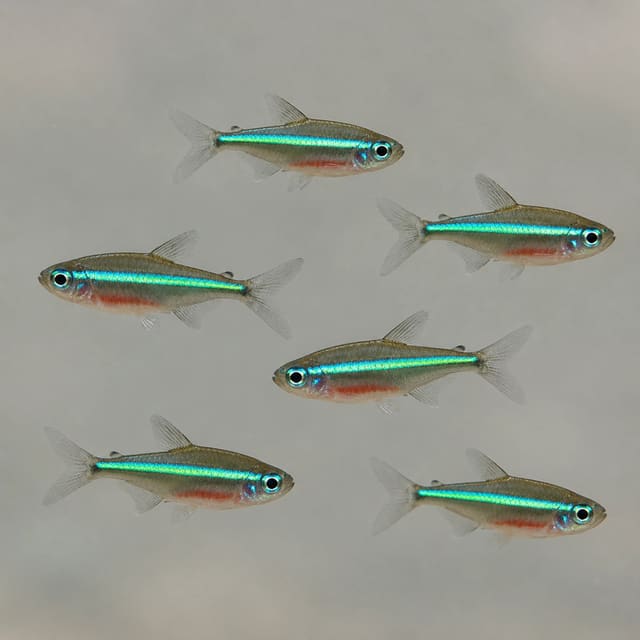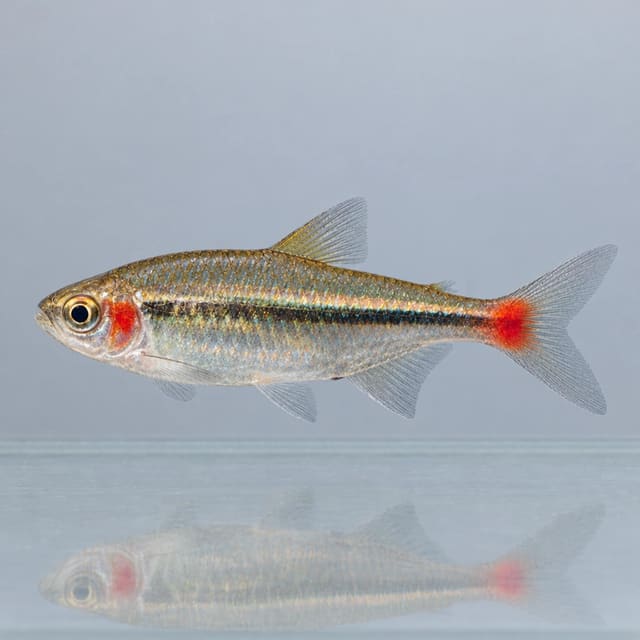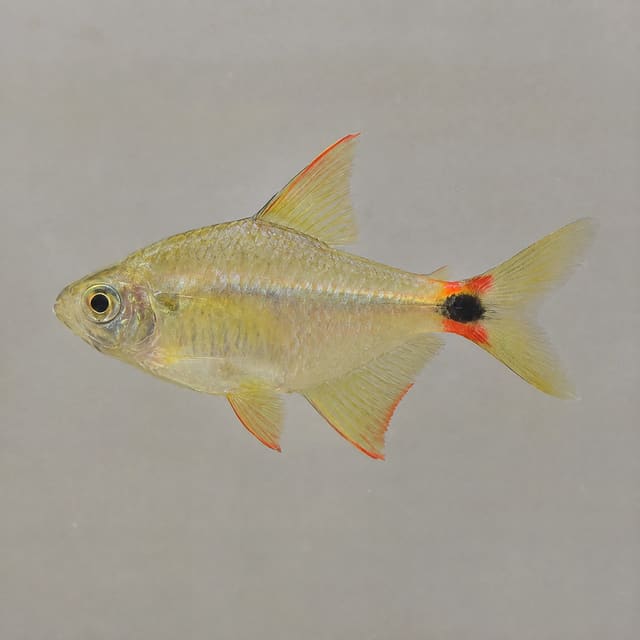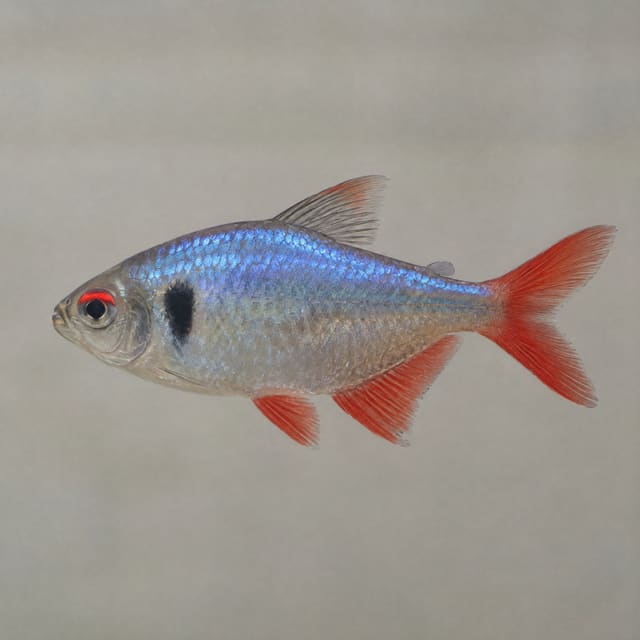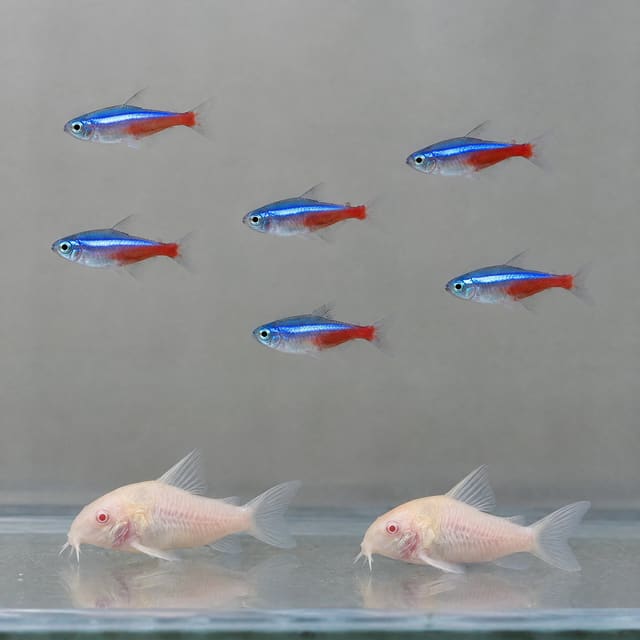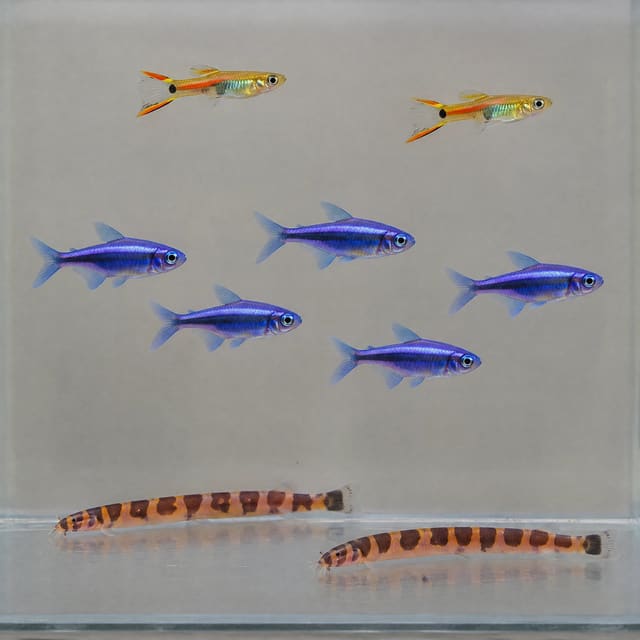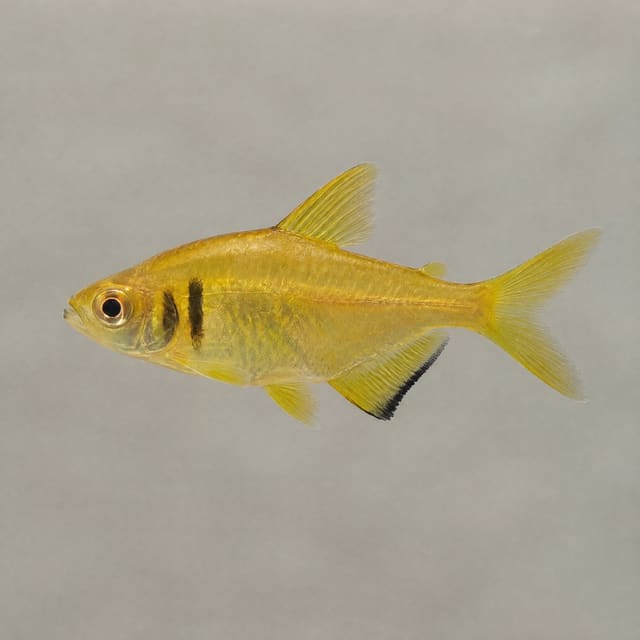
Flame Tetra Yellow (Hyphessobrycon flammeus yellow)
22–26°C · pH 6.5–7.5 · 54L
£3.99
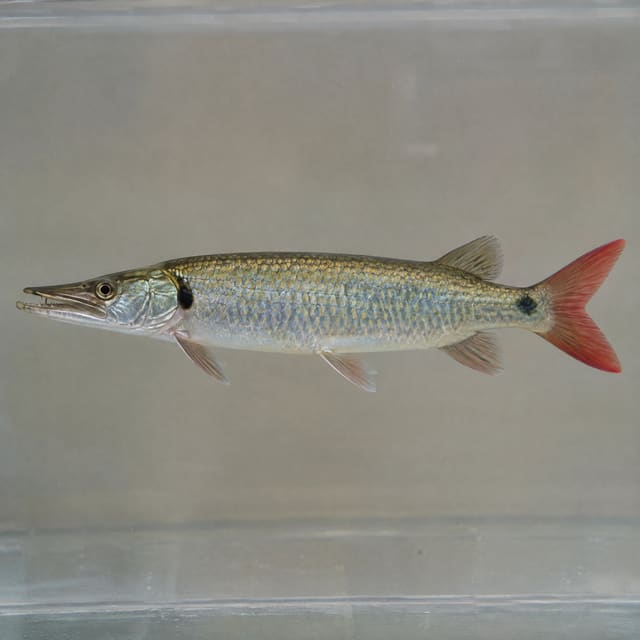
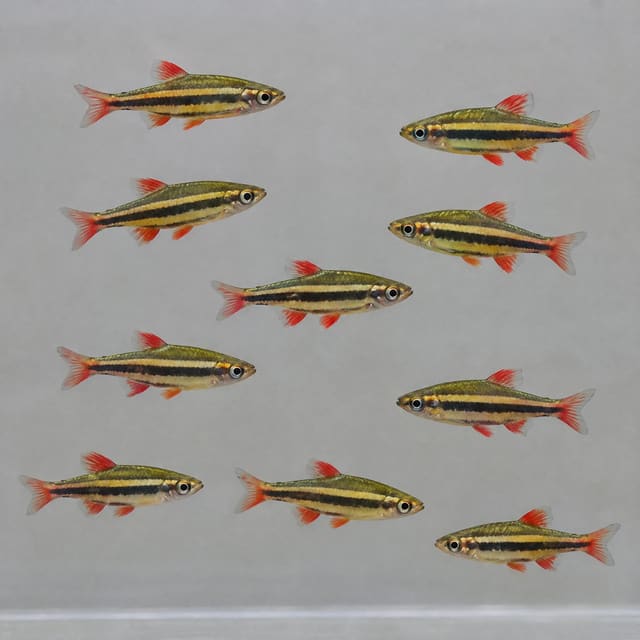
The Red Line Lizard Tetra is a slim, peaceful Iguanodectes from the Rio Negro, Madeira and Orinoco basins, silvery with a red stripe from eye to tail. Keep a group of eight to ten in a mature tank with soft, acidic water, a sandy floor and wood. Sold singly as one live fish.
Iguanodectes sp.
Quantity discounts are pricing offers, not a group-size recommendation. Check the full care guidance and your existing animals before choosing a quantity.
The Red Line Lizard Tetra is a slim, peaceful Iguanodectes from the Rio Negro, Madeira and Orinoco basins, silvery with a red stripe from eye to tail. Keep a group of eight to ten in a mature tank with soft, acidic water, a sandy floor and wood. Sold singly as one live fish.
Read the full care guidance when planning conditions for your aquarium.
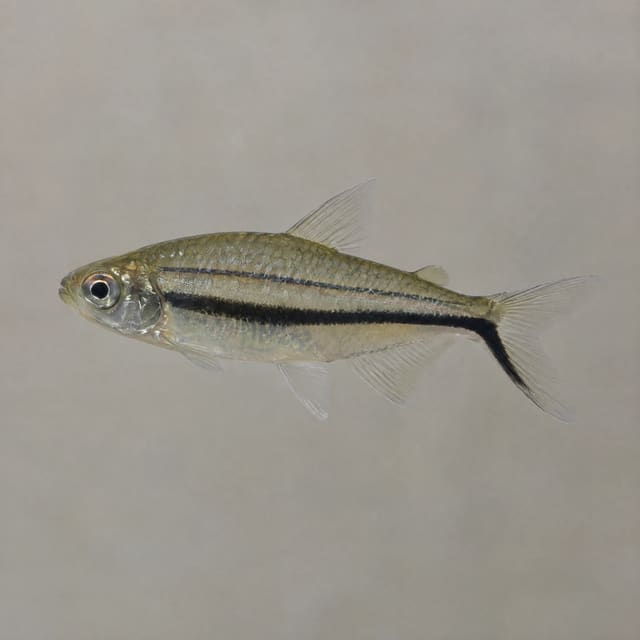
The Red Line Lizard Tetra is a slim, torpedo-shaped tetra from the blackwater and clearwater streams of the Amazon and Orinoco. Its body is silvery and almost transparent, with a fine red stripe running from just behind the eye all the way to the base of the tail. A group cruising together just below the surface looks more like a shoal of tiny pike than a typical tetra, and that long, narrow shape is where the "lizard" in its name comes from.
According to Seriously Fish, the genus name Iguanodectes joins the Taino word for lizard, iwana, with the Greek word for biter. The genus contains fewer than ten species and belongs to a small family, Iguanodectidae. It is a quiet, peaceful fish for keepers who can offer soft, acidic water and a mature, stable tank.
| Name | What it tells you |
|---|---|
| Red Line Lizard Tetra | The trade name, for the red flank stripe and slim, lizard-like body |
| Iguanodectes geisleri (Géry, 1970) | The species Seriously Fish lists as the red line lizard tetra |
| Iguanodectes adujai | A close relative that is sold under the same trade name |
| Iguanodectes sp. | How we label this fish, because the trade name covers more than one species |
| Iguanodectidae | The family, separate from the true tetras of Characidae |
Seriously Fish gives a simple test between the two species sold under this name: in I. geisleri a thin black stripe runs along the body below the red one, while in I. adujai it is missing. There are finer differences too, such as the position of the dorsal and anal fins and the number of anal-fin rays (20–25 in I. geisleri, 28–34 in I. adujai), but they are hard to see in a living fish. The green line lizard tetra, I. spilurus, is a much larger relative that reaches 102 mm standard length and has no red stripe.
Do not confuse this fish with the Red-Line Tetra (Hyphessobrycon amapaensis), a deeper-bodied tetra that also carries a red stripe but belongs to a different family and has different needs.
One purchase quantity supplies one live Red Line Lizard Tetra. The fish are not sexed at sale. Our photographs show the form of the fish; colour depth varies between individuals and is often paler for a few days after a move. Males show their best red when they are settled and competing with each other.
Red Line Lizard Tetras swim mostly in the upper and middle water and need length to move as a group. Seriously Fish gives a minimum base of 120 × 30 cm, about 108 litres. That is larger than many people expect for a fish of this size, but the group is active and spreads out along the tank.
In the wild this fish lives in small tributaries with thick overhanging vegetation, fallen branches, roots and leaf litter. Seriously Fish describes the water as acidic, low in carbonate hardness and conductivity, and stained brown by humic substances. In the upper Orinoco it is also found in morichales: clear streams with sandy bottoms and dense plants.
| Zone | What to put there | Why it helps |
|---|---|---|
| Surface | Some floating plants and a secure lid | Softens the light over a fish that lives near the surface |
| Upper and middle water | A long open lane | Room for the group to cruise and display |
| Back and corners | Driftwood roots and branches, or a planted section | Shelter and a natural look, as in the wild |
| Floor | Soft sand with a scattering of dried leaves | Matches the habitat; the leaves grow microbes the fish pick at |
Seriously Fish says a sandy floor with driftwood suits it best, that it also does well in a planted tank, and that natural peat is unnecessary. Dried leaf litter adds cover and a source of microbial food.
This is the part of care that decides success. The published values for this fish are softer and more acidic than OATA's general tetra range, and they come from a species-specific source, so we follow them.
| Source | Temperature | pH | General hardness |
|---|---|---|---|
| Seriously Fish, I. geisleri | 20–26°C | 5.0–7.0 | 1–5°dH |
| OATA, tetras in general | 22–27°C | 6.5–8.0 | 4–12°dH |
| Our planning range | 23–26°C | 6.0–7.0 | 2–5°dH |
OATA itself notes that wild-caught fish may need different values from its general range. Ammonia and nitrite must stay at zero, and nitrate as low as you can keep it.
Most UK tap water is harder than 5°dH, especially in the south and east of England. Blend tap water with reverse osmosis water to reach the range, keep the mix the same at every water change, and let wood and leaves lower the pH gently rather than adding chemicals. Our water chemistry guide and the guide to pH for tropical fish explain how. The water matcher shows which other fish suit the same water.
Seriously Fish warns that this species is sensitive to poor water and should never go into a biologically immature aquarium. That means a fully cycled filter, steady readings for several weeks, and no shortcuts. If you are setting up from scratch, our explanation of the nitrogen cycle shows how long it takes. Seriously Fish suggests a filter turning the water over four to five times per hour; our aquarium filtration guide helps you choose one.
Seriously Fish believes the species is omnivorous in nature, feeding on small invertebrates, crustaceans, filamentous algae and fallen fruit. It accepts dried foods in the aquarium but does best on a varied menu that includes bloodworm, mosquito larvae, Daphnia and Moina.
Turn the lights off before you start. OATA's method is to float the bag for about 10 minutes, then add small amounts of tank water over up to 20 minutes. Practical Fishkeeping warns that after a long journey ammonia rises in the bag and the pH drops, so once the bag is open the fish should go into the tank promptly, or you should add an ammonia detoxifier. Use a net and leave the transport water behind.
| When | What to do | What to look for |
|---|---|---|
| Day 1 | Lights off; no food for the first few hours | Fish hiding near the surface or among plants is normal |
| Day 2 | Small meal of daphnia or flake | Interest in food; some fish take a day or two |
| Days 3–4 | Test ammonia, nitrite and pH | Zero ammonia and nitrite; pH steady |
| Days 5–7 | First water change with matched water | The group swimming together in open water |
Practical Fishkeeping advises a quarantine or hospital tank whatever the source of your fish, and it is a sensible step for a sensitive species going into an established tank.
A healthy group swims near the surface with fins open, and males flash red on their fins when they spar. OATA lists warning signs: hanging at the surface or sitting on the bottom, fast breathing, clamped fins, flicking, white spots, fluffy growths, colour much paler or darker than usual, weight loss and poor appetite.
| What you see | Likely cause | First action |
|---|---|---|
| Fish pale and hiding after a week | Group too small or water too hard | Check hardness and pH; enlarge the group |
| Gasping at the surface | Ammonia, nitrite or low oxygen | Test, change water, add surface movement |
| White spots, flicking | White spot | Treat promptly and keep the water stable |
| One male chasing others constantly | Too many males | Add females or more fish to spread attention |
Seriously Fish describes the species as generally peaceful and suggests similarly sized characids, hatchetfish, pencilfish, small catfish of the corydoras and loricariid families, and non-predatory small to medium cichlids as tank mates. Males compete among themselves, which is display rather than real fighting, and they show their best colour while doing it.
| Suits | Avoid |
|---|---|
| Surface company such as the Marbled Hatchetfish | Predators that can swallow a slim 6–7 cm fish |
| Pencilfish such as the Three-Lined Pencilfish | Hard-water fish such as Malawi cichlids and most livebearers |
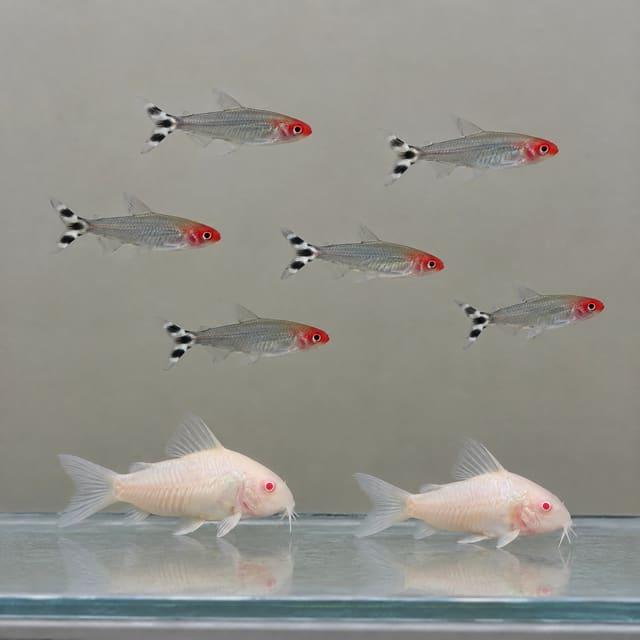
| Soft-water tetras such as the Rummy Nose Tetra | Boisterous fish that grab all the food at the surface |
| Bottom dwellers such as the Panda Corydoras, and dwarf cichlids from our Apistogramma guide | A group of fewer than eight lizard tetras |
Find more soft-water companions in the South American tetra category, our tetras page and our range of schooling fish.
Seriously Fish notes that adult males carry red markings on the pectoral, pelvic, anal and tail fins, which females lack. In the related green line lizard tetra, nuptial males also develop small hooks on the front rays of the anal fin. Breeding has not been described in the sources we checked, and OATA notes that tetras rarely breed successfully in a community tank. Treat this as a display and community fish, not a breeding project.
No. The Red-Line Tetra sold on our site is Hyphessobrycon amapaensis, a deeper-bodied tetra from a different family. The Red Line Lizard Tetra is a slim Iguanodectes, a pike-shaped fish with a red stripe from the eye to the tail.
We label it Iguanodectes sp. Seriously Fish gives the name red line lizard tetra to I. geisleri and notes that I. adujai is sold under the same name. In I. geisleri a thin black stripe runs below the red one; in I. adujai it is absent.
The genus name Iguanodectes joins the Taino word for lizard, iwana, with the Greek for biter, as Seriously Fish explains. It describes the long, slender, lizard-like body.
Seriously Fish and FishBase both give a maximum of 55 mm standard length for I. geisleri, measured without the tail. With the tail, expect a slim fish of roughly 6–7 cm.
Seriously Fish recommends a mixed group of at least 8–10, with more females than males, kept alongside other schooling fish. One or two kept alone will hide and lose colour.
Soft, acidic water. Seriously Fish gives 20–26°C, pH 5.0–7.0 and 1–5°dH. Most UK tap water is harder than this and needs blending with reverse osmosis water.
Adult males have red markings on the pectoral, pelvic, anal and tail fins, which females lack, according to Seriously Fish. Males also show their strongest colour when competing with each other.
No. Seriously Fish says it is sensitive to poor water and should not go into a biologically immature aquarium. Wait until the filter is fully cycled and the tank has run steadily for some weeks.
No reviews for this item yet. Bought one? Honest reviews only, good or bad.
What customers say about ordering from us
Easy website plenty of info on fish your buying great to pick a time slot
TRACEY DURRANT · 7 Oct 2026
Got some lovely fish thank you
Kevin Mackie · 7 Oct 2026
Reviews of our shop, collected by Judge.me, an independent third-party review collector. Newest first.
Moved by UK carriers licensed to handle live animals
Hand-packed with oxygen bags, poly box, heat pack
Email photos the same day; an optional unboxing video helps us review problems faster — claim terms apply
Klarna & PayPal Pay in 3 at checkout