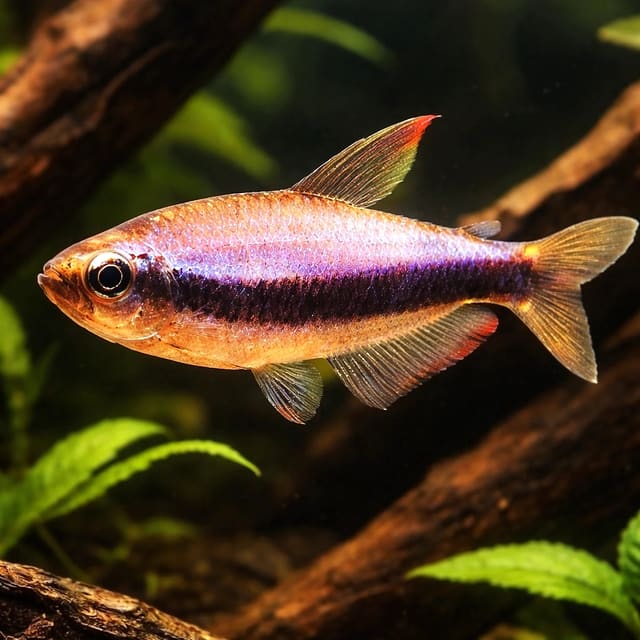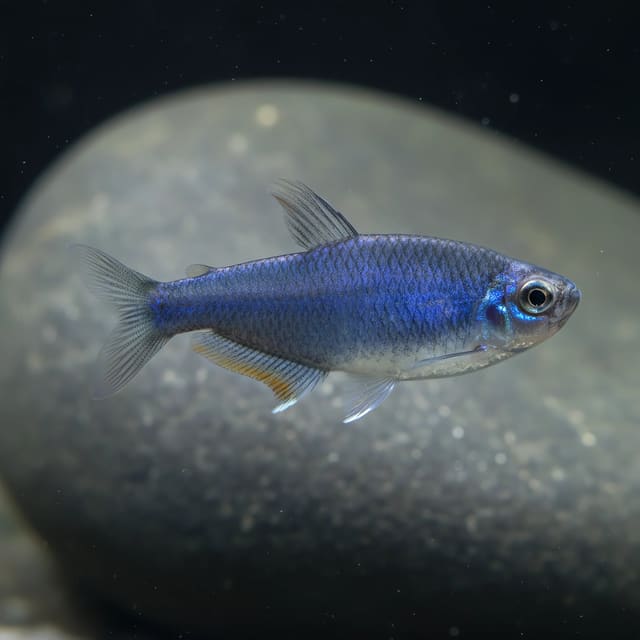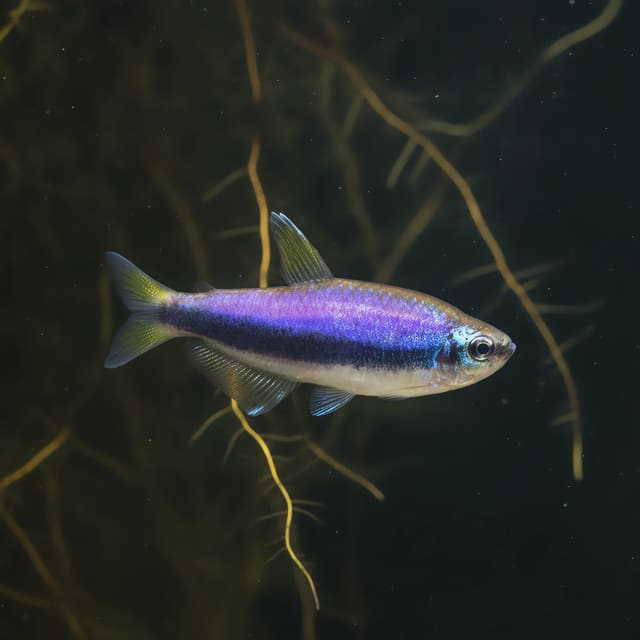
6 × Blue Emperor Tetras (Inpaichthys kerri)
24–27°C · pH 5.5–7
£11.99

The Royal Tetra (Inpaichthys kerri) is a small American tetra from the Aripuanã River in Brazil that reaches 2.8 cm. It suits calm community aquariums in groups of at least five; keep 24–27°C, pH 6.5–7.0 and 5–12 dGH, the routine overlap of FishBase, Seriously Fish and OATA’s tetra guidance. Sold as one pack of 10 live fish.
Adult size is the maximum length this species reaches at full maturity (scientific sources). The livestock you receive will be younger and smaller. Product-photo provenance and any image-specific limitations are stated on the listing.
Inpaichthys kerri
The Royal Tetra (Inpaichthys kerri) is a small American tetra from the Aripuanã River in Brazil that reaches 2.8 cm. It suits calm community aquariums in groups of at least five; keep 24–27°C, pH 6.5–7.0 and 5–12 dGH, the routine overlap of FishBase, Seriously Fish and OATA’s tetra guidance. Sold as one pack of 10 live fish.
Adult size is the maximum length this species reaches at full maturity (scientific sources). The livestock you receive will be younger and smaller. Product-photo provenance and any image-specific limitations are stated on the listing.
Maintain these water conditions for optimal health and vibrant colors
The Royal Tetra (Inpaichthys kerri) is a small freshwater American tetra from the Aripuanã River in the upper Madeira basin of Mato Grosso, Brazil. It belongs to the family Acestrorhamphidae and reaches 2.8 cm. This peaceful, social fish suits a keeper who can provide a mature, filtered aquarium, stable soft-to-moderately-hard water, a proper group and calm companions. Its compact body does not remove the need for swimming room: plan around the shoal, aquarium footprint and total community rather than the length of one fish.
Keep it at 24–27°C, pH 6.5–7.0 and 5–12 dGH. Those routine values are the overlap of FishBase’s recorded environment, the species aquarium range from Seriously Fish and OATA’s wider tetra guidance. A group should contain at least five, while this ten-fish pack starts with a more substantial social group.
Plan for an adult length of 2.8 cm, the maximum standard length FishBase records. Leave enough room for every fish to feed and swim at that adult length rather than the size supplied. Seriously Fish pairs a small group with a base of 60 × 38 cm and a volume of around 68 litres.
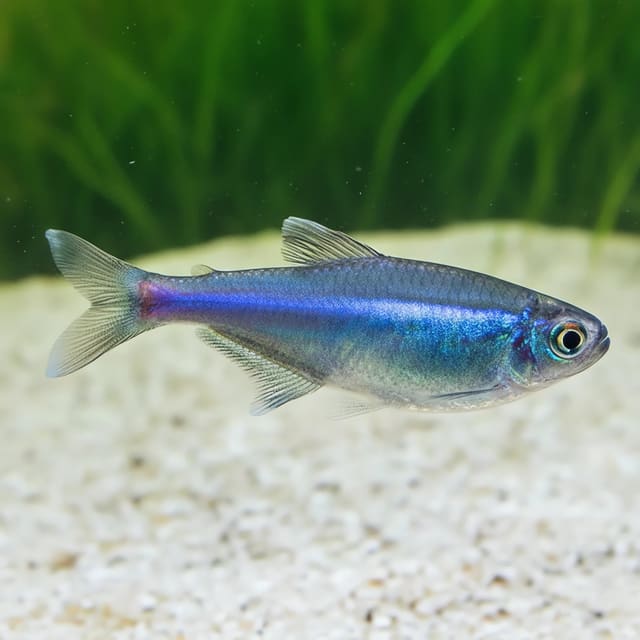
Royal Tetra, Blue Emperor Tetra and Regal Tetra are established names for this species. It is sometimes confused with the Emperor Tetra, Nematobrycon palmeri, but Royal Tetras possess an adipose fin while Nematobrycon species do not. Use the scientific name when matching care requirements or checking the identity of another fish.
One purchase supplies one pack containing ten live Royal Tetras. The pack quantity is fixed, so prepare the aquarium and biological filter for all ten fish before they arrive. Their social needs are already central to the offer: FishBase recommends groups of five or more, OATA advises at least five for tetras, and Seriously Fish notes that a group of around half a dozen helps keep any aggression among the Royal Tetras themselves.
Sex is guaranteed only when the selected option explicitly states male or female. This 10 × Royal Tetras listing has no sex-guaranteed option.
Seriously Fish describes females as far less colourful and stockier, with a predominantly red adipose fin, while males have a blue adipose fin. Treat those details as species biology rather than a promise about the composition of this pack. Do not plan a breeding ratio or a particular display around an assumed number of either sex.
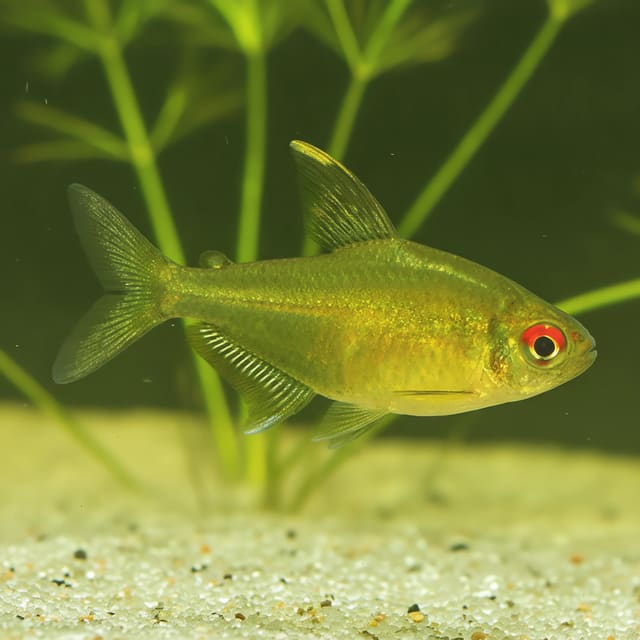
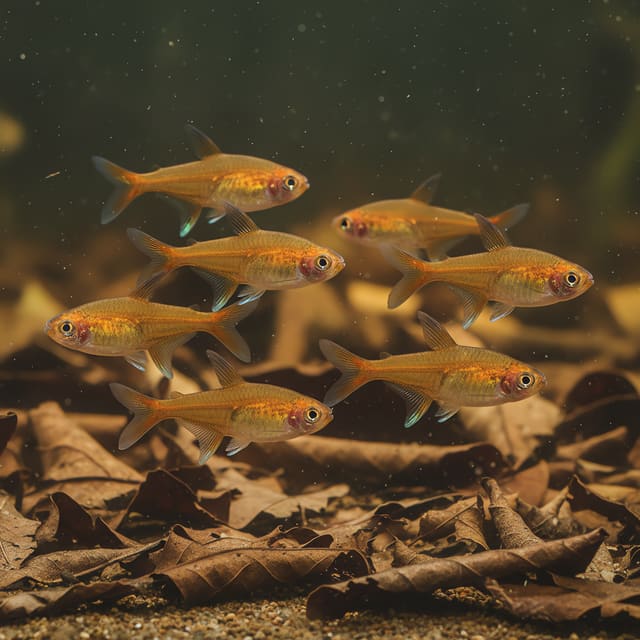
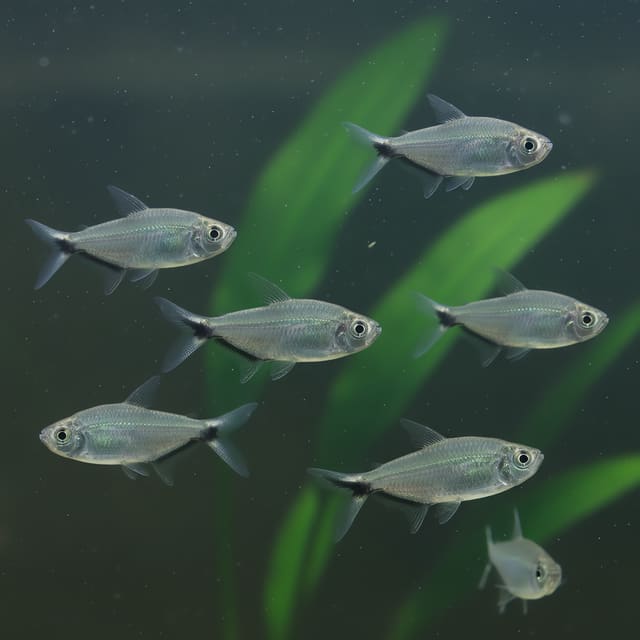
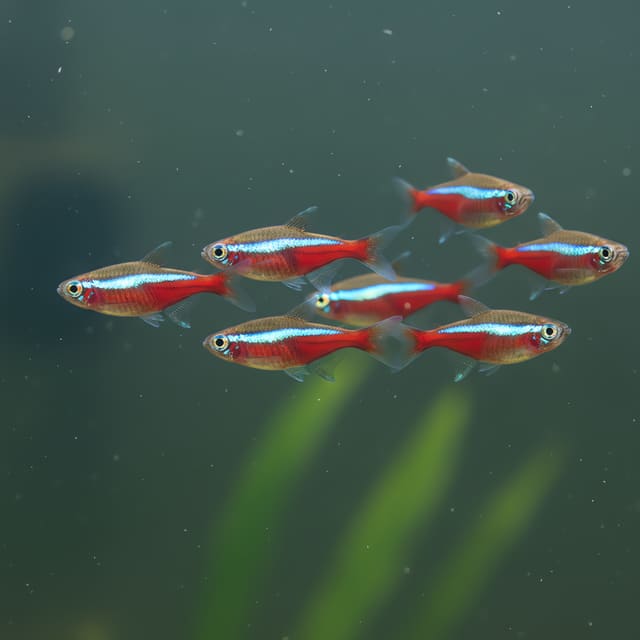
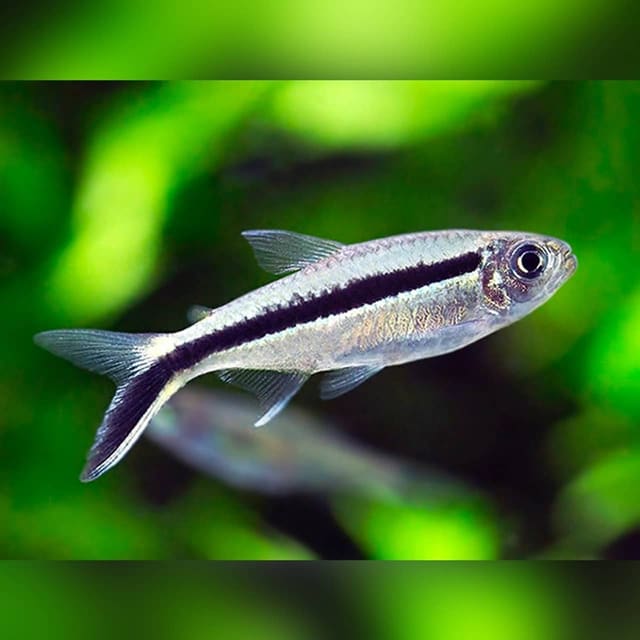
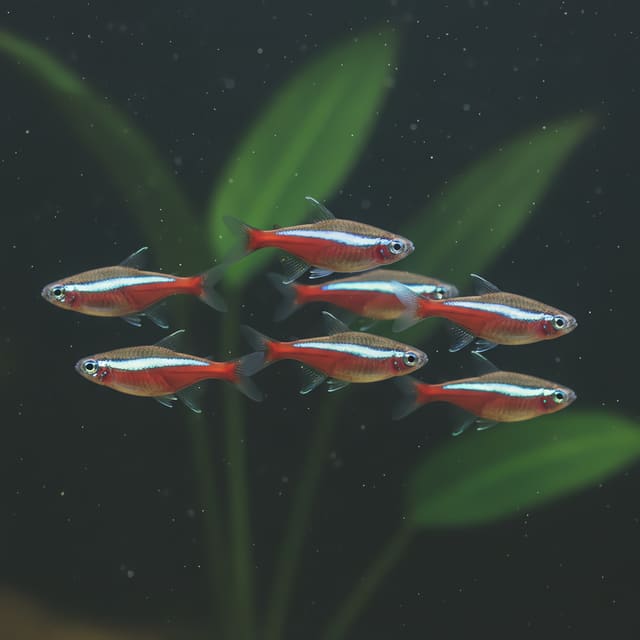
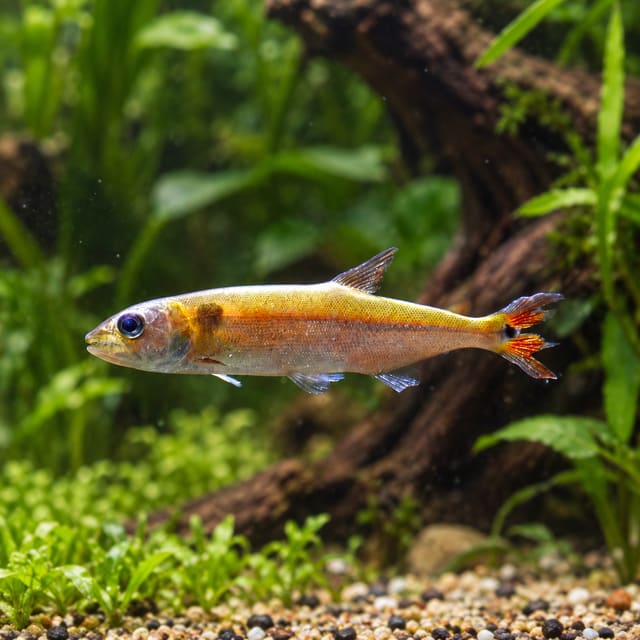
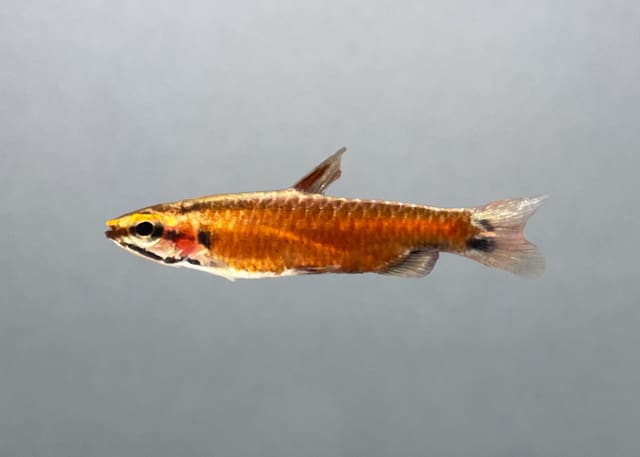
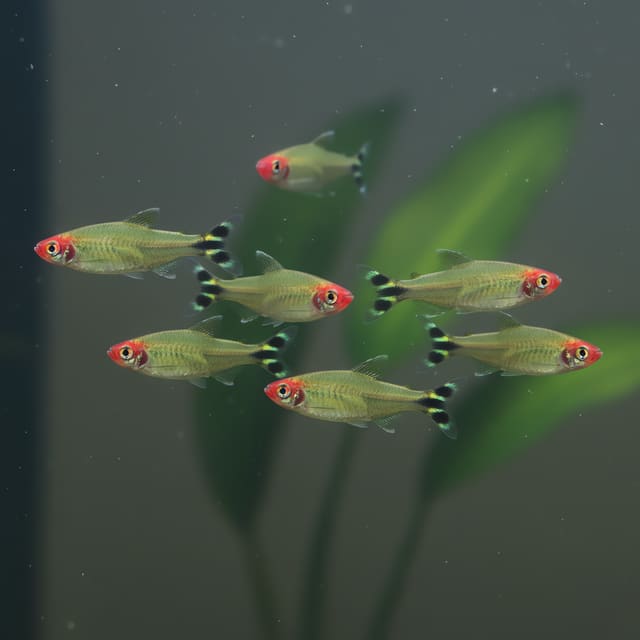
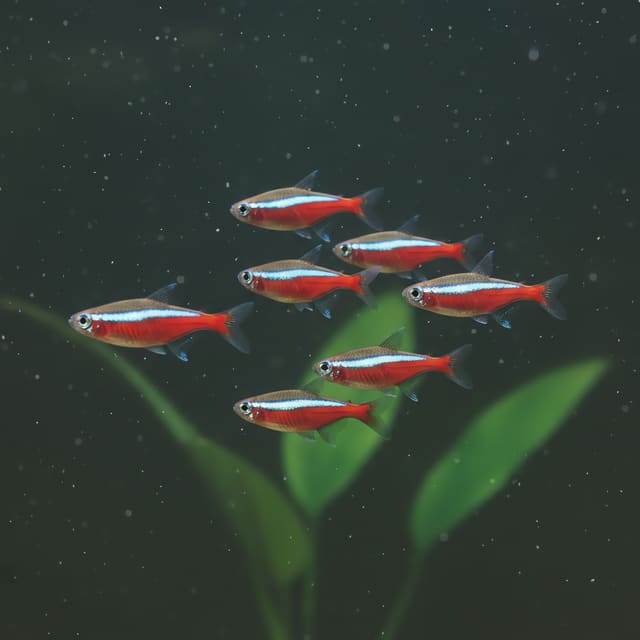
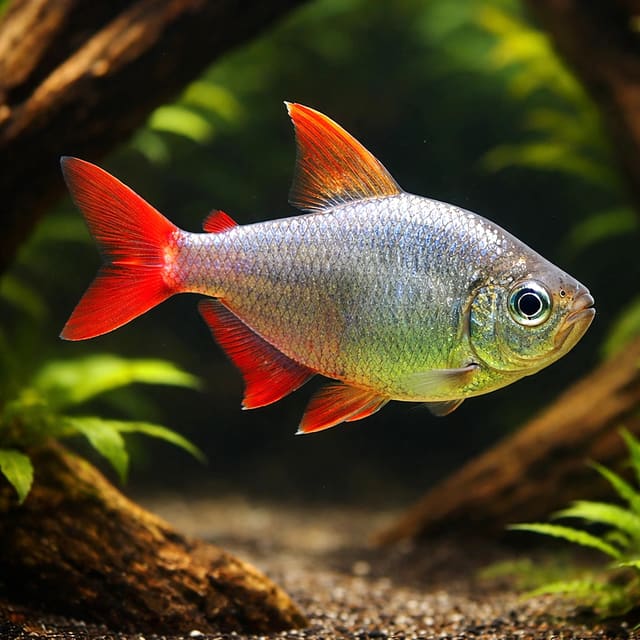
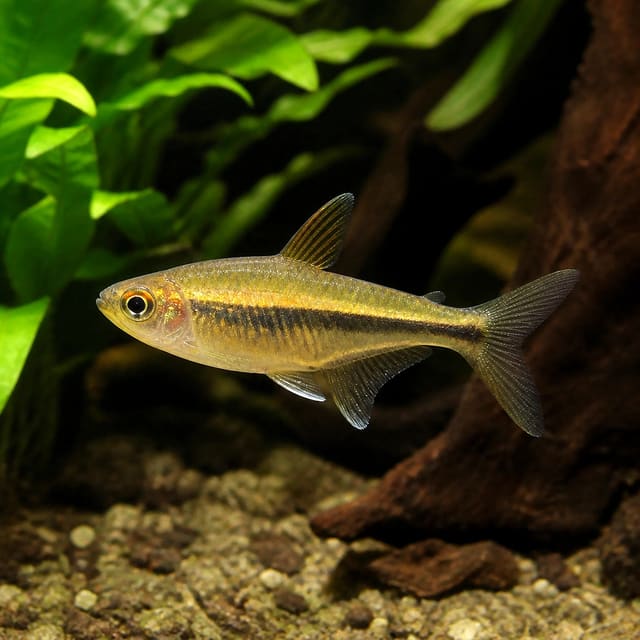
The gallery images are representative of this type of animal rather than photographs of the exact animal supplied, so colours can look slightly different from the live animal.
Lighting, background and the fish’s condition can all affect how iridescent colour appears. Judge suitability from the care requirements, adult planning size and group behaviour rather than expecting every fish to match one photographed pose or shade. A Royal Tetra’s trade names may emphasise blue or regal colour, but the scientific identity remains Inpaichthys kerri.
Check the aquarium’s base dimensions, mature filtration, existing stocking and calm swimming space before introducing the pack. A 60 × 38 cm base and around 68 litres are the species profile’s reference for a small group; a ten-fish community must also allow for every existing inhabitant and the waste produced by the complete population.
This pack is a good fit when the aquarium can hold a stable 24–27°C, neutral-to-slightly-acidic water, gentle movement and a calm community. It is a poor fit for an alkaline aquarium, a tank without mature biological filtration or any community that includes fish large enough to eat these small tetras.
| Suits | Not suited to |
|---|---|
| A mature, filtered freshwater aquarium | An unfiltered or newly prepared aquarium |
| A group of at least five Royal Tetras | Keeping one Royal Tetra by itself |
| Calm fish of a comparable size and temperament | Fish large enough to eat small tetras |
| 24–27°C and pH 6.5–7.0 | Alkaline conditions |
| A 60 × 38 cm base with open swimming room | A cramped layout chosen only from body length |
OATA describes most tetras as undemanding aquarium inhabitants that are easy to keep. We assess the Royal Tetra as easy when its core requirements are met: stable water, a mature filter, a proper group, restrained feeding and compatible companions. A beginner still needs to test the water and complete maintenance consistently.
The decisive difficulty is not specialised feeding or a very large adult body. It is keeping ten fish in stable conditions without rushing the aquarium’s biological capacity. The RSPCA explains that fish release toxic ammonia and that a working biological filter supports bacteria which convert it first to nitrite and then to safer nitrate.
Start with an aquarium base of 60 × 38 cm and a volume of around 68 litres. Seriously Fish uses those dimensions for a small group of Royal Tetras, and FishBase gives a minimum aquarium size of 60 cm. For this pack, assess the full ten-fish shoal together with any existing community and choose more space when the combined stocking requires it.
Arrange shelter around the edges while leaving an open route across the aquarium. OATA recommends gravel or sand, cover from plants or suitable ornaments and swimming space for tetras, with a gentle current for smaller species. A densely filled foreground may look sheltered but can reduce the usable footprint, so keep the central route clear.
A Royal Tetra aquarium can follow either of two styles. A well-maintained, heavily planted layout provides cover and a calm visual setting. Alternatively, a blackwater-inspired arrangement can use river sand, driftwood branches, twisted roots and dried beech or oak leaves under fairly dim lighting. Aquatic plants are not a feature of the species’ natural waters, so planting is a husbandry choice rather than a requirement for copying its habitat.
Wood and dried leaves may stain the water to the colour of weak tea. Remove old leaves and replace them every few weeks so they do not rot and foul the water. If peat is used to help simulate blackwater conditions, place aquarium-safe peat in a small net bag in the filter and continue checking the actual pH and hardness rather than judging chemistry from colour.
Any beech used as wood should be thoroughly dried and stripped of bark. Use wood, leaves and peat only when they are prepared for aquarium use, and keep decorations stable so the swimming route remains open.
Measure the aquarium base itself rather than relying on a marketing name or nominal capacity. A tall vessel can hold a similar volume while offering less horizontal room than a 60 × 38 cm base. Once substrate, wood and equipment are installed, confirm that the shoal can cross the tank without repeatedly turning around obstacles.
Keep Royal Tetras at 24–27°C, pH 6.5–7.0 and 5–12 dGH. This is the routine overlap of FishBase’s recorded environment, Seriously Fish’s species aquarium values and OATA’s group-level tetra guidance. Seriously Fish warns that the species does not do well in alkaline conditions, so keep the pH at or below 7.0 even though wider tetra guidance allows higher values.
OATA’s wider targets are ammonia at 0 mg/l, nitrite at 0 mg/l, nitrate no more than 20 mg/l above the normal tap-water level and carbonate hardness of 3–10 dKH. Use these tetra-group limits alongside the Royal Tetra range above.
Measure the aquarium rather than assuming the tap-water value remains unchanged after substrate, wood, leaves, peat, livestock and maintenance have affected it. Our water chemistry guide explains what the principal readings mean, while the water matcher helps compare measured values with the 24–27°C, pH 6.5–7.0 and 5–12 dGH target.
A useful pre-arrival check records temperature, pH, general hardness, ammonia, nitrite and nitrate. If pH is above 7.0 or either ammonia or nitrite is detectable, correct the aquarium before introducing the fish. Make changes steadily and confirm them with another test rather than relying on the amount of a product added.
For an aquarium of around 68 litres in a room near 20°C, Seriously Fish suggests roughly 75–100 W to hold 24–27°C. Room temperature, aquarium volume and heat loss affect the equipment required, so confirm the result with a thermometer placed in the aquarium.
Record a normal reading when the aquarium is stable. That baseline makes a later change easier to recognise and gives more useful context than a single reading taken only after fish behave abnormally.
Use a mature, well-maintained biological filter before adding the ten fish. The RSPCA’s aquarium welfare guidance explains that filters remove waste and support beneficial bacteria which convert toxic ammonia into nitrite and then nitrate. A filter is essential in every aquarium holding these fish.
For an aquarium around 68 litres, Seriously Fish suggests turnover of four to five times the aquarium volume each hour and a filter rated around 270–340 litres per hour. Treat the rating as an equipment reference for that aquarium size, then consider how media, pipework and blockage affect actual movement. OATA advises a gentle current for smaller tetras, so arrange the outlet to circulate water without forcing the shoal to struggle continuously.
Prepare and mature the aquarium before the pack arrives. Our first tropical aquarium guide covers the preparation sequence. Confirm ammonia and nitrite at 0 mg/l before introducing fish, and check that the temperature and pH remain stable while the filter is running.
This offer introduces ten fish as one pack, so the aquarium must be ready for their combined waste load. OATA warns that adding livestock faster than the beneficial bacterial population can respond may lead to new tank syndrome, with harmful ammonia and nitrite. Do not treat clear water as proof that the biological filter is ready; use test results.
Watch where the shoal chooses to hold position. If every fish crowds into the quietest corner while swimming hard, review the outlet direction rather than switching filtration off. Redirect flow across glass, wood or open water while preserving circulation through the aquarium.
Check the filter for blockages during routine maintenance. A falling output can reduce waste processing and circulation, while a sudden harsh jet after cleaning may remove the gentle conditions preferred by a small tetra. Return the outlet to the tested position after every maintenance session.
Record ammonia, nitrite and nitrate regularly while the full group settles. Feed controlled portions, remove uneaten food and compare readings with the established baseline. If ammonia or nitrite appears, respond to the water-quality problem immediately and avoid adding more livestock.
Feed a good-quality flake or granule as the regular prepared food, supported by small live or frozen foods. Seriously Fish says Royal Tetras accept most prepared foods but should also be offered regular meals of small live or frozen items such as brine shrimp and Daphnia. OATA also lists small bloodworm or tubifex for tetras and pencilfish.
Offer only what the fish can eat within a few minutes, once a day. This is OATA’s feeding schedule for the wider tetra group. Start with a restrained portion distributed where all ten fish can reach it, then watch until feeding activity stops. Remove food that remains because uneaten material breaks down and releases waste into the water.
A worked portion check is simple: add a small amount, wait for it to be eaten, and add another small amount only while the shoal is still feeding actively. Stop within the few-minute window. This method responds to the fish rather than assuming that a fixed pinch suits every food shape or aquarium.
Rotate prepared food with appropriately small brine shrimp, Daphnia or similar live and frozen foods. Seriously Fish connects a varied diet with good colour and development. Variety means changing suitable food types across meals, not combining several full portions into one oversized feed.
Choose pieces the fish can take readily. If larger fragments fall uneaten to the substrate, reduce the particle size or use a finer food at the next meal. When feeding frozen food, count the whole portion within the same few-minute allowance.
Look for fish that repeatedly fail to approach food, spit it out or lose condition while others feed. First check whether stronger flow or boisterous companions prevent access. Then test water quality, because reduced food intake is one of OATA’s warning signs.
Do not compensate for one reluctant fish by overfeeding the whole shoal. Observe where that fish holds position, offer the normal food within reach and deal with the cause while protecting water quality.
At least once every week, change 25% of the aquarium water. OATA strongly recommends that frequency and amount for tetras and pencilfish. Use a siphon to remove solid waste from the substrate, and treat replacement tap water with conditioner to remove chlorine or chloramine before adding it to the aquarium.
Testing before the change shows what developed during the week. A second check is useful whenever a result is abnormal or the fish behave differently after maintenance.
Check the filter for blockages. If the media needs cleaning, do not run it under the tap. Rinse it lightly in aquarium water removed during the partial water change, reducing the beneficial bacteria lost from the media.
A filter may look cleaner after vigorous washing while functioning less effectively biologically. Preserve the established bacterial population and clean only enough to restore water movement. Return media in the correct position and restart the filter promptly.
In a leaf-and-wood layout, remove old leaves and replace them every few weeks so they do not rot. Siphon trapped debris from around wood and roots without stripping the aquarium of every sheltered area. If peat is used in the filter, continue measuring pH and hardness because the colour of the water is not a chemistry reading.
Keep the weekly records together. A gradual rise in nitrate, slower filter output or repeated uneaten food indicates that the routine needs attention before the fish show severe signs. Compare readings with the normal values for this aquarium and preserve the required ammonia and nitrite result of 0 mg/l.
Test water quality first when swimming, colour, breathing, temperament, appearance, body condition or appetite changes. OATA identifies these as practical warning areas for aquarium fish. The first response is observation and measurement, not a guessed treatment.
| Change you see | First action |
|---|---|
| Hanging at the surface or sitting on the bottom | Test ammonia, nitrite, temperature and filter operation |
| Erratic swimming | Check water readings and compare flow with the normal outlet position |
| Darker or paler colour | Review water quality, companions and recent changes |
| Faster or slower gill movement | Test the aquarium promptly and inspect filtration |
| White spots, fluffy growths or damaged scales | Record the signs clearly and seek prompt guidance |
| Reduced feeding or weight loss | Check access to food, water quality and companion behaviour |
Royal Tetras may spread through the aquarium rather than forming one tight shoal. Seriously Fish notes that they do not shoal particularly tightly, so ordinary spacing is not automatically a health problem. Look for a change from the group’s normal pattern, especially when it appears with rapid breathing, loss of appetite, hiding or damaged fins.
Check all ten fish rather than focusing only on the most visible individual. One fish holding apart may indicate a local social or health issue; most of the shoal behaving abnormally points more strongly towards an aquarium-wide change.
Write down temperature, pH, ammonia, nitrite, nitrate, the time the change began and any recent maintenance or stocking event. Take clear images of the affected fish if possible. If you are concerned about any fish, test the water first and then contact us for further guidance.
Avoid adding a treatment solely from a broad symptom such as hiding or pale colour. Those signs can accompany water-quality and social problems, so measurements and a clear description are the useful starting point.
Ammonia and nitrite should both remain at 0 mg/l. If either is detected, protect the fish by addressing water quality and filter performance without waiting for more signs. Review feeding, remove uneaten material and do not add further livestock while the biological system is under strain.
Be present to receive the parcel, then film, open and inspect it on the day it arrives. The fish are hand-bagged in pure oxygen and placed in an insulated poly box, with a heat pack used when the weather calls for it. Read the current delivery and Live Arrival Guarantee policy before the delivery date so the required recording and acclimatisation steps are clear.
Keep the continuous unboxing video and order number. The guarantee requires someone to receive the parcel, same-day opening and inspection, and continuous footage beginning with the sealed parcel.
Confirm 24–27°C, pH 6.5–7.0, ammonia at 0 mg/l and nitrite at 0 mg/l before delivery. Correct any reading outside these values before the fish arrive. Ensure the filter is operating and that the planned swimming space is ready for all ten fish.
Do not use arrival day to finish maturing the filter, rearrange the entire aquarium or decide whether the existing population leaves enough room. Those decisions should already be complete because the product supplies the whole ten-fish group together.
Count the fish, watch breathing and swimming, and compare their behaviour across the group. If something appears wrong, test the aquarium and send the unboxing video and order number on the same day the fish arrive. Do not diagnose a disease from temporary colour alone, because transport and a new background may affect how the fish appear.
Keep Royal Tetras with peaceful fish that share their water range and will not eat or outcompete them. Avoid any fish large enough to eat these small tetras. OATA gives that rule for smaller tetra species, while Seriously Fish says Royal Tetras do not compete well with much larger or more boisterous tankmates.
Seriously Fish names small tetras, pencil fish, hatchet fish, Apistogramma or other dwarf cichlids, Corydoras, Otocinclus, smaller gouramis, rasboras and peaceful barbs as possible companions. These are starting categories for screening, not automatic combinations. Every proposed fish must still fit the aquarium’s dimensions, temperature, pH, hardness, stocking capacity and temperament.
| Candidate | Decision test |
|---|---|
| Small tetras, pencil fish or hatchet fish | Confirm calm behaviour, shared water and enough swimming room |
| Corydoras or Otocinclus | Confirm the exact species fits the water and total stocking plan |
| Apistogramma or another dwarf cichlid | Provide the space and layout required by both species |
| Smaller gouramis, rasboras or peaceful barbs | Reject boisterous individuals and check the full water overlap |
| A much larger fish | Avoid it if it can eat the Royal Tetras; otherwise Royal Tetras will not compete well with it. |
A fish described as peaceful can still be unsuitable if it requires different water, occupies the same limited space or prevents the Royal Tetras from feeding. Compare adult size and behaviour rather than the current shop size. Then calculate whether filtration and swimming room can support the whole community.
Ideally choose other South American species, and still check each one against the aquarium's water, space and temperament.
After any introduction, look for repeated chasing, blocked access to food, persistent hiding or fin damage. If Royal Tetras repeatedly fail to reach food around a more forceful species, the combination is not working even when both species fit the same water range.
Keep at least five Royal Tetras together. FishBase gives five or more for aquarium keeping, while OATA says tetras should be kept in groups of at least five and that more is better. This offer provides ten, so keep the group together in an aquarium prepared for the entire pack.
Royal Tetras do not always form a tight shoal. Seriously Fish says they fare best as a group even though they may spread through the aquarium. Individuals displaying to one another or occupying nearby positions can therefore be normal; judge concern from persistent harm, exclusion, damaged fins or failure to feed.
Rival males will show their best colours when displaying at one another, but the pack has no promised sex composition. Do not interpret the absence of a particular display as evidence about the sex of the group.
The species is capable of fin nipping, but Seriously Fish reports that this tends to occur when too few are kept. With a group of around half a dozen, aggression is usually restricted to other Royal Tetras. A ten-fish group addresses the number-related part of that risk, while space, water quality and companion temperament still need separate checks.
If nipping appears, first count the group and observe where the incidents happen. Check whether every fish has swimming room and access to food. Do not describe the species as universally aggressive, but do not dismiss repeated fin damage as harmless display.
Long-finned or very timid fish require careful screening because Royal Tetras can nip and may be a poor match if that behaviour develops. More boisterous fish create the opposite problem by outcompeting the Royal Tetras. The preferred middle ground is a calm community of similarly sized fish with compatible water requirements.
Never use the Royal Tetra group itself as a substitute for adequate aquarium dimensions. Social numbers and physical space solve different problems: the group supports normal interaction, while the footprint provides swimming and separation room.
Adding another species changes feeding competition, waste production and usable space. Recheck the complete stocking plan before each addition, and preserve the Royal Tetras’ group rather than reducing it to make room for an incompatible community choice.
FishBase records a maximum standard length of 2.8 cm for the Royal Tetra. Plan the aquarium around that adult figure rather than the fish’s length when it arrives.
Use a base of 60 × 38 cm and around 68 litres for a small group, as recommended by Seriously Fish. Account for all ten fish and every companion when deciding whether more space is required.
Keep at least five Royal Tetras together. FishBase recommends five or more, and OATA’s tetra guidance also sets a group of at least five while noting that more is better.
OATA describes most tetras as undemanding and easy to keep, and we assess Inpaichthys kerri as easy when given mature filtration, stable water, a proper group and consistent maintenance.
Feed good-quality flake or granules once daily in an amount eaten within a few minutes. Add regular small live or frozen foods such as brine shrimp or Daphnia for variety.
Keep it at 24–27°C, pH 6.5–7.0 and 5–12 dGH. These values are the routine overlap of FishBase, Seriously Fish and OATA’s tetra guidance.
They are peaceful but capable of fin nipping when kept in insufficient numbers. Seriously Fish says a group of around six usually keeps aggression among the Royal Tetras themselves.
Possible companions include small tetras, pencil fish, hatchet fish, Corydoras, Otocinclus, dwarf cichlids, smaller gouramis, rasboras and peaceful barbs. Avoid fish large enough to eat them and screen every candidate for water and temperament.
Start filming the sealed parcel before opening it or floating the bag. Continue through opening and showing the fish in the sealed bag, then float the bag for 20–30 minutes before release; the fish are packed in pure oxygen inside an insulated box.
No reviews for this item yet. Bought one? Honest reviews only, good or bad.
What customers say about ordering from us
I have a small group of long finned mountain minnows. So was delighted to be able to order ten of this variety to increase the genetics in my tank . The ones I recieved are healthy but it’s to early to give a verdict on wether they are of a long finned type since they are small currently.
Gordon Walker · 23 Sept 2026
100% success travel and "installation". Pleased with quality of purchase. The Siamese fighter a bit "shy" so have not yet seen him at his best yet but looking good. Happy customer. GG
George E Garratt · 21 Sept 2026
Reviews of our shop, collected by Judge.me, an independent third-party review collector. Newest first.