Moderate
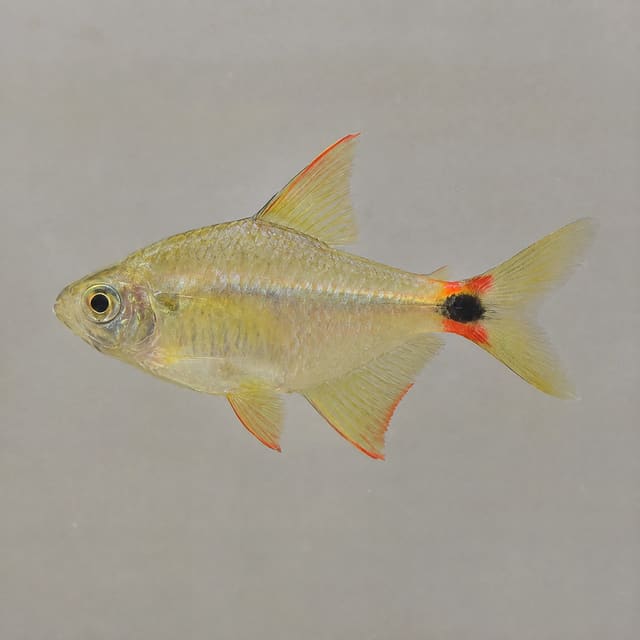
Peugeot's Tetra (Hyphessobrycon peugeoti)
22–27°C · pH 6.5–8 · 45L
£13.99
The Cherry Spot Tetra (Jupiaba sp. "Cherry Spot") is a rare, undescribed tetra from the upper Orinoco region: a lively, silvery fish of about 7 cm with a dark lateral stripe and bright red spots on the shoulder and tail root. Keep a group of eight or more in a long, planted tank with soft to medium water. Sold singly as one live fish.
Jupiaba sp. "Cherry Spot" (undescribed)
Quantity discounts are pricing offers, not a group-size recommendation. Check the full care guidance and your existing animals before choosing a quantity.
The Cherry Spot Tetra (Jupiaba sp. "Cherry Spot") is a rare, undescribed tetra from the upper Orinoco region: a lively, silvery fish of about 7 cm with a dark lateral stripe and bright red spots on the shoulder and tail root. Keep a group of eight or more in a long, planted tank with soft to medium water. Sold singly as one live fish.
Read the full care guidance when planning conditions for your aquarium.
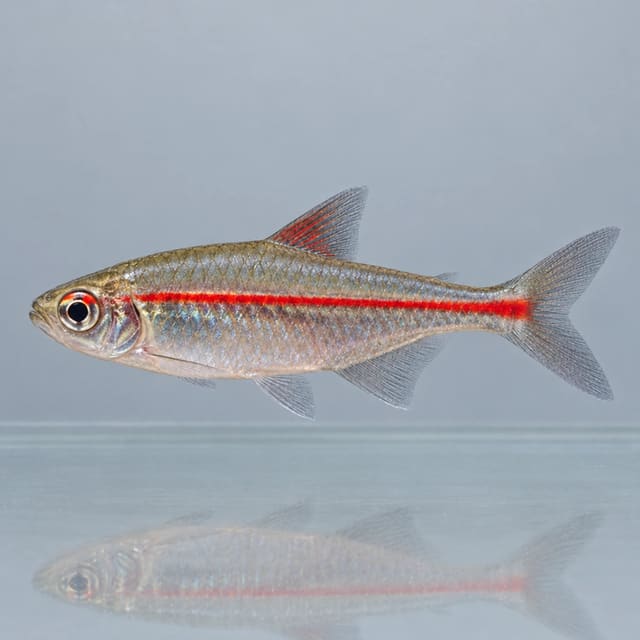
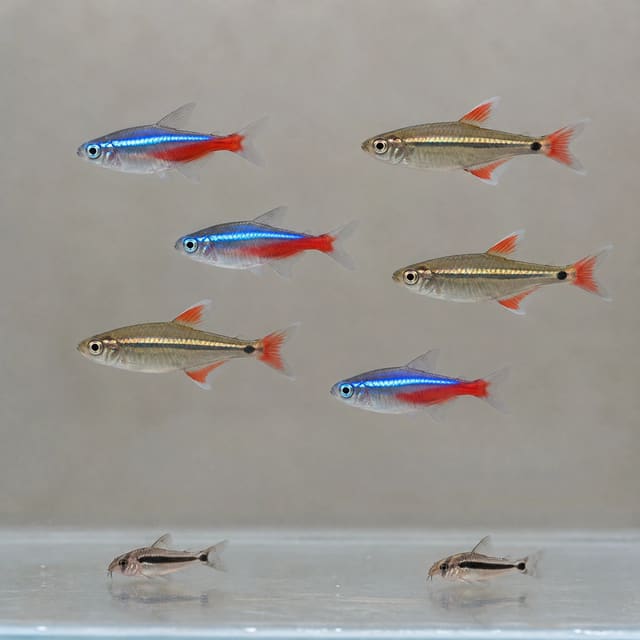
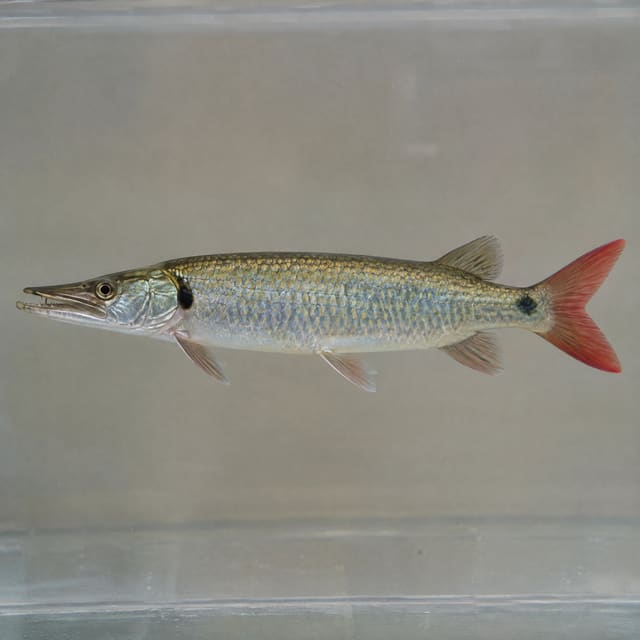
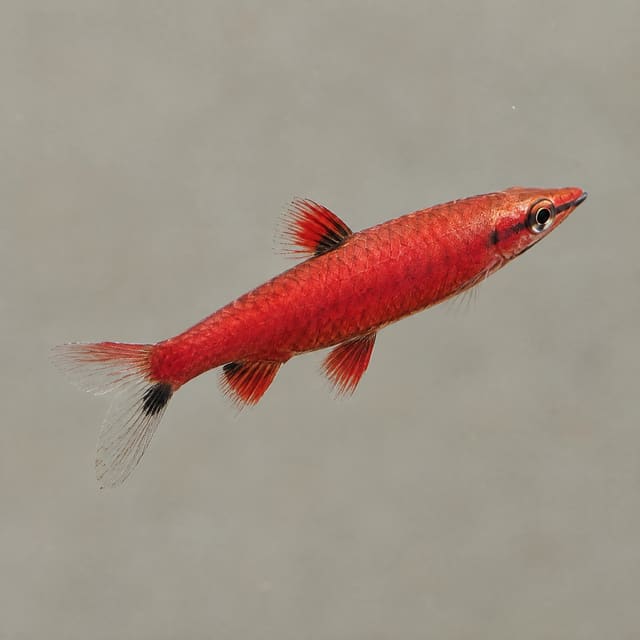
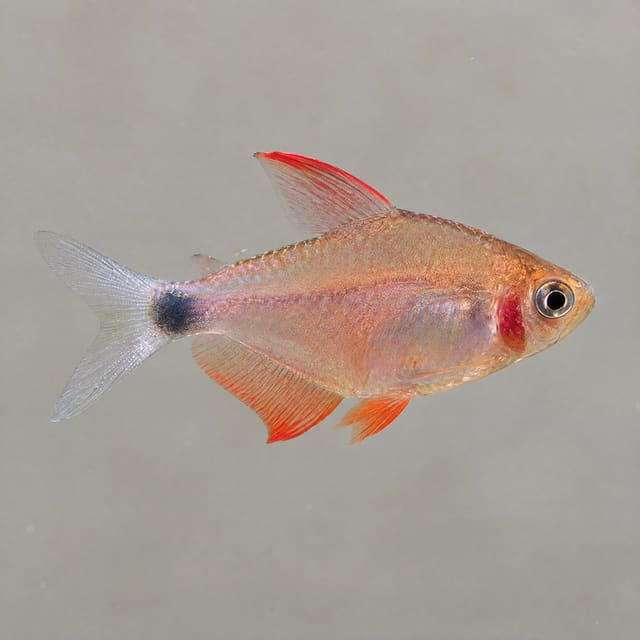
The Cherry Spot Tetra is a rare South American tetra that most fishkeepers will never have seen in a UK shop. It is a lively, silvery fish of about 7 cm with a dark stripe running along the middle of the flank, a bright cherry-red spot just behind the gill cover and a second red patch at the base of the tail. In a planted tank a group of them catches the light as it turns, and the two red marks stand out against green leaves.
This is not a fish with a long hobby history. It was first published by the German importer Aquarium Glaser, who brought it in from the upper Orinoco region in 2018 and again in 2020 under the working name Jupiaba sp. "Cherry Spot". The importer wrote that it did not resemble any species they knew, which is why it still carries "sp." instead of a full scientific name.
| Name | What it tells you |
|---|---|
| Cherry Spot Tetra | The trade name, from the red spots on the shoulder and tail root |
| Jupiaba sp. "Cherry Spot" | The importer's working name for an undescribed species |
| Jupiaba | A genus of South American tetras described by Zanata in 1997, with 29 valid species listed on Wikipedia |
| Acestrorhamphidae | The family FishBase and Wikipedia now use for Jupiaba; older books place these tetras in Characidae |
The genus placement itself is a best estimate. Aquarium Glaser explains that the fish clearly belong to the broad Astyanax group of tetras and most probably to Jupiaba, but the feature that defines the genus, a pair of elongated, sharp pelvic bones, cannot be seen in a living fish. The body shape reminded them of J. pirana and the stripe of J. anteroides. The importer also points to a black-pigmented lateral line, which they described as unique among the fish they knew, and a prominent spot at the tail root accompanied by two brilliant red spots.
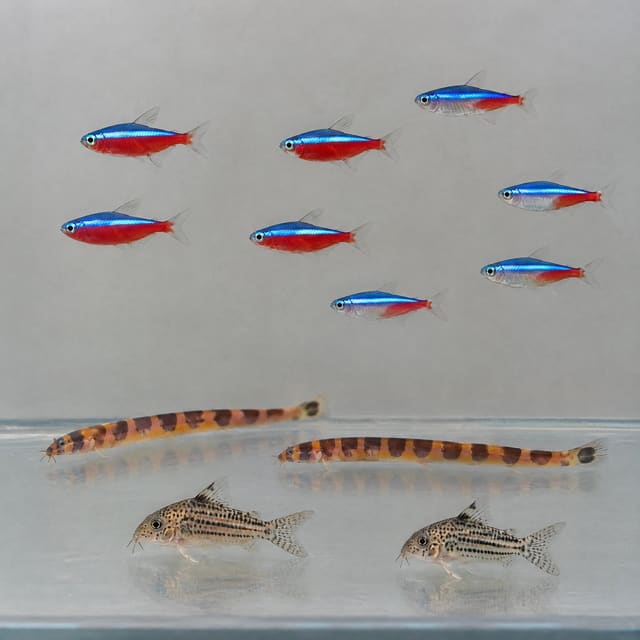
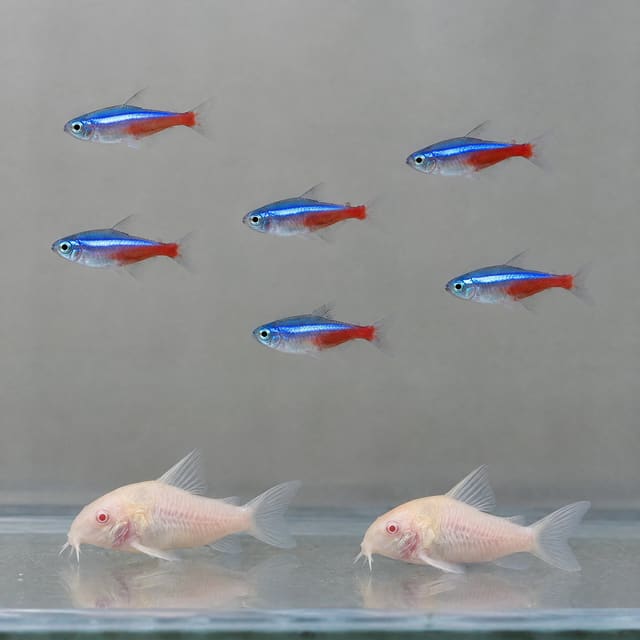
One purchase quantity supplies one live Cherry Spot Tetra, as a single fish. Order the number you want for your group in one go so the fish travel and settle together. Our photographs show the form of the fish; colour and markings vary a little between individuals, and newly moved tetras are usually paler for the first few days.
Cherry Spot Tetras are fast midwater swimmers, and the importer describes them as very lively. Length of tank matters more than height, because the group needs room to swim in a straight line and turn without hitting the glass.
A layout that gives the fish both shelter and a clear lane keeps them calm and shows their colour. Dense planting along the back and sides, with an open strip of water through the middle and front, suits most active tetras. Dark substrate and some floating plants soften the light, which helps a fish that the importer describes as slightly inclined to panic.
| Zone | What to put there | Why it helps |
|---|---|---|
| Surface | A few floating plants and a tight lid | Dims the light and stops startled fish jumping |
| Midwater | An open swimming lane along the front | Lets the group shoal and show its colour |
| Back and sides | Tall stem plants, wood and roots | Gives cover to dart into when something moves |
| Floor | Fine gravel or sand, smooth stones | Safe for corydoras and easy to siphon |
OATA also recommends placing a tropical tank away from draughts, heat sources, direct sunlight, loud noise, vibration and sudden movement. That advice matters more than usual here: a tank beside a busy door will keep a nervous tetra on edge.
Because the Cherry Spot Tetra has not been described, no one has published water measurements from its habitat. What we do know is where it was collected: small brooks near Puerto Inírida, a town on the Colombian side of the upper Orinoco basin close to the Venezuelan border. Seriously Fish describes the habitat of another characin from the same region, the red line lizard tetra, as clear and black waters that are acidic and low in minerals, including clear, sandy-bottomed streams in the Orinoco. We therefore lean towards soft to medium water rather than hard water.
| Source | Temperature | pH | General hardness | Carbonate hardness |
|---|---|---|---|---|
| OATA general tetra guidance | 22–27°C | 6.5–8.0 | 4–12°dH | 3–10°dKH |
| Habitat data for this form | not published | not published | not published | not published |
| Our suggested planning range | 24–26°C | 6.5–7.2 | 4–10°dH | 3–6°dKH |
OATA also notes that wild-caught fish may need different values from captive-bred stock, which is another reason to keep the water stable and clean rather than chase a precise number. Ammonia and nitrite must read zero, and OATA advises keeping nitrate no more than 20 mg/l above your tap water level.
UK tap water varies from very soft in much of Scotland, Wales and the north and west of England to hard in much of the south and east. If your water is hard, blend it with reverse osmosis water to bring the hardness down gradually, and test before every change. Our water chemistry care guide explains pH, GH and KH in plain terms.
A group of active 7 cm fish produces a steady load of waste, and an undescribed wild fish has no track record of tolerating poor water. A filter is essential, as OATA says, and it should be matured before the fish arrive. Moderate flow suits a fast swimmer, but leave quieter areas behind plants where the fish can rest.
Feeding studies on this exact fish do not exist, but its relatives are small predators of invertebrates. Practical Fishkeeping's report on two newly described Jupiaba species notes that one fed mainly on aquatic invertebrates and the other on invertebrates and plant material. In the aquarium that means a good dry food as the base, with frozen and live foods several times a week.
Fish that have travelled are stressed, and a nervous species benefits from a quiet arrival. OATA's floating method is simple: lights off, float the sealed bag for about 10 minutes to match temperature, then add small amounts of tank water to the bag over up to 20 minutes before netting the fish out. Practical Fishkeeping adds that after a long journey ammonia builds up in the bag and pH falls, so once the bag is open you should not drag the process out; move the fish across after temperature matching, or use an ammonia detoxifier in the bag. Our guide on how to acclimatise new fish walks through both methods.
| When | What to do | What to look for |
|---|---|---|
| Day 1 | Keep the lights off for the rest of the day; do not feed for the first few hours | Fish hiding is normal; check none have jumped |
| Day 2 | Offer a small meal of flake or daphnia | Some fish take a day or two to start eating |
| Days 3–4 | Test ammonia and nitrite | Both must read zero with the new stock added |
| Days 5–7 | Do the first weekly water change | The group should be swimming together in open water |
Practical Fishkeeping recommends a quarantine or hospital tank whatever the source of your fish. It is especially sensible for a rare, wild-collected species going into an established community.
Healthy Cherry Spot Tetras swim together in midwater with fins spread and feed eagerly. OATA lists the signs that something is wrong: hanging at the surface or sitting on the floor, faster breathing, clamped fins, flicking against objects, white spots, fluffy growths, colour that is much darker or paler than usual, and a loss of appetite.
| What you see | Likely cause | First action |
|---|---|---|
| Fast breathing, fish at the surface | Ammonia, nitrite or low oxygen | Test at once, change 25–50% of the water, increase surface movement |
| White salt-like spots, flicking | White spot | Raise the temperature gradually and treat; see our white spot treatment guide |
| Ragged fins | Nipping or poor water | Check tank mates and nitrate; separate the culprit |
| Constant hiding and dashing | Group too small, tank too busy | Add more of the same fish, more plants and a quieter position |
| Thin fish despite feeding | Outcompeted at meals or parasites | Feed in two places; quarantine and seek advice |
OATA's rule for tetras is to keep them with fish of similar size and temperament, away from fish large enough to eat them, and to keep boisterous species away from timid or long-finned fish. For this fish we add one point of our own: a busy, nervous tetra is calmer when it shares the tank with other confident schooling fish. Aquarium Glaser describes Jupiaba as medium-sized schooling fish that suit larger aquaria with cichlids and catfish.
| Suits | Avoid |
|---|---|
| Similar-sized tetras such as the Red Eye Tetra, Banded Astyanax and Two-Spot Astyanax | Large cichlids, catfish or other predators that can swallow a 7 cm tetra |
| Bottom dwellers such as Julii Corydoras and the Bristlenose Pleco | Slow, long-finned fish such as bettas and fancy guppies |
| Surface fish such as the Silver Hatchetfish in a long tank | Very small nano fish, and shrimp colonies you want to breed |
| Peaceful medium-sized South American cichlids | Fin-nippers and aggressive fish that would keep the group hiding |
Before you buy, run your planned mix through our tank mate checker, and browse the South American tetra category or our wider tetra range for fish of a matching size. The tetra buying guide explains how tetras of different sizes mix.
Undescribed fish come with honest gaps. For the Cherry Spot Tetra nobody has published the adult size, how to tell males from females, or how it breeds. Within the genus, FishBase gives Jupiaba pirana a maximum of 4.4 cm standard length and J. anteroides 7.5 cm, while Aquarium Glaser describes the genus as medium-sized schooling fish of 10–15 cm. These figures do not agree, partly because standard length leaves out the tail, so plan your tank for a fish of at least 7 cm.
OATA notes that tetras rarely breed successfully in a community tank and that, where they do spawn, eggs hatch within a couple of days. If your group shows clear colour or shape differences as it matures, or if you see spawning behaviour among the plants, note it down: observations from keepers are how fish like this become better understood.
It is an undescribed South American tetra traded as Jupiaba sp. "Cherry Spot". Aquarium Glaser, the German importer that first published it, reports fish of about 7 cm from small brooks near Puerto Inírida in the upper Orinoco region, with a dark lateral line, a spot at the tail root and two bright red spots.
No. "sp." means the species has not been formally named. The importer places it in Jupiaba by body shape, but notes that the feature that defines the genus, elongated sharp pelvic bones, cannot be seen in a living fish.
Imported fish measured about 7 cm. The adult size is not documented. Related Jupiaba range from 4.4 cm standard length (J. pirana) to 7.5 cm (J. anteroides) on FishBase, so plan for a fish of 7 cm or a little more.
OATA advises at least five of any tetra and says more is better. Because this fish is lively and slightly nervous, we suggest a group of eight or more in a tank at least 100 cm long.
Nobody has published water values for this form. Use the general tetra range from OATA (22–27°C, pH 6.5–8.0, 4–12°dH) and aim for the softer, slightly acidic half of it: about 24–26°C, pH 6.5–7.2 and 4–10°dH.
Yes, with tank mates of similar size and temperament. Avoid very small nano fish, slow long-finned fish and large predators, and keep it in a full group so it stays confident.
The importer notes a slight tendency to panic. A secure lid, dim lights for the first day, plants along the back and sides, and a calm spot away from doors all help a new group settle.
Adult cherry or Amano shrimp are usually too big for a tetra of this size, but baby shrimp and tiny fry may be eaten. Keep a breeding shrimp colony in its own tank.
No reviews for this item yet. Bought one? Honest reviews only, good or bad.
What customers say about ordering from us
Easy website plenty of info on fish your buying great to pick a time slot
TRACEY DURRANT · 7 Oct 2026
Got some lovely fish thank you
Kevin Mackie · 7 Oct 2026
Reviews of our shop, collected by Judge.me, an independent third-party review collector. Newest first.
Moved by UK carriers licensed to handle live animals
Hand-packed with oxygen bags, poly box, heat pack
Email photos the same day; an optional unboxing video helps us review problems faster — claim terms apply
Klarna & PayPal Pay in 3 at checkout