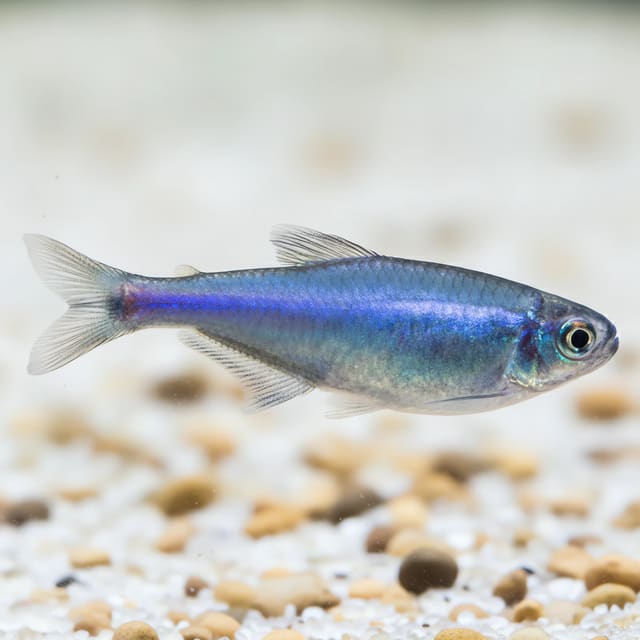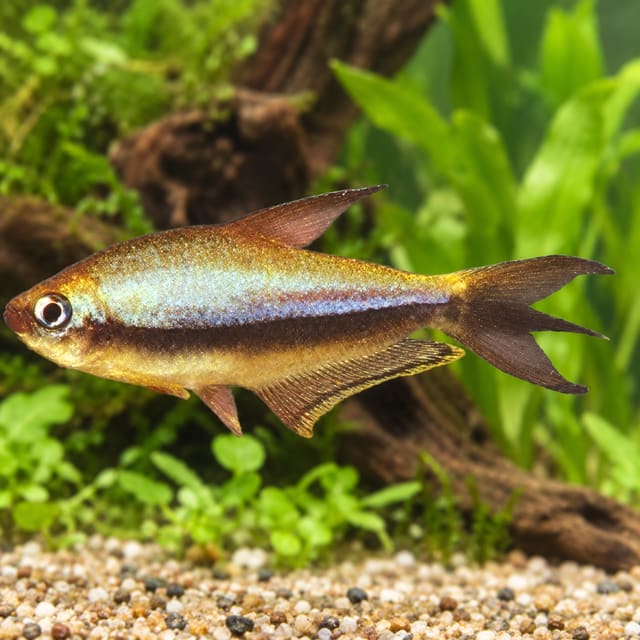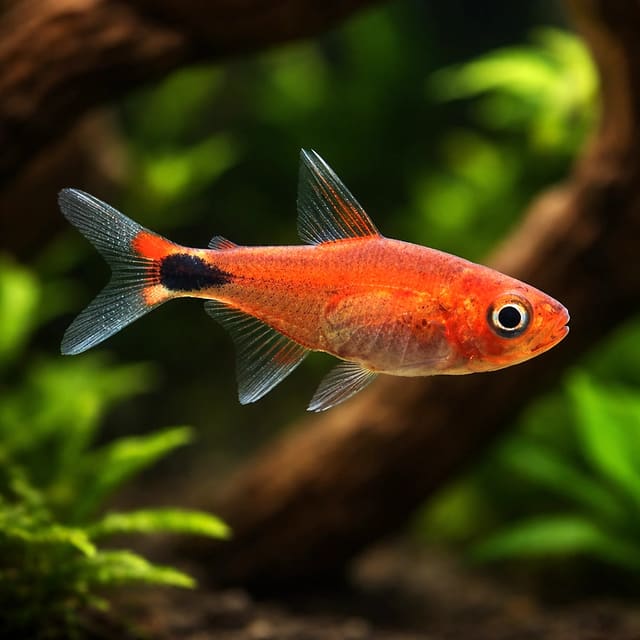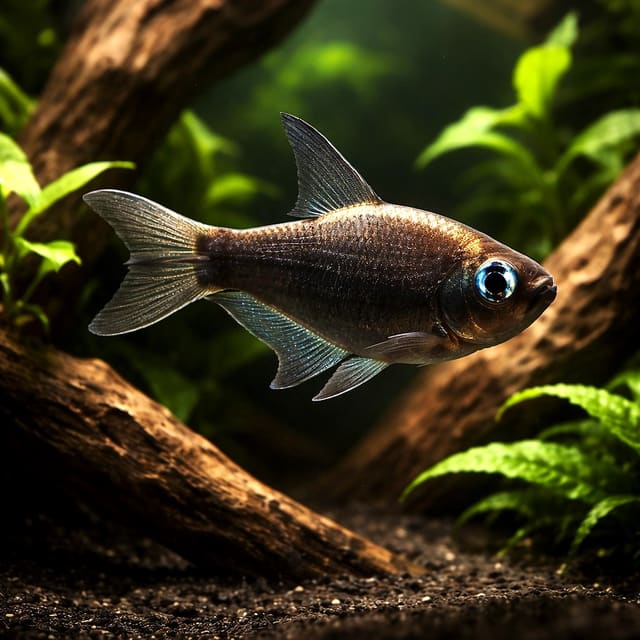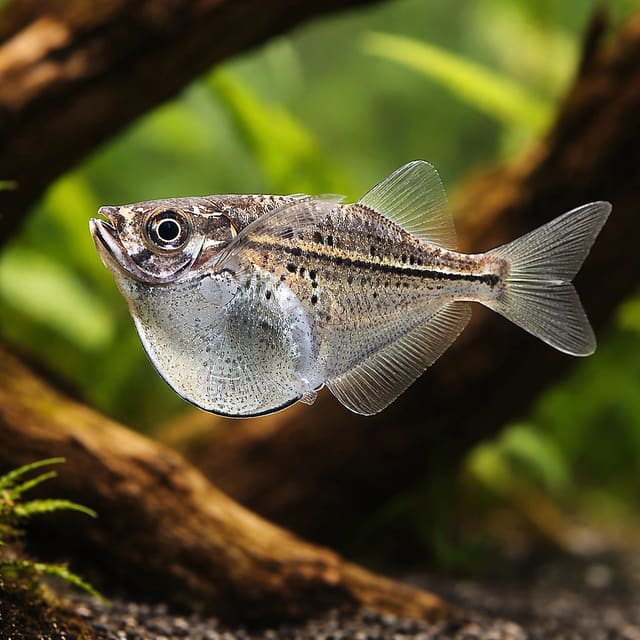
Blackwing hatchetfish (Carnegiella marthae)
23–27°C · pH 5.5–6.5 · 54L
£5.99

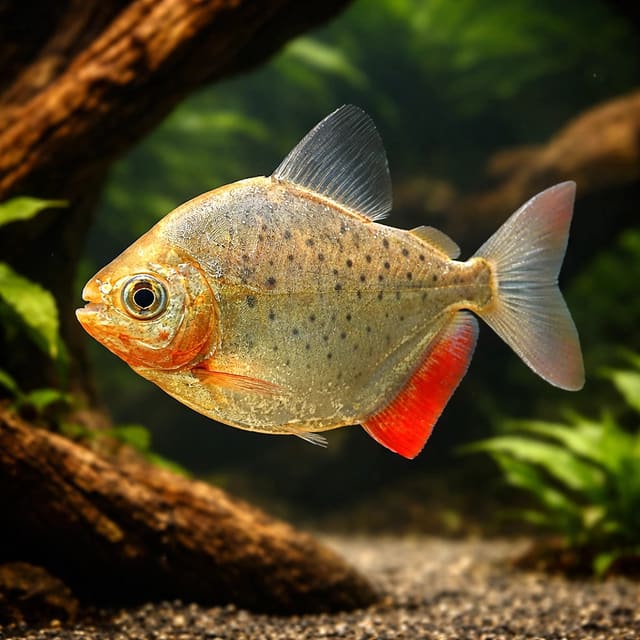
Schreitmüller's Silver Dollar (Metynnis hypsauchen) is a deep-bodied South American schooling fish for a long, mature aquarium. One purchase supplies one live fish in the chosen 2 cm, 3–3.5 cm, 4–5 cm, 5.5–6 cm, 7–9 cm or XL size; FishBase records 18 cm standard length for adults.
Adult size is the maximum length this species reaches at full maturity (scientific sources). The livestock you receive will be younger and smaller — pick a size above for the actual shipping size. Product-photo provenance and any image-specific limitations are stated on the listing.
Metynnis hypsauchen
Shoaling fish: kept in a group they feel safer, stay calmer and show their best colour.
Schreitmüller's Silver Dollar (Metynnis hypsauchen) is a deep-bodied South American schooling fish for a long, mature aquarium. One purchase supplies one live fish in the chosen 2 cm, 3–3.5 cm, 4–5 cm, 5.5–6 cm, 7–9 cm or XL size; FishBase records 18 cm standard length for adults.
Adult size is the maximum length this species reaches at full maturity (scientific sources). The livestock you receive will be younger and smaller — pick a size above for the actual shipping size. Product-photo provenance and any image-specific limitations are stated on the listing.
Maintain these water conditions for optimal health and vibrant colors
Schreitmüller's Silver Dollar (Metynnis hypsauchen) is a deep-bodied South American schooling fish from the family Serrasalmidae. A settled group brings coordinated movement to the middle and upper levels of a large aquarium, but the adult space, group size and feeding load are very different from those of a small community tetra.
This listing uses the accepted species identity Metynnis hypsauchen and the long-standing trade name Schreitmüller's Silver Dollar. FishBase also uses the common name Silver dollar. Similar-looking Metynnis are sold under overlapping common names, so the scientific identity matters more than a loose shop label or an impression formed from one image.
| Sold unit | One live fish per purchase |
|---|---|
| Size choices | 2 cm, 3–3.5 cm, 4–5 cm, 5.5–6 cm, 7–9 cm and XL |
| Adult size records | FishBase: 18 cm standard length, male/unsexed; Seriously Fish: 150 mm standard length |
| Adult group | At least five under the species profile |
| Adult aquarium plan | At least a 180 × 38 cm base and about 260 litres for a group, with length and width prioritised over height |
| Water | 24–28°C, pH 6.0–7.0 and up to 10 dGH in the species profile |
The size you select is the size supplied, not the adult size. A small juvenile still needs a credible route to the adult aquarium and complete social group. The centimetres in the live selector describe dispatch size; standard length records describe the fish from the snout to the base of the tail. The two standard-length records remain separate; neither is converted to total length.
Sex is guaranteed only when the selected option explicitly states male or female. This Schreitmüller's Silver Dollar listing has no sex-guaranteed option.
| Suits | Less suitable for |
|---|---|
| Keepers with a long, mature aquarium and room for at least five adults | Anyone planning to keep a single fish in a standard small community tank |
| People who can provide open swimming space, dimmer refuge and secure cover | A narrow aquarium filled edge to edge with sharp hardscape |
| Aquarists comfortable with a vegetable-rich diet and regular removal of leftovers | Displays where delicate live plants must remain untouched |
| Communities of larger peaceful fish with genuinely overlapping water needs | Very small fish that may be eaten or aggressive companions that keep the group unsettled |
| Keepers ready to size filtration for an adult group and monitor water trends | A temporary juvenile tank without a funded adult plan |
The store assessment is intermediate because water values are straightforward but adult space, schooling, appetite and startle behaviour demand planning. This is not a fish to buy first and rehome later if growth becomes inconvenient.
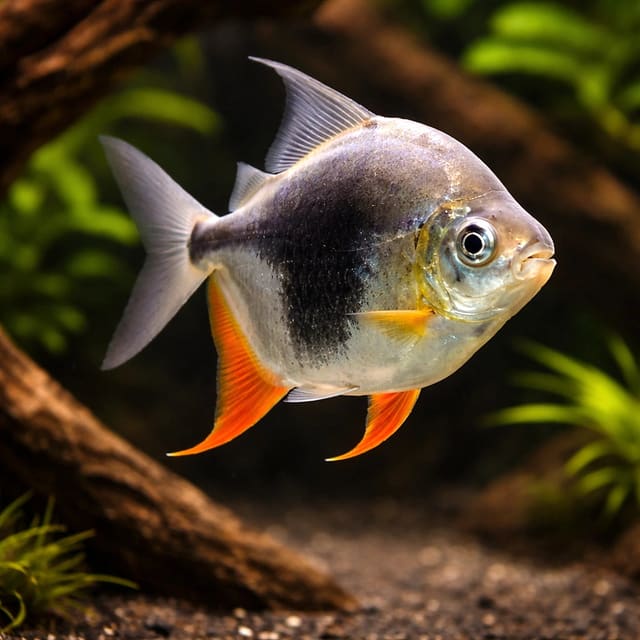
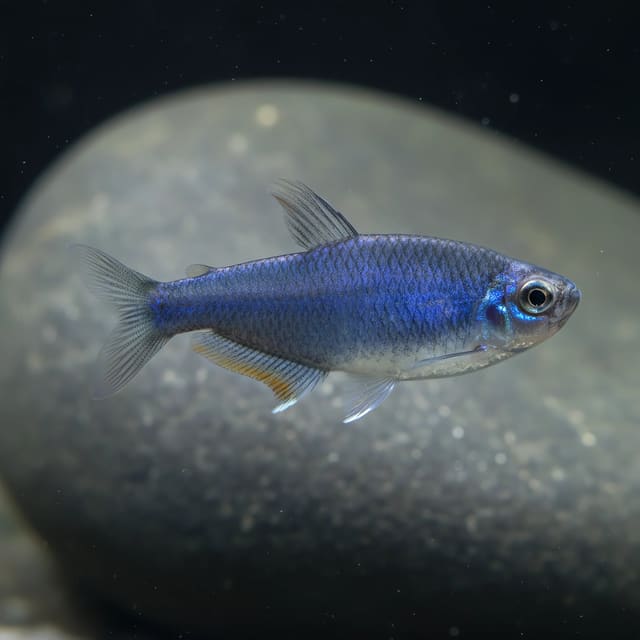
Gallery images have been digitally enhanced to improve image quality. Natural colour, pattern, size and maturity can vary between live animals.
For a broader look at smaller characiform choices, browse the current tetra collection. Treat that as navigation, not a compatibility list for this much larger fish.
FishBase records Metynnis hypsauchen from the Amazon and Paraguay River basins and rivers north of the Guiana Shield. The family is Serrasalmidae, alongside piranhas and pacus, even though retailers often place silver dollars near tetras for shopping convenience.
Two useful adult-length records have different values but the same measuring convention. FishBase gives a maximum of 18 cm standard length for male/unsexed fish. Seriously Fish gives 150 mm standard length. Standard length excludes the tail, so neither figure should be relabelled as total length. The larger FishBase record is retained for growth planning, while the specialist profile's 150 mm record remains visible as its own scoped observation.
Seriously Fish recommends an aquarium at least 180 × 38 × 38 cm, approximately 260 litres, for a group of adults. Its guidance emphasises that length and width matter more than height. The base gives the group room to turn, maintain spacing and move together; litres alone can hide an aquarium that is too short or too narrow.
Keep at least five fish. A complete group allows normal schooling movement and spreads social attention. One or two may appear manageable while young, but an undersized group can be nervous and is not a responsible way to reduce the required aquarium space.
| Planning question | Practical decision |
|---|---|
| Is the aquarium at least 180 cm long? | Use the specialist species footprint rather than relying on nominal volume alone |
| Is the front-to-back width at least 38 cm? | Allow for the adult fish's deep body and group turning space |
| Can at least five adults live there? | Calculate filtration, feeding and companion space for the whole group |
| Is the aquarium mature? | Prove biological filtration with measured zero ammonia and nitrite before arrival |
| Is there a secure cover? | Close escape gaps while keeping equipment and gas exchange safe |
Juveniles can be housed in smaller aquaria according to the species profile, but that does not make a temporary tank the long-term plan. Set a clear move date based on growth and group space, and have the adult aquarium running before the current tank becomes restrictive. A promise to upgrade later is useful only when the location, budget and equipment already exist.
Silver dollars can be nervous. Use dimmer lighting, shaded retreat areas and a broad open route through the middle and upper water. Smooth wood and stable rounded stone can give structure without creating narrow traps. Keep sharp points, exposed fixings and unstable rock away from the path of a startled fish.
Living plants may be eaten. The species profile suggests hardy plants, while acknowledging that even those may need replacement; fabric or silk-style artificial plants can provide visual cover without being consumed. Leave enough open surface for feeding and gas exchange, and anchor every decoration securely.
Position the aquarium where sudden movement is limited. Bring room lighting up before the main aquarium light when possible, and avoid abrupt darkness. A calm routine helps the group use the full aquarium instead of spending the day pressed into one refuge.
A large tank still needs a mature filter. The RSPCA's aquarium environment guidance explains that beneficial bacteria convert toxic ammonia to nitrite and then nitrate. Confirm zero ammonia and nitrite, track nitrate and stock gradually so filtration can respond to added feeding and waste.
The fish's appetite and vegetable foods can create fine debris. Combine dependable biological media with mechanical capture that is easy to service. Provide circulation across the aquarium without forcing the group to fight one relentless jet, and maintain strong gas exchange at the surface.
If this is your first large tropical aquarium, work through the first tropical tank setup guide before choosing livestock. The fish should enter a demonstrated mature system, not become the test of whether the cycle worked.
The Seriously Fish species profile gives 24–28°C, pH 6.0–7.0 and 0–10 dGH for Metynnis hypsauchen. FishBase records the same temperature and pH as environmental values and gives hardness up to 10 dH. Choose a stable point compatible with the fish already present instead of making repeated rapid corrections.
Measure the aquarium, not a postcode assumption. Source water can vary, and substrate, stone, top-ups, wood and biological activity may change the tank. The water parameters guide explains temperature, pH and hardness in practical terms; the water matcher can compare the values you actually measured.
Warmer water holds less oxygen, while a large active group and generous feeding increase demand. Maintain surface movement, unobstructed flow and clean mechanical media. Watch the fish during the warmest part of the day and after feeding, not only when the room is cool and quiet.
OATA's broad tetra and pencilfish care sheet strongly recommends a 25% partial water change at least weekly, regular testing and filter checks. That is group-level guidance rather than a species-specific optimum, but the routine is useful for planning. Increase or refine maintenance from measured nitrate, feeding, stocking and source-water results.
A water log need not be complicated. Date, readings, change volume, food changes and one sentence about behaviour are enough to reveal a trend. If the group becomes less confident or feeds poorly, those notes help separate a sudden equipment fault from a slow increase in waste or an unsuitable companion.
Seriously Fish recommends a large amount of vegetable matter, naming courgette, cucumber, peas, spring greens and other green vegetables. It also recommends algae wafers, spirulina and vegetable flake, while noting that silver dollars accept many aquarium foods and can receive treats such as bloodworm and brine shrimp.
The useful description is plant-forward omnivore. Vegetable matter and plant-based prepared foods form the foundation; suitable invertebrate foods add variety rather than becoming the main ration. That balance supports the species' feeding pattern without creating an unnecessarily rich, waste-heavy diet.
| Food role | Examples and use |
|---|---|
| Prepared plant staple | Vegetable flake, spirulina foods and algae wafers distributed across the group |
| Fresh vegetable matter | Clean courgette, cucumber, peas or spring greens in measured portions |
| Occasional variety | Suitable bloodworm or brine shrimp offered sparingly |
| Observation | Check that shy fish feed and remove fresh food before it decays |
Offer portions the group can finish without leaving vegetables to soften and foul the aquarium. Feeding response is information: one bold fish taking everything, a smaller fish hanging back or a sudden whole-group refusal each deserves a different response. Spread foods across more than one area and watch from a distance before assuming every fish has eaten.
Plant grazing is normal. It does not automatically mean the prepared ration is deficient. If keeping live plants is important, use robust choices in small amounts and expect losses. Wood, stone, open swimming room and artificial cover can form a reliable aquascape without depending on delicate stems.
If several fish change together, test water and inspect equipment first. If one fish changes, compare it with the rest of the group and review injury, competition and recent additions. Avoid treating a vague sign with several medicines at once; accurate observation and water results give the next decision a firmer basis.
FishBase warns that the species has powerful dentition capable of serious bites. Use a net or suitable container rather than handling a large fish with bare hands, and take care during maintenance around a feeding group. This is a practical handling warning, not a claim that the species is aggressive toward suitable tank mates.
The six live choices describe the fish at dispatch, while the adult records describe a different planning horizon. The FishBase species record gives a maximum of 18 cm standard length for male/unsexed Metynnis hypsauchen. The Seriously Fish profile records 150 mm standard length. Keep both records in their original scope: standard length runs from the snout to the base of the tail, so it is not interchangeable with an overall measurement that includes the tail.
A regular review is more useful than waiting until the fish obviously look crowded. Watch how the complete group turns, accelerates and separates around feeding. Check whether the broadest fish can change direction without brushing decorations or another fish, and whether every animal can use an open route rather than queuing through one narrow gap. Body depth matters here: a deep-bodied fish can need more practical turning room than a slender fish of similar measured length.
The 18 cm FishBase maximum provides the cautious capacity figure in this listing; it does not predict the final size of an individual fish. The separate 150 mm specialist record remains useful context, but choosing the smaller figure to justify a shorter aquarium would discard the larger verified record. Plan the adult group around the long 180 × 38 cm base and approximately 260 litres described by the species profile, then use observed growth to decide when a juvenile holding arrangement must end.
| Review and record | Decision it supports |
|---|---|
| On dispatch day, note the selected size band and date, and keep a clear side photograph | Confirms the starting point without treating it as adult size |
| Monthly, note standard length where it can be estimated without handling, body depth and condition | Shows whether the current space and ration still suit the fish |
| Observe group turning, spacing, the startle route and access to refuge | Reveals practical crowding that litres alone may miss |
| Record which fish reach staple and vegetable foods | Helps correct unequal access before condition diverges |
| Record nitrate trend, filter flow and maintenance demand | Tests whether equipment and routine support the growing biomass |
Do not chase an exact measurement by netting a healthy fish simply to update a notebook. Consistent photographs against a known feature of the aquarium and observation of movement can be enough for routine planning. If the current aquarium is temporary, set the transfer trigger before it is reached: adult tank installed, cycled, covered and able to hold the complete group.
The XL choice has no verified centimetre value in the supplied offer. Treat XL as the named shop option, not as a hidden promise about length. Confirm the current specimen details before using that choice to match an established group. The numbered choices remain the clearer options when a particular dispatch band matters.
A successful setup is not only a tank of the stated dimensions. It is an operating plan for at least five large, active fish: enough open water for coordinated movement, shaded refuge, filtration that copes with their food, and a routine that finds change early. Write the plan for the whole group even if juveniles arrive in stages.
Build the layout from the swimming route outward. First reserve a broad middle and upper lane along most of the aquarium length. Add smooth wood, rounded stone or robust cover around that lane rather than across it. View the aquarium from both ends to find pinch points that are easy to miss from the front. A branch, intake cage or plant mass that looks decorative can still interrupt a group's turn.
Give nervous fish more than one direction of retreat. One dense refuge at the end of the aquarium can cause the whole group to compress there when startled; distributed cover and subdued areas allow individuals to settle without losing the main route. Fasten hardscape and keep the cover secure. Check openings again after moving cables, filters or feeding hatches.
Fresh vegetables and soft plant foods make leftover control part of water care. Start with a measured portion, note how quickly the group reaches it and remove uneaten material before it breaks down. Use more than one feeding point so a confident fish cannot dominate every item. If food repeatedly reaches the filter intake or collects behind wood, change the feeding position or flow rather than accepting a permanent debris pocket.
Judge filtration by results rather than motor size. Clear water does not prove that ammonia and nitrite are safe, and a quoted flow rate does not prove water reaches the whole aquarium. Combine test results with a visual check of circulation, surface movement and captured waste. Service mechanical media when flow declines, while preserving established biological media and avoiding simultaneous disruption of every filter component.
| Signal and expected routine | Response to a change |
|---|---|
| Group position: fish use open and sheltered areas | Check disturbance, companion pressure, layout and water |
| Breathing: similar across the group | Test water and review temperature, oxygen and flow promptly |
| Feeding access: every fish reaches appropriate food | Spread the ration and watch for exclusion or illness |
| Ammonia and nitrite: zero on the test used | Stop adding load and correct the water-quality problem |
| Nitrate: stable within the aquarium.s managed trend | Review portion size, debris removal and water-change frequency |
| Filter flow: consistent surface movement and circulation | Inspect intakes and service clogged mechanical media |
Review several signals together. Fish hiding after a sudden room disturbance with normal tests is a different pattern from group-wide heavy breathing, weak surface movement and a rising temperature. Recording the time, recent feeding, maintenance and readings makes that distinction easier and discourages a string of unrelated changes.
Have a separation option ready before adding companions. It should be suitable for the animal's size and water needs, not an unheated bucket treated as a long stay. The plan is there for persistent aggression, injury or an unexpected feeding conflict; its existence does not turn an unsuitable community into an acceptable experiment.
Metynnis hypsauchen is generally peaceful, but an adult is large, fast and powerful at feeding time. Seriously Fish recommends other larger peaceful species and warns that much smaller fish may be eaten. Compatibility therefore begins with adult scale, shared water values and enough room for every species.
| More suitable direction | Caution or avoid |
|---|---|
| Larger peaceful fish with the same 24–28°C, pH 6.0–7.0 and soft-water plan | Very small fish that can be treated as food |
| Larger peaceful catfish, including suitable plecos and doradids named by the species profile | Aggressive or persistently territorial fish that prevent the group settling |
| Bottom-dwelling companions where the aquarium footprint supports both groups | Slow feeders likely to be outcompeted by a fast schooling fish |
| Robust aquascapes with open middle and upper water | Communities dependent on delicate plants remaining untouched |
The word peaceful does not remove the need for observation. A companion may share water values yet compete at food, occupy the same swimming lane or trigger repeated startle responses. Research the adult size and normal behaviour of every species, then assess the complete aquarium rather than approving pairs in isolation.
The minimum group applies to Metynnis hypsauchen. Mixing one or two fish from several silver dollar species does not automatically create the same social unit, and uncertain identification can make later group management harder. Keep purchase records and clear photographs, especially when adding to an established group.
Likewise, smaller tetras are not direct alternatives for a keeper who specifically wants this adult fish; they represent a different aquarium scale. If the available aquarium cannot support the adult footprint, choosing a genuinely smaller species is better than attempting to compress the Silver Dollar's group.
Silver dollars mainly occupy the middle and top. A bottom-dwelling companion can reduce direct competition for swimming space, but food still has to reach it. Deliver foods deliberately and observe the slowest animal. Refuge should allow a fish to withdraw without becoming trapped behind hardscape.
Prepare the aquarium before the delivery day. Confirm temperature, zero ammonia and nitrite, acceptable nitrate, secure cover and normal filter flow. Complete disruptive maintenance early enough for the aquarium to settle before the fish arrives.
Follow the current order guidance and keep changes gradual. The store policy advises floating the bag for 20–30 minutes before release. Never pour transport water into the aquarium. Keep the transfer to the stated store procedure; normal room activity can remain calm while attention stays on the measured steps.
During the first week, watch feeding access, breathing, schooling, fins and skin. A new fish that remains isolated or repeatedly collides with the glass needs prompt water, oxygen, group-security and injury checks. Do not assume every startle response is disease, but do not ignore a sustained departure from the rest of the group.
Keep wet equipment clean and avoid sharing nets or siphons between aquariums without an appropriate hygiene routine. Record the introduction date and any signs. A short note is valuable if behaviour changes later because it identifies which addition or maintenance event came first.
FishBase records Metynnis hypsauchen to 18 cm standard length for male/unsexed fish, while Seriously Fish lists 150 mm standard length. Both measurements exclude the tail; they are retained as separately scoped records and neither is converted to total length.
Seriously Fish recommends at least a 180 × 38 cm base and about 260 litres for an adult group. Length and width matter more than height because these deep-bodied fish need room to turn and school.
Keep at least five. The species profile treats this as a social schooling fish, so one or two are not a responsible shortcut for reducing adult aquarium space.
It receives an intermediate store assessment. The water range is manageable, but the adult footprint, group requirement, vegetable-rich feeding, plant grazing and startle behaviour suit a prepared keeper with a mature large aquarium.
Make vegetable matter the foundation, using foods such as courgette, cucumber, peas, spring greens, spirulina, vegetable flake and algae wafers. Suitable bloodworm or brine shrimp can be occasional variety; remove fresh leftovers before they spoil.
The Seriously Fish species profile gives 24–28°C, pH 6.0–7.0 and 0–10 dGH. Match companions to the same range, test the aquarium and make necessary changes gradually.
The species profile describes it as generally peaceful with larger peaceful fish. Its size and speed still demand robust companions, ample room and observation; very small fish may be eaten.
Consider larger peaceful fish and suitable larger catfish, including compatible plecos or doradids, in a sufficiently spacious aquarium. Avoid bite-sized fish and any companion whose water needs, temperament or feeding speed conflicts with the group.
Tropical Fish Co hand-packs live fish in oxygenated bags, an insulated box and a heat pack when weather calls for it, using a licensed live-animal courier. Read the current delivery and Live Arrival Guarantee policy; for a claim, contact the team the same day with the order number and a continuous unboxing video that begins with the parcel sealed and shows the fish in the bag.
Numbers are labelled by measurement and source so the larger FishBase maximum, the specialist care record and the dispatch sizes remain distinct.
No reviews for this item yet. Bought one? Honest reviews only, good or bad.
What customers say about ordering from us
I have a small group of long finned mountain minnows. So was delighted to be able to order ten of this variety to increase the genetics in my tank . The ones I recieved are healthy but it’s to early to give a verdict on wether they are of a long finned type since they are small currently.
Gordon Walker · 23 Sept 2026
100% success travel and "installation". Pleased with quality of purchase. The Siamese fighter a bit "shy" so have not yet seen him at his best yet but looking good. Happy customer. GG
George E Garratt · 21 Sept 2026
Reviews of our shop, collected by Judge.me, an independent third-party review collector. Newest first.