−15%
Red Turquoise Discus (Symphysodon spp.)
26–30°C · pH 6–7.5
£37.99£53.99

The Blue Snakeskin Discus (Symphysodon spp.) is a freshwater cichlid colour form from a genus native to Brazil’s Amazon basin. It suits experienced keepers; OATA’s discus guidance calls for groups of at least five, 26–30°C, pH 6.0–7.5 and 4–12°dH. Sold individually in labelled dispatch sizes from 2cm to 14 cm (18 cm), plus XL selection HQ.
Symphysodon spp.
Save when buying multiple fish. Each quantity is one fish; sex and pair formation are not guaranteed unless the selected variant explicitly states them.
The Blue Snakeskin Discus (Symphysodon spp.) is a freshwater cichlid colour form from a genus native to Brazil’s Amazon basin. It suits experienced keepers; OATA’s discus guidance calls for groups of at least five, 26–30°C, pH 6.0–7.5 and 4–12°dH. Sold individually in labelled dispatch sizes from 2cm to 14 cm (18 cm), plus XL selection HQ.
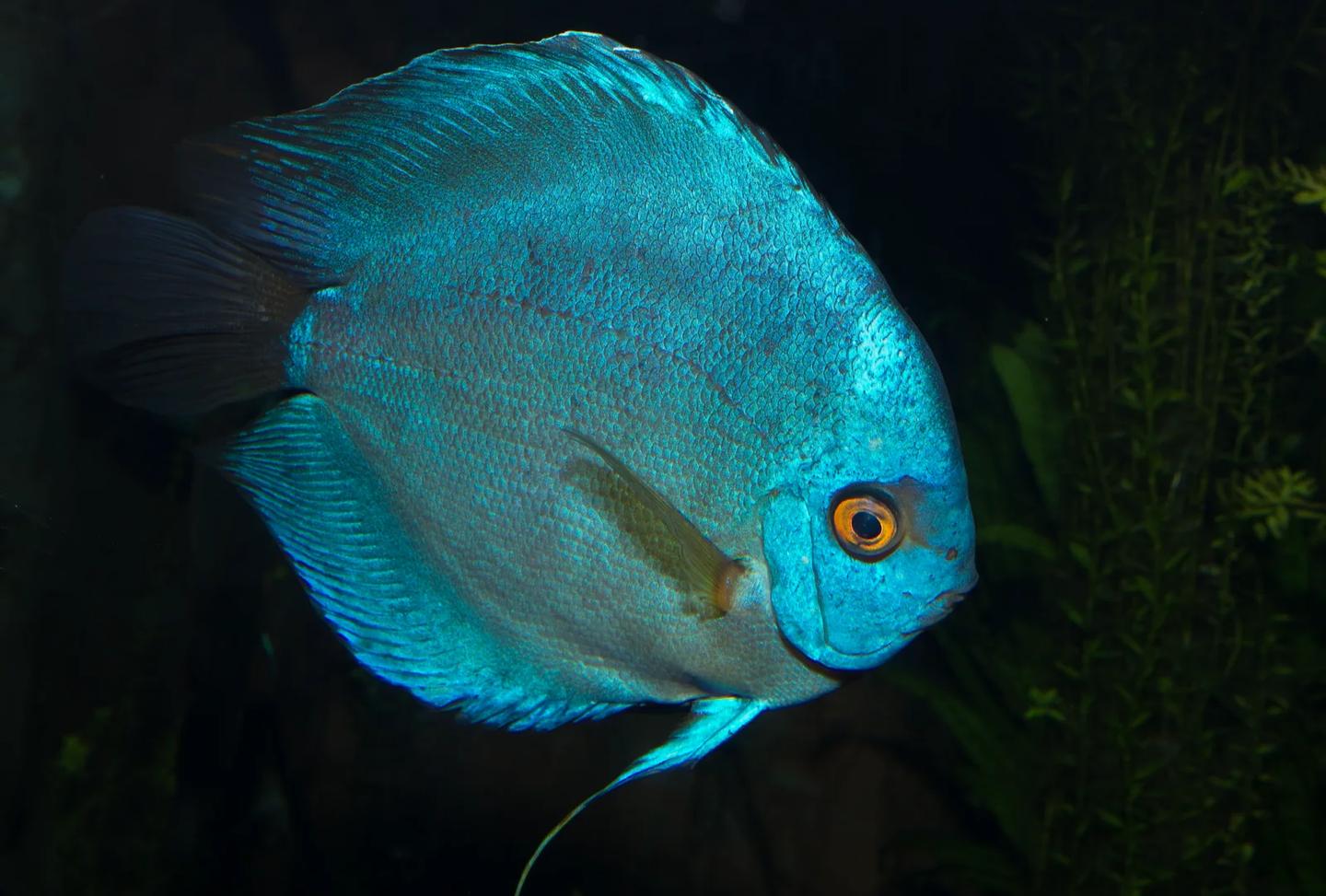
Discus are social Amazonian cichlids with specialised aquarium needs. OATA advises at least five fish, except an established breeding pair, and about 50 litres per adult—roughly 300 litres for six adults. Use that as a planning floor, then check usable dimensions, filtration, source water and the actual fish.
Maintain these water conditions for optimal health and vibrant colors
The Blue Snakeskin Discus (Symphysodon spp.) is a freshwater cichlid colour form from a genus native to the Amazon river basin in Brazil. WoRMS places Symphysodon in the family Cichlidae, while Wikipedia describes the genus as calm, distinctively shaped and represented by many bright aquarium colours and patterns. This is a rewarding choice for an experienced keeper who can maintain warm, clean water, a mature biological filter and a properly planned social group.
We class this as advanced care because discus need more specific water conditions than many tropical fish and depend on consistent testing, maintenance and feeding. Keep them at 26–30°C, pH 6.0–7.5 and 4–12°dH, with ammonia and nitrite at 0 mg/l and nitrate no higher than 20 mg/l. OATA’s discus guidance gives these as group-level aquarium values, so use them as the working range for this genus-level identity and concentrate on keeping readings stable.
Discus are shoaling fish. Keep at least five together, with more being better where aquarium capacity permits. OATA explains that discus kept singly or in too small a group will often become stressed or bullied by larger, more dominant fish. A pair is a separate arrangement that applies only to two fish already established as a breeding pair; two newly chosen fish should not be treated as one.
| Suits | Not suited to |
|---|---|
| Experienced keepers who test water and maintain a mature filter | A newly filled or biologically immature aquarium |
| A planned group of at least five discus | Keeping one discus alone or in a group of fewer than five |
| Warm water maintained at 26–30°C | An aquarium intended for animals needing cooler conditions |
| Generous floor space, cover and open group swimming room | A cramped layout without room for the group to move together |
Begin with the group, water and space decisions rather than choosing on colour alone. OATA recommends 50 litres of water volume for each adult discus and gives approximately 300 litres as an example for six adults. Those figures must also leave enough floor space for feeding, shelter and open swimming.
One purchase supplies one Blue Snakeskin Discus in the size label selected. Use the live size selector to choose among labels such as 2cm, 6cm, 10cm, 12cm, 14 cm (18 cm) and XL selection HQ. Read a bracketed entry as one complete catalogue label. XL selection HQ is a nonnumeric label, so it should not be treated as a centimetre measurement, a sex description or a breeding-pair designation.
The size you select is the size supplied, not the adult size. A dispatch label is there to help you plan transport into an existing group, feeding access and the immediate amount of growing room. Size alone does not show a fish’s sex or origin. Compare the chosen label with the fish already in the aquarium and make sure every member of the group will have practical access to food and shelter.
The exact species has not been identified, so the care advice here follows the genus Symphysodon and its care group. The scientific label therefore remains Symphysodon spp. rather than assigning one species to every fish sold under this colour-form name.
Sex is guaranteed only when the selected option explicitly states male or female. This Blue Snakeskin Discus listing has no sex-guaranteed option.
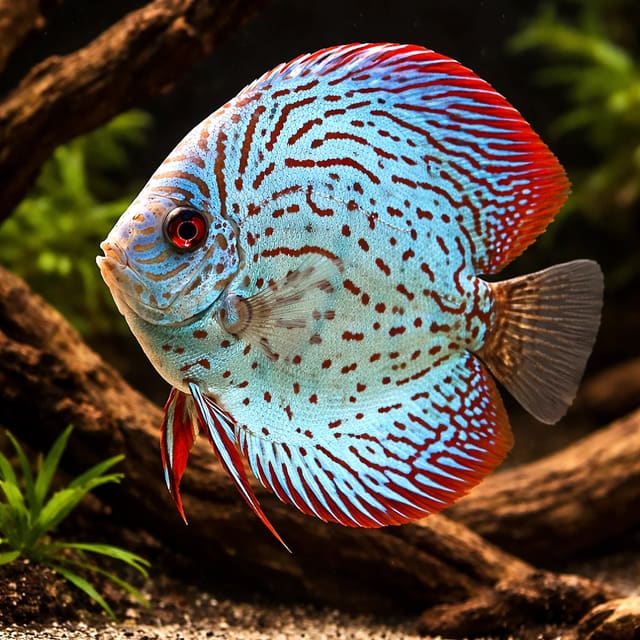
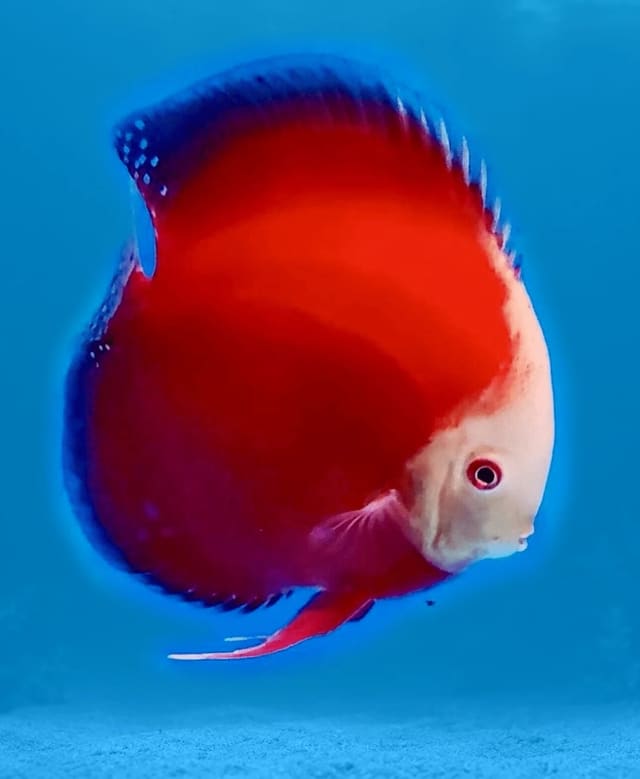
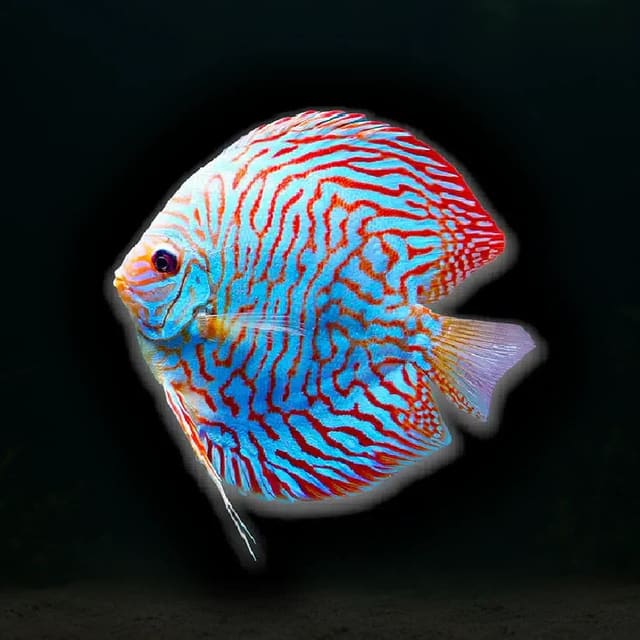
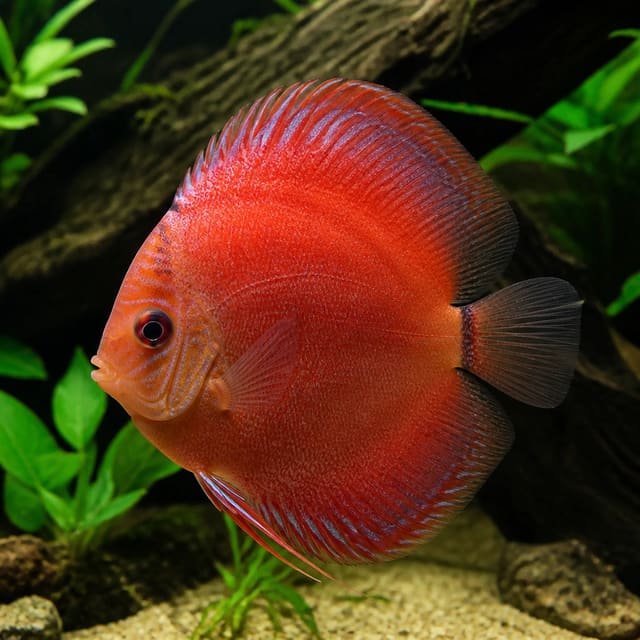
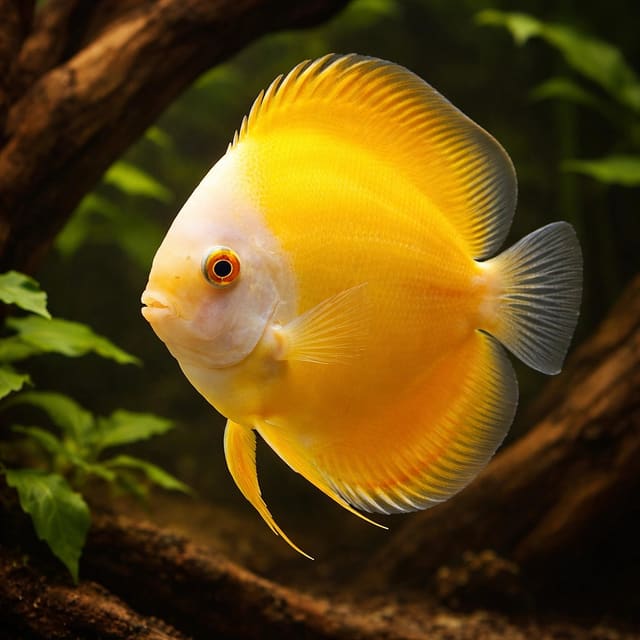
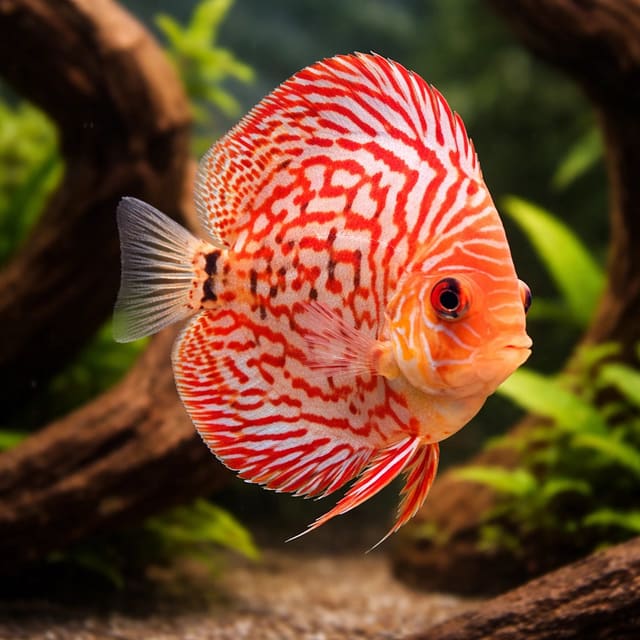
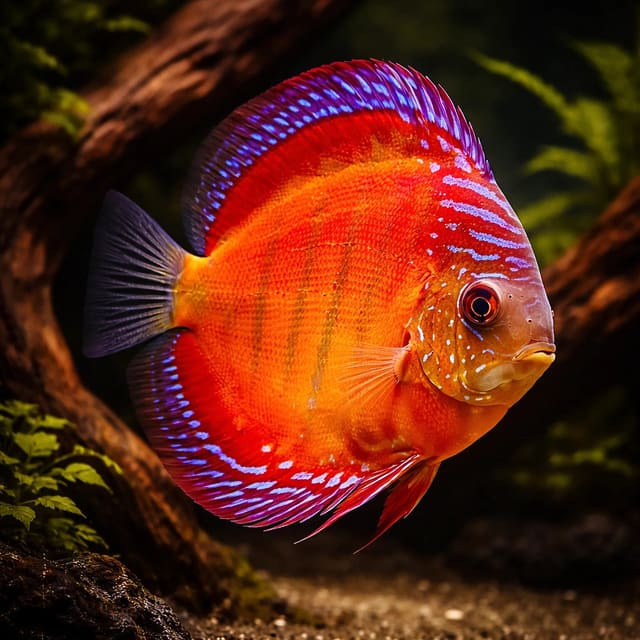
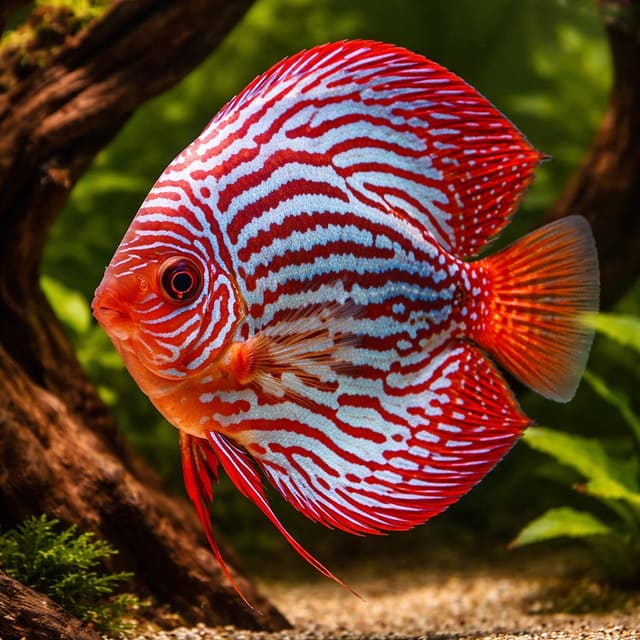
The gallery images are representative, based on reference photographs of this kind of animal, so colours can look slightly different from the live animal. One gallery scene shows two fish because that is what is visible in the scene; it does not change the sale unit of one fish per purchase. Use the images to understand the intended blue snakeskin appearance, not to predict the exact arrangement of lines, spots or colour on an individual.
When comparing choices, decide in this order: confirm that the aquarium can support at least five discus, confirm that its water remains within the stated range, and then choose a dispatch label suited to the existing group. If you want to compare the colour-form identity with other choices, browse the discus collection after completing those care checks.
Keep the aquarium at 26–30°C, pH 6.0–7.5 and 4–12°dH. Carbonate hardness should remain within 3–10°dKH. Ammonia and nitrite must both remain at 0 mg/l, while nitrate must not exceed 20 mg/l. These figures work together: temperature and chemistry define the living conditions, while ammonia, nitrite and nitrate show whether filtration, stocking, feeding and maintenance are controlling waste.
Test at least once each week and record the figures so that a change is visible rather than guessed from one isolated result. The aquarium water chemistry guide explains what the main readings mean, while the water matcher lets you compare measured values with this working range.
| Reading | Action |
|---|---|
| Ammonia or nitrite above 0 mg/l | Pause further additions, check filtration and feeding, and carry out the maintenance needed to restore both to zero. |
| Nitrate approaching 20 mg/l | Use the weekly partial-water-change routine and reassess stocking and uneaten food. |
| Temperature, pH or hardness outside range | Correct the aquarium conditions without exposing the fish to an abrupt change. |
| All readings within range | Continue the same testing and maintenance schedule rather than relaxing it. |
Clean, warm, soft to medium and slightly acidic water is the target. Regular partial water changes are the main routine OATA recommends for maintaining those conditions. Treat replacement tap water with a suitable conditioner to remove chlorine or chloramine before it enters the aquarium.
Plan space for the complete adult group, not just the dispatch size of the first fish. OATA recommends 50 litres of water volume for each adult discus and approximately 300 litres for a shoal of six adults. It also advises buying as large an aquarium as is reasonable because greater water volume makes temperature and water quality more stable.
| Group plan | Volume calculation |
|---|---|
| Five adults | Five multiplied by 50 litres gives a 250-litre starting calculation. |
| Six adults | OATA gives approximately 300 litres as the practical example. |
| Discus plus companions | Add capacity for every companion’s adult size, waste and use of swimming or floor space. |
The arithmetic is only the first check. Plenty of floor space is also required, and the group needs open room to swim together. Cover must not consume so much of the aquarium that the discus cannot explore as a shoal. Companion fish also occupy volume and feeding space, so do not calculate the aquarium as though the discus were its only residents when that is not the plan.
Use a mature aquarium with an established biological filter. If this will be your first setup, follow the first tropical aquarium guide and complete the maturation process before adding livestock. A large new aquarium is not biologically ready merely because it contains more water; the filter bacteria must be established and able to process the waste produced by feeding and fish.
A larger aquarium creates room to separate open swimming areas from plants, wood and other cover. Where more than six discus or any companion species are planned, increase capacity instead of trying to fit the additional animals into the six-fish example.
Before committing to a layout, check three points together: the 50-litre adult calculation, the usable floor space and the filter’s ability to keep ammonia and nitrite at zero. Passing only one of those checks is not enough for a stable discus group.
Provide fine gravel or sand, live plant cover, branches, wood or other suitable ornaments, and an open area where the discus can swim as a group. OATA recommends this combination because discus may be shy and benefit from places to retreat, while their size and body shape also make unobstructed group swimming space important.
Fine gravel or sand allows discus to feed naturally by blowing at the substrate. If sand is used, stir the open areas regularly so waste does not collect in dead spots. This maintenance point should influence the layout from the start: densely packed ornaments may look sheltered but can make waste difficult to reach.
Plants and hard cover should frame the swimming area rather than block it. A useful arrangement places taller cover towards the edges and leaves a broad central route. That gives the group a choice between shelter and open water without forcing every fish into one narrow channel.
Look across the aquarium at the level where the group will swim. There should be a clear path, more than one covered area and enough floor space for the adult stocking calculation. Check that wood and ornaments remain stable and that routine siphoning can reach the places where waste settles.
OATA also recommends overhead aquarium lighting. Fit the lighting as part of the complete aquarium plan while preserving plant cover and sheltered areas. The purpose of the layout is not simply to display the colour form; it must support feeding, cleaning, social movement and retreat every day.
Run a well-established and properly maintained filter at all times. The RSPCA explains that fish release toxic ammonia and that a working biological filter supports bacteria which convert ammonia to nitrite and then to the safer nitrate. For discus, the required result is still exact: ammonia and nitrite must each remain at 0 mg/l.
Do not rinse established filter media under the tap. Chlorine or chloramine may kill the beneficial bacterial population established in the media, reducing the filter’s ability to process waste. Cleaning lightly in removed aquarium water preserves more of that population while clearing the blockage or debris that prompted the maintenance.
Add fish progressively rather than making a sudden large increase in feeding and waste. OATA warns that the bacterial population established during filter maturation must grow whenever more fish and food are added. If stocking rises faster than the filter can respond, ammonia and nitrite may reach harmful levels in what is commonly called new tank syndrome.
A first-month routine can stay simple and measurable: test at least weekly, complete the weekly 50% water change, inspect the filter for blockages and compare each result with the previous one. If feeding rises or fish are added, pay particular attention to ammonia, nitrite and nitrate because those readings reveal whether the biological filter is coping.
Keep maintenance regular even when the water looks clear. Clarity does not show whether dissolved ammonia, nitrite or nitrate is within range. The test results, filter condition and waste-removal routine together provide the useful picture.
Feed a specialised dried discus granule or pellet at least once each day, then use suitable frozen or live foods for variety. OATA describes discus as generally carnivorous and records aquatic invertebrates as their natural food. It names bloodworm, beef heart and special discus mixes among the frozen or live choices that discus will appreciate.
| Meal | Decision |
|---|---|
| First small meal | Use a specialised dried discus granule or pellet, which OATA advises at least once a day to provide adequate vitamins. |
| Second small meal | Offer another small portion; frozen or live bloodworm, beef heart or a discus mix can add variety. |
| Optional third small meal | Use another small portion only when the fish finish the earlier meals and maintenance controls leftovers. |
Give two or three small feeds through the day because discus have relatively small stomachs. At every meal, offer only what the fish can consume within a few minutes. Watch the group while it eats so that reduced interest is noticed rather than hidden by the activity of other fish.
Remove uneaten food before it breaks down. Overfeeding raises the amount of organic waste entering the system and can contribute to toxic water conditions. A meal is correctly sized when the group finishes it within a few minutes and the substrate is not left carrying decaying food.
The specialised dried feed should appear at least once daily because OATA recommends it to ensure adequate vitamins are provided. Frozen or live items add variety, but they do not remove the need for controlled portions or weekly water-quality checks.
If food remains after several minutes, reduce the next portion and remove what is left. If one fish loses interest while the others continue eating, treat that as a health observation rather than automatically adding more food. Test the water and compare its behaviour, colour, breathing and condition with its normal pattern.
Match the physical size of the food to the selected dispatch size. The goal is a portion the fish can take readily, not a larger meal intended to accelerate growth. Consistent feeding and clean water are the priorities for these slow-growing cichlids.
Have the aquarium mature, heated, filtered and within the stated water range before the fish reaches you. Test ammonia and nitrite and proceed only when both are 0 mg/l. Confirm that the planned group and its companions fit the aquarium’s water volume, floor space and filtration rather than relying on the small dispatch size. Ask us about the water conditions the discus are currently kept in, and aim to match them in your aquarium before the fish arrives.
Increase the fish population slowly. Every added fish and every increase in feeding adds biological load, so the established filter bacteria need time to grow with that change. Before buying, ask us whether your aquarium is the right size for the number of discus you want to keep, and pace every addition around the filter's capacity.
Our delivery and Live Arrival Guarantee policy says that someone must be present to receive live fish. The fish is hand-bagged in pure oxygen and placed in an insulated poly box, with a heat pack used when the weather calls for one.
If anything has gone wrong, contact us the same day with your order number and the unboxing video.
Once the fish has entered the aquarium, keep the stocking pace slow and monitor the same values used in preparation. The first useful checkpoints are whether ammonia and nitrite remain at zero, whether the fish joins normal swimming activity and whether it takes appropriately sized food.
Do not treat acclimatisation as a substitute for matching the aquarium to discus requirements. The 20–30-minute floating step is one part of arrival; the mature filter, warm water, social plan and continuing weekly maintenance are what support the fish afterwards.
Observe swimming, colour, temperament, breathing, physical appearance, body condition and feeding. Healthy fish should have clear, bright eyes, undamaged fins, intact scales, no ulcers or bumps and swimming behaviour appropriate to the aquarium. Learn the group’s normal pattern so that a meaningful change can be recognised early.
| Change you see | First action |
|---|---|
| Hanging at the surface, sitting on the bottom or erratic swimming | Test temperature, ammonia, nitrite, nitrate and the remaining water values. |
| Becoming darker or paler than normal | Compare behaviour and feeding, then test the water. |
| More aggression or hiding than normal | Check group size, cover, swimming space and whether one fish is being bullied. |
| Gill covers moving faster or slower than normal | Test water quality promptly and assess the filter’s operation. |
| White spots, fluffy growths, damaged fins or lost scales | Record the change clearly and check all water readings. |
| Weight change or reduced interest in food | Review portions, leftovers, group feeding and water quality. |
A water test is the first practical response because ammonia, nitrite, nitrate, temperature and chemistry can change without making the water look dirty. Compare the result with the required ranges and correct the husbandry issue indicated by the reading.
Do not increase food merely because one fish has stopped eating. Extra leftovers can worsen water quality and obscure the original problem. Remove uneaten food, keep observing the whole group and note whether the change affects one fish or several.
If you are concerned about a health change, test the aquarium water and contact us for further guidance. Share the readings and the specific change in swimming, breathing, appearance, condition or feeding so that the next decision can be based on concrete observations.
Keep at least five discus together, with more being better when the aquarium can support them. Social compatibility begins within the discus group itself: OATA explains that discus kept singly or in groups that are too small will often become stressed or bullied by larger or more dominant fish.
| Arrangement | Decision |
|---|---|
| One discus | Avoid: a discus kept singly will often become stressed or bullied. |
| Two newly chosen discus | Do not treat them as an established pair. |
| At least five compatible discus | This meets OATA’s minimum group guidance. |
| More than five | Suitable only when volume, floor space, filtration and maintenance all scale with the group. |
| An already established breeding pair | A possible specialist exception rather than the normal group plan. |
Group size does not remove the need to watch individual behaviour. Check whether every fish can reach food, use cover and move through the open swimming area. A group that meets the number but occupies a cramped aquarium can still leave a lower-ranking fish with too little room to withdraw.
When adding to an existing group, compare the selected dispatch label with the residents so that every fish can reach food and use the available cover. OATA notes that fish kept singly or in too small groups are often bullied by larger or more dominant fish. Add fish slowly so that the biological filter can respond to the increase in waste and feeding.
OATA says keeping two may be possible when they are already an established breeding pair. That exception does not turn two separately chosen fish into a pair. Plan the normal aquarium around a group of at least five unless the fish are already known to form that specific established relationship.
The same social rule applies across the size choices. A larger dispatch label does not make solitary keeping appropriate, while a smaller label does not reduce the eventual need for group space, stable water and mature filtration.
Build the aquarium around the discus first. OATA says only a handful of other species are likely to suit their specialised conditions and names medium-sized tetras, Corydoras, plecos and dwarf cichlids as possible tank mates. These are categories for assessment, not blanket approval for every species carrying one of those names.
| Named group | Conditional decision |
|---|---|
| Medium-sized tetras | Consider only an exact species that matches the warm water and remaining swimming capacity. |
| Corydoras | Consider only an exact species whose water needs and use of floor space align. |
| Plecos | Check the exact adult requirements, floor-space use and effect on filtration before adding one. |
| Dwarf cichlids | Assess the exact species, aquarium territory and feeding arrangement. |
Discus may use smaller companion fish as dither fish, becoming more confident when the other fish indicate that no predator is nearby. That possible benefit does not override the water, space and feeding checks. The exact companion still has to fit every condition of the aquarium.
Temperament labels alone are not enough. OATA describes discus as less aggressive than some close cichlid relatives, but it also notes that discus kept singly or in too small a group will often become stressed or bullied. The decision is therefore conditional: the named companion groups may work when the exact species and complete aquarium plan align.
Base a stocking and compatibility assessment on the exact names and numbers of every planned animal, the aquarium volume and current water readings. That assessment is more useful than relying on a broad term such as tetra, pleco or community fish.
The name covers Symphysodon spp., so do not treat a dispatch label as a final mature measurement. Plan space with OATA’s discus guidance of 50 litres per adult and approximately 300 litres for six adults.
OATA recommends 50 litres per adult and approximately 300 litres for six adult discus, with plenty of floor space, open swimming room, cover and an essential filter. A group of five is the social minimum.
OATA says to keep at least five, with more being better when aquarium capacity permits. Discus kept singly or in too small a group will often become stressed or bullied; OATA says keeping two is sometimes possible only when they are already an established breeding pair.
We rate it advanced because it needs a mature filter, warm and closely managed water, weekly testing, a 50% weekly water change, controlled feeding and a properly planned social group.
Feed a specialised discus granule or pellet at least once daily, with suitable frozen or live variety such as bloodworm, beef heart or discus mixes. OATA advises two or three small feeds that are eaten within a few minutes.
OATA’s discus guidance gives 26–30°C, pH 6.0–7.5 and 4–12°dH. Keep ammonia and nitrite at 0 mg/l and nitrate no higher than 20 mg/l.
OATA describes discus as less aggressive than some close cichlid relatives, but discus kept singly or in too small a group will often become stressed or bullied by larger or more dominant fish.
OATA names medium-sized tetras, Corydoras, plecos and dwarf cichlids as possible companions. Each exact species must match 26–30°C water, fit the remaining space and leave the discus reliable access to food.
Start filming before opening the sealed parcel. It is hand-bagged in pure oxygen, packed in an insulated poly box with a heat pack when weather calls for one, and carried by a licensed live-animal courier; someone must be present to receive it.
No reviews for this item yet. Bought one? Honest reviews only, good or bad.
What customers say about ordering from us
I have a small group of long finned mountain minnows. So was delighted to be able to order ten of this variety to increase the genetics in my tank . The ones I recieved are healthy but it’s to early to give a verdict on wether they are of a long finned type since they are small currently.
Gordon Walker · 23 Sept 2026
100% success travel and "installation". Pleased with quality of purchase. The Siamese fighter a bit "shy" so have not yet seen him at his best yet but looking good. Happy customer. GG
George E Garratt · 21 Sept 2026
Reviews of our shop, collected by Judge.me, an independent third-party review collector. Newest first.