−15%
Red Turquoise Discus (Symphysodon spp.)
26–30°C · pH 6–7.5
£37.99£53.99

Red Marlboro Discus (domestic Symphysodon strain) is a cichlid from South American discus lineage that reaches 13.7 cm standard length. It suits experienced keepers planning at least five fish at 26–30°C and pH 6.0–7.5. Sold individually in sizes from “2 cm (2.5 cm)” to “XL selection HQ”.
Adult size is the maximum length this species reaches at full maturity (scientific sources). The livestock you receive will be younger and smaller — pick a size above for the actual shipping size. Product-photo provenance and any image-specific limitations are stated on the listing.
domestic Symphysodon strain
Save when buying multiple fish. Each quantity is one fish; sex and pair formation are not guaranteed unless the selected variant explicitly states them.
Red Marlboro Discus (domestic Symphysodon strain) is a cichlid from South American discus lineage that reaches 13.7 cm standard length. It suits experienced keepers planning at least five fish at 26–30°C and pH 6.0–7.5. Sold individually in sizes from “2 cm (2.5 cm)” to “XL selection HQ”.
Adult size is the maximum length this species reaches at full maturity (scientific sources). The livestock you receive will be younger and smaller — pick a size above for the actual shipping size. Product-photo provenance and any image-specific limitations are stated on the listing.
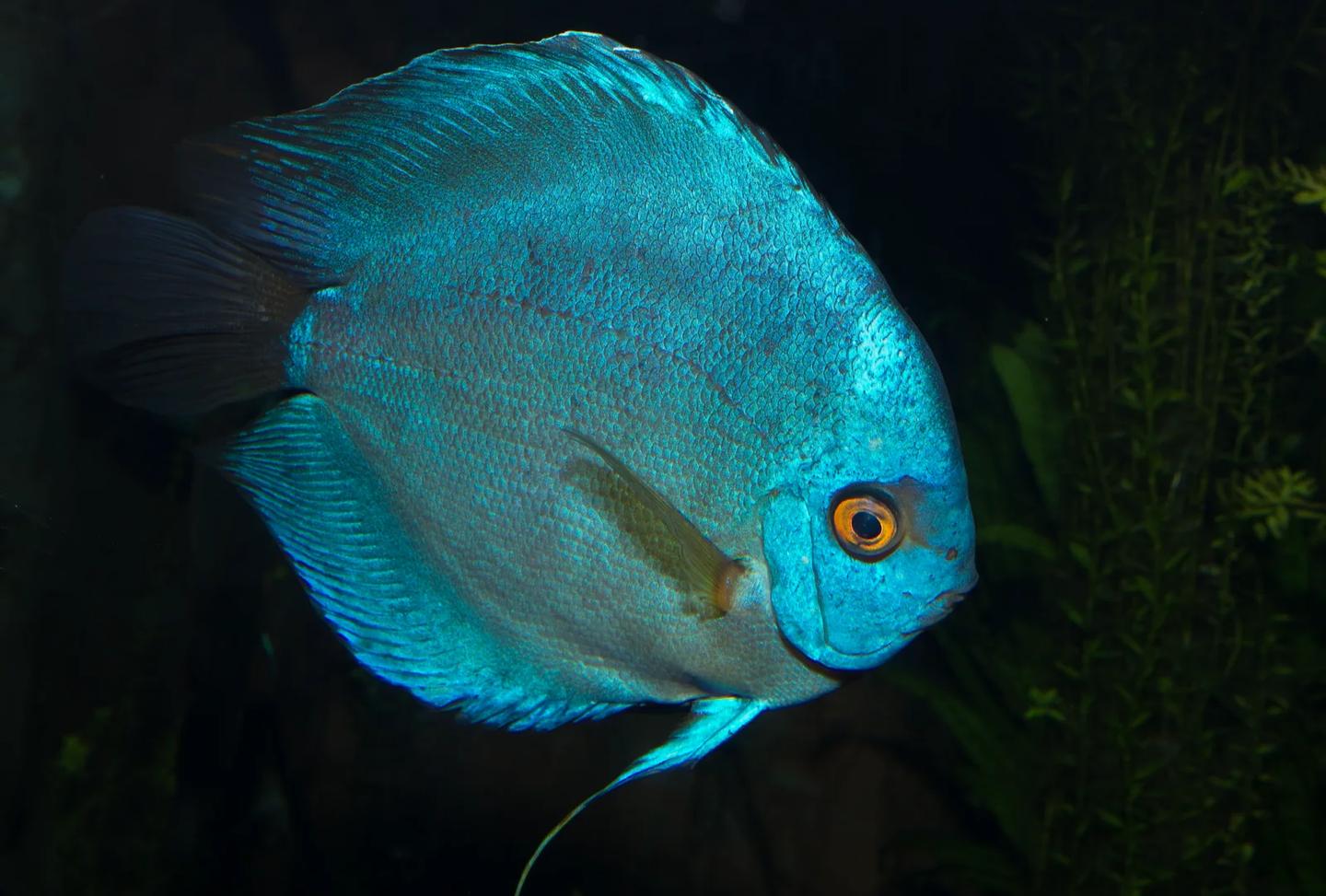
Discus are social Amazonian cichlids with specialised aquarium needs. OATA advises at least five fish, except an established breeding pair, and about 50 litres per adult—roughly 300 litres for six adults. Use that as a planning floor, then check usable dimensions, filtration, source water and the actual fish.
Maintain these water conditions for optimal health and vibrant colors
Red Marlboro Discus is a domestic colour strain within Symphysodon, the South American cichlid genus known as discus. Red Marlboro is a trade strain name rather than a separate Latin species. The scientific care anchor used here is Symphysodon aequifasciatus, which FishBase places in the cichlid family Cichlidae.
The rounded, laterally compressed form matters when planning the aquarium. FishBase records a maximum of 13.7 cm standard length for S. aequifasciatus. Discus can be as tall as they are long. OATA’s wider discus guidance says adults can reach up to 20 cm across. Allow for that full body span rather than judging the future space requirement from the selected dispatch grade.
For natural-history context, FishBase describes wild S. aequifasciatus living in deep, rocky areas among crevices and roots. It records schooling behaviour outside the breeding season and territorial behaviour during breeding. Wild fish feed on insect larvae, insects and planktonic invertebrates. These observations explain why aquarium discus benefit from cover, social companions and appropriately sized foods, while the routine feeding schedule belongs in the care guidance below.
This is an advanced retailer suitability choice because success depends on several linked tasks: maintaining warm, stable water, keeping an adequate social group, providing substantial space, feeding small portions through the day and completing large weekly partial water changes. It suits a keeper prepared to test the aquarium regularly and respond to changes before they affect the fish.
One purchase quantity supplies one Red Marlboro Discus in the option selected on the live size selector. The selector may show labels including “2 cm (2.5 cm)”, “3 cm (4 cm)”, “4 cm (5 cm)”, “5cm (6,5cm)”, “6 cm (7.5 cm)”, “7cm”, “8cm”, “9cm”, “10cm”, “11cm”, “12cm”, “13 cm (16 cm)”, “14 cm (18 cm)” and “XL selection HQ”. Read the exact selector label before ordering because it defines the chosen grade.
The size you select is the size supplied, not the adult size. A smaller grade does not reduce the adult space, group or water-quality requirement. Prepare the aquarium around a discus that may reach the recorded 13.7 cm standard length and the wider discus planning span of up to 20 cm across.
Use the live selector for the size choices shown at the point of purchase. A practical comparison starts with the aquarium rather than the label: first confirm that its dimensions and mature filter can support the intended adult group, then choose the dispatch grade. If more fish will be added later, plan the completed group and its total adult water allowance before introducing the first member.
| Suits | Not suited to |
|---|---|
| Experienced keepers planning at least five discus in warm, stable water. | Aquariums unable to provide adult group space, mature filtration and the stated weekly maintenance. |
Sex is guaranteed only when the selected option explicitly states male or female. This Red Marlboro Discus listing has no sex-guaranteed option.
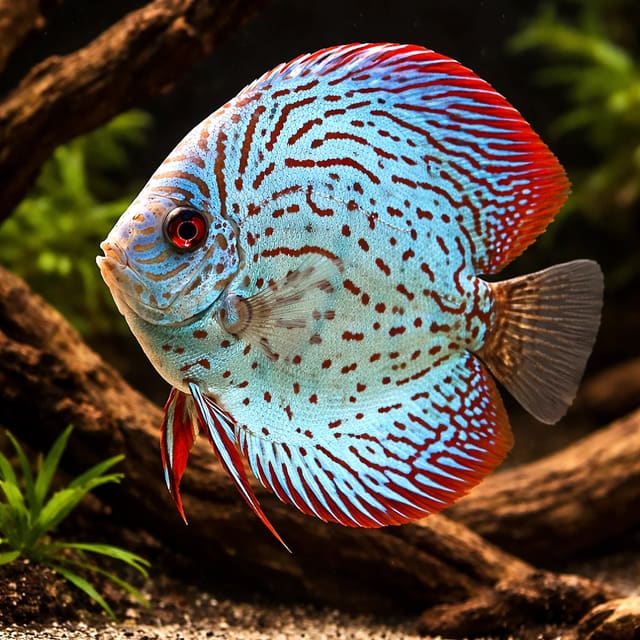
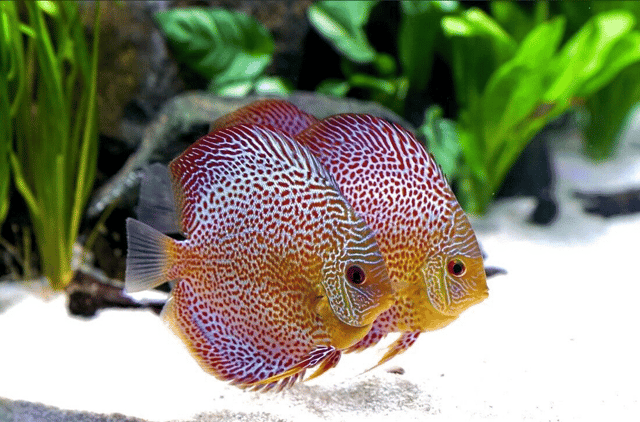
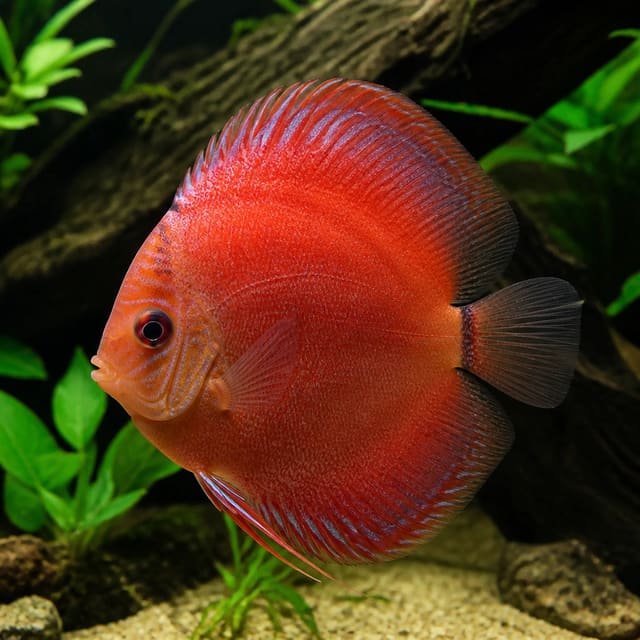
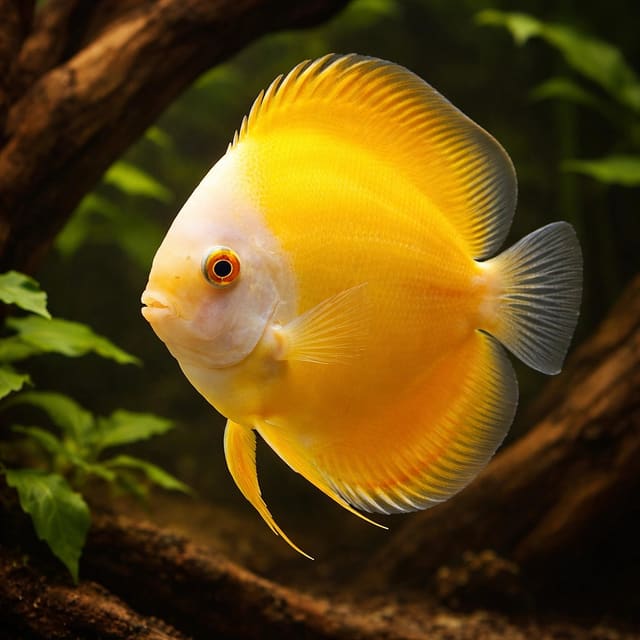
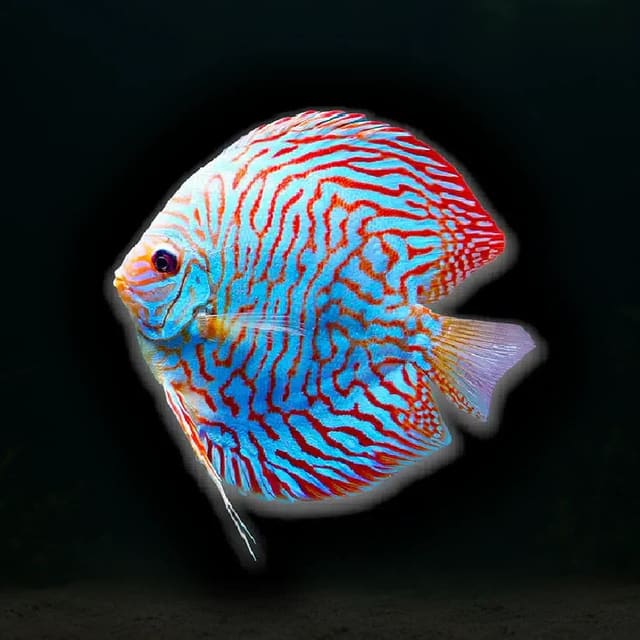
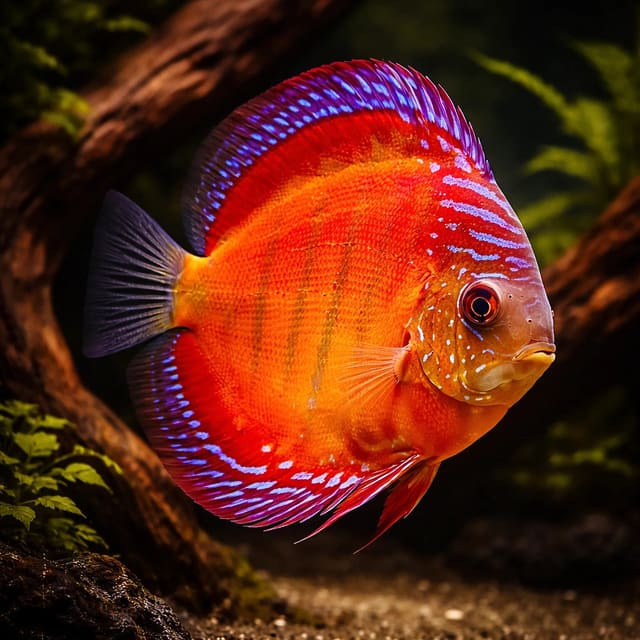
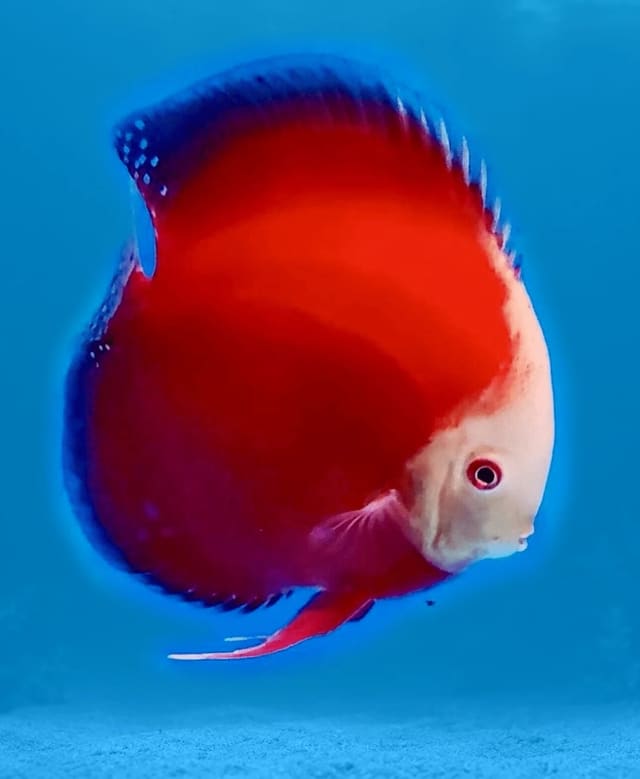
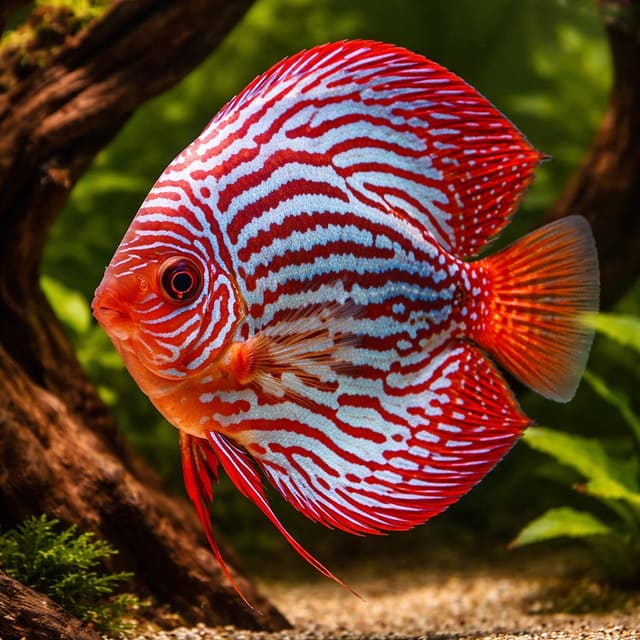
The gallery images are representative, based on reference photographs of this species, so colours can look slightly different from the live animal. Use them to understand the rounded discus form and the general red-strain appearance rather than as a promise of identical markings. To compare other strain presentations and selector labels, browse the current discus collection.
Before choosing this fish, make four connected decisions. The aquarium must provide enough volume and dimensions for the completed group, the water must remain within the routine range, the filter must already be biologically mature, and the weekly routine must include testing and substantial partial water changes.
| Decision | Planning point |
|---|---|
| Social group | Keep at least five discus; more is better. |
| Adult allowance | Use approximately 50 litres per adult; six adults are a 300-litre example. |
| Dimensions | Use at least 120 cm aquarium length as the FishBase planning reference and provide height for the tall body. |
| Routine water | 26–30°C, pH 6.0–7.5 and 4–12°dH. |
| Nitrogen waste | Ammonia 0 mg/l, nitrite 0 mg/l and nitrate no more than 20 mg/l. |
| Maintenance | Change 50% of the water at least weekly and test at least weekly. |
OATA’s discus guidance gives 26–30°C, pH 6.0–7.5 and 4–12°dH for the group. These routine values sit within FishBase’s environmental ranges of 26–30°C, pH 5.0–8.0 and 0–12°dH for S. aequifasciatus.
A few juveniles or an established breeding pair have a separate 255-litre example, but that does not turn a pair of unrelated fish into an appropriate social unit. For ordinary group keeping, calculate around the intended number of adults and preserve enough open space, cover and aquarium height at the same time.
Start with the intended adult group. OATA recommends approximately 50 litres for each adult and gives a 300-litre aquarium as an example for six adults. Five adults produce a 250-litre volume calculation, but volume alone is not the whole decision: discus need useful height, floor space, cover and open swimming room.
The Seriously Fish profile for S. aequifasciatus recommends about 120 × 45 × 45 cm, or 255 litres, for a few juvenile fish or a pair of breeding adults. FishBase also uses 120 cm as its minimum aquarium length reference. Treat those dimensions as a starting point and increase the aquarium where necessary to meet the adult group allowance.
Fine gravel or sand supports the substrate-blowing feeding behaviour described by OATA. With sand, keep open areas accessible because they must be stirred during maintenance to prevent waste accumulating in dead spots. Overhead aquarium lighting is recommended, while plant and wood cover gives shy fish places to withdraw.
Do not trade social space for decoration. If wood, plants and ornaments leave too little open room for the group, reduce or reposition them. The successful layout gives the fish a clear choice between sheltered cover and open water without compromising the filter, cleaning access or adult water allowance.
Stand in front of the aquarium and trace a clear route through the open area before adding fish. Every member of the planned group should be able to leave cover and cross the aquarium without being forced through one narrow gap. Then check that a siphon can reach the exposed substrate and that decorations do not block filter access. If the design passes the volume calculation but prevents group movement or routine cleaning, simplify it before the aquarium is occupied.
Set the routine aquarium target at 26–30°C, pH 6.0–7.5 and general hardness of 4–12°dH. OATA also gives carbonate hardness of 3–10°dKH for discus. Stability within these values is more useful than repeatedly pushing the aquarium from one end of a range to the other.
Ammonia must remain at 0 mg/l, nitrite at 0 mg/l and nitrate must not exceed 20 mg/l. These numbers are operating limits, not goals for occasional checks. Test before adding the fish, after changes in stocking or feeding, and at least once each week as part of the normal routine. Our water chemistry guide explains what each measurement means, while the water matcher helps compare measured values with this range.
The RSPCA explains why a mature biological filter is essential: fish release toxic ammonia, bacteria convert it to nitrite, and further bacterial action converts nitrite to the safer nitrate. A filter must therefore be established and maintained before it is asked to process the waste from a discus group.
Our first tropical aquarium guide covers preparation and filter maturation. Increasing fish numbers or feeding raises the waste entering the system, so beneficial bacteria need time to respond. If ammonia or nitrite appears, pause further additions, test repeatedly and restore safe water quality before continuing the stocking plan.
Record temperature, pH, general hardness, ammonia, nitrite and nitrate before introduction. Repeat the same measurements after a change in fish numbers or feeding. A written sequence distinguishes a stable aquarium from one that happens to show a safe result on a single day. For example, ammonia readings of 0 mg/l before and after an addition support the next observation stage; any detectable ammonia stops the stocking sequence until filtration and water quality recover.
Complete a 50% partial water change at least once every week. Regular changes help preserve the clean, warm, soft and slightly acidic conditions recommended for discus while controlling nitrate and dissolved waste. Treat replacement tap water with conditioner before it enters the aquarium so chlorine or chloramine cannot damage the fish or biological filter.
Clean filter media only when flow or accumulated material makes cleaning necessary. Rinse it lightly in aquarium water removed during the partial change. Do not run it under the tap because any chlorine or chloramine present may kill the beneficial bacteria responsible for processing ammonia and nitrite.
Use the nitrate limit to judge whether the routine is keeping pace. A reading approaching or exceeding 20 mg/l calls for prompt water-quality action and a review of maintenance, feeding and stocking pressure. Uneaten food adds waste as it breaks down, so correct portion control works alongside water changes rather than replacing them.
Consistency is the practical advantage of a larger aquarium: temperature and water chemistry generally change less abruptly when more water is present. That benefit still depends on testing, suitable filtration and regular partial changes; volume cannot compensate for neglected maintenance.
In the OATA example of a 300-litre aquarium for six adults, a 50% change means replacing approximately 150 litres. Plan the containers, siphon route and conditioned replacement water around that amount before the maintenance day. If a weekly service repeatedly becomes difficult to complete, change the working method rather than reducing the stated percentage. The routine must remain practical enough to repeat every week while preserving stable temperature and safe nitrogen-waste readings.
Discus are generally carnivorous, and the wild diet described for S. aequifasciatus centres on zooplankton, insects and other small invertebrates. In the aquarium, OATA recommends specialised dried discus granules or pellets at least once a day so the diet includes an appropriate vitamin contribution.
Offer two or three smaller feeds through the day because discus have relatively small stomachs. Each portion should be limited to what the fish can eat within a few minutes. This gives a clear stopping rule: once food is being ignored or settling uneaten, stop adding more and remove the residue where practical.
| Feed | Decision |
|---|---|
| First small feed | Use a specialised dried discus granule or pellet. |
| Later small feed | Repeat the dried diet or offer a suitable frozen or live food. |
| Optional third feed | Give only when the earlier portions were eaten promptly and water quality remains controlled. |
OATA names bloodworm, beef heart and prepared discus mixes among the frozen or live foods discus may appreciate. Use variety without allowing richer additions to displace the daily specialised dried food. Portion every item by the same few-minutes rule.
Overfeeding creates two linked problems. The fish receive more food than their small stomachs require, and the uneaten portion breaks down into waste that burdens the biological filter. If nitrate rises towards 20 mg/l, ammonia or nitrite appears, or food remains after the group has stopped feeding, reduce the next portion and restore safe water quality.
Watch how the whole group feeds. Reduced intake or loss of interest in food is a health-change signal, while one fish repeatedly missing meals needs closer observation for hiding, bullying, altered breathing or changed body condition. Keep feeding locations accessible and remove trapped food during the normal maintenance routine.
Begin with a small amount and watch the whole group for the next few minutes. If every fish is still feeding and no food is settling, add only another small amount. If one member stays under cover while dominant fish take every portion, use the compatibility and group checks rather than compensating with a large feed. More food does not solve unequal access when the excess remains uneaten and increases waste.
Finish the aquarium before delivery day. Confirm the filter is mature, ammonia and nitrite are 0 mg/l, nitrate is no more than 20 mg/l, and temperature is steady within 26–30°C. Record pH and hardness as well. Request the current holding values before dispatch and aim to avoid an abrupt difference during introduction.
The 20–30 minute float time follows our delivery and Live Arrival Guarantee policy. Film every delivery from the sealed parcel onward. If making a claim, send the short unboxing video with the order number.
Introduce livestock at a pace the biological filter can process. A larger planned group does not justify adding more waste than the mature bacterial population can handle. Test ammonia and nitrite after an increase in fish numbers or feeding, and do not continue additions while either reading is above 0 mg/l.
Discus can be shy and skittish, so using plant, branch or wood cover gives a new arrival somewhere to settle. Observation should be quiet and purposeful. Avoid repeatedly disturbing the aquarium merely to make the fish enter open water.
A fish using cover on the first day may be responding to the new surroundings, so compare several indicators rather than forcing it into view. Normal breathing, controlled swimming and gradual interest in food form a different pattern from persistent abnormal breathing, erratic swimming or declining appetite. Test the water whenever the pattern causes concern, then compare the result with the pre-arrival baseline and the required limits.
Learn the group’s normal appearance and behaviour so a change is easy to recognise. Healthy-fish checks include clear, bright eyes, undamaged fins, intact scales, an absence of ulcerations or bumps and appropriate swimming behaviour. Use those points as a repeatable observation list rather than relying on colour alone.
| Change | First action |
|---|---|
| Surface hanging, bottom sitting or erratic swimming | Test ammonia, nitrite, nitrate and temperature immediately. |
| Darker or paler colour | Compare behaviour, breathing, feeding and water readings. |
| More hiding or altered aggression | Check group pressure, cover and whether breeding territoriality is developing. |
| Faster or slower gill movement | Test the water and watch every member of the group. |
| White spots, fluffy growths or damaged fins and scales | Record the change and contact us for health guidance. |
| Reduced feeding or body condition | Check portion access, social pressure and water quality. |
Water testing comes first because toxic ammonia and nitrite must remain at 0 mg/l, while nitrate must stay at or below 20 mg/l. A normal-looking temperature does not rule out a nitrogen-waste problem, and a recent water change does not replace a test.
Do not choose a disease treatment from appearance alone. Different changes can overlap, and treatment instructions require a proper assessment. Record when the change began, the measured water values, recent feeding, maintenance and additions to the aquarium. Those details make subsequent guidance more useful.
During the first month, compare observations across days rather than reacting to one brief retreat into cover. Shyness can occur, but persistent loss of appetite, abnormal breathing, unusual swimming or declining body condition requires prompt action.
Write down the time, the affected fish, the exact behaviour and the current test results. After water-quality action, repeat the relevant readings and compare the fish’s breathing, swimming and feeding with the earlier note. This prevents a brief improvement in colour from replacing the required ammonia, nitrite and nitrate checks. It also reveals whether the change affects one individual or the whole group, which matters when reviewing feeding access and social pressure.
Plan Red Marlboro Discus as a social fish. FishBase recommends aquarium groups of five or more, while OATA says at least five and adds that more is better. A lone discus or a group that is too small will often become stressed or be bullied by larger, more dominant fish.
Use approximately 50 litres per adult when calculating the group. Six adults give the OATA example of about 300 litres. Apply that calculation alongside the 120 cm length reference, useful aquarium height, open group space and adequate cover. A volume that meets the arithmetic but lacks usable dimensions is not a complete solution.
| Plan | Assessment |
|---|---|
| One fish | Does not meet the group recommendation. |
| Two unrelated fish | Does not create the recommended group and may concentrate social pressure. |
| Established breeding pair | May be kept as a pair when genuinely established and given suitable space. |
| Five adults | Meets the minimum social number; calculate about 250 litres before accounting for dimensions and layout. |
| Six adults | Matches the approximately 300-litre group example. |
Breeding changes the social picture because wild S. aequifasciatus is recorded as territorial during the breeding season. An established pair is therefore a distinct arrangement, not a shortcut for placing two arbitrary fish together. Preserve cover and open space so individuals can move away from pressure.
When building a group in stages, assess the completed adult plan before the first purchase. Increase fish numbers only as quickly as the biological filter can respond to additional waste and feeding. Watch for one member hiding more, eating less, changing colour or receiving repeated pressure from a dominant fish.
Compare every fish at feeding time and during open-water movement. A workable group allows all members to reach food and use both cover and open space. If one individual remains hidden, misses repeated feeds or receives continuing pressure, check the aquarium layout, group size, breeding behaviour and water readings together. Do not treat an acceptable total volume as proof that the social arrangement is working.
Build a discus-led aquarium rather than adding Red Marlboro Discus to a community assembled around different conditions. OATA says only a handful of other species will suit a discus aquarium and names medium-sized tetras, Corydoras, plecos and dwarf cichlids as possible categories. These are candidates for assessment, not automatic matches.
Avoid species that cannot thrive throughout the chosen discus temperature and water range. Do not assume that sharing a broad label such as tetra, catfish or cichlid settles the decision; assess the exact fish against the same conditions and available space.
Medium-sized tetras may act as dither fish and help discus feel more confident. Corydoras, plecos and dwarf cichlids may also be considered where their own temperature, chemistry, space and behaviour requirements align. The honest compatibility rule is conditional: choose companions around the discus environment, not around appearance or a generic community label.
Breeding behaviour adds uncertainty even when a combination has previously been calm. Maintain retreats, open water and close observation so changed territorial behaviour is noticed early. If you want a stocking and compatibility assessment, contact us with the aquarium dimensions, measured temperature, pH and hardness, current livestock and intended adult discus number.
A candidate passes only when every screen aligns. For example, a fish that fits the remaining physical space still stops at the water check if it cannot thrive at 26–30°C. A fish that shares the water range still stops if its adult space would remove the open area required by the discus group. After any addition, test ammonia and nitrite and observe feeding access before considering another change.
It is a domestic discus colour strain with Symphysodon aequifasciatus as its scientific care anchor, rather than a separate Latin species.
One purchase quantity supplies one animal in the option chosen from the live size selector.
Each selector label is a dispatch grade. The chosen size is not the adult size; plan for 13.7 cm standard length and up to 20 cm across.
Use a mature filtered aquarium with useful height, at least 120 cm length, cover, open swimming space and approximately 50 litres per adult.
Keep at least five, with more being better. An established breeding pair is a separate arrangement, and discus become territorial during breeding.
OATA’s discus guidance says to keep this Symphysodon strain at 26–30°C, pH 6.0–7.5 and 4–12°dH, with ammonia and nitrite at 0 mg/l and nitrate no higher than 20 mg/l.
Give two or three small daily feeds, including specialised dried discus granules or pellets at least once a day, with suitable frozen or live variety.
Start filming before opening the sealed parcel, continue through opening until the fish is shown inside the sealed bag, then float the bag for 20–30 minutes before releasing the fish without pouring transport water into the aquarium.
Consider medium-sized tetras, Corydoras, plecos or dwarf cichlids only when the exact species shares its water, space and behavioural requirements.
No reviews for this item yet. Bought one? Honest reviews only, good or bad.
What customers say about ordering from us
I have a small group of long finned mountain minnows. So was delighted to be able to order ten of this variety to increase the genetics in my tank . The ones I recieved are healthy but it’s to early to give a verdict on wether they are of a long finned type since they are small currently.
Gordon Walker · 23 Sept 2026
100% success travel and "installation". Pleased with quality of purchase. The Siamese fighter a bit "shy" so have not yet seen him at his best yet but looking good. Happy customer. GG
George E Garratt · 21 Sept 2026
Reviews of our shop, collected by Judge.me, an independent third-party review collector. Newest first.