Advanced
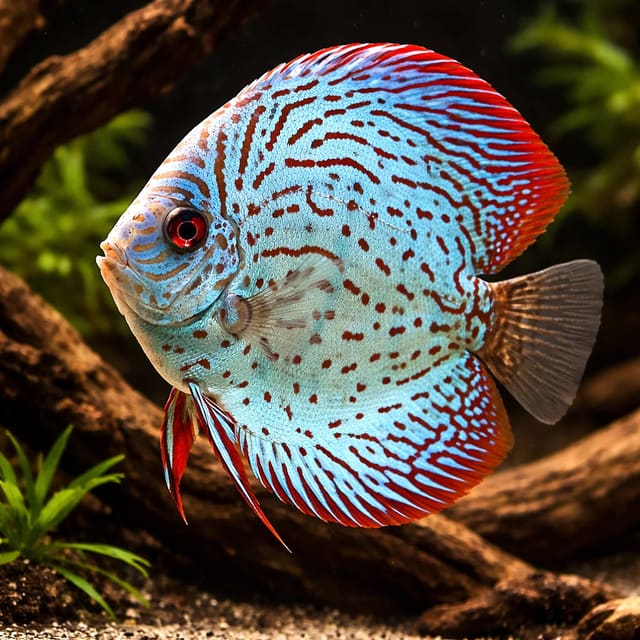
Brilliant Turquoise (Symphysodon aequifasciatus) — Domestic Strain
26–30°C · pH 6–7.5
£39.09
Leopard Spotted Discus (Symphysodon sp.) is a domestic discus trade form supplied as one live fish at the listed 10 cm (12.5 cm) grade. It is an advanced choice needing a mature, generously sized warm aquarium, broad discus-group water targets, a planned social group, small varied feeds and calm compatible companions.
Symphysodon sp.
Save when buying multiple fish. Each quantity is one fish; sex and pair formation are not guaranteed unless the selected variant explicitly states them.
Leopard Spotted Discus (Symphysodon sp.) is a domestic discus trade form supplied as one live fish at the listed 10 cm (12.5 cm) grade. It is an advanced choice needing a mature, generously sized warm aquarium, broad discus-group water targets, a planned social group, small varied feeds and calm compatible companions.
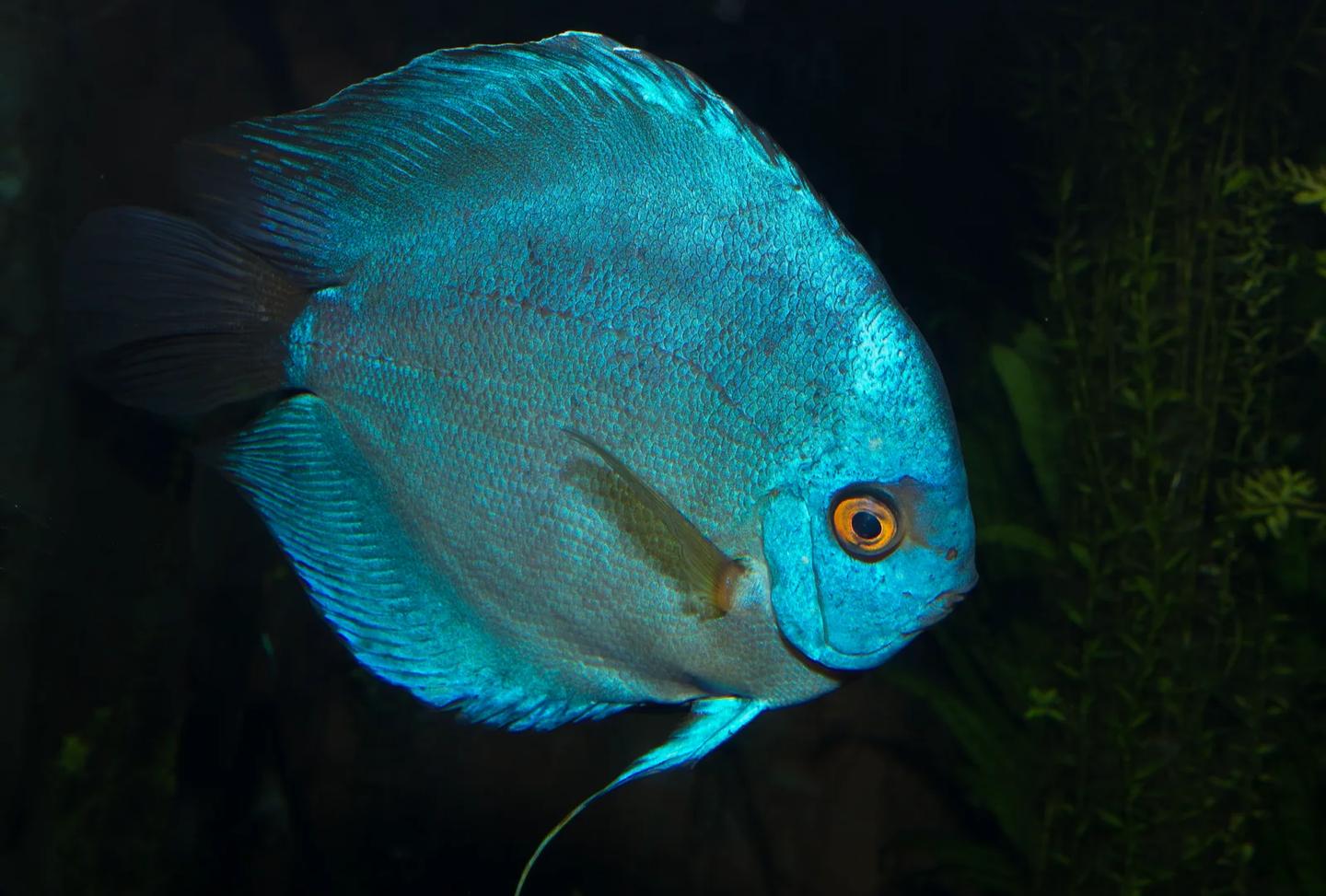
Discus are social Amazonian cichlids with specialised aquarium needs. OATA advises at least five fish, except an established breeding pair, and about 50 litres per adult—roughly 300 litres for six adults. Use that as a planning floor, then check usable dimensions, filtration, source water and the actual fish.
Maintain these water conditions for optimal health and vibrant colors
Leopard Spotted Discus is the trade name for this patterned domestic discus form. One purchase supplies one live fish at the listed 10 cm (12.5 cm) dispatch grade. That wording is retained as the supplied-size grade; it is not converted into a range or presented as adult size.
The exact species has not been identified, so the care advice here follows the genus Symphysodon and its care group. The scientifically responsible label is therefore Symphysodon sp. “Domestic Strain” identifies the trade presentation approved for this offer; it does not prove a breeder, pedigree, collection locality or genetic lineage.
Sex is guaranteed only when the selected option explicitly states male or female. This Symphysodon leopard spotted listing has no sex-guaranteed option. Discus are difficult to sex outside breeding condition, so colour, body shape, size and the gallery must not be used as a sex promise.
| Suits | An experienced keeper with a mature, generously sized aquarium and a dependable testing and water-change routine |
|---|---|
| Social plan | OATA's wider discus guidance recommends a group of at least five; more is better when capacity allows |
| Water approach | Warm, clean, soft-to-medium, slightly acidic water kept stable and matched carefully at introduction |
| Feeding approach | Specialist dried discus food supported by suitable frozen or live variety in small portions |
This is a centrepiece fish for a keeper who enjoys disciplined aquarium management. Discus need more specific water conditions than many tropical fish, and the maintenance load grows with the social group and feeding schedule. A large tank helps by diluting waste and reducing sudden swings, but size alone never replaces a mature filter, testing and regular partial water changes.
We class this offer as advanced care. That is a store suitability assessment based on warm-water stability, social planning, frequent observation and water-quality work. It is not a claim that every discus is delicate. The aim is to remove avoidable stress: poor group structure, unsuitable companions, sudden chemistry change, missed waste and food competition.
A suitable home is more than a tank with a heater. It has a filter that is already processing the expected waste load, measured water that can be kept within the broad discus range, enough volume and open floor area for the planned adult group, and a layout that lets every fish feed and withdraw. The keeper can explain how the 50% weekly change will be prepared, where replacement water will come from and how its temperature and chemistry will be matched.
Look at the plan as a chain. Several small meals increase observation opportunities, but also increase the number of chances for food to be missed. More discus support natural social behaviour, but also increase oxygen demand, waste and competition. Warm water suits the fish, but leaves less room for neglect because biological activity and feeding continue every day. The right aquarium brings those linked needs together rather than solving one in isolation.
If the proposed tank cannot provide the adult group volume, a stable warm range, zero ammonia and nitrite, nitrate control and calm feeding access at the same time, postpone the purchase. Correcting the system before arrival is kinder and usually simpler than reacting after a discus is already under pressure.
Confirm that routine water changes, filter access and feeding observation remain practical after all plants, wood and equipment are in place.
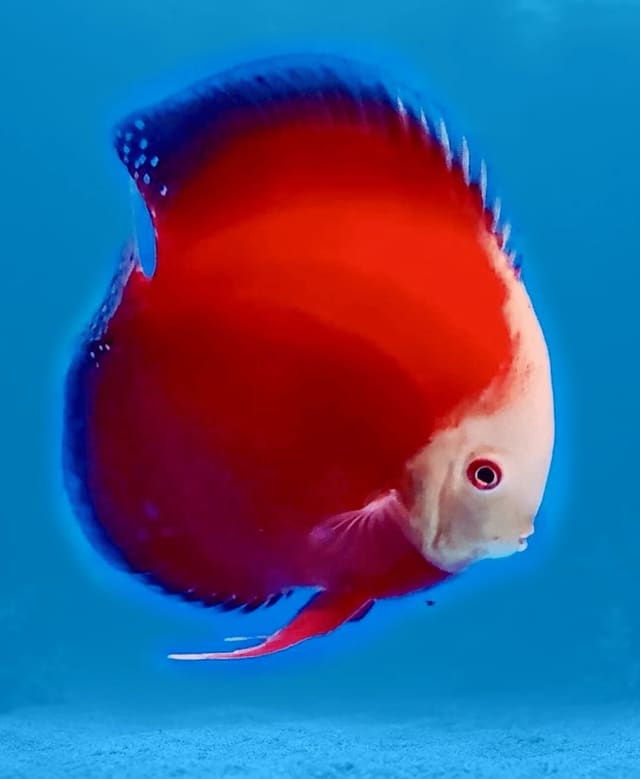
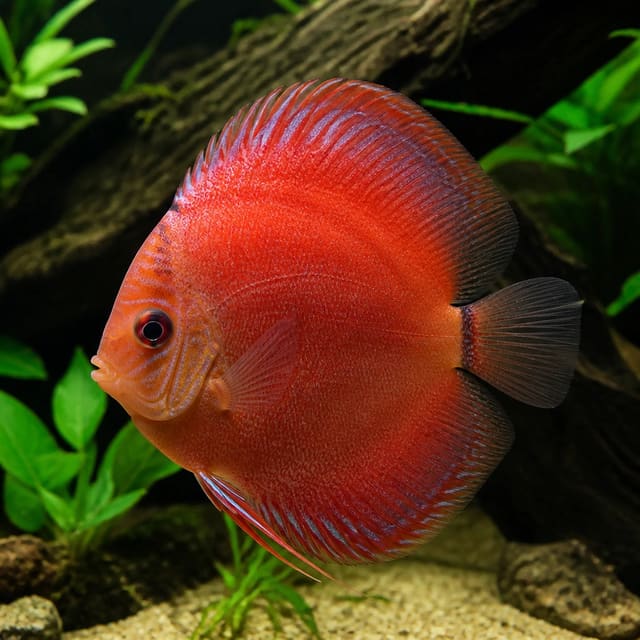
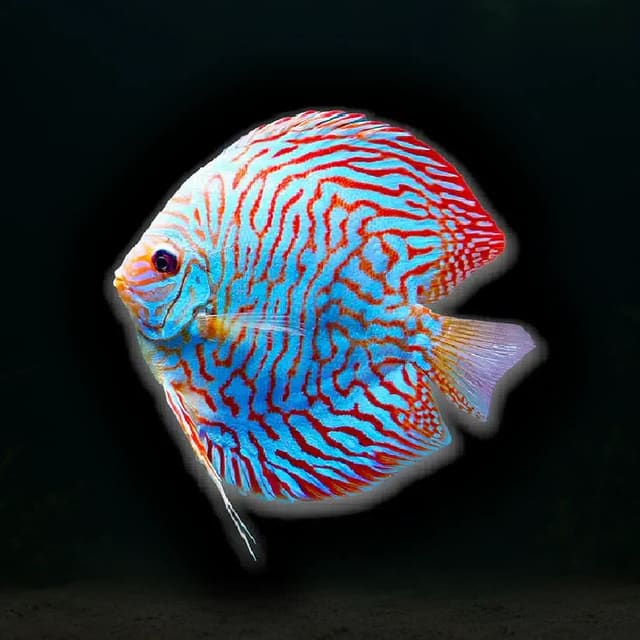
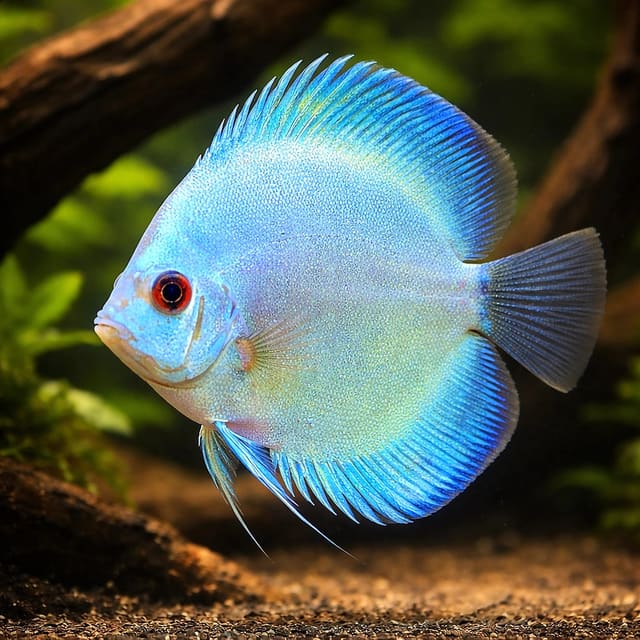
Gallery images have been digitally enhanced to improve image quality. Natural colour, pattern, size and maturity can vary between live animals.
To compare another feature-fish direction before committing to discus care, browse the centrepiece fish collection. A different feature fish is an alternative purchase, not an automatic companion for this aquarium.
A working biological filter must already be processing waste before discus are introduced. Beneficial bacteria convert toxic ammonia to nitrite and then to the safer end product nitrate. Clear water is not proof that this cycle is ready, so test it. OATA's discus guidance requires ammonia and nitrite at zero and warns that adding fish faster than the bacterial population can grow leads to new tank syndrome.
The first tropical aquarium guide explains the preparation sequence, while the water-chemistry guide gives the meaning behind the readings. For a discus group, do not stop at a one-off cycle result. The filter must cope with the real feeding and waste load while the aquarium remains warm.
OATA's broad planning rule is 50 litres of water volume for each adult discus and approximately 300 litres for six adults, with plenty of floor space. Those figures are group guidance rather than a species-specific minimum for this trade form. They still make the buying decision concrete: plan the adult group first, then choose a tank and layout that meet or exceed that demand.
More water volume usually makes temperature and chemistry easier to stabilise, but unusable space still matters. Keep a substantial open area where the group can swim and feed together. Add live plants, branches, wood or other secure cover around that space so shy fish can withdraw without the centre becoming an obstacle course.
Begin with the number of adults the aquarium is intended to support, not the size of the first fish bought. Under OATA's broad guide, five adults account for 250 litres before allowing for displacement by substrate, wood, rocks, internal equipment and companions. Six adults point to approximately 300 litres. Those numbers do not turn every aquarium of that nominal size into a good discus home: floor space, shape, usable swimming room, filtration and maintenance access still decide whether the volume works.
Write down the intended final group, the water volume after décor, the feeding plan and every additional fish category. This exposes a common mismatch: a tank may appear generous when empty but become crowded once cover, equipment and companion groups are included. A taller body shape also makes clear open routes important; narrow gaps between ornaments are not a substitute for shared swimming space.
Stock slowly enough for the biological filter to respond to added waste, while keeping the social destination clear. Test ammonia and nitrite after additions and watch feeding access. Slow stocking protects the filter, but it should not become an indefinite plan to keep a lone discus. The goal is a mature system capable of supporting the intended social group without sacrificing water quality.
OATA gives 26–30°C, pH 6.0–7.5, general hardness of 4–12°dH and carbonate hardness of 3–10°dKH for discus. Ammonia and nitrite should be zero, and nitrate should not exceed 20 mg per litre. These are broad discus-group values, not a species-specific optimum for the Leopard Spotted trade form.
The same care sheet describes clean, warm, soft, slightly acidic water as the optimum general direction. It also notes that tank-bred discus may tolerate harder water than wild fish, but this offer carries no exact breeding-line history. “Domestic Strain” is a trade-form label here, so water quality still needs full attention and the fish's hardness history should be checked directly.
Start with the conditions in which the fish has actually been held and move gradually towards a stable long-term plan. Use the water-parameter matcher to compare measured values with the broad discus guidance, then look at the differences that must be managed during introduction and maintenance. A reading inside a published range is not useful if it swings sharply from day to day.
| Temperature | 26–30°C under broad OATA discus guidance; keep the aquarium heated and stable |
|---|---|
| pH | 6.0–7.5 as wider discus guidance; avoid sudden movement |
| General hardness | 4–12°dH, soft to medium, with the holding water considered during adjustment |
| Carbonate hardness | 3–10°dKH under the same group-level care sheet |
| Ammonia and nitrite | Zero mg per litre |
| Nitrate | Not above 20 mg per litre |
Ammonia or nitrite above zero is an immediate sign that biological processing is not keeping pace with the load. Do not hide that result by concentrating only on pH or hardness. Check recent additions, feeding, filter flow, blockages and any cleaning that may have disturbed the bacterial population. Reduce the cause and restore safe water with appropriately matched, conditioned replacement water.
Nitrate tells a different part of the story. A reading that rises towards the 20 mg-per-litre ceiling between weekly changes can indicate that feeding, stocking or maintenance demand is outrunning the plan even while ammonia and nitrite remain zero. Record the value before and after maintenance so the trend is visible. A repeated pattern is more useful than a single apparently acceptable measurement.
Temperature, pH and hardness should also be read together. The published band does not make a rapid jump safe, and an aquarium at one edge of the band should not be pushed towards the other merely to copy a midpoint. Match the discus's known holding conditions gradually, choose a stable destination within the broader guidance and prepare replacement water consistently. When the source water changes seasonally, measure it before a large water change rather than discovering the difference after it reaches the tank.
Discus need open swimming space for group movement and feeding, but they can also be shy. Arrange live plants, wood and branches around the margins or in deliberate islands, leaving clear water between them. Cover should break exposure without dividing the shoal into narrow channels where one fish can block another.
Fine gravel or sand supports the discus habit of blowing at the substrate while feeding. Whichever material you choose, keep it clean enough that uneaten food and solid waste do not disappear into inaccessible pockets. An attractive substrate becomes a liability if the keeper cannot siphon the open areas required by the maintenance plan.
Use overhead lighting to maintain a clear day-night cycle, but keep it moderate. Floating plants, branches and planted shade can help the fish feel secure. Position the aquarium away from direct sunlight, draughts, heaters, loud noise, vibration and repeated sudden movement.
A heater is required to hold the warm range throughout the year. Choose equipment with capacity appropriate to the aquarium and verify the result with a separate thermometer rather than relying only on a dial. Filtration is essential at every tank size; distribute flow so waste reaches the filter while the discus still have calm areas for ordinary swimming and feeding.
OATA strongly recommends a partial water change of 50% at least once every week for discus. Treat replacement tap water with a conditioner that removes chlorine or chloramine before it enters the aquarium. Match temperature and other important chemistry closely enough that maintenance improves water quality without creating a fresh shock.
Test ammonia, nitrite, nitrate, pH and hardness every week, especially while the aquarium is settling after new fish are added. Record the results. A series reveals drift that a single reading hides and helps connect a change to feeding, stocking, filter performance or source water.
When filter media needs cleaning, rinse it lightly in aquarium water removed during the partial water change. Do not run it under tap water: chlorine or chloramine can kill much of the bacterial population the aquarium relies on. Check blockages, keep the filter running reliably between service visits, and record normal flow so a later reduction is easier to notice.
A weekly routine should produce information as well as clean water. Note the volume changed, conditioner used, temperature before and after, core test results, filter flow and anything unusual in the group. That record makes gradual drift visible and helps distinguish a one-off event from a recurring mismatch between feeding, stock and filtration.
Do not respond to every observation by dismantling the filter or changing several conditions at once. First confirm the measurement, inspect the equipment and compare the fish with their normal behaviour. When corrective work is needed, protect the established bacterial media, use conditioned water and avoid creating an additional temperature or chemistry shock. Multiple simultaneous changes can make the cause harder to identify.
Practical access determines whether the schedule is sustainable. Leave room to siphon open substrate, remove and rinse media in old tank water, clean blocked intakes and refill without disturbing the whole layout. If wood, plants or décor make half the tank impossible to maintain, revise the arrangement before the group grows. A beautiful setup that prevents the required weekly work is not yet a finished discus aquarium.
OATA describes discus as generally carnivorous, with aquatic invertebrates in the wild diet. Use a specialist dried discus granule or pellet at least once each day so a formulated source of vitamins remains part of the menu. Suitable frozen or live foods can add variety.
Discus have relatively small stomachs and the guidance recommends two or three smaller feeds through the day. Offer only what the fish can consume within a few minutes. This is not merely about appearance: uneaten food decomposes, adds nitrogen waste and makes the demanding water-quality target harder to maintain.
Watch the group rather than the surface of the tank. A bold fish can take repeated mouthfuls while a quieter one hangs behind wood. Use feeding positions that let you see each individual, and note a fish that repeatedly misses meals, spits food or withdraws when others approach.
Body condition and feeding interest belong in the daily check. A decrease in weight, reduced intake or a sudden change in position within the group can appear before an obvious external mark. Test the water as part of the response, because feeding and water quality are closely linked in a warm, well-fed discus aquarium.
Check swimming, breathing, colour, hiding, temperament, body condition and feeding every day. OATA highlights hanging at the surface, sitting on the bottom, erratic swimming, unusual darkening or paling, faster or slower gill movement, white spots, fluffy growths, fin or scale loss, weight change and reduced appetite as signs that deserve attention.
A single behaviour needs context. A fish resting briefly is different from one repeatedly isolated, dark and breathing hard. Compare the individual with its own usual pattern and with the rest of the group, then test the water promptly. Accurate notes about when the change began, recent additions, maintenance and food make advice more useful.
Discus kept singly or in too small a group will often become stressed or bullied by larger or more dominant fish. Watch whether every fish can enter the open swimming area, approach food and use cover without being driven away. Torn fins are obvious; repeated displacement, hiding and poor feeding can show a social problem earlier.
Do not use colour intensity alone as a health score or identity test. Domestic colour forms can vary, and the required gallery disclosure makes clear that colour, pattern, size and maturity differ between live animals. Combine appearance with breathing, movement, condition, appetite and measured water quality.
Be present for delivery and have the mature heated aquarium ready. The delivery and Live Arrival Guarantee policy requires a continuous unboxing video if a claim may be needed: begin with the parcel sealed, show the outer box, open it in one take and keep the fish visible inside the sealed bag before anything is disturbed.
Temperature matching is only the beginning for discus. Continue with gradual chemistry adjustment before transfer, keep the container from cooling, and never pour transport water into the aquarium. Monitor the new fish carefully through the first week, with particular attention to water quality, breathing, swimming, colour, feeding and its place in the group.
Use that first week to establish a clear baseline. Test the aquarium, confirm normal heater and filter operation, and note where the new fish rests, how it breathes and whether it reaches food without being displaced. Compare changes across days rather than relying on colour alone. If appetite falls, breathing changes, the fish isolates itself or ammonia or nitrite appears, respond to the measured water and observed group behaviour promptly. A short daily record of readings, meals and interactions makes a developing problem easier to describe and helps avoid guessing at several causes at once.
OATA describes discus as shoaling and recommends at least five in the home aquarium, with more being better where space and filtration allow. A group that is too small can concentrate dominance on one fish. The broad exception is an already established breeding pair, not two unpaired fish placed together as a shortcut.
One purchase here supplies one fish, so the listing's sale unit and the animal's social plan are separate decisions. Work out the intended group, adult water volume and filter capacity before buying the first fish. Adding slowly protects the biological filter, but the endpoint still needs to meet the group's social needs.
Use open water for group movement and distribute shade and cover so a fish can withdraw without being trapped in a dead end. Feed where several fish can approach. If one individual stays dark, hides, breathes differently or repeatedly misses food, investigate water quality and social pressure rather than assuming it is merely shy.
OATA names medium-sized tetras, Corydoras, plecos and dwarf cichlids as possible companions for discus. Each category contains many species, so use it as a research starting point. The exact candidate must tolerate the same sustained warmth, soft-to-medium slightly acidic water, maintenance routine and available swimming space.
Temperament and feeding pace matter just as much. Exclude fish that nip fins, rush every meal, constantly startle the group or require forceful flow. Check the adult size and social needs of the companion species independently; a small juvenile in a shop tank cannot predict long-term suitability.
Companions should not force the keeper to compromise the warm water, social group or open swimming area. A bottom-dweller still adds waste. A dither fish still needs an appropriate shoal. A pleco still needs suitable food, cover and enough room. Add the biological load to the maintenance calculation instead of treating supporting fish as decoration.
Related product suggestions are alternatives for the buyer, not compatibility endorsements. An angelfish or acara listing may offer a different centrepiece direction, but its presence in a related field does not mean it belongs with this discus.
The four OATA categories are a starting point for research, not interchangeable labels. A medium tetra still needs its own shoal and may be unsuitable if its exact temperature limit or behaviour conflicts. A Corydoras, pleco or dwarf cichlid still needs species-appropriate substrate, food, cover and space. Check the actual species rather than assuming that every member of a broad group shares the same needs.
Observe a new mix at feeding time, around preferred cover and during ordinary group swimming. A calm first hour is insufficient to judge long-term compatibility. Repeated hiding, colour change, damaged fins, missed meals or displacement are reasons to reassess the mix promptly, alongside water tests. Keep the discus group's core conditions and access to food as the priority.
These signs do not identify one cause by themselves. Test the water, observe interactions and separate an unsafe mix rather than waiting for severe injury or weight loss. Keep a suitable spare aquarium available when introducing any uncertain companion.
The best community is sometimes a discus-only group. Choosing no additional species leaves more water volume, feeding access and observation capacity for the fish that define the aquarium.
Use OATA's broad discus planning guidance: allow 50 litres of water volume per adult, with generous floor and open swimming space, and plan about 300 litres for six adults. Those are group-level figures rather than a species-specific minimum for this trade form, so choose the larger stable aquarium when the layout or companions increase demand.
OATA's discus-group guidance says at least five, with more being better where aquarium capacity and maintenance allow. Discus are social, and too few can leave an individual stressed or bullied. One purchase here supplies one fish, so plan the complete social group and the adult water volume before ordering.
It is better treated as an advanced fish. The challenge is not aggression but consistent warm water, low nitrogen waste, substantial weekly maintenance, careful feeding, social-group planning and gentle chemistry adjustment at introduction. A mature, stable aquarium and confident water testing should already be in place.
OATA's broad discus guidance gives 26–30°C, pH 6.0–7.5 and soft-to-medium general hardness of 4–12°dH, with carbonate hardness of 3–10°dKH. Treat these as discus-group guidance, not a species-specific optimum, and match the fish's holding water gradually while keeping ammonia and nitrite at zero.
Use a specialist dried discus granule or pellet at least once daily for a dependable vitamin source, with suitable frozen or live foods as variety. OATA advises two or three smaller feeds through the day and only what the fish can consume within a few minutes. Remove leftovers because decomposing food adds toxic waste.
Discus are described as less aggressive than many related cichlids, but social dominance can still leave a fish bullied when the group is too small. Do not combine them with boisterous or fin-nipping fish. Watch access to food, colour, hiding, breathing and swimming rather than judging compatibility from the first calm hour.
OATA names medium-sized tetras, Corydoras, plecos and dwarf cichlids as possible discus companions. Each candidate still needs to suit the same warm, soft, slightly acidic aquarium, remain calm at feeding time and have enough space. These are broad compatibility categories; check the exact species and individual before deciding.
No. Leopard Spotted and Domestic Strain describe the trade form, while the scientifically supported identity is Symphysodon sp. Species, breeder, locality and genetic lineage remain unspecified, so the care plan stays at genus and broad discus-group level.
Be present and record a continuous unboxing video from the sealed parcel if you may need the Live Arrival Guarantee. Float the sealed bag for 20–30 minutes, then use a clean container and a slow airline drip to adjust water chemistry without letting the temperature fall. Net the fish into the aquarium, discard transport water and monitor it closely for the first week.
The accepted Symphysodon genus record establishes genus and family only. It does not identify the Leopard Spotted trade form to species or establish a domestic pedigree.
The OATA discus care sheet supplies the practical water, group, aquarium, feeding, introduction, maintenance and compatibility guidance. Its numbers remain broad discus-group guidance. The complete introduction section was read directly and supports gradual airline-drip chemistry adjustment, temperature protection, netting the fish, disposal of transport water and first-week monitoring.
The RSPCA aquarium-environment guidance supports the general need for a mature biological filter and control of ammonia and nitrite. Offer identity and the supplied-size grade remain grounded in the current shop and exact trade record.
No reviews for this item yet. Bought one? Honest reviews only, good or bad.
What customers say about ordering from us
Easy website plenty of info on fish your buying great to pick a time slot
TRACEY DURRANT · 7 Oct 2026
Got some lovely fish thank you
Kevin Mackie · 7 Oct 2026
Reviews of our shop, collected by Judge.me, an independent third-party review collector. Newest first.