Easy
Poecilia reticulata male tuxedo blond gold
22–28°C · pH 7–8 · 41L
£3.99
Photo coming soon
The size, price and care details on this page are for this listing.
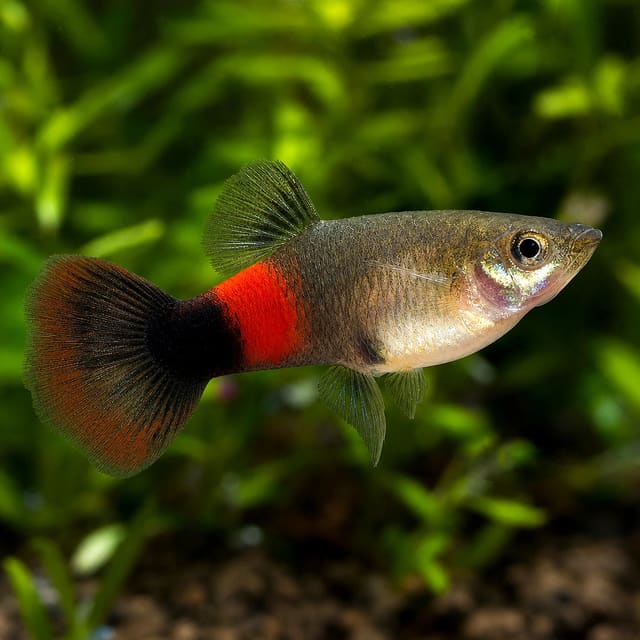
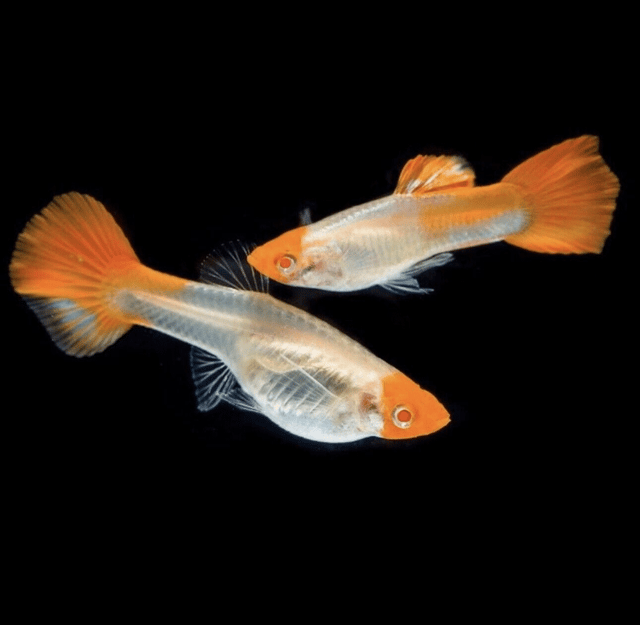
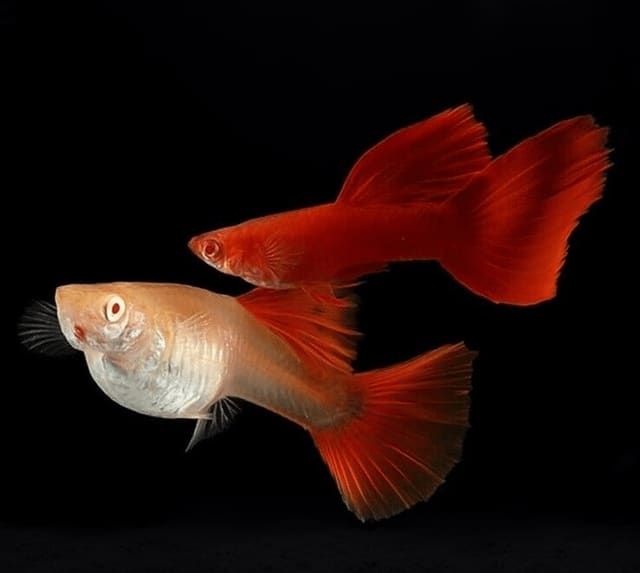
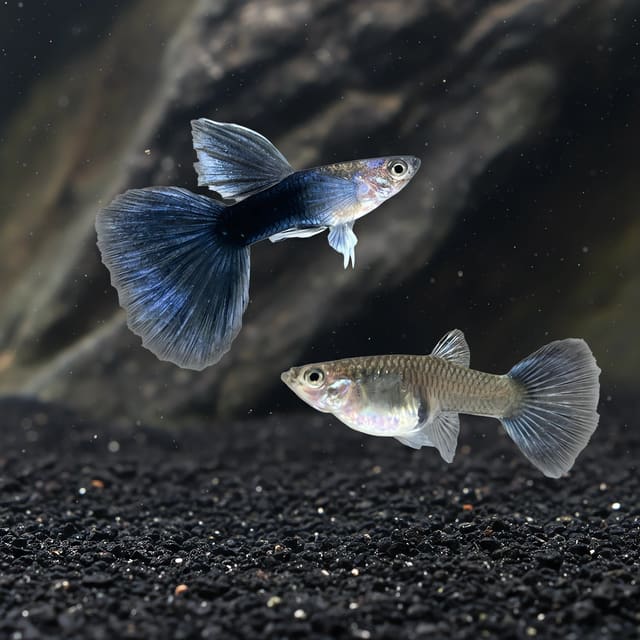
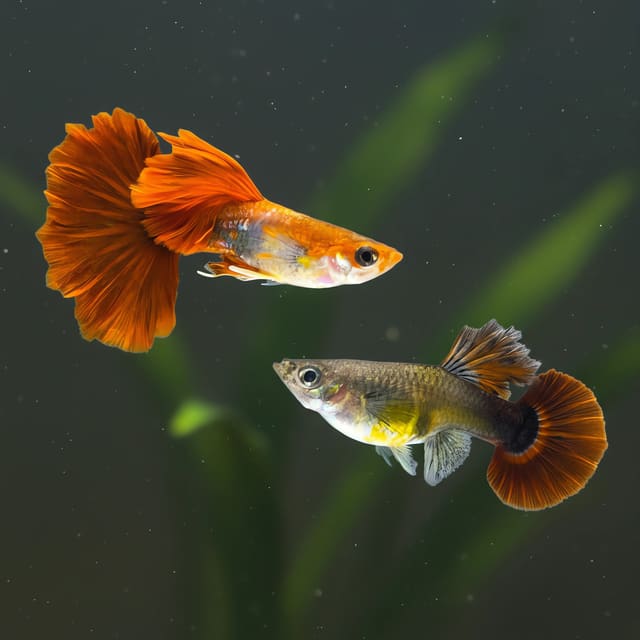
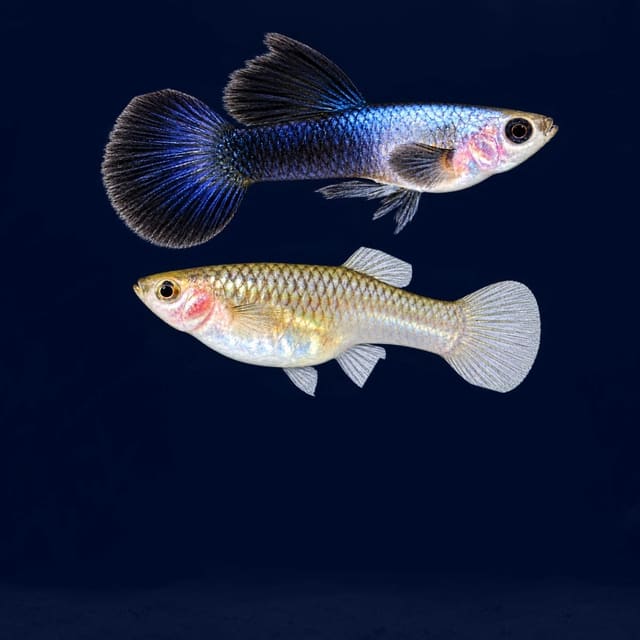
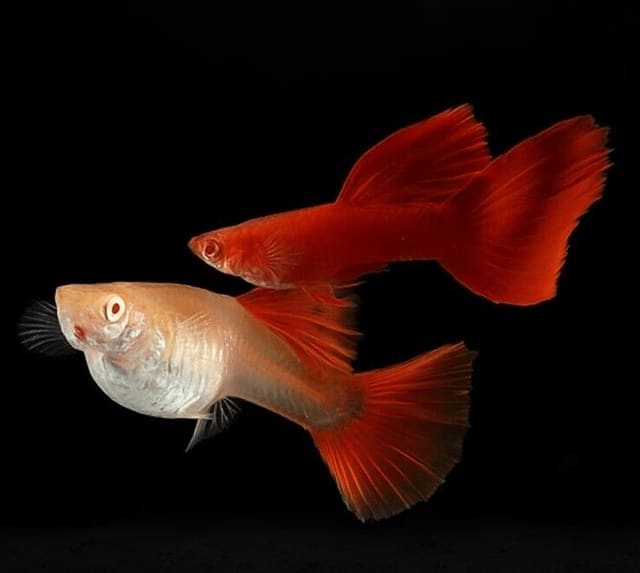
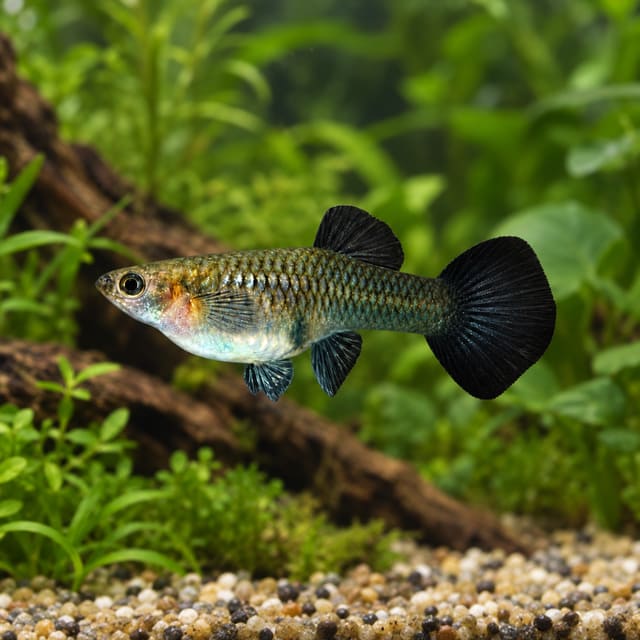
One female guppy of the blond gold tuxedo colour line, Poecilia reticulata. Females are the larger, plumper sex, reaching 6 cm standard length on FishBase, with quieter colour than males and a darker rear body from the tuxedo pattern. Peaceful, happy at 18 to 28 °C in moderately hard water, and able to store sperm, so she may arrive carrying young.
Adult size is the maximum length this species reaches at full maturity (scientific sources). The livestock you receive will be younger and smaller. Product-photo provenance and any image-specific limitations are stated on the listing.
Poecilia reticulata
Shoaling fish: kept in a group they feel safer, stay calmer and show their best colour.
Minimum of 2 per order.
One female guppy of the blond gold tuxedo colour line, Poecilia reticulata. Females are the larger, plumper sex, reaching 6 cm standard length on FishBase, with quieter colour than males and a darker rear body from the tuxedo pattern. Peaceful, happy at 18 to 28 °C in moderately hard water, and able to store sperm, so she may arrive carrying young.
Adult size is the maximum length this species reaches at full maturity (scientific sources). The livestock you receive will be younger and smaller. Product-photo provenance and any image-specific limitations are stated on the listing.
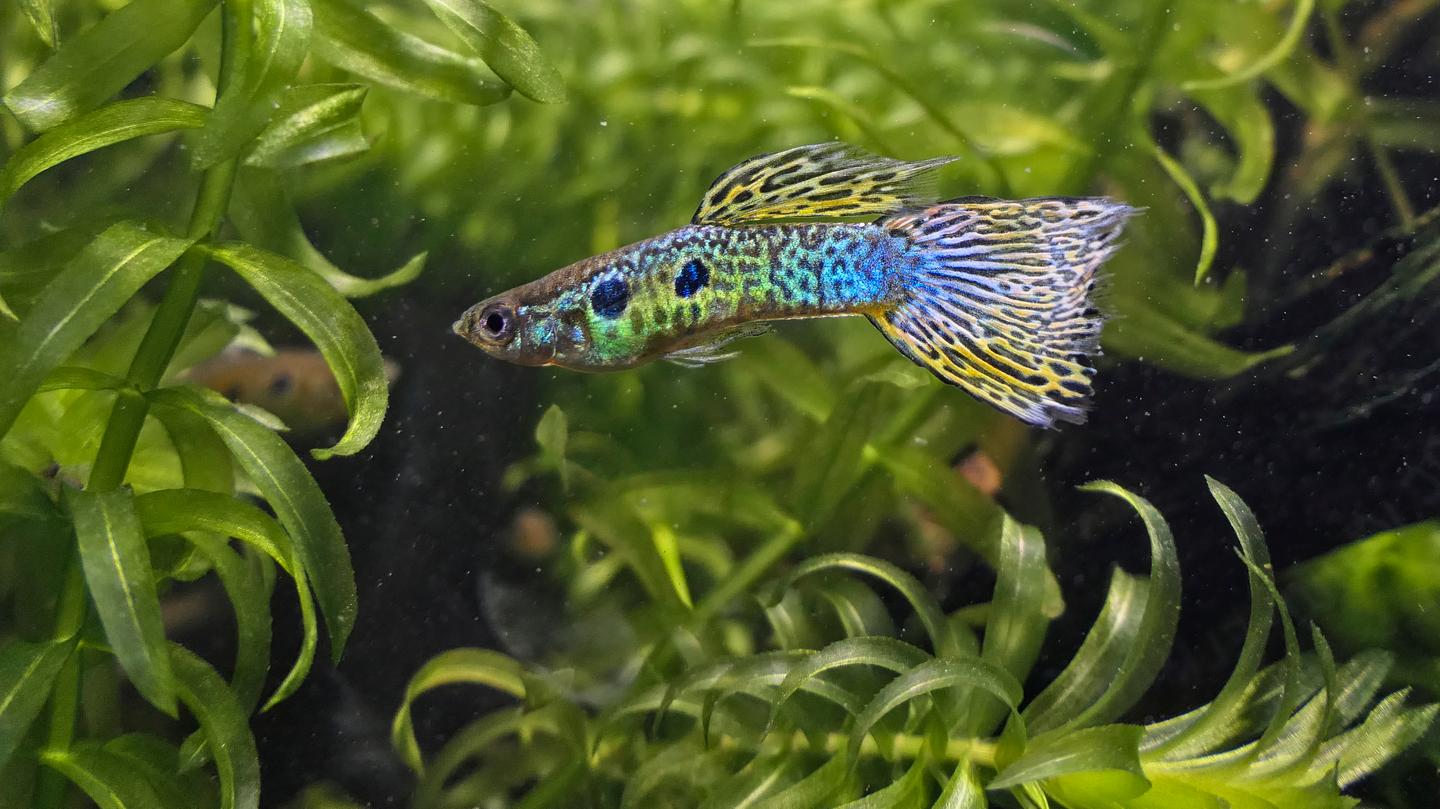
Guppies are social livebearers suited to a prepared beginner, not a fish-per-litre formula. Use a mature filtered aquarium, tested neutral-to-alkaline mineral-bearing water, deliberate sex and population planning, open swimming room, cover and a separation option.
Maintain these water conditions for optimal health and vibrant colors
This listing is for a single female guppy from the blond gold tuxedo colour line. The species is Poecilia reticulata, first described by Wilhelm Peters in 1859 and placed in Poeciliidae, the livebearer family. If you keep an older fishkeeping book on the shelf you may find her filed as Lebistes reticulatus. That name was in use from 1913 until 1963, when Rosen and Bailey returned the fish to Poecilia, and it is the same animal. The English name remembers Robert John Lechmere Guppy, who sent specimens from Trinidad to the Natural History Museum in London in the 1860s.
She is sold by the fish. One unit in your basket is one female. If you want a little group of three or five, order that many.
Why choose females on their own? There are three good reasons:
Females are the bigger sex in this species. FishBase records a maximum of 6.0 cm standard length for females and 5.0 cm for males. Standard length runs from the tip of the snout to the base of the tail fin, so a large female measured with her tail included comes out longer than that figure. Wikipedia puts typical females at 3 to 7 cm and males at 1.5 to 4 cm. In a domestic Tuxedo strain measured in Singapore for a 1999 genetics paper, adult females reached 5 to 6 cm total length while males were 3 to 4 cm, and both were larger than feral wild-type guppies caught in a Singapore hill stream. That domestic strain outgrew its feral cousins, which is worth bearing in mind when you plan the tank.
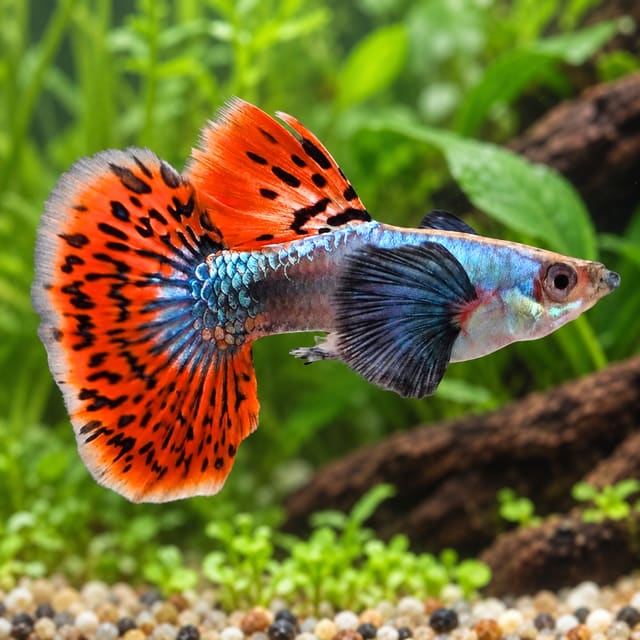
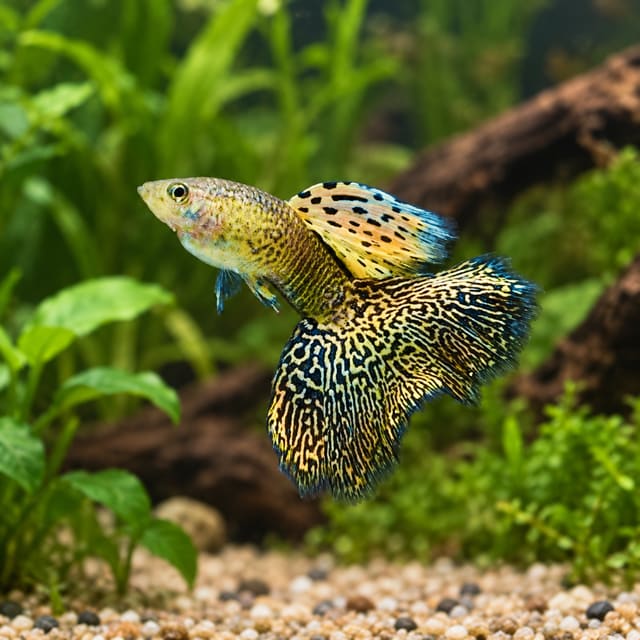
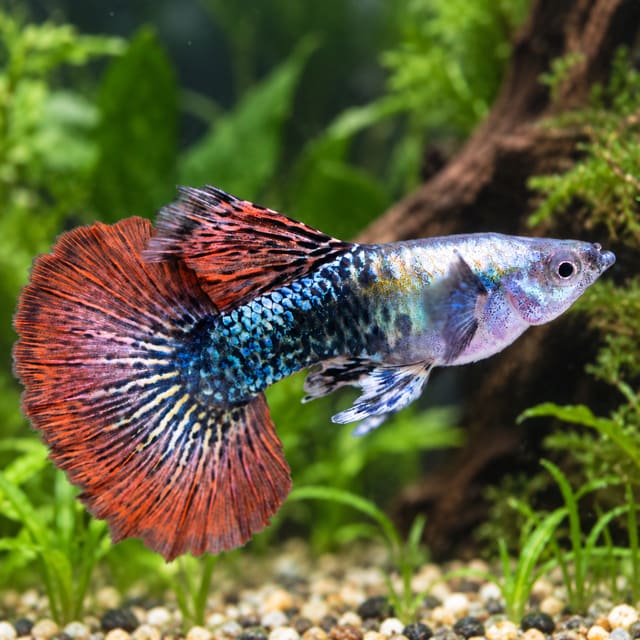
She will not have the long, flowing tail of a male, and she has no gonopodium, the rod-like anal fin that males use to mate. Her anal fin is the ordinary fan shape. Her body is deeper, particularly through the belly, and when she is carrying young you may see the enlarged, darkened patch near her vent that keepers call the gravid spot. The male of the same colour line is listed separately as the male blond gold tuxedo guppy, and the section on males further down explains how many of each to keep if you want both.
Fancy guppy names are a stack of separate traits, and it helps to pull them apart, because each one shows a little differently on a female than on a male.
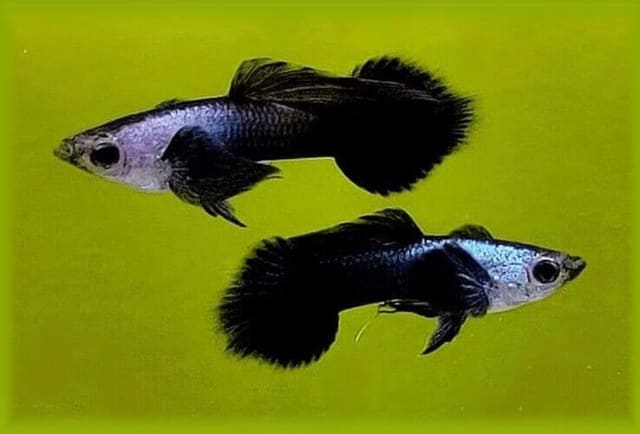
Tuxedo is the breeders' name for a guppy whose rear body, from roughly the middle of the fish back to the tail, is much darker than the front. A 1999 paper in Zoological Science by Khoo, Lim, Chan and Phang worked out how this pattern is inherited in a Tuxedo strain farmed commercially in Singapore. They found that the black rear body, which they call the black caudal peduncle, is controlled by a single dominant gene carried on the sex chromosomes and is expressed in both sexes. That last point matters for anyone buying a female: she carries the pattern too, but it looks different on her.
In their description, Tuxedo males had a black or dark grey rear body and a red to orange-red tail. Tuxedo females showed a grey rear body instead of a black one, an otherwise wild-type olive-brown body, and faint red tinges on a greyish-white tail. That was a red-tailed tuxedo line rather than a blond gold one, so treat it as a guide to how the pattern behaves on females in general. The take-away is simple: on a female, the tuxedo marking is usually softer and greyer than on her brothers.
Blond is one of the classic body-colour genes in guppy genetics. A 2008 letter by Philip Shaddock in the journal AACL Bioflux, drawing on a 1944 study by Goodrich and colleagues, explains that blond fish have black pigment cells that are smaller and more thinly spread than in wild guppies. They contain less melanin overall, so the whole fish looks paler. The gene is recessive, so a guppy only shows it when it inherits a copy from both parents.
Shaddock also points out something useful for tuxedo lovers. The dark pigment cells in the half-black rear body are a different, much larger type, and a blond guppy can still carry a very black rear section. In other words, blond lightens the rest of the body without necessarily washing out the tuxedo. On a female, where the tuxedo area is already greyer, expect a light body with a darker back half rather than a sharp black-and-white contrast.
Golden is another of the classic body-colour genes in guppies. The 1944 work summarised by Shaddock compared wild, golden, blond and cream fish (cream being the double mutant) and showed each with a different size and density of black pigment cells. Trade names do not always line up neatly with genes, so read "blond gold" as a description of a light, warm-toned body rather than as a genetic certificate.
Two honest caveats. First, every female in a colour line is an individual, and the strength of her tuxedo shading and the warmth of her body tone will vary from fish to fish. Second, colour on any guppy looks weaker when she is stressed, cold or newly moved. Give her a couple of weeks in a settled, well-fed tank before you judge her colour.
The guppy's original home is north-eastern South America and the southern Caribbean. FishBase lists Venezuela, Barbados, Trinidad, northern Brazil and Guyana, and Seriously Fish adds Suriname, French Guiana and Tobago. Wikipedia also includes Antigua and Barbuda.
Within that range, guppies turn up almost anywhere there is slow, warm, shallow water. Seriously Fish describes them in almost every kind of habitat, from high-altitude streams to murky swamps and ditches, and notes that they do best where there is lush algae, marginal plants or aquatic vegetation. FishBase mentions warm springs and weedy ditches, and Wikipedia says they favour smaller streams and pools near the coast over large rivers. They are tolerant of salt as well: FishBase classes the species as freshwater and brackish, and Wikipedia reports tolerance of salinity up to one and a half times that of normal seawater.
Trinidad's streams also made the guppy a favourite of field biologists. Wikipedia lists predators such as Crenicichla alta, Anablepsoides hartii and Aequidens pulcher, and describes how guppies living alongside heavy predation differ from those in low-predation populations. Research by John Endler on colour and by David Reznick on life history used these contrasting populations, and the guppy is now a model organism in ecology, evolution and behaviour. One of the findings that matters to anyone who keeps females: female guppies are drawn to brightly coloured males, especially those with orange spots on the flank, and Wikipedia suggests they may be picking healthy males that are good at finding food.
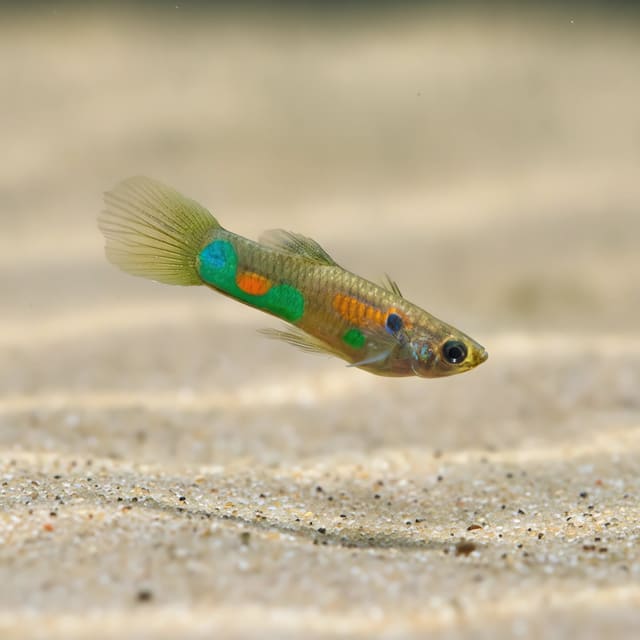
Wild female guppies look nothing like a showy tank-bred male. Khoo and colleagues describe wild-type females as a drab olive-brown with no bright colour patterns at all, and wild males as small fish with highly variable spots and patches. Every fancy line, the blond gold tuxedo included, was built by breeders selecting from that starting point. Wikipedia notes that breeders have produced a variety of fancy strains differing in colour, pattern, fin shape and size.
The species has also travelled a long way with human help. FishBase records that it has been widely introduced and established elsewhere, mainly for mosquito control, and Wikipedia adds that in many places the released guppies harmed native fish. That is one reason we ask every customer never to release aquarium fish or empty tank water into ponds, streams or drains. On the IUCN Red List the guppy is assessed as Least Concern, last reviewed in 2020.
For a small group of guppies, Seriously Fish recommends a tank with a base of at least 45 by 30 cm. Remember that she may grow to 6 cm standard length, larger than most of the males you will see in shops, and that females in a group need room to get away from each other and from any males. Length and floor area give a group more room than extra height does.
In the wild, guppies live in loose groups, and Wikipedia notes that shoaling is strongest in populations under heavy predation. In the aquarium, a few females together look more settled and more natural than a lone fish. If you are adding males, the guidance from Seriously Fish is several females to each male, because males pursue females vigorously and one female with several males will be worn down.
A female-only tank is perfectly reasonable and is one of the easiest set-ups in fishkeeping. Just be aware of the twist explained in the breeding section below: a female who has met a male before she reaches you can still give birth weeks or months later.
All fancy guppies are the same species, so a blond gold tuxedo female will happily share a tank with females of other colour lines, such as the red tuxedo female guppy or the sunset blond female guppy. The only thing to think about is breeding. If any male shares the tank, the young will be a mixture of whatever genes the parents carry. Because blond is recessive, a cross with a male that does not carry it will produce darker-bodied youngsters, and the light body may not reappear until a later generation.
Have the aquarium running, heated and with a mature filter well before you order. Test the water so you know where you stand on temperature, pH and hardness, because those three numbers are the ones that matter most for a guppy and they are covered in the next section.
Guppies are adaptable, but they are not soft-water fish. The references we used point to warm, neutral to alkaline, moderately hard water. The figures differ a little from source to source, which is normal, so here they are side by side.
| Parameter | FishBase | Seriously Fish | Wikipedia |
|---|---|---|---|
| Temperature | 18 to 28 °C | 17 to 28 °C | 25.5 to 27.8 °C in the aquarium; 22.2 to 26.1 °C preferred for breeding |
| pH | 7.0 to 8.0 | 7.0 to 8.5 | not stated |
| Hardness | 9 to 19 dGH | 8 to 30 dGH | prefers a hard-water aquarium |
The care figures on this listing follow FishBase: 18 to 28 °C, pH 7 to 8 and 9 to 19 dGH. Within that, most keepers run a guppy tank in the mid-20s Celsius. The bottom of the FishBase range sits well below the aquarium preference Wikipedia gives, so do not aim for it. Wikipedia's aquarium figure of 25.5 to 27.8 °C sits at the warm end, so anywhere in the mid-20s is a sensible target for a community tank.
Hardness is where many people slip up. Seriously Fish notes that guppies tolerate a wide range of conditions but need moderately hard water in the long term. Test your tap water's hardness before you order. If it turns out to be very soft, talk to us first, because a guppy kept for months in soft, acidic water is working against her own biology.
A steady temperature and steady chemistry do far more for her than hitting an exact figure. Change part of the water regularly with tap water that has been dechlorinated and brought to roughly the tank's temperature, and test for ammonia and nitrite whenever something looks off. A new tank needs to finish cycling before any fish go in.
Guppies are naturally tolerant of brackish water, and FishBase lists the species from both fresh and brackish habitats. That tolerance is a fact about the species, not an instruction to add salt. A freshwater community tank with plants and other fish does not need it, and some tank mates and plants will not appreciate it.
In the wild, guppies eat whatever small food their stream offers. FishBase lists zooplankton, small insects and detritus. Wikipedia adds algal remains, diatoms, other invertebrates and the larvae of aquatic insects, and points out that the diet shifts with what each habitat provides. Seriously Fish describes wild fish as mainly insectivorous, while noting that tank-bred guppies are a long way removed from their ancestors and will take most foods offered.
So she is easy to feed. What makes the difference is variety and portion size, not a special diet.
Little and often suits a small livebearer. Offer what the fish clear in a couple of minutes, once or twice a day, and remove anything left on the bottom. Overfeeding fouls the water long before it harms the fish directly, and dirty water is a bigger risk to a newly arrived guppy than a missed meal.
Guppies are opportunists, and that includes their own newborn young. Wikipedia says that well-fed adults do not often eat their fry, although safe areas are sometimes needed, whereas Seriously Fish states plainly that adults will eat the young. The two accounts differ in emphasis, but they agree on the practical point: a well-fed tank with dense planting is the best protection for any fry she produces.
Feeding time is your daily health check. A settled female comes up for food with the others and eats with interest. If she hangs back, hides in the plants and ignores food for more than a day or two, look at the water quality first and then at her behaviour and fins.
Seriously Fish calls the guppy a very peaceful community fish, and a female is about as gentle as aquarium fish come. She will not bother other fish, and she is too small to be a threat to anything but the tiniest fry.
Seriously Fish lists other livebearers, rasboras, corydoras, small loricariids and tetras as fish the guppy does well alongside in a quiet community tank. The word quiet is important. A female guppy does best with calm, similarly sized fish that share her liking for warm, moderately hard water.
The same source warns against keeping guppies with fin-nipping species, naming tiger barbs and serpae tetras as examples. Females have shorter fins than males, but persistent nipping still stresses them. Anything large enough to swallow a 5 to 6 cm fish is also out, and so are boisterous species that dominate feeding time.
If you want both sexes, the safest arrangement is several females to each male, as Seriously Fish advises. Male guppies are tireless: they display and chase almost all day, and a female with no escape spends her life being pursued. With a better ratio, plenty of plants and some floating cover, the attention is spread out and each female gets some peace.
For a matched pair of colours, the male of this blond gold tuxedo line is the obvious partner. If you are only after a lively display and are not planning a breeding project, any healthy male guppy will do, but remember that every male in the tank will father young.
Keeping females on their own is a perfectly good choice. They feed together, explore the planting and behave naturally without the constant courtship. It is also the calmest way to keep guppies in a shared community tank with shy fish. Read the next section before you assume a female-only tank means no babies, though.
Guppies are livebearers. Fertilisation is internal, the eggs develop inside the female, and she gives birth to free-swimming young. FishBase gives a gestation of four to six weeks with broods of 20 to 40 young. Seriously Fish agrees on four to six weeks and gives a much wider brood range of 5 to 100. Wikipedia reports 20 to 60 days, depending on temperature and conditions, and 30 to 60 fry per brood. The spread between those figures shows how much broods vary, so do not judge a female by her first one.
This is the part that surprises new keepers. Female guppies store sperm. FishBase notes that they can keep it for later fertilisation and may produce young every four weeks. Seriously Fish says a female can keep producing young for six months or more with no male present, and Wikipedia gives up to eight months.
We cannot tell you whether a particular female has mated before she reaches you, and we will not promise either way. Plan as if she might drop fry in the weeks after arrival. If that happens in a female-only tank, it is not a mistake or a mix-up; it is normal guppy biology.
There is no parental care. FishBase is explicit on that point, and the adults may eat the fry. For the best survival, Seriously Fish recommends a densely planted species tank with lots of floating vegetation, and suggests separating adults from the fry once they are born if you want every youngster to live. In a community tank, a thick clump of fine-leaved plants or floating plants near the surface gives newborn fry somewhere to hide and gives some of them a chance.
Wikipedia notes that a female is ready to conceive again quickly after giving birth. In a mixed tank, then, she will produce brood after brood. Young males can mature in under seven weeks, and females from about 10 to 20 weeks, so plan homes for the youngsters early.
If you want to keep the blond gold tuxedo look going, pair her with a male of the same line. Because blond is recessive, both parents need to carry it for the young to show it. The tuxedo rear body, by contrast, is dominant according to Khoo and colleagues, so it tends to appear in the young even when only one parent carries it.
A healthy female guppy is alert, swims easily at the top and middle of the tank, holds her fins open and comes up to feed. Her body is smoothly rounded, without a pinched belly or a hollow behind the head, and her breathing is steady rather than rapid.
Seriously Fish is frank that many commercial guppy strains are weakened by inbreeding and mass production, which makes them more prone to disease than wild-type fish. That does not mean a fancy female is fragile, but it does mean that clean, stable, moderately hard water and a calm tank count for more with a colour line than with a wild-caught fish. In practice, unstable water, a cold tank and too many males are the first things to rule out.
If you see any of these, test the water first. A large share of fish health problems are water problems, and fixing the water often fixes the fish. If the water is fine and she is still unwell, get in touch for advice.
If you already have an established tank, a separate quarantine tank for new fish is good practice. Keeping a new female on her own for a couple of weeks lets you watch her closely, feed her well and be sure she is healthy before she joins your other fish.
Wikipedia gives a typical lifespan of about two years for wild guppies. It does not give a figure for aquarium fish, and we would rather not invent one. Good water, a sensible male-to-female ratio and steady warmth are what give any guppy her best chance of a full life.
Please read our delivery and live-arrival information before you order, so you know how the process works and what we ask of you on the day.
Your female travels in an oxygen-filled bag inside insulated packaging, with heat packs when the weather calls for them, and is carried by a tracked courier licensed to transport live animals.
This step protects you. Start a continuous video while the parcel is still sealed, then open it in the same take and show the fish in the bag before the bag is opened. If a fish arrives dead, dying or clearly in poor condition, email hello@tropicalfishco.co.uk on the day of delivery with your order number and that video. Photos alone do not meet the policy. Where a claim is accepted, we replace the affected fish with your next order or refund it, subject to our guarantee terms.
Keep the lights low for the rest of the first day and leave her to explore. Offer a small amount of food the next day rather than straight away. Over the first week, watch three things: her breathing, her appetite and her behaviour. A new female often spends the first day near the plants and then starts coming up to feed with the others. Her colour may look paler at first and usually improves as she settles.
If there are males in the tank already, keep an eye on how much they chase her in the first few days. If she is being harried, more females or more cover usually solves it.
These are the sources behind the facts on this page. They are worth reading in full if you want to go deeper into guppy care and colour genetics.
No reviews for this item yet. Bought one? Honest reviews only, good or bad.
What customers say about ordering from us
Easy website plenty of info on fish your buying great to pick a time slot
TRACEY DURRANT · 7 Oct 2026
Got some lovely fish thank you
Kevin Mackie · 7 Oct 2026
Reviews of our shop, collected by Judge.me, an independent third-party review collector. Newest first.