Easy
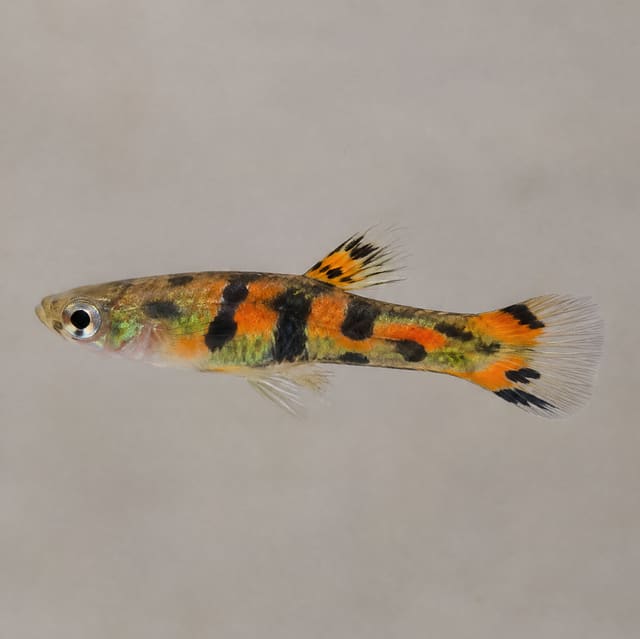
Campoma El Tigre Endler (Poecilia wingei)
20–28°C · pH 7–8
£16.99
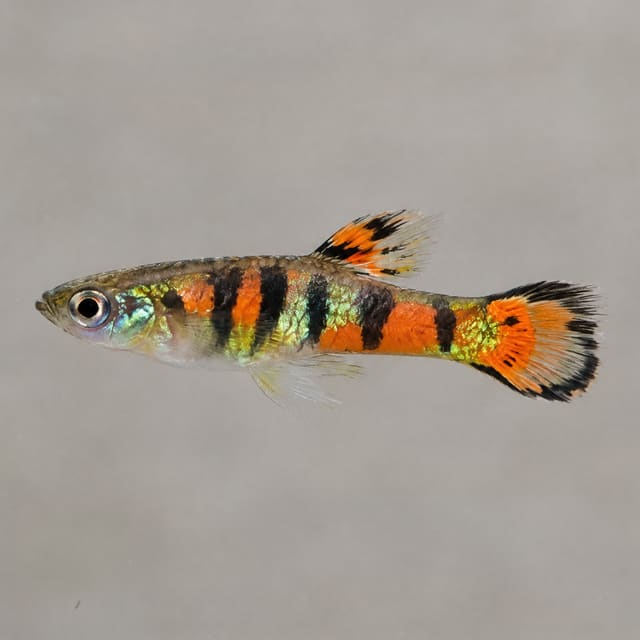
One male Tiger Green Endler guppy (Poecilia wingei) per unit, graded at about 2.5 cm on dispatch. A tiny, peaceful livebearer for planted tanks of 40 litres or more with warm, moderately hard water. Males are peaceful towards each other, so an all-male group gives colour without fry.
Adult size is the maximum length this species reaches at full maturity (scientific sources). The livestock you receive will be younger and smaller. Product-photo provenance and any image-specific limitations are stated on the listing.
Poecilia wingei
Save when buying multiple fish. Each quantity is one fish; sex and pair formation are not guaranteed unless the selected variant explicitly states them.
One male Tiger Green Endler guppy (Poecilia wingei) per unit, graded at about 2.5 cm on dispatch. A tiny, peaceful livebearer for planted tanks of 40 litres or more with warm, moderately hard water. Males are peaceful towards each other, so an all-male group gives colour without fry.
Adult size is the maximum length this species reaches at full maturity (scientific sources). The livestock you receive will be younger and smaller. Product-photo provenance and any image-specific limitations are stated on the listing.
Endler's livebearer is a small, social, rapidly reproducing Venezuelan fish. Start with a mature filtered aquarium, a deliberate sex and population plan, stable tested medium-hard water, open swimming room and cover. Our conservative house screen is an aquarium at least 60 cm long and a group of five or more where capacity allows.
Read the full care guidance when planning conditions for your aquarium.
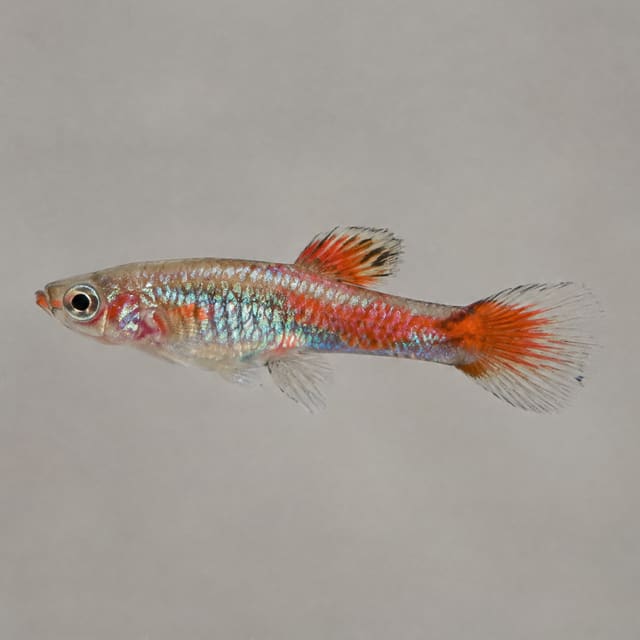
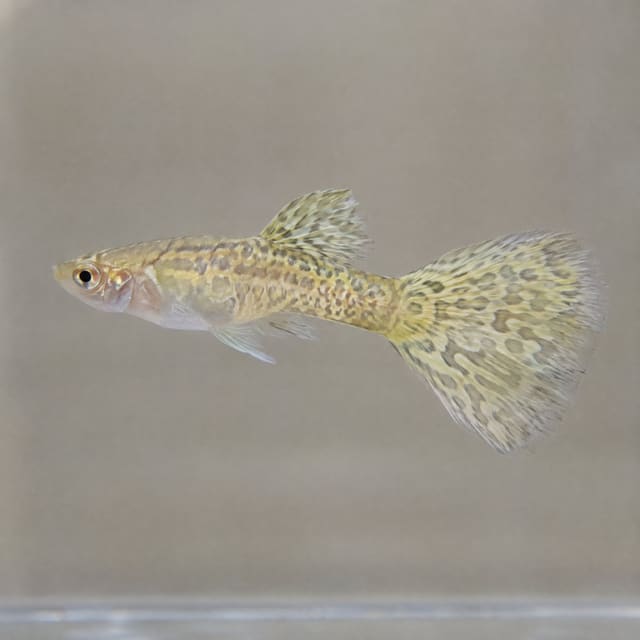
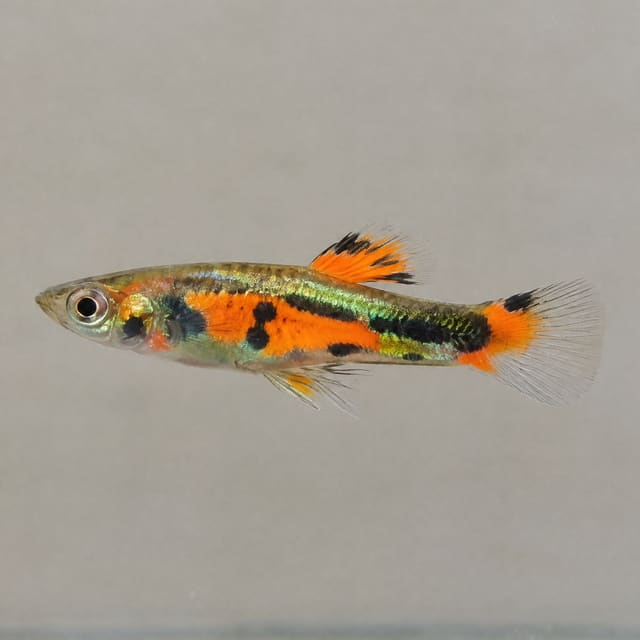
Each unit on this page is one male Endler's livebearer of the colour form sold as Tiger Green. Our stock records grade these males at about 2.5 cm when they go out. No females come with this listing, so a group bought here is an all-male group: plenty of colour and movement, and no surprise fry turning up a few weeks later. If you do want to breed, females have to be added separately, and the breeding section further down explains what that involves.
The scientific name on the label is Poecilia wingei, the name FishBase lists as valid for the Endler's guppy. You will also see these fish labelled "Poecilia endler" in shops and on some of our own older listings. That isn't a published scientific name. It is shorthand that stuck because nearly everybody calls the fish Endlers, after John Endler, the biologist who found them again in 1975 at Laguna de Patos in north-east Venezuela. Franklyn Bond had first collected them in 1937, but the species was not formally described until 2005, when Poeser, Kempkes and Isbrücker named it after Øjvind Winge, who described many of the guppy's colour patterns and the genetics of how its sex is determined.
This is the question we hear most about Endlers, so here it is straight. Endler's livebearer and the ordinary guppy, Poecilia reticulata, are very close relatives. They cross readily in aquariums and the young are fertile. In 2009 Schories, Meyer and Schartl used a molecular family tree to confirm that P. wingei is a valid species in its own right, but the same paper found that the guppy, the Endler and a third species from Trinidad, Poecilia obscura, form a cryptic species complex. Their physical features overlap so much that, according to the authors, you can't sort them reliably on looks alone; it takes genetic analysis.
Wikipedia's account spells out what that means in practice: undocumented fish sold in pet shops as Endlers are assumed to carry some degree of guppy ancestry. Keepers who need a guaranteed pure line maintain registry records for their fish. We don't hold registry records for this line, so we will not tell you these males are pure P. wingei. They are sold, kept and cared for as Endlers, and for a display tank that is what counts. An Endler-type male with some guppy in its family tree needs the same water, the same food and the same kind of company as a pure one.
So, who is this fish for? It suits anyone after a small, bright, peaceful fish for a planted tank of 40 litres or more with warm, moderately hard water, and anyone who wants colour without a population explosion. It is the wrong choice if you are setting up a conservation line or want a documented wild-type population; for that, look for a specialist breeder who can show you the lineage.
There are three good reasons. The males are where the colour is: Seriously Fish describes them as far more colourful than the females. They get along: the same source says males are peaceful towards one another, while females can be territorial. And livebearers breed fast. A female Endler can produce a brood every three weeks or so, and in a community tank that soon means more fish than the tank was planned for. An all-male group gives you the display without a growing population to manage.
One naming trap is worth flagging. Our Tiger Male Guppy is a guppy, Poecilia reticulata, not an Endler. The shared word "tiger" is simply how the trade names colour forms. It doesn't make the two the same fish.
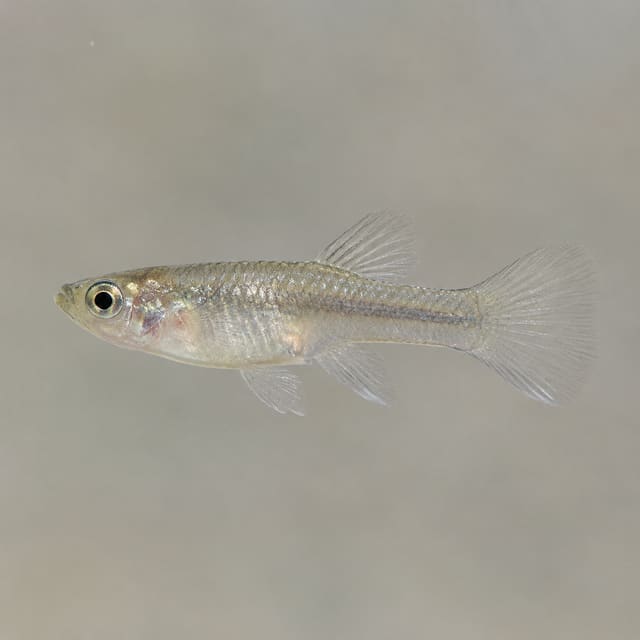
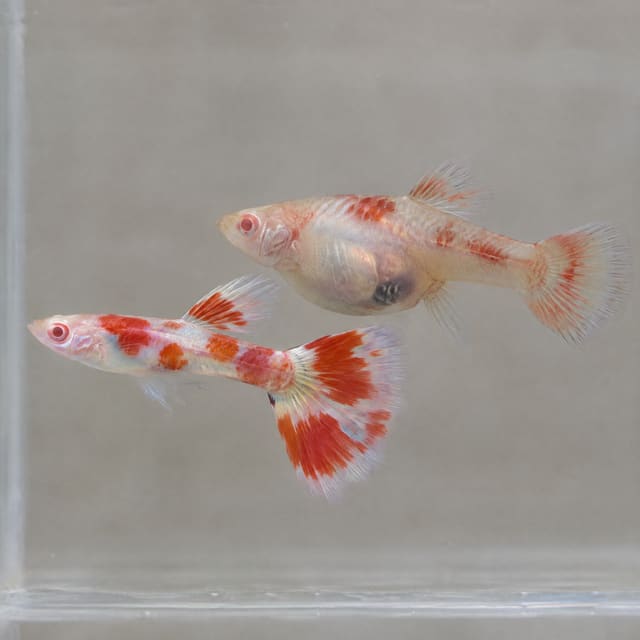
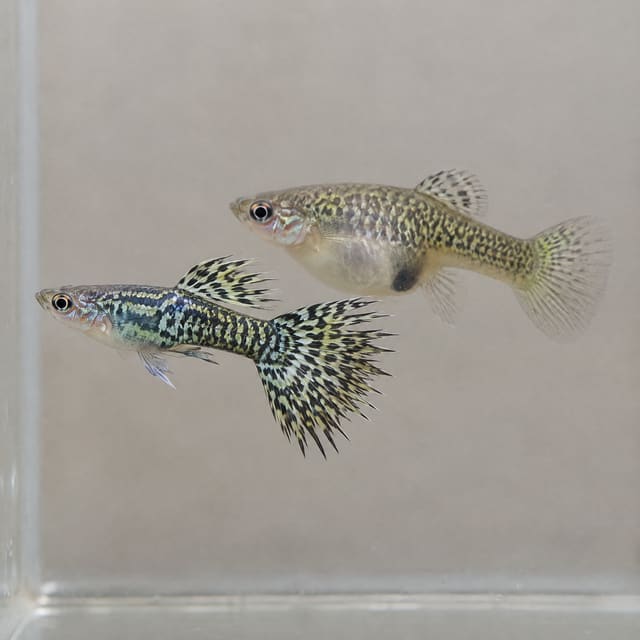
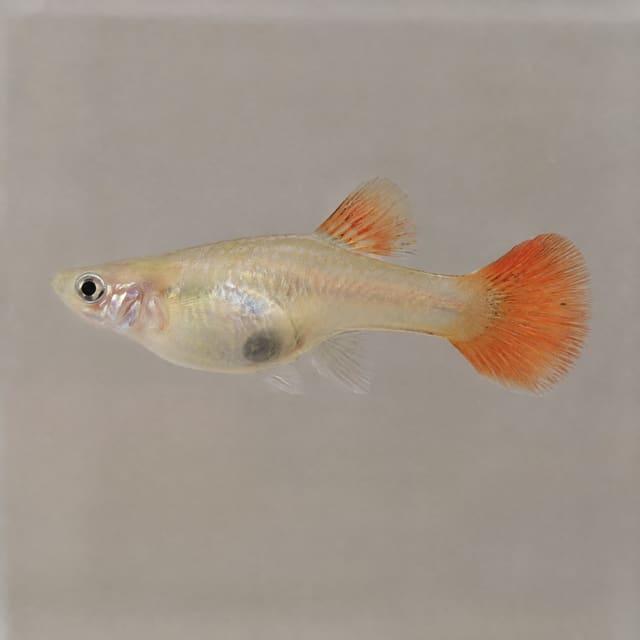
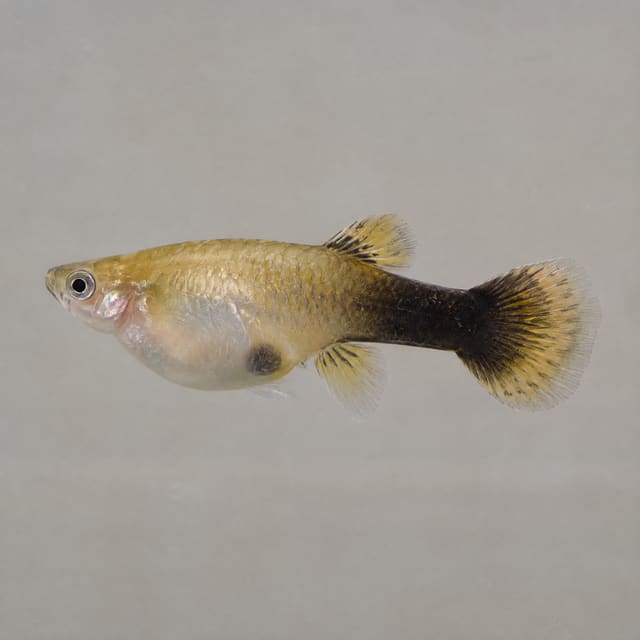
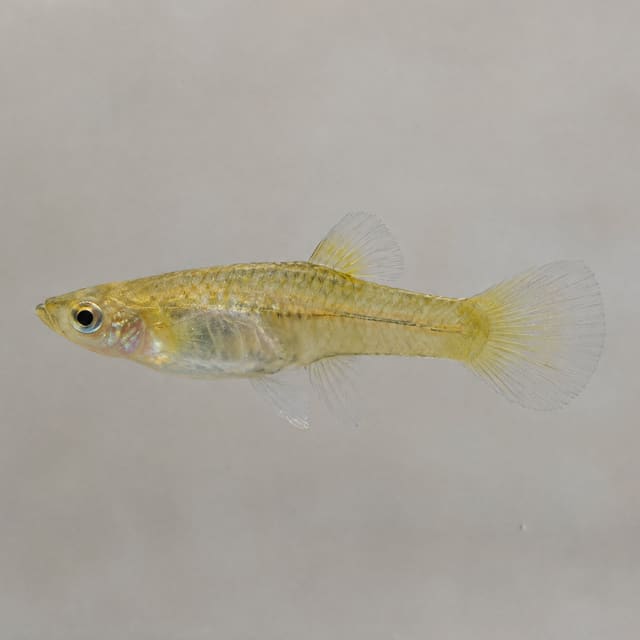
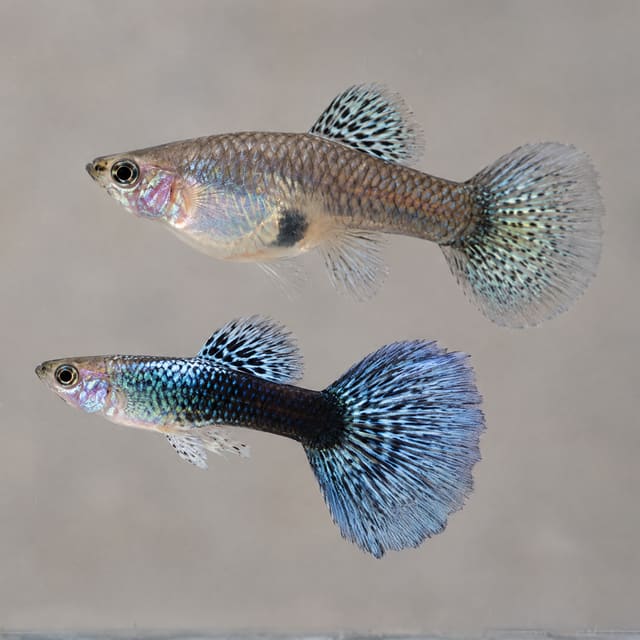
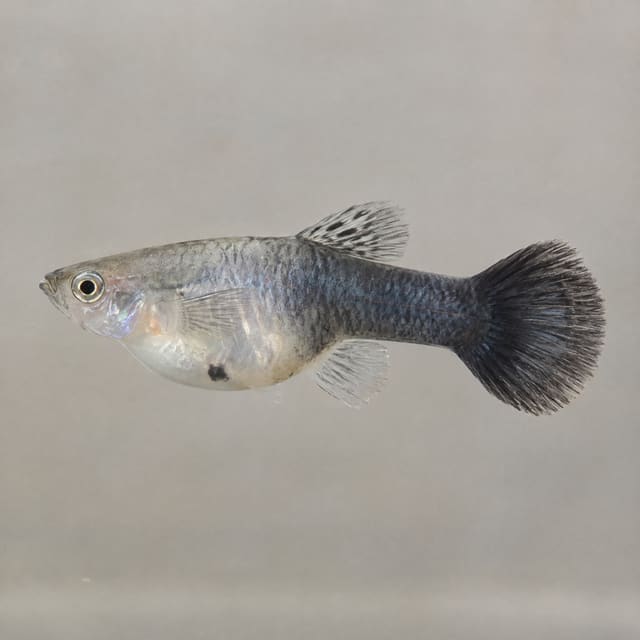
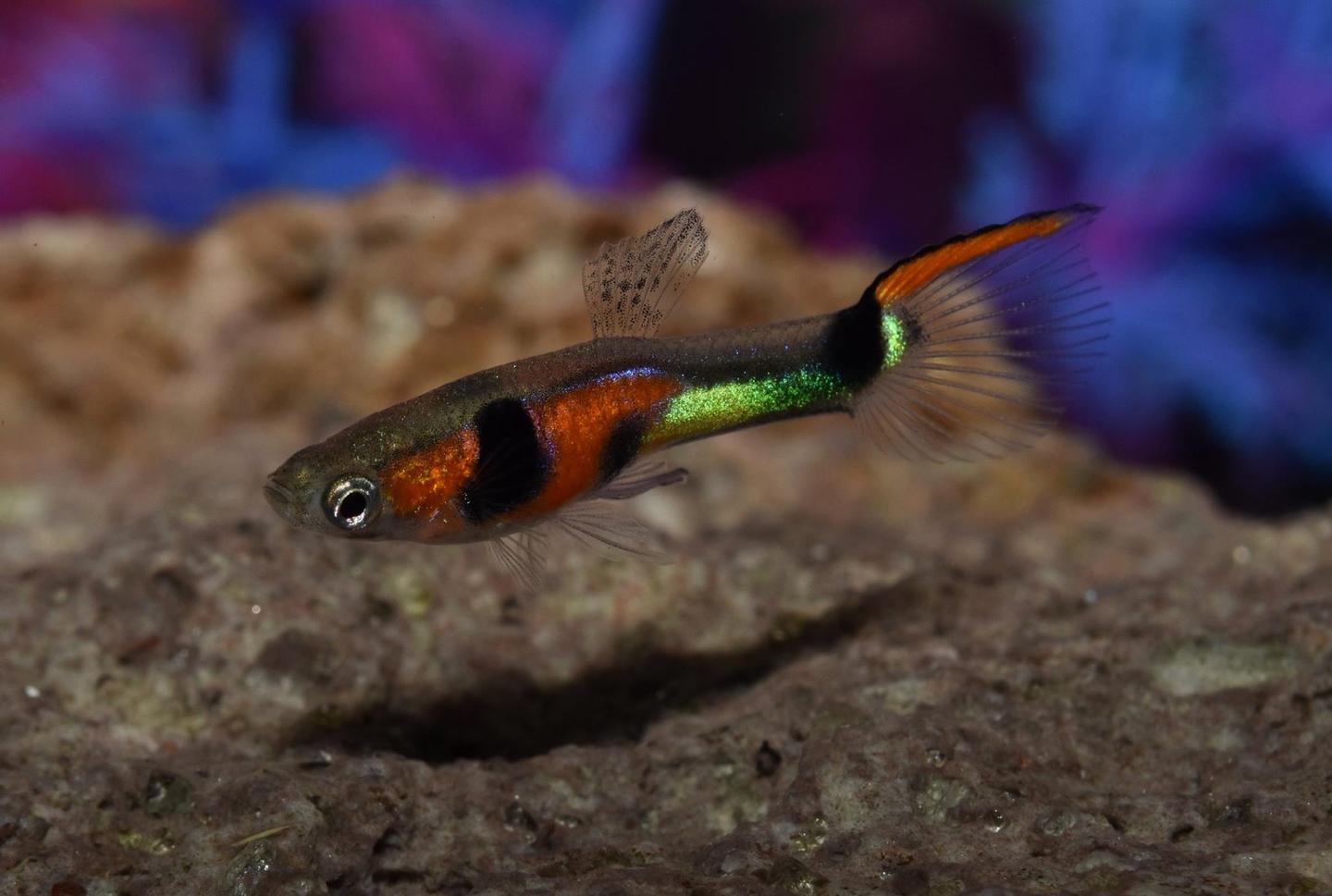
Endlers are one of those fish where the two sexes hardly look like the same animal. Seriously Fish describes the males as smaller and far more colourful, and the females as much plumper and, in its words, almost perpetually gravid. Wikipedia adds that a full-grown female can be as much as twice the size of a male. If you are looking at a tiny, slim, restless fish covered in bold colour, it's a male. The larger, rounder, plainer fish are the females.
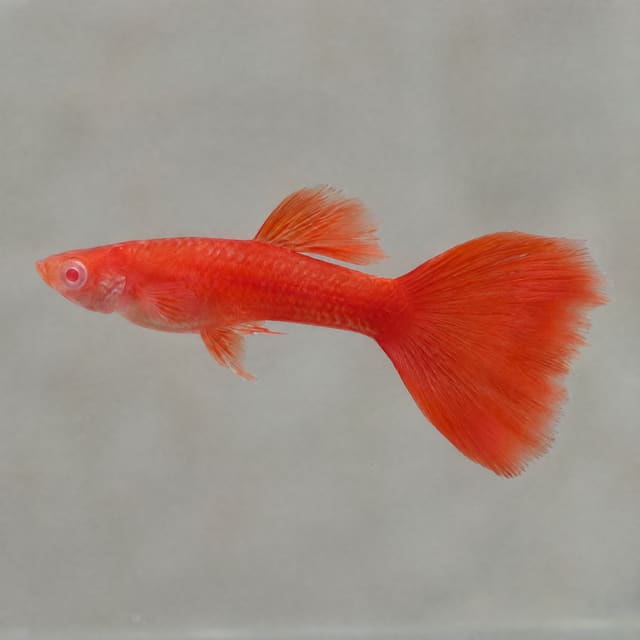
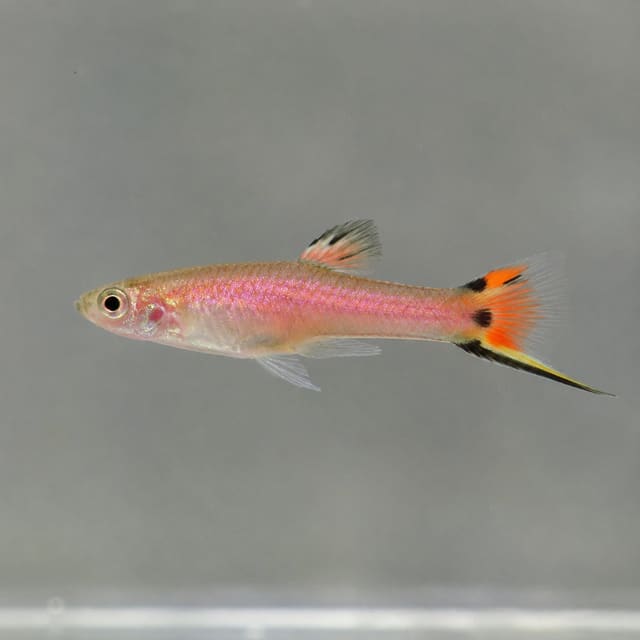
For something so small, a male Endler carries a lot of colour. Wikipedia singles out the black, orange and metallic green as especially intense, says natural patterns are highly variable, and notes that many males show a double sword tail, with both the upper and lower edges of the tail fin drawn out into points. Seriously Fish adds a note of caution: much of the natural variation found in wild fish has been lost through inbreeding in the hobby, although several distinct forms are still kept.
Tiger Green is a trade name for a colour form, not a scientific category, and nobody has published a standard that defines it. Read it as a description of what this line is sold for: green tones combined with tiger-style markings. We would rather not describe the pattern in more detail than the name and the published accounts of the species support. Expect each male to differ a little from the next one in the bag, which is normal for Endlers.
There is one genuine "tiger" in Endler history, and it is easy to confuse with trade names. Wikipedia describes El Tigre Endlers as P. wingei collected from the El Tigre stream in the Campoma region of Venezuela. If that locality interests you, we list a Campoma El Tigre Endler, and there is also a separate Tiger Endler to compare. We have no record linking the Tiger Green line to the El Tigre stream, though, so please don't buy it on the assumption that it is a locality fish.
Male colour builds over weeks and months rather than days. Seriously Fish says young males show adult colouring at three to five weeks old, while Wikipedia says colour starts to show at three to four weeks but takes several months to reach full intensity. Because these fish are sold as males, they are old enough to be told apart from females, but their colour may still be deepening. If a male looks a touch muted when he arrives, give him a settled tank, good food and a little patience before you judge him.
The Endler comes from a very small corner of the world: the Paría Peninsula in north-eastern Venezuela. FishBase gives its range as the Campoma and Buena Vista lagoons, and Seriously Fish describes it from fresh waters in those lagoons out towards Carúpano. FishBase classes it as a tropical freshwater fish.
The best-known site is Laguna de Patos near Cumaná, where Endler collected in 1975. Seriously Fish explains that this was once a brackish lake, cut off from the sea by a sandbar, which gradually became fresh. The water there was very warm and hard, and very green from a heavy growth of algae. Sadly, the same source reports that the species is now thought to be extinct at that lake, after a rubbish dump was built next to it and the water became polluted.
Laguna de Patos also held wild guppies. Seriously Fish says the two lived side by side there without interbreeding, and that guppies were much less common wherever P. wingei was thriving. That makes an interesting contrast with the aquarium, where the two cross readily and their young are fertile.
FishBase lists Endler's livebearer as Endangered on the IUCN Red List, with the assessment dated 8 March 2021, and Wikipedia gives the same category. The threats Wikipedia names are people moving into the habitat, the release of invasive species, pollution and the destruction of the waters themselves, with hybridisation with released guppies a serious extra risk. Wild Endlers face exactly the mixing problem aquarium keepers talk about, only on a scale that threatens the wild populations themselves.
That is also why the purity question above matters more to conservation breeders than to the rest of us. A display tank of Endler-type males does no harm, but fish from the hobby should never be released anywhere, in Venezuela or here.
The useful lesson for a keeper is the water. These are fish of warm, hard lagoon water, which at Laguna de Patos was thick with algae, not fish of soft, acidic forest streams. That is why the care advice below leans towards warm, moderately hard water, and why a film of algae on the plants is nothing to panic about in an Endler tank. Wikipedia even mentions young Endlers picking at the algae layer on plants.
The short answer is: very small. FishBase gives a maximum of 2.0 cm standard length, recorded for a female. Seriously Fish gives a slightly larger maximum of 25 mm standard length. Since a full-grown female can be up to twice the size of a male, a male Endler sits at the small end of an already tiny species. The "Max Adult Size" shown on this page is the FishBase figure, 2.0 cm.
Both published figures are standard lengths, and it helps to know what that means. Standard length is measured from the tip of the snout to the end of the backbone, where the tail fin begins, so it leaves the tail fin out altogether. Total length runs from the snout to the tip of the longer lobe of the tail. A fish's total length is always the bigger of the two numbers.
That matters when you compare the scientific figure with the grade on this listing. Our stock records put these males at about 2.5 cm on dispatch. That number is a size band used for dispatch, not a scientific measurement, and it isn't stated as a standard length, so please don't set it against the 2 cm maximum and conclude that the fish is already "oversized" or that it has lots of growing still to do. What both numbers do tell you is that these are tiny fish, and everything about the set-up should reflect that: very fine food, covered filter intakes and gentle companions.
A fish of this size has very little in reserve. It can't push its way to food past bigger fish, it can be drawn against an uncovered filter intake, and a fish that disappears into a dense plant thicket can be hard to keep an eye on. None of that makes Endlers difficult, but it does reward a bit of forethought. A sponge over the filter intake, food broken down small enough to fit a tiny mouth, and a tank stocked with fish of a similar size cover most of it.
None of the references we used gives a reliable lifespan figure for Endler's livebearer, so we won't put a number on it here. Good water, sensible feeding and calm company are what give any small livebearer the best chance of a long life.
Small fish don't automatically mean a small tank. Seriously Fish recommends a base of at least 45 × 30 cm, which works out at roughly 41 litres, and says a tank of 45 × 30 × 30 cm is big enough for quite a substantial colony. It also makes the point that these are active fish that need room to swim, and that they shouldn't go into anything smaller. On this listing we give 40 litres as the minimum, in line with that advice.
Bigger is easier. A 60 cm tank holds more water, so temperature and water quality drift more slowly, and it gives a group of males more space to patrol. If you plan to add companions, size the tank for the whole community rather than for the Endlers alone.
Seriously Fish strongly recommends a planted aquarium with floating plants. In practice that means a reasonably open swimming area at the front, with stem plants, mosses or other fine-leaved planting towards the back and sides, and something floating on the surface to soften the light. Leave enough open water near the top for a group of small fish to be seen. A darker background or substrate makes small, bright fish easier to pick out.
As an example, a 60 × 30 cm tank makes a comfortable Endler home. Use a dark sand or fine gravel, a sponge filter or a small filter with a sponge fitted over the intake, and a thermostatic heater set in the middle of the range. Plant taller stems along the back, put a few clumps of moss or low plants on wood or stone in the middle ground, and leave the front third fairly open. Let a floating plant cover part of the surface, but not all of it, so the light is softened without the tank going dark. That gives the males open water to show off in and cover to retreat to.
According to Seriously Fish, Endlers produce very little waste, so in a tank kept just for them a powerful filter isn't necessary, and water movement doesn't trouble them. A gentle internal sponge filter or a small hang-on filter is plenty for a species tank. In a mixed community the filter needs to be sized for everything else in there too. Whatever you use, fit a sponge over the intake: a 2 cm fish is light enough to be held against a strong intake.
Endlers should go into an aquarium that is already cycled, with ammonia and nitrite testing at zero and the heater holding a steady temperature. A brand-new tank, a bowl or an unheated container is not suitable. If the tank has been running for a few weeks with plants growing and a filter that has been seeded, you're in a good position.
That depends on your tank and on what else lives in it, so there is no magic number. Because Seriously Fish describes male Endlers as peaceful towards one another, an all-male group is straightforward to put together. We'd suggest buying several rather than one: a single tiny fish is easy to lose sight of in a planted tank, while a group shows off the colour and gives the tank life from one end to the other.
Get the water right before you order and Endlers are one of the easier fish to keep. The ranges below come from Seriously Fish, and they match what is known about the wild habitat.
| Parameter | Range |
|---|---|
| Temperature | 24–30 °C |
| pH | 7.0–8.5 |
| General hardness | 15–35 dGH |
| Ammonia and nitrite | 0, as for any fish |
Seriously Fish calls the Endler a moderately hard water fish. It may cope with soft or acidic water for a while, but long-term care should be in moderately hard or harder water. That fits the description of Laguna de Patos as very warm and hard. If you keep these males in soft, acidic water because it suits other fish in the tank, you are working against them rather than with them.
Before you order, test the general hardness (GH), carbonate hardness (KH) and pH of your tap water once it has stood for a day. If it already falls inside the ranges above, you have the simplest possible set-up: dechlorinate, match the temperature, and use it. If your tap water is very soft, think carefully about whether Endlers are the right fish for you, and if you do go ahead, raise the hardness in a steady, repeatable way rather than with occasional big corrections.
The range runs from 24 to 30 °C, but you don't need to sit at either end. A steady setting somewhere in the middle suits a mixed community and leaves room either side for a hot summer or a cold snap. A thermostatic heater with a separate thermometer you can read at a glance is worth having in a tank this small, because small volumes change temperature quickly.
Regular partial water changes with dechlorinated, temperature-matched water keep nitrate down and the chemistry stable. Little and often is kinder to tiny fish than large, infrequent changes, and it stops the water drifting away from the values the fish settled into. Stability matters more than chasing an exact number.
Seriously Fish describes the Endler as an omnivore that feeds on a variety of small bottom-living invertebrates and detritus in the wild. In the aquarium it will eat most foods offered, but it should have some vegetable matter in the diet. The real limit is the size of the mouth, not the appetite.
Offer small amounts, once or twice a day, that disappear within a minute or two. If flakes drift to the bottom uneaten, you are feeding too much or the pieces are too big. In a small tank, leftover food fouls the water faster than anything else you can do.
A settled male Endler is busy, alert and quick to come to the front at feeding time. His fins are held open, his body is slim but not pinched, and his colour is clear. Get to know your fish in the first week, because the earliest sign of trouble is usually a change in behaviour rather than anything you can see on the body.
If you see any of these, test the water before reaching for medication. Ammonia, nitrite, a temperature swing or a bully in the tank are far more common causes than disease, and adding a treatment to bad water rarely helps. Quarantining new fish in a separate tank for a few weeks before they join an established community is good practice with any livestock, Endlers included.
Male Endlers are peaceful little fish. Seriously Fish says males are peaceful towards one another, and suggests other small, peaceful species as companions, giving dwarf Corydoras, small rainbowfish and peaceful tetras as examples. The same source recommends keeping them on their own if you plan to breed them.
Anything predatory or large enough to see an Endler as food is out. So are boisterous feeders that leave tiny fish hungry, and species that genuinely need soft, acidic water, because one of the two will always be living in the wrong conditions.
Seriously Fish is blunt that Endlers shouldn't be kept with guppies, because they will crossbreed. With an all-male group that risk works like this:
If you already keep guppies and want Endlers as well, the cleanest approach is two tanks. That way neither line gets muddled, and you can set each tank up for the fish in it.
In our view the simplest Endler tank is often the best: a planted 45 or 60 cm tank, a group of males, and perhaps a few small bottom-dwellers. Males of different Endler colour forms can share that tank, since the males are peaceful with each other, and with no females present nothing gets mixed.
This listing sells males only, so on their own these fish won't breed. If you would like a colony, you'll need to add females, such as our Female Endler Guppy. Be ready for the result: Seriously Fish says breeding Endlers is more a question of when than how.
Endlers are livebearers, so the female carries the young and gives birth to free-swimming fry. Wikipedia gives a gestation of about 23 days, and Seriously Fish says a female can produce a new brood every 23 to 24 days. Brood size depends on the age and size of the female: Seriously Fish gives anything from 5 to 25 young, while Wikipedia gives one to 30, possibly more.
The fry are quite large at birth. Seriously Fish says they will take brine shrimp nauplii or powdered flake straight away and grow quickly if fed two or three times a day. Males can show adult colouring at three to five weeks, and females can be producing young of their own at two months old. Wikipedia also mentions powdered fry food, crushed flake and the algae layer on plants as early foods. It warns that fry are vulnerable as soon as they are born, so plenty of floating plants and fine cover gives them somewhere to hide from the adults.
Seriously Fish recommends several females to each male, so that the males' attention is shared out, and notes that females can be quite territorial with one another, which is another reason to keep several rather than one or two. A tank set up this way soon becomes a self-sustaining colony, and you will need a plan for the surplus young.
If you breed Endlers, keep them well away from guppies. Hybrids are fertile, and once guppy genes are in a colony there is no practical way of breeding them back out. Even if, like this Tiger Green line, your fish can't be called pure, it is good manners not to add to the mixing problem.
Please read our delivery and live-arrival information before ordering. Endlers are tiny, and a calm, prepared arrival makes a real difference.
Fish travel in oxygen-filled bags inside insulated packaging, with heat packs when conditions call for them, and they are carried by a tracked courier licensed to carry live animals.
Start a continuous video while the parcel is still sealed, then open it in the same take and show the fish in their still-sealed bag. If a fish arrives dead, dying or clearly compromised, email hello@tropicalfishco.co.uk on the day of delivery with your order number and that video. Photos alone don't meet the policy. Where a claim is accepted, the resolution is a replacement with your next order or a refund for the affected fish, subject to the guarantee terms.
Watch breathing, appetite and behaviour closely. Offer a small amount of finely crushed food the next day and see who comes for it. Don't worry if the newcomers keep close to the plants at first; give them time. Hold off on adding more fish, moving décor or making big water changes until the newcomers are eating well and behaving normally.
These are the sources behind the facts on this page, if you'd like to read more about Endler's livebearer:
No reviews for this item yet. Bought one? Honest reviews only, good or bad.
What customers say about ordering from us
Easy website plenty of info on fish your buying great to pick a time slot
TRACEY DURRANT · 7 Oct 2026
Got some lovely fish thank you
Kevin Mackie · 7 Oct 2026
Reviews of our shop, collected by Judge.me, an independent third-party review collector. Newest first.
Moved by UK carriers licensed to handle live animals
Hand-packed with oxygen bags, poly box, heat pack
Email photos the same day; an optional unboxing video helps us review problems faster — claim terms apply
Klarna & PayPal Pay in 3 at checkout