Easy
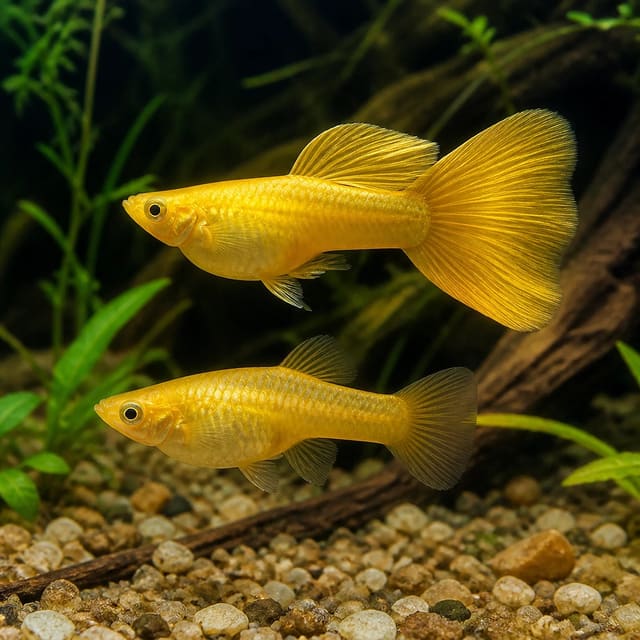
Full Gold 24K Guppy (Poecilia reticulata)
22–28°C · pH 6.8–8.5 · 40L
£10.99

A 3-4 cm Yellow Tuxedo Female Guppy, Poecilia reticulata, for peaceful planted community aquariums. Fuller-bodied female livebearer with yellow tuxedo colour, calm community behaviour and Live Arrival Guarantee.
Adult size is the maximum length this species reaches at full maturity (scientific sources). The livestock you receive will be younger and smaller — pick a size variant above for the actual shipping size. Product-photo provenance and any image-specific limitations are stated on the listing.
Poecilia reticulata
Save when buying multiple fish. Each quantity is one fish; sex and pair formation are not guaranteed unless the selected variant explicitly states them.
Confirm your email, then we’ll send an availability message for this exact item if it returns within 180 days.
This request is only for this product—no newsletter or other promotions. A mail-provider retry may very rarely duplicate the same availability message. Unconfirmed addresses are removed after 48 hours. See our privacy policy.
A 3-4 cm Yellow Tuxedo Female Guppy, Poecilia reticulata, for peaceful planted community aquariums. Fuller-bodied female livebearer with yellow tuxedo colour, calm community behaviour and Live Arrival Guarantee.
Adult size is the maximum length this species reaches at full maturity (scientific sources). The livestock you receive will be younger and smaller — pick a size variant above for the actual shipping size. Product-photo provenance and any image-specific limitations are stated on the listing.
22–28°C · pH 6.8–8.5 · 40L
24–28°C · pH 7–8 · 41L

22–28°C · pH 7–8 · 41L
22–28°C · pH 7–8 · 41L
Guppies are social livebearers suited to a prepared beginner, not a fish-per-litre formula. Use a mature filtered aquarium, tested neutral-to-alkaline mineral-bearing water, deliberate sex and population planning, open swimming room, cover and a separation option.
Maintain these water conditions for optimal health and vibrant colors
The Yellow Tuxedo Female Guppy (Poecilia reticulata) is a classic livebearer with a bright, attractive pattern and a lively, peaceful nature. Females are often slightly larger and fuller-bodied than males, and they play an important role in breeding groups, community aquariums, and display tanks where a splash of colour is wanted without aggressive behaviour.
This variety is widely appreciated for its hardiness, adaptability and constant activity. As with all guppies, strong water quality and a sensible stocking plan are key to keeping them in top condition. If you are setting up a new aquarium, verify your local water parameters and match them as closely as possible to the needs of your fish.
At Tropical Fish Co, we supply live tropical fish carefully selected for quality and health. Your fish will be packed for safe transit and should be acclimatised slowly on arrival to reduce stress and help them settle into their new home.
Female guppies are usually less flashy than show males, but a good Yellow Tuxedo Female Guppy still gives real display value. The appeal is a fuller female body, warm yellow colour and darker tuxedo contrast rather than oversized fins. In a planted tank, the yellow reads clearly against green plants and darker backgrounds, especially when several females move together near the top and middle of the aquarium.
Compared with male guppies, females are more practical for breeding projects and often calmer in mixed groups. Compared with platies, they are slimmer and quicker. Compared with Endler's livebearers, they are fuller-bodied and generally larger. This makes them useful when you want a colourful livebearer group with natural behaviour, not only a single show fish.
Female guppies are social and should not be treated as solitary display animals. They usually settle better in a small group, provided the aquarium is large enough and filtration can handle the stock. If males are present, use sensible ratios so females are not chased constantly. In cramped setups, female guppies can become stressed and lose condition.
Female guppies are best kept in a mature, filtered freshwater aquarium with stable conditions and plenty of swimming space. A planted aquascape is especially helpful, as live plants and soft cover give them confidence and create calmer social interactions within the group.
We recommend keeping guppies only in aquariums of 40 litres or more, with more room preferred for groups, mixed sex colonies, or community setups. Bigger aquariums are usually more stable and make it easier to maintain water quality, which is essential for livebearers.
Because Poecilia reticulata can adapt to a variety of freshwater conditions, the best approach is to maintain consistency rather than chasing specific numbers. If you are unsure about your tap water, verify it with a reliable test kit or your local water supplier before purchasing.
Our stock records for this specific SKU does not provide water parameters, so this listing uses the project care evidence for Poecilia reticulata: 20-28 C and pH around 7.0-8.0 for planning. Guppies can adapt to a variety of freshwater conditions, but they are healthiest when the tank is stable rather than repeatedly adjusted.
If your water is very soft, acidic or unstable, test it before ordering. Prepare the aquarium in advance and avoid sudden water-chemistry changes on arrival day. Stable, clean, mineral-bearing tropical water is more important than chasing a perfect number.
Female guppies are omnivores and should be offered a varied diet to keep them in good colour and condition. A quality tropical flake or micro pellet can form the staple, supported by regular small servings of frozen or live foods and vegetable matter.
Feed little and often rather than overfeeding. Guppies have small stomachs and do best with modest portions they can finish quickly. Overfeeding can reduce water quality and increase the risk of digestive problems, especially in smaller aquariums.
Female Yellow Tuxedo Guppies are generally peaceful and active in the upper and middle parts of the aquarium. They are best matched with other calm community species that will not nip their fins or outcompete them for food. Groups of females are usually more relaxed than isolated fish, and they benefit from being kept with compatible companions.
Where possible, choose tank mates that share similar water requirements and a peaceful temperament. Guppies can be delicate around overly boisterous tank mates, and females can become stressed if chased continuously or forced to compete for food.
This species is a livebearer, which means females give birth to free-swimming young rather than laying eggs. Breeding can happen readily if males are present, so if you want to avoid fry, keep only females or maintain careful sex ratios. If you do want to breed them, provide dense planting and hiding places for young fish.
Female guppies can store sperm and produce multiple broods after a single mating, so new fry may appear even if males are removed later. For that reason, it is sensible to plan your stocking and rearing strategy in advance. If breeding is not your goal, keep an eye on the group and separate fry if necessary.
Guppies are hardy, but like all livebearers they are sensitive to poor water quality and sudden changes. Stable conditions, careful acclimatisation and a varied diet go a long way towards preventing common problems. New fish should always be quarantined where possible before being added to an established display.
Monitor your fish closely during the first few days after introduction. Healthy guppies are alert, active and keen to feed, with good body condition and normal swimming behaviour. If you notice clamped fins, lethargy or unusual spots, check water quality immediately and verify your aquarium conditions.
Your Yellow Tuxedo Female Guppy will be dispatched by UK live-animal courier at around 3-4 cm. We pack live fish carefully for transit and support eligible livestock orders with our Live Arrival Guarantee. Please have a mature, heated and filtered aquarium ready before dispatch.
On arrival, keep lights low, float the sealed bag to equalise temperature, then acclimate slowly to your aquarium water. Do not pour transport water into the aquarium. Avoid heavy feeding on the first day and give the fish time to settle. Stable water, peaceful tank mates and a sensible group plan give this female guppy the best start.
Max adult size is the length this species reaches at full maturity (from scientific sources). The livestock you receive will be younger and smaller — pick a size variant on the buy box for the actual shipping size. Product-photo provenance and any image-specific limitations are stated on the listing.
Female Yellow Tuxedo Guppies do best with calm, similarly sized community fish that will not nip fins, dominate feeding or require very different water conditions.
Always research specific species before adding them to your tank. Consider:
No reviews for this item yet. Bought one? Honest reviews only, good or bad.
What customers say about ordering from us
I have a small group of long finned mountain minnows. So was delighted to be able to order ten of this variety to increase the genetics in my tank . The ones I recieved are healthy but it’s to early to give a verdict on wether they are of a long finned type since they are small currently.
Gordon Walker · 23 Sept 2026
100% success travel and "installation". Pleased with quality of purchase. The Siamese fighter a bit "shy" so have not yet seen him at his best yet but looking good. Happy customer. GG
George E Garratt · 21 Sept 2026
Reviews of our shop, collected by Judge.me, an independent third-party review collector. Newest first.