By Tropical Fish Co Editorial Team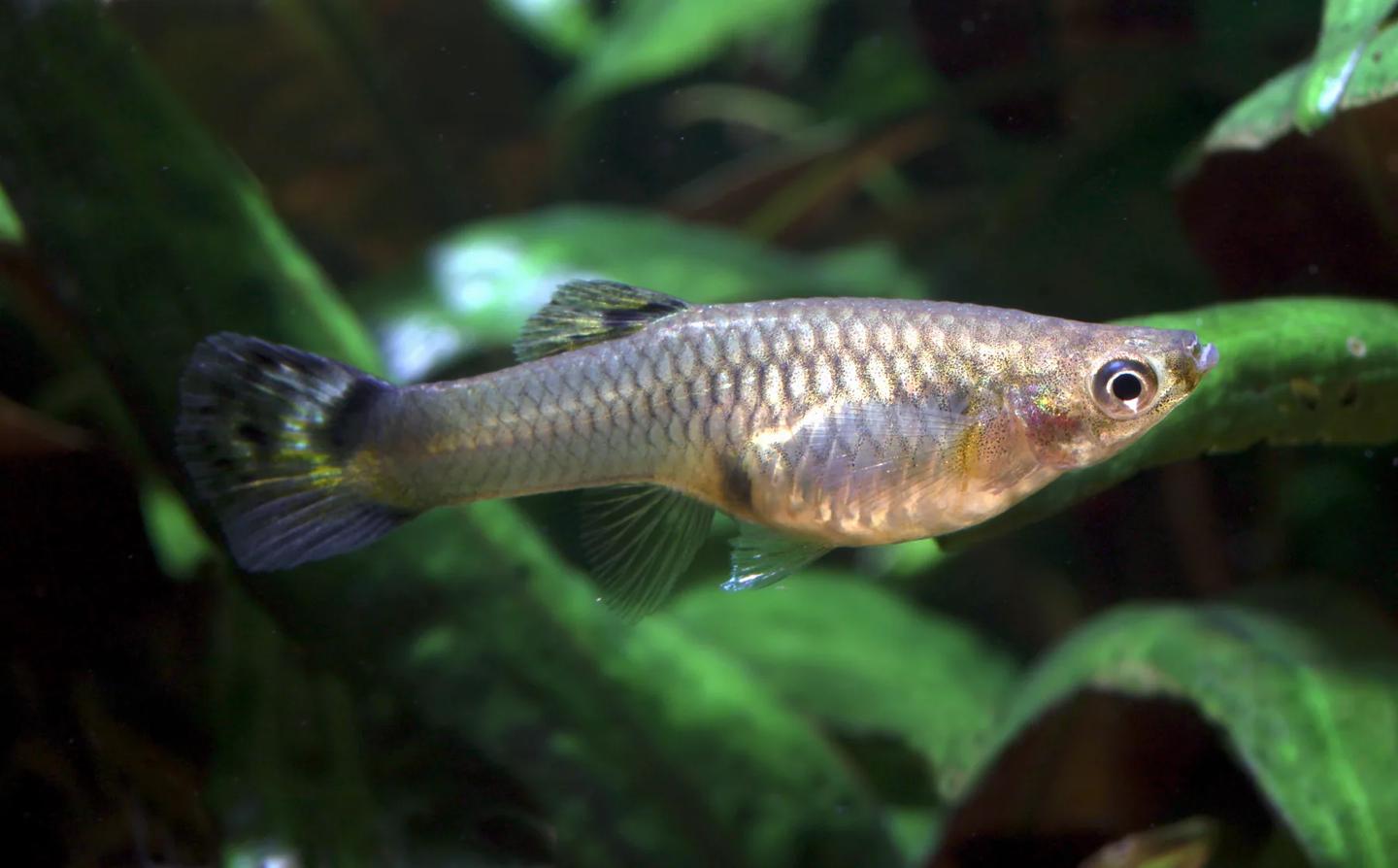
The direct answer: female is a sex, not a strain
A female guppy is a female Poecilia reticulata. “Female Guppy”, “Cobra Female”, “Moscow Female” and similar shop names do not identify different species. The accepted species name is Poecilia reticulata (Peters, 1859) [1].
For a mature fish, the most useful quick sexing cue is the anal fin:
- a male has a narrow, modified anal fin called a gonopodium;
- a female has a broader, triangular anal fin; and
- body size and colour can support the decision, but should not decide it alone.
OATA uses the same anal-fin distinction in its UK care sheet [3]. Developmental research also matters: very young guppies do not yet show all adult external differences, so a tiny juvenile cannot always be sexed confidently from one photograph [8].
FishBase records a maximum of 6 cm standard length for females, compared with 5 cm for male or unsexed fish [2]. Standard length stops at the base of the tail; it is not the same as total length, and a long domestic tail should not be silently added to it.
Female guppy fish for sale: use the live listing
This guide explains the decision. The cards below are the stock-bearing part of the page and appear only when a matching product has current availability, a positive price and a usable image. Price, sale size, pack quantity and availability change; permanent copy should not freeze them.
Female guppies currently available
Read the exact card before ordering. Confirm the stated sex, scientific name, sale size and unit, and whether the image is the exact fish, a batch example or a representative visual. Current price and availability come from the listing, not this guide.
The live Guppy collection is the commercial owner for the wider range. The Guppy care guide owns full species husbandry, while the Guppy Types guide owns colour and fin-form terminology. This page stays focused on female identity, group planning and buying.
Before selecting a card, check:
- Species: the record should say Poecilia reticulata, not Poecilia wingei or an undocumented hybrid.
- Stated sex: “assorted guppy” does not necessarily mean female, and a category photograph is not proof.
- Sale size: ask whether the number is current sale length, expected adult length, standard length or total length.
- Sale unit: one fish, a quantity option, a pair and a trio are different promises.
- Image meaning: exact individual, batch example and representative illustration must not be confused.
- Current terms: read availability, delivery area and live-arrival requirements on the live site.
Male vs female guppy: a responsible comparison
| Check | Mature female | Mature male | What can mislead you |
|---|---|---|---|
| Anal fin | Broader and triangular | Narrow gonopodium | Juveniles may not yet show a clear adult form |
| Body | Often deeper-bodied and larger | Often slimmer and smaller | Feeding, age, illness and domestic selection change shape |
| Colour | Wild-type females are generally less conspicuous; domestic females may be colourful | Domestic males are often strongly patterned | Colour alone does not prove sex |
| Abdomen | May be rounded; a darker area may be visible | Usually slimmer | A rounded abdomen or dark patch does not prove pregnancy |
| Behaviour | Social and active; may avoid persistent courtship | Often displays and pursues females | One short observation cannot predict an individual's long-term behaviour |
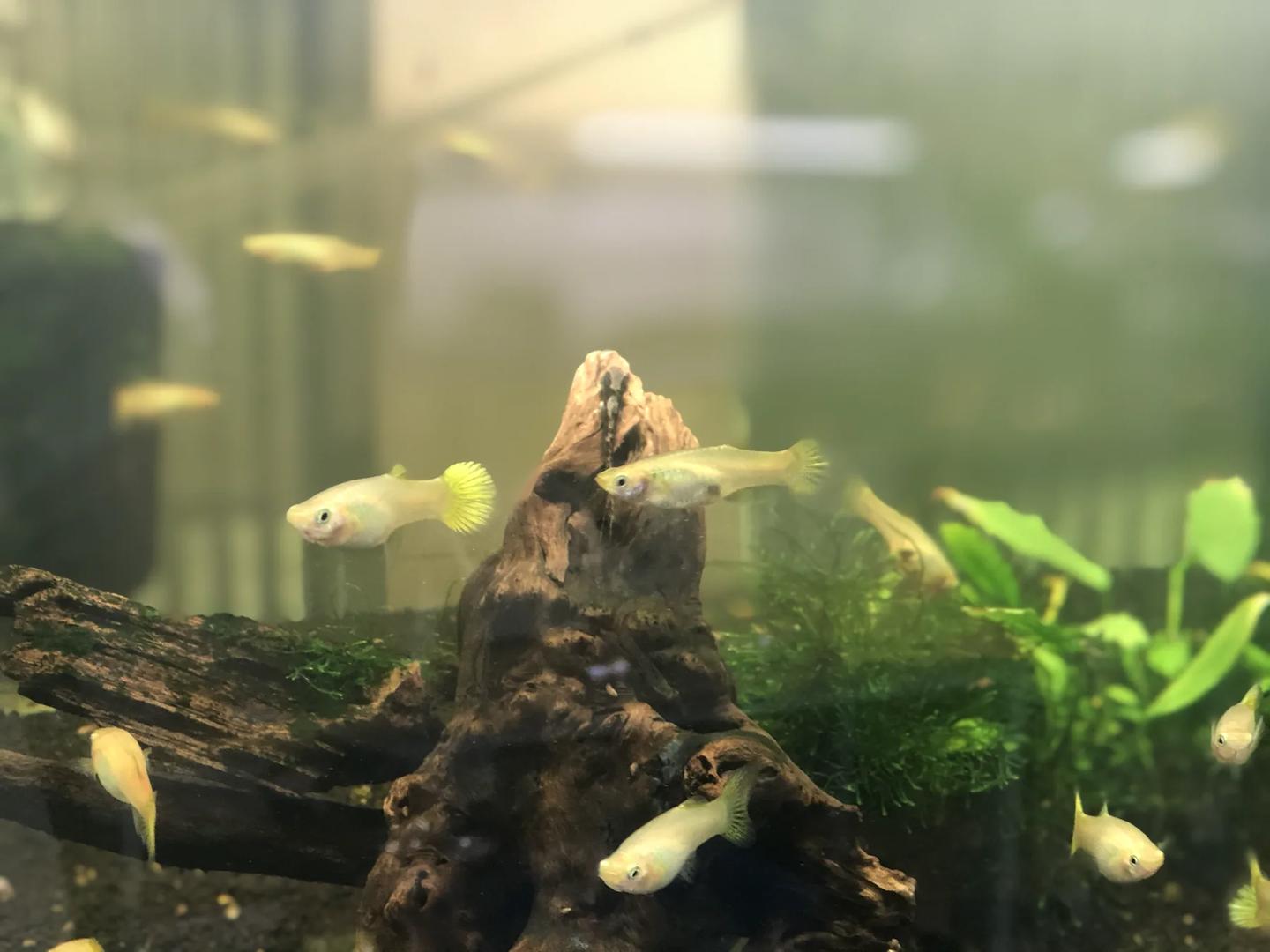
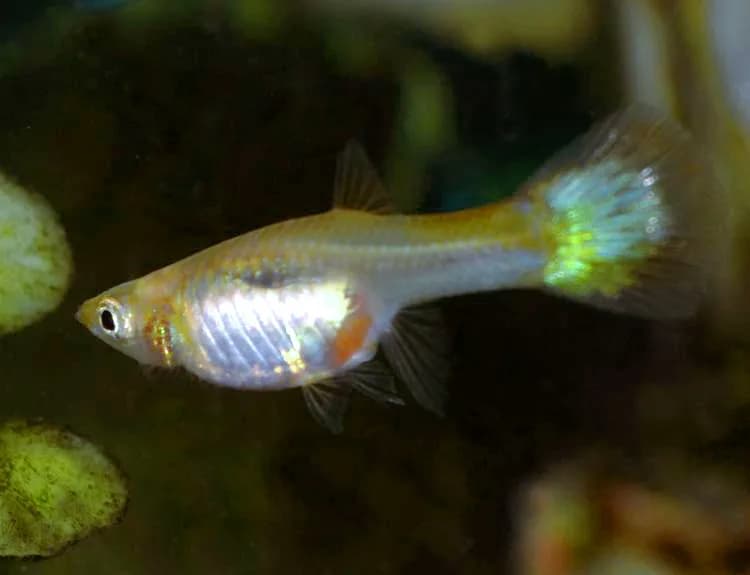
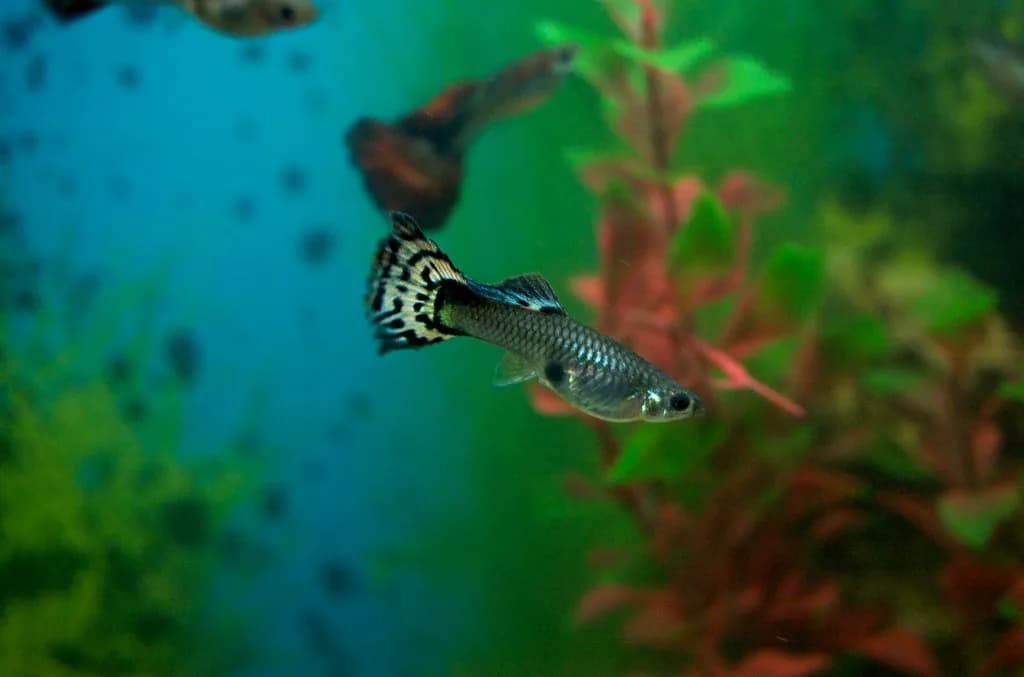
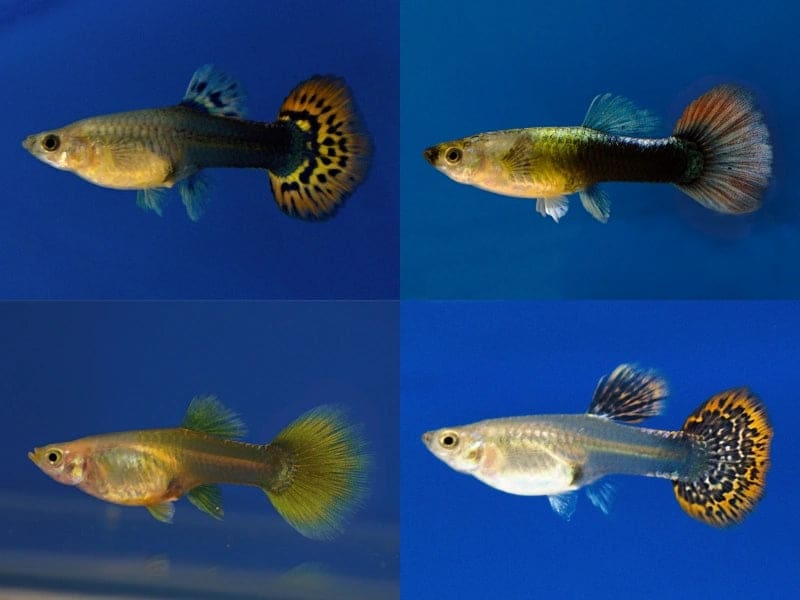
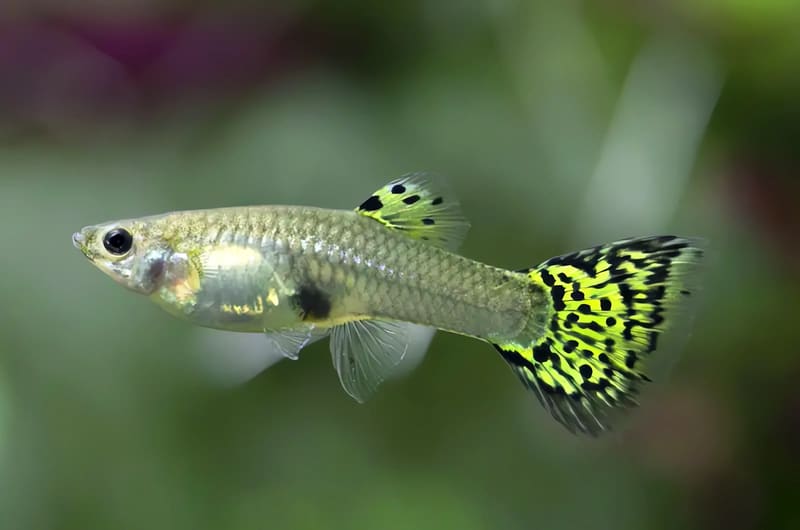
Domestic colour is why the old “plain equals female, colourful equals male” rule fails. The two source-labelled single-fish photographs in the gallery show different female colour expression, but neither is a universal sexing key or a promise about a current product. Look for the fin, then confirm the seller's stated sex.
A dark area near the rear abdomen is often called a gravid spot, but one photograph cannot confirm pregnancy, brood timing or health. Body fullness can reflect normal anatomy, feeding, age, developing young or a health problem. Ask about previous housing and observe the whole fish instead of diagnosing from one patch.
Female-only, mixed or male-only?
Choose the population plan before choosing colour.
| Plan | What it changes | What it does not guarantee |
|---|---|---|
| Female-only | Prevents new mating inside the group | No later fry from stored sperm; no competition or chasing |
| Mixed sex | Allows courtship and likely reproduction | That one ratio prevents pressure, injury or rapid population growth |
| Male-only | Avoids new mixed-sex reproduction | That displays and pursuit remain harmless |
Guppies are social fish. OATA advises at least three and suggests two females per male in mixed groups [3]. Tropical Fish Co applies a more conservative house screen: a mature, filtered aquarium at least 60 cm long for one small guppy group, with five or more fish where the sex plan, water, filtration and other livestock allow. It is a disclosed store policy, not a scientific magic number.
Female-only can be a sensible plan when you want to avoid new mating, but it is not permission to keep one female alone and it is not an instant no-fry guarantee. Mixed groups need close monitoring. An experiment with wild Trinidadian guppies found that male harassment changed where females chose to live [6]. Another replicated semi-natural study found that harassment disrupted female association patterns and social recognition [7].
Those studies do not reproduce a home aquarium or prove one retail ratio. They do establish that repeated pursuit is biologically meaningful. If a female is cornered, excluded from food, breathing rapidly, hiding continuously or showing fin/body damage, intervene and separate rather than adding more fish to “fix the ratio”.
Why a female-only purchase can still produce fry
Guppies are livebearers with internal fertilisation. Female sperm storage separates mating from later fertilisation, so a female can produce successive broods after the male is no longer present.
In a controlled study, researchers used artificial insemination to compare stored and newly introduced sperm across reproductive cycles. The paper documents across-cycle storage and cites guppy records of up to eight successive cycles from one mating [4]. A separate study describes storage lasting several months and a material contribution of stored sperm to male reproductive success [5].
The practical conclusions are narrower than many care pages claim:
- possible is not certain: do not say every shop female is already pregnant;
- female-only prevents new mating: it cannot undo previous mating;
- one brood does not prove a hidden male: stored sperm is a real alternative;
- no fixed countdown: a photograph cannot predict the delivery date or brood size; and
- plan before purchase: capacity, filtration, food and responsible rehoming must exist before fry appear.
Predation by adults or tank mates is not a welfare plan. If you deliberately raise fry, use a mature biosecure system with safe filtration, appropriate food and repeated water testing. If you cannot care for additional fish, ask the retailer or an experienced local aquatics organisation about responsible rehoming before buying a previously mixed-housed female.
Aquarium and water screen
This page does not duplicate the full Guppy care guide, but a female-buying decision is incomplete without a housing screen.
OATA recommends at least 45 litres for a small group of smaller livebearers, a filter in every aquarium, plant or decor cover, open swimming space, a heater and regular testing [3]. Our more conservative screen adds a usable-length check: at least 60 cm for one small guppy group. Litres alone do not measure footprint, mature filtration, sex mix, tank mates or future fry.
Use these OATA water values as a broad screen:
- temperature 20–28 °C, held at a suitable stable point;
- pH 7.0–8.0;
- general hardness 8–18 dGH;
- zero detectable ammonia; and
- zero detectable nitrite.
“UK tap water is ideal” is too broad. The Drinking Water Inspectorate explains that hardness varies with local geology and recommends checking the supplier's figures [10]. Test the water actually used, dechlorinate replacement water, compare it with the seller's current conditions and change chemistry gradually. Do not add salt or minerals without a measured purpose and a compatibility check for every animal and plant.
Choosing healthy fish without diagnosing from a picture
OATA advises looking for clear eyes, intact scales, undamaged fins, appropriate swimming and steady breathing, and avoiding a tank where other fish appear sick [3]. The RSPCA similarly treats changes in swimming, breathing, colour, body condition and feeding as warning signs that need investigation rather than a guess [9].
Use a whole-fish check:
- steady swimming and regular breathing;
- open fins without fresh tears or severe erosion;
- intact scales and no obvious wounds or cotton-like growths;
- a body profile appropriate for the individual, not visibly wasted;
- normal response to the group and access to food; and
- no persistent surface gasping, bottom-sitting or loss of balance.
Do not use pregnancy as a flattering explanation for every swollen abdomen, and do not call a thin fish “young” without evidence. A retail image may have been taken earlier, may show another batch or may be a representative visual. The live description should tell you what its image means.
Colour names and female identity
Cobra, Moscow, Tuxedo, Snakeskin, Mosaic, Red Cap and other domestic labels describe selected appearance. They do not create a new species and do not, by themselves, prove pedigree, fertility, temperament, lifespan or the exact colour a mixed batch will contain.
Females can show substantial tail and dorsal colour. That makes them attractive display fish, but it also makes internet sexing by colour unreliable. If the listing matters for a female-only group, confirm the stated sex and ask how the seller handles a mis-sexed fish. If preserving a documented line matters, keep it separate from undocumented guppy or Endler stock and maintain records.
Use the Guppy Types guide for colour and fin labels. It compares terms without promising that a trade name proves genetics or that a representative image matches every animal.
Arrival and the first week
Prepare the aquarium before dispatch. The delivery page is the current source of truth for postcode coverage, packing, arrival reporting and the Live Arrival Guarantee. Follow the instructions supplied with the order; one fixed acclimation timer cannot account for journey duration, bag conditions and the difference between transport and aquarium water.
After transfer:
- keep lighting subdued and provide cover;
- observe balance, breathing and swimming without crowding the glass;
- confirm that every fish can reach food and is not persistently pursued;
- test ammonia and nitrite rather than assuming “hardy” means unaffected;
- record concerns promptly under the current guarantee process; and
- keep a cycled separation option for aggression, illness or an incorrectly sexed fish.
The Animal Welfare Act frames the choice around a suitable environment and diet, normal behaviour, appropriate housing with or apart from other animals, and protection from suffering and disease [11]. Buying five because a guide lists five is not enough if the aquarium, water or observed behaviour fails those needs.
How this page was checked
The accepted species name was checked against Eschmeyer's Catalog of Fishes and the female size record against FishBase. The aquarium, sexing and UK water screen comes from OATA; female sperm storage and male-pressure claims are bounded to peer-reviewed experiments rather than expanded into certainty.
Fresh Search Console evidence showed no UK-mobile Web or Image rows in either matched 28-day period, and URL Inspection reported a successful mobile crawl but “Crawled — currently not indexed”. Fresh GA4 showed no UK-mobile Organic Search landing sessions. That means there was no CTR to optimise yet: the repair had to create a distinct, useful female-specific page instead of repeating general Guppy care.
External UK estimates placed “female guppy / female guppies” at about 880 monthly searches, with additional demand around sexing, pregnancy and purchase intent. These are estimates, not guarantees. The live mobile SERP mixed shops, category pages, images, People Also Ask and an AI answer, so this guide gives direct bounded answers and keeps changing commerce on live cards.
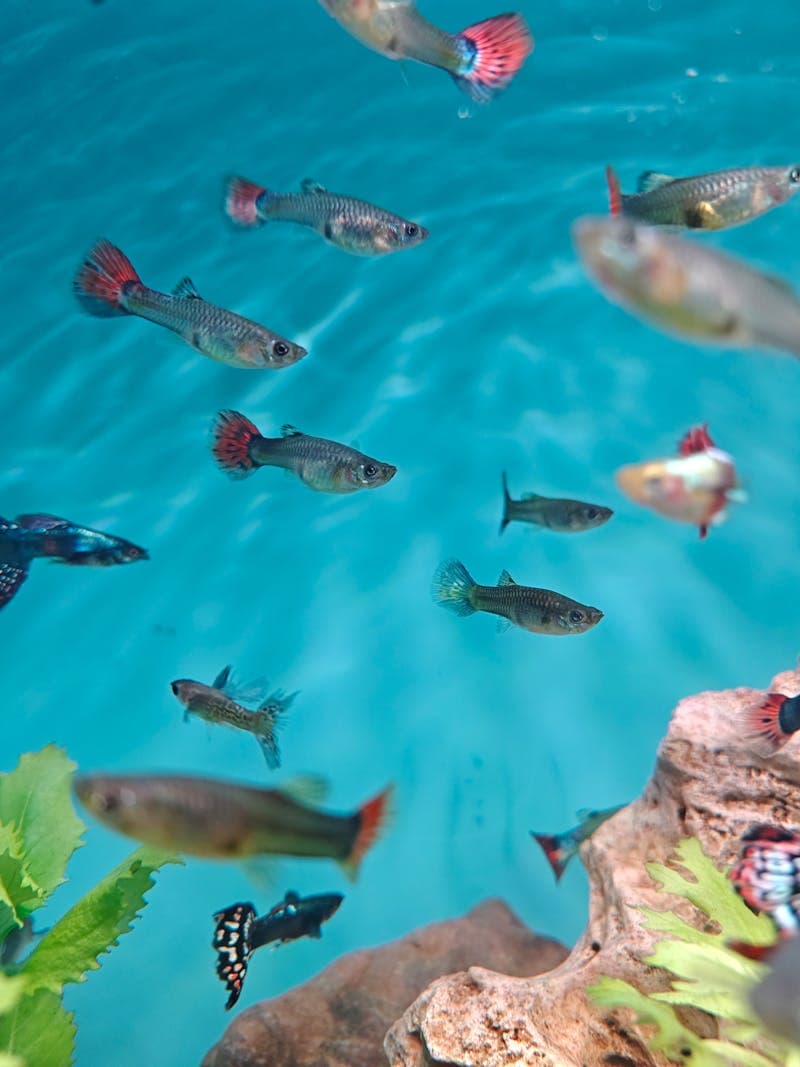
All four claimed images have separate roles, exact public-byte hashes and explicit rights records. All four are source-labelled photographs of female Poecilia reticulata or a female group. None is presented as the exact fish a customer will receive, proof of pregnancy or a universal sexing chart.
Forms, correction emails, audio plays and newsletter actions are not leads or ecommerce conversions. Commercial outcomes are add-to-cart, checkout, purchase and revenue, with purchase and revenue as the final outcomes. Ranking, image visibility, AI citation and sales uplift remain unclaimed until Google recrawls the rebuilt page and a comparable final measurement window exists.
Corrections are welcome through the edit link below. Include the exact passage and a reliable source so the claim can be rechecked.