Easy
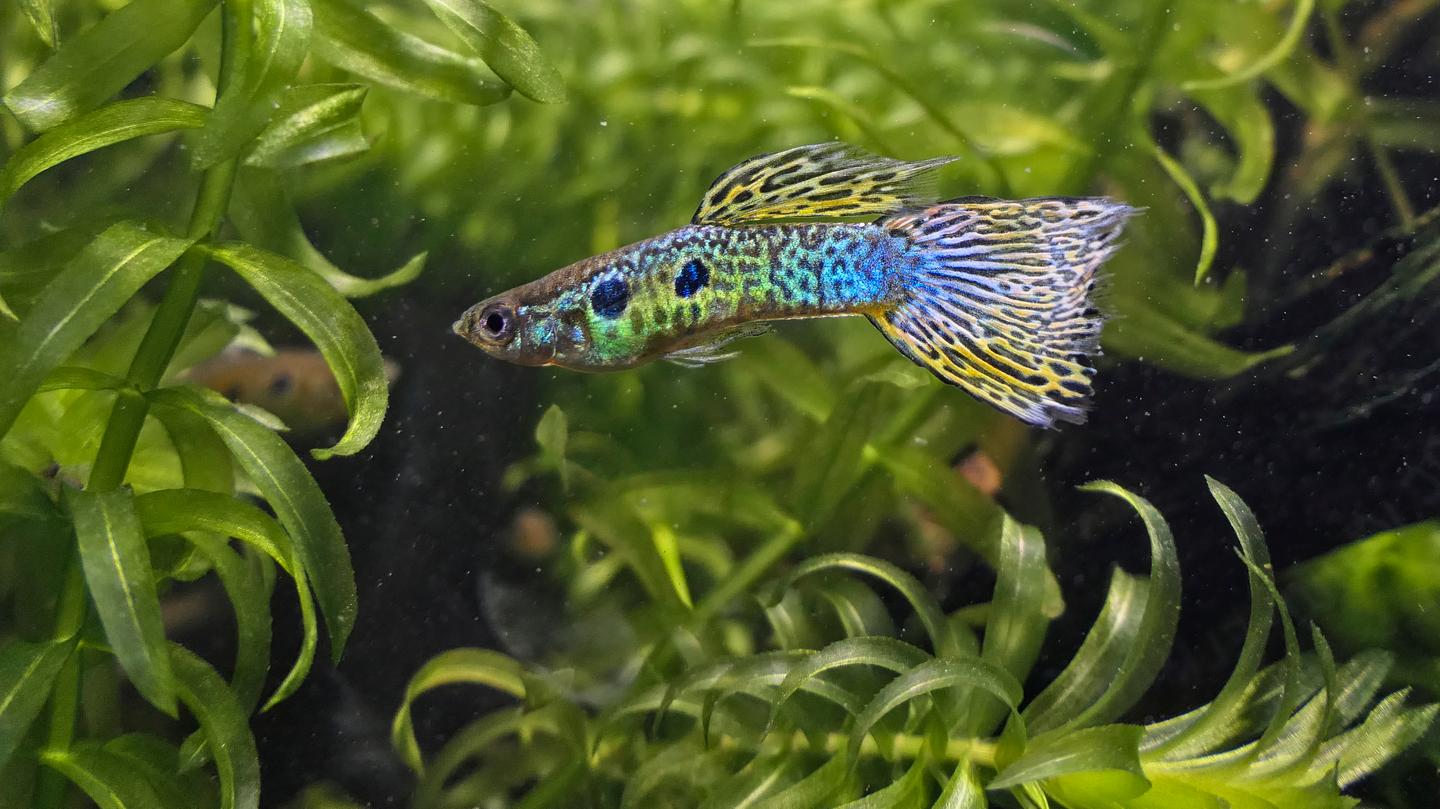
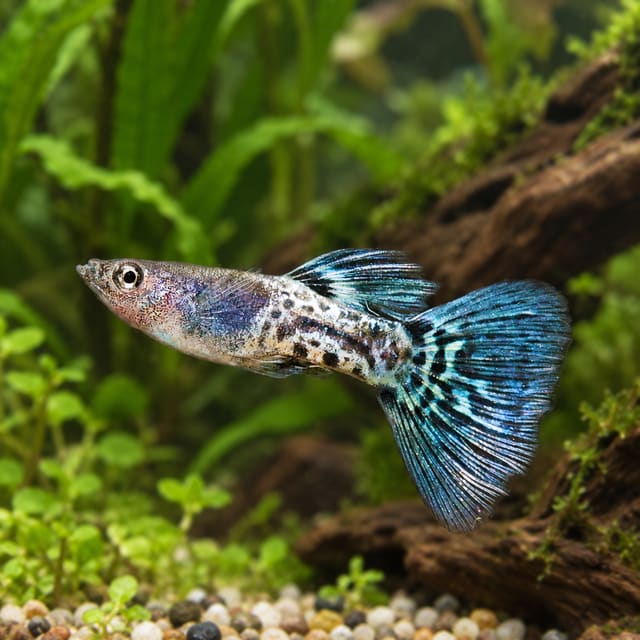
A fancy Poecilia reticulata pair: the male has black-edged dragon scales on a metallic blue body, a tall turquoise dorsal and a blue fan tail streaked navy. One pair per quantity, 3.5 cm. Peaceful and easy at 22–28°C, pH 7.0–8.0, in 60 litres or more.
Adult size is the maximum length this species reaches at full maturity (scientific sources). The livestock you receive will be younger and smaller. Product-photo provenance and any image-specific limitations are stated on the listing.
Each quantity is one pack containing 2 fish. Discounts count packs. Selected: 1 pack (2 fish).
A fancy Poecilia reticulata pair: the male has black-edged dragon scales on a metallic blue body, a tall turquoise dorsal and a blue fan tail streaked navy. One pair per quantity, 3.5 cm. Peaceful and easy at 22–28°C, pH 7.0–8.0, in 60 litres or more.
Adult size is the maximum length this species reaches at full maturity (scientific sources). The livestock you receive will be younger and smaller. Product-photo provenance and any image-specific limitations are stated on the listing.
Guppies are social livebearers suited to a prepared beginner, not a fish-per-litre formula. Use a mature filtered aquarium, tested neutral-to-alkaline mineral-bearing water, deliberate sex and population planning, open swimming room, cover and a separation option.
Read the full care guidance when planning conditions for your aquarium.
Both photos on this page show a male Blue Dragon guppy, once swimming among plants and once against a plain black backdrop. He is a fancy, aquarium-bred form of Poecilia reticulata, the common guppy. The female who makes up the other half of your pair is not pictured, so everything in this section describes the male.
The head is a smoky grey-brown, with a small flash of electric blue low on the cheek. Just behind the gill cover the flank lights up in metallic turquoise and blue-green, with a greenish-gold shimmer in places. Under good lighting this front third of the fish is the brightest part of him.
From the middle of the body back to the root of the tail, every scale is outlined in black around a pale, blue-white centre. The effect is a coat of small, close-fitting plates, like chain mail, running right down the tail stalk. Of all the features in the photos, this bold scale pattern is the one the word dragon suits best, and it is the feature to look for when you compare this fish with other blue guppies.
The dorsal fin is enormous for a fish this size. Raised, it stands as a tall turquoise sail well above the back and sweeps rearwards over the start of the tail, flecked all over with dark spots and short streaks. The tail is a broad, rounded fan, far taller than the body is deep, in rich blue with dark navy to black streaks radiating from the base like the spokes of a wheel, finished with a softer, paler blue rim. Underneath the body, the small fins are a crisp black and white.
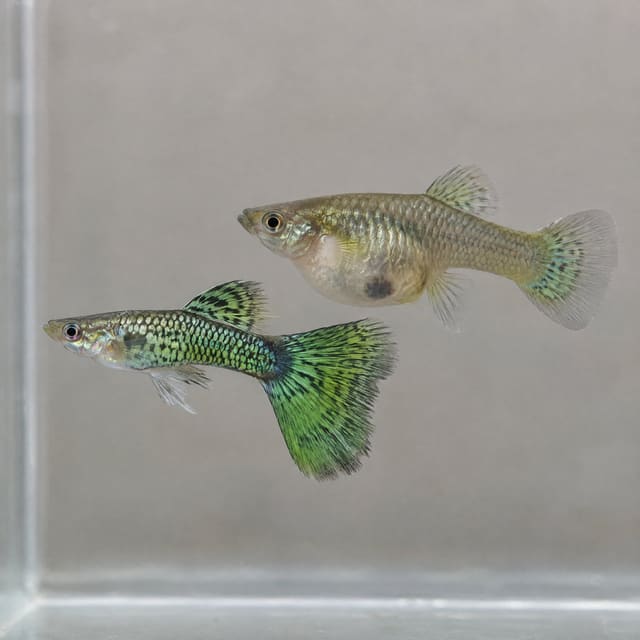
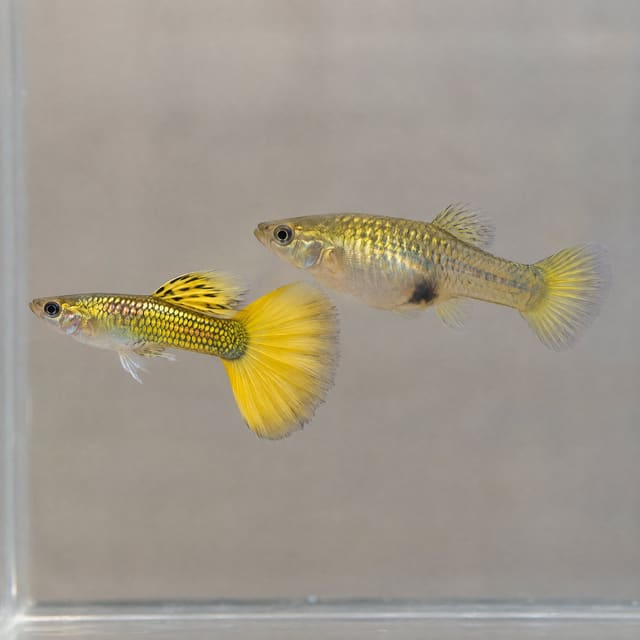
Fancy guppies are never identical, so expect the spread of colour and the exact tail shape on your male to differ a little from the fish photographed. If the dragon-scale pattern is what draws you, we also list the Green Dragon Guppy Pair and the Metal Yellow Dragon Halfmoon Guppy Pair in other colours.
One quantity on this listing is one pair: one male and one female Blue Dragon guppy, sent at 3.5 cm. If you order a quantity of two, you receive two pairs. The 3.5 cm figure is the size the fish are when they travel, not the size they will finish at.
FishBase records the largest guppies at 5.0 cm standard length for males and 6.0 cm for females. Standard length is the body measured from the snout to where the tail begins, so a long-finned male looks considerably bigger than his standard length suggests. Seriously Fish gives 60 mm standard length for the species, matching the FishBase female figure. Wikipedia describes males as typically 1.5–4 cm and females as 3–7 cm, and the OATA care sheet gives about 5 cm for traditional guppies. Those top numbers are the largest fish on record; use them to plan space, not as a size every fish reaches.
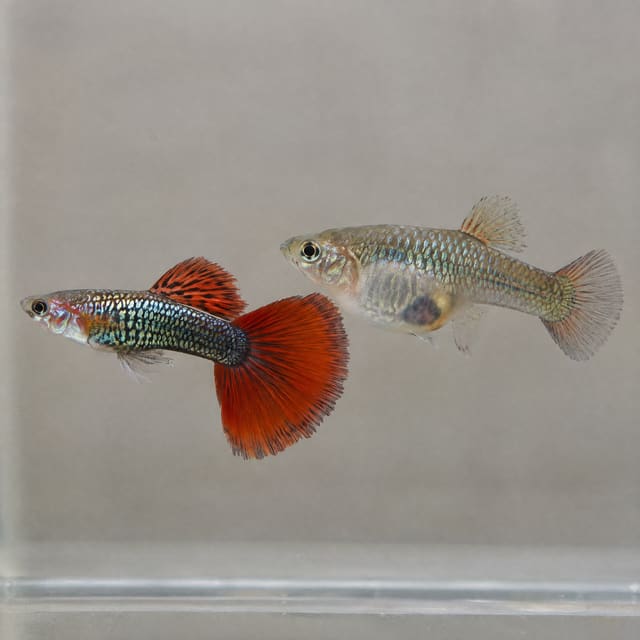
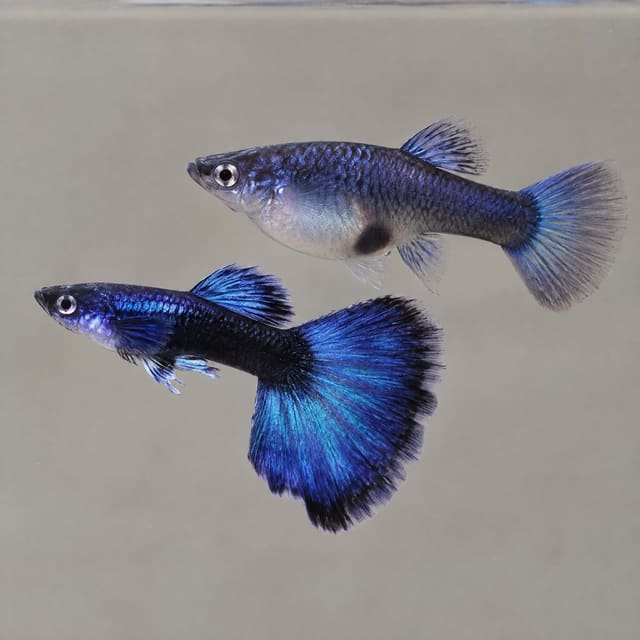
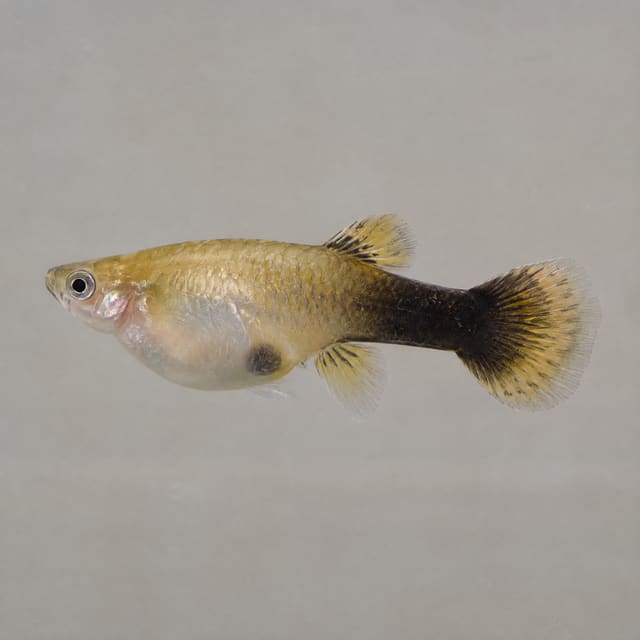
Because the photos show only the male, it is worth being clear about what the other fish in your pair will be like. Seriously Fish describes female guppies as larger, plumper and generally duller than males, and males as the more colourful sex with the long fins. We do not photograph the female for this listing, so we will not promise a particular colour or pattern on her. Judge her by what matters: a full, rounded body, clear eyes, tidy fins and a good appetite.
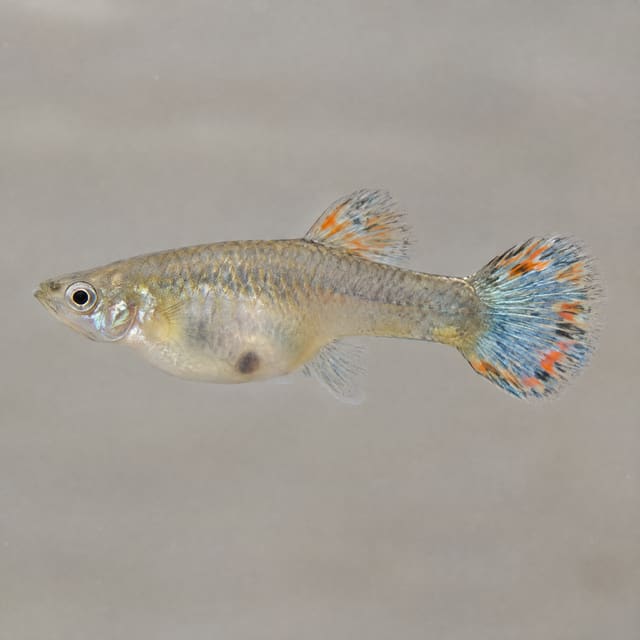
You will not need help working out which is which, but the reliable test is the anal fin. Wikipedia explains that in the male it is modified into a tube-like gonopodium used to fertilise the female internally. The female keeps an ordinary anal fin, and as she carries young the gravid spot near her vent becomes larger and darker, according to Wikipedia. Size settles it too: she will grow into the bigger fish of the two.
Plenty of blue guppies are sold under similar names. The Blue Dragon is the one with the black-edged scale pattern on the rear body and the streaked fan tail seen in our photos. If you were searching for a sky blue guppy, that is a different strain, listed separately as the Albino Sky Blue Guppy Pair.
A Blue Dragon pair is an easy fish for most people, but it pays to run through a few honest questions first.
If the answer to each is yes, the rest of this guide covers the detail.
Seriously Fish sums up the guppy's temperament simply: a very peaceful fish. Wikipedia adds that guppies shoal. Most of the life in a guppy tank happens in the upper and middle water, which is where a Blue Dragon male will spend his day patrolling, feeding and showing off his fins.
A male carrying a dorsal fin and tail this size has a lot of fin to manage. Seriously Fish advises against strong currents for guppies, so aim the filter outlet at the glass or along the surface, or choose a sponge filter, and leave calmer zones among the plants where he can hang without being pushed about.
Much of what you will watch is courtship. Wikipedia describes the male bending into an S shape and quivering rapidly beside the female to show himself off. It also describes a second tactic, a quick unannounced approach in which the male thrusts his gonopodium towards her. Both are normal guppy behaviour. On a Blue Dragon the display is worth watching: when he flares, the tall dorsal and the streaked tail open fully and the dragon scales catch the light. With a single pair, though, the female is the only target for all of it, which is why we come back to adding females later in this guide.
Seriously Fish suggests a quiet community of other livebearers, rasboras, Corydoras, small loricariids and tetras. Choose from those groups and pick species that like the same warm, moderately hard water. Small, calm and unhurried is the theme.
Last, a fact of guppy life: newborn fry are food for almost everything in the tank, including their own parents. Seriously Fish says adults eat the young. The breeding section explains how to save some if you want to.
Every Blue Dragon descends from a small fish of north-eastern South America and the southern Caribbean. FishBase gives its native range as Venezuela, Barbados, Trinidad, northern Brazil and the Guianas, and Seriously Fish extends the list to Tobago, Antigua and Barbuda and the Netherlands Antilles. Peters described the species in 1859 from a river at Caracas, which Seriously Fish names as the Guayre.
FishBase paints a picture of an adaptable animal. Adults live in warm springs and the streams that run out of them, in weedy ditches and canals, and anywhere from murky lowland ponds to clear mountain streams. They tend to be found where predators are few, in very small streams and in densely vegetated lakes and springs. FishBase adds that although they tolerate a wide range of salinity, they need fairly warm water of about 23–24°C and quiet, plant-filled conditions to survive. Seriously Fish agrees that the species does best where algae and plants grow thickly.
A wild guppy would not be mistaken for a Blue Dragon. Wikipedia says wild females are grey, while wild males carry irregular patches of colour. Seriously Fish notes that the wild form is rarely offered, so nearly every guppy in the hobby is an aquarium-bred variety, selected for elongated fins and strong colour. According to Wikipedia, selective breeding has produced a wide range of colours, patterns and fin shapes, and the traits involved are heritable and frequently linked to the Y chromosome. The Blue Dragon's scale pattern, metallic sheen and sail-like fins are the result of that kind of selection.
Wikipedia describes the guppy as a model organism in ecology, evolution and behaviour, with research in Trinidad on how populations respond to predators. One well-known finding is that female guppies prefer brightly coloured males, particularly those with orange spots on the flank.
Guppies have been moved around the world, often with the aim of controlling mosquitoes, says Wikipedia. Seriously Fish reports feral populations in about fifty countries, the UK among them, and FishBase classes the species as a potential pest, citing Australian populations that were established before the 1970s from discarded aquarium fish. Unwanted guppies, including the surplus young a pair will produce, belong with another hobbyist, a club or a shop, never in a pond or waterway.
Published minimums for guppies are modest. Seriously Fish suggests a base of 45 × 30 cm, roughly 41 litres. FishBase cites advice to keep them in groups of five or more in a tank no shorter than 60 cm. Our recommendation for this pair is 60 litres or more: a pair breeds, extra females improve life for the female you buy, and a Blue Dragon male with fins this size looks far better with room to spread them.
Seriously Fish recommends a planted aquarium with floating vegetation, which echoes the weedy waters FishBase describes. A layout that works well:
The RSPCA advises keeping aquariums out of direct sunlight and away from radiators, because both can overheat the water, and placing them on a solid, level surface. It suggests eight to ten hours of light a day, with the lights off at night. Every tropical tank also needs a thermostatically controlled heater set for the species, and the RSPCA recommends reading a digital thermometer daily rather than trusting the heater's dial.
Metallic blue and turquoise look their richest against dark surroundings. Our studio photo on black shows how the scale pattern and the tail streaks stand out when nothing competes with them. A dark background, darker gravel and plenty of green plants will bring out the same effect at home.
Every published range for guppies sits on the hard, neutral-to-alkaline side, and Seriously Fish describes them as a hard water fish: they may get by in soft, acidic conditions, but long-term keeping should be in moderately hard water. Here is what each source gives.
People often ask what temperature FishBase gives for Poecilia reticulata. The answer is 18–28°C, but the lower end is the limit of what the species tolerates, not where it thrives. The same FishBase page says wild guppies need fairly warm water of about 23–24°C to survive. For a fancy pair indoors, set the heater towards the middle or upper part of 22–28°C and keep it there. Steady matters more than any single number.
The RSPCA explains that fish produce ammonia, which is toxic, and that bacteria living in a working biological filter turn it first into nitrite, also toxic, and then into nitrate, which is less harmful. A new filter has no such bacteria. The RSPCA recommends cycling without fish, either with a bacterial starter or with media from a mature filter, and says it takes at least two weeks, with no exact rule. Fish should go in only after ammonia and nitrite have peaked and fallen back to zero. Test kits for both, it says, are essential, not optional.
OATA's guppy targets are 0 mg/L ammonia, 0 mg/L nitrite and nitrate no more than 20 mg/L above your tap water. Its routine is a 25% water change every week and testing at least weekly. The RSPCA's general fish advice is lighter, 10% a week with testing every fortnight; for a breeding livebearer we would follow OATA. Always dechlorinate new water and match it to the tank's temperature, as the RSPCA advises, because chlorine harms both fish and filter bacteria.
Test the water on the same day each week, so changes in the readings stand out.
Guppies tolerate salt remarkably well: FishBase notes a wide salinity range, and Wikipedia reports survival at up to 150% of seawater. That is a fact about the species' biology, not a reason to add salt. Keep a Blue Dragon pair in ordinary fresh water.
Test it before buying. Soft, acidic tap water means planning a steady way to raise hardness; hard, slightly alkaline tap water may need nothing more than dechlorinating. Avoid repeated quick fixes that swing the numbers up and down.
Guppies are small omnivores with small mouths. In the wild, FishBase lists zooplankton, small insects and detritus in the diet, and Wikipedia adds algae remains, diatoms, invertebrates, plant fragments and insect larvae. Seriously Fish says wild fish lean towards insects, but aquarium-bred guppies take most foods offered.
Guppies take food at the surface and in midwater, so floating flake and slow-sinking foods suit them better than heavy pellets. In a mixed tank, check that both your guppies get a fair share; quicker tank mates can beat them to it.
Young guppies need food fine enough to swallow. Powder a little flake between finger and thumb and give small pinches several times a day, then keep a closer eye on water quality, because fine food that is not eaten fouls the water quickly. Fry sheltering in floating plants will also graze on what grows there.
Leftover food breaks down into ammonia, and a tank that is fed too much will soon be a dirty tank. If food is still drifting a few minutes after you add it, cut the next portion back.
A pair is the smallest possible group of guppies, and it has one weakness. Seriously Fish warns that males can pursue females constantly and quite vigorously, and it recommends several females for each male. OATA asks for a minimum of three guppies with two females to every male. With only one female, she takes the full weight of the male's attention.
Adding one or two more females spreads that attention and lets her rest. Any female guppy does the job, though young from mixed strains will not breed true to the Blue Dragon look. Our Female Guppy Mix (Poecilia reticulata) is one way to add females. Thick planting gives her cover in the meantime.
Guppies are livebearers. The male fertilises the female internally with the gonopodium, and she later gives birth to free-swimming young. The sources put the details like this:
| Question | What the sources say |
|---|---|
| How long is pregnancy? | 4–6 weeks (FishBase, Seriously Fish); 24–30 days (OATA); 20–60 days at 25–27.8°C (Wikipedia) |
| How many young? | 20–40 (FishBase); 5–100 (Seriously Fish); 20–80 (OATA); usually 30–60, from as few as two to as many as 200 (Wikipedia) |
| How often? | FishBase says females may produce young every four weeks |
| Can she breed without the male? | Yes, for a time: stored sperm lets her keep producing young for six months or more (Seriously Fish), up to eight months (Wikipedia) |
| When are the young adult? | Males at 2 months and females at 3 months (FishBase); males by 7 weeks or less, females at 10–20 weeks (Wikipedia) |
Wikipedia describes the gravid spot near the vent growing larger and darker during pregnancy, and says that shortly before birth the eyes of the young can sometimes be seen through the skin there. Her belly will look steadily fuller over the weeks.
Seriously Fish says adult guppies eat their young and recommends separating fry after birth if you want every one to survive. In practice you have three options: leave it to nature in a heavily planted tank, where a few fry will make it; move the female to a breeding box or nursery tank shortly before she gives birth; or net the fry out to their own tank as soon as you see them.
If you keep fry, give them clean, warm water in the same range as the adults, small frequent feeds and regular small water changes. Watch them as they grow. Wikipedia says males can mature in seven weeks or less and FishBase gives two months, so the young become able to breed very early. If you want to control breeding, move young males into their own tank as soon as you can tell them apart; otherwise brothers and sisters will be breeding with each other within a couple of months. That matters with fancy guppies, given Seriously Fish's warning that inbreeding is one reason many commercial lines are not very hardy.
With maturity at around two to three months and broods every few weeks, one pair can fill a tank surprisingly quickly. Decide in advance where surplus young will go, such as a friend, a local club or a shop that takes home-bred fish, and keep your filter and water changes ahead of the growing population.
Guppies are often sold as the toughest of beginner fish. Fancy lines deserve a little more care: Seriously Fish cautions that many commercially bred guppies are not very hardy, because of inbreeding and over-production, and are prone to disease and dying young. Good conditions are your best insurance: a mature filter, stable warm water in the right hardness range, steady water changes and enough females.
OATA lists clear, bright eyes, undamaged fins, intact scales and no ulcers or bumps. On a Blue Dragon male, add one more: the dorsal fin raised and the tail spread when he swims, rather than both held folded.
OATA highlights the first three as indicators of disease. Whatever you see, test the water first. If ammonia, nitrite or temperature is wrong, put that right before anything else.
Large fins are the most delicate part of this fish. Keep sharp decorations out of the tank, keep fin-nippers out of the community, and keep the water clean. Check the edges of the tail whenever you feed; it only takes a few seconds and it is the quickest way to notice a problem.
Wikipedia gives a typical lifespan of around two years in the wild, though it varies widely. OATA says guppies can live several years in a well-matured set-up. Stable conditions are what give a fancy guppy the chance to reach the upper end.
Before ordering, please read our delivery and live-arrival page. It sets out how livestock travels and how a claim works.
The aquarium should be completely ready before the fish set off: filter running and cycled, water tested and the heater holding the temperature in range. Someone has to be at the delivery address to take in the parcel, because live animals cannot be left. We email your confirmed delivery date and the tracking details.
Your guppies are packed in an oxygen-filled bag inside insulated packaging, with a heat pack when the conditions call for one, and travel with a tracked courier licensed to carry live animals.
We strongly recommend an unboxing video when practical: it helps us resolve arrival concerns faster, investigate packing or transit issues and reduce recurrence. Video is optional and clear photos are accepted. Never delay necessary animal care to record evidence. If filming, begin while the parcel is still sealed, then open it in that same unbroken video until the fish are visible in their sealed bag. Should a fish arrive dead, dying or obviously in poor condition, email hello@tropicalfishco.co.uk on the day of delivery, quoting your order number and attaching clear photos or an optional video. Subject to the guarantee terms, we then replace the affected fish with your next order or refund them.
Keep the lighting low at first and, over the first week, watch how the pair breathe, eat and behave. Look over the male's fins after the journey, and keep watching the female: if she is never left in peace, the extra females discussed earlier are the next step.
These are the pages behind the facts in this guide.
Independently collected by Judge.me from customers who bought this item. All reviews are shown.
All good thanks
Moved by UK carriers licensed to handle live animals
Hand-packed with oxygen bags, poly box, heat pack
Email photos the same day; an optional unboxing video helps us review problems faster — claim terms apply
Klarna & PayPal Pay in 3 at checkout



22–26°C · pH 6–7.8 · 75L