Easy
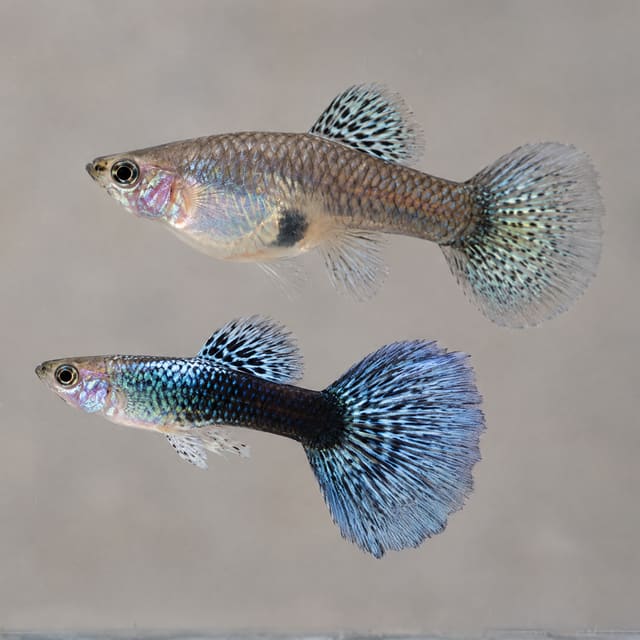
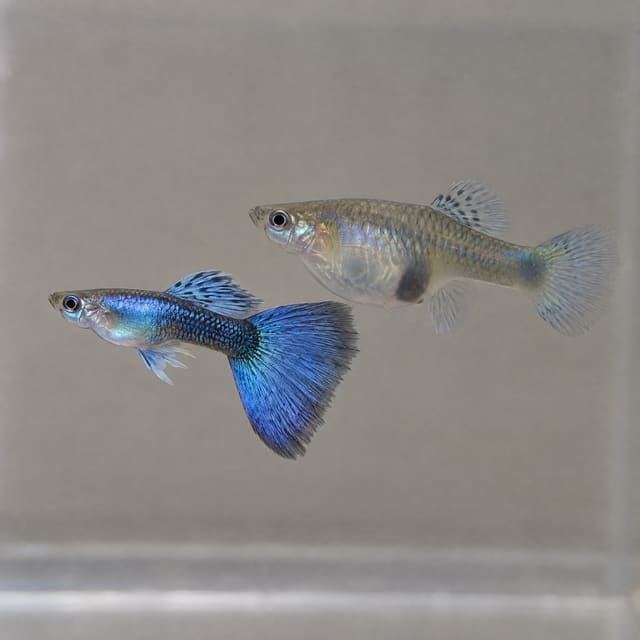
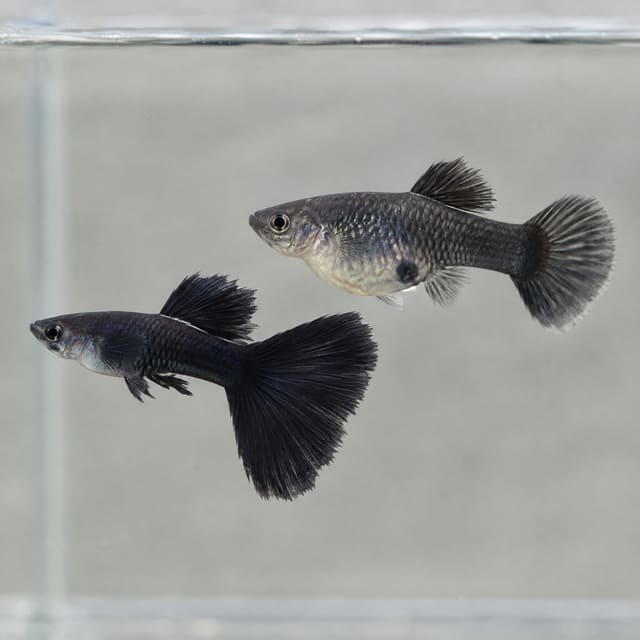
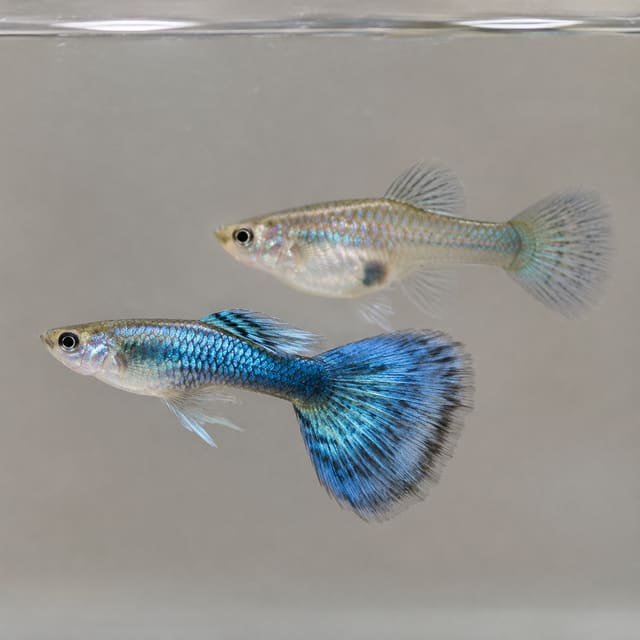
A pair of Blue Moscow guppies (Poecilia reticulata): one male and one female per quantity, dispatched at about 3.5 cm. The male is navy-black with a shimmering electric-blue tail and dorsal fin. Peaceful, easy livebearers for a mature aquarium of 60 litres or more at 22–28°C, pH 7.0–8.0 and 9–18 dGH.
Adult size is the maximum length this species reaches at full maturity (scientific sources). The livestock you receive will be younger and smaller. Product-photo provenance and any image-specific limitations are stated on the listing.
Poecilia reticulata
Each quantity is one pair containing 2 fish. Discounts count pairs. Selected: 1 pair (2 fish).
A pair of Blue Moscow guppies (Poecilia reticulata): one male and one female per quantity, dispatched at about 3.5 cm. The male is navy-black with a shimmering electric-blue tail and dorsal fin. Peaceful, easy livebearers for a mature aquarium of 60 litres or more at 22–28°C, pH 7.0–8.0 and 9–18 dGH.
Adult size is the maximum length this species reaches at full maturity (scientific sources). The livestock you receive will be younger and smaller. Product-photo provenance and any image-specific limitations are stated on the listing.
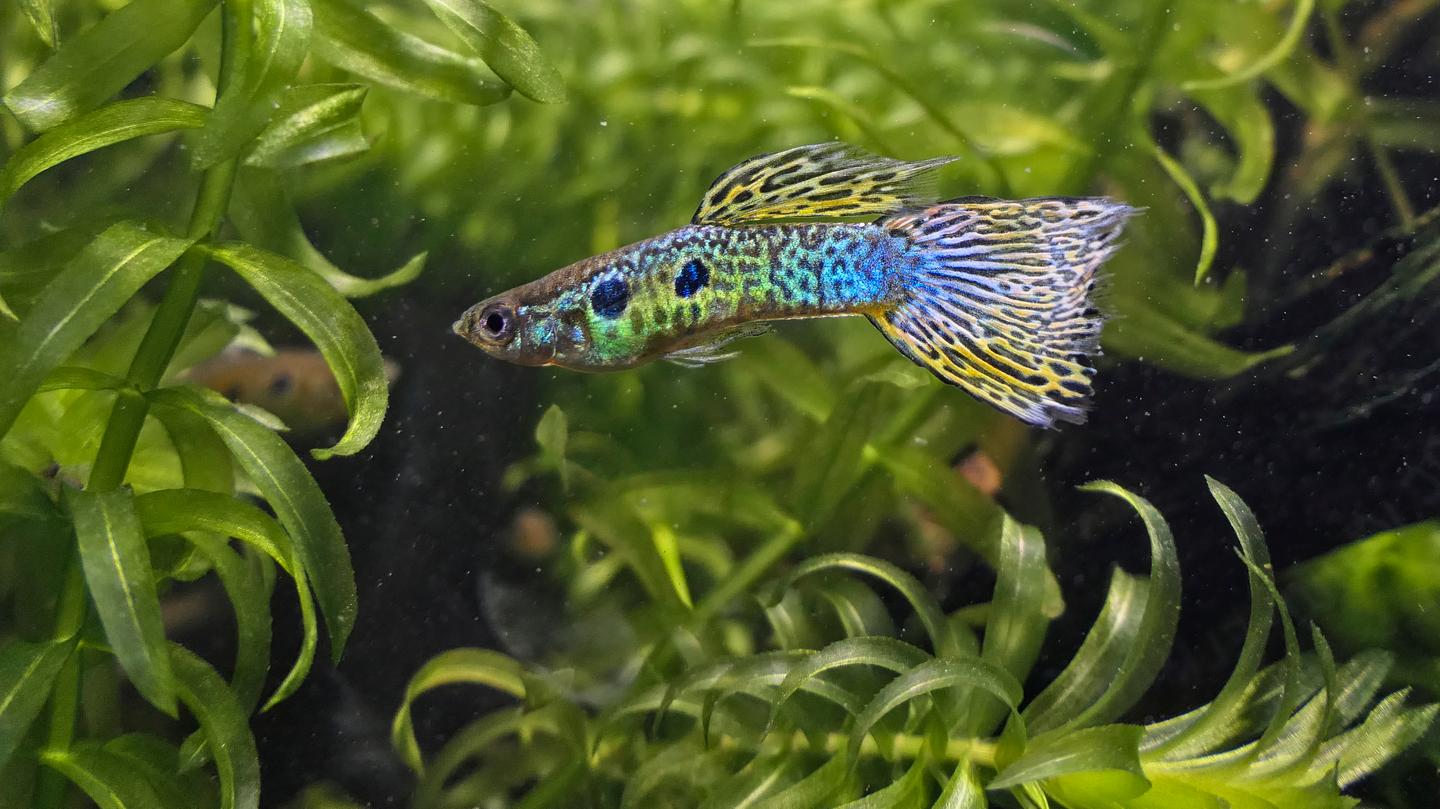
Guppies are social livebearers suited to a prepared beginner, not a fish-per-litre formula. Use a mature filtered aquarium, tested neutral-to-alkaline mineral-bearing water, deliberate sex and population planning, open swimming room, cover and a separation option.
Read the full care guidance when planning conditions for your aquarium.
The Blue Moscow is one of the solid-colour fancy guppies: a dark, almost inky fish with a big blue tail that catches the light every time he turns. This listing is for a pair. One quantity is one pair, one male and one female, dispatched at about 3.5 cm. If you order two, you receive two pairs.
Every fancy guppy, however it has been bred, belongs to the same species, Poecilia reticulata, a small livebearer in the family Poeciliidae. That matters for two reasons. First, the care is simply guppy care, which is well documented and forgiving once you give the fish hard, clean, warm water. Second, a Blue Moscow will breed with any other guppy in the tank, so the colour you see here only carries on if Blue Moscows are kept with Blue Moscows.
The 3.5 cm on the size option is the dispatch size, the size the fish are when they leave us. It is not the finished size. FishBase gives a maximum of 5.0 cm standard length for males and 6.0 cm standard length for females, and a common length for males of 2.8 cm total length. Standard length is measured from the tip of the snout to the base of the tail, so a male with a large tail looks noticeably longer in the aquarium than his standard length suggests. Most males stay well short of that FishBase maximum, and the female normally ends up the bigger of the two.
| Quick facts | Blue Moscow guppy |
|---|---|
| Scientific name | Poecilia reticulata Peters, 1859 (fancy aquarium strain) |
| Family | Poeciliidae, the livebearers |
| Wild range | Venezuela, Barbados, Trinidad, northern Brazil and the Guianas |
| Adult size | Up to 5.0 cm SL for males and 6.0 cm SL for females (FishBase maxima) |
| Temperature | 22–28°C for routine keeping |
| pH | 7.0–8.0 |
| General hardness | 9–18 dGH |
| Aquarium | 60 litres or more; FishBase suggests a tank at least 60 cm long |
| Diet | Omnivore: small flake, micro-pellets and small frozen or live foods |
| Temperament | Very peaceful |
| Care level | Easy |
| Sold as | One pair (one male and one female) per quantity, about 3.5 cm |
In short, this is an easy fish for a mature community aquarium with hard or moderately hard water, and a good choice for anyone who wants strong colour without fuss. The one thing to plan for from day one is that guppies breed readily, and a healthy pair will very likely give you young within weeks.
A Blue Moscow pair suits three kinds of keeper particularly well. The first is someone with hard tap water setting up a first community tank, who wants a centrepiece that will not bully anything. The second is the keeper who would like to watch livebearers breed and raise a few young of a single, consistent colour. The third is anyone who already keeps guppies and wants a dark, solid-colour strain to contrast with brighter fish, accepting that mixed strains will interbreed.
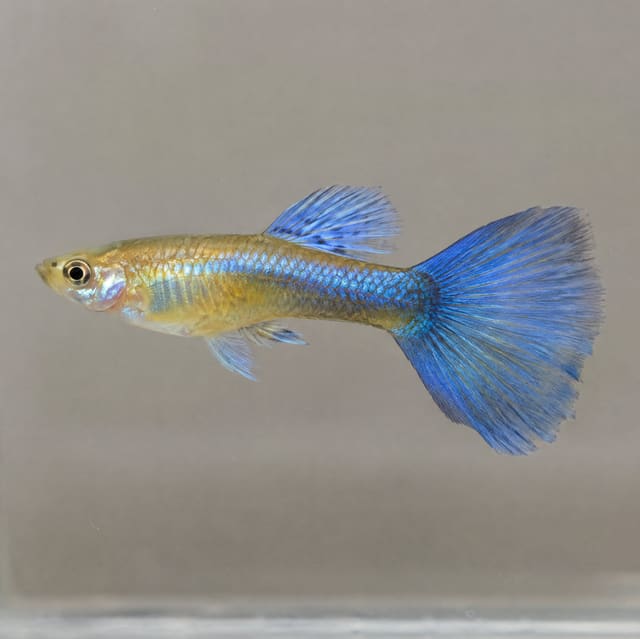
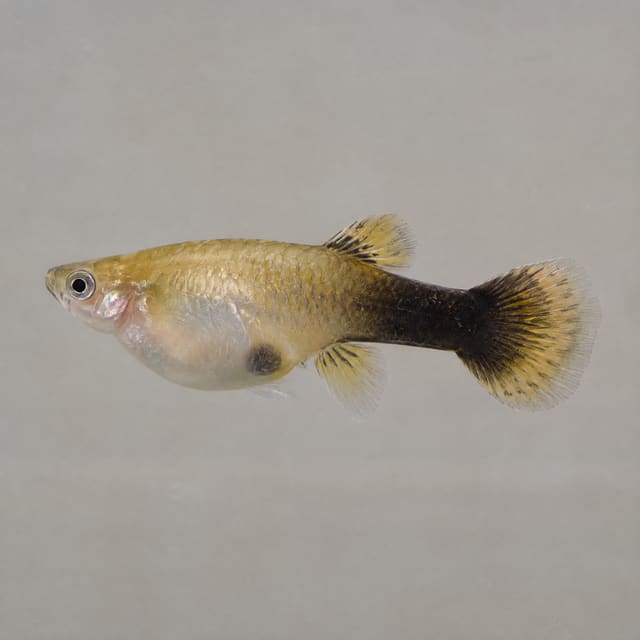
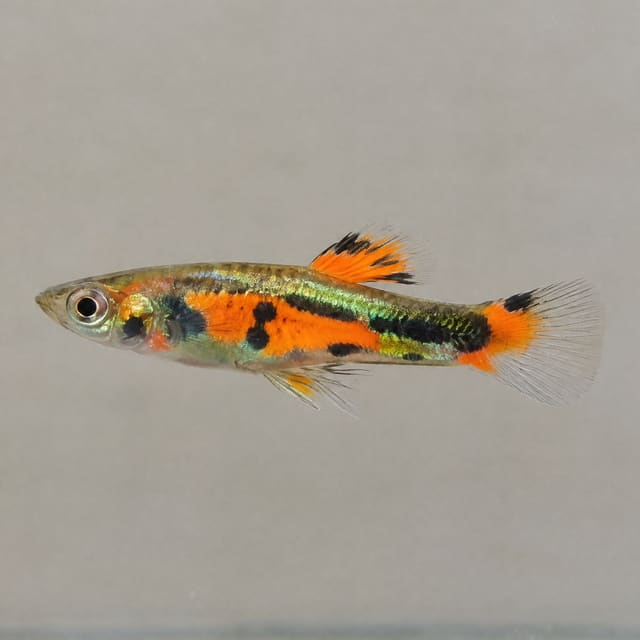
The male is the one you will notice first. In our photographs his head and body are a deep navy that reads as black in dim light, with the scales along the back picking up a blue sheen. The underside of the head and the throat are pale and silvery, which makes the dark body look darker still. His dorsal fin is long, blue and swept back over the body, and the tail is the main event: a broad, triangular fan of shimmering electric blue that darkens to a near-black fringe at the trailing edge. The small fins under his belly are dark and tipped with white.
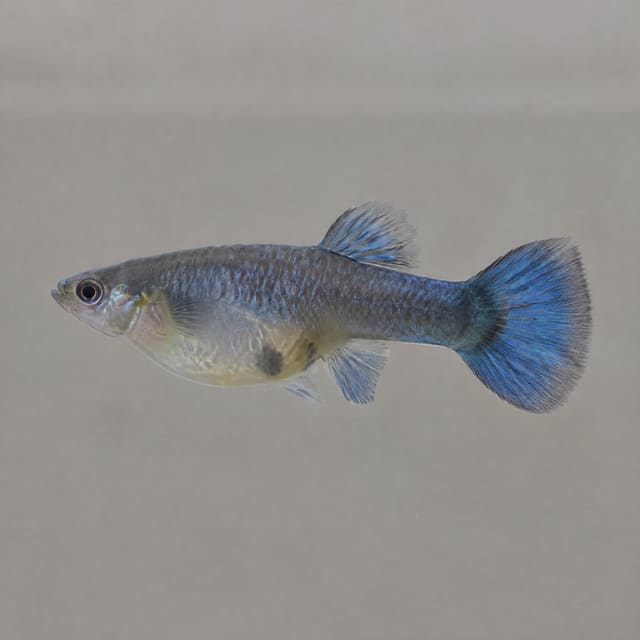
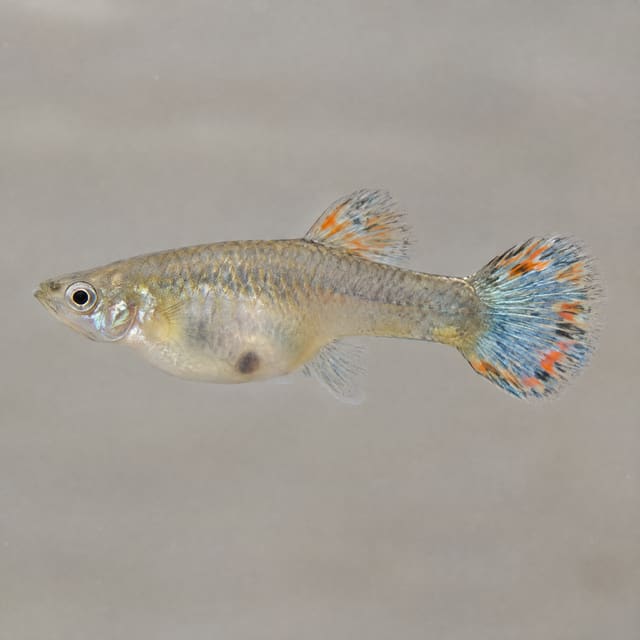
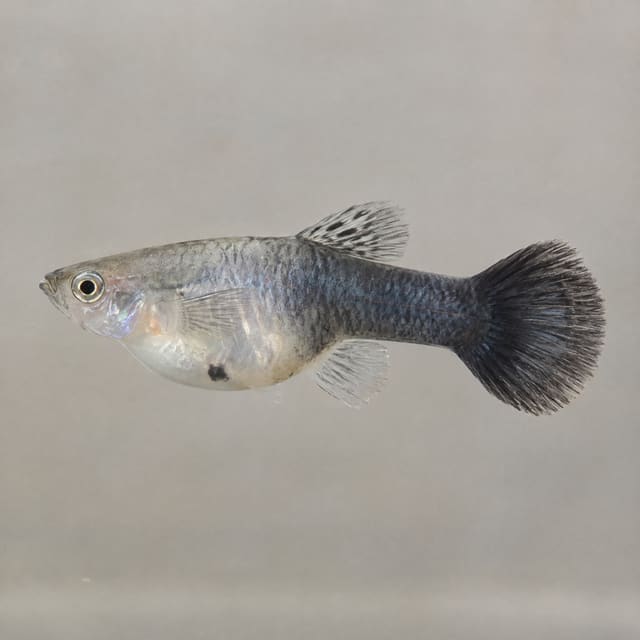
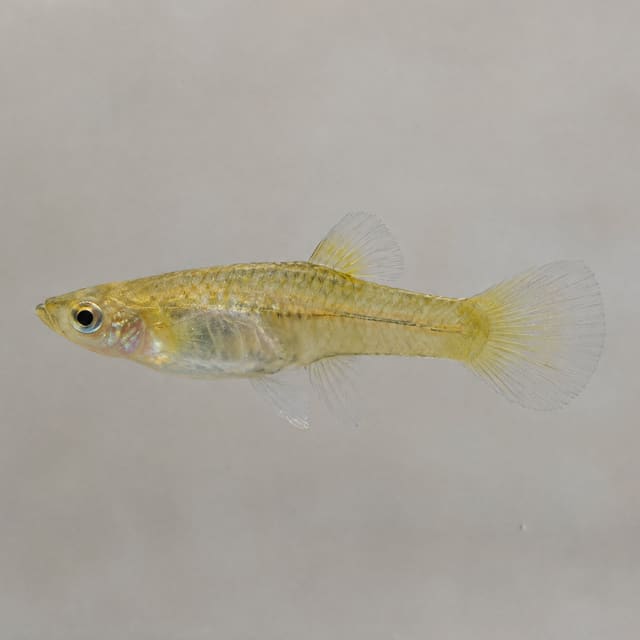
One of those belly fins does a job. Like every male guppy, he carries a gonopodium, a modified anal fin used for mating. Seriously Fish describes the difference between the sexes plainly: males are more colourful and have elongated fins, while females are larger, plumper and duller. Wikipedia adds that wild-type females are grey in body colour, and that is broadly what to expect here. The Blue Moscow female is a quieter fish, silvery-grey in the body, often with a blue tint in the tail. Do not expect her to match the male. In guppies the female never does, and that is not a fault in the fish.
When the bag arrives, telling them apart takes a few seconds:
Fancy guppies are bred for colour and fin shape, and no two are identical. Expect some variation from the fish in our photographs in how intense the blue is, how far the dark colour reaches back towards the tail, and how wide the tail spreads. Wikipedia lists several tail shapes recognised among domestic guppies, including veil, triangle, fan and flag tails; the males in our photographs carry a broad, triangular tail.
If you want a second reference picture, Wikipedia's guppy article uses a photograph of a male Moscow guppy to illustrate its section on reproduction. The name Moscow is a breeder's name for a type of colouring. It does not describe a wild population, and you will not find Blue Moscows in any river.
The wild guppy comes from the north-east of South America and the southern Caribbean. FishBase lists Venezuela, Barbados, Trinidad, northern Brazil and the Guianas; Seriously Fish adds islands such as Antigua and Barbuda and the Netherlands Antilles. Peters described the species as Poecilia reticulata in 1859, and that remains the accepted name on FishBase today.
The common name came a few years later. In 1866 Albert Günther described fish that Robert John Lechmere Guppy had sent from Trinidad to the Natural History Museum in London, and named them in his honour. Günther's scientific name did not last, but the surname did, and the fish has been the guppy ever since. It is also known as the millionfish or the rainbow fish.
What stands out about the wild guppy is how adaptable it is. FishBase describes it living in warm springs, weedy ditches and canals, in habitats ranging from turbid ponds to mountain streams. Seriously Fish puts it more bluntly: almost every imaginable biotope, from high-altitude streams to turbid swamps and ditches, with the species doing best where there are lush growths of algae, marginal vegetation or aquatic plants. FishBase lists it from both fresh and brackish water, and Wikipedia reports that guppies can withstand salinity up to one and a half times that of normal seawater. Treat that as a measure of how tough the species is, not as a suggestion for your aquarium.
Those wild fish share their streams with predators, and that has made the guppy a favourite subject for biologists. Wikipedia describes long-running work in Trinidad comparing upstream and downstream populations that face different levels of predation. Where predators are common, guppies school more and males evolve duller colours; where predators are scarce, males tend to be brighter. Wikipedia also notes that females tend to prefer brightly coloured males, especially those with orange spots on the flank. Today the guppy is used as a model organism in ecology, evolution and behaviour research.
The colour of a Blue Moscow has nothing to do with any of those wild populations. It is the work of aquarium breeders, selecting generation after generation for body colour, fin length and tail shape. Seriously Fish points out that the wild form is rarely available to hobbyists and that the aquarium varieties are known for elongated finnage and gaudy colouration. Wikipedia makes the same point: selectively bred strains carry traits very distinct from the wild type.
There is one more FishBase note every guppy keeper should know. Guppies were released across the tropics for mosquito control, and FishBase records that this had rare to non-existent effects on mosquitoes and negative to perhaps neutral effects on native fishes. FishBase lists the guppy as a potential pest. The IUCN assessed the species as Least Concern in 2020, so there is no conservation concern, but please never release aquarium fish or their young into ponds, rivers or drains.
A pair of guppies does not need a large tank, but they do need a stable one. FishBase gives a minimum aquarium length of 60 cm and recommends keeping the species in groups of five or more. Seriously Fish is a little more relaxed, suggesting a base of 45 × 30 cm, roughly 41 litres. Our recommendation for this listing is 60 litres or more, which gives a pair room to grow into a small group and gives you some margin once the first young appear.
Think of the pair as a starting point rather than a finished display. FishBase's group advice and Seriously Fish's advice to keep several females for every male point the same way: one male and one female is a workable start, but the female copes better once the male's attention is shared. Adding a few more females is the simplest way to do that, and keeping them all Blue Moscow keeps the colour consistent if they breed. We list Blue Moscow female guppies on their own for exactly that purpose.
Layout matters more than raw volume. Seriously Fish recommends a planted tank with floating vegetation and advises against strong currents, which suits a long-finned fish like this male. A Blue Moscow male drags a large tail behind him, and a filter outlet that would not trouble a tetra can push him around the tank. Set the filter so it turns the water over without blasting the surface, aim the outlet along the back glass, and leave a calm stretch near the top where he can cruise.
For planting, think in layers:
Guppies spend their time in the upper and middle water, so surface area counts for more than height. A long, fairly shallow tank shows them off better than a tall, narrow one. Substrate is your choice; a dark gravel or sand gives the blue more contrast than a pale one.
Whatever you choose, the tank must be fully cycled before the fish arrive: the filter running and mature, ammonia and nitrite reading zero, and the heater already holding the temperature inside the range given below. A tank set up a few days before the parcel arrives is not ready, however clear the water looks.
Guppies are hard-water fish. Seriously Fish calls the species exactly that, while noting that it can manage softer, more acidic water in the short term. The published ranges are wide, and they do not all agree:
| Source | Temperature | pH | Hardness |
|---|---|---|---|
| FishBase | 18–28°C | 7.0–8.0 | 9–19 dH |
| Seriously Fish | 17–28°C | 7.0–8.5 | 8–30 dGH |
| Wikipedia (aquarium preference) | 25.5–27.8°C | not given | hard water |
| Our routine range | 22–28°C | 7.0–8.0 | 9–18 dGH |
Our routine range sits inside both the FishBase and Seriously Fish figures and stays away from the extremes at either end. The lower temperatures in the published lists show what the species can tolerate, not what you should aim for. In a heated aquarium, a setting in the middle to upper part of our range, in the mid-20s, overlaps with the warmer preference Wikipedia gives and keeps the pair comfortable through a British winter.
Two hardness figures turn up on test kits, and they mean different things. General hardness (GH, given in dGH) measures the dissolved calcium and magnesium in the water, and that is the figure the ranges above refer to. Carbonate hardness (KH) measures the water's buffering capacity, which is what holds the pH steady between water changes. Guppies want a healthy reading on both: enough GH to sit within the range, and enough KH that the pH does not drift downwards as the tank matures.
If your tap water is hard, as it is in many parts of the UK, guppies are straightforward. Test the general hardness (GH), carbonate hardness (KH) and pH of your tap water before you buy. If GH comes out low and pH sits below 7, guppies are still possible, but you will need to raise and hold the hardness, so ask us for advice before ordering. Aim for steady values rather than chasing a perfect number; a pH that holds at the same reading week after week is worth more than one that is adjusted up and down.
Keep the water clean as well as hard. Change part of the water every week, vacuum the gravel where uneaten food collects, and keep nitrate low. Treat every top-up with a dechlorinator and bring new water close to tank temperature before it goes in. Test ammonia, nitrite and nitrate regularly in the first months, and again whenever the fish behave oddly.
Salt is a question we are asked often. Wild guppies tolerate brackish water, and Wikipedia mentions small salt additions for aquarium guppies, but FishBase and Seriously Fish give freshwater values for the species, and the ranges on this page are freshwater ranges. A Blue Moscow pair kept in clean, hard, alkaline freshwater does not need salt.
In the wild, guppies eat whatever small food the water offers. Wikipedia lists algal remains, diatoms, invertebrates, zooplankton, aquatic insect larvae, plant fragments and detritus, with the balance shifting from one habitat to the next. FishBase summarises the diet as zooplankton, small insects and detritus, and Seriously Fish describes wild fish as primarily insectivorous. Aquarium-bred guppies, Seriously Fish adds, accept most foods.
That makes feeding easy, but the mouth is tiny, so the size of the food matters more than the brand. A routine that works well looks like this:
Feed only what the pair clears in a couple of minutes. Uneaten food sinks into the gravel, breaks down and pushes up ammonia and nitrate, and a small tank feels that quickly. Two guppies need very little food indeed, so feed for the size of the fish, not the size of the tank.
The male's appetite is a useful daily health check. A Blue Moscow male that rises to the surface as soon as food lands is in good condition; one that hangs back, ignores food or spits it out deserves a closer look at the water and at his fins. A female that suddenly stops coming up for food may be under pressure from the male, which is covered in the next section.
Seriously Fish describes the guppy as very peaceful, and that is how Blue Moscows behave in a community tank. They are no threat to other fish of a similar size, and they spend the day cruising the upper and middle water.
The one source of friction is the male himself. Male guppies court and chase females almost constantly, and Seriously Fish advises keeping several females to each male for exactly that reason. With a single pair, all of that attention lands on one female. Give her some help: dense planting and floating cover to break the male's line of sight, and, ideally, a few more females so he spreads his attention more thinly. Signs that she needs that help are a female who spends the day hiding at the back, holds her fins tight against her body or stops coming up for food.
Good companions, taken from the Seriously Fish list, are peaceful fish that share the guppy's liking for a quiet tank:
Check the water needs of any companion before you buy it. Not every rasbora or tetra wants the hard, alkaline water that suits guppies, and it is easier to choose fish that match your tap water than to find a compromise that suits nobody.
Avoid fin-nippers. Seriously Fish names tiger barbs and serpae tetras specifically, and a long-finned Blue Moscow male is an obvious target. Avoid any fish big enough to swallow a 3.5 cm guppy, and remember the fry: Seriously Fish notes that adult guppies eat their own young, and other fish in the tank can be expected to do the same.
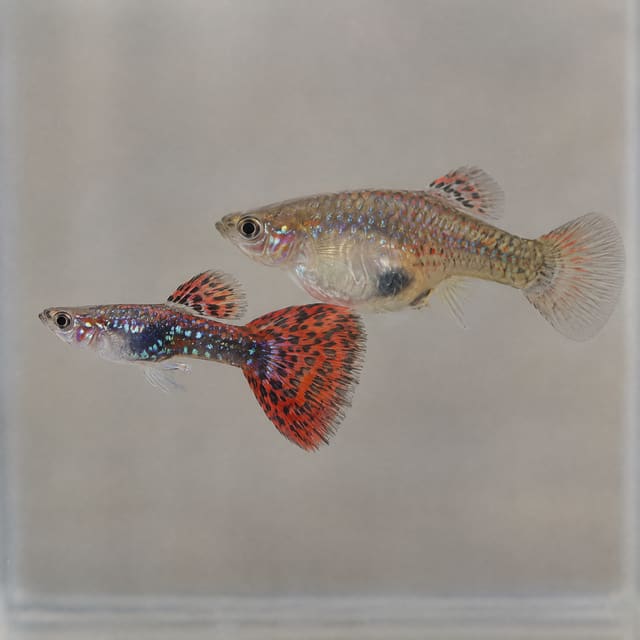
Because every fancy guppy is the same species, a Blue Moscow will share a tank with other guppies without trouble, and will breed with them. If you like blue guppies, our Half Black Blue Big Tail guppy pair and the Singapore Blue Delta guppy are worth comparing, but keep each strain on its own if you want young that look like their parents. If you are keeping guppies for colour rather than breeding a line, our mixed female guppies are an easy way to balance the sexes in a tank with several males.
Put a male and a female guppy together in a warm, healthy tank and you should expect fry. Guppies are livebearers: the male fertilises the female internally using his gonopodium, and she gives birth to live young rather than laying eggs. FishBase notes that there is no parental care, so the young are on their own from birth.
The published figures vary, and here is how the sources compare:
Sperm storage catches people out in two ways. First, a female of breeding age may already be carrying young when she reaches you, so do not be surprised by fry within the first few weeks. Second, if you later move the male elsewhere to keep him on display alone, the female may go on giving birth for months.
If you want the young to survive, Seriously Fish's advice is a densely planted tank with plenty of floating vegetation, which it calls the best way to ensure the survival of the fry. Seriously Fish also says that adults will eat the young, so removing them after the birth is the only way to save every one. In practice, Blue Moscow keepers choose between two approaches:
Fry need food small enough for very small mouths, such as finely crushed flake, offered little and often, and clean water above all. Keep the rearing tank at the same temperature and hardness as the main aquarium so the young can move across without a shock.
Watch the calendar as the young grow. FishBase puts male maturity at about two months, and Wikipedia says seven weeks or less, so a brood of young Blue Moscows can start breeding among themselves surprisingly early. If you want to control what happens next, separate the young males from the young females before that point. The males are the ones that start to develop a gonopodium and longer fins; the females stay plainer and grow deeper in the body.
If you want young Blue Moscows rather than a mix, keep the strain on its own. Any other guppy in the tank, whatever its colour, is a potential father. And plan ahead for numbers. FishBase rates the guppy's resilience as high, with a minimum population doubling time of under fifteen months, and a single pair in a good tank can turn into more fish than you have room for. Before that happens, decide where the young will go: a local aquatic shop or fish club may take healthy, well-grown youngsters, and keeping the sexes apart is the simplest way to slow things down.
Seriously Fish calls the guppy one of the most popular aquarium fish, and in good water it is an easy one to keep. The caveat comes from Seriously Fish, which warns that many commercially bred guppies are not very hardy because of inbreeding and over-production, and are prone to disease and premature death. Its advice is to start with good-quality stock. After that, the best thing you can do for a pair of fancy guppies is to give them stable, clean, hard water and a calm tank.
Spend a minute looking at the pair each day, ideally at feeding time when both are out in the open. The things worth watching are:
If something looks wrong, check the water before reaching for a treatment. Water quality is the first thing to rule out, and medicines are best kept for when you have a clear reason to use them. If you are unsure what you are seeing, contact us with a clear photograph and your test results and we will help where we can.
If you already keep fish, it is good practice to keep new arrivals in a separate, mature tank for a couple of weeks before they join the main aquarium. That gives you time to watch the pair closely and protects the fish you already have.
On lifespan, Wikipedia gives a typical figure of around two years for wild guppies, while noting that it varies greatly. It does not give a figure for aquarium fish, and fancy strains differ, so treat two years as a guide rather than a promise.
Live fish need a little planning on your side as well as ours. Please read our delivery and live arrival information before ordering. The aquarium must be ready before the parcel arrives: filter running, water tested and the temperature matched to the range on this page. Someone must be at the delivery address to receive the parcel, because live animals cannot be left unattended.
Your pair travels in an oxygen-filled bag inside insulated packaging, with heat packs when conditions call for them, via a tracked courier licensed to carry live animals. We email you the confirmed delivery date and the tracking details, so you know when to be at home.
For a live arrival claim, the order of events matters:
Photos alone do not meet the policy. Where a claim is accepted, the resolution is a replacement with your next order or a refund for the affected fish, subject to the guarantee terms.
To move the pair into the aquarium:
Over the first week, watch breathing, appetite and behaviour. Look for the male swimming openly with his fins spread and the female coming up to feed alongside him. If either fish worries you, test the water first and then get in touch.
Every fact on this page about the guppy comes from these three sources, which are worth reading in full if you want to know more about the species:
No reviews for this item yet. Bought one? Honest reviews only, good or bad.
What customers say about ordering from us
Easy website plenty of info on fish your buying great to pick a time slot
TRACEY DURRANT · 7 Oct 2026
Got some lovely fish thank you
Kevin Mackie · 7 Oct 2026
Reviews of our shop, collected by Judge.me, an independent third-party review collector. Newest first.
Moved by UK carriers licensed to handle live animals
Hand-packed with oxygen bags, poly box, heat pack
Email photos the same day; an optional unboxing video helps us review problems faster — claim terms apply
Klarna & PayPal Pay in 3 at checkout



22–26°C · pH 6–7.8 · 75L