Easy
Supercolour Male Endler Guppy (Poecilia endler)
24–30°C · pH 7–8.5 · 41L
£4.99
Photo coming soon
The size, price and care details on this page are for this listing.
Jumbo Male Endler guppy: male Endler-type livebearers (Poecilia wingei), one per unit. Tiny, peaceful and colourful; an all-male group needs a planted 45 cm tank of warm, hard water and never breeds. Purity is not certified, and 'jumbo' is a line name, not a size promise.
Adult size is the maximum length this species reaches at full maturity (scientific sources). The livestock you receive will be younger and smaller. Product-photo provenance and any image-specific limitations are stated on the listing.
Poecilia wingei
Shoaling fish: kept in a group they feel safer, stay calmer and show their best colour.
Jumbo Male Endler guppy: male Endler-type livebearers (Poecilia wingei), one per unit. Tiny, peaceful and colourful; an all-male group needs a planted 45 cm tank of warm, hard water and never breeds. Purity is not certified, and 'jumbo' is a line name, not a size promise.
Adult size is the maximum length this species reaches at full maturity (scientific sources). The livestock you receive will be younger and smaller. Product-photo provenance and any image-specific limitations are stated on the listing.
Endler's livebearer is a small, social, rapidly reproducing Venezuelan fish. Start with a mature filtered aquarium, a deliberate sex and population plan, stable tested medium-hard water, open swimming room and cover. Our conservative house screen is an aquarium at least 60 cm long and a group of five or more where capacity allows.
Maintain these water conditions for optimal health and vibrant colors
This page sells male Endler guppies of the line called Jumbo, one fish per unit. There is a single option and no size grade attached to it, so "jumbo" is part of the name rather than a measurement we promise. Males are the colourful sex of this species, and a group of males on their own is the simplest way to keep Endlers: no fry appearing every few weeks, no accidental crosses and no need for a nursery tank.
Until recently the listing carried the label "Poecilia endler". That is shop shorthand rather than a scientific name. FishBase's accepted name for Endler's guppy is Poecilia wingei, described in 2005 by Poeser, Kempkes and Isbrücker, so that is what the title now shows.
Three facts shape everything else on this page. Endlers are genuinely tiny, with the species description giving males at up to about 15 mm of body length. Like most Endlers sold through shops, these come without a pedigree, and Wikipedia states that undocumented Endlers in the trade are assumed to carry some degree of guppy hybridisation. And they want warm, hard, alkaline water with small, gentle neighbours. Provide that and male Endlers are hardy, undemanding fish.
Male Endlers fit a few kinds of keeper particularly well: someone with a small planted aquarium of 45 to 60 cm who wants bright colour without managing fry; anyone whose tap water is naturally hard and alkaline, which suits livebearers better than soft-water species; and fishkeepers putting together a nano community of very small, peaceful fish. They fit less well in a busy community of mid-sized fish, in a soft-water tank built for acid-loving species, or in any tank shared with guppies.
Here is the straight answer on the name. "Jumbo" is how this line is known in the trade. It is not a scientific category, there is no recognised standard behind it, and because we do not sell this listing in size grades we do not attach a number to it either. What we can give you is what the research says about how large an Endler gets, so you know what to expect from any male of this species.
Standard length is taken from the snout to the base of the tail fin, so the tail adds a little to every figure in that list. Even allowing for that, a full-grown male Endler is a small fish beside a fancy guppy, and FishBase records male guppies at up to 5.0 cm standard length.
When you see Endlers described as reaching 2 or 2.5 cm, those numbers describe the species as a whole, and the FishBase maximum is recorded for a female. Wikipedia notes that full-grown females can be as much as twice the size of males. A male Endler sitting well under the headline figure is normal, not undersized.
If you want to see how your males compare, measure them the way the scientists do. Wait until a fish rests side-on near the front glass, hold a ruler flat against the outside of the glass, and read from the tip of the snout to the point where the body meets the tail fin. That is standard length. Add the tail and you have total length, the figure most people mean when they say how long a fish is, and on a male with a well-developed tail the difference is easy to see.
Endlers and guppies interbreed. Wikipedia notes that the offspring are fertile, that crosses with fancy guppies often turn out bright and colourful, and that some of those hybrids have been line-bred and sold on under Endler names of their own. We hold no breeding records for the Jumbo line, so we sell it as an Endler-type male of aquarium breeding and do not describe it as pure Poecilia wingei. We cannot promise a particular size and we will not pretend the name does.
For most buyers that changes nothing in practice. Housing, water and food are identical either way. It matters if you are setting up a registered pure line, in which case you need documented stock with records behind it, and it matters if you plan to breed, because whatever is in a male's ancestry can show up in his offspring.
Telling the sexes apart is easy once you know where to look, and it is worth checking your fish when they arrive. The anal fin is the giveaway. In males it is reshaped into a gonopodium, the organ livebearer males use to mate, while females keep a triangular anal fin; OATA's care sheet for guppies and mollies uses exactly this difference for sexing. In the male the species was described from, the gonopodium is heavily marked with dark pigment right out to its fleshy tip.
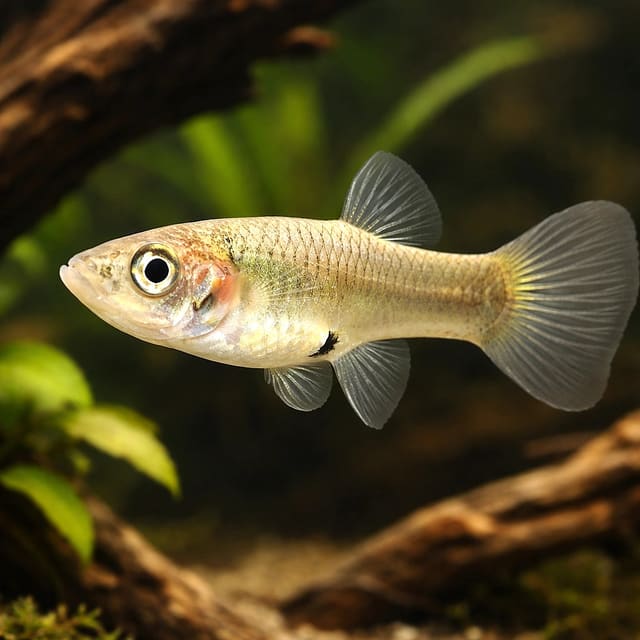
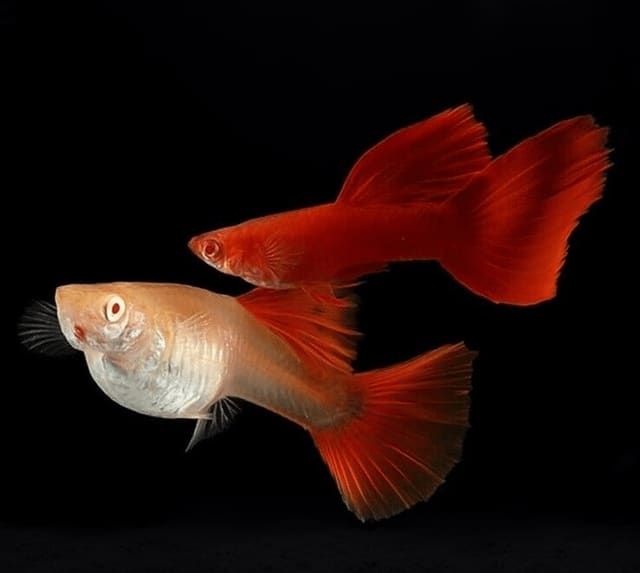
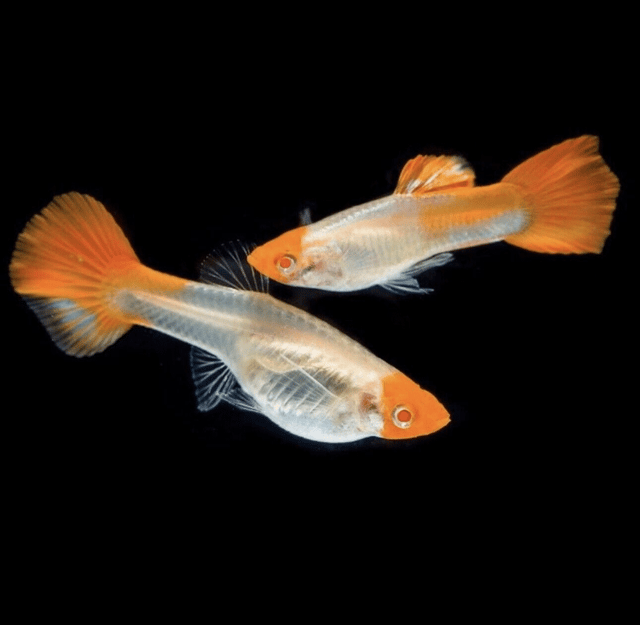
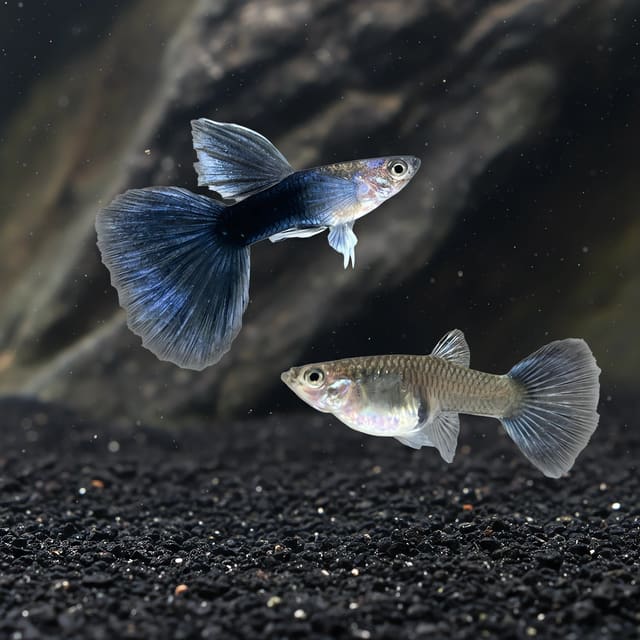
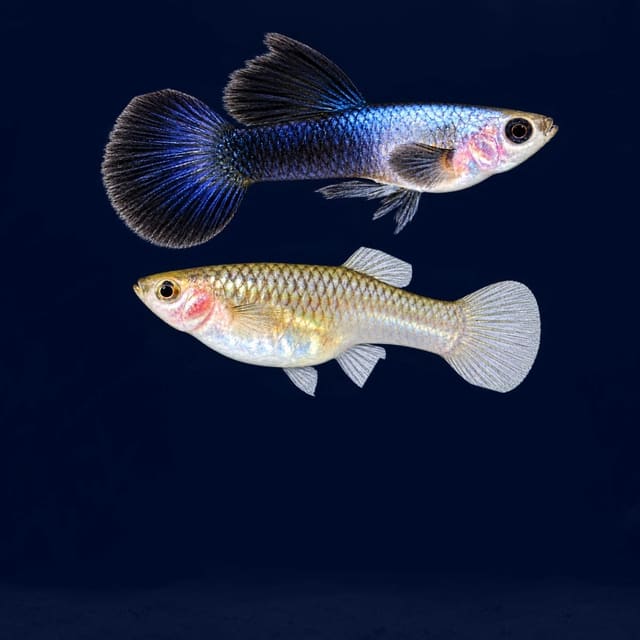
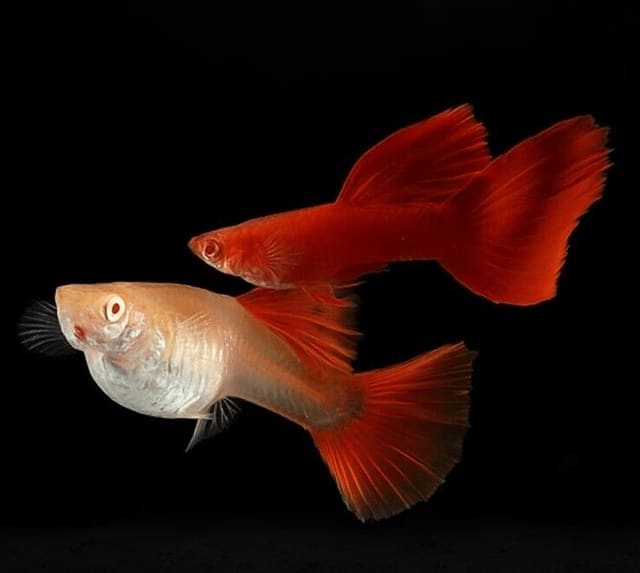
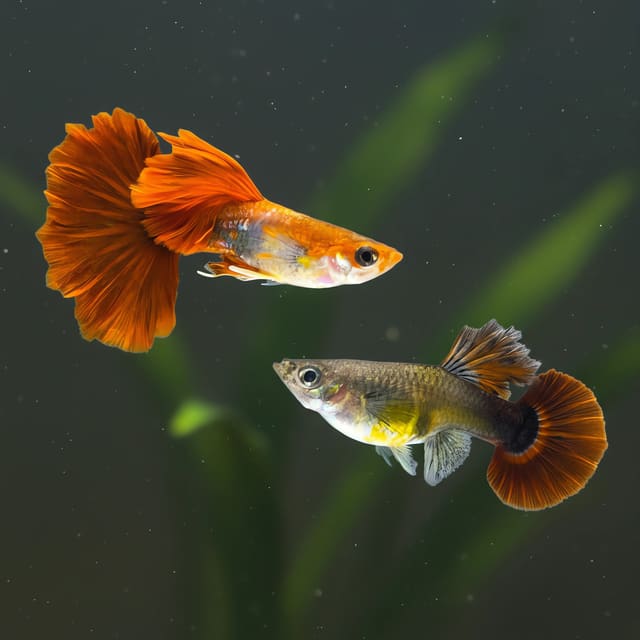
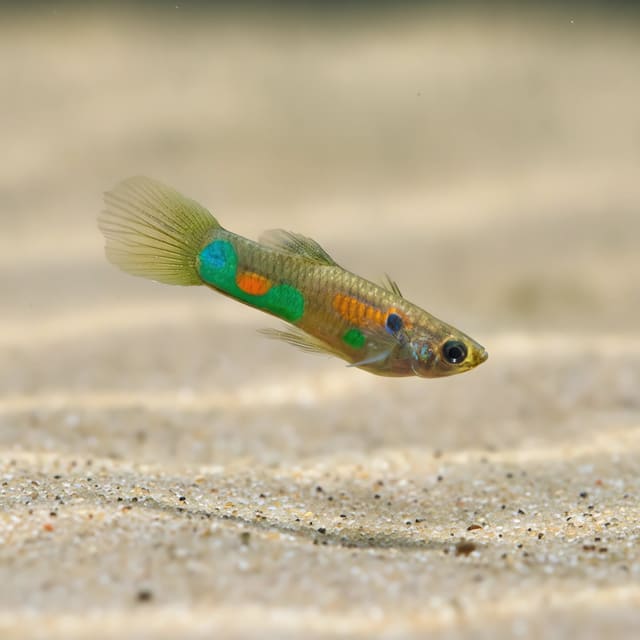
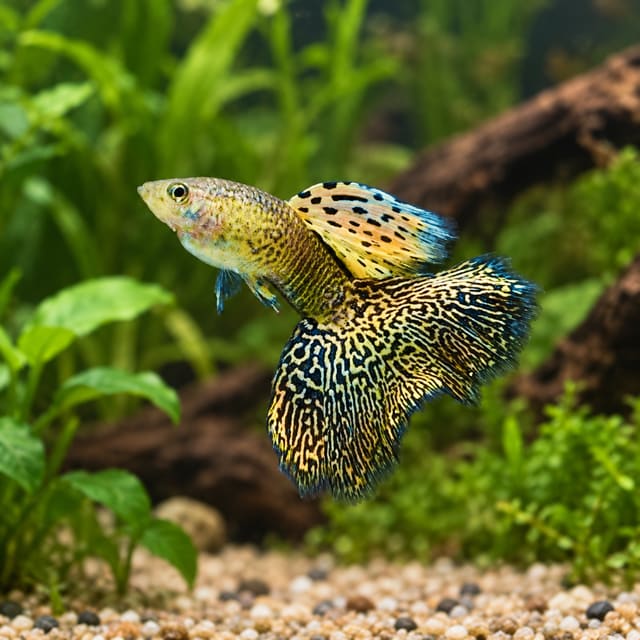
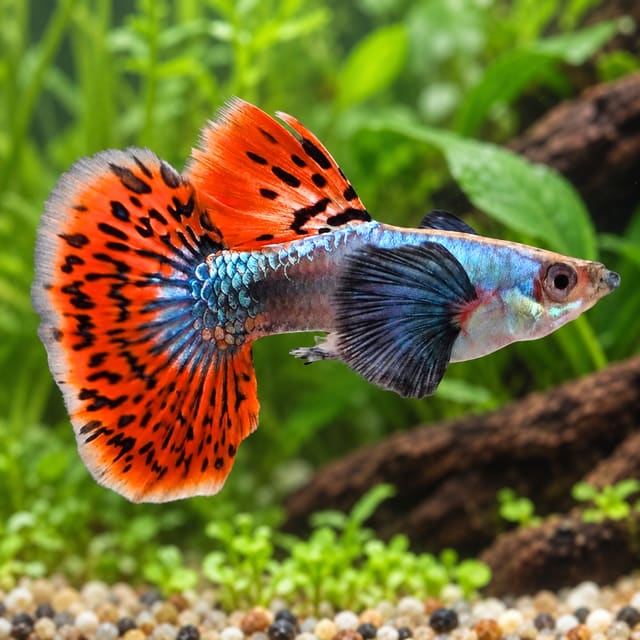
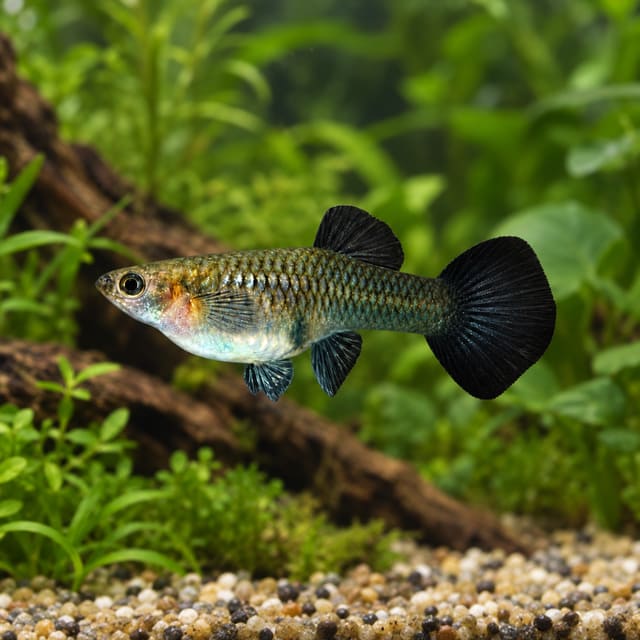
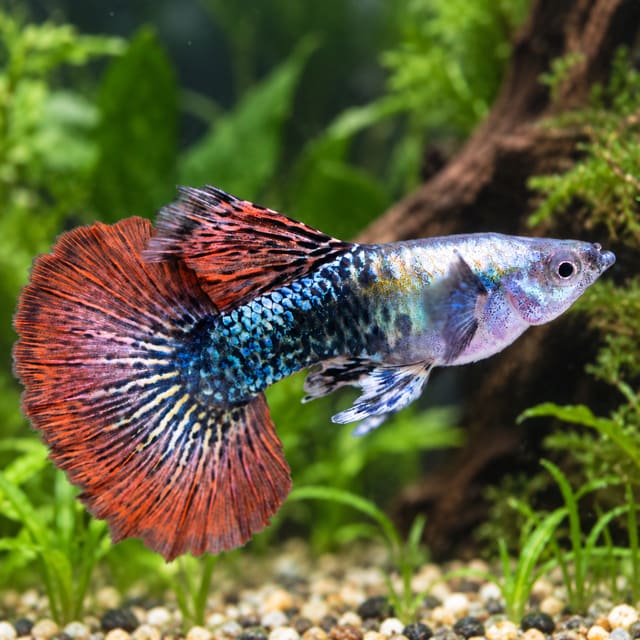
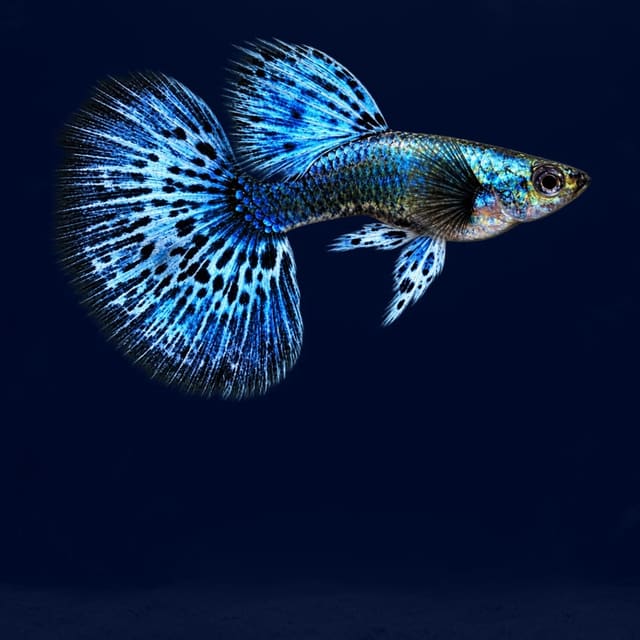
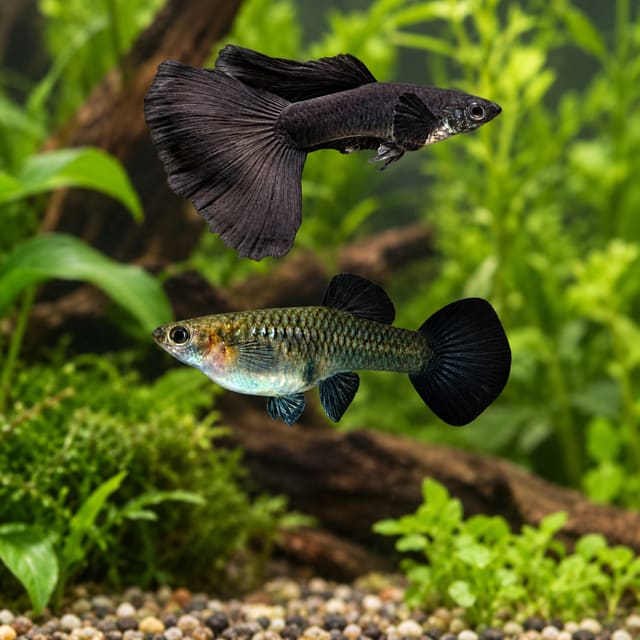
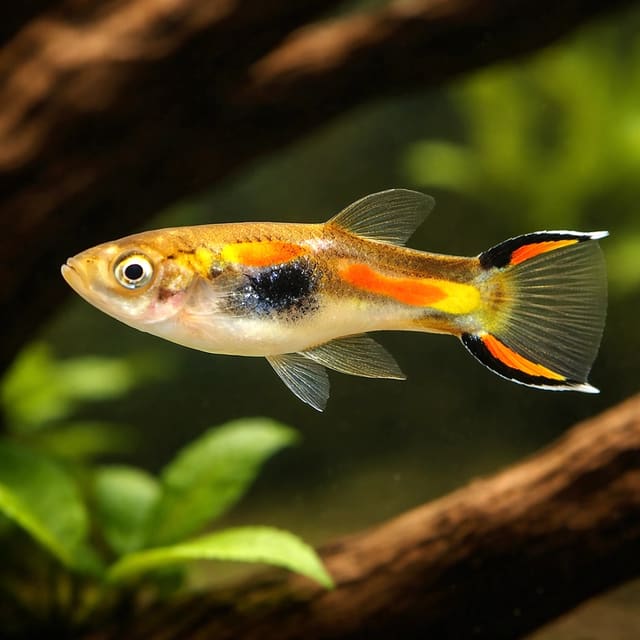
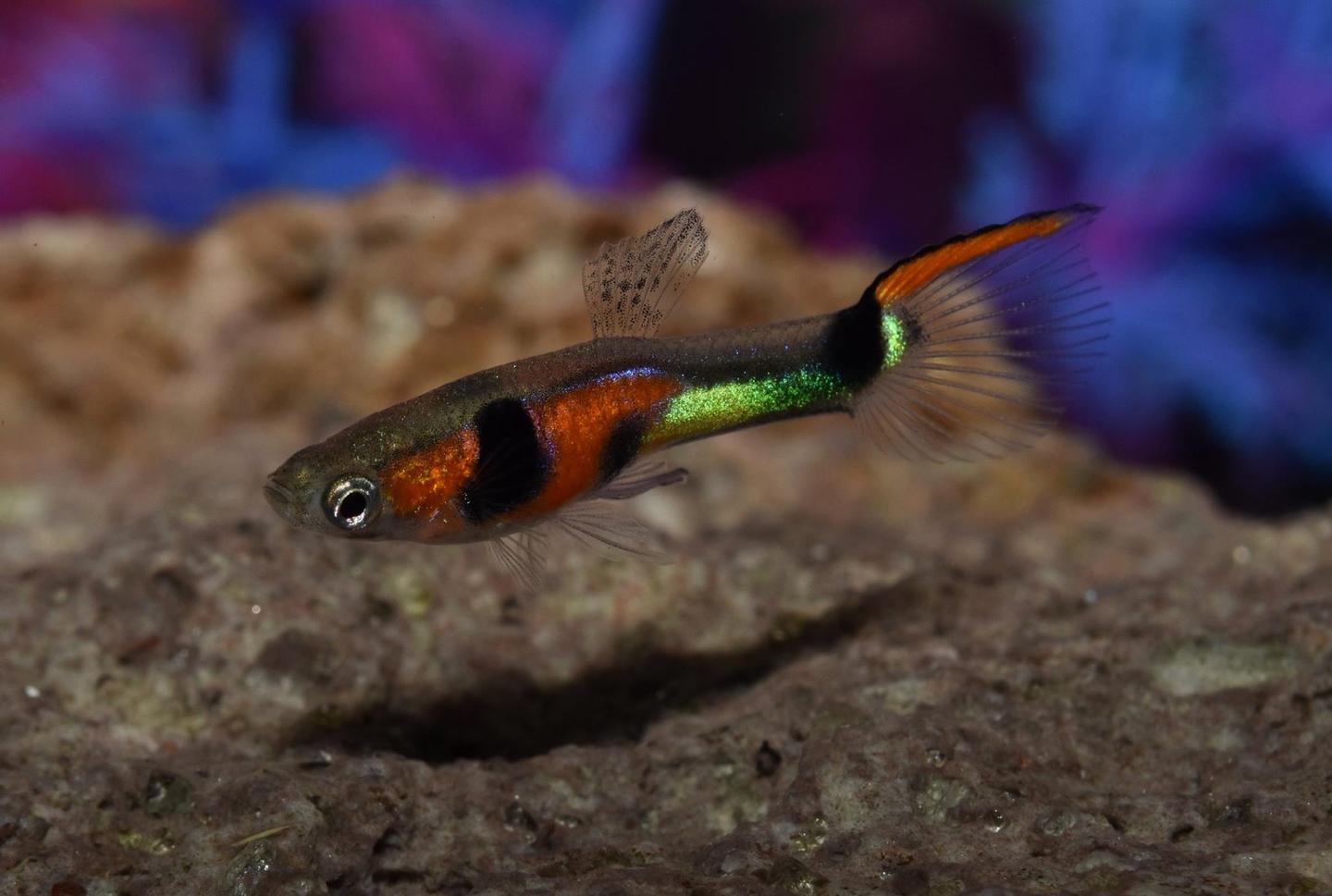
FishBase describes the species as having polychromatic males and uniform females. Wikipedia picks out black, orange and metallic green as the strongest male colours, describes natural patterns as highly variable, and says many males show a double sword. Those "swords" are short, and Wikipedia notes they are often no more than vivid colour along the edges of an otherwise clear tail.
Wild males examined for the 2005 description carried black markings and metallic patches, and where they lived alongside wild guppies they wore a broad dark band across the middle of the body. The authors also found Endlers more metallic on the body than guppies. Wikipedia records that breeders have developed many lines with particular colours and patterns, among them red chest, black bar, peacock and yellow sword.
We describe this line by its name and do not promise a pattern. Individual males in any Endler line differ, and the 2005 authors remark that within a population no two males are exactly alike.
Male Endlers colour early and keep improving. Wikipedia gives three to four weeks for the first colour to appear and says the full richness can take several months, deepening through the first half-year of life. If a newly arrived male looks a little muted, give him a few weeks of good food in a settled tank before you decide what he really looks like.
This listing sells males only, but if you ever add females you will notice how different they are. Wikipedia describes them as up to twice the size of males when full grown, coloured anywhere from pale silver to a dull dark gold, and able to shift their shade a little between light and dark surroundings. The 2005 description goes as far as saying they cannot be told from female guppies except for a faint metallic sheen in life.
Give the fish a day or two to settle, then look at each one side-on as it swims past. Use the anal fin rather than colour to confirm a male, because colour in young males is still developing and can be faint for some weeks. If you think a fish is not a male, contact us with a clear video of it swimming side-on.
The species belongs to a small stretch of coast in north-eastern Venezuela. FishBase places it in the Campoma and Buena Vista lagoons, and the 2005 description traces it through fresh water from those lagoons towards Carúpano on the Paría Peninsula. The describing authors called it the Campoma guppy and named it after Dr Øjvind Winge, the Carlsberg Laboratory scientist whose guppy-breeding experiments unravelled much of how guppy colour patterns and sex determination are inherited.
Aquarists knew the fish for decades before science named it. According to Wikipedia, Franklyn F. Bond collected it at Laguna de Patos near Cumaná in 1937, and John Endler found it there again in 1975, bringing in the first fish to reach the hobby. That is why keepers still call it Endler's livebearer. Seriously Fish describes Laguna de Patos as a lagoon cut off from the sea by a sandbar that gradually turned fresh with runoff, holding very warm, hard water coloured green by algae when the fish were rediscovered. That lagoon is the habitat most keepers have read about, and its warm, hard water matches what Endlers need at home.
The 2005 authors added an interesting footnote. They suspected the Laguna de Patos fish were a local population most likely released there by people, from stock originating in the Cariaco and Carúpano area, rather than a natural outpost.
Wikipedia's account of Endler lines includes two well-known deliberate crosses, and they show how a fish can carry an Endler name while being part guppy. The Japan blue line began with a male wild-type guppy collected from Lac du Rorota, a reservoir in French Guiana; a breeder crossed him with Cumaná Endler females to preserve the strain, and it reached the hobby as the Japan blue wild-type guppy. The Staeck line began with a guppy caught in 2004 in a creek near Laguna de los Patos and identified as pure Poecilia reticulata; it was crossed with a 'Yellow Top Sword' Endler female and introduced as the Hamburg hybrid Endler strain. Both are openly described as hybrids. Most trade lines carry no paper trail at all, which is why we make no purity claim for Jumbo males.
Wild Endlers are classed as Endangered on the IUCN Red List, as FishBase records. Wikipedia lists the threats as people moving into the habitat, pollution, released non-native fish and hybridisation with escaped guppies, and notes that Laguna de Patos has been affected by runoff from a municipal rubbish dump. Seriously Fish says the fish are now thought to be extinct at that site. Hobby lines such as Jumbo are bred in aquariums, not taken from the wild.
Not everyone accepts the Endler as a separate species. A 2009 molecular study by Schories, Meyer and Schartl supported it, and Seriously Fish follows that study; a 2014 paper by Herdegen and colleagues on Venezuelan guppy populations argued against it, and Wikipedia presents the question as open. We follow FishBase, which keeps Poecilia wingei as the accepted name.
A males-only group needs less space than a breeding colony, because the numbers never grow, but these are still very active fish. Seriously Fish sets the minimum aquarium for the species at 45 × 30 × 30 cm, roughly 40 litres, and advises against anything smaller. OATA's guppy and molly sheet puts the floor for a small group of the smaller livebearers at 45 litres. Either way, a standard 45 or 60 cm tank does the job well.
Keep a group rather than a single fish. OATA recommends at least three of these livebearers together, and Seriously Fish says Endler males are peaceful towards one another, which is what makes an all-male tank work. More males simply means more colour.
Seriously Fish strongly recommends plants, floating plants included. In a males-only tank, plants are less about hiding fry and more about giving the fish a natural, broken-up space to move through and display in, while floating cover softens bright lighting. Aquarium gravel or sand, as OATA suggests, makes a good base for rooted plants.
According to Seriously Fish, powerful filtration is unnecessary in a species tank because Endlers seem to produce very little waste. Choose a gentle, mature filter, such as an air-driven sponge filter or a small internal unit with the flow turned low, so that fish this small are not pushed around by the current.
OATA's standard for these livebearers is zero ammonia and zero nitrite, and that only happens once a filter has had time to mature. Set the tank up, plant it, run it and test it for some weeks before ordering. A ready aquarium is also a condition of our live-arrival policy, set out further down.
As a worked example, a 60 cm aquarium comfortably holds a group of male Endlers and a few small companions. Plant the back and sides fairly densely, leave an open strip along the front where the males show themselves off, and let floating plants cover part of the surface. Run an air-driven sponge filter or a small internal filter on low flow, set the heater to a steady figure in the mid-twenties, and fit a cover glass to cut evaporation and help hold the temperature. Put the light on a timer so the day length stays the same, which keeps the plants growing evenly and the tank's routine predictable.
Endlers are a hard-water fish. Seriously Fish says they may cope with soft or acidic water for a while, but that for long-term keeping they belong in moderately hard or harder water. These are its figures for the species:
OATA's care sheet, which covers guppies and mollies together rather than Endlers alone, gives a slightly cooler and softer band of 20 to 28 °C, pH 7.0 to 8.0, general hardness of 8 to 18 °dH and carbonate hardness of 5 to 15 °dKH. It also sets the quality limits that apply to every tank: ammonia and nitrite at zero, and nitrate no more than 20 mg per litre above your tap water.
Put the two together and a comfortable target for male Endlers sits where the ranges overlap: a steady 24 to 28 °C, pH between 7.0 and 8.0, and general hardness in the mid-to-high teens. Stability matters more than hitting an exact number, so choose a heater setting and leave it alone.
OATA's routine is a sensible one to copy: change at least a quarter of the water each week, test for ammonia, nitrite, nitrate, pH and hardness weekly, and clean filter sponges in water taken from the tank so the bacteria that break down waste are not killed by chlorinated tap water. Dechlorinate and temperature-match the new water before it goes in.
Find out what comes out of your tap before you buy. Soft water can be made suitable by raising hardness and buffering with an aquarium remineralising product or a calcium-based substrate, but do it in a tank without fish, and wait until the readings stay put. None of this means salting the aquarium; FishBase classes the Endler as a freshwater species.
FishBase classes Endlers as a tropical fish, and 24 °C is warmer than most rooms for much of the year, so a thermostatic heater is essential. Choose one sized for your tank, check it against a separate thermometer, and glance at the reading every time you feed. A heater that sticks on or off shows up on the thermometer long before it shows up in the fish.
A liquid test kit for ammonia, nitrite, nitrate and pH, plus general and carbonate hardness, covers everything on OATA's list. Note the results each week with the date and how much water you changed. A simple log makes slow drifts obvious, such as pH sliding as carbonate hardness is used up, well before the fish show any sign of trouble.
In the wild, Seriously Fish says, Endlers feed on small bottom-dwelling invertebrates and detritus, and in the aquarium they take most foods offered. It adds that their diet should include some vegetable matter. A staple food with plant or algae content covers that easily.
OATA advises feeding guppies and mollies once a day with a quality flake or granule that is high in algae, giving only what disappears within a few minutes, and adding live or frozen foods such as daphnia or bloodworm from time to time. For male Endlers, scale everything down. Crush flake finely, use micro-granules, and choose the smallest frozen foods; daphnia and baby brine shrimp are ideal, while bloodworm should be chopped for fish this size.
Two small feeds instead of one are fine, as long as the daily total stays modest. Watch the first few minutes after food goes in. Food left lying on the substrate afterwards is food you did not need to give, and in a small tank it quickly becomes pollution.
Rotate two or three staple foods rather than relying on a single tub. Thaw frozen food in a little tank water first, and give only as much as the group clears.
One advantage of keeping males only is that feeding stays simple. There are no newborns needing powdered food several times a day and no growing youngsters competing at mealtimes. A varied, plant-inclusive diet, fed sparingly, is all a group of males needs.
Seriously Fish gives the most useful single line of advice for anyone who wants Endlers without the breeding: if you are not interested in breeding them, buy only male fish. Because males are peaceful towards one another, a tank of males is calm, colourful and stable in numbers. It also avoids the problem that comes with mixed groups, where males chase females so hard that Seriously Fish advises several females per male to spread the attention.
Without females present, nothing breeds, so different Endler lines can share a tank with no risk of blending them. A mix of male lines gives you more variety of colour in one tank. Our Supercolour Male Endler guppy and Golden Male Endler guppy listings are both sold as males and can go in alongside Jumbo males.
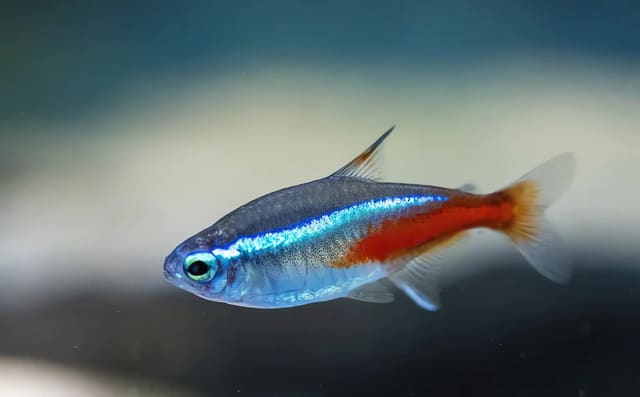
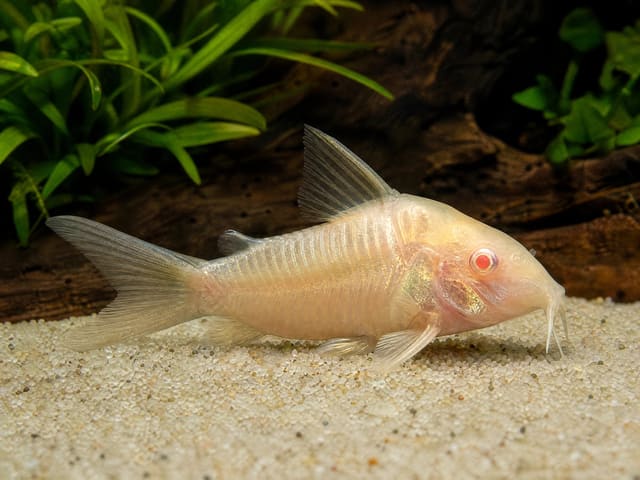
Size sets the limit. Seriously Fish says Endlers are unsuitable for a general community because they are so small, and recommends other small peaceful species instead: dwarf corydoras, small rainbowfish such as Iriatherina werneri, Pseudomugil blue-eyes, and peaceful tetras. Check that any companion is happy in the same hard, alkaline water before you buy it. Avoid anything big enough to bully a fish under two centimetres long or to treat it as food.
Seriously Fish is clear that Endlers should not share a tank with guppies, because the two crossbreed. With male Endlers that means, above all, no female guppies in the same aquarium. Keep fancy guppies in a tank of their own.
If you are planning a small community around male Endlers, add fish in stages rather than all at once, so the filter's bacteria can keep pace with each rise in waste. Start with one group, give it a couple of weeks, test the water, then add the next. Check every species against the same water targets before you buy; a fish that needs soft, acidic water is the wrong partner however small and peaceful it is.
If you decide to breed, the picture changes quickly. Our Female Endler guppy listing is there for that, but think it through first, because any fry will reflect both parents' lines, and with a trade line like Jumbo nobody can tell you exactly what is in the background.
Seriously Fish advises several females for every male, to share out vigorous courting, and several females in any case because females may turn territorial with each other. OATA's guidance of two females to each male points the same way. In practice, adding females to a group of males usually means a bigger tank or fewer males.
Seriously Fish says a female can produce a brood every 23 to 24 days, numbering anywhere from 5 to 25 depending on her age and size. Wikipedia gives about every 23 days, and from one to 30 or more young per drop. Newborns spend their first hours on the bottom absorbing their yolk sacs, and Wikipedia notes they are most at risk then, including from their own mothers and other females; males seem less interested in eating them.
Seriously Fish says adult Endlers rarely eat their young, but still recommends moving a gravid female to a separate tank to give birth, and advises against breeding traps and nets because the fish are so small. The fry are large for the size of their parents, take baby brine shrimp or powdered flake straight away, and grow fast if fed two or three times a day. Males show adult colour at three to five weeks, and females can breed at around two months old.
Wikipedia warns that giving birth can be hard on females and that some do not survive long after very large broods. Seriously Fish adds that much of the species' natural variety has already been lost to inbreeding in the hobby. If you do breed, start with unrelated fish where you can, keep the ratio in the females' favour, and never introduce guppies.
Please read our delivery and live-arrival page before ordering. The aquarium needs to be set up and ready on the day: filter running, water tested and temperature matched. Someone needs to be at the delivery address to receive the parcel.
Males travel in bags filled with oxygen, packed inside an insulated box, with heat packs added when the weather requires them. They go by tracked courier licensed to carry live animals, and you receive an email confirming the delivery date along with the tracking details.
Before you cut the tape, start recording a video and keep it running without a break while you open the box and show the fish inside the still-sealed bag. Should any fish be dead, dying or obviously unwell, send that video and your order number to hello@tropicalfishco.co.uk the same day the parcel arrives. Photographs on their own are not accepted under our policy. Valid claims are settled by replacing the fish with your next order or refunding them, under the terms of the guarantee.
For the first week, keep an eye on breathing, feeding and behaviour. OATA's signs of a healthy fish are clear, bright eyes, whole fins, intact scales and no sores or swellings; clamped fins, rubbing or flicking against objects, and shimmying in place are its warning signs. Healthy new males should be exploring and taking food within a couple of days. If one is not, check ammonia, nitrite and temperature before anything else.
If you add these males to an established group, a few weeks in a separate quarantine tank first is good practice, since any problem can then be treated without medicating the main display.
If you already keep male Endlers, add the newcomers once quarantine is over, with the lights low and a little food going in at the same time to spread attention. Watch the first hour for any persistent chasing, although Seriously Fish describes males of this species as peaceful with each other. Avoid adding new males to a tank that also holds your own females unless you are happy for the lines to mix.
Our Endler sources do not give a lifespan. OATA says guppies and mollies can live for several years in a well-matured aquarium, and with steady water and careful feeding a group of male Endlers has every chance of doing likewise.
The facts on this page come from the following sources.
No reviews for this item yet. Bought one? Honest reviews only, good or bad.
What customers say about ordering from us
Easy website plenty of info on fish your buying great to pick a time slot
TRACEY DURRANT · 7 Oct 2026
Got some lovely fish thank you
Kevin Mackie · 7 Oct 2026
Reviews of our shop, collected by Judge.me, an independent third-party review collector. Newest first.