Easy
Female Endler Guppy (Poecilia wingei)
20–28°C · pH 7–8
£6.29
One golden male Endler guppy supplied at the 2.5 cm dispatch grade. This active small livebearer suits a mature, filtered group aquarium with stable medium-hard water, open swimming room, cover and a deliberate plan for social behaviour and future population changes.
Poecilia endler
Shoaling fish: kept in a group they feel safer, stay calmer and show their best colour.
One golden male Endler guppy supplied at the 2.5 cm dispatch grade. This active small livebearer suits a mature, filtered group aquarium with stable medium-hard water, open swimming room, cover and a deliberate plan for social behaviour and future population changes.
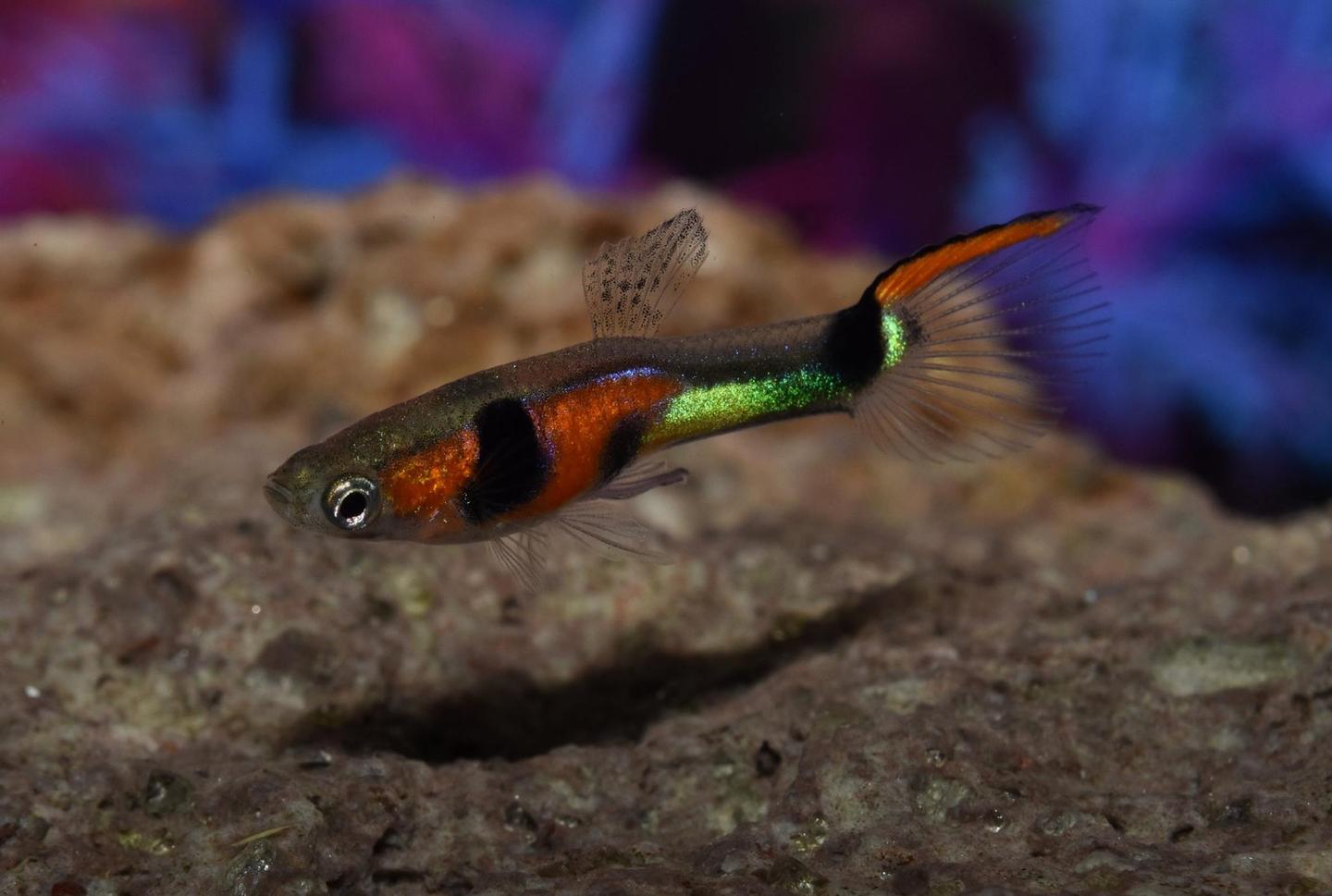
Endler's livebearer is a small, social, rapidly reproducing Venezuelan fish. Start with a mature filtered aquarium, a deliberate sex and population plan, stable tested medium-hard water, open swimming room and cover. Our conservative house screen is an aquarium at least 60 cm long and a group of five or more where capacity allows.
Maintain these water conditions for optimal health and vibrant colors
The Golden Male Endler Guppy is a small, active livebearer selected for its warm yellow-gold body colour and lively display behaviour. The exact offer is one live fish per purchase at the supplier’s 2.5 cm dispatch grade. That grade describes the size supplied and does not establish a universal adult length or measurement convention. It is a social aquarium fish, so plan the whole group and aquarium before adding a single bright male simply to fill an empty space.
The supplier identity behind this offer is Poecilia endler, which is retained in the title so the product stays anchored to the animal ordered. The accepted scientific name in FishBase, Eschmeyer’s Catalog of Fishes and the original species description is Poecilia wingei. The accepted-name bridge is useful because care and conservation references usually sit under P. wingei, while the offer record uses P. endler. It does not prove a documented wild locality line, pure pedigree or absence of domestic hybrid ancestry; appearance alone cannot make those claims.
Sex is guaranteed only when the exact product or selected option explicitly states male or female. This Golden Male Endler Guppy listing is sold as male.
Tropical Fish Co’s conservative house screen is a mature aquarium at least 60 cm long and a group of five or more where capacity, sex planning and other livestock allow. OATA gives at least 45 litres for a small group of the smaller guppy species and advises at least three guppies. The store’s larger screen is a cautious retail policy, not a research claim that five is a magic welfare number. Aquarium length, filtration, swimming room, social pressure and spare capacity still matter.
A male-only group avoids new mixed-sex mating inside that correctly sexed group, but it does not promise an aggression-free display. Males can pursue and display to one another. Provide open water, sight breaks and more than one feeding route, then watch whether every fish can swim, feed and rest without being persistently cornered. The small body size is not permission to use an uncycled bowl, vase or unstable desktop container.
| Question | Practical answer |
|---|---|
| What does one purchase supply? | One live male at the 2.5 cm supplier dispatch grade. |
| Which scientific name should I use for research? | The offer retains Poecilia endler; the accepted name is Poecilia wingei. |
| How large is an adult? | Published records differ by sex and sample: FishBase lists 2.0 cm SL for a female, Seriously Fish gives 25 mm SL, and original-description material includes males of 18.8–21.3 mm SL and females of 26.9–30.4 mm SL. |
| What is the store’s starting plan? | A mature aquarium at least 60 cm long and five or more where sex planning, filtration, water tests and capacity allow. |
| What is the main compatibility rule? | Use small peaceful companions with overlapping water needs, avoiding predators, fin-nippers and common guppies where line identity matters. |
Read the full Endler Guppy Care Guide for the identity and population-planning detail, or browse the current Endler guppy collection when comparing another sex or colour offer.
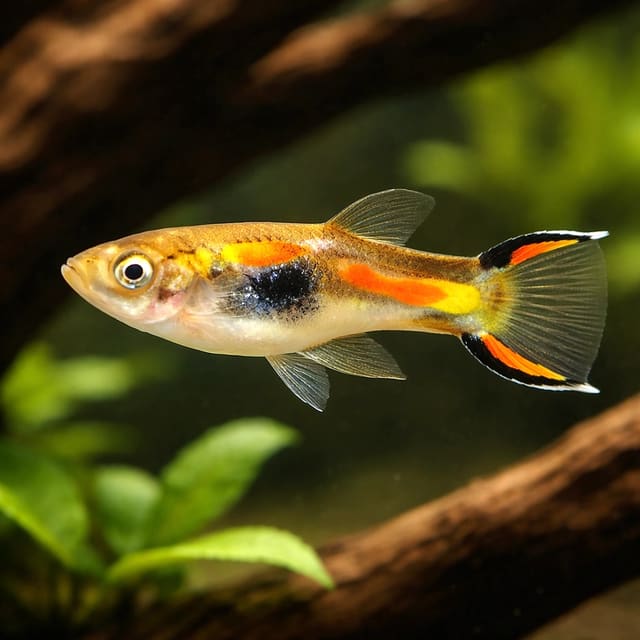
Gallery images have been digitally enhanced to improve image quality. Natural colour, pattern, size and maturity can vary between live animals.
A Golden Male Endler can suit a prepared beginner, but “easy” describes its general accessibility rather than freedom from maintenance. Start with a mature biological filter, an aquarium long enough for continuous swimming, stable tested water and a plan for the number and sex of every livebearer. The fish’s constant movement and small size make early problems easy to underestimate.
Size figures in the sources use standard length, which stops at the base of the tail. FishBase lists a 2.0 cm SL maximum for a female. Seriously Fish gives 25 mm SL. The original description includes separate stream material with males of 18.8–21.3 mm SL and females of 26.9–30.4 mm SL. These are not one interchangeable measurement and should not be compressed into an unqualified “3 cm adult maximum.”
The supplier’s 2.5 cm dispatch grade is also separate because its measurement convention is not stated. A fish supplied at that grade may include the tail in the trade measurement, while the scientific records above are labelled SL. No conversion was made. For practical planning, use the store’s adult-group aquarium screen and observe actual growth, body condition and social behaviour rather than calculating stocking from a single centimetre figure.
OATA recommends at least 45 litres for a small group of the smaller guppy species. Seriously Fish gives a 45 × 30 cm base, approximately 41 litres, for a substantial colony of Poecilia wingei. Tropical Fish Co uses the more conservative screen of at least 60 cm aquarium length for an adult group. These figures answer slightly different questions, so volume does not cancel the store’s length screen.
Leave an open horizontal swimming route and add cover that breaks lines of sight without filling the tank. Live plants and floating plants can supply cover and grazing surfaces. Artificial cover can also work when smooth, stable and easy to inspect. Protect filter intakes where a small fish could be trapped, use a secure lid and arrange equipment so no individual must fight a continuous high-velocity jet.
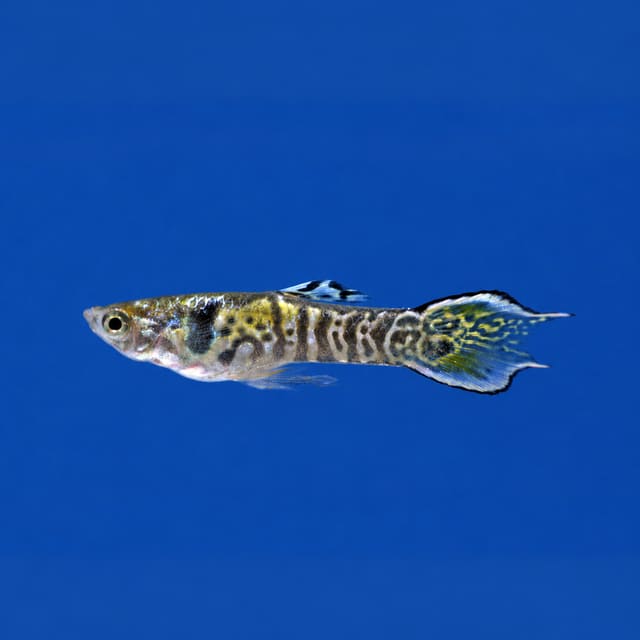
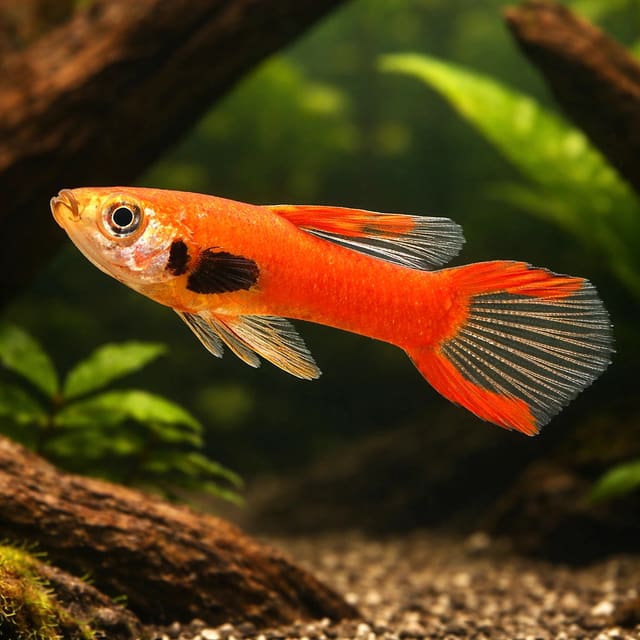
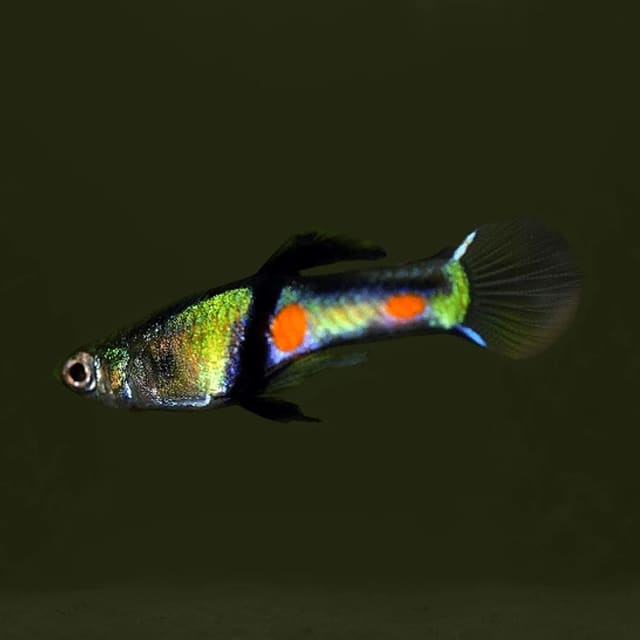
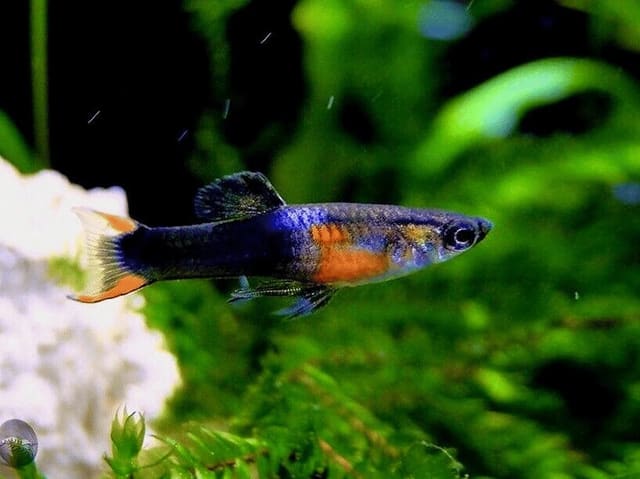
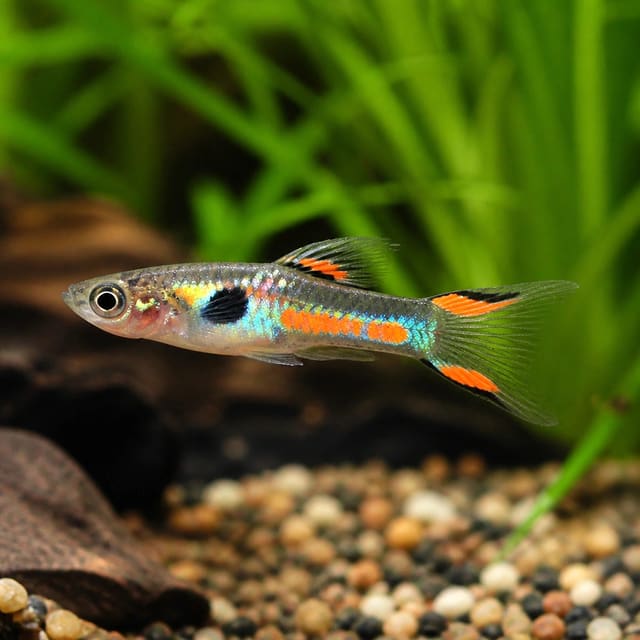
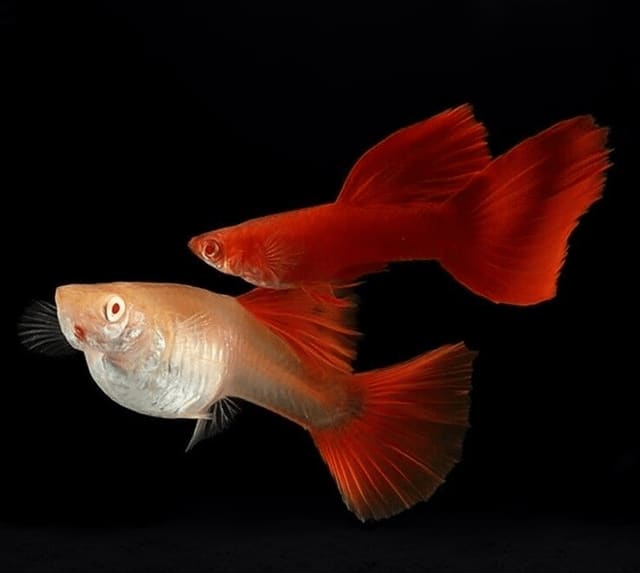
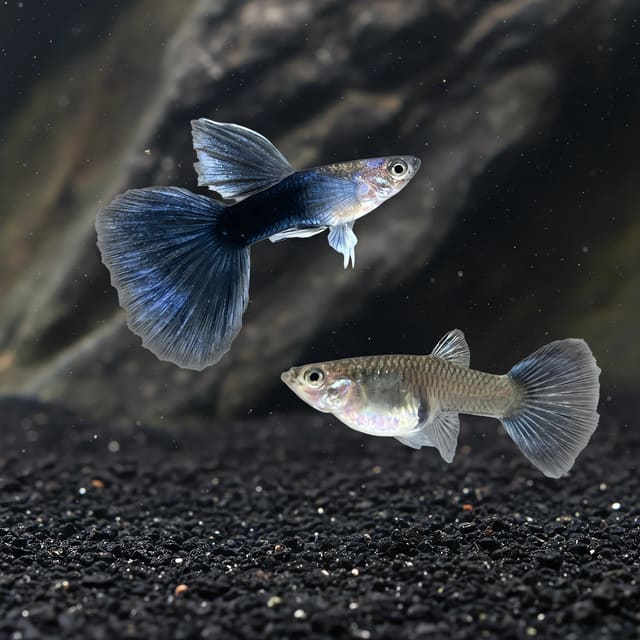
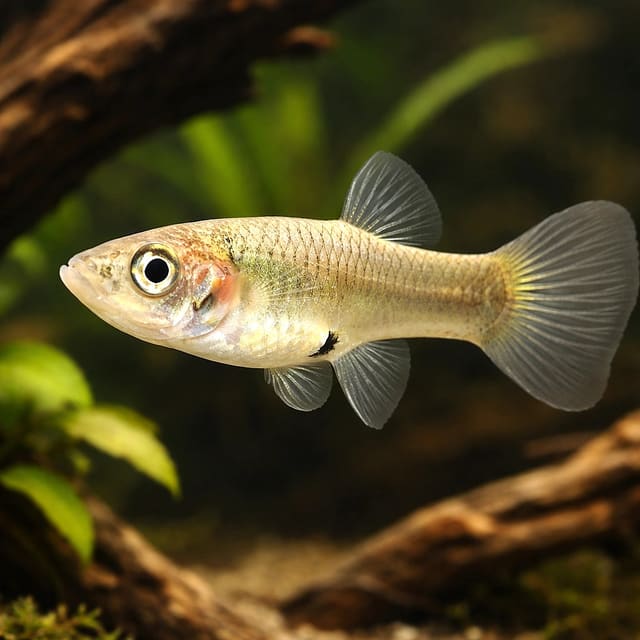
A dark background or substrate may make gold and orange markings easier to see, but it is an aesthetic choice rather than treatment. The photographed fish shows yellow-gold colour with orange-and-black marks; colour, pattern and maturity vary. Good water and a complete diet support normal condition, yet no food, light or background can promise an exact shade.
OATA’s UK guppy-and-molly sheet gives 20–28°C, pH 7.0–8.0 and 8–18 dGH. It explicitly includes Endler guppies, but it remains broad group-level husbandry guidance rather than an exact-species tolerance experiment. Seriously Fish gives narrower species-profile guidance of 24–30°C, pH 7.0–8.5 and 15–35 dGH. The ranges differ; do not call one the proven optimum or combine them into a midpoint that neither source recommends.
The store uses OATA’s 20–28°C, pH 7.0–8.0 and 8–18 dGH as a practical UK screening range, then asks keepers to match the water the exact fish occupies and make changes gradually. Use the water chemistry guide to understand the tests and the water matcher to compare actual measurements. Test both source and aquarium water instead of assuming a postcode determines hardness.
| Measure | How to use it |
|---|---|
| Temperature | 20–28°C as labelled OATA group guidance; verify with an independent thermometer and avoid rapid swings. |
| pH | 7.0–8.0 in the same group sheet; keep it stable and avoid chasing it with unmeasured additives. |
| General hardness | 8–18 dGH as broad UK husbandry guidance; measure rather than describing all tap water as hard or soft. |
| Ammonia and nitrite | Both should remain undetectable before and after stocking. |
| Nitrate | OATA advises no more than 20 mg/L above the normal tap-water level. |
A heater may be needed to hold a suitable year-round temperature in a UK home. Check the water with a separate thermometer rather than trusting the dial. Avoid direct sunlight and cold draughts, and increase vigilance during hot weather because warmer water holds less oxygen. Surface movement should support gas exchange without exhausting the fish.
Before any livestock arrives, follow the first tropical tank guide and confirm the biological cycle with repeated tests. Fish release ammonia; beneficial bacteria convert it to nitrite and then nitrate. Clear water can still contain toxic dissolved waste, so visual clarity is not a substitute for testing.
Stock gradually. Test at least weekly during normal care and more often after a new group, equipment problem or unexpected behaviour. OATA strongly recommends a partial water change of 25% at least once every week for guppies and mollies. Treat replacement water for chlorine or chloramine and bring it close to the aquarium temperature. Adjust the routine to measured waste, total stocking and feeding rather than allowing an arbitrary day to replace observation.
Inspect filter flow and intakes for blockages. When mature filter media needs cleaning, rinse it lightly in removed aquarium water or another dechlorinated method that protects the bacterial colony; tap chlorine or chloramine can harm beneficial bacteria. Avoid replacing all mature media at once unless the manufacturer’s safety direction or a qualified aquatic professional requires a different response.
OATA advises at least three guppies and, for mixed groups, two females to each male to reduce pressure. Tropical Fish Co’s more conservative recommendation is five or more where capacity and the sex plan allow. This product supplies a male, so a keeper who wants a male-only display can build one without adding females. That choice prevents new mating within a correctly sexed all-male group, but it does not remove display competition or pursuit.
Watch the whole group rather than the boldest fish. At feeding time, check whether an individual hangs back, misses food or is driven into a corner. Repeated hiding, ragged fins, weight loss or relentless following calls for a change: more usable space and sight breaks, different feeding positions or a mature separation aquarium. Adding fish simply to “spread aggression” is unsafe when the tank is already at capacity.
If females of any Endler or guppy form are present, plan for mating and fry before they share the aquarium. Livebearers can reproduce readily, and female livebearers may retain sperm from earlier matings. A current male-only purchase cannot guarantee that unrelated existing females will not produce young. Prepare spare mature capacity and responsible rehoming rather than treating adult predation as population control.
OATA and Seriously Fish describe Endlers as omnivorous. Use an appropriately small, complete flake or micro-granule as the nutritional foundation. Add safe variety such as cyclops or other mouth-sized frozen or live food and suitable plant-rich content. The particle must be small enough to take without repeated spitting, and food should reach quieter individuals before it sinks out of reach.
OATA suggests one daily portion that can be eaten within a few minutes. That is broad household guidance, not an exact-species feeding trial. Start conservatively, observe body condition and feeding response, remove food that repeatedly remains and adjust after changes in group size, temperature or filter performance. Fry, recovering fish and particular complete foods may need a different plan.
Do not collect live food from an unknown pond. Store dry food away from heat and moisture, avoid thawing and refreezing frozen food, and keep feeding tools clean. Visible algae and micro-organisms can add grazing interest but do not replace a complete diet. Rich food is not a shortcut to stronger colour, and overfeeding can quickly damage water quality.
Before dispatch, confirm stable temperature and chemistry, zero detectable ammonia and nitrite, a working filter and heater, and enough cover for the whole group. When the parcel arrives, follow the current arrival directions on the delivery page and order email. Avoid relying on a remembered universal acclimation method because the journey and the difference between bag and aquarium water matter.
For the first week, note breathing, balance, fin position, appetite, waste and social access. Temporary paleness after a journey can have several causes and should not be automatically dismissed. Test the aquarium, check the equipment and keep photographs if the fish’s condition changes. Persistent gasping, clamped fins, spots, wounds, loss of balance or refusal to feed requires prompt investigation and qualified help.
Start with water-quality and equipment checks before reaching for salt, heat or medicine. One symptom can have several causes, and an unsuitable treatment may add stress. Keep quarantine equipment separate, use a mature quarantine aquarium and seek a fish-experienced vet or knowledgeable aquatic professional when signs are severe or persistent.
Published work on one captive line recorded 22 spinal deformities among 600 observed fish. That limited result is not a species-wide rate and appearance alone cannot diagnose the cause. Do not breed an affected fish, but do not label every curved body as proof of inbreeding either. Obtain expert assessment and review nutrition, water, injury risk and lineage records.
Never release Endlers, hybrids, fry, plants, pathogens or aquarium water outdoors. Captive abundance and a wild conservation status do not turn aquarium stock into a reintroduction project. Prevent unmanaged breeding, keep permanent suitable care available and arrange responsible rehoming through experienced keepers, societies or retailers.
The golden trade form describes appearance, not a wild locality. Lighting, age, health, social context and camera processing can alter how yellow, orange and black markings look. Give the fish suitable care and judge welfare from breathing, swimming, appetite, body condition and fin position rather than using colour intensity as the only health test.
Young or recently transported fish may not match the brightest gallery view immediately. Allow a stable settling period and compare changes over time. A sudden loss of colour alongside rapid breathing or abnormal swimming deserves a water and health check; gradual variation by itself does not prove disease. Avoid foods or additives sold with promises of forcing a particular shade without a sound basis.
Before adding this male, write down the aquarium length, tested water, current fish, their adult sizes and their group requirements. Then ask whether the filter and open swimming room can support the store’s five-or-more Endler plan. If the answer depends on removing cover, ignoring fry or assuming no fish will chase another, the plan is not ready.
For a male-only display, count all existing Endler males and watch whether each can leave another’s path. For a mixed livebearer aquarium, add the possibility of retained sperm, courtship and repeated broods to the capacity calculation. A larger tank can still become overcrowded when fry survive, while a small tank can become unsafe before water tests visibly deteriorate.
Plan exits before problems occur: a mature spare aquarium, a divider that fits the layout and a responsible rehoming contact. Do not depend on a shop, club or friend taking unexpected fish at short notice. Prevention through sex planning is kinder and more reliable than improvising once young fish appear.
Use a separate mature, heated aquarium with dedicated equipment. Provide cover and enough space for normal swimming while keeping the layout simple enough to observe appetite, breathing, fins and waste. Test quarantine water as carefully as the display aquarium; a temporary system still needs biological filtration and stable temperature.
Move no water, net or siphon between systems without cleaning and drying as appropriate. If illness is suspected, record signs and test results before choosing a treatment. Small livebearers can be sensitive to rapid changes and overdosing, so diagnosis and UK-authorised product directions matter. A fixed medication recipe does not belong in general care guidance.
After a heater failure, heatwave or power cut, measure the water and observe the fish before feeding normally. Restore circulation and temperature gradually. During hot conditions, increase attention to gas exchange and stocking pressure; during cold conditions, check that the heater maintains the water rather than merely warming one corner.
Keep a basic contingency kit: an independent thermometer, water tests, conditioner, a safe aeration option and contact details for experienced help. Equipment is useful only when its operation is understood before an emergency. Test spare pumps and air lines periodically rather than discovering a fault when the aquarium is already under stress.
Compatibility is conditional. Begin with overlapping temperature, pH and hardness, then compare adult size, mouth size, speed, fin-nipping risk, territorial behaviour and the space needed by every social group. A tank mate that is peaceful in one aquarium can still create feeding pressure or crowding in another.
Seriously Fish names dwarf corydoras, small rainbowfish such as Iriatherina werneri or Pseudomugil species, and peaceful tetras as possible companions. OATA broadly warns against species large enough to eat an Endler and against fin-nippers such as barbs. Treat those examples as a starting screen, then check the exact companion’s water, group and footprint requirements.
Bottom-dwelling fish do not automatically conflict with a small livebearer, but they add their own social and feeding needs. Confirm that the aquarium has enough area and filtration for both groups. Provide food in a way that gives surface, midwater and bottom feeders access without overfeeding the entire aquarium.
Avoid large predators and any fish able to swallow an Endler. Avoid persistent fin-nippers even though this golden male’s tail is not as exaggerated as some fancy guppies. Damage risk depends on the exact species, group size, layout and individual behaviour. Watch newly combined fish during feeding and after the room quietens.
Fast or boisterous fish can exclude Endlers without overt biting. Signs include a fish staying behind cover at every meal, losing weight or abandoning open water. Add genuine sight breaks and distribute food, but separate animals if the behaviour continues. Do not wait for major injury before acting.
Poecilia wingei and the common guppy Poecilia reticulata are recognised as separate species, yet laboratory research confirms they can hybridise. Keep documented Endler lines apart from common guppies and known hybrids. A gold colour name, body pattern or informal class label cannot prove pedigree.
Hybrid fish can still receive excellent care and make valid display animals when labelled honestly. The problem is not the fish; it is making ancestry claims without documentation or passing offspring on under a false identity. For documented lines, record breeder and chain-of-custody details and avoid using appearance as the only test.
Do not promise shrimp safety. Adult shrimp may coexist in a sufficiently large, well-covered aquarium with compatible water, but small shrimp and shrimplets can be eaten. Moss and other cover reduce exposure without guaranteeing survival. Snails also have their own mineral and feeding requirements and do not replace maintenance.
Endler fry are vulnerable to filtration intakes and tank mates. Protect intakes if fry are part of a deliberate plan, but recognise that dense cover can increase survival and accelerate crowding. Decide whether fry are wanted before using the aquarium layout to maximise survival.
| Check | Question to answer |
|---|---|
| Water | Do the actual temperature, pH and hardness ranges overlap without forcing either species to an edge? |
| Adult size | Could the companion swallow or seriously injure a small Endler? |
| Behaviour | Is the companion a known fin-nipper, relentless pursuer or territorial feeder? |
| Space | Does the aquarium meet every species’ swimming, bottom-area and social-group needs? |
| Feeding | Can every fish take an appropriate food without one group monopolising it? |
| Population | Could livebearer mating create more fish than the system can support? |
Have a mature separation option ready before testing a new combination. A divider, spare filter media and a cycled aquarium are useful only when prepared before conflict. If a fish is injured or repeatedly excluded, separation is better than adding more animals or repeatedly rearranging the entire aquarium.
Keep the records scoped. FishBase lists 2.0 cm SL for a female, Seriously Fish gives 25 mm SL, and original-description material includes males of 18.8–21.3 mm SL and females of 26.9–30.4 mm SL. Standard length excludes the tail. The 2.5 cm supplier grade is the dispatch size, not an adult maximum.
OATA gives at least 45 litres for a small group of the smaller guppy species. Tropical Fish Co adds a conservative adult-group screen of at least 60 cm aquarium length, with mature filtration, swimming room, cover and a population plan. Neither number is a litres-per-fish entitlement.
OATA advises at least three guppies, while the store’s conservative house recommendation is five or more where capacity and the sex plan allow. This male offer can form part of a male-only display, but observe pursuit, feeding access and fin condition and keep a mature separation option.
It can suit a prepared beginner who has a mature filtered aquarium, tests water and plans the group. The “easy” store label does not make an uncycled bowl, unstable nano aquarium or unplanned mixed-sex group suitable.
Use an appropriately small complete flake or micro-granule as the staple, with mouth-sized live or frozen variety and suitable plant-rich content. OATA specifically notes that Endlers may need smaller frozen items such as cyclops. Feed an amount the group can finish without leaving waste.
OATA’s combined guppy-and-molly guidance gives 20–28°C, pH 7.0–8.0 and 8–18 dGH and explicitly includes Endlers. These are broad UK husbandry values, not exact-species tolerance limits. Test the source and aquarium water and change conditions gradually.
It is generally a small peaceful livebearer, but male display and pursuit still need monitoring. Provide usable swimming length, cover and several feeding routes. Separate fish if one is persistently cornered, injured or prevented from eating.
Small peaceful tetras, dwarf corydoras and small peaceful rainbowfish are examples named by the species profile when water and space also match. Avoid predators and fin-nipping fish. Keep common guppies and known hybrids out of documented Poecilia wingei lineage aquariums.
Tropical Fish Co uses a licensed live-animal courier and sends tracking and the confirmed delivery date by email. Someone must receive the parcel. For a Live Arrival Guarantee claim, record one continuous video from the still-sealed parcel through opening to the fish still in its sealed bag, then contact the store the same day.
The accepted identity, distribution and FishBase length record come from the FishBase species account for Poecilia wingei. The Catalog of Fishes entry and the original species description support the accepted name and preserve the sex- and sample-scoped SL records.
The Seriously Fish species profile supplies practical species-level aquarium guidance. The OATA guppy and molly care sheet supplies broad UK group guidance on water, minimum volume, social care, maintenance and feeding.
The RSPCA aquarium environment guidance explains biological filtration. Additional scientific context comes from work on species distinction and overlapping appearance, a single captive line’s spinal deformities, and a limited life-history study. These papers do not justify population-wide disease rates, pedigree claims or universal breeding promises.
For normal and concerning signs, see the RSPCA pet fish health guidance. For receipt and claim steps, use the store’s current delivery and Live Arrival Guarantee information.
No reviews for this item yet. Bought one? Honest reviews only, good or bad.
What customers say about ordering from us
Easy website plenty of info on fish your buying great to pick a time slot
TRACEY DURRANT · 7 Oct 2026
Got some lovely fish thank you
Kevin Mackie · 7 Oct 2026
Reviews of our shop, collected by Judge.me, an independent third-party review collector. Newest first.