Easy
Female Endler Guppy (Poecilia wingei)
20–28°C · pH 7–8
£5.99

The Red Rainbow Female Endler Guppy (Poecilia wingei-type) is a Poeciliidae livebearer linked to Venezuela’s Campoma and Buena Vista lagoon systems, with a recorded female maximum of 2.5 cm standard length. It suits a prepared beginner with a mature filtered aquarium of at least 41 litres; our house plan is at least 60 cm long and five or more fish where capacity allows, using the 24–28°C, pH 7–8 and 15–18 dGH overlap of Seriously Fish and OATA guidance. Sold individually as female at a 1.5–2.5 cm dispatch grade.
Adult size is the maximum length this species reaches at full maturity (scientific sources). The livestock you receive will be younger and smaller. Product-photo provenance and any image-specific limitations are stated on the listing.
Poecilia wingei-type
Save when buying multiple fish. Each quantity is one fish; sex and pair formation are not guaranteed unless the selected variant explicitly states them.
The Red Rainbow Female Endler Guppy (Poecilia wingei-type) is a Poeciliidae livebearer linked to Venezuela’s Campoma and Buena Vista lagoon systems, with a recorded female maximum of 2.5 cm standard length. It suits a prepared beginner with a mature filtered aquarium of at least 41 litres; our house plan is at least 60 cm long and five or more fish where capacity allows, using the 24–28°C, pH 7–8 and 15–18 dGH overlap of Seriously Fish and OATA guidance. Sold individually as female at a 1.5–2.5 cm dispatch grade.
Adult size is the maximum length this species reaches at full maturity (scientific sources). The livestock you receive will be younger and smaller. Product-photo provenance and any image-specific limitations are stated on the listing.
Endler's livebearer is a small, social, rapidly reproducing Venezuelan fish. Start with a mature filtered aquarium, a deliberate sex and population plan, stable tested medium-hard water, open swimming room and cover. Our conservative house screen is an aquarium at least 60 cm long and a group of five or more where capacity allows.
Maintain these water conditions for optimal health and vibrant colors
The Red Rainbow Female Endler Guppy (Poecilia wingei-type) is a small freshwater livebearer in the Poeciliidae family. FishBase places Poecilia wingei in Venezuela’s Campoma and Buena Vista lagoon systems and records a female maximum of 2 cm standard length. Standard length ends at the base of the tail, so it is a scientific measurement rather than a dispatch measurement.
This fish suits a prepared beginner who will use mature biological filtration, test the water and plan the social group before purchase. We rate its care level easy because the routine is straightforward once those foundations are in place. Easy care still requires stable water, a suitable group, daily feeding, weekly maintenance and a plan for possible reproduction in any mixed-sex aquarium. Our complete Endler Guppy care guide explains the house standards behind that rating.
Keep the aquarium at 24–28°C, pH 7–8 and 15–18 dGH. These values are the overlap between the Seriously Fish species profile and OATA’s group guidance for guppies and mollies. The overlap keeps routine aquarium values within both ranges rather than treating either range as a target to explore from end to end.
| Suits | Not suited to |
|---|---|
| A prepared beginner with a mature filtered aquarium | An uncycled bowl, vase or unfiltered container |
| A planned female or mixed-sex livebearer group | A lone-fish plan with no compatible group |
| Medium-hard water within the stated overlap | Water outside the needs shared by every resident |
| Small peaceful companions that pass every compatibility check | Predators, fin-nippers or an unscreened general community |
Each purchase supplies one Red Rainbow female Endler-type fish at a 1.5–2.5 cm dispatch grade. It is one fish, not a pair, trio or pack. The dispatch grade describes the size sent from the fishroom; it is separate from the recorded adult measurement and should not be used to calculate permanent stocking capacity.
Sex is guaranteed only when the exact product or selected option explicitly states male or female. This Red Rainbow Female Endler Guppy listing is sold as female. Mature female Endlers are usually plumper and less colourful than males, while males have a modified anal fin called a gonopodium. Colour or body fullness alone should not be used to make breeding or population decisions.
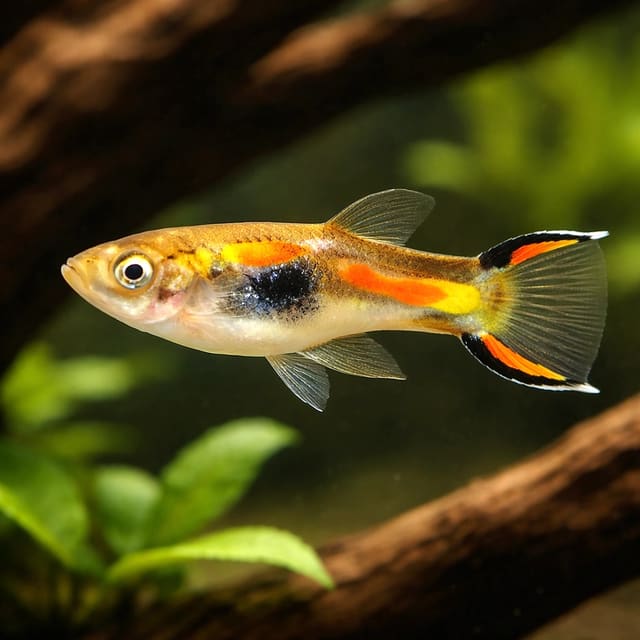
“Red Rainbow” is an aquarium trade designation for this form, not a locality name or taxonomic rank. Treat the colour label as an identification aid for the offered form rather than a pedigree certificate. The Poecilia wingei-type wording also keeps that distinction clear when planning a documented line.
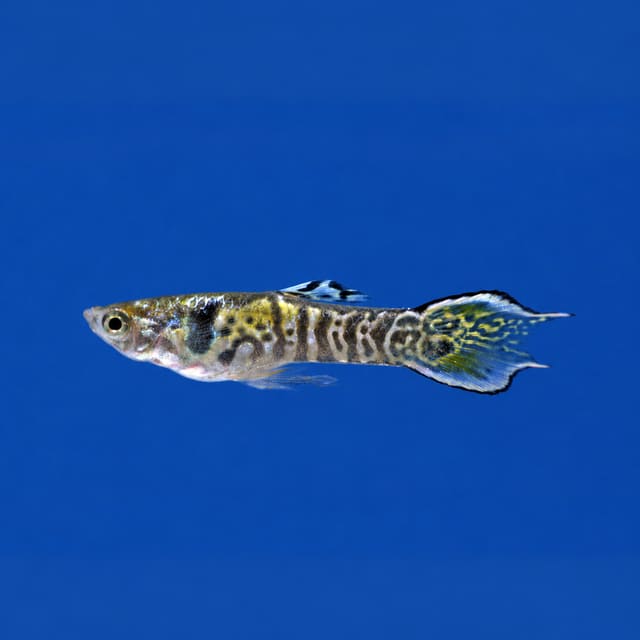
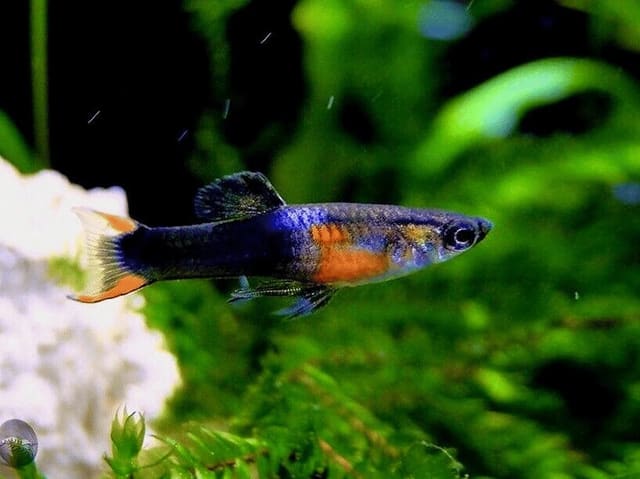
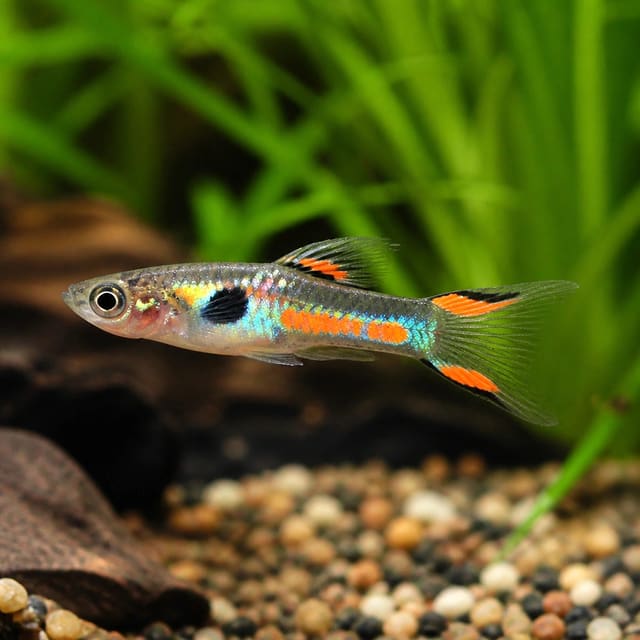
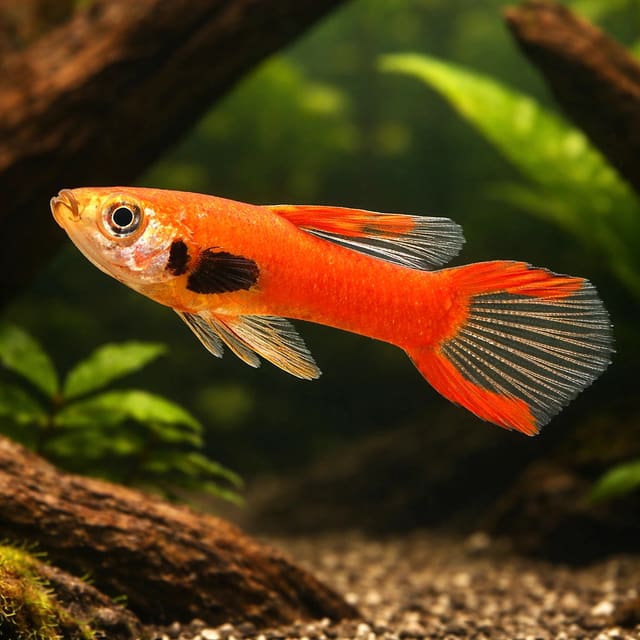
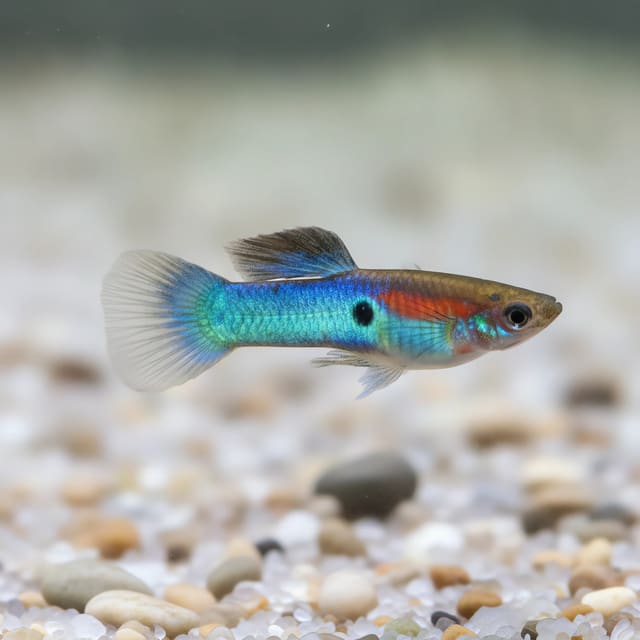
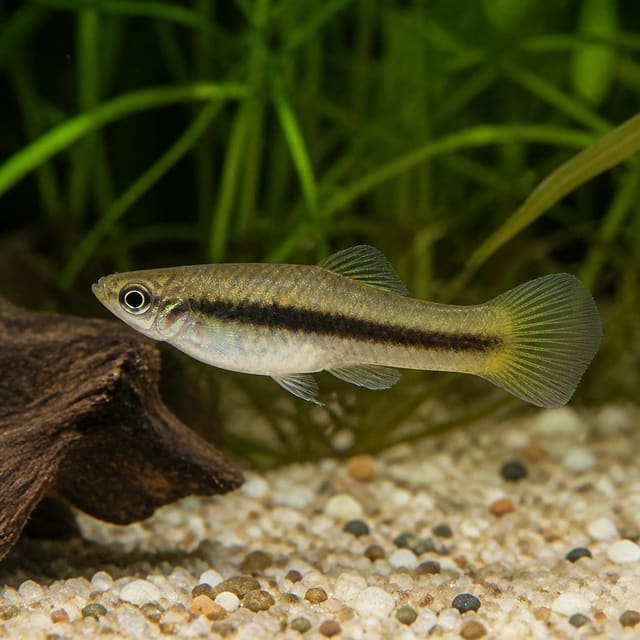
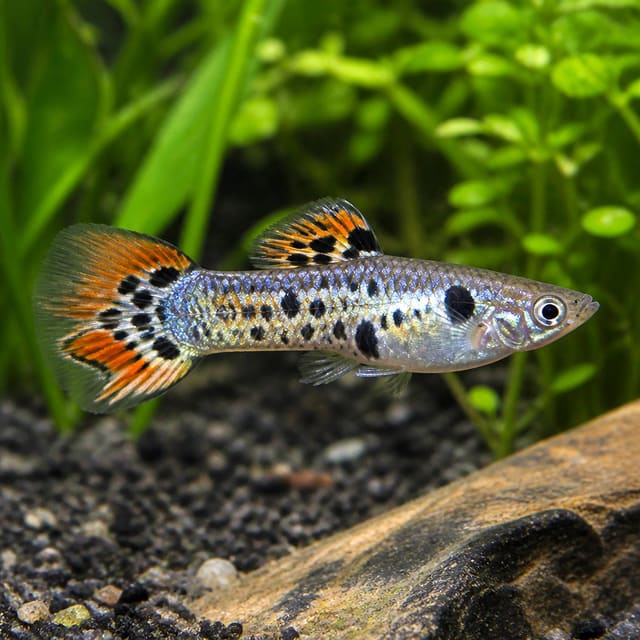
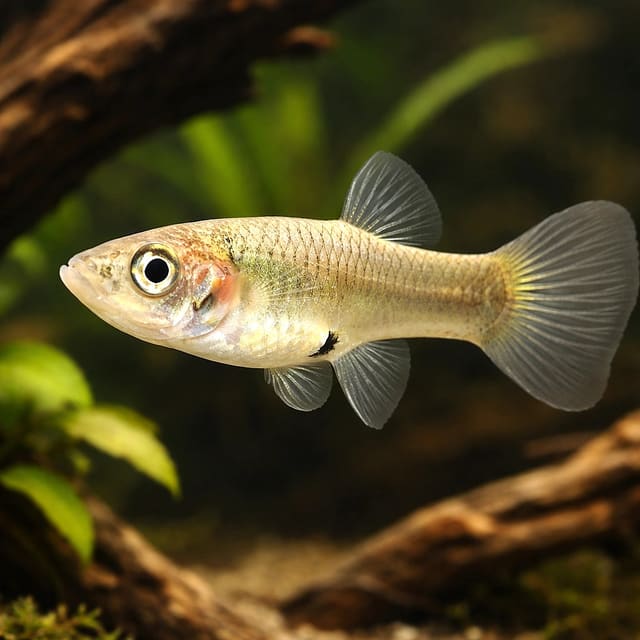
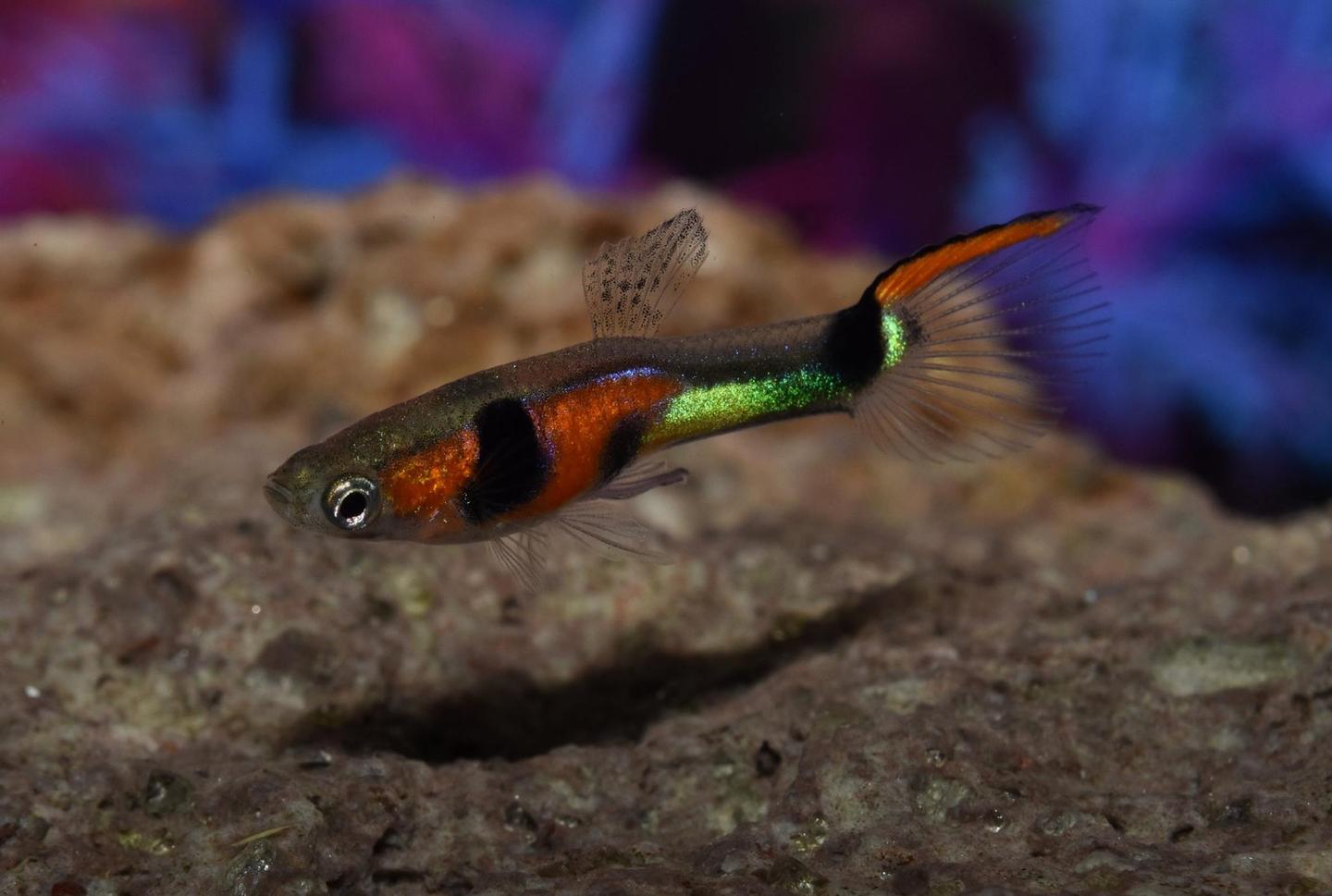
The gallery images are representative of this type of animal rather than photographs of the exact animal supplied, so colours can look slightly different from the live animal. Use the gallery to understand the general fish type and scene, while allowing for individual differences in colour placement, intensity and proportions.
You can browse the wider Endler guppy collection to compare sex and trade-form descriptions. Keep each product’s identity, sale unit and social implications separate when building a group.
Poecilia wingei is the valid species name associated with Endler’s livebearer. Eschmeyer’s Catalog of Fishes places it in Poeciliidae, while the original species description links it to the Paría Peninsula region of Venezuela. “Endler guppy” remains a familiar aquarium trade name.
The Red Rainbow designation describes appearance in the aquarium trade. It should not be treated as proof of a wild collection locality, generation history or conservation line. A later morphological and molecular comparison supports P. wingei as a distinct species while also showing why appearance alone is a poor pedigree test.
This distinction matters most when the aim is to preserve a documented P. wingei line. Seriously Fish states that Endlers should not be kept with common guppies because Poecilia wingei and Poecilia reticulata will crossbreed. Keep the two apart whenever line identity matters, and record the ancestry of any fish intended for a formal breeding project.
Plan around the recorded female maximum of 2 cm standard length, but do not turn that small measurement into permission for a tiny container. Seriously Fish gives 2.5 cm standard length for the species and a 45 × 30 × 30 cm aquarium of about 41 litres. FishBase’s female maximum is the more specific adult planning figure for this female offer.
Start with a mature aquarium that is at least 60 cm long under our conservative house screen. The longer footprint gives an active group swimming room and makes it easier to provide cover without filling every usable area. OATA separately recommends at least 45 litres for a small group of the smaller guppy species. Treat the 41-litre species profile, OATA’s 45-litre group recommendation and our 60 cm length screen as complementary checks, not interchangeable litres-per-fish formulas.
A planted setup is strongly recommended by Seriously Fish. Arrange plants or other safe cover around open swimming room so a fish can move out of another’s path. Floating plants may add cover, but retain clear surface space and make sure the layout does not hide persistent pursuit from view.
Use a secure lid and inspect openings around cables and equipment. Position ornaments and artificial plants so fins cannot catch on rough or sharp surfaces. Small body size makes careful intake protection and feeding access particularly important.
Keep the aquarium at 24–28°C, pH 7–8 and 15–18 dGH. This routine range is the overlap of Seriously Fish’s 24–30°C, pH 7–8.5 and 15–35 dGH species values with OATA’s 20–28°C, pH 7–8 and 8–18 dGH guppy-and-molly values. Choose a stable point that also suits every other resident.
Use a thermostatically controlled aquarium heater where room conditions cannot hold the target temperature, and check the water with an independent thermometer. Adjustments should be gradual. A heater dial, room label or postcode does not replace a water reading.
| Measurement | Action |
|---|---|
| Temperature | Hold a stable value from 24–28°C and investigate unexpected movement. |
| pH | Keep it from 7–8 and avoid repeated adjustment towards an arbitrary midpoint. |
| General hardness | Keep it from 15–18 dGH and measure before changing mineral content. |
| Ammonia and nitrite | Maintain both at 0 mg/L. |
| Nitrate | Keep it no more than 20 mg/L above the normal tap-water level under OATA guidance. |
Test the aquarium and replacement water rather than assuming they match. The aquarium water-chemistry guide explains what pH, GH, KH, ammonia, nitrite and nitrate mean, while the water matcher helps compare measured aquarium values with the stated range.
If pH or hardness sits outside the target, identify the starting water, ornaments, substrate and any mineral products before changing it. Make one measured change at a time and retest. Stability matters, but stability outside the fish’s planned range is not the goal.
Use a mature, working biological filter and confirm 0 mg/L ammonia and 0 mg/L nitrite before adding the fish. The RSPCA explains that fish release toxic ammonia, which filter bacteria convert first to nitrite and then to safer nitrate. A filter must therefore be established and maintained, not merely present.
If this is your first setup, follow the first tropical aquarium guide before livestock enters the aquarium. Add fish gradually so the bacterial population can respond to increased waste and feeding. A clear aquarium can still have unsafe ammonia or nitrite, so use liquid or other suitable aquarium tests rather than appearance alone.
Seriously Fish notes that this species produces relatively little waste in a species aquarium, but filtration remains essential. Size the filter for the complete aquarium population and protect the intake where a small fish or fry could be trapped. Maintain useful circulation while ensuring the fish can swim and hold position without constant effort.
If ammonia or nitrite appears, pause further additions, test again and review feeding, filter flow, recent cleaning and the number of animals. Correct the water-quality problem before treating a behavioural or appetite change as a disease.
Feed an appropriately small, complete flake or granule as the regular staple. Seriously Fish records Poecilia wingei as an omnivore that takes zoobenthos and detritus in nature and should receive vegetation in its aquarium diet. OATA recommends a good-quality flake or granule with algal content for guppies and mollies, supported by suitably small live or frozen variety.
Offer only what the group can finish within a few minutes once a day. Watch the smallest fish take food cleanly rather than judging the portion by what disappears at the surface. Crush flakes or choose smaller granules if particles are repeatedly mouthed and rejected.
| Food choice | Use |
|---|---|
| Complete fine flake or granule | Daily nutritional base in a particle size every fish can take. |
| Daphnia, small bloodworm or tubifex | Suitable live or frozen variety in modest portions. |
| Cyclops | A particularly small frozen option identified by OATA for Endlers. |
| Food with vegetable or algal content | Supplies the plant component of this omnivorous diet. |
Distribute food across more than one point if a faster companion controls the first feeding area. Check that each fish approaches food, swallows it and maintains condition. Persistent leftovers mean the next portion should be smaller; remove food that repeatedly remains before it breaks down and raises the waste load.
Visible algae and occasional frozen food are not complete diets by themselves. Keep dry food sealed and dry, handle frozen food safely and vary the menu without turning every feeding into a large mixed portion.
Plan a group of five or more under our house policy where aquarium capacity, the sex plan and other livestock allow. OATA’s lower group recommendation is at least three guppies. Seriously Fish adds an important female-specific point: females may act territorially, so keeping several can disperse potential bullying.
A female-only group avoids new mixed-sex mating within a correctly sexed aquarium, but it still needs observation. Watch for persistent pursuit, one fish being cornered, missed feeding, hiding that continues through feeding time or damaged fins. Add visual breaks only when they preserve swimming and feeding access, and have mature separation space ready for a fish that remains under pressure.
OATA suggests two females to each male to reduce stress on females and other inhabitants. This ratio is a starting instruction, not permission to exceed the aquarium’s capacity. Seriously Fish describes Endlers as prolific livebearers and recommends several females to each male because male attention can be vigorous.
Mixed-sex groups can reproduce readily. Decide in advance how filtration, swimming room and responsible rehoming will cope if fry remain. A laboratory life-history study followed ten litters and 122 fry under one regime, so its timings and brood observations should not be turned into a promise for an individual female.
Prepare the mature aquarium before the journey: confirm the planned temperature, 0 mg/L ammonia, 0 mg/L nitrite and normal filter operation. Keep the receiving person ready to take the parcel because live fish cannot be left unattended.
These steps follow the Tropical Fish Co delivery and Live Arrival Guarantee policy. Keep the order number with the video. If the fish’s condition causes concern, contact us the same day using the reporting route on that policy page.
Once released, observe balance, breathing, fin position and whether established residents block access to space. Test the aquarium if behaviour changes or the fish struggles. Do not add more livestock while the filter is adjusting to the new biological load.
A settled female should swim steadily, breathe regularly, hold her fins normally and approach food consistently. OATA identifies surface hanging, bottom sitting, erratic swimming, unusual colour change, increased hiding, altered breathing, spots, fluffy growths, loss of fins or scales, changing body condition and reduced feeding as signs that need attention.
Test ammonia, nitrite, nitrate, pH and temperature first. Then inspect filter flow, heater operation, recent maintenance, food, new animals and social pressure. The RSPCA’s fish-health guidance supports this water-quality-first response and veterinary escalation for persistent or severe signs.
| Observation | First response |
|---|---|
| Surface hanging or rapid breathing | Test the water and inspect filtration and circulation immediately. |
| Persistent hiding or missed meals | Check pursuit, feeding access and water values. |
| Damaged fins | Observe interactions and prepare mature separation space. |
| Spots, growths or swelling | Record the change, test the water and seek a fish-health assessment. |
| Loss of balance | Treat it as urgent and review water and equipment at once. |
Do not choose medication, salt or heat from one symptom alone. Different problems can look similar, while an unsuitable treatment can add stress or damage filtration. A fish vet can assess persistent or severe signs and advise on UK-authorised treatment.
A study of one captive Poecilia wingei line recorded spinal deformities with several possible contributors. A curved body should therefore lead to welfare assessment rather than a diagnosis based on appearance. Do not breed an affected fish while its condition remains unresolved.
Avoid any species large enough to eat this small livebearer. OATA also says guppies should not be kept with fin-nipping species such as barbs. Seriously Fish considers Endlers unsuitable for an unscreened general community because of their small size, so a broad “peaceful community” label is not enough.
Potential companions named by Seriously Fish include dwarf corydoras, small rainbowfish such as Iriatherina werneri or Pseudomugil species, and peaceful tetras. Each remains conditional on overlapping temperature, pH and hardness, enough room for every social group, feeding access and no predation or fin-nipping risk.
Female territorial behaviour adds another variable. Observe the Endler group as carefully as the companion species, especially at feeding time and around preferred cover. A fish that hides continuously, loses condition or cannot reach food needs intervention rather than another addition.
Ask us for a stocking and compatibility assessment if you provide the aquarium dimensions, measured water values, existing species, numbers and adult sizes. A useful assessment depends on the whole aquarium rather than one proposed companion name.
Avoid common guppies (Poecilia reticulata). Seriously Fish states that the two should not be kept together because they will crossbreed. Separation is especially important when preserving a documented Poecilia wingei line, but it also prevents uncertainty over the identity of future offspring in an ornamental group.
Avoid barbs and any other species that may nip fins under OATA guidance. Also avoid every fish large enough to swallow an Endler. Predation risk is decided by the companion’s adult behaviour and feeding biology, not by how calm or small it looks at purchase.
| Companion | Decision |
|---|---|
| Dwarf corydoras | Potentially suitable after water, group and footprint screening. |
| Iriatherina werneri or Pseudomugil species | Potentially suitable when their full social and water needs fit. |
| Peaceful tetras | Consider only species with compatible water and no predation or fin-nipping risk. |
| Common guppies | Avoid because crossbreeding can occur. |
| Barbs or other fin-nippers | Avoid because fin damage is a stated risk. |
| Predatory fish | Avoid if capable of eating an Endler. |
Adult shrimp may coexist in a carefully screened aquarium, but small shrimp and young can be eaten. Dense cover may reduce exposure without making survival certain. Check the shrimp’s temperature and mineral requirements and provide food access for both animals.
If breeding Endlers is the aim, Seriously Fish recommends keeping them alone. This removes interspecies predation and competition from the breeding plan, but the Endler group still needs mature filtration, tested water and adequate capacity.
FishBase records a female Poecilia wingei maximum of 2 cm standard length, measured to the base of the tail. Plan the aquarium around that adult figure rather than the 1.5–2.5 cm dispatch grade.
Seriously Fish gives about 41 litres with a 45 × 30 cm base, OATA recommends at least 45 litres for a small group of smaller guppies, and Tropical Fish Co applies a conservative aquarium-length screen of at least 60 cm.
Our house plan is five or more where capacity and the sex plan allow; OATA advises at least three guppies, while Seriously Fish says several females help disperse potential territorial bullying.
It can suit a prepared beginner and carries our easy care rating, but it needs a mature filtered aquarium, 0 mg/L ammonia and nitrite, stable tested water, weekly maintenance and a planned social group.
Feed a suitably small complete flake or granule with vegetable content once daily, offering only what it can eat within a few minutes. OATA also recommends small live or frozen daphnia, bloodworm, tubifex or cyclops for variety.
Keep it at 24–28°C, pH 7–8 and 15–18 dGH; these values are the overlap of the Seriously Fish species range and OATA’s guppy-and-molly guidance.
Females may act territorially, so keep several and watch for persistent pursuit, hiding or blocked feeding. OATA warns against fin-nipping companions such as barbs rather than identifying Endlers as fin-nippers.
Seriously Fish names dwarf corydoras, Iriatherina werneri, Pseudomugil species and peaceful tetras as possible companions after full screening. Avoid common guppies, predators and fin-nippers; small shrimp and young may be eaten.
Tropical Fish Co hand-bags live fish in oxygen, uses an insulated poly box and adds a heat pack when the weather calls for it. Receive the parcel in person, film continuously from the sealed parcel, inspect the fish in its sealed bag, then float the bag for 20–30 minutes before release.
No reviews for this item yet. Bought one? Honest reviews only, good or bad.
What customers say about ordering from us
I have a small group of long finned mountain minnows. So was delighted to be able to order ten of this variety to increase the genetics in my tank . The ones I recieved are healthy but it’s to early to give a verdict on wether they are of a long finned type since they are small currently.
Gordon Walker · 23 Sept 2026
100% success travel and "installation". Pleased with quality of purchase. The Siamese fighter a bit "shy" so have not yet seen him at his best yet but looking good. Happy customer. GG
George E Garratt · 21 Sept 2026
Reviews of our shop, collected by Judge.me, an independent third-party review collector. Newest first.