Easy
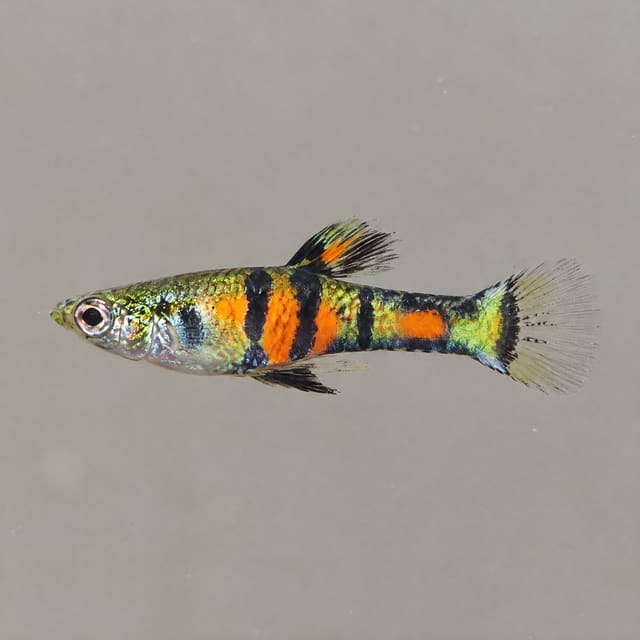
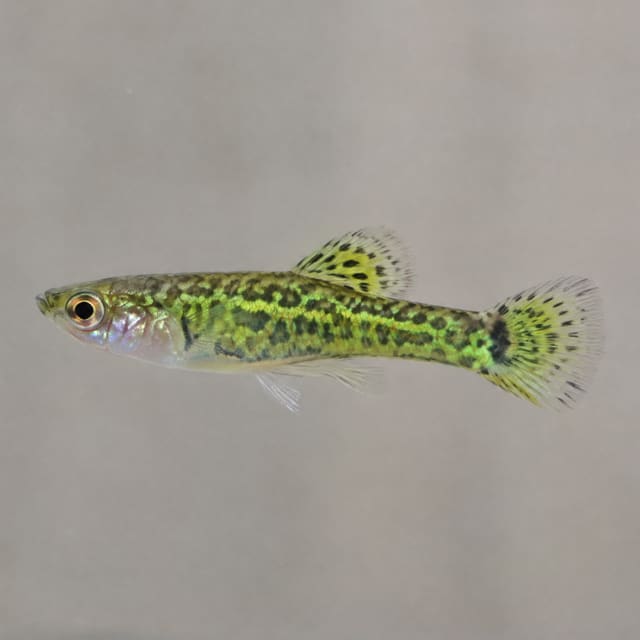
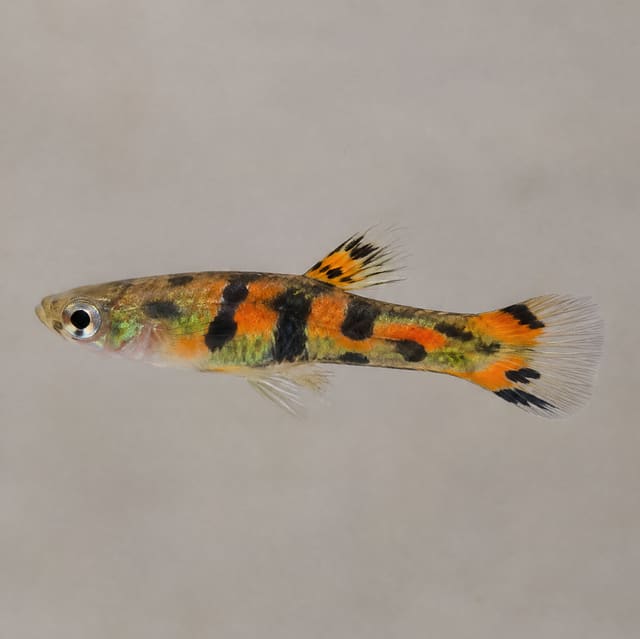
One El Tigre Endler male (Poecilia wingei), from a line named after the El Tigre stream in Venezuela's Campoma region. A tiny, boldly barred livebearer for a planted tank of 41 litres or more at 24 to 30 °C in hard, alkaline water. Keep away from guppies to avoid crossbreeding.
Adult size is the maximum length this species reaches at full maturity (scientific sources). The livestock you receive will be younger and smaller. Product-photo provenance and any image-specific limitations are stated on the listing.
Poecilia wingei
Quantity discounts are pricing offers, not a group-size recommendation. Check the full care guidance and your existing animals before choosing a quantity.
One El Tigre Endler male (Poecilia wingei), from a line named after the El Tigre stream in Venezuela's Campoma region. A tiny, boldly barred livebearer for a planted tank of 41 litres or more at 24 to 30 °C in hard, alkaline water. Keep away from guppies to avoid crossbreeding.
Adult size is the maximum length this species reaches at full maturity (scientific sources). The livestock you receive will be younger and smaller. Product-photo provenance and any image-specific limitations are stated on the listing.
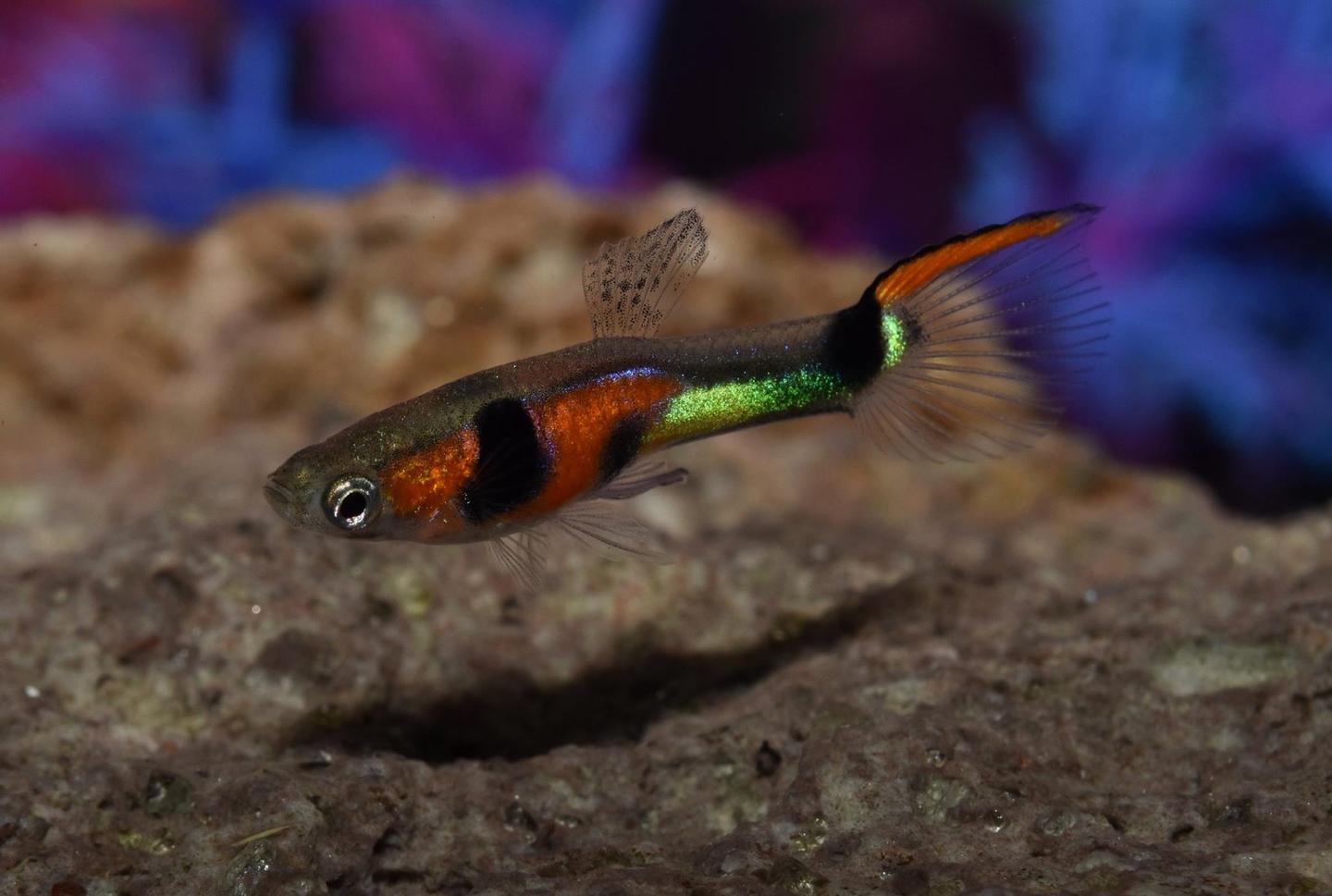
Endler's livebearer is a small, social, rapidly reproducing Venezuelan fish. Start with a mature filtered aquarium, a deliberate sex and population plan, stable tested medium-hard water, open swimming room and cover. Our conservative house screen is an aquarium at least 60 cm long and a group of five or more where capacity allows.
Read the full care guidance when planning conditions for your aquarium.
This listing is for one male Endler's livebearer, Poecilia wingei, sold under the El Tigre name. Each unit you order is a single male fish. If you would like a little display group of males, simply order the number you need; there is no female in this listing, so on its own he will not give you fry.
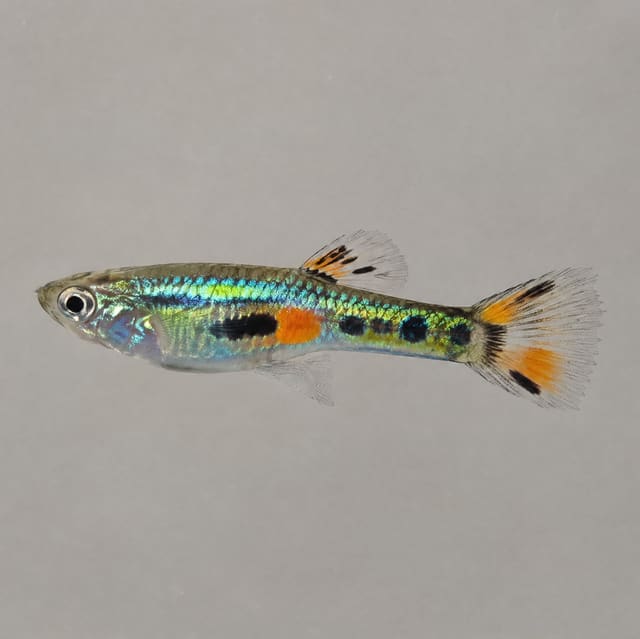
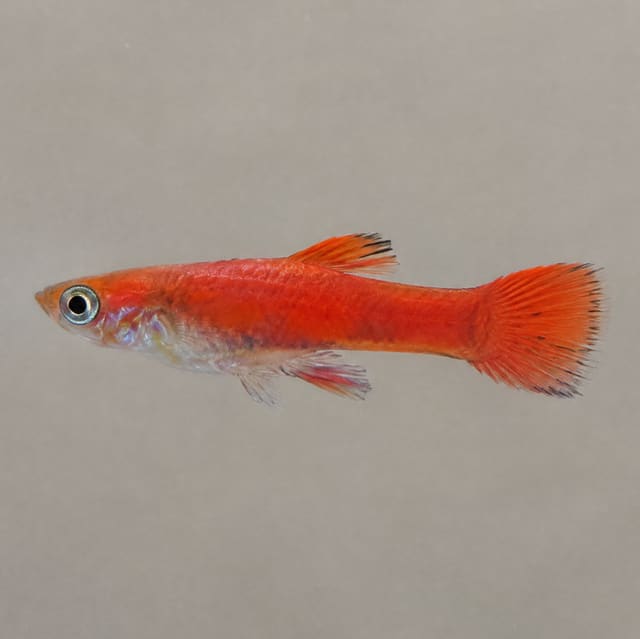
With Endlers, the males are where the colour is. FishBase describes the species as showing distinct sexual dimorphism, with polychromatic males and uniform females, and Seriously Fish says the males are smaller and far more colourful than the females. Buying a male means buying the colour.
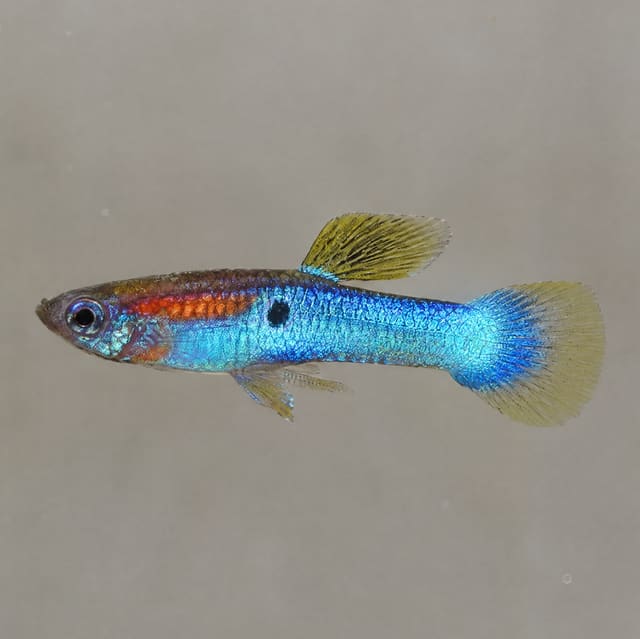
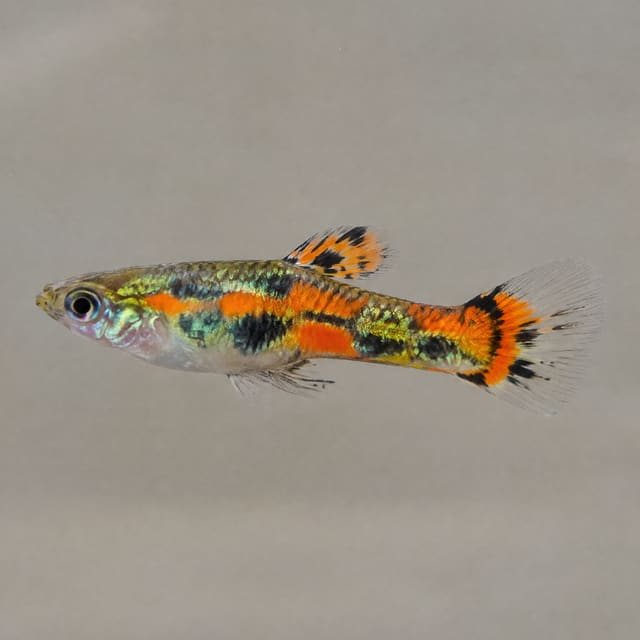
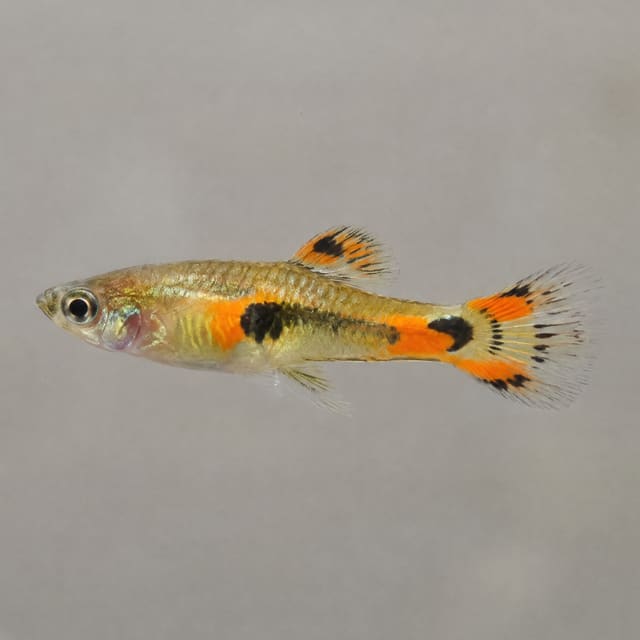
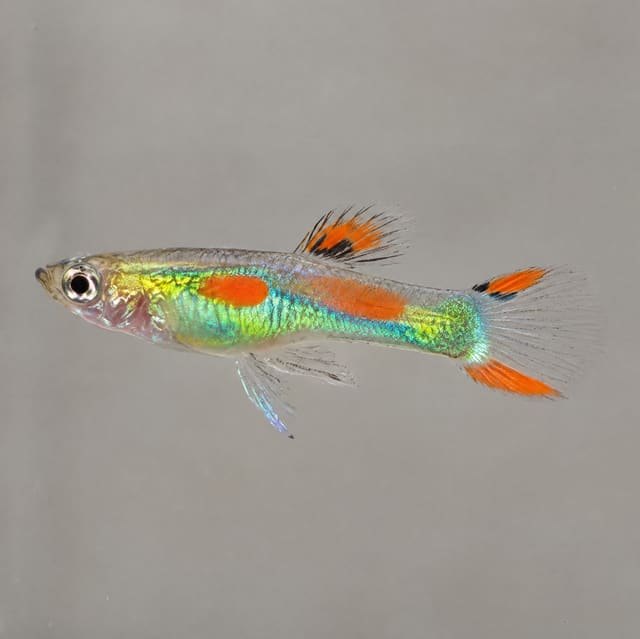
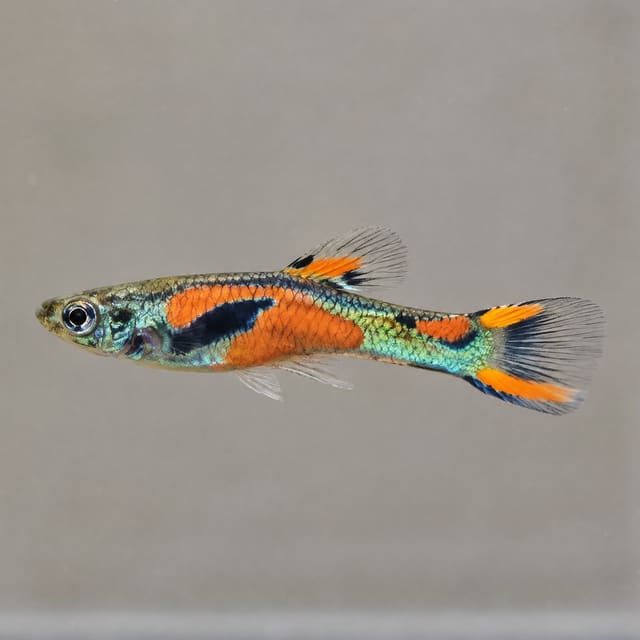
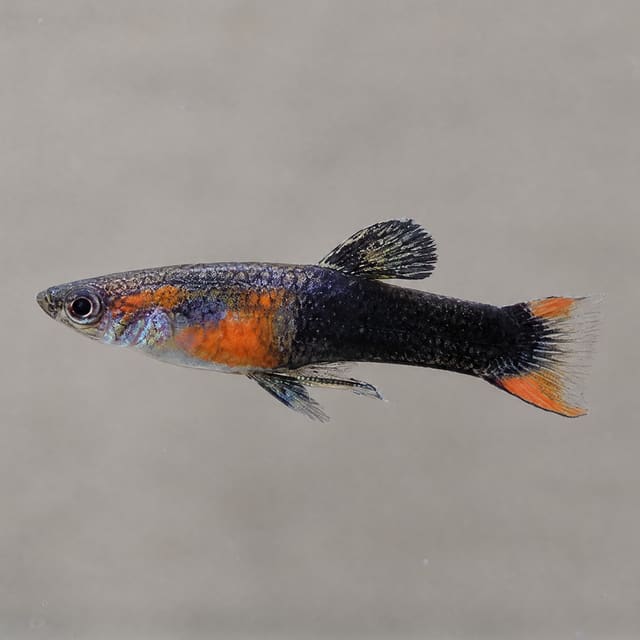
The photo on this page shows a male side-on against a plain blue background. His body is olive-gold, crossed by dark vertical bars through the middle and broken into a dark, marbled pattern towards the tail. The tail is yellow-green with a dark net of markings, edged black above and below, and those black edges run out into short points. The small dorsal fin is edged in pale blue and black. Your fish will be a different individual, and the details of the pattern vary from male to male, but that is the look the El Tigre name is sold on.
Endlers are tiny, and the males are the smaller sex. FishBase gives a maximum of 2.0 cm standard length for a female, measured from the snout to the base of the tail fin. Seriously Fish gives 25 mm standard length and adds that males are notably smaller. Wikipedia notes that full-grown females can be as much as twice the size of males. Plan for a slim little fish of around those dimensions: perfect for a small planted tank, and easy to lose among large or boisterous companions.
| Fact | Detail | Source |
|---|---|---|
| Accepted name | Poecilia wingei Poeser, Kempkes and Isbrücker, 2005 | FishBase |
| Family | Poeciliidae (livebearers) | FishBase |
| Wild range | Campoma and Buena Vista lagoons, north-eastern Venezuela | FishBase |
| El Tigre population | El Tigre stream, Campoma region | Wikipedia |
| Maximum size | 2.0 cm SL (female); 25 mm SL, males smaller | FishBase; Seriously Fish |
| Temperature | 24 to 30 °C | Seriously Fish |
| pH and hardness | pH 7.0 to 8.5; 15 to 35 dGH | Seriously Fish |
| Smallest tank | 45 by 30 by 30 cm, about 41 litres | Seriously Fish |
| What you get | One male | This listing |
Wikipedia describes Endlers as hardy and undemanding as far as survival goes. Survival is not the same as suitability, though, and three questions decide whether this male will do well with you.
If the answers suit, an El Tigre male is a lovely fish for a small planted aquarium, and a group of males makes a busy, colourful display without the fry that come with mixed sexes.
Plenty of the Endlers we list carry colour names, such as red, golden or Japan blue. El Tigre is different. It is the name of a wild population. According to Wikipedia, El Tigre are Poecilia wingei collected from the El Tigre stream in the Campoma region of Venezuela. That stream is not connected to Laguna Campoma, so the El Tigre fish belong to their own distinct population.
Wikipedia describes three regional populations that hobbyists keep apart by name:
Wikipedia adds that all El Tigre found in the hobby today are descended from fish collected by Phil Voisin. In other words, every El Tigre in an aquarium, including this one, comes from captive breeding of that collected stock rather than from the stream itself.
A population name tells you where a line started. It cannot, on its own, tell you what has happened in the aquarium generations since. Seriously Fish warns that much of the species' natural variability has been lost through inbreeding in the hobby, although several forms are still available. Wikipedia makes a related point: the strength and look of a line depend on how it is kept, including the aquascape, diet, water, tank mates and the ratio of males to females. So we sell this male under the El Tigre name it carries in the trade and describe him by what you can see: the gold body, the dark bars and the black-edged tail. We don't make claims about his pedigree beyond that.
We also list the Campoma El Tigre Endler (Poecilia wingei) and the El Tigre Endler Guppy (Poecilia endler). Each listing sets out its own offer, so read the one you are ordering from.
Endlers are slim, torpedo-shaped little fish. FishBase describes the body as fusiform, with six or seven soft rays in the dorsal fin and nine in the anal fin. What sets a male apart is colour, and on an El Tigre male the colour is all about contrast.
Male Endlers colour up early and keep improving. Wikipedia says males start to show colour at about three to four weeks old, and that their colours gradually intensify over the first six months of life. Seriously Fish puts adult male colouration at three to five weeks in well-fed fry. So a young male may look a little less bold than he will in a few months, and good food and settled conditions give him the best chance to show what he has.
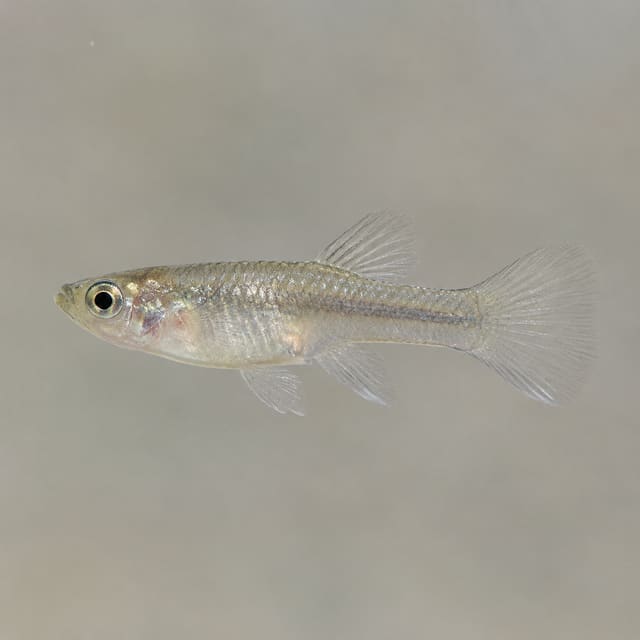
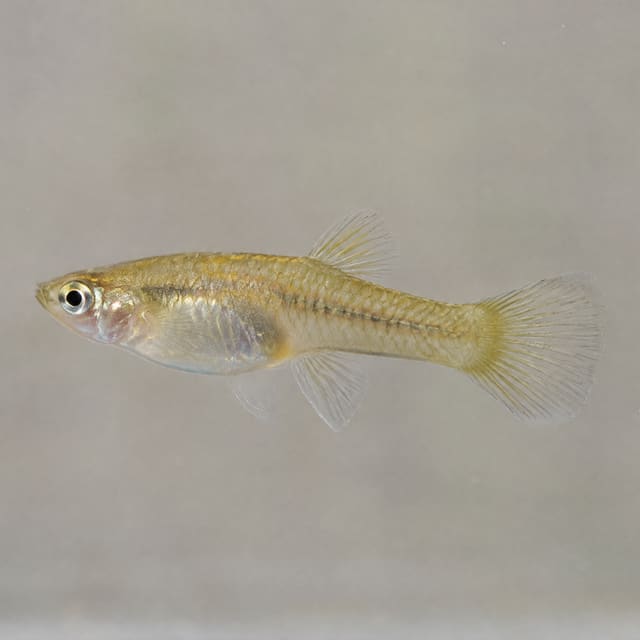
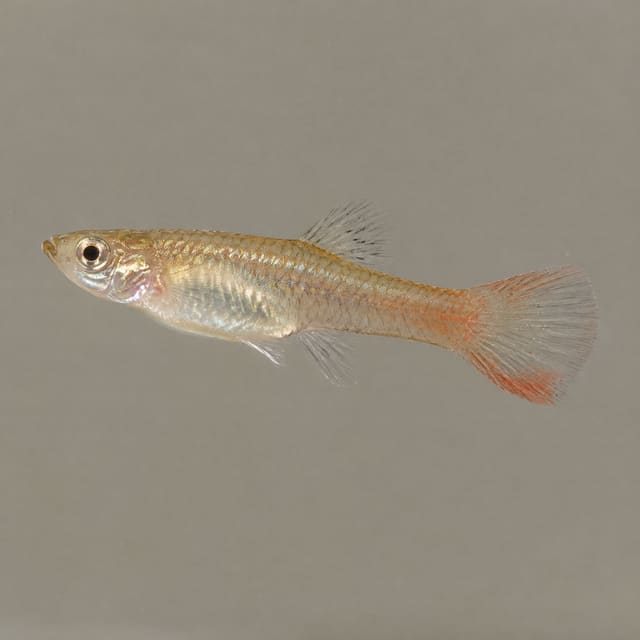
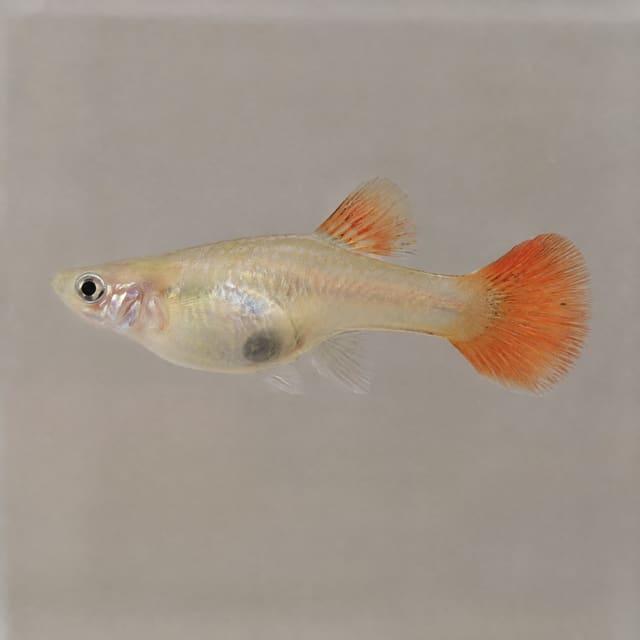
If you ever add females, you will see why the males get the attention. Wikipedia says females spend their whole lives with rather unexciting colouring, and that full-grown females can be up to twice the size of males. Seriously Fish describes them as much plumper, being almost perpetually gravid. A female Endler is a plain, uniformly coloured fish with a fuller belly; a male is far slimmer and covered in pattern.
The pattern on any one male is his own. FishBase's word for the males, polychromatic, means they come in many colours, and even within a named population you should expect variation in the exact shape of the bars and the markings on the tail.
It is a fair question, and it has a longer answer than you might expect. The short version is that the Endler's livebearer is now treated as its own species, Poecilia wingei, closely related to the common guppy, Poecilia reticulata, and able to interbreed with it.
FishBase gives the accepted name as Poecilia wingei Poeser, Kempkes and Isbrücker, 2005, and its main reference is the paper in which the three authors described the species as new, from the Paría Peninsula in Venezuela. Seriously Fish places it in the subgenus Acanthophacelus, alongside the guppy. Before 2005 the fish was known in the hobby simply as Endler's guppy or Endler's livebearer, after John Endler, who rediscovered it in 1975. Seriously Fish records that it was in fact first found in 1937 by Franklyn F. Bond.
The strongest evidence came from DNA rather than from looks. In 2009 Susanne Schories, Manfred Meyer and Manfred Schartl published a study in the journal Zootaxa whose abstract states that P. wingei is unequivocally defined by the molecular phylogeny as a valid species. The same paper describes a third close relative, Poecilia obscura from Trinidad, and treats the three as a cryptic species complex, meaning they are hard to tell apart on appearance alone. Seriously Fish adds a telling detail from the wild: Endler's fish were found living alongside a wild form of P. reticulata without interbreeding with it.
Not everyone agrees. Wikipedia quotes Stan Shubel, author of Aquarium Care for Fancy Guppies, as saying that the Endler guppy is not a separate species. FishBase, Seriously Fish and the 2009 molecular study all treat it as distinct, and that is the position this page follows.
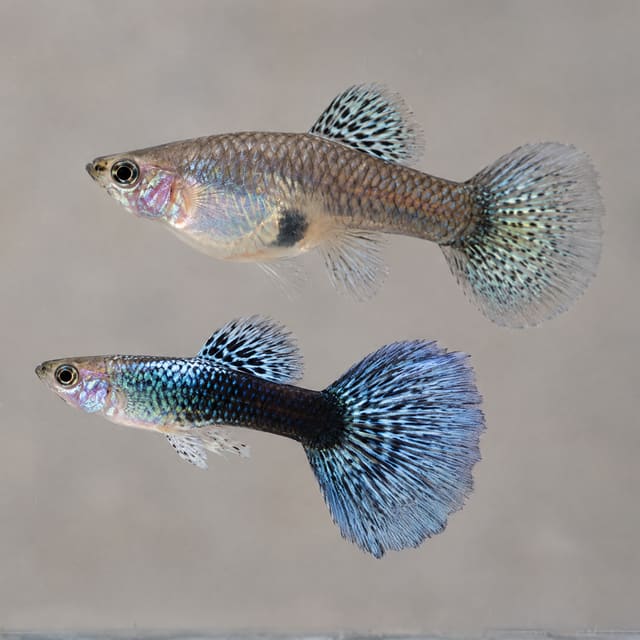
In an aquarium the two species cross readily. Seriously Fish says Endlers hybridise with the guppy to produce fertile offspring, and Wikipedia says the hybrid young are fertile too. That has two practical results. First, crosses turn up in the trade, and some are sold openly as such, like our Santa Maria Endler Guppy Males (Poecilia reticulata × wingei Hybrid). Second, if you want to keep an El Tigre male's look in any young he sires, keep him away from guppies.
Size is the easy clue. FishBase gives a maximum of 2.0 cm standard length for a female Endler. Wikipedia gives guppy females as 3 to 7 cm and males as 1.5 to 4 cm, and notes that many domestic guppy strains are larger and much more lavishly ornamented than their wild ancestors. Even allowing for standard length leaving out the tail, an Endler is the smaller fish, and an El Tigre male carries his pattern on a compact body and short tail rather than on big, trailing fins. Beyond that, the species form a cryptic complex, so appearance alone is not a reliable test, which is why the population and line names keepers use matter so much.
FishBase gives the distribution of Poecilia wingei as the Campoma and Buena Vista lagoons in Venezuela. Seriously Fish describes it as occurring in fresh waters in those lagoons unto Carúpano, in the north-east of the country. The El Tigre stream, the source of this male's population name, lies in the Campoma region, according to Wikipedia.
The story of the species centres on Laguna de Patos near Cumaná, the type locality. Seriously Fish explains that it was originally a brackish lake, formed when a sandbar cut it off from the sea, and that it later became fresh through runoff. The water there was very warm and hard, and very green from high concentrations of algae. That description is the best clue we have to the conditions Endlers are adapted to, and it is the reason the water advice further down asks for warm, hard, alkaline water.
Endlers are widely kept in aquariums and scarce in nature. Seriously Fish says the species is now thought to be extinct at Laguna de Patos, after a garbage dump was built beside the lake and the water became polluted. Wikipedia says the original Laguna de Patos population is threatened by runoff from a municipal dump. FishBase shows the species as Endangered on the IUCN Red List, and Wikipedia says it has been listed as in danger of extinction in the wild.
That has two consequences for keepers. The fish in shops are captive-bred, as the El Tigre history above shows, so buying one takes nothing from the wild. And since Seriously Fish says much of the species' natural variety has already been lost through inbreeding, keeping named populations such as El Tigre separate is one way keepers hold on to what is left.
Never release an Endler, or any of its young, into a pond, stream or lake. Aquarium fish belong in aquariums.
Seriously Fish says a tank measuring 45 by 30 by 30 cm, about 41 litres, is big enough to house quite a substantial colony of Endlers, and that they should not be kept in anything smaller. For one male or a small group of males, that is the size to aim for as a minimum. A larger tank is easier to keep stable, and stable water matters more than anything else with a fish this small.
Seriously Fish strongly recommends a planted set-up, and floating plants too. Fine-leaved stem plants, mosses and a layer of floating cover suit an Endler tank well, with some open water left at the front for swimming. Keep the filter flow gentle, since a fish this small is better served by calm water than a strong current, and cover the intake with a sponge if there is any chance of small fish or fry being drawn in.
FishBase records the species as a tropical freshwater fish but gives no figures for temperature or water chemistry. Seriously Fish does, and its numbers fit the warm, hard lagoon water described above:
| Parameter | Range | Source |
|---|---|---|
| Temperature | 24 to 30 °C | Seriously Fish |
| pH | 7.0 to 8.5 | Seriously Fish |
| General hardness | 15 to 35 dGH | Seriously Fish |
Seriously Fish adds that moderately hard or harder water is needed for long-term success. A heater set somewhere around 25 to 27 °C sits comfortably inside the Seriously Fish range with room on either side.
Hardness is quoted in several units, which can make the Seriously Fish figure hard to compare with your test kit or your water company's report. One degree of general hardness (dGH) is equal to about 17.8 milligrams per litre, or parts per million, expressed as calcium carbonate. So 15 to 35 dGH works out at roughly 270 to 620 ppm. Many water reports give hardness in mg/l or ppm, and many strip tests give dGH, so it is worth converting before you decide whether your tap water suits.
If your water comes out soft, you have two honest choices. One is to raise the hardness with a mineral product made for hard-water aquarium fish, mixed into every water change so the level stays steady. The other is to choose a fish that suits soft water. What you should not do is put an Endler into soft, acidic water and hope.
Test your tap water before ordering. If it is soft or acidic, an Endler is not the right fish without changing your water, and it is better to know that in advance. In a matured tank, ammonia and nitrite should read zero. Regular small partial water changes, with dechlorinated water close to tank temperature, keep everything steady without sudden swings.
Seriously Fish describes Poecilia wingei as an omnivore that feeds on a variety of zoobenthos (small bottom-living animals) and detritus in the wild, adding that it will eat most foods offered but should have some vegetation in the diet. That gives a simple plan for a male in your tank.
Feed little and often, giving only what is eaten in a minute or two. A fish this small has a tiny stomach, and leftover food spoils water quickly in a small tank.
A healthy El Tigre male is busy. He swims in the open water, holds his fins spread and comes up readily for food. Watch for the opposite: clamped fins held tight to the body, hanging near the surface or in a corner, rapid breathing, refusing food, white spots or a frayed tail. Any of these is a reason to test the water first, since poor water is a common cause of trouble in a small tank.
Seriously Fish notes that much of the species' natural variability has been lost through inbreeding in the hobby. Wikipedia says Endlers are hardy and undemanding as far as survival goes, but that aquascaping, diet, water conditions, tank mates and the ratio of males to females all affect the strength and appearance of a line. For a single male that means good conditions show his colour at its best; for anyone breeding, it means thinking about where new blood will come from over the generations.
If you add more fish later, keeping them in a separate tank for a couple of weeks first is a sensible precaution before they join him. It protects the fish you already have from anything a newcomer brings with it.
Seriously Fish is blunt about Endlers in a general community: they are not suitable, because of their small size, and they should be kept alone if you want to breed them. A fish of around two centimetres is easily bullied or eaten by larger tank mates, and easily outcompeted at feeding time.
If you want colour without a steady stream of fry, a tank of males only is the simple answer. Without females there can be no young, and a group of patterned males in a planted tank makes a lively display. If you go this way, order the number of males you want and give them the tank space described above. If there are females in the tank, Seriously Fish's advice is to keep several females to every male.
This listing sells a single male, so breeding depends on what else is in your tank. If you do keep females, be ready: Seriously Fish rates breeding as very easy and says Endlers will breed in a community tank and are incredibly prolific.
Endlers are livebearers. The female carries the young and gives birth to free-swimming fry rather than laying eggs. Seriously Fish says broods can appear every 23 to 24 days, with anything from 5 to 25 young depending on the female's age and size. Wikipedia gives a birth roughly every 23 days and a range of one to 30 babies, possibly more depending on several variables.
Seriously Fish says the fry grow very quickly if fed two or three times a day, with males showing adult colour in only three to five weeks and females able to produce young at two months old. Dense fine-leaved plants and floating cover give newborn fry places to hide. Use foods fine enough for their tiny mouths, such as powdered fry food or newly hatched brine shrimp.
If you want young that look like El Tigre, the female matters as much as the male. Seriously Fish and Wikipedia both note that Endlers cross with guppies to give fertile young, and the different Endler populations are one species, so they interbreed freely with each other. So:
We list a Female Endler Guppy (Poecilia wingei). Its listing does not name a population, so offspring from her and this male would be a cross between lines rather than pure El Tigre. That is fine if you simply want healthy, colourful Endlers; it is worth knowing if you are trying to keep a named line going.
A few females produce a lot of fish quickly at a brood every three weeks or so. Have a plan for the young before you start: a second tank, a fellow keeper or a local club. Never release them.
Get the tank ready before you order. The filter should be running and matured, the water tested and the heater holding a steady temperature inside the 24 to 30 °C range. Someone must be at the delivery address to take the parcel in, as it contains live animals. Please read our delivery and live-arrival information before ordering.
Fish travel in oxygen-filled bags in insulated packaging, with heat packs when conditions call for them, via a tracked courier licensed to carry live animals. We send the confirmed delivery date and tracking by email.
The resolution is a replacement with your next order or a refund for the affected fish, subject to the guarantee terms.
Dim the lights. Float the sealed bag in the tank for 20 to 30 minutes so the water inside reaches tank temperature. Floating matches temperature only, not pH or hardness, so if your water is very different from the ranges above, ask us for advice before he goes in. Then net him gently across into the aquarium and throw the bag water away. Never pour it into your tank.
Keep the lights low for the rest of the first day and hold off feeding until the next day, then offer a tiny pinch of fine food. Over the first week, watch his breathing, appetite and behaviour. A small male in a new tank may hide among the plants at first, and the planting recommended above gives him somewhere to do that. Once he is swimming in the open and feeding, he has settled.
Wikipedia says the colours of a male Endler gradually intensify over the first six months of his life, so a young male may still be filling in. Keep to a routine for the first month: the same feeding times, small regular water changes and a weekly test for ammonia, nitrite and pH while the tank adjusts to its new resident. If you plan to add companions or more males, add them slowly so the filter keeps pace, and check that every newcomer fits the small, calm profile on this page.
The facts on this page come from these sources:
No reviews for this item yet. Bought one? Honest reviews only, good or bad.
What customers say about ordering from us
Easy website plenty of info on fish your buying great to pick a time slot
TRACEY DURRANT · 7 Oct 2026
Got some lovely fish thank you
Kevin Mackie · 7 Oct 2026
Reviews of our shop, collected by Judge.me, an independent third-party review collector. Newest first.
Moved by UK carriers licensed to handle live animals
Hand-packed with oxygen bags, poly box, heat pack
Email photos the same day; an optional unboxing video helps us review problems faster — claim terms apply
Klarna & PayPal Pay in 3 at checkout