Easy
Female Endler Guppy (Poecilia wingei)
20–28°C · pH 7–8
£5.99

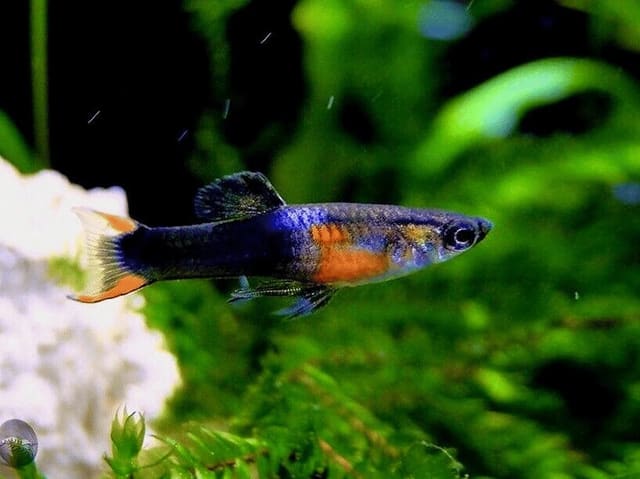
The Blue Male Endler Guppy (Poecilia wingei) is a small livebearer from Venezuela’s Campoma and Buena Vista lagoon systems, with males measured at 18.8–21.3 mm standard length. It suits prepared beginners who follow Tropical Fish Co’s house plan of five or more in a mature aquarium at least 60 cm long, using the Seriously Fish and OATA overlap of 24–28°C and pH 7.0–8.0. Sold individually at a dispatch grade of 1–2 cm.
Shoaling fish: kept in a group they feel safer, stay calmer and show their best colour.
The Blue Male Endler Guppy (Poecilia wingei) is a small livebearer from Venezuela’s Campoma and Buena Vista lagoon systems, with males measured at 18.8–21.3 mm standard length. It suits prepared beginners who follow Tropical Fish Co’s house plan of five or more in a mature aquarium at least 60 cm long, using the Seriously Fish and OATA overlap of 24–28°C and pH 7.0–8.0. Sold individually at a dispatch grade of 1–2 cm.
Endler's livebearer is a small, social, rapidly reproducing Venezuelan fish. Start with a mature filtered aquarium, a deliberate sex and population plan, stable tested medium-hard water, open swimming room and cover. Our conservative house screen is an aquarium at least 60 cm long and a group of five or more where capacity allows.
Maintain these water conditions for optimal health and vibrant colors
The Blue Male Endler Guppy (Poecilia wingei) is a small freshwater livebearer in the family Poeciliidae. It comes from the Campoma and Buena Vista lagoon systems in Venezuela, with males measured at 18.8–21.3 mm standard length. This active social fish can suit a prepared beginner who will provide mature filtration, stable medium-hard water, swimming space and a deliberate group plan.
FishBase places Poecilia wingei in Poeciliidae and records the narrow Venezuelan distribution. Eschmeyer’s Catalog of Fishes recognises the current valid name. The familiar Endler or Endler’s livebearer name refers to this species; “blue” describes the appearance selected for this offer rather than a documented wild locality.
| Suits | Not suited to |
|---|---|
| A mature, filtered aquarium at least 60 cm long | An uncycled bowl, vase or very small aquarium |
| A planned social group of five or more where capacity allows | Being kept alone without a social plan |
| Stable water at 24–28°C, pH 7.0–8.0 and 15–18 dGH | Soft, acidic conditions as the long-term plan |
| Small peaceful companions that pass every compatibility check | Predators, fin-nippers or common guppies |
Our retailer assessment is easy, but that means suitable for a prepared keeper rather than maintenance-free. Read the complete Endler Guppy care guide when planning the wider group, sex balance and long-term population.
Plan around the recorded male measurements of 18.8–21.3 mm standard length. Standard length ends at the base of the tail, so the full fish can look longer when its tail is included. The original species description recorded those male measurements in a separate stream sample.
Other references report different measurements: FishBase lists a 2 cm female maximum, Seriously Fish gives 25 mm standard length without limiting that figure to the sold sex, and the Tropical Fish Co guide uses 3 cm from the largest female measurement in the original description. Use the recorded 18.8–21.3 mm male standard-length range throughout the plan for this fish.
For the adult group, use a mature aquarium of at least 45 litres and at least 60 cm long. Seriously Fish gives a 45 × 30 cm base and about 41 litres for the species. OATA recommends at least 45 litres for a small group of the smaller guppies, while Tropical Fish Co applies the more conservative 60 cm minimum-length screen. These figures are starting filters, not a litres-per-fish formula.
Keep five or more under our house plan where filtration, swimming room, other occupants and the sex plan allow. OATA’s social floor is at least three guppies; five or more is Tropical Fish Co’s more conservative house recommendation, not a research-derived minimum. A five-fish plan still needs adjustment if one fish hides persistently, misses food or cannot move out of another fish’s path.
Keep the water at 24–28°C, pH 7.0–8.0 and 15–18 dGH. These figures are the overlap between the Seriously Fish species aquarium ranges and OATA’s guppy-and-molly guidance. Begin with a mature biological filter and zero detectable ammonia and nitrite.
One purchase supplies one Blue Male Endler Guppy. The dispatch grade is 1–2 cm, which describes the fish’s supplied size rather than its life stage or final adult length. Plan its permanent aquarium around the recorded male measurements of 18.8–21.3 mm standard length and the needs of the whole social group.
Sex is guaranteed only when the exact product or selected option explicitly states male or female. This Blue Male Endler Guppy listing is sold as male.
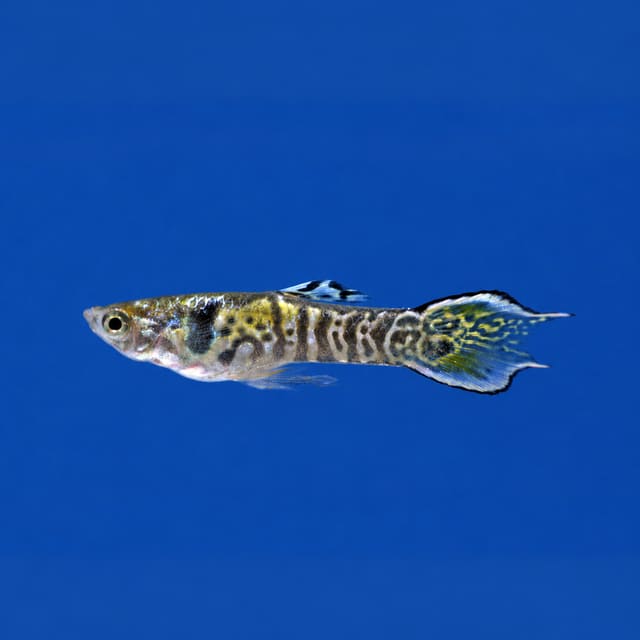
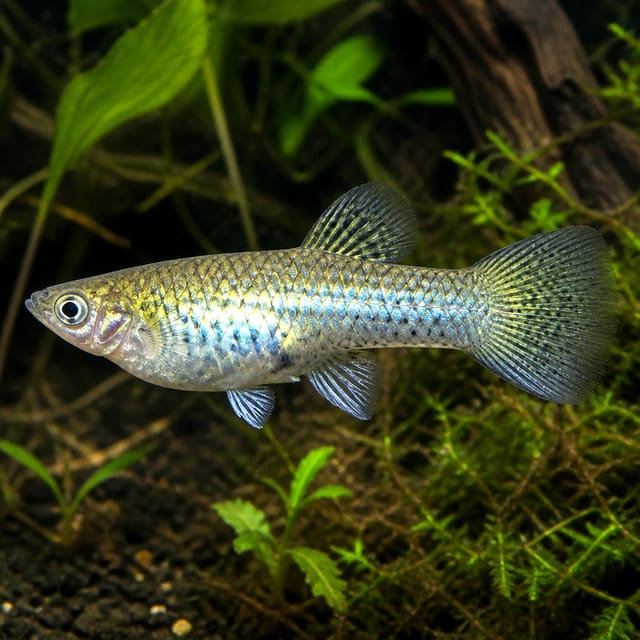
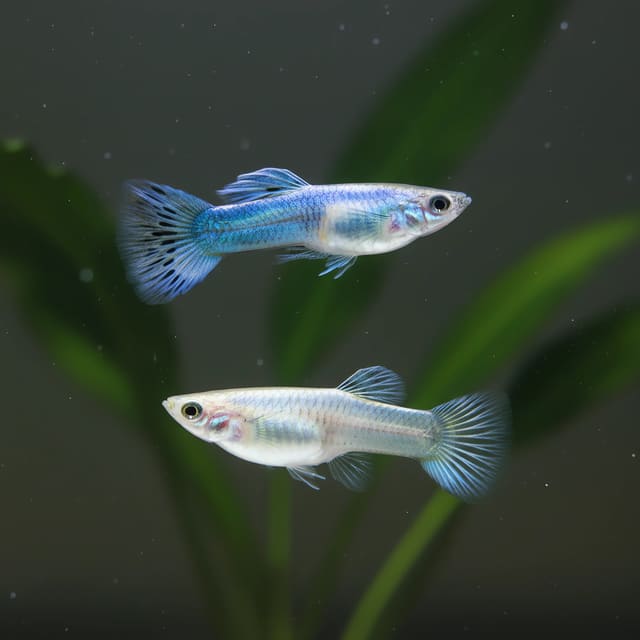
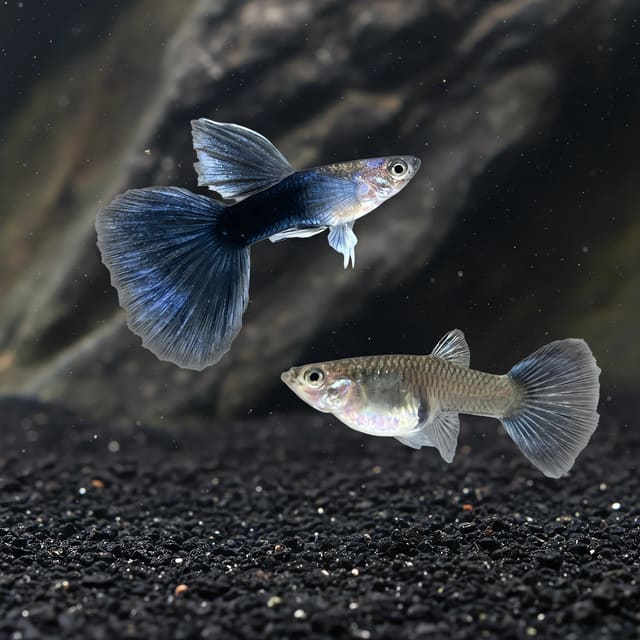
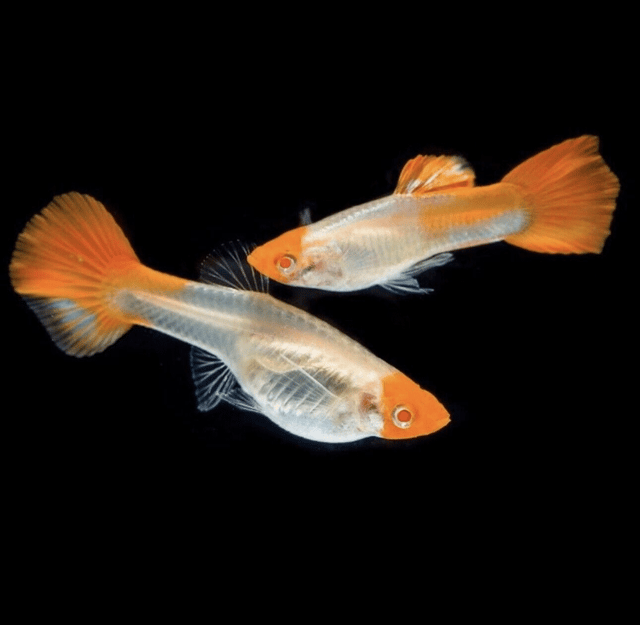
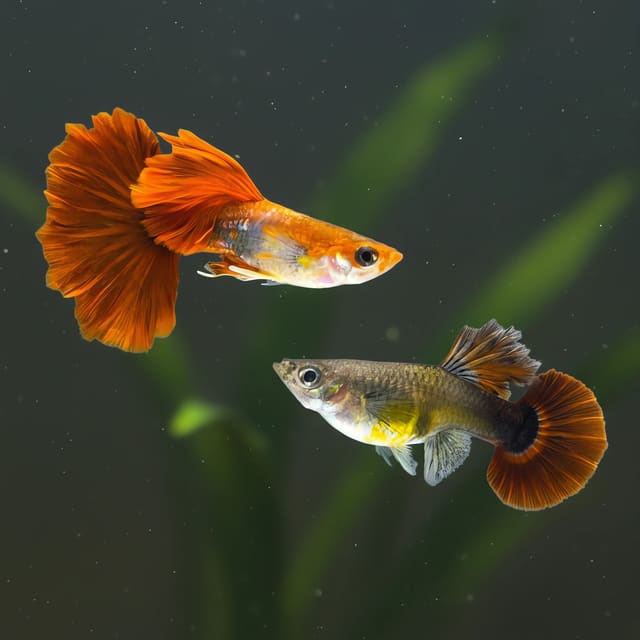
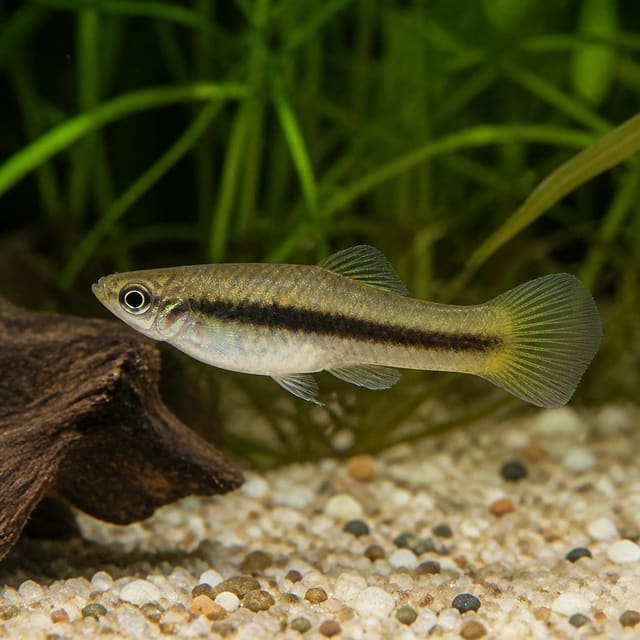
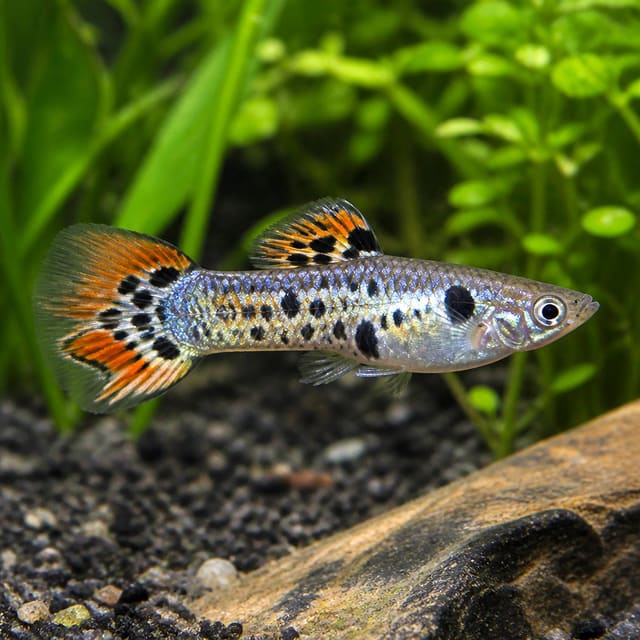
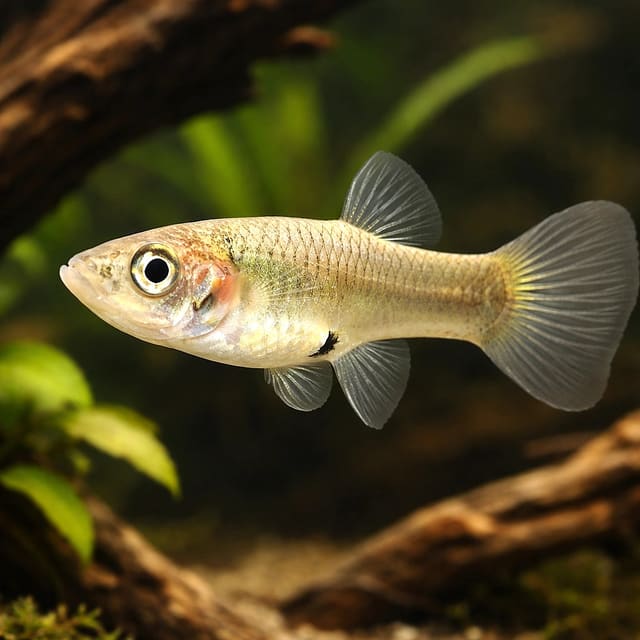
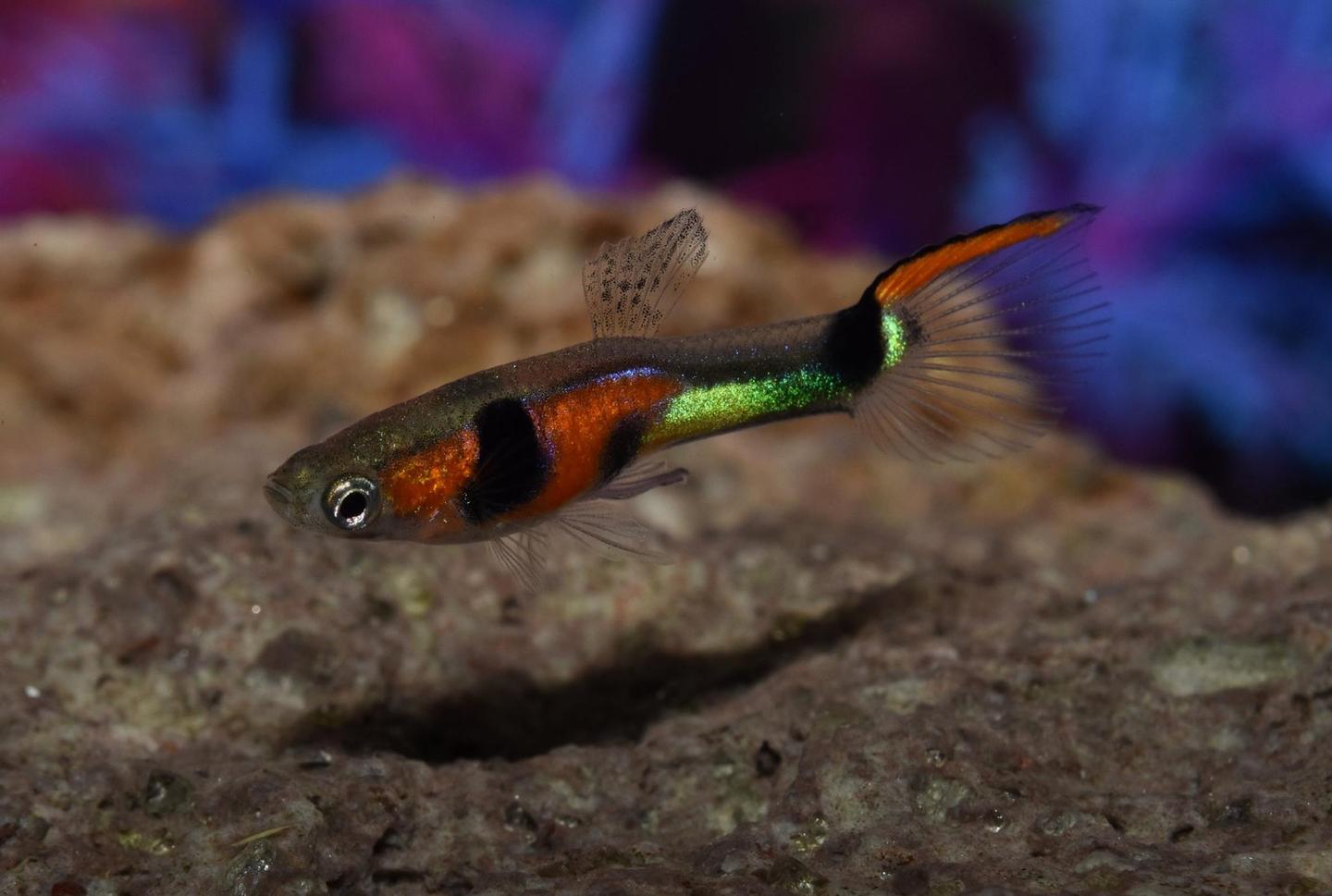
The gallery images are representative of this type of animal rather than photographs of the exact animal supplied, so colours can look slightly different from the live animal. The visible blue and black pattern is therefore a guide to the named appearance, not a promise that every marking will occupy the same position.
If you are comparing other named appearances or sex-labelled offers, browse the Endler guppy collection. Keep the scientific identity, sex plan and future fry capacity central to that comparison rather than choosing solely by colour.
Start with a fully mature biological filter, open horizontal swimming room and structured cover. Plants are strongly recommended, including floating plants where they leave enough open water for continuous movement. Rounded stones, wood and suitable ornaments can create sight breaks, but arrange them so you can still observe every fish at feeding time.
The RSPCA explains why biological filtration is essential: fish release toxic ammonia, and established bacteria convert it first to nitrite and then to safer nitrate. A planted aquarium can still be immature or overloaded, so confirm the filter’s performance with water tests rather than using plant growth as a substitute for cycling.
Watch the aquarium from the front and both ends before judging the arrangement complete. Each fish should have a clear swimming route, access to the feeding area and more than one way around major pieces of wood or stone. If one narrow passage becomes the only route between cover and open water, move the obstruction before fish are added.
Use the first feeding sessions as a practical layout test. Food should reach more than one part of the swimming area, and every fish should be visible long enough for you to assess its appetite and fin condition. If one animal remains hidden whenever another approaches, add or reposition a sight break while preserving open water. If a fish becomes cornered behind decor, simplify the arrangement rather than adding more cover.
Water movement is acceptable when each fish can hold position and feed without continuous effort. Size the filter for the aquarium and its total livestock rather than choosing it only for this species’ low adult length. Maintain useful surface movement and inspect the filter for reduced flow or blockages.
Use the first tropical aquarium guide to prepare and mature a new setup before livestock arrives. Add fish gradually after cycling because every increase in animals and feeding asks the biological filter to process more waste.
Keep this fish at 24–28°C, pH 7.0–8.0 and 15–18 dGH. Seriously Fish gives the species-level aquarium ranges of 24–30°C, pH 7.0–8.5 and 15–35 dGH. OATA’s guppy-and-molly guidance gives 20–28°C, pH 7.0–8.0 and 8–18 dGH for the wider group. The recommended figures are the overlap between them.
Maintain zero detectable ammonia and zero detectable nitrite. OATA also recommends keeping nitrate no more than 20 mg/l above the normal level in the tap water. Test the aquarium at least weekly and after any unexplained change in breathing, swimming, appetite or behaviour.
If temperature is within 24–28°C but changes sharply between checks, investigate heater operation and room influences before adjusting the set point. If pH remains within 7.0–8.0 and the fish behave normally, keep the routine steady instead of making unnecessary chemical corrections. A hardness result below 15 dGH or above 18 dGH calls for a measured water plan rather than an abrupt alteration.
Any detectable ammonia or nitrite takes priority over fine adjustment within the other ranges. Check flow, recent filter work, uneaten food, dead organic matter and additions to the livestock. Reduce further waste entering the system while protecting the mature filter community, then repeat the tests to confirm the reading is moving back towards zero. When nitrate rises faster than usual, reassess feeding, stocking and the effectiveness of the weekly partial water change.
Our water chemistry guide explains what the principal readings mean. Enter measured values in the water matcher to compare the aquarium with the target range; use an actual test result rather than a postcode assumption.
A value inside the range is only one part of good care. Filtration, oxygen exchange, total stocking, organic waste and the speed of any change all affect how well the fish cope. Correct an ammonia or nitrite reading promptly by protecting the fish, restoring filter function and reducing the waste load.
Use an appropriately small, complete flake or granule as the staple food, with some vegetation included in the diet. Seriously Fish describes Poecilia wingei as omnivorous and records zoobenthos and detritus in its wild diet. OATA recommends a good-quality flake or granule with a high algae content for guppies and mollies, supported by suitably small live or frozen variety.
Offer one daily portion that the group finishes within a few minutes. Start modestly, watch every fish eat and reduce the next portion when food repeatedly reaches the substrate uneaten. Extra food does not compensate for competition; spread a small portion across the swimming area so less assertive fish have a chance to feed.
| Use | Decision check |
|---|---|
| Small complete flake or granule | Particles are swallowed without repeated spitting |
| Daphnia, small bloodworm or tubifex | Offer as compatible variety, not the sole diet |
| Small frozen cyclops | Useful where larger frozen items are difficult to take |
| Food containing vegetation | Supports the recorded omnivorous diet |
Begin with a small daily amount and observe from the moment it touches the water. Suitable particles should be taken promptly without repeated attempts to swallow them. If several pieces remain after the fish stop feeding, remove the leftovers and reduce the following day’s portion. If the food disappears immediately, first check that every fish ate before considering a modest increase.
Compare individuals rather than watching only the quickest fish. A fish that approaches food but repeatedly loses it to companions may need wider food distribution, a smaller particle or intervention for social exclusion. A fish that ignores a familiar food while the rest feed normally needs observation for breathing, swimming and other health changes. Test the water when appetite changes across the whole group.
Check body condition and feeding response across the whole group. A fish that repeatedly hangs back, spits every particle or loses condition needs closer observation of particle size, competition, water quality and health. Remove decaying leftovers before they add to the waste processed by the filter.
Store dry food in a cool, dry place and handle frozen food safely. Do not repeatedly thaw and refreeze frozen portions. Do not collect live food from an unknown pond or other outdoor water. Visible aquarium algae is not a complete feeding plan, even when the fish graze surfaces.
Change about 25% of the water at least once each week, using a siphon to remove solid waste where needed. Condition replacement tap water before adding it and keep its temperature close enough to avoid an abrupt swing. Test ammonia and nitrite at least weekly, then record nitrate, pH and temperature so gradual changes are easier to recognise.
Check the filter for reduced flow and blockages. When established media needs cleaning, rinse it lightly in aquarium water removed during the water change, never under the tap. Avoid replacing all mature media together, because preserving its bacterial community protects the biological cycle.
A settled Endler should swim steadily, breathe regularly, hold its fins normally and feed consistently. Warning signs include hanging at the surface, sitting on the bottom, erratic swimming, unusually fast or slow gill movement, persistent hiding, colour becoming markedly paler or darker, damaged fins, spots, fluffy growths, wounds, swelling or loss of appetite.
RSPCA fish-health guidance supports a water-quality-first check and veterinary escalation. Do not select salt, heat or medication from one symptom alone.
A published study of spinal deformities in one captive Poecilia wingei line considered genetic, nutritional, environmental and traumatic factors. Treat an unusual body curve as a reason for assessment rather than diagnosing its cause from appearance or assuming it represents the species as a whole.
Prepare and test the aquarium before the fish travels. OATA advises confirming zero detectable ammonia and nitrite before fish are introduced. Tropical Fish Co hand-bags fish in pure oxygen, uses an insulated poly box and adds a heat pack when the weather calls for it.
These steps come from the current delivery and Live Arrival Guarantee policy, which also explains the reporting route and conditions.
Observe swimming, breathing, balance, fin position and whether the fish can move away from the other occupants. Pale colour can have several causes, so use behaviour and water tests together instead of dismissing a change automatically. Test promptly if the fish gasps, loses balance, sits continuously on the bottom or cannot swim normally.
During the first week, keep the routine stable, continue the weekly testing schedule and check feeding access across the group. Do not respond to one missed feeding by adding a large amount of food. Remove persistent leftovers and reassess water quality, particle size and social pressure.
Across the first month, add further livestock only gradually. OATA warns that stocking too quickly can create new tank syndrome when the bacterial population cannot process the increased waste. Recheck the combined adult space, filtration and compatibility plan before every addition rather than treating unused litres as automatic capacity.
This male offer can form part of an all-male display, which avoids new mixed-sex mating inside a correctly sexed group. It does not remove social display, pursuit or competition, so continue to monitor feeding access, hiding and fin condition. Keep a mature separation option ready if one fish is persistently excluded or injured.
Poecilia wingei is a livebearer, and adding females creates a realistic prospect of fry. Decide before forming a mixed-sex group whether the aquarium and filter have spare capacity, whether appropriately small complete food can be supplied, and how surplus young will receive permanent suitable care.
A laboratory study of Endler life-history traits followed ten litters and 122 fry under one breeding regime. Seriously Fish describes the species as prolific; that study covers only one laboratory regime, so plan capacity without promising a fixed interval or brood number for every female.
If fry appear unexpectedly, test the water and reassess biological filter capacity immediately. Do not move fish into an uncycled container. Use safe food sized for the young fish, separate sexes only when identification is confident, and arrange responsible long-term housing or rehoming before crowding develops.
Dense planting can increase the cover accessible to fry. That can be helpful in a deliberate breeding plan but may accelerate population growth in a mixed aquarium. Choose the layout and sex plan together rather than adding extensive fry cover without capacity for the young fish that survive.
Never release adults, fry, hybrids, plants, snails or aquarium water outdoors, into a drain, pond or natural waterway. Prevention, permanent suitable care and planned responsible rehoming are the appropriate outcomes for aquarium livestock.
Choose only small peaceful companions with overlapping temperature, pH and hardness needs, enough room for every social group and no realistic predation or fin-nipping risk. Compatibility remains conditional on the exact aquarium, individual behaviour, feeding access and total adult stocking.
Seriously Fish names dwarf corydoras, peaceful tetras and small peaceful rainbowfish such as Iratherina werneri or Pseudomugil species as possible companions. Each still needs its own footprint, group size and water requirements checked before it is combined with Endlers.
| Screening result | Action |
|---|---|
| Small, peaceful fish with matching water needs | Assess adult size, group space and feeding access |
| A species large enough to eat an Endler | Avoid the combination |
| A known fin-nipper such as a barb | Avoid exposing the Endler’s fins to that risk |
| Common guppy | Avoid mixing because the two species can hybridise |
| Adult shrimp in matching water | Treat coexistence as conditional, especially around young |
For example, a peaceful tetra does not pass the screen merely because aggression is unlikely. Its required temperature, pH, hardness, adult group size and swimming space must all fit alongside the Endler group. The aquarium must also let both groups reach food without one consistently displacing the other. If meeting the tetra’s social needs would crowd the 60 cm plan, keep the Endler group without that addition.
Apply the same method to bottom-dwelling companions. Dwarf corydoras may use a different part of the aquarium, but their footprint, group and water needs still count towards the complete plan. Check that decor leaves suitable movement space and that food reaches the lower area without encouraging excess waste. Different swimming zones do not create extra filtration capacity.
No fish can be promised as shrimp-safe. Adult Neocaridina or Amano shrimp may coexist in a suitably planned aquarium, but small shrimp and young may be eaten and feeding competition can occur. Cover can reduce exposure without guaranteeing survival. Check the shrimp’s own mineral, temperature and social requirements rather than adding it as a maintenance tool.
Do not use the Endler’s small adult length as the only compatibility test. A peaceful fish can still be unsuitable if it needs softer water, occupies the same limited swimming space, outcompetes the group at meals or requires a social group the aquarium cannot hold. Keep a mature separation plan ready whenever species are combined.
Males are generally peaceful towards one another, but an all-male group is not guaranteed to be free from pursuit or display competition. Use the 60 cm minimum-length screen, sight breaks and a group of five or more where capacity allows, then judge the result from the behaviour of every fish rather than from the group label.
Avoid keeping Poecilia wingei with the common guppy, Poecilia reticulata, because the two can produce fertile hybrids. Morphological and molecular comparison supports P. wingei as a distinct species while also showing why appearance alone is not a dependable pedigree test.
A colour name, tail shape or representative photograph cannot establish a documented locality line. Keep records when ancestry matters, house documented lines separately and label any future offspring honestly. Choose this blue offer for its named appearance without turning colour into a claim about wild locality or pedigree.
Before adding another social species, count the space needed by both complete groups and consider where each will feed and swim. If the combined plan is close to the aquarium’s limit, choose fewer species rather than compressing their group needs.
The original species description measured males at 18.8–21.3 mm standard length, measured to the base of the tail. Use that recorded male range when planning for this male-only offer.
Use a mature, filtered aquarium of at least 45 litres and at least 60 cm long for the adult group. Seriously Fish gives about 41 litres for the species, OATA gives at least 45 litres for a small group of smaller guppies, and Tropical Fish Co applies the 60 cm minimum-length screen.
Follow Tropical Fish Co’s house plan of five or more where aquarium capacity and the sex plan allow. OATA advises at least three guppies. Monitor pursuit, hiding, feeding access and fin condition, and keep a mature separation option ready.
Yes, the store rates it easy for a prepared beginner with a mature filtered aquarium, zero detectable ammonia and nitrite, stable tested water and a planned social group. It is not suitable for an uncycled bowl or a setup without regular maintenance.
Feed one daily portion of appropriately small complete flake or granules that the group finishes within a few minutes. Include vegetation and offer compatible variety such as daphnia, small bloodworm, tubifex or small frozen cyclops.
For a Blue Male Endler Guppy, keep the water at 24–28°C, pH 7.0–8.0 and 15–18 dGH. These figures are the overlap between the Seriously Fish aquarium range for the species and OATA’s guppy-and-molly guidance. Maintain zero detectable ammonia and nitrite.
Male Endler guppies are generally peaceful towards one another, but display and pursuit can still exclude an individual from food or space. Monitor the whole group and separate a fish if pursuit becomes persistent or fins are damaged.
Possible companions include dwarf corydoras, peaceful tetras and small peaceful rainbowfish such as Iratherina werneri or Pseudomugil species when water and space needs overlap. Avoid predators, known fin-nippers and common guppies. Young shrimp may be eaten.
Tropical Fish Co hand-bags fish in pure oxygen, uses an insulated poly box and adds a heat pack when weather calls for it. Someone must be present to receive the parcel. Start filming before opening it, showing the sealed parcel, continuous opening and fish still in the bag. Float the bag for 20–30 minutes before release and never pour bag water into the aquarium. Open and inspect the parcel the same day it arrives, and contact us that day with your order number and the unboxing video if anything has gone wrong.
Independently collected by Judge.me from customers who bought this item. All reviews are shown.
Slowly acclimatised them like with shrimp, majority have caught white spot, and now spread to my existing fish, the conditions in my tanks are perfect. Its been a nightmare trying to keep under control, not sure if il be buying from this place again.
Reply from Tropical Fish Co
<p>Chris, that sounds miserable and I'm sorry — an outbreak jumping into an established tank is every fishkeeper's nightmare, and I'm not going to question your water.</p> <p>White spot travels. Stressed fish shed it, so stock that looks clean here can still carry it through a move. That part is ours.</p> <p>One tip that may spare you a repeat: slow drip acclimation is right for shrimp but works against bagged fish. The CO2 in the bag keeps the ammonia harmless until you open it — then the pH climbs and it turns toxic. Float the sealed bag to temperature, net them straight in, bin the water.</p> <p>For the outbreak: treat the whole tank, and keep dosing a week past the last visible spot — the spots aren't the stage the treatment kills, which is why it comes back. Tell me if you keep shrimp or loaches. <br>Please contact us we will do our best to help you.</p>