Easy
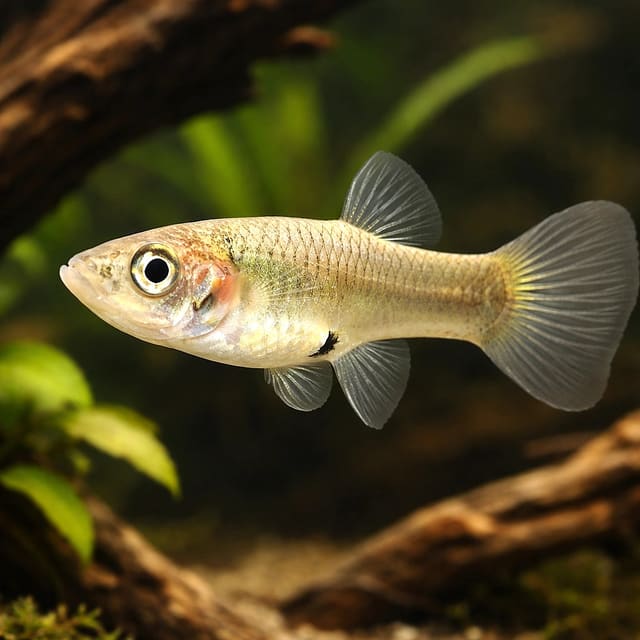
Female Endler Guppy (Poecilia wingei)
20–28°C · pH 7–8
£5.99

The Poecilia wingei black bar (Poecilia wingei) is an Endler livebearer from Venezuela’s Campoma and Buena Vista lagoon systems that reaches 2 cm standard length. It suits prepared beginners; use our group plan of five or more and the 24–28°C, pH 7.0–8.0 and 15–18 dGH overlap of Seriously Fish species guidance and OATA’s group guidance. Sold individually as one live fish per purchase.
Adult size is the maximum length this species reaches at full maturity (scientific sources). The livestock you receive will be younger and smaller. Product-photo provenance and any image-specific limitations are stated on the listing.
Poecilia wingei
Shoaling fish: kept in a group they feel safer, stay calmer and show their best colour.
The Poecilia wingei black bar (Poecilia wingei) is an Endler livebearer from Venezuela’s Campoma and Buena Vista lagoon systems that reaches 2 cm standard length. It suits prepared beginners; use our group plan of five or more and the 24–28°C, pH 7.0–8.0 and 15–18 dGH overlap of Seriously Fish species guidance and OATA’s group guidance. Sold individually as one live fish per purchase.
Adult size is the maximum length this species reaches at full maturity (scientific sources). The livestock you receive will be younger and smaller. Product-photo provenance and any image-specific limitations are stated on the listing.
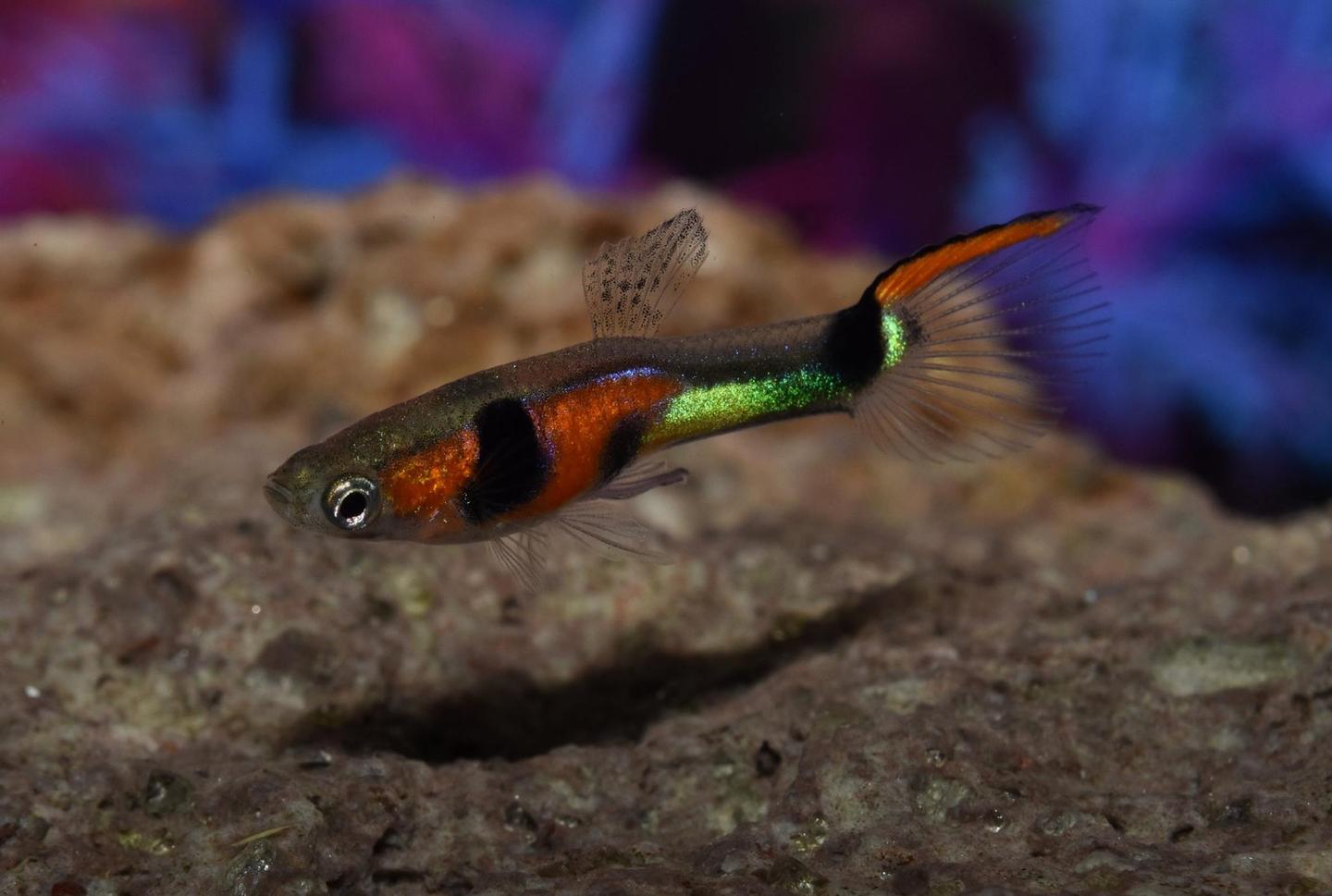
Endler's livebearer is a small, social, rapidly reproducing Venezuelan fish. Start with a mature filtered aquarium, a deliberate sex and population plan, stable tested medium-hard water, open swimming room and cover. Our conservative house screen is an aquarium at least 60 cm long and a group of five or more where capacity allows.
Maintain these water conditions for optimal health and vibrant colors
The Poecilia wingei black bar (Poecilia wingei) is a small Endler livebearer in the family Poeciliidae from Venezuela’s Campoma and Buena Vista lagoon systems. FishBase records a maximum of 2.0 cm standard length. It suits a prepared beginner who can provide a mature filtered aquarium, stable medium-hard water, a planned social group and capacity for possible fry.
Small adult size does not make a bowl or immature nano aquarium suitable. Standard length ends at the base of the tail rather than the tip of the caudal fin. The original species description measured a separate stream sample in which females reached up to 30.4 mm standard length. Use the FishBase figure of 2.0 cm as the adult-size value for this animal; the larger measured sample is a distinct published size difference rather than a promised result for every fish.
Black Bar is the colour-form name attached to this aquarium fish, while the accepted species name is Poecilia wingei. The species description associates it with the Paría Peninsula region of Venezuela. One recorded site was a clear stream with bank vegetation and no submerged plants. Design the aquarium around stable water, usable swimming room, cover and social management rather than copying one field site.
Morphological and molecular comparison supports P. wingei as distinct from the common guppy, P. reticulata, even though appearance can overlap. A colour label alone is not a pedigree test. Keep documented Endler lines separate from common guppies because they will crossbreed.
One purchase supplies one animal.
Sex is guaranteed only when the selected option explicitly states male or female. This Poecilia wingei black bar listing has no sex-guaranteed option.
Plan the social group and population capacity without assuming the sex of this animal. Mature males usually have a narrow modified anal fin called a gonopodium, while mature females have a broader triangular anal fin. Colour, body depth, size or a rounded abdomen alone should not be used as proof. If a mixed-sex group develops, reproduction may follow readily, so spare filtered capacity and a responsible rehoming plan should already be in place.
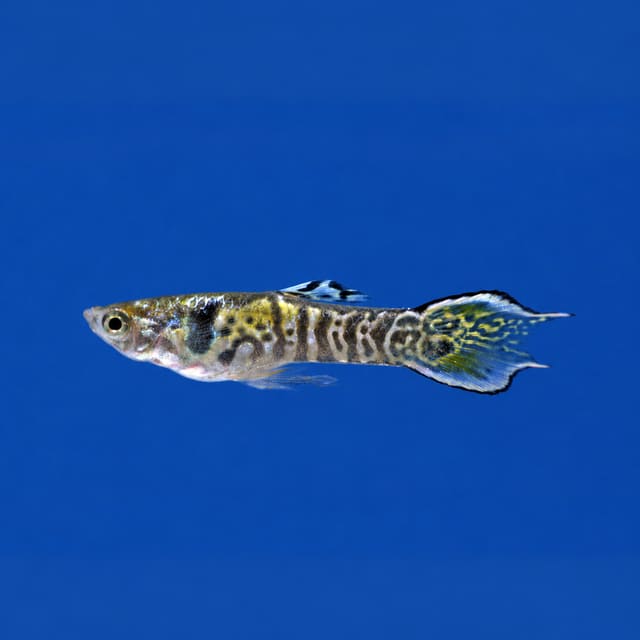
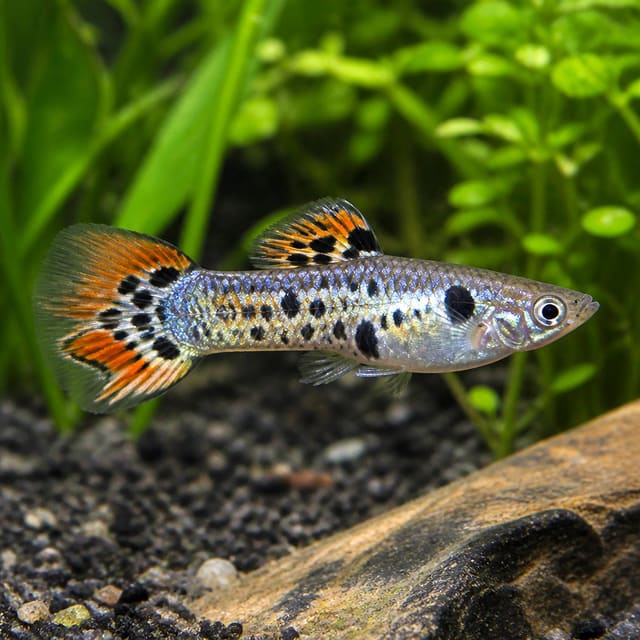
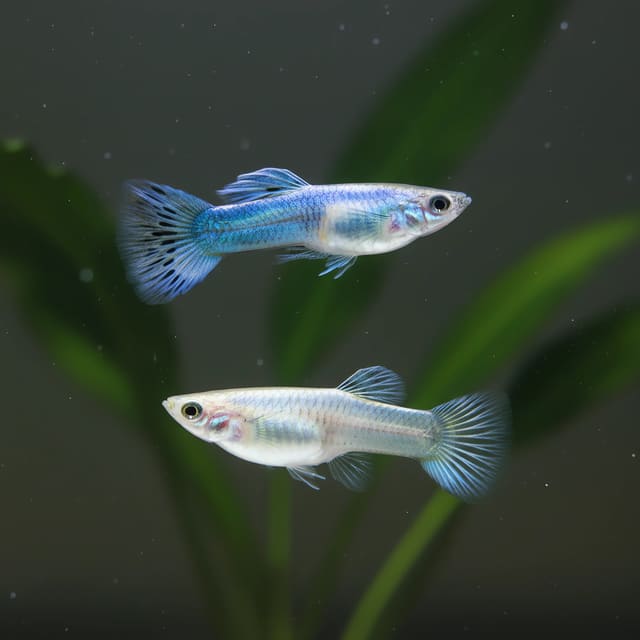
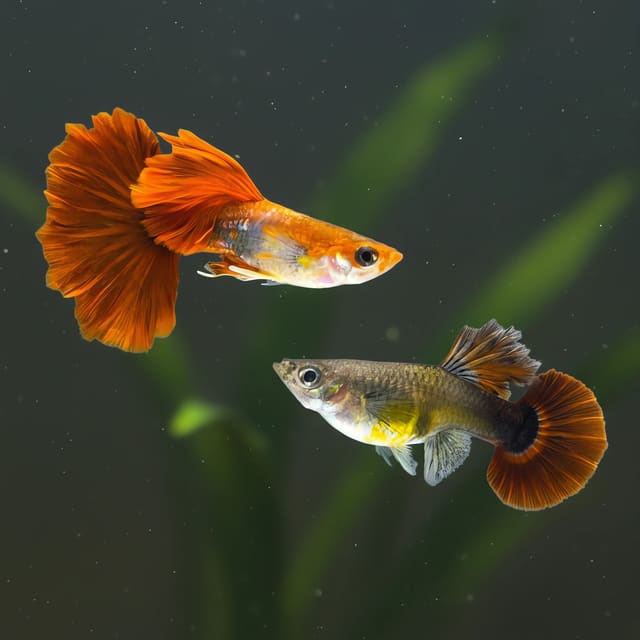
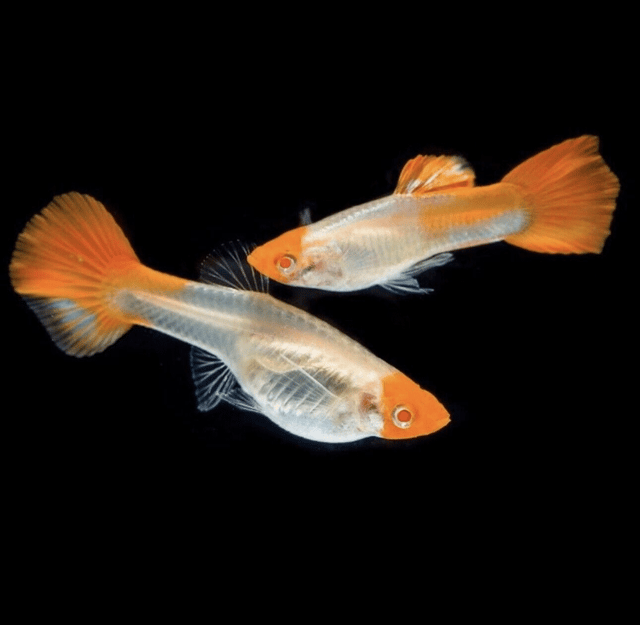
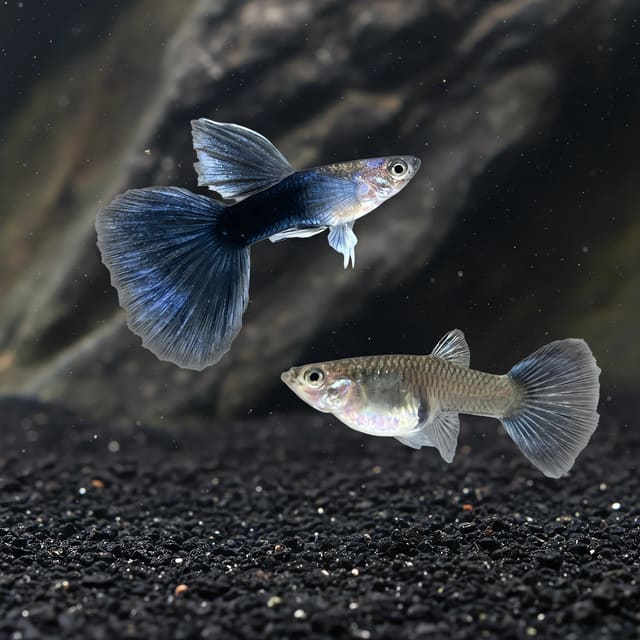
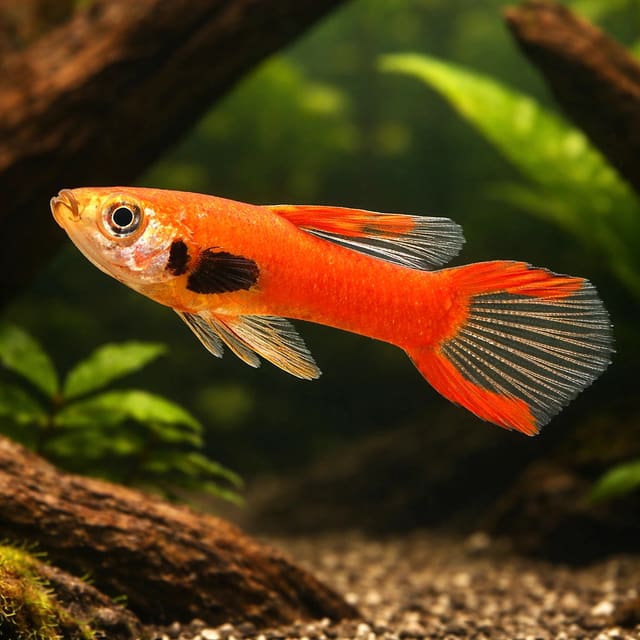
The gallery images are representative of this type of animal rather than photographs of the exact animal supplied, so colours can look slightly different from the live animal.
Use the Endler guppy collection to compare clearly named Endler forms. A colour name describes appearance within the offer; it does not replace the scientific identity or establish locality ancestry.
| Offer detail | How to use it |
|---|---|
| Purchase unit | One animal per purchase |
| Adult size | Plan around 2.0 cm standard length |
| Sex plan | Do not assume male or female for this offer |
Start with a mature, filtered aquarium rather than choosing the smallest container that can physically hold this fish. Seriously Fish gives a 45 × 30 cm base and approximately 41 litres for Poecilia wingei. OATA recommends at least 45 litres for a small group of the smaller guppy species. Our more conservative Endler guppy care guide uses an aquarium at least 60 cm long and a group of five or more where filtration, measured water, other livestock and the sex plan allow.
Keep the water at 24–28°C, pH 7.0–8.0 and 15–18 dGH. These values are the overlap between the Seriously Fish species range of 24–30°C, pH 7.0–8.5 and 15–35 dGH and OATA’s guppy-and-molly group guidance of 20–28°C, pH 7.0–8.0 and 8–18 dGH. They are a routine working range, not a species-specific optimum. Keep ammonia and nitrite at zero, then make any chemistry change gradually.
| Suits | Not suited to |
|---|---|
| Prepared beginners with a mature filtered aquarium | Bowls, vases or uncycled aquariums |
| A group of five or more where capacity and sex planning allow | A plan based on keeping one fish or a pair |
| At least 60 cm aquarium length under our house screen | Layouts without usable swimming room |
| Stable 24–28°C, pH 7.0–8.0 and 15–18 dGH | Rapidly changing or untested water |
| Small peaceful companions that pass every compatibility check | Fish large enough to eat it or species that nip fins |
Our easy care rating assumes that these foundations are already in place. It does not mean that cycling, testing, maintenance or population planning can be skipped. A prepared beginner can succeed by choosing stable water and adequate usable length before focusing on colour or décor.
Use a mature aquarium at least 60 cm long under our house policy, with open horizontal water for active swimming. The 45-litre group minimum remains a starting screen rather than a litres-per-fish formula. Length, biological filter capacity, oxygen exchange, social pressure and existing livestock all affect how many fish the aquarium can support.
Plants are strongly recommended by Seriously Fish and can make social management easier, but they do not replace filtration or water testing. Dense cover may also increase fry survival. That can be helpful in a planned breeding aquarium and difficult in a display with no spare capacity, so match the planting density to the population plan.
If this is your first setup, follow the steps for a mature first tropical aquarium before arranging the animal’s arrival. Add livestock gradually after the filter can process waste without detectable ammonia or nitrite. A newly filled tank with clear water is not automatically mature.
During the first week, watch whether every fish can cross the aquarium, leave another fish’s path and feed without remaining hidden. Persistent cornering, repeated pursuit, missed feeding or fin damage calls for more usable separation, fewer competing animals or a move to mature alternative housing. Adding another fish should never be the automatic response to pressure in an already crowded aquarium.
Target 24–28°C, pH 7.0–8.0 and 15–18 dGH. These values are the overlap of the Seriously Fish species range and OATA’s narrower group range. Stability matters more than chasing a particular point within the overlap, so measure the aquarium and make changes in controlled steps.
Test tap water as well as the aquarium. UK water can vary between areas and can change when supply zones are blended. Use the water chemistry guide to distinguish pH, general hardness and carbonate hardness, then use the water matcher to compare measured aquarium values with the working range.
| Reading | Action |
|---|---|
| 24–28°C | Hold steady with a thermostatically controlled heater where room conditions cannot maintain it |
| pH 7.0–8.0 | Check stability before changing chemistry |
| 15–18 dGH | Keep the water medium-hard within the working overlap |
| Ammonia above zero | Pause additions, test again and address filtration or excess waste |
| Nitrite above zero | Treat it as an urgent water-quality problem |
| Rising nitrate | Review feeding, stocking and the water-change routine |
OATA advises nitrate should not exceed 20 mg per litre above the normal tap-water level. Compare like with like: test the replacement water and the aquarium rather than judging the tank result in isolation.
Use an independent thermometer rather than relying only on the heater dial. Place the heater where water movement distributes warmth and avoid direct sunlight, cold draughts and sudden large adjustments. If the aquarium sits at 23°C, move towards the working range gradually instead of turning the control sharply upwards.
Abrupt pH or hardness manipulation can create a less stable aquarium than accepting a safe value already within range. Measure additives and replacement water consistently; do not rely on an untested tap-water or reverse-osmosis recipe.
RSPCA aquarium guidance explains that fish release toxic ammonia and that a working biological filter supports bacteria that convert ammonia through nitrite to safer nitrate. Keep the filter running continuously and size it for the entire aquarium rather than this small fish alone.
Provide useful water circulation and surface movement while ensuring the fish can hold position and feed without constant effort. Seriously Fish notes that flow is not inherently a problem because Endlers are active. The practical limit is the behaviour in front of you: if fish are continually swept away, cannot rest or struggle to take food, redirect or diffuse the outlet without removing essential filtration.
For an aquarium around 41 litres, Seriously Fish gives a turnover example of four to five times the aquarium volume per hour, equivalent to about 165–205 litres per hour. That is an equipment-sizing example, not a promise about real flow after media, pipework and head height reduce output. Check the fish and surface movement after the filter is installed.
If ammonia or nitrite appears, stop adding fish and reduce the causes of excess waste. Check for uneaten food, a blocked filter, decaying material or a rapid population increase. Water changes can reduce the immediate concentration, but the biological capacity and underlying cause also need attention.
Poecilia wingei is omnivorous. Seriously Fish describes wild feeding on zoobenthos and detritus and advises including vegetation in the aquarium diet. OATA recommends a good-quality flake or granule with high algal content, with suitably small live or frozen variety such as daphnia, small bloodworm or tubifex. Cyclops is specifically suggested as a smaller option for Endlers.
Use an appropriately small complete flake or granule as the nutritional base. Crush or select particles that the smallest fish can take without repeated spitting. Frozen or live variety can supplement that base, but a single treat food should not replace a complete diet.
OATA’s practical portion guide is what the fish can eat within a few minutes once a day. “A few minutes” is an observation window, not permission to keep adding food continuously. If particles reach the substrate untouched or remain caught around décor, reduce the portion or choose a more suitable size.
Store dry food sealed and dry. Handle frozen foods without repeated thawing and refreezing, and do not collect live food from an unknown pond. Visible algae should not be treated as a complete ration. A sudden loss of feeding interest is a health or water-quality signal, so test the aquarium and assess behaviour rather than masking it with repeated treats.
Endlers are social livebearers. OATA advises at least three guppies, while our conservative house plan is five or more where the aquarium’s length, biological capacity, other animals and sex plan allow. Five is a planning policy rather than a guarantee that every group will behave identically.
For a five-fish starting plan, count every Endler already present and assess the aquarium as a whole. Five fish in a mature 60 cm aquarium with open swimming room is a different proposition from five added to a crowded community containing several other social groups. The volume cannot be divided into automatic fish allowances.
OATA suggests two females for each male in mixed groups to reduce pressure on females. Apply that advice only when fish have been confidently sexed and the aquarium has room for the complete group. A ratio does not make an undersized aquarium safe, and this offer should not be used to order a presumed sex.
Mixed-sex groups can reproduce readily. A laboratory life-history study followed ten litters and 122 fry under one regime, so its intervals and brood results should not become promises for a home aquarium. Plan mature spare capacity, appropriately small complete food and responsible rehoming before fry appear.
If young fish appear unexpectedly, test ammonia and nitrite, review filter capacity and reassess the total population immediately. Do not transfer them to an uncycled container. Dense cover can improve fry survival, so planting choices and population control should be considered together.
Prepare and test the aquarium before the parcel arrives. Confirm that temperature is within 24–28°C, ammonia and nitrite are zero, and the mature filter is operating normally.
These steps come from our delivery and Live Arrival Guarantee policy. Keep the continuous video and order number if you need to report a problem, and use the policy’s same-day reporting route.
Look at swimming, balance, respiration and fin position together. A fish hanging at the surface, lying on the bottom, rolling, breathing abnormally or unable to maintain balance needs prompt water checks and assessment.
Keep temperature and chemistry stable, maintain normal filtration and allow the fish access to cover and open water. If established occupants begin persistent pursuit, use the mature separation plan rather than waiting for injury.
During the first feeding opportunity, offer only a manageable amount and confirm that the newcomer can take the particle size. Continued refusal combined with altered breathing, balance, colour or hiding calls for water testing and closer assessment.
OATA strongly recommends a partial water change of 25% at least once a week. Treat that as the normal starting rhythm, then use measured water quality and stocking pressure to decide whether the aquarium needs additional intervention.
| Weekly task | Reason |
|---|---|
| Test ammonia and nitrite | Both should remain at zero |
| Check nitrate | Track the change above the normal tap-water level |
| Measure temperature | Confirm the heater and thermometer agree |
| Change 25% | Complete this at least once a week to remove waste and refresh conditioned water |
| Siphon visible debris | Prevent food and waste accumulating in the substrate |
| Check filter flow | Catch blockages before circulation falls significantly |
| Observe every fish | Spot feeding exclusion, pursuit or physical change early |
Condition replacement tap water to neutralise chlorine or chloramine before it reaches the aquarium. Match temperature closely enough to avoid an abrupt swing. If tap-water pH or hardness differs markedly from the tank, use smaller controlled changes rather than creating a sudden chemistry shift.
Rinse filter media only when flow or accumulated debris makes it necessary, and use removed aquarium water. Cleaning every surface and every piece of media at once can remove useful biological capacity. Stagger disruptive jobs and retest afterwards.
A new fish, fry growth or an increase in feeding can raise the load on the filter. Test more frequently during the following week and watch whether food disappears cleanly. If nitrate climbs faster, waste collects or ammonia or nitrite appears, reduce the pressure and restore water quality before considering another addition.
Keep a simple log of test results, water changes, unusual behaviour and feeding response. Trends are easier to recognise when values are written down, and the notes help distinguish a one-off reading from a developing maintenance problem.
A settled Endler should swim steadily, breathe regularly, hold its fins normally and show a consistent feeding response. Changes in those patterns matter more than trying to diagnose a disease from one mark or colour shift.
RSPCA fish-health guidance highlights altered swimming, breathing, appetite, body condition, skin and fin appearance as warning signs. If you see surface gasping, bottom sitting, erratic swimming, clamped fins, white spots, fluffy growths, wounds, swelling, rapid weight change or loss of appetite, test temperature, ammonia, nitrite, nitrate and pH promptly.
Do not choose salt, extra heat or medication from one symptom. Similar outward signs can have different causes, and unnecessary treatment can add stress or affect the filter. Stabilise water and use UK-authorised products under appropriate direction.
A study of one captive line observed spinal deformities in 22 of 600 fish. That result should not be treated as a species-wide rate or used to diagnose the cause of a curved body by sight. Genetic, nutritional, environmental and traumatic factors may all require consideration. Do not breed a visibly affected fish while assessment is pending.
For a new-fish quarantine plan, use a separate mature aquarium with dedicated equipment. An uncycled container is not a safe substitute. Water-quality-led investigation and quarantine guidance from the MSD Veterinary Manual supports protecting the established aquarium only when water quality, temperature, feeding and observation remain suitable throughout the period.
Check the fish at several points in the day rather than only at feeding time. Confirm steady swimming, regular breathing, normal fin carriage and access to both open water and cover. Observe the whole group while food is distributed so a small or less assertive fish is not missed.
Test ammonia and nitrite more often after the new addition. Both should remain at zero. Compare temperature daily and note any large difference between morning and evening. If values move, correct the underlying heating, filtration or stocking issue rather than repeatedly changing settings.
If one checkpoint repeatedly fails, change the plan before adding more livestock. Examples include increasing mature filtration when waste exceeds capacity, opening a blocked swimming route, separating persistent aggressors into prepared housing or reducing food when leftovers accumulate.
Several years may be possible for small guppies kept in a mature aquarium with good water quality, according to OATA, but avoid planning around a fixed lifespan promise. Age, lineage, previous conditions and long-term husbandry vary. The practical commitment is suitable care for the animal throughout its life rather than a guaranteed number of years.
This fish is very small, so compatibility begins with predation risk. OATA says Endlers should not be kept with a species large enough to eat them. It also warns against fish that may nip guppy fins. Seriously Fish does not recommend P. wingei for a general community without qualification because of its size.
Small peaceful species may work when all six checks pass. Seriously Fish names dwarf corydoras, small peaceful rainbowfish such as Iriatherina werneri or Pseudomugil species, and peaceful tetras as examples, but those names are not blanket approval. The exact species still needs matching for water, footprint, group size, feeding speed and behaviour.
| Observation | Response |
|---|---|
| Brief display with normal feeding | Continue observing the whole group |
| One fish always hides at feeding | Change food distribution and assess social pressure |
| Repeated nipping or cornering | Separate before fins or condition deteriorate |
| Predatory stalking or attempted swallowing | Remove the incompatible pairing |
| Different water requirements | Choose a companion with genuine overlap instead |
For a stocking and compatibility assessment, contact us with the aquarium dimensions, measured water values, filter details and full livestock list. That information makes the decision more useful than a generic community label.
Seriously Fish says Poecilia wingei should not be kept with common guppies because they will crossbreed. Laboratory work has produced reciprocal P. wingei × P. reticulata offspring, including later generations. Keep common guppies and known hybrids in separate aquariums.
Appearance cannot establish ancestry. Colour, tail shape and informal class labels may communicate a breeder convention, but overlapping morphology means appearance alone cannot establish that offspring are pure. This matters especially when fish or fry may later be rehomed.
Do not promise that any fish is shrimp-safe. Adult shrimp may coexist in a suitably sized aquarium with compatible temperature and mineral requirements, but small shrimp and newly hatched young may be eaten. Feeding competition can also occur.
Dense moss or other fine cover reduces exposure for young shrimp but cannot guarantee survival. It can also shelter Endler fry, increasing population pressure. Decide whether the aquarium’s priority is an Endler display, a shrimp colony or managed breeding, then design cover and feeding around that priority.
Seriously Fish recommends a species-only setup when breeding is the objective. This reduces predation and hybridisation risk, but it does not remove the need for mature filtration, controlled feeding and a plan for every surviving fry. Powerful flow is not essential in a species aquarium, although filtration remains necessary.
Snails or other invertebrates should also pass the same temperature, hardness, feeding and population checks. No animal should be added as a substitute for removing waste or maintaining the aquarium. The keeper remains responsible for water changes, substrate cleaning and controlling uneaten food.
Individual behaviour, crowding and feeding access can change after introduction, so compatibility is an ongoing observation rather than a permanent guarantee made from a species name.
FishBase records a maximum of 2.0 cm standard length for Poecilia wingei. Plan the aquarium around that adult-size value rather than the fish’s size when supplied.
Use a mature filtered aquarium at least 60 cm long under our house policy. Seriously Fish gives a 45 × 30 cm base and about 41 litres for the species, while OATA recommends at least 45 litres for a small group of the smaller guppy species.
Our house plan is five or more where aquarium capacity and sex planning allow; OATA’s group guidance starts at three. Monitor feeding access, pursuit and hiding rather than treating volume as an automatic fish allowance.
It can suit a prepared beginner who provides a mature filtered aquarium, zero ammonia and nitrite, stable tested water, a planned social group and capacity for possible fry. The store’s easy rating does not mean maintenance-free care.
Feed an appropriately small complete flake or granule with algal content once daily in an amount eaten within a few minutes. Small daphnia, bloodworm, tubifex or cyclops can provide suitable live or frozen variety.
Keep it at 24–28°C, pH 7.0–8.0 and 15–18 dGH. These values are the overlap of Seriously Fish species guidance and OATA’s guppy-and-molly group guidance; keep ammonia and nitrite at zero.
Males are peaceful towards one another, while females may act territorially. Monitor pursuit, feeding access, hiding and fin condition, and separate fish if repeated pressure causes exclusion or injury.
Seriously Fish names dwarf corydoras, small peaceful rainbowfish and peaceful tetras as possible companions, subject to matching water, space, group and feeding needs. Avoid species large enough to eat an Endler, fish that may nip fins and common guppies because they will crossbreed.
Be present to receive it and film every delivery continuously from the sealed parcel as it is opened, showing the fish still in the sealed bag. Float the bag for 20–30 minutes, release the fish carefully and never pour the bag water into the aquarium.
No reviews for this item yet. Bought one? Honest reviews only, good or bad.
What customers say about ordering from us
I have a small group of long finned mountain minnows. So was delighted to be able to order ten of this variety to increase the genetics in my tank . The ones I recieved are healthy but it’s to early to give a verdict on wether they are of a long finned type since they are small currently.
Gordon Walker · 23 Sept 2026
100% success travel and "installation". Pleased with quality of purchase. The Siamese fighter a bit "shy" so have not yet seen him at his best yet but looking good. Happy customer. GG
George E Garratt · 21 Sept 2026
Reviews of our shop, collected by Judge.me, an independent third-party review collector. Newest first.