Easy
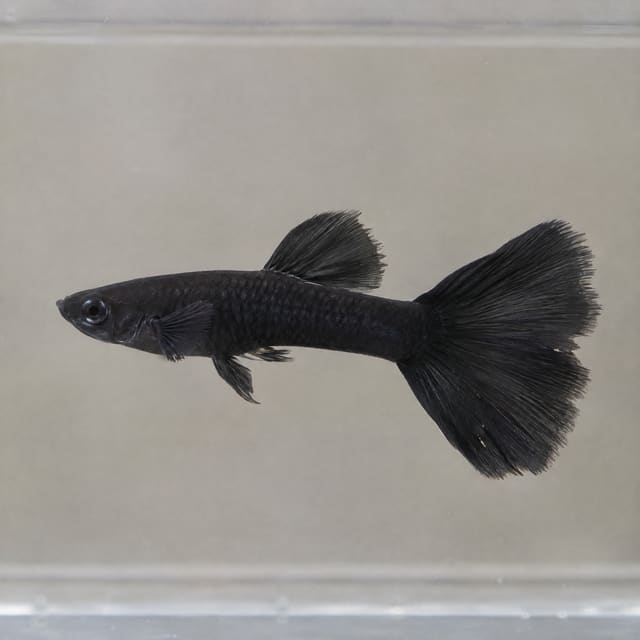
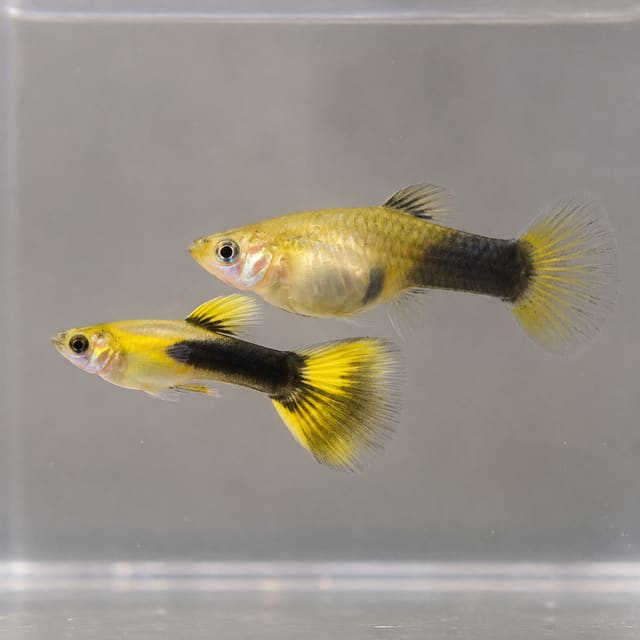
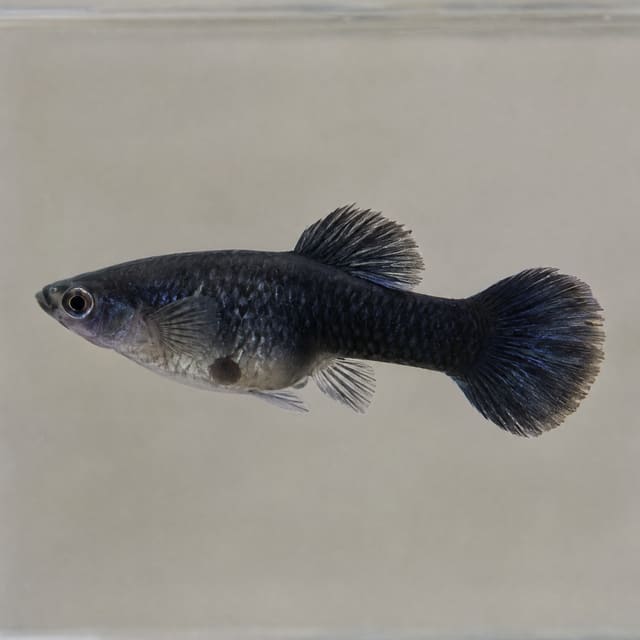
One Black Moscow guppy pair, one male and one female, sent at about 3.5 cm. The male is black from snout to tail tip, with a broad, flowing tail. An easy, peaceful livebearer for a mature aquarium of 60 litres or more at 22–28°C, pH 7.0–8.0 and 9–18 dGH.
Adult size is the maximum length this species reaches at full maturity (scientific sources). The livestock you receive will be younger and smaller. Product-photo provenance and any image-specific limitations are stated on the listing.
Poecilia reticulata
Each quantity is one pack containing 2 fish. Discounts count packs. Selected: 1 pack (2 fish).
One Black Moscow guppy pair, one male and one female, sent at about 3.5 cm. The male is black from snout to tail tip, with a broad, flowing tail. An easy, peaceful livebearer for a mature aquarium of 60 litres or more at 22–28°C, pH 7.0–8.0 and 9–18 dGH.
Adult size is the maximum length this species reaches at full maturity (scientific sources). The livestock you receive will be younger and smaller. Product-photo provenance and any image-specific limitations are stated on the listing.
Guppies are social livebearers suited to a prepared beginner, not a fish-per-litre formula. Use a mature filtered aquarium, tested neutral-to-alkaline mineral-bearing water, deliberate sex and population planning, open swimming room, cover and a separation option.
Read the full care guidance when planning conditions for your aquarium.
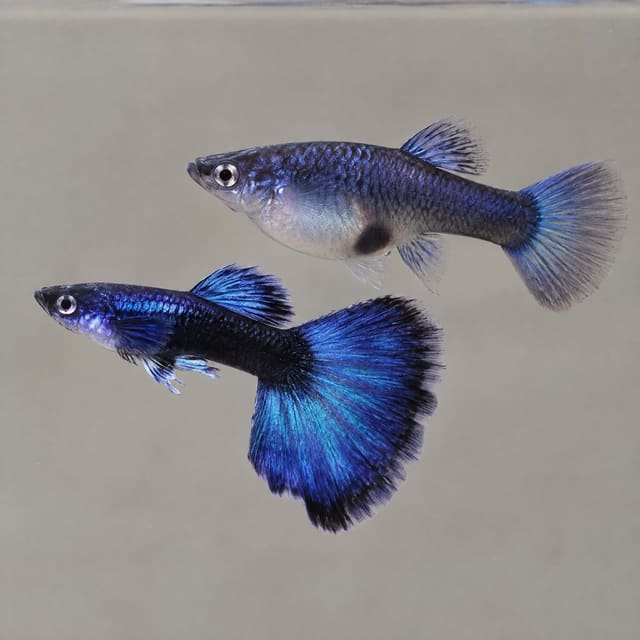
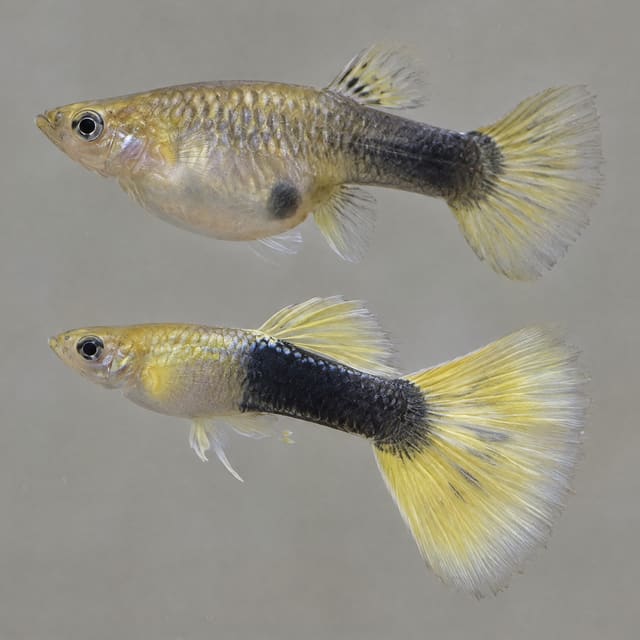
The Black Moscow is a fancy strain of the guppy, Poecilia reticulata, and its appeal takes one sentence to explain: the male is black from snout to tail tip. In the two photographs on this page the body, the tall dorsal fin and the wide, fan-shaped tail are all the same deep shade, broken only by a small silvery patch behind the gill cover where the throat runs into the belly. Look closely at the tail and you can see fine ray lines running through the black, and under aquarium lighting the scales carry a soft sheen rather than looking flat.
Guppies are livebearers in the family Poeciliidae, the same family as mollies, platies and swordtails. However exotic a fancy guppy looks, it is the same species as the small wild fish that FishBase lists from Venezuela, Trinidad, Barbados, northern Brazil and the Guianas. Breeders have spent generations selecting for colour and fin shape, and Wikipedia notes that males and females of many domestic strains are larger and far more heavily ornamented than their wild ancestors. The Black Moscow is one product of that long selection.
"Moscow" is a strain name used in the hobby. It is not a separate species, and it is sold with a colour word in front of it; our own range also carries Blue Moscow male guppies. With this one, the colour word tells you all you need: black is the whole point of the fish, and there is no contrasting tail colour to look for.
A black guppy works as a contrast piece. Set against green plants, bogwood and a pale gravel, as in the first photograph, the male's outline reads clearly from across the room. In a tank already full of red, yellow or blue guppies, he gives the eye a dark anchor point. Black fish are also honest about their condition, because a torn fin edge or a white speck shows up immediately against the dark colour, which makes this an easy strain to keep an eye on.
| At a glance | Black Moscow guppy |
|---|---|
| Scientific name | Poecilia reticulata Peters, 1859 |
| Family | Poeciliidae (livebearers) |
| What one order contains | One pair: one male and one female |
| Size when sent | About 3.5 cm |
| Maximum size (FishBase) | Males 5.0 cm SL, females 6.0 cm SL |
| Temperature we recommend | 22–28°C |
| pH | 7.0–8.0 |
| General hardness | 9–18 dGH |
| Aquarium | 60 litres or more |
| Care level | Easy |
One quantity of this listing is one pair: one male and one female Black Moscow guppy, sent at about 3.5 cm. That is the only size we offer for this strain. If you want two pairs, order two; if you are thinking about a larger group, read the part on chasing further down before deciding how many males to add.
The 3.5 cm figure describes the fish as they leave us. It is a dispatch size, not an adult size. FishBase gives a maximum of 5.0 cm standard length for males and 6.0 cm standard length for females. Standard length runs from the tip of the snout to the base of the tail, so it leaves the caudal fin out; on a long-tailed fancy male, the tail adds a good deal to how big he looks in the tank. FishBase also gives a common length of 2.8 cm total length for males, and Wikipedia puts typical adults at 1.5–4 cm for males and 3–7 cm for females. Put simply, the female is the one that keeps growing, and she ends up the larger, deeper-bodied fish of the two.
Sexing adult guppies is straightforward. The male's anal fin is modified into a gonopodium, a narrow, rod-like fin he uses to fertilise the female internally, and it lies tucked back under his belly. The female's anal fin is the normal fan shape. Seriously Fish describes males as more colourful with longer fins, and females as larger, plumper and duller, except in some bred varieties. Expect the female in this pair to be plainer than the male. Domestic females are often more ornamented than wild ones, so she may carry some darker colour, but how much varies from fish to fish, and she will never have his flowing tail.
Female guppies also have a gravid spot, a darker area near the vent at the rear of the belly. Wikipedia notes that it becomes larger and darker in pregnant females, so it is the simplest way to judge when your female is getting close to giving birth.
A female guppy can store sperm and use it for months. Seriously Fish says stored sperm lets a female keep producing young for six months or more without a male present, and Wikipedia gives a figure of up to eight months. FishBase puts female maturity at around three months. Treat any adult female as potentially pregnant from the day she arrives, and have fine-leaved plants in place before the parcel comes, so any early fry have somewhere to hide.
Wild guppies come from north-eastern South America and the islands of the southern Caribbean. FishBase lists Venezuela, Barbados, Trinidad, northern Brazil and the Guianas, and Seriously Fish adds Antigua and Barbuda and the former Netherlands Antilles. Wilhelm Peters described the species from Venezuela in 1859 as Poecilia reticulata, and that is still the accepted name. It has collected others along the way. Albert Günther named it Girardinus guppii after Robert John Lechmere Guppy, who sent specimens from Trinidad to the Natural History Museum in London, and in 1913 Regan moved it to Lebistes reticulatus, a name you will still find in older aquarium books. The everyday English name comes from that Trinidad collector.
The wild habitats are remarkably varied. FishBase describes guppies in warm springs and weedy ditches, and in everything from turbid ponds to mountain streams. Seriously Fish describes the range of biotopes as almost unlimited, and says the fish do best where algae and aquatic plants are plentiful. FishBase classes the species as both freshwater and brackish, Seriously Fish notes that some wild populations tolerate brackish water, and Wikipedia cites tolerance of salinity up to 150% of normal seawater. None of that means your Black Moscow pair needs salt. It simply explains why the guppy copes with such a wide spread of conditions, and why it has a name as a forgiving first fish.
Wild guppies are also the subject of some famous field studies. In Trinidad, Wikipedia reports, guppies living alongside many predators shoal more and have evolved duller colours than populations in streams with few predators. Wild females prefer brightly coloured males, particularly those with orange spots on the flank. Fancy strains are the aquarium side of that same colour variation, selected by breeders rather than by predators and female choice. A Black Moscow male, with almost all of the wild pattern replaced by black, shows how far selective breeding can take it.
The guppy has been carried all over the world. FishBase says it has been widely introduced and established, mainly for mosquito control, but that it had rare to non-existent effects on mosquitoes and negative to perhaps neutral effects on native fishes, and that several countries report adverse ecological impact. FishBase lists it as a potential pest. That is why we ask every customer never to release guppies, fry or tank water into a pond, stream or drain. If you end up with more young than you can house, ask a local aquatic shop or fishkeeping club whether they can take them.
The wild species is in no danger. FishBase records it as Least Concern on the IUCN Red List, assessed in 2020. Fancy strains such as this one are aquarium-bred, and Seriously Fish notes that wild-type guppies are rarely available to hobbyists at all.
Guppies are small, but they are not bowl fish. The published minimums vary: Seriously Fish suggests a tank with a base of 45 × 30 cm, 30 cm tall, roughly 41 litres; OATA's care sheet gives 45 litres for a small group; and FishBase recommends an aquarium of at least 60 cm for groups of five or more. We recommend 60 litres or more for a Black Moscow pair. Two fish do not strictly need that much water, but a pair of guppies rarely stays a pair for long, and the extra volume gives you room for the first broods, for extra females later and for steadier water quality between changes.
Guppies are tropical fish and need a heater with a thermostat in a UK home. Seriously Fish pairs its 45 cm set-up with a 50 W heater and a filter rated at about 165–205 litres per hour. Keep the flow gentle: Seriously Fish advises against strong currents, and the Black Moscow male's tail is a lot of fin to push through moving water. Angle the filter outlet against the glass or along the surface, and leave a calmer corner where he can rest without being pushed about.
The filter must be mature before the fish arrive. OATA's targets are zero ammonia and zero nitrite, with nitrate no more than 20 mg/l above your tap water. Test for all three before you order, not after, and only place the order once a new tank has settled at those readings.
Seriously Fish recommends a planted aquarium with some floating vegetation, and that layout suits this pair. Floating plants soften the light and give the female a break when the male is being persistent. Fine-leaved stems and dense clumps near the bottom give newborn fry a place to hide, which matters because FishBase notes that guppies give no parental care and adults may eat their own young. Keep an open swimming lane along the front glass too; the male needs space to display, and you will want to see him do it.
With a black fish, think about the backdrop. Our first photograph shows how well the black stands out against green plants, wood and a pale, mixed gravel. Put the same fish in front of a black background over dark substrate and he can almost disappear. A light or mid-toned substrate, plenty of green and a lit background make the most of him. Choose wood and stone without sharp edges, because a long tail tears easily.
If the pair breeds, which is very likely, the number of fish will climb. Decide early whether you want fry to grow up in the main tank, in a separate grow-on tank, or to go to new homes. The breeding section below sets out the options, and the answer affects how much tank space you need over the next few months.
Look up guppy water parameters and you will find several ranges that seem to disagree. They make sense once you know what each source is measuring. The table sets the main published figures side by side, with the routine range we recommend for this pair.
| Source | Temperature | pH | Hardness |
|---|---|---|---|
| FishBase | 18–28°C | 7.0–8.0 | 9–19 dH |
| Seriously Fish | 17–28°C | 7.0–8.5 | 8–30 dGH |
| OATA care sheet | 20–28°C | 7.0–8.0 | 8–18 dGH, KH 5–15 dKH |
| Our routine range | 22–28°C | 7.0–8.0 | 9–18 dGH |
FishBase's 18–28°C is the range for the species as a whole, wild populations included. The cool end is what guppies can tolerate, not a target for a long-finned fancy strain in a living room. We set our recommendation at 22–28°C to keep the pair active and feeding. Pick a temperature inside that band and hold it steady; a reliable heater with a thermostat does the work for you, and a stick-on or glass thermometer lets you check it at a glance when you feed.
On pH and hardness, all three sources agree on the main point: guppies are hard-water fish. Seriously Fish describes them exactly that way, and says they tolerate softer, more acidic conditions only for short periods. A pH of 7.0–8.0 with general hardness of 9–18 dGH sits inside every published range, and OATA adds a carbonate hardness of 5–15 dKH, which helps keep pH from drifting downwards between water changes. If your tap water is soft, test GH and KH before the pair arrives and ask us for advice. It is far easier to set a tank up for guppies than to change it once they are living in it.
The ranges above describe the chemistry of the water, but the bigger day-to-day risk for most guppies is waste. OATA asks keepers to test ammonia, nitrite, nitrate, pH and hardness every week and to change at least 25% of the water weekly. When the filter needs cleaning, rinse the media in water taken out of the tank, never under the tap, so the bacteria that process ammonia and nitrite survive. Bring replacement water to tank temperature and dechlorinate it before it goes in.
A note on salt, since it comes up with guppies: FishBase lists the species as freshwater and brackish, and Wikipedia records tolerance of salinity well above seawater. That tells you how tough the wild species is. It is not a recommendation, and a Black Moscow pair lives perfectly well in fresh, hard, alkaline water with no salt added.
Wild guppies eat small things, often. FishBase lists zooplankton, small insects and detritus. Wikipedia adds algae, diatoms, plant fragments and insect larvae, and notes that algae usually makes up the largest part of the diet. Seriously Fish describes wild fish as mainly insect-eaters, but says tank-bred guppies accept most foods offered. A fancy guppy is easy to feed; the skill lies in keeping the portions small.
OATA's care sheet suggests feeding once a day, giving only what the fish eat within a few minutes, using a good-quality flake or granule with some algae content, plus frozen foods such as daphnia and bloodworm. That routine suits this pair well. These are small fish, so choose small flakes or micro-granules and crumble anything larger between your fingers before it goes in.
A sensible pattern for the week:
Overfeeding is the most common mistake with a single pair. Two fish of 3.5 cm need very little, and flake that sinks uneaten breaks down into ammonia, which matters most in a tank that is still young. If the water starts to cloud or the nitrate reading climbs faster than usual, cut the portions back before you look for any other cause.
Do not worry if you see the pair picking at the glass and the leaves between meals. Algae forms a large part of a wild guppy's diet, and grazing on surfaces is normal behaviour, not a sign that they are hungry.
Thaw frozen food in a little tank water first and feed only what is eaten. If fry appear, they need much finer food than the adults, because they are born small; crush a little of the same flake to a powder for them, and feed tiny amounts so the tank stays clean.
A male guppy spends a surprising part of his day courting. Wikipedia describes the display: he bends his body into an S shape in front of the female and quivers rapidly. He will also try to mate without any display at all, approaching the female and thrusting his gonopodium towards her. Seriously Fish describes males as vigorous in their pursuit of females, and that is the one real drawback of keeping a single pair. With only one female in the tank, all of his attention lands on her.
Seriously Fish and OATA both advise keeping more females than males. Seriously Fish suggests several females to each male; OATA's minimum is a group of three, with two females per male. A pair is a fine start in a well-planted tank, where the female can slip away among stems and floating plants. Watch her for the first few weeks. If she spends most of her time hiding near the surface or tucked behind the heater, or her fins start to look ragged, it is time to add more females.
Which females you add depends on what you want from the tank:
If you want more than one black male on show, our black male guppies look the part beside him, but every extra male needs extra females, and more space, to keep the chasing spread out.
Guppies are peaceful and live well with other small, calm fish that want the same hard, alkaline water. Seriously Fish lists other livebearers, rasboras, Corydoras, loricariid catfish and tetras as suitable companions. The fish to avoid are fin-nippers: Seriously Fish names tiger barbs and serpae tetras, and any fish with that habit will go straight for a long black tail. Leave out anything large enough to swallow a guppy. Bear in mind too that adult guppies eat their own fry, according to FishBase, and other fish in the tank may well do the same.
Before buying any companion, check its water needs against this tank. Some popular community fish prefer soft, acidic water, and a guppy aquarium kept at pH 7.0–8.0 and 9–18 dGH will not suit them. Choose loricariids that stay small enough for a 60-litre tank.
Guppies breed readily, and a healthy pair will almost certainly produce young. FishBase gives maturity at about two months for males and three months for females. Wikipedia is a little more specific, putting males at seven weeks or less and females at 10–20 weeks.
Fertilisation is internal, through the male's gonopodium, and the female gives birth to live young. FishBase and Seriously Fish both give gestation as four to six weeks. Wikipedia adds that it varies considerably, from 20 to 60 days at 25–27.8°C, depending on several environmental factors. As the birth approaches, the female's belly fills out and her gravid spot grows larger and darker.
Brood sizes vary a lot between sources and between females. FishBase gives 20–40 young; Seriously Fish gives 5–100 per brood; Wikipedia records anything from two to 200, with 30–60 typical. Because females store sperm, one mating can produce several broods in a row, and Seriously Fish describes the species as highly prolific. A single Black Moscow pair can turn into dozens of fish within a few months.
Putting the published figures together gives a realistic picture of how quickly things move. Treat it as a guide, not a schedule; temperature, food and the female's age all shift the dates.
| Stage | What to expect | Source of the figure |
|---|---|---|
| Arrival | The female may already carry stored sperm, so a brood is possible within weeks | Seriously Fish, Wikipedia |
| Each pregnancy | About four to six weeks, but anywhere from 20 to 60 days | FishBase, Seriously Fish, Wikipedia |
| Brood size | Commonly 20–60 young, sometimes far fewer or far more | FishBase, Wikipedia |
| Young males mature | Seven weeks or less, up to about two months | Wikipedia, FishBase |
| Young females mature | About three months, up to 20 weeks | FishBase, Wikipedia |
In practice, that means the first-born young can be breeding among themselves around four months after your pair arrives. If you do not want a crowded tank by then, separate young males from young females as soon as you can see the gonopodium forming, or arrange new homes early.
FishBase states that guppies give no parental care and that the parents may eat their young, and Wikipedia adds that males sometimes attack females while they are giving birth. There are three straightforward approaches:
If you want the next generation to look like this pair, keep them away from other guppy strains. A female that has mated with a different male will produce mixed young, and because she can store sperm, that can carry on for months after the other male has gone. Over several generations, breeding brothers to sisters in one tank brings its own problem. Seriously Fish and Wikipedia both point to inbreeding in commercial guppies as a cause of reduced hardiness and higher disease susceptibility, and Wikipedia adds fertility problems and effects on body size. Bringing in an unrelated Black Moscow pair from time to time keeps the line vigorous.
Plan what happens to the young before they arrive. Seriously Fish recommends specialist breeders and fishkeeping society auctions as the best places to find good guppies, and the same routes work in reverse when you have healthy, well-grown young to pass on. Never release surplus fish outdoors.
A guppy in good condition swims openly, holds its fins spread and feeds eagerly. OATA lists the warning signs to watch for: abnormal swimming, changes in colour, damaged fins, white spots, a change in breathing rate and a change in feeding. A black fish makes several of these easy to spot. White specks or a frayed fin edge show up clearly against the dark body and tail, so give the male a quick look every time you feed.
Fancy guppies are not as tough as wild ones. Seriously Fish warns that many commercially bred guppies suffer from inbreeding and over-production, leaving them less hardy and more prone to disease, and Wikipedia makes the same point. You cannot change a fish's genetics, but you control everything around it, and stable temperature, clean water, sensible feeding and calm tank mates are the things that keep a fancy strain healthy.
The male's broad tail is the reason to buy him and also his weak point. Large fins tear on sharp décor and are an obvious target for fin-nipping fish, which is why Seriously Fish lists tiger barbs and serpae tetras as unsuitable companions. Use smooth wood and rounded stones, and keep the flow gentle so he is not forever fighting the current.
OATA's weekly routine is the best protection you have: test ammonia, nitrite, nitrate, pH and hardness, change at least a quarter of the water, and keep nitrate within 20 mg/l of your tap water. If one of the pair looks unwell, test the water before doing anything else. In a small tank with two fish, a missed water change or a few days of heavy feeding is a far more likely cause than an unusual disease.
Wikipedia gives the lifespan of wild guppies as typically around two years, varying with predation. OATA says guppies can live for several years in a well-maintained aquarium. Somewhere between those two figures is a fair expectation for a fancy pair given good care. OATA's care sheet also reminds keepers that the Animal Welfare Act 2006 gives every pet owner a legal duty of care, and that includes fish.
Please read our delivery and live arrival information before you order. The essentials are below.
Your pair travels in an oxygen-filled bag inside insulated packaging, with heat packs when the weather calls for them, carried by a tracked courier licensed to transport live animals.
We strongly recommend an unboxing video when practical: it helps us resolve arrival concerns faster, investigate packing or transit issues and reduce recurrence. Video is optional and clear photos are accepted. Never delay necessary animal care to record evidence. If filming, record one continuous video that begins with the parcel still sealed, carries on as you open it, and shows the fish in the still-sealed bag. If a fish has arrived dead, dying or clearly compromised, email hello@tropicalfishco.co.uk on the day of delivery with your order number and clear photos or an optional video. Where a claim is accepted, we replace the affected fish with your next order or refund them, subject to the guarantee terms.
Keep the lights low for the rest of the first day. Over the following week, watch three things: breathing, appetite and behaviour. A settled pair swims openly, takes food and the male soon goes back to courting. A fish that stays clamped, gasps at the surface or refuses food needs a water test straight away. Feed lightly for the first few days while the filter adjusts to the extra fish, and keep up the weekly water change from the start.
These are the sources behind the figures on this page, all free to read.
No reviews for this item yet. Bought one? Honest reviews only, good or bad.
What customers say about ordering from us
Easy website plenty of info on fish your buying great to pick a time slot
TRACEY DURRANT · 7 Oct 2026
Got some lovely fish thank you
Kevin Mackie · 7 Oct 2026
Reviews of our shop, collected by Judge.me, an independent third-party review collector. Newest first.
Moved by UK carriers licensed to handle live animals
Hand-packed with oxygen bags, poly box, heat pack
Email photos the same day; an optional unboxing video helps us review problems faster — claim terms apply
Klarna & PayPal Pay in 3 at checkout



22–26°C · pH 6–7.8 · 75L