Easy
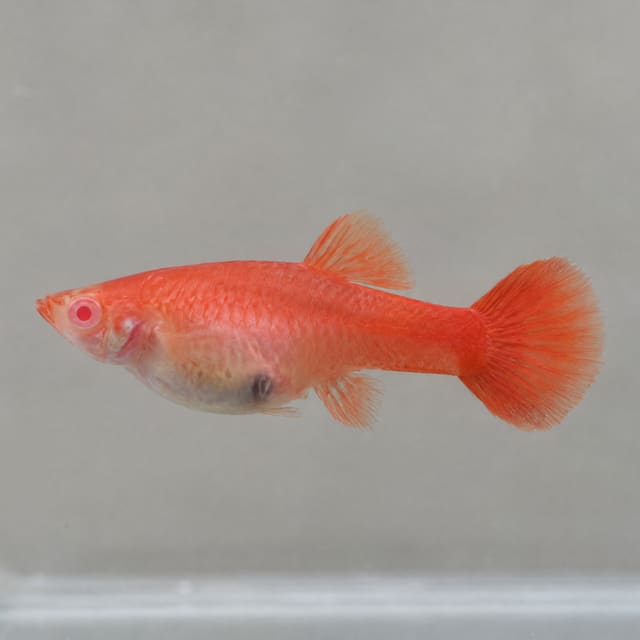
One Full Red Albino guppy pair, one male and one female, sent at 2–3.5 cm. The male is solid orange-red over body, dorsal fin and broad tail, with red albino eyes and no black pigment. Peaceful and easy to keep in 60 litres or more of hard, alkaline water at 22–28°C, with softer lighting and some shade.
Adult size is the maximum length this species reaches at full maturity (scientific sources). The livestock you receive will be younger and smaller. Product-photo provenance and any image-specific limitations are stated on the listing.
Poecilia reticulata
Each quantity is one pair containing 2 fish. Discounts count pairs. Selected: 1 pair (2 fish).
One Full Red Albino guppy pair, one male and one female, sent at 2–3.5 cm. The male is solid orange-red over body, dorsal fin and broad tail, with red albino eyes and no black pigment. Peaceful and easy to keep in 60 litres or more of hard, alkaline water at 22–28°C, with softer lighting and some shade.
Adult size is the maximum length this species reaches at full maturity (scientific sources). The livestock you receive will be younger and smaller. Product-photo provenance and any image-specific limitations are stated on the listing.
Guppies are social livebearers suited to a prepared beginner, not a fish-per-litre formula. Use a mature filtered aquarium, tested neutral-to-alkaline mineral-bearing water, deliberate sex and population planning, open swimming room, cover and a separation option.
Read the full care guidance when planning conditions for your aquarium.
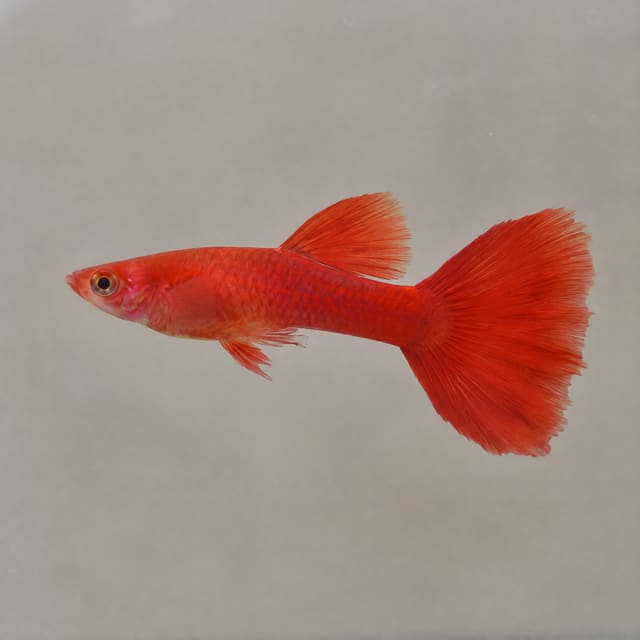
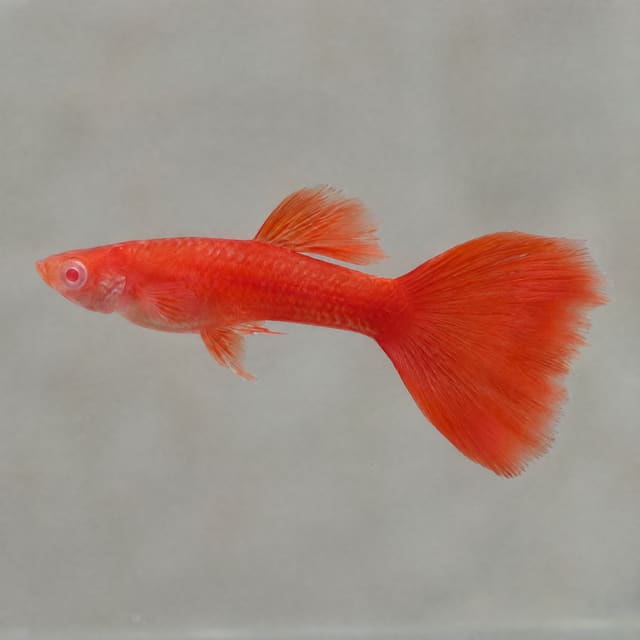
The male in our photographs is about as red as a guppy gets. His body, his tall dorsal fin and his broad, finely fringed tail are one even shade of bright orange-red, and his eye is red as well, with no black pupil ring to break it up. The only parts that are not red are the small, clear-to-white fins beneath his belly. There is no black anywhere on him: no dark tail edging, no flank pattern and no shading along the back.
The name describes exactly that. "Full red" is the solid colour across body and fins, and "albino" is the missing dark pigment, which is why the eye shows red instead of black. Underneath the colour this is the ordinary guppy, Poecilia reticulata, a livebearer of the family Poeciliidae, bred in aquaria as a fancy strain. If you would rather have the same red with normal dark eyes, look at our Full Red male guppy; the eye is the quickest way to tell the two lines apart.
| Key facts | Full Red Albino guppy |
|---|---|
| Species | Poecilia reticulata (fancy strain), family Poeciliidae |
| Strain features | Red body and fins, red eyes, no black pigment |
| Each order contains | One male and one female |
| Size range sent | 2–3.5 cm |
| Largest recorded (FishBase) | Male 5.0 cm SL; female 6.0 cm SL |
| Water we recommend | 22–28°C, pH 7.0–8.0, 9–18 dGH |
| Tank | 60 litres or more |
| Temperament | Peaceful |
| Care level | Easy |
One quantity is one pair: one male and one female Full Red Albino guppy. The size option, 2–3.5 cm, is the range we send fish out at, not the size they finish at. If you want two pairs, order a quantity of two.
A 2 cm guppy is a young one. FishBase puts the common length of a male at 2.8 cm total length, with the largest males on record at 5.0 cm SL and females at 6.0 cm SL. SL, standard length, stops at the base of the tail, so a fancy male always looks longer than the figure suggests. Wikipedia's adult ranges, males from 1.5 to 4 cm and females from 3 to 7 cm, point the same way: either fish may still have some growing to do, and the female will end up clearly the larger of the two.
The male's anal fin develops into a gonopodium, a slim, pointed organ for internal fertilisation; the female keeps a rounded, fan-shaped anal fin. Seriously Fish describes females as bigger, fuller-bodied and less colourful, with exceptions in some bred varieties. So expect the female in this pair to be plainer than the male, with a much shorter tail; how much red she carries varies from one fish to another. She comes from the same albino line, so her eyes should be red like his.
Wikipedia describes a gravid spot near the female's vent that grows and darkens during pregnancy. In an albino female, with no dark pigment, don't rely on that spot to judge her condition; the fullness of her belly is the better guide.
Albinism, in most animals, is the absence of melanin, the pigment responsible for black, brown and grey colouring. Wikipedia's article on albinism in biology explains why albino eyes look red: the iris has no pigment, so the colour of blood in the retina shows through. That is what you are looking at in the eye of this male.
Albino does not have to mean white. The same article notes that an amelanistic animal, one lacking melanin, may still carry yellow, orange or red pigment, and uses reptiles as the example. A Full Red Albino guppy works the same way: the melanin is gone, the red remains, and with no black to darken it, the red looks clean and bright. Wikipedia also records the stricter view that a fish should only be called albino if it has a white body and pink or red eyes. In fishkeeping, the word is used more loosely for red-eyed strains that keep their other colours, and that is how this strain name uses it.
Albino guppies have been studied for a long time. In 1948 Caryl and Edna Haskins published a paper in the journal Heredity describing albinism in the guppy, then called Lebistes reticulatus, as a semi-lethal autosomal mutation. Autosomal means the gene sits on an ordinary chromosome rather than a sex chromosome, so males and females can both be albino. Semi-lethal is the geneticists' word for a mutation that lowers the chances of survival without being fatal in every case. Today's albino fancy strains have been bred in aquaria for many generations since then, but the point stands: an albino guppy is not a fish to keep in rough conditions.
Melanin also plays a part in how the eye develops. Wikipedia's albinism article says its absence can lead to abnormal eye development and to problems including sensitivity to light, a point made about animals in general. We have not found a study measuring this in albino guppies, so we make no claim that these fish see poorly. It is still a sensible reason to give an albino strain moderate rather than glaring light, some floating cover for shade, and food that is easy to find.
Wikipedia adds that albino animals in the wild lack camouflage and are easier for predators to spot. In a home aquarium that matters less, but it is one more reason to keep a red albino well away from any fish big enough to treat it as a meal.
| Full Red Albino | Dark-eyed red guppy | |
|---|---|---|
| Eye colour | Red, because there is no pigment in the iris | Dark |
| Melanin (dark pigment) | Absent | Present, at least in the eyes |
| Lighting | Moderate, with floating cover for shade | Normal aquarium lighting |
| Fry from a pure pairing | Albino, if the trait is recessive as most albinism is | Mostly dark-eyed |
| Water, food and tank size | The same for both: hard, alkaline water, small varied foods, 60 litres or more | |
Everything else about keeping the two is identical. They are the same species, they want the same water, and they will happily interbreed if kept together, which is the main reason to choose one line or the other for a breeding tank rather than mixing them.
Every guppy strain, however far it has been bred from the original, goes back to a small fish from north-eastern South America and the southern Caribbean. FishBase gives the native range as Venezuela, Barbados, Trinidad, northern Brazil and the Guianas, and Seriously Fish also lists Antigua and Barbuda and the Netherlands Antilles. Wilhelm Peters described the species in 1859 from Venezuelan specimens. Its English name honours Robert John Lechmere Guppy, who sent fish from Trinidad to the Natural History Museum in London.
The scientific name has moved about over the years, and that matters if you ever read the older papers on albino guppies. Albert Günther named the fish Girardinus guppii in Guppy's honour, and in 1913 Regan moved it to the genus Lebistes as Lebistes reticulatus. That is why the 1948 albinism study and much of the early genetics work on guppies uses Lebistes. FishBase today accepts Peters' original Poecilia reticulata, so the fish in those old papers and the fish in your tank are one and the same.
Wild guppies turn up in a startling variety of water. FishBase mentions warm springs, weedy ditches, murky ponds and mountain streams, and classes the species as living in both fresh and brackish water. Seriously Fish adds that they do best where algae and plants grow thickly, which tells you a good deal about the kind of aquarium they settle into.
Colour is central to guppy life. According to Wikipedia, females prefer brightly coloured males, particularly those with orange spots on the flank, and the strength of that orange depends partly on how many carotenoids a male eats and on his parasite load. Guppies cannot make carotenoids themselves and have to get them from food; in Trinidad, Wikipedia notes, one source is the orange, carotenoid-rich fruit of the cabrehash tree, Sloanea laurifolia.
Predators pull the other way. In Trinidad streams with many predators, guppies have evolved duller colours and shoal more than those in streams with few. An aquarium has no predators selecting against bright fish, and breeders have selected for colour instead. The Full Red Albino is one of the clearest results: red over the whole fish and no dark pigment left at all.
Guppies have been spread far beyond their home waters. FishBase records widespread introductions for mosquito control that had little or no effect on mosquitoes and negative to perhaps neutral effects on native fish, and it lists the guppy as a potential pest. Please never let guppies, fry or tank water find their way into a pond, river or drain. Surplus fish belong with a shop or another fishkeeper. The wild species itself is not threatened; FishBase gives it Least Concern status on the IUCN Red List, from a 2020 assessment.
Start with size. FishBase recommends at least 60 cm of aquarium for a group of five or more guppies; Seriously Fish works from a 45 × 30 cm footprint, about 41 litres; and OATA's guppy and molly care sheet starts at 45 litres for a small group. For this pair we suggest 60 litres or more. The female will almost certainly have young, and a larger body of water stays stable when the numbers go up.
Give an albino strain a tank with both bright and shaded areas rather than even, intense light everywhere. Floating plants, which Seriously Fish recommends for guppies in any case, are the simplest way to do it. They break up the light from above and leave calmer, dimmer water below, and the female uses them as cover when the male gets pushy. Put the lights on a timer so day and night arrive at the same time every day, and avoid placing the tank where direct sunlight falls on it.
Guppies are tropical and need a thermostatic heater in a British home. For its basic set-up, Seriously Fish suggests a 50 W heater with a filter of roughly 165–205 litres per hour, and it advises against strong currents. That matters for this male in particular: the broad tail in our photographs works like a sail. Spread or angle the filter return so the water moves gently. The filter has to be mature before the fish arrive; OATA's targets are 0 mg/l ammonia, 0 mg/l nitrite and nitrate no more than 20 mg/l above your tap water.
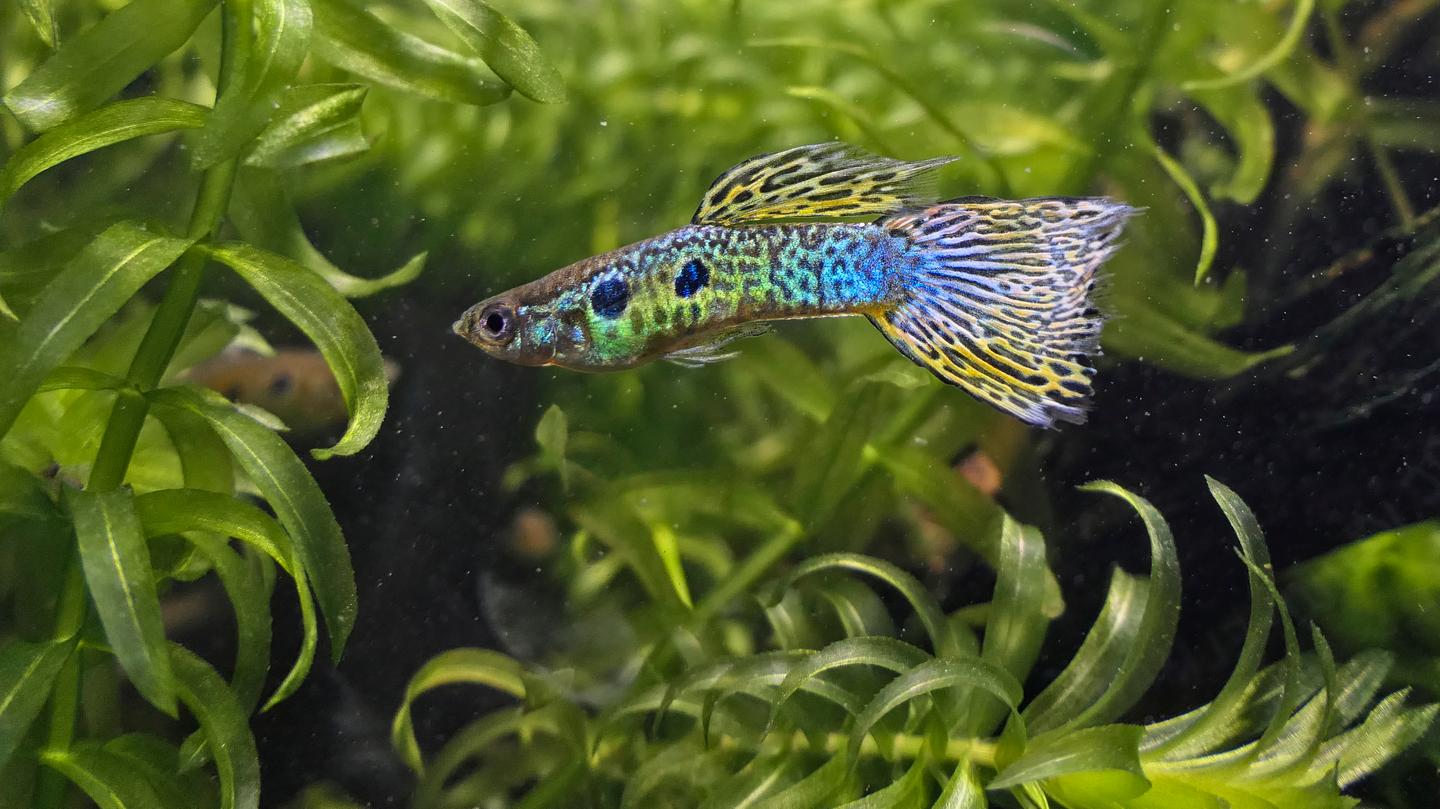
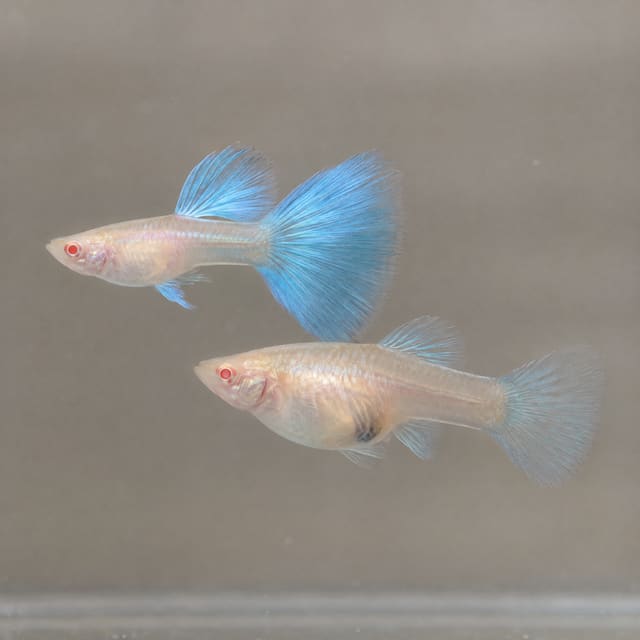
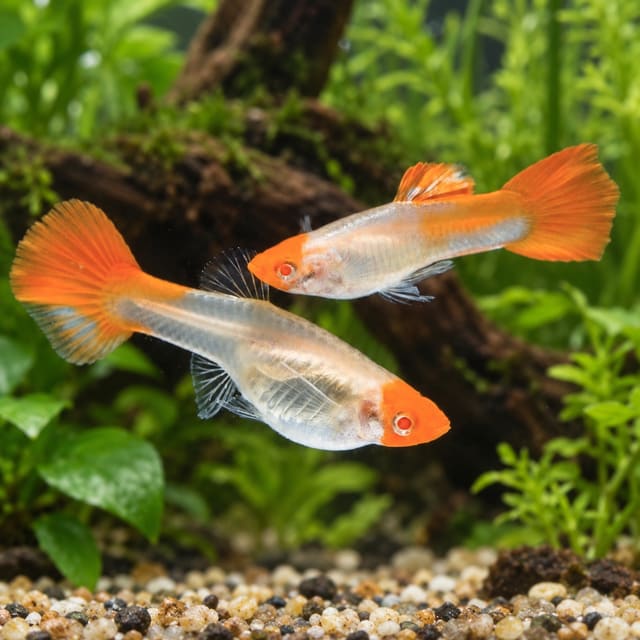
Red shows best against green. In the first photo the male swims over small round-leaved plants, wood and a pebble gravel, and nothing around him competes with his colour. The second photo shows that a plain dark backdrop suits him too. Low down in the tank, fine-leaved plants and dense growth give newborn fry somewhere to go, which they need: FishBase notes that guppies show no parental care and may eat their own young. Keep wood and rock smooth so the long fins do not snag.
Here are the published figures for Poecilia reticulata, laid out by parameter, with what we recommend for this pair.
| Parameter | FishBase | We recommend | Other references |
|---|---|---|---|
| Temperature | 18–28°C | 22–28°C, held steady | Seriously Fish 17–28°C; OATA 20–28°C |
| pH | 7.0–8.0 | 7.0–8.0 | Seriously Fish 7.0–8.5; OATA 7.0–8.0 |
| Hardness | 9–19 dH | 9–18 dGH | Seriously Fish 8–30 dGH; OATA 8–18 dGH and 5–15 dKH |
| Ammonia and nitrite | Not given | Zero | OATA: zero |
| Nitrate | Not given | Kept low | OATA: no more than 20 mg/l above tap water |
FishBase's lower figure of 18°C covers the whole species, wild fish from mountain streams included. It tells you what guppies can survive, not what a fancy albino strain does best in. Our 22–28°C band keeps the pair active and feeding. Choose a setting inside it and keep it there; a thermometer you can read at feeding time is the cheapest insurance you can buy.
All three references agree that guppies want hard, alkaline water, and Seriously Fish says soft, acidic conditions are tolerated only briefly. Test your tap water's GH, KH and pH before you order. KH, the carbonate hardness, is the figure that steadies pH between water changes, which is why OATA gives a target of 5–15 dKH alongside general hardness. If your water is very soft or very acidic, ask us for advice before the fish are on their way.
Salt is not part of the routine. FishBase lists the species from brackish as well as fresh water, and Wikipedia records tolerance of salinity above that of seawater, but those facts describe how tough wild guppies are. They are not instructions for a fancy pair in a home aquarium.
Guppies are small omnivores. In the wild, FishBase lists zooplankton, small insects and detritus; Wikipedia says algae usually forms the largest share, with diatoms, insect larvae and plant fragments alongside; and Seriously Fish notes that tank-bred guppies accept most foods offered.
OATA's guppy routine is a single daily feed of good-quality flake or granules that include algae, with frozen foods such as daphnia and bloodworm as extras, offering only what disappears within a few minutes. That is the routine we would follow for this pair, with two additions that suit a red albino.
Red and orange colour in guppies depends partly on diet. Wikipedia explains that guppies cannot make carotenoids and must get them from their food, and that the saturation of a male's orange spots is affected by how much carotenoid he eats. For a red strain it makes sense to include a food whose label lists a carotenoid, such as astaxanthin, among the ingredients. Diet supports the colour a fish already has; it will not turn one strain into another.
Given what is known about eye development in albino animals generally, make feeding easy. Feed at the same spot each day, choose small pieces that sink slowly, and watch that both fish actually eat. If one hangs back, try two or three tiny pinches a minute apart instead of one larger one. The female, who may well be carrying young, needs her share.
Two guppies of 2–3.5 cm need very little food. Uneaten flake rots, raises ammonia and feeds algae, and a pair in a 60-litre tank is easy to overfeed. If anything is lying on the gravel five minutes after feeding, give less next time. Frozen food should be thawed first and offered in small amounts.
Fry born in the tank are far smaller than the adults and need food to match. Grind a little of the adults' flake between finger and thumb until it is a fine dust, and give a very small amount so the water stays clean.
Male guppies court almost non-stop. Wikipedia describes the sigmoid display, in which the male bends his body into an S and vibrates in front of the female, and also a blunter approach in which he simply thrusts his gonopodium towards her. Seriously Fish describes males as vigorous pursuers. In a pair, the female gets all of that attention herself.
The answer is more females. OATA recommends at least three fish, two females to each male, and Seriously Fish suggests several females per male. Our Full Red Albino female guppies are the obvious choice: they keep the tank to one strain, so the young should stay albino if the trait behaves in the usual recessive way. Two or three extra females turn a pair into a calmer, better-balanced group, and the male spreads his attention around.
Watch the female in the first weeks. If she spends most of her time tucked into the floating plants or high in a corner, or her fins look tatty, she needs company sooner rather than later.
If you like albino strains, our Albino Sky Blue guppy pair is another red-eyed line. Bear in mind that guppy strains interbreed freely, so keeping two strains together gives you mixed young rather than more of either.
Seriously Fish lists other livebearers, rasboras, Corydoras, loricariids and tetras as good companions for guppies, provided they share the hard, alkaline water. It warns against fin-nippers, naming tiger barbs and serpae tetras. Leave out anything big enough to swallow a guppy, and remember FishBase's note that adult guppies will eat their own fry; other fish in the tank may do the same.
For an albino pair, pick companions that are calm at feeding time. Fast, greedy fish that crowd the surface the moment food goes in can leave a red-eyed guppy with very little. Keep any loricariid to a size that suits a 60-litre tank, and check that every species you add is happy in water of pH 7.0–8.0 and 9–18 dGH.
Guppies give birth to live young, and a healthy pair will breed without any help from you. FishBase puts maturity at about two months for males and three for females; Wikipedia says males can mature in seven weeks or less and females at 10–20 weeks. With fish sent at 2–3.5 cm, it may be a few weeks before the younger of the two is ready.
The male fertilises the female internally, and gestation is four to six weeks according to FishBase and Seriously Fish. Wikipedia gives a wider spread of 20 to 60 days at 25–27.8°C, depending on conditions. Brood sizes vary: FishBase gives 20–40 young, Seriously Fish 5–100, and Wikipedia anything from two to 200, usually 30–60. A female can also store sperm and go on producing broods long after mating; Seriously Fish says six months or more, and Wikipedia up to eight months.
Wikipedia notes that most forms of albinism are inherited recessively, and the 1948 Heredity study described guppy albinism as autosomal. If the guppy's albinism follows that usual pattern, two albino parents produce albino young, while an albino crossed with a dark-eyed guppy produces mainly dark-eyed young that carry the gene hidden. In practice: keep this pair, and any females you add, away from dark-eyed guppies if you want red eyes in the fry.
| How you keep the pair | What to expect in the fry |
|---|---|
| The pair on its own | Albino young, assuming the usual recessive pattern |
| The pair plus extra Full Red Albino females | Albino young, with the male's attention spread over several females |
| Kept with dark-eyed guppies of any strain | Mixed young, mostly dark-eyed, some quietly carrying the albino gene |
| A female that mated before she reached you | Her first broods may reflect that earlier male, because she can store sperm for months |
The last row is worth remembering. Stored sperm means an early brood is not proof of what your own male will produce; judge the line on the broods that follow.
The same 1948 paper called the mutation semi-lethal, so treat albino fry as the delicate end of an otherwise tough species. Clean, stable water and fine food in small amounts give them the best start.
FishBase states that guppies give no parental care and that parents may eat their young, and Wikipedia adds that males sometimes attack females while they are giving birth. Choose one of these approaches:
Seriously Fish warns that inbreeding and over-production have left many commercially bred guppies less hardy and more prone to disease, and Wikipedia lists reduced hardiness, fertility problems, body size effects and disease susceptibility among the costs of extensive inbreeding. If you plan to breed this strain for several generations, bring in unrelated Full Red Albino fish from time to time, and only keep the best-shaped, most active young for breeding.
Have homes in mind before the fry grow. Seriously Fish points to specialist breeders and fishkeeping society auctions as the best places to find quality guppies, and they work just as well when you have healthy young to pass on.
A healthy Full Red Albino swims openly with fins spread, comes up for food and keeps an even, bright colour. OATA's list of warning signs is a good daily checklist: abnormal swimming, changes in colour, damaged fins, white spots, a change in breathing rate and a change in appetite.
With a red fish, colour itself is worth watching. Wikipedia notes that the saturation of a wild male's orange is affected by both carotenoid intake and parasite load. If this male's red fades noticeably over a few days, check the water first, then the diet, and look closely for spots, clamped fins or rapid breathing before you assume anything else.
The broad tail is easily torn on sharp décor and is a target for fin-nipping fish, so keep both out of the tank. Seriously Fish's warning about inbreeding in commercial guppies applies to every fancy strain, and Haskins and Haskins' 1948 description of albinism as semi-lethal adds a reason to treat this one gently. Stable temperature, clean water, sensible portions and calm companions are what keep it healthy.
Test the water before anything else. OATA's weekly figures (zero ammonia, zero nitrite, nitrate within 20 mg/l of the tap) are the first thing to confirm, because in a small tank with a pair of fish, poor water is a much more common cause of trouble than disease. Then ask for advice before adding any treatment.
According to Wikipedia, wild guppies usually live around two years, depending on predation. OATA says guppies can live for several years in a well-maintained aquarium. For a fancy pair kept well, a couple of years or more is a fair expectation, and OATA's care sheet reminds owners that under the Animal Welfare Act 2006 that care is a legal duty, not an option.
Before you order, read our delivery and live arrival information in full. Here is what it means for this pair.
The aquarium must be ready before the parcel comes: filter running and mature, heater on, temperature steady in the 22–28°C band, and the water tested. Someone needs to be at the delivery address to take the parcel, because live animals have to be handed over in person. We email you the confirmed delivery date and tracking details.
The pair travels in a bag filled with oxygen, packed in insulated packaging with heat packs when conditions call for them, and carried by a tracked courier licensed to move live animals.
Before the box is opened, start recording. Keep it as one continuous take: the sealed parcel, the opening, and then the fish inside the bag while it is still sealed. Our Live Arrival Guarantee depends on that video. Should a fish arrive dead, dying or obviously compromised, email hello@tropicalfishco.co.uk on the same day the parcel is delivered, quoting your order number and attaching the video. Photographs on their own do not meet the policy. For an accepted claim, the affected fish are replaced with your next order or refunded, subject to the guarantee terms.
Leave the lights low for the rest of arrival day, and keep the light period gentle for the first few days. Through the week, watch breathing, appetite and behaviour. A pair that has settled explores the tank, takes food and the male starts displaying again. A fish that hides constantly, breathes fast or ignores food needs a water test straight away. Feed sparingly at first and carry on with the weekly water change as normal.
Every figure on this page comes from one of these sources.
No reviews for this item yet. Bought one? Honest reviews only, good or bad.
What customers say about ordering from us
Easy website plenty of info on fish your buying great to pick a time slot
TRACEY DURRANT · 7 Oct 2026
Got some lovely fish thank you
Kevin Mackie · 7 Oct 2026
Reviews of our shop, collected by Judge.me, an independent third-party review collector. Newest first.
Moved by UK carriers licensed to handle live animals
Hand-packed with oxygen bags, poly box, heat pack
Email photos the same day; an optional unboxing video helps us review problems faster — claim terms apply
Klarna & PayPal Pay in 3 at checkout



22–26°C · pH 6–7.8 · 75L